


 Скачать презентацию Di RT Dust in Real-Time CS 426
a272a02b34e8f175cfcf0de05ba08f18.ppt
- Количество слайдов: 16
 Di. RT – Dust in Real-Time CS 426 Senior Projects Team Members: Marcos Bagby Ryan Romero Brett Sulprizio Hiroko Uda Advisors: Dr. Sergiu Dascalu Brian Westphal Dr. Frederick Harris Joseph Jaquish
 Overview • • Project Description Applications Objectives Development/Design Challenges Demo Future Work Questions/Comments
 Di. RT (Dust in Real-Time) is a… 3 D dust visualization program
 Main Objectives • Simulate & Model Dust – Realistic – Real-time – Minimum number of resources – Multiple Methods • Why this subject? – Initially planned for Desert Research Institute’s (DRI) CAVE Project CAVE = (Computer Automated Virtual Environment)
 Applications • Military – Simulations • enable realistic rehearsals of potential encounters and situations • better understanding of combat environment leads to strategizing more effectively • Video Games – Low resource gaming engines • CAVE Project – Immersive virtual environment
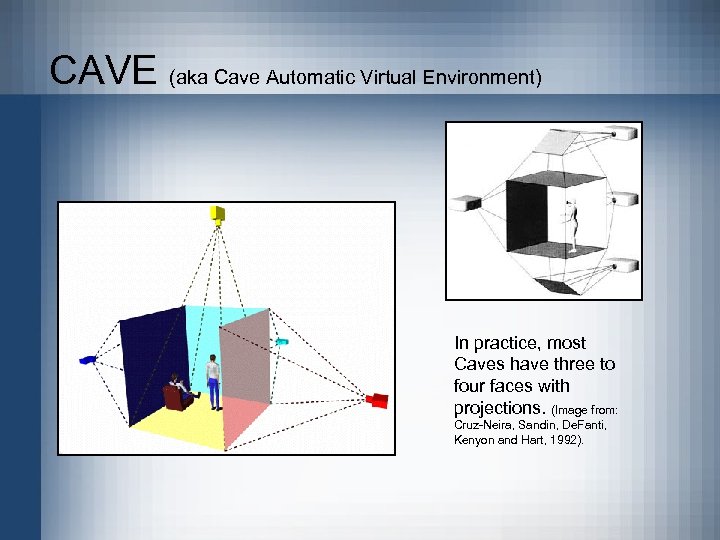 CAVE (aka Cave Automatic Virtual Environment) In practice, most Caves have three to four faces with projections. (Image from: Cruz-Neira, Sandin, De. Fanti, Kenyon and Hart, 1992).
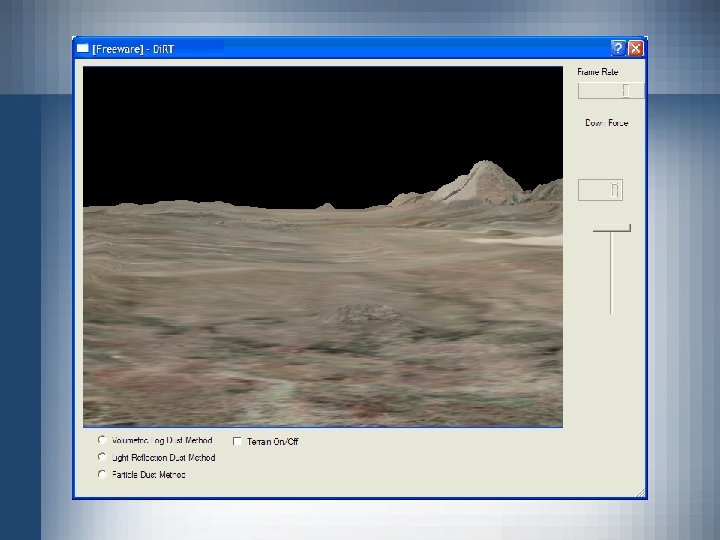
 Specifications • • • C++ Open. GL QT for GUI Flyable Model Camera Control Frame Rate Display
 Development • Three Planned Methods – Volumetric Fog • Using Open. GL’s fog extensions to simulate – Diffuse Reflection • Relying on light to create the effect – Particle System • Generating individual particles (slower) • Freeform particle movement inside specified region
 Volumetric Fog • • Large affected area divided into small volumes Volumes will translate, morph, etc… – Will have different densities • • Translation and morphing specified by airflow parameters Stencil Buffer and Alpha Blending with multi-pass rendering creates the illusion
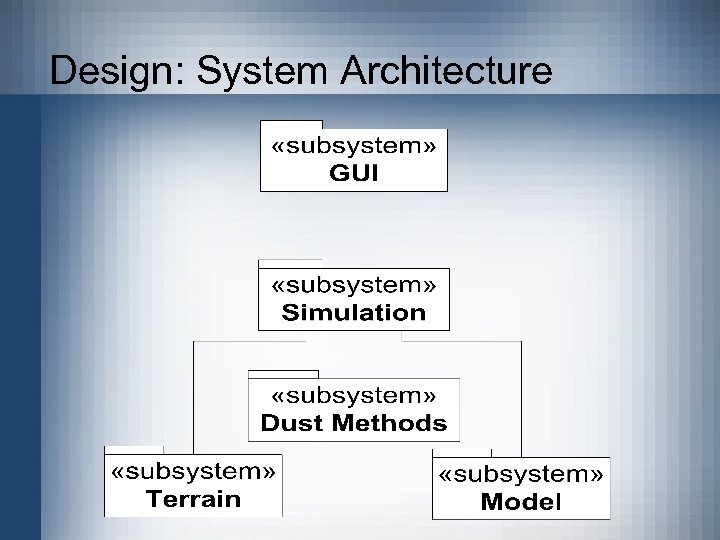 Design: System Architecture
 Challenges • Camera – Had problems with controls & terrain • Dust methods – References on methods vague – Harder than expected • Model – Not too familiar with loaders, challenge was integrating with our terrain
 Demo
Demo
 Future Work • Diffuse Reflection and Particle System methods – Diffuse reflection probably most difficult to implement – Particle system probably easiest to implement, but very resource intensive • • • More advanced algorithms Implement for CAVE use Voxel Processing Method
 Any Questions/Comments?