 Скачать презентацию DGS PD John Ashbee Earl Santee 1 Today s Business
94670be04f38f5ba5aa93430b5001f1c.ppt
- Количество слайдов: 56



DGS/PD John Ashbee/Earl Santee 1
Today’s Business Environment • Global competitiveness • Strong focus on time-to-market • Emphasis on reduced project costs • Integration of technologies DGS/PD John Ashbee/Earl Santee 2
Accelerating Trends • Corporate globalization • Massive mergers and reorganizations • Flatter organizations • Drive for faster results DGS/PD John Ashbee/Earl Santee PM 3
Accelerating Trends • • • Team environment Importance of interpersonal skills Multinational projects Recognition of cultural differences Dependence on technology PM DGS/PD John Ashbee/Earl Santee 4
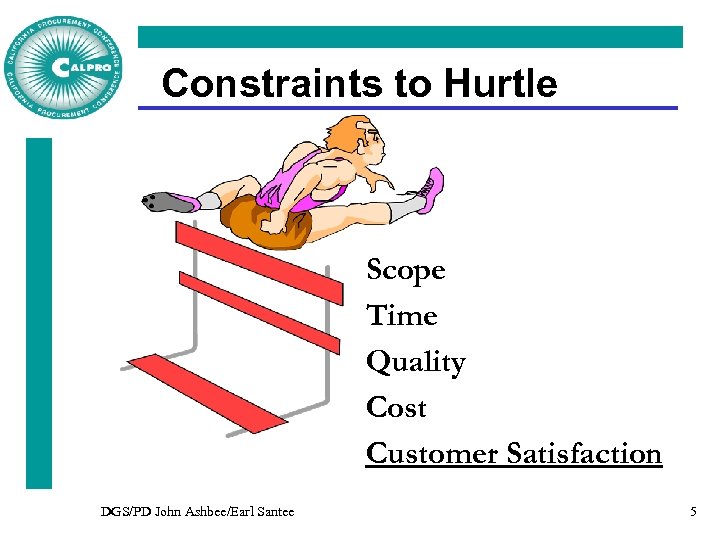
Constraints to Hurtle Scope Time Quality Cost Customer Satisfaction DGS/PD John Ashbee/Earl Santee 5
The Marketplace • Rewards those that rapidly change to meet market conditions • Kills those that change in the wrong direction (or won’t change) DGS/PD John Ashbee/Earl Santee 6
Successful Change Must. . . • Be Managed • Be orchestrated • Be corporate, it cannot be just local. DGS/PD John Ashbee/Earl Santee 7
Corporate Change • Needs to harness the energy and support of individuals – Must be understood by all members – Must be traceable to all organizational levels – Must have buy-in DGS/PD John Ashbee/Earl Santee 8
Objectives • To Introduce the Project Management Institute (PMI) Project Management Body of Knowledge (PMBOK) Framework • To explain our PD project management skills development program DGS/PD John Ashbee/Earl Santee 9
Project Management Building professionalism in project management. TM DGS/PD John Ashbee/Earl Santee 10
What is Project Management? • The application of: knowledge, skills, tools, and techniques to all project activities in order to meet or exceed project stakeholder needs and expectations DGS/PD John Ashbee/Earl Santee 11 From A Guide to the Project Management Body of Knowledge (PMBOK ® Guide)
Why Project Management? • Project management provides a framework of methods, processes, monitoring and change control. • Disciplined project management provides: – A focal point for effective communications, coordination, and control – Emphasis on time and cost performance – A plan to assess progress DGS/PD John Ashbee/Earl Santee 12
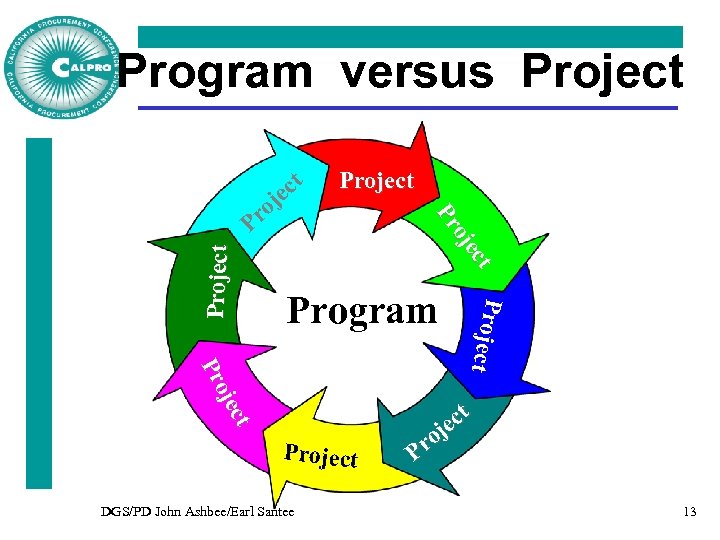
Program versus Project ct e Program ct ct oje Pr Pr Project DGS/PD John Ashbee/Earl Santee Projec t Project t t ec ec oj oj Pr Project ct e oj Pr 13
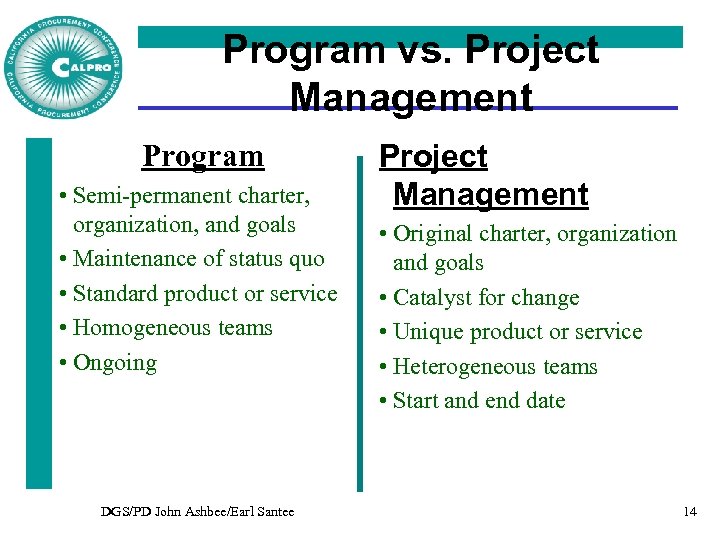
Program vs. Project Management Program • Semi-permanent charter, organization, and goals • Maintenance of status quo • Standard product or service • Homogeneous teams • Ongoing DGS/PD John Ashbee/Earl Santee Project Management • Original charter, organization and goals • Catalyst for change • Unique product or service • Heterogeneous teams • Start and end date 14
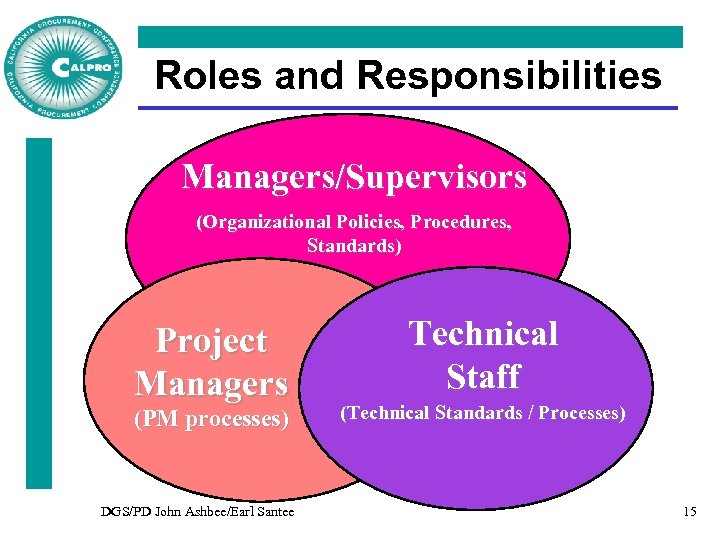
Roles and Responsibilities Managers/Supervisors (Organizational Policies, Procedures, Standards) Project Managers (PM processes) DGS/PD John Ashbee/Earl Santee Technical Staff (Technical Standards / Processes) 15
The Question DGS/PD John Ashbee/Earl Santee 16
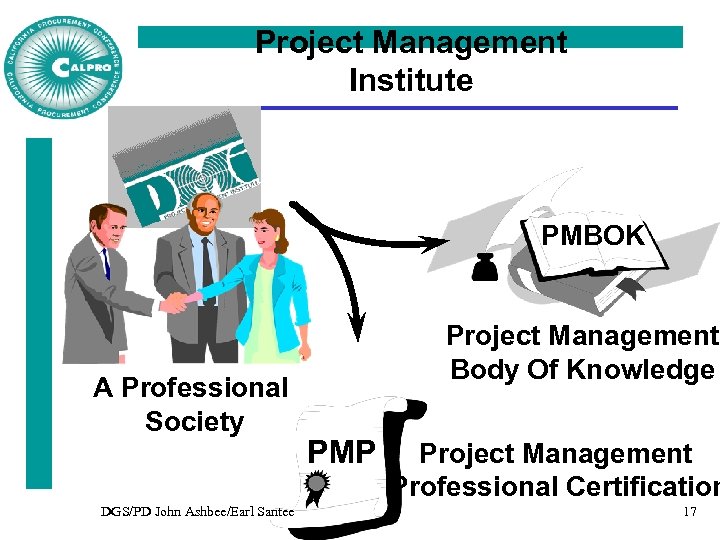
Project Management Institute PMBOK A Professional Society DGS/PD John Ashbee/Earl Santee Project Management Body Of Knowledge PMP Project Management Professional Certification 17
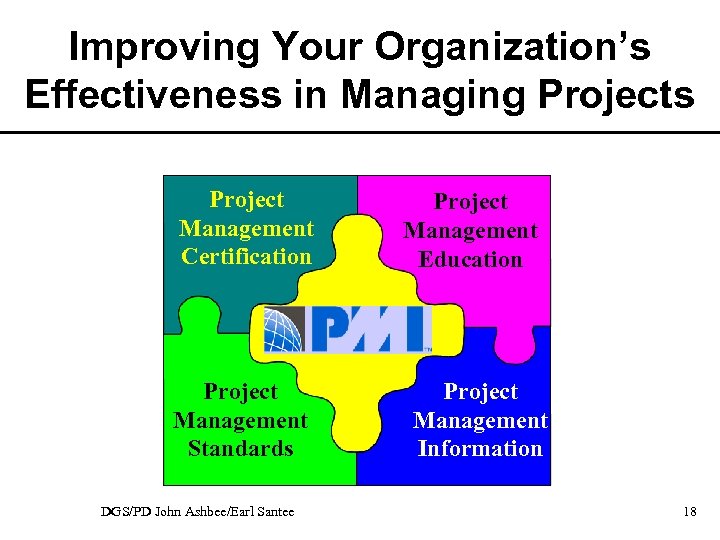
Improving Your Organization’s Effectiveness in Managing Projects Project Management Certification Project Management Standards DGS/PD John Ashbee/Earl Santee Project Management Education Project Management Information 18
Organization PM Benefits • Increase stakeholder trust and confidence • Continuously improve project: – Control – Change management – Probability of project success Project Managem DGS/PD John Ashbee/Earl Santee ent 19
Organization PM Benefits • Balance competing demands • Improve monitoring and control (providing a consistent method for tracking tasks and milestones) • Expand communication among participants • Refine projections of resource requirements • Provide a mechanism for performance measurement DGS/PD John Ashbee/Earl Santee PM 20
Organization PM Benefits • • Identify problem areas Clarify project goals and project scope Quantify project risk PM Rank projects DGS/PD John Ashbee/Earl Santee 21
PM Benefits for Individuals • Creates high visibility of project results • Enhances both professional and personal growth opportunities • Builds one’s reputation and network • Develops portable skills and experience DGS/PD John Ashbee/Earl Santee 22
Another Question DGS/PD John Ashbee/Earl Santee 23
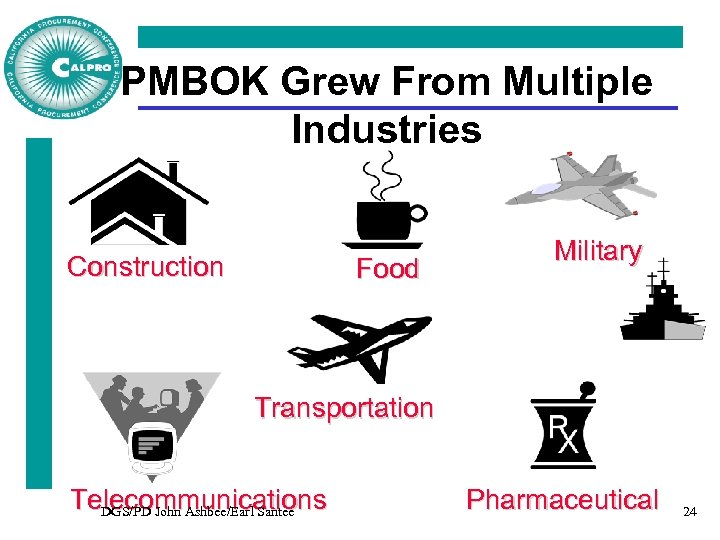
PMBOK Grew From Multiple Industries Construction Food Military Transportation Telecommunications DGS/PD John Ashbee/Earl Santee Pharmaceutical 24
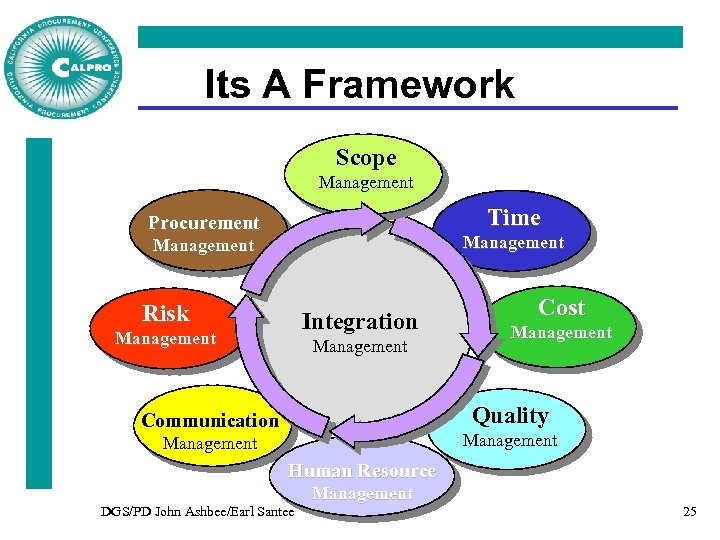
Its A Framework Scope Management Time Procurement Management Risk Integration Management Cost Management Quality Communication Management Human Resource Management DGS/PD John Ashbee/Earl Santee 25
PMBOK. . . • IS a framework of project management principles. • IS a series of tools for project managers AND project leads, team leaders, project team members, and other stakeholders. • IS NOT a replacement for guidance such as ISO 9000, SAMM, or other State guidelines. DGS/PD John Ashbee/Earl Santee 26
PMBOK Benefits • UNIVERSAL: Common/generally accepted standards across multiple disciplines. • COMPLETE: The big picture on the subject of project management. • SIMPLE: Assembled in “cliff notes” format for ease of absorption. DGS/PD John Ashbee/Earl Santee 27
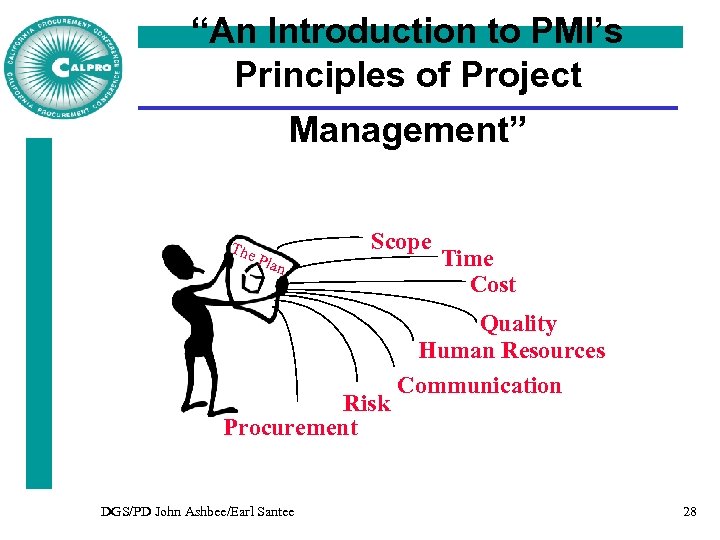
“An Introduction to PMI’s Principles of Project Management” The Plan Scope Risk Procurement DGS/PD John Ashbee/Earl Santee Time Cost Quality Human Resources Communication 28
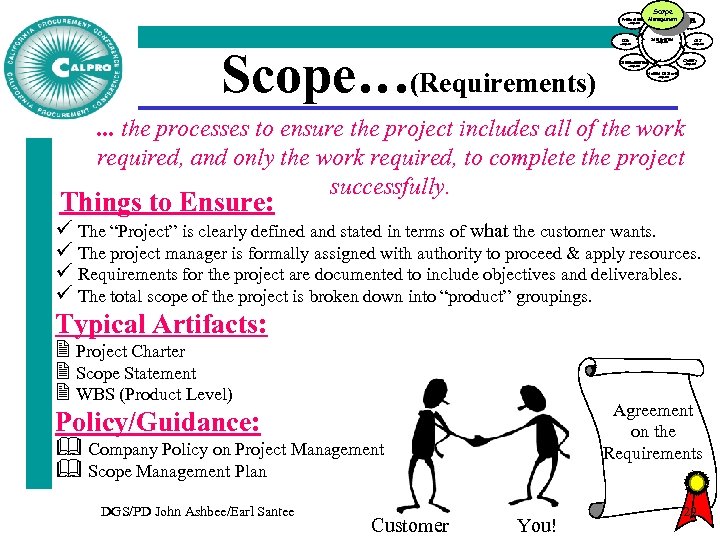
Scope Management Procurement Time Management Integration Risk Scope…(Requirements) Cost Management Quality Communication Management Human Resource Management . . . the processes to ensure the project includes all of the work required, and only the work required, to complete the project successfully. Things to Ensure: ü The “Project” is clearly defined and stated in terms of what the customer wants. ü The project manager is formally assigned with authority to proceed & apply resources. ü Requirements for the project are documented to include objectives and deliverables. ü The total scope of the project is broken down into “product” groupings. Typical Artifacts: 2 Project Charter 2 Scope Statement 2 WBS (Product Level) Agreement on the Requirements Policy/Guidance: & Company Policy on Project Management & Scope Management Plan DGS/PD John Ashbee/Earl Santee Customer You! 29
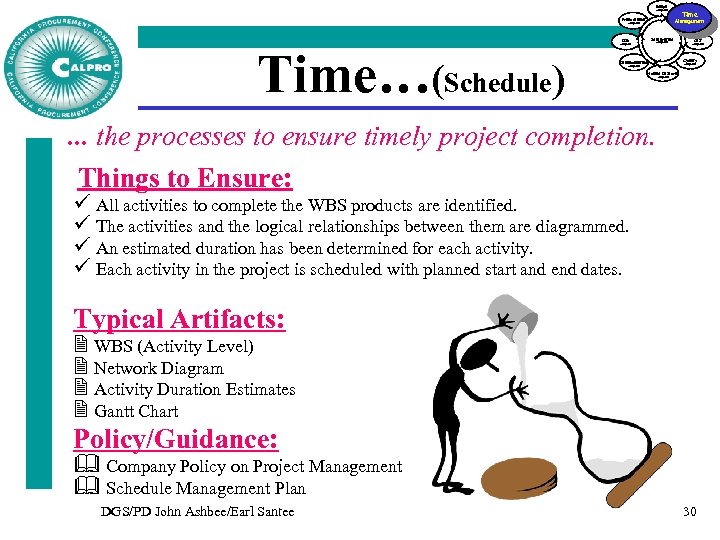
Scope Management Procurement Integration Risk Time…(Schedule) Time Management Cost Management Quality Communication Management Human Resource Management . . . the processes to ensure timely project completion. Things to Ensure: ü All activities to complete the WBS products are identified. ü The activities and the logical relationships between them are diagrammed. ü An estimated duration has been determined for each activity. ü Each activity in the project is scheduled with planned start and end dates. Typical Artifacts: 2 WBS (Activity Level) 2 Network Diagram 2 Activity Duration Estimates 2 Gantt Chart Policy/Guidance: & Company Policy on Project Management & Schedule Management Plan DGS/PD John Ashbee/Earl Santee 30
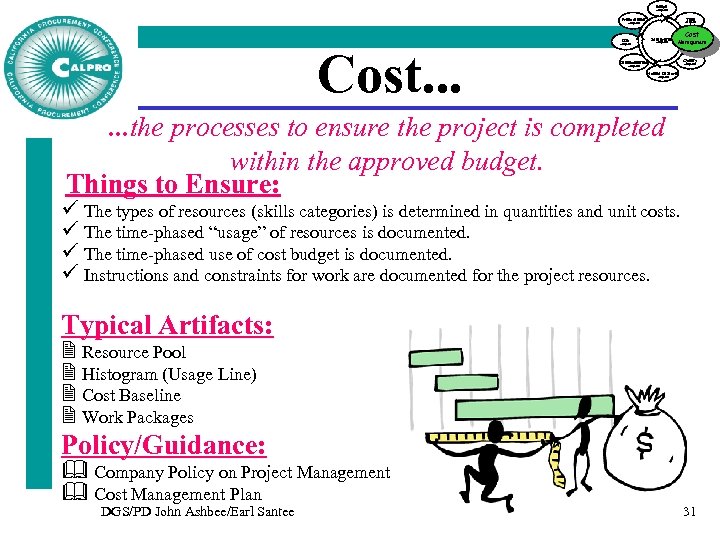
Scope Management Time Procurement Management Integration Risk Cost. . . Management Cost Management Quality Communication Management Human Resource Management . . . the processes to ensure the project is completed within the approved budget. Things to Ensure: ü The types of resources (skills categories) is determined in quantities and unit costs. ü The time-phased “usage” of resources is documented. ü The time-phased use of cost budget is documented. ü Instructions and constraints for work are documented for the project resources. Typical Artifacts: 2 Resource Pool 2 Histogram (Usage Line) 2 Cost Baseline 2 Work Packages Policy/Guidance: & Company Policy on Project Management & Cost Management Plan DGS/PD John Ashbee/Earl Santee 31
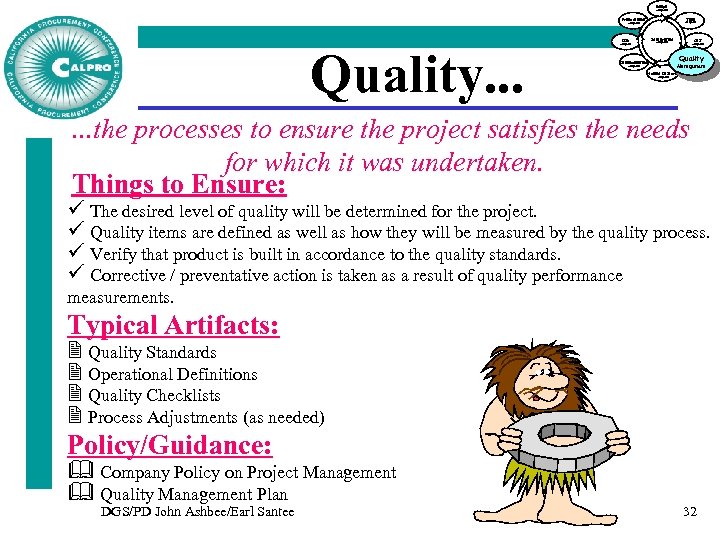
Scope Management Time Procurement Management Integration Risk Quality. . . Cost Management Quality Communication Management Human Resource Management . . . the processes to ensure the project satisfies the needs for which it was undertaken. Things to Ensure: ü The desired level of quality will be determined for the project. ü Quality items are defined as well as how they will be measured by the quality process. ü Verify that product is built in accordance to the quality standards. ü Corrective / preventative action is taken as a result of quality performance measurements. Typical Artifacts: 2 Quality Standards 2 Operational Definitions 2 Quality Checklists 2 Process Adjustments (as needed) Policy/Guidance: & Company Policy on Project Management & Quality Management Plan DGS/PD John Ashbee/Earl Santee 32
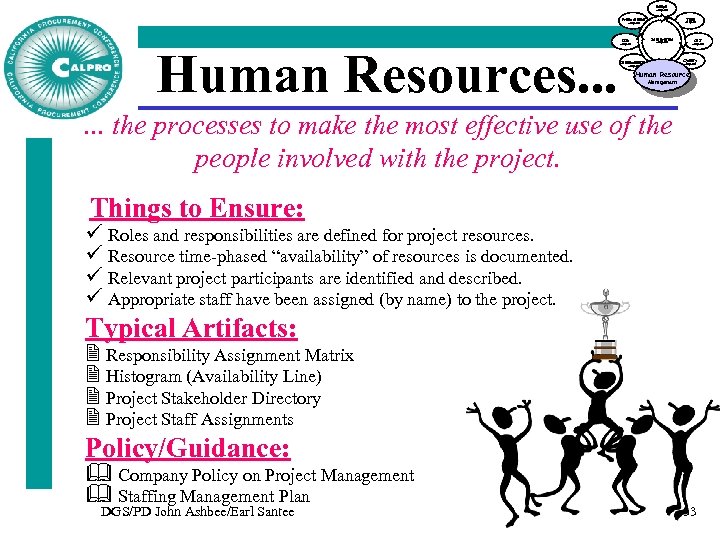
Scope Management Time Procurement Management Integration Risk Human Resources. . . Cost Management Quality Communication Management Human Resource Management . . . the processes to make the most effective use of the people involved with the project. Things to Ensure: ü Roles and responsibilities are defined for project resources. ü Resource time-phased “availability” of resources is documented. ü Relevant project participants are identified and described. ü Appropriate staff have been assigned (by name) to the project. Typical Artifacts: 2 Responsibility Assignment Matrix 2 Histogram (Availability Line) 2 Project Stakeholder Directory 2 Project Staff Assignments Policy/Guidance: & Company Policy on Project Management & Staffing Management Plan DGS/PD John Ashbee/Earl Santee 33
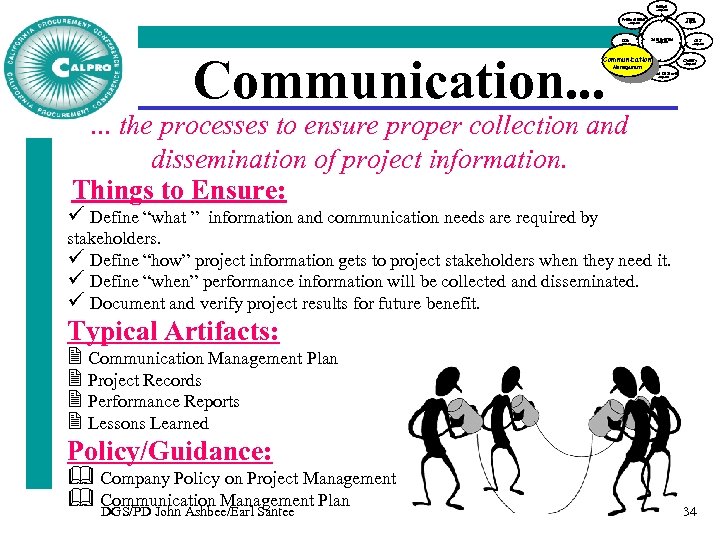
Scope Management Time Procurement Management Risk Integration Management Communication. . . Communication Cost Management Quality Management Human Resource Management . . . the processes to ensure proper collection and dissemination of project information. Things to Ensure: ü Define “what ” information and communication needs are required by stakeholders. ü Define “how” project information gets to project stakeholders when they need it. ü Define “when” performance information will be collected and disseminated. ü Document and verify project results for future benefit. Typical Artifacts: 2 Communication Management Plan 2 Project Records 2 Performance Reports 2 Lessons Learned Policy/Guidance: & Company Policy on Project Management & Communication Management Plan DGS/PD John Ashbee/Earl Santee 34
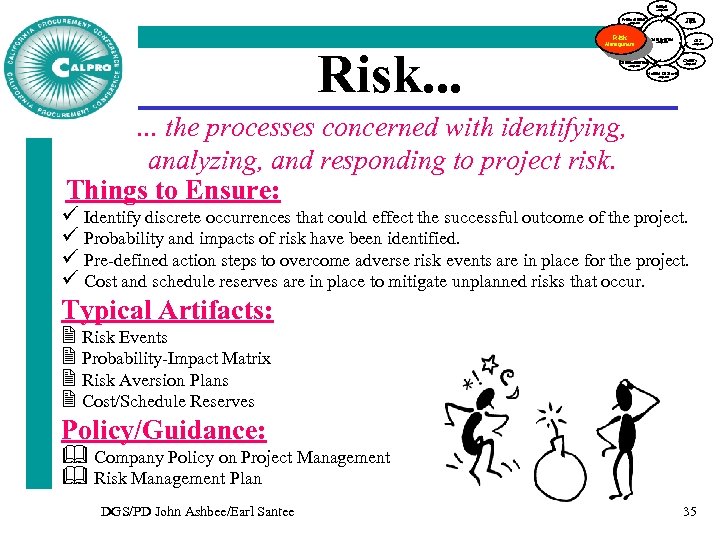
Scope Management Time Procurement Management Risk. . . Integration Management Cost Management Quality Communication Management Human Resource Management . . . the processes concerned with identifying, analyzing, and responding to project risk. Things to Ensure: ü Identify discrete occurrences that could effect the successful outcome of the project. ü Probability and impacts of risk have been identified. ü Pre-defined action steps to overcome adverse risk events are in place for the project. ü Cost and schedule reserves are in place to mitigate unplanned risks that occur. Typical Artifacts: 2 Risk Events 2 Probability-Impact Matrix 2 Risk Aversion Plans 2 Cost/Schedule Reserves Policy/Guidance: & Company Policy on Project Management & Risk Management Plan DGS/PD John Ashbee/Earl Santee 35
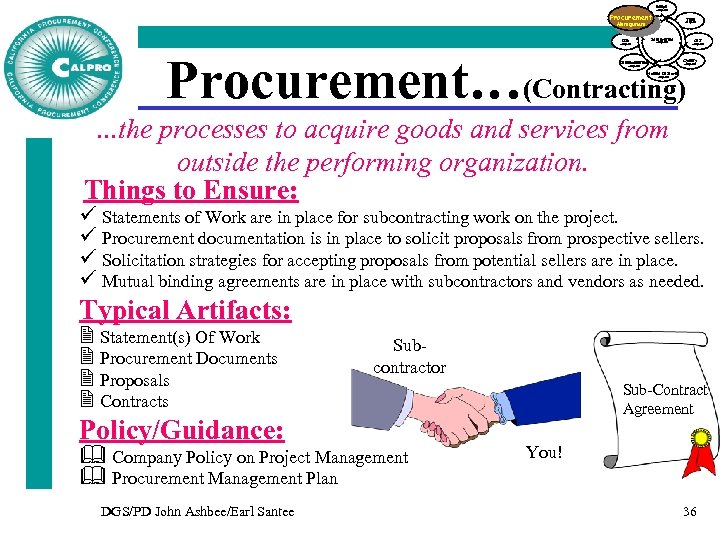
Scope Management Procurement Time Management Integration Risk Cost Management Procurement…(Contracting) Quality Communication Management Human Resource Management . . . the processes to acquire goods and services from outside the performing organization. Things to Ensure: ü Statements of Work are in place for subcontracting work on the project. ü Procurement documentation is in place to solicit proposals from prospective sellers. ü Solicitation strategies for accepting proposals from potential sellers are in place. ü Mutual binding agreements are in place with subcontractors and vendors as needed. Typical Artifacts: 2 Statement(s) Of Work 2 Procurement Documents 2 Proposals 2 Contracts Policy/Guidance: Subcontractor & Company Policy on Project Management & Procurement Management Plan DGS/PD John Ashbee/Earl Santee Sub-Contract Agreement You! 36
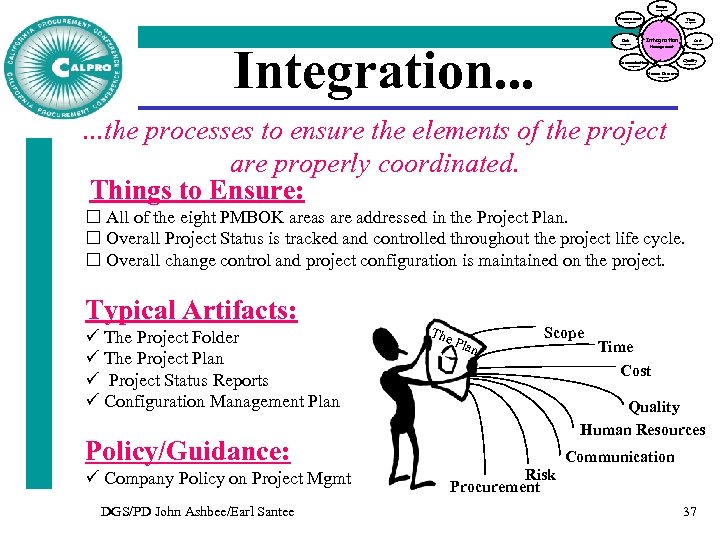
Scope Management Procurement Time Management Risk Integration. . . Management Integration Cost Management Quality Communication Management Human Resource Management . . . the processes to ensure the elements of the project are properly coordinated. Things to Ensure: ¨ All of the eight PMBOK areas are addressed in the Project Plan. ¨ Overall Project Status is tracked and controlled throughout the project life cycle. ¨ Overall change control and project configuration is maintained on the project. Typical Artifacts: ü The Project Folder ü The Project Plan ü Project Status Reports ü Configuration Management Plan Policy/Guidance: ü Company Policy on Project Mgmt DGS/PD John Ashbee/Earl Santee The Plan Scope Time Cost Quality Human Resources Risk Procurement Communication 37
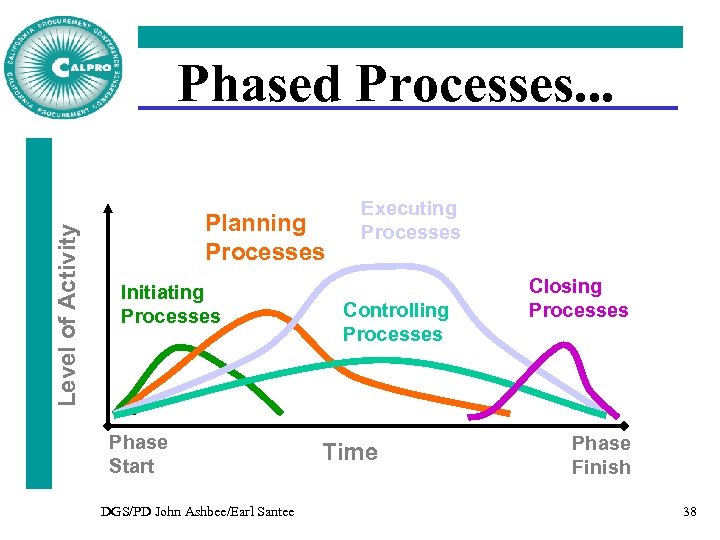
Level of Activity Phased Processes. . . Planning Processes Initiating Processes Phase Start DGS/PD John Ashbee/Earl Santee Executing Processes Controlling Processes Time Closing Processes Phase Finish 38
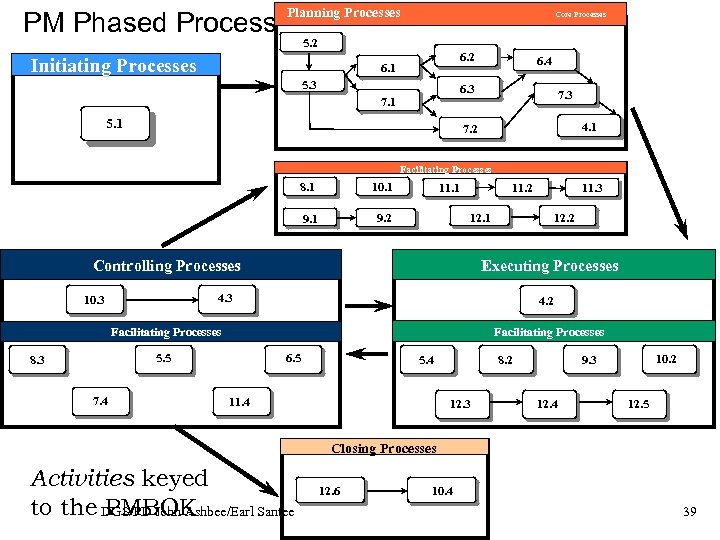
PM Phased Process Planning Processes Core Processes 5. 2 Initiating Processes 6. 2 6. 1 5. 3 6. 4 6. 3 7. 1 5. 1 7. 3 4. 1 7. 2 Facilitating Processes 8. 1 10. 1 9. 2 11. 1 11. 2 12. 1 4. 3 4. 2 Facilitating Processes 5. 5 8. 3 7. 4 12. 2 Executing Processes Controlling Processes 10. 3 11. 3 6. 5 5. 4 11. 4 12. 3 10. 2 9. 3 8. 2 12. 4 12. 5 Closing Processes Activities keyed to the DGS/PD John Ashbee/Earl Santee PMBOK 12. 6 10. 4 39
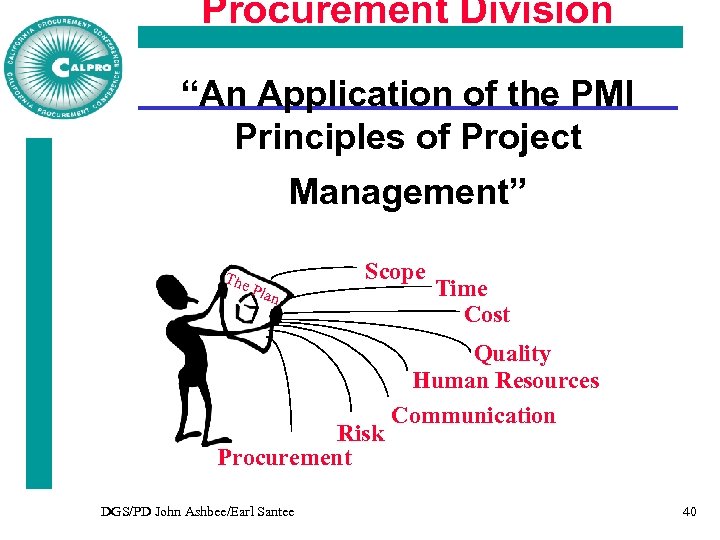
Procurement Division “An Application of the PMI Principles of Project Management” The Plan Scope Risk Procurement DGS/PD John Ashbee/Earl Santee Time Cost Quality Human Resources Communication 40
PD Training & Applications DGS/PD John Ashbee/Earl Santee 41
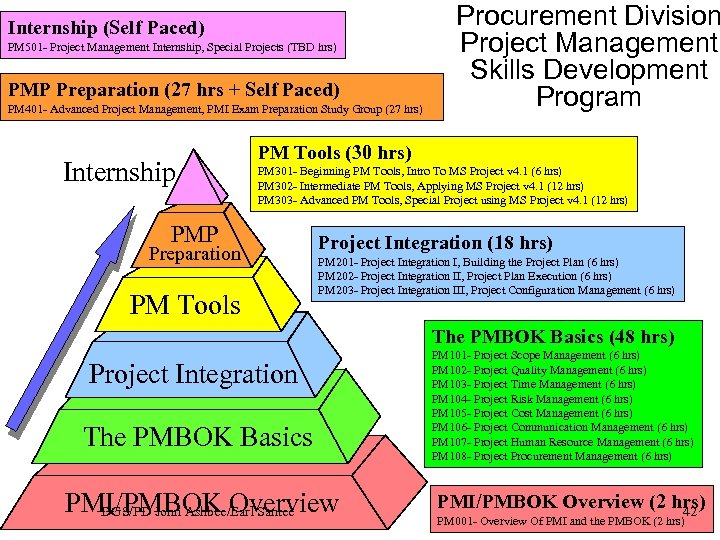
Internship (Self Paced) PM 501 - Project Management Internship, Special Projects (TBD hrs) PMP Preparation (27 hrs + Self Paced) PM 401 - Advanced Project Management, PMI Exam Preparation Study Group (27 hrs) Internship Procurement Division Project Management Skills Development Program PM Tools (30 hrs) PM 301 - Beginning PM Tools, Intro To MS Project v 4. 1 (6 hrs) PM 302 - Intermediate PM Tools, Applying MS Project v 4. 1 (12 hrs) PM 303 - Advanced PM Tools, Special Project using MS Project v 4. 1 (12 hrs) PMP Preparation PM Tools Project Integration (18 hrs) PM 201 - Project Integration I, Building the Project Plan (6 hrs) PM 202 - Project Integration II, Project Plan Execution (6 hrs) PM 203 - Project Integration III, Project Configuration Management (6 hrs) The PMBOK Basics (48 hrs) Project Integration The PMBOK Basics PMI/PMBOK Overview DGS/PD John Ashbee/Earl Santee PM 101 - Project Scope Management (6 hrs) PM 102 - Project Quality Management (6 hrs) PM 103 - Project Time Management (6 hrs) PM 104 - Project Risk Management (6 hrs) PM 105 - Project Cost Management (6 hrs) PM 106 - Project Communication Management (6 hrs) PM 107 - Project Human Resource Management (6 hrs) PM 108 - Project Procurement Management (6 hrs) PMI/PMBOK Overview (2 hrs) 42 PM 001 - Overview Of PMI and the PMBOK (2 hrs)
Strategic Planning DGS/PD John Ashbee/Earl Santee 43
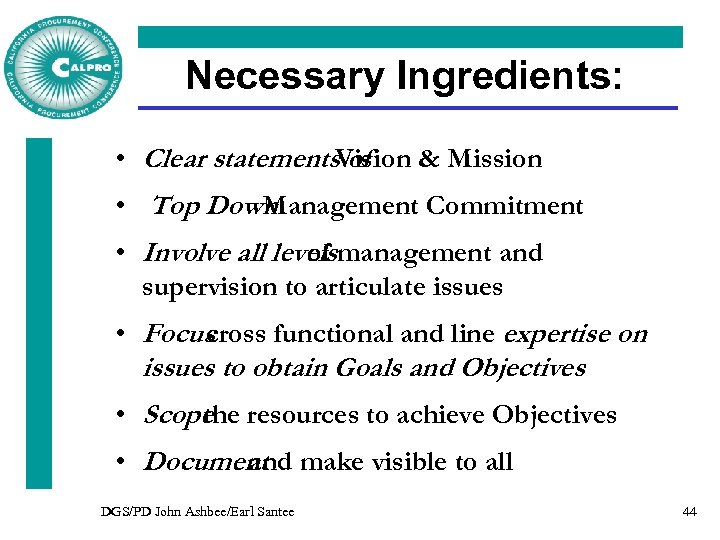
Necessary Ingredients: • Clear statements. Vision & Mission of • Top Down Management Commitment • Involve all levelsmanagement and of supervision to articulate issues • Focus cross functional and line expertise on issues to obtain Goals and Objectives • Scope resources to achieve Objectives the • Document make visible to all and DGS/PD John Ashbee/Earl Santee 44
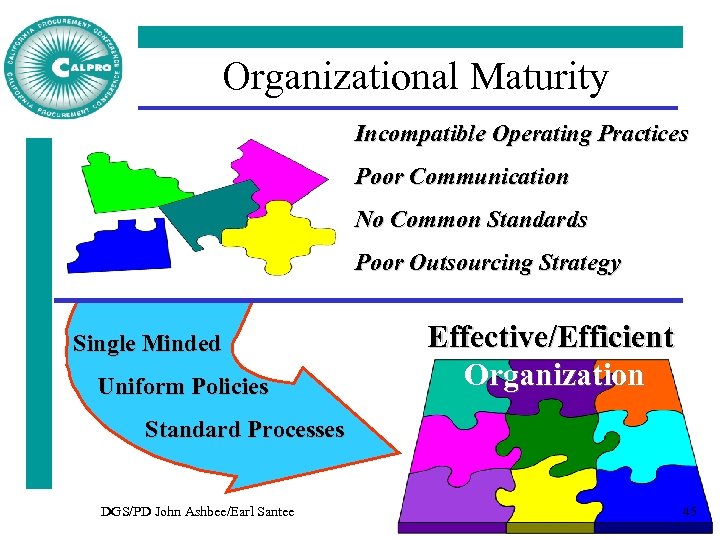
Organizational Maturity Incompatible Operating Practices Poor Communication No Common Standards Poor Outsourcing Strategy Single Minded Uniform Policies Effective/Efficient Organization Standard Processes DGS/PD John Ashbee/Earl Santee 45
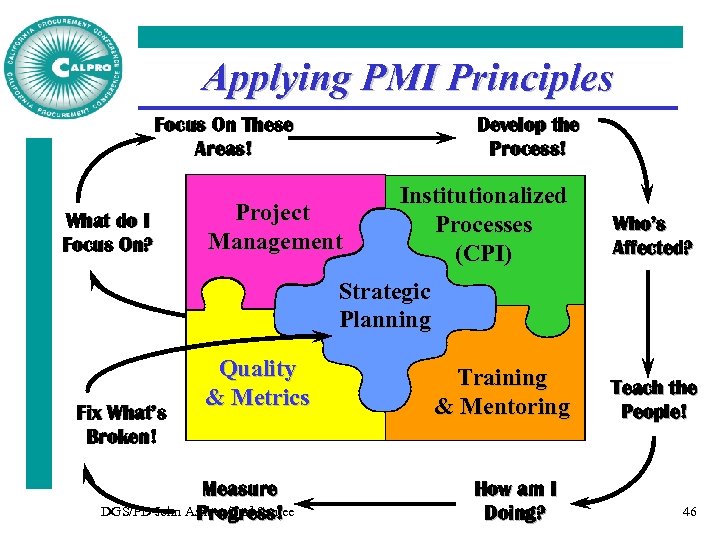
Applying PMI Principles Focus On These Areas! What do I Focus On? Develop the Process! Project Management Institutionalized Processes (CPI) Who’s Affected? Strategic Planning Fix What’s Broken! Quality & Metrics Measure DGS/PD John Ashbee/Earl Santee Progress! Training & Mentoring How am I Doing? Teach the People! 46
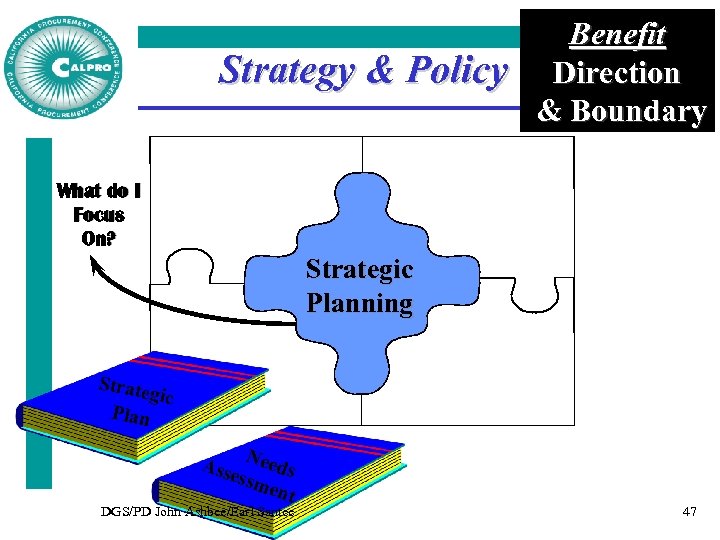
Strategy & Policy Benefit Direction & Boundary What do I Focus On? Strategic Planning Strate gic Plan Ass Needs essm ent DGS/PD John Ashbee/Earl Santee 47
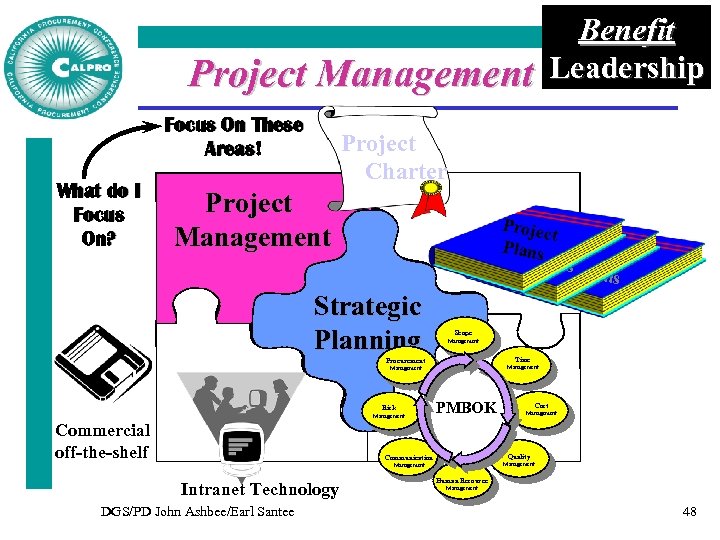
Project Management Focus On These Areas! What do I Focus On? Project Charter Project Management Projec At Plans ction ctio A n Plans Strategic Planning Scope Management Procurement Time Management Risk Management Commercial off-the-shelf PMBOK Management Intranet Technology Cost Management Quality Communication DGS/PD John Ashbee/Earl Santee Benefit Leadership Human Resource Management 48
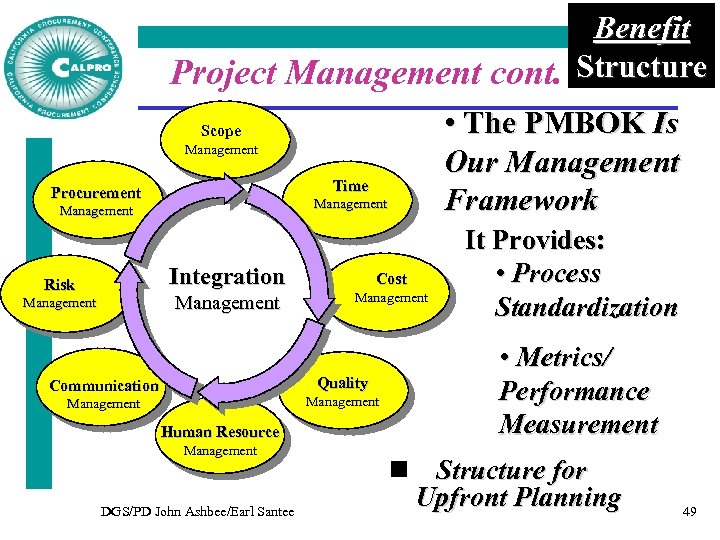
Benefit Project Management cont. Structure • The PMBOK Is Our Management Framework Scope Management Time Procurement Management Integration Risk Management Cost Management Quality Communication Management Human Resource Management DGS/PD John Ashbee/Earl Santee It Provides: • Process Standardization • Metrics/ Performance Measurement n Structure for Upfront Planning 49
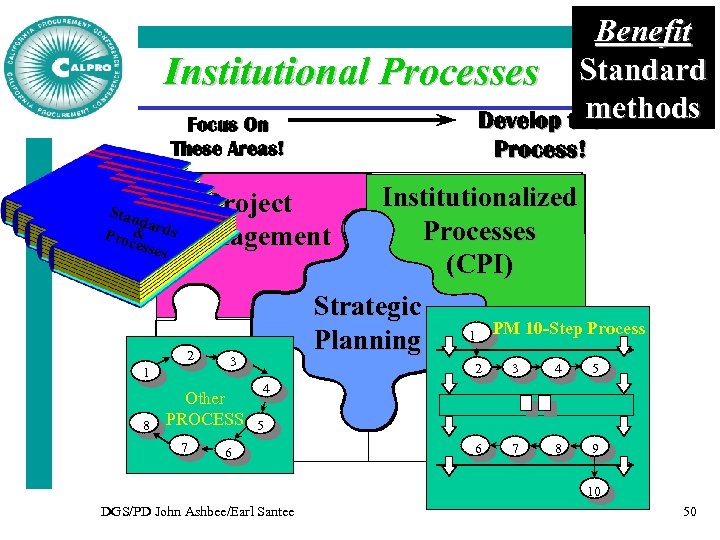
Benefit Institutional Processes Standard methods Develop the Focus On Process! These Areas! Institutionalized Processes (CPI) Strategic 1 PM 10 -Step Process Planning Project Management Stan da Proc& rds esse s 2 1 8 3 Other PROCESS 7 2 3 4 5 6 7 8 9 4 5 6 10 DGS/PD John Ashbee/Earl Santee 50
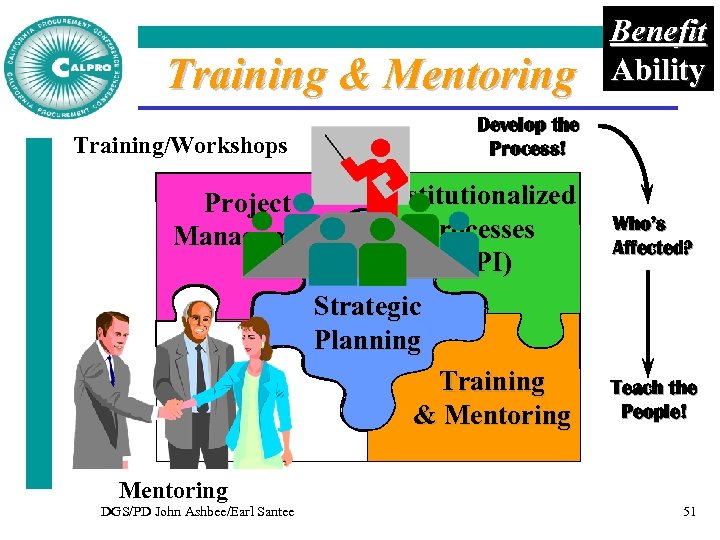
Training & Mentoring Benefit Ability Develop the Process! Training/Workshops Project Management Institutionalized Processes (CPI) Who’s Affected? Strategic Planning Training & Mentoring Teach the People! Mentoring DGS/PD John Ashbee/Earl Santee 51
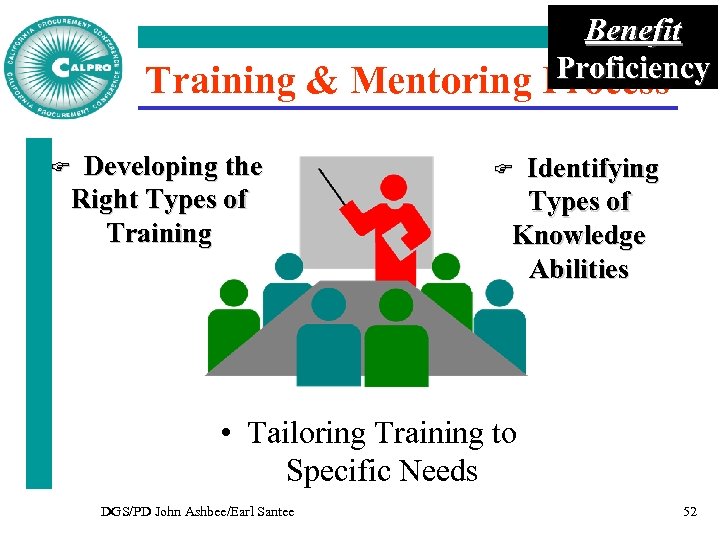
Training & Mentoring F Developing the Right Types of Training Benefit Proficiency Process Identifying Types of Knowledge Abilities F • Tailoring Training to Specific Needs DGS/PD John Ashbee/Earl Santee 52
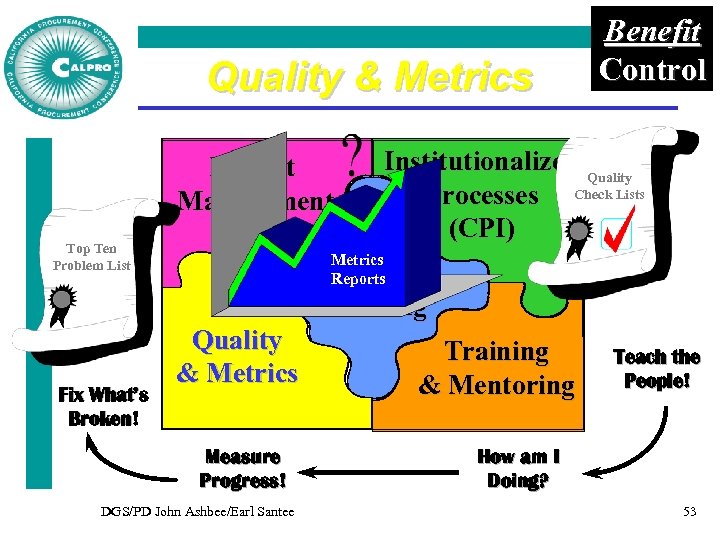
Quality & Metrics Project Management Top Ten Problem List Fix What’s Broken! Benefit Control Institutionalized Quality Processes Check Lists (CPI) Metrics Reports Strategic Planning Quality & Metrics Measure Progress! DGS/PD John Ashbee/Earl Santee Training & Mentoring Teach the People! How am I Doing? 53
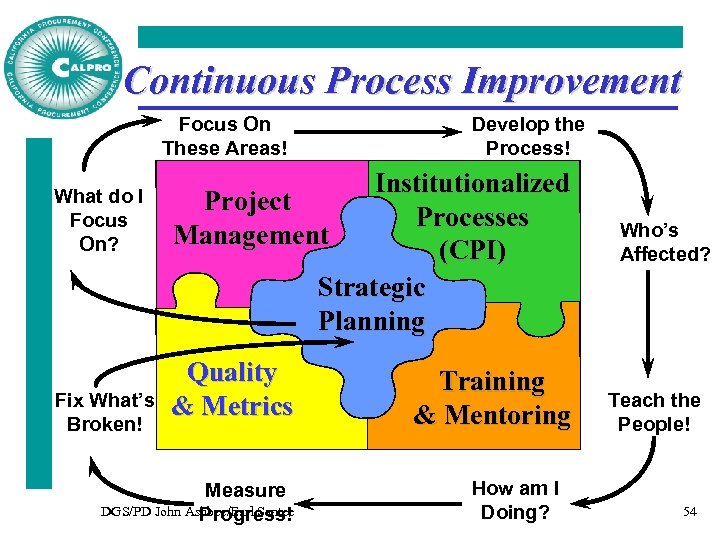
Continuous Process Improvement Focus On These Areas! What do I Focus On? Fix What’s Broken! Develop the Process! Institutionalized Project Processes Management (CPI) Strategic Planning Quality & Metrics Measure DGS/PD John Ashbee/Earl Santee Progress! Training & Mentoring How am I Doing? Who’s Affected? Teach the People! 54
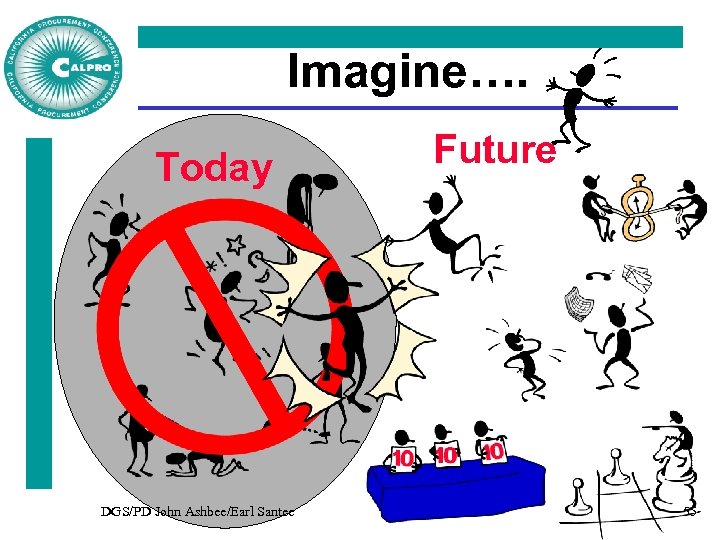
Imagine…. Today DGS/PD John Ashbee/Earl Santee Future 55
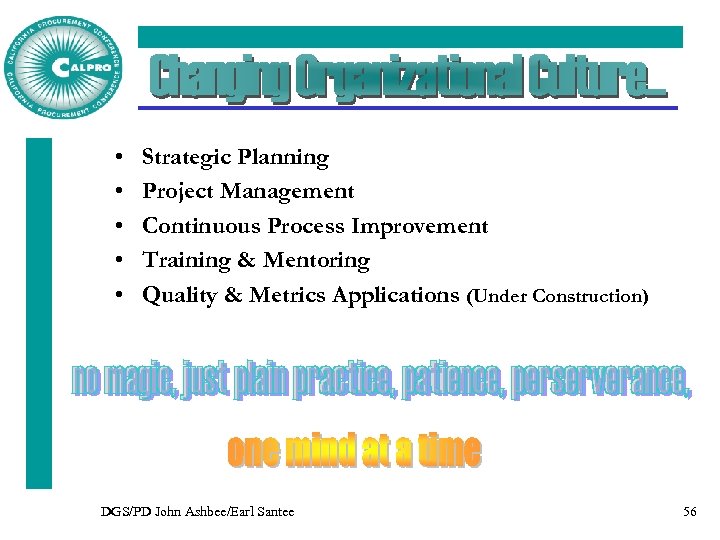
• • • Strategic Planning Project Management Continuous Process Improvement Training & Mentoring Quality & Metrics Applications (Under Construction) • Strategic Planning DGS/PD John Ashbee/Earl Santee 56
Скачать презентацию DGS PD John Ashbee Earl Santee 1 Today s Business
94670be04f38f5ba5aa93430b5001f1c.ppt