


 Скачать презентацию DG Measurement at RHIC-PHENIX Pacific Spin Seattle Kensuke
f67720e9f62a0635e1eedf4625e0e6c7.ppt
- Количество слайдов: 16
 DG Measurement at RHIC-PHENIX Pacific Spin, Seattle Kensuke Okada (RBRC) for The PHENIX Collaboration 8/4/2003 Kensuke Okada (RBRC)
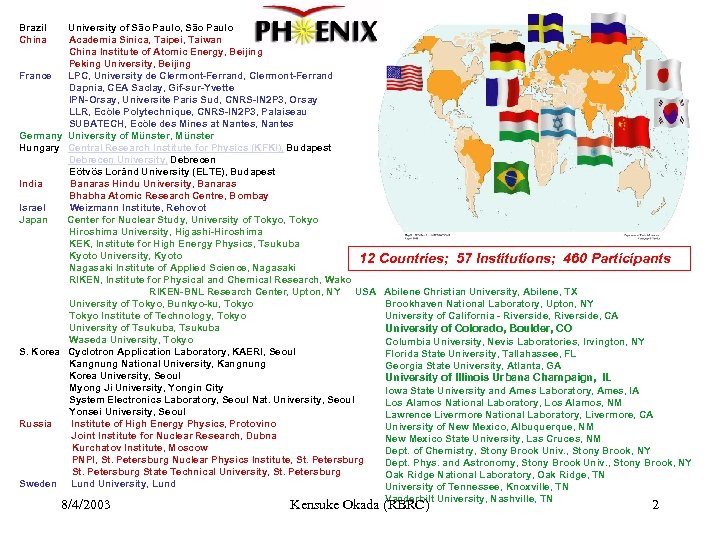 Brazil China University of São Paulo, São Paulo Academia Sinica, Taipei, Taiwan China Institute of Atomic Energy, Beijing Peking University, Beijing France LPC, University de Clermont-Ferrand, Clermont-Ferrand Dapnia, CEA Saclay, Gif-sur-Yvette IPN-Orsay, Universite Paris Sud, CNRS-IN 2 P 3, Orsay LLR, Ecòle Polytechnique, CNRS-IN 2 P 3, Palaiseau SUBATECH, Ecòle des Mines at Nantes, Nantes Germany University of Münster, Münster Hungary Central Research Institute for Physics (KFKI), Budapest Debrecen University, Debrecen Eötvös Loránd University (ELTE), Budapest India Banaras Hindu University, Banaras Bhabha Atomic Research Centre, Bombay Israel Weizmann Institute, Rehovot Japan Center for Nuclear Study, University of Tokyo, Tokyo Hiroshima University, Higashi-Hiroshima KEK, Institute for High Energy Physics, Tsukuba Kyoto University, Kyoto 12 Countries; 57 Institutions; 460 Participants Nagasaki Institute of Applied Science, Nagasaki RIKEN, Institute for Physical and Chemical Research, Wako RIKEN-BNL Research Center, Upton, NY USA Abilene Christian University, Abilene, TX Brookhaven National Laboratory, Upton, NY University of Tokyo, Bunkyo-ku, Tokyo University of California - Riverside, CA Tokyo Institute of Technology, Tokyo University of Tsukuba, Tsukuba University of Colorado, Boulder, CO Waseda University, Tokyo Columbia University, Nevis Laboratories, Irvington, NY S. Korea Cyclotron Application Laboratory, KAERI, Seoul Florida State University, Tallahassee, FL Kangnung National University, Kangnung Georgia State University, Atlanta, GA Korea University, Seoul University of Illinois Urbana Champaign, IL Myong Ji University, Yongin City Iowa State University and Ames Laboratory, Ames, IA System Electronics Laboratory, Seoul Nat. University, Seoul Los Alamos National Laboratory, Los Alamos, NM Yonsei University, Seoul Lawrence Livermore National Laboratory, Livermore, CA Russia Institute of High Energy Physics, Protovino University of New Mexico, Albuquerque, NM Joint Institute for Nuclear Research, Dubna New Mexico State University, Las Cruces, NM Kurchatov Institute, Moscow Dept. of Chemistry, Stony Brook Univ. , Stony Brook, NY PNPI, St. Petersburg Nuclear Physics Institute, St. Petersburg Dept. Phys. and Astronomy, Stony Brook Univ. , Stony Brook, NY St. Petersburg State Technical University, St. Petersburg Oak Ridge National Laboratory, Oak Ridge, TN Sweden Lund University, Lund University of Tennessee, Knoxville, TN Vanderbilt University, Nashville, TN 8/4/2003 Kensuke Okada (RBRC) 2
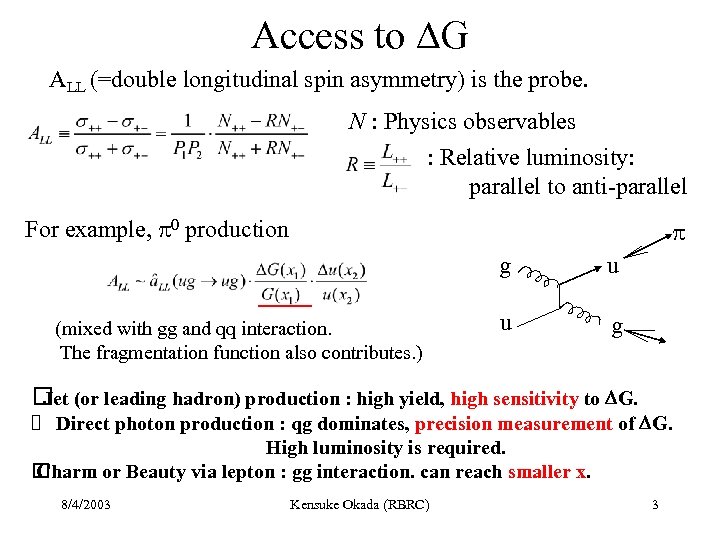 Access to DG ALL (=double longitudinal spin asymmetry) is the probe. N : Physics observables : Relative luminosity: parallel to anti-parallel For example, 0 production g (mixed with gg and qq interaction. The fragmentation function also contributes. ) u u g (or leading hadron) production : high yield, high sensitivity to DG. Jet Direct photon production : qg dominates, precision measurement of DG. High luminosity is required. Charm or Beauty via lepton : gg interaction. can reach smaller x. 8/4/2003 Kensuke Okada (RBRC) 3
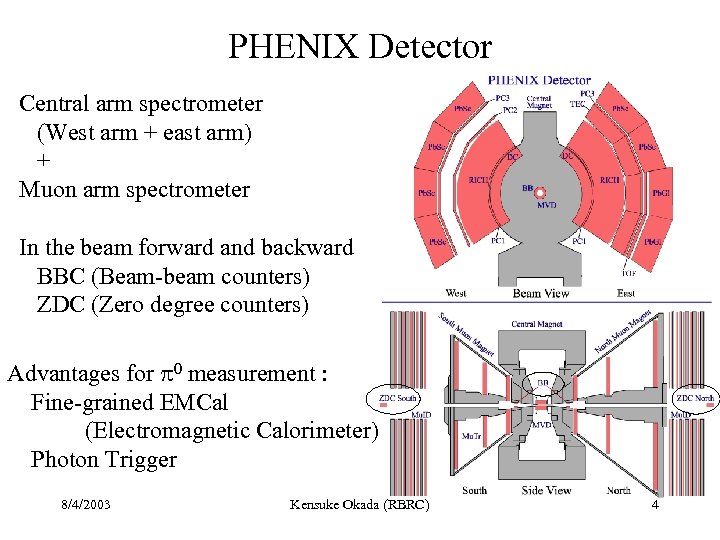 PHENIX Detector Central arm spectrometer (West arm + east arm) + Muon arm spectrometer In the beam forward and backward BBC (Beam-beam counters) ZDC (Zero degree counters) Advantages for 0 measurement : Fine-grained EMCal (Electromagnetic Calorimeter) Photon Trigger 8/4/2003 Kensuke Okada (RBRC) 4
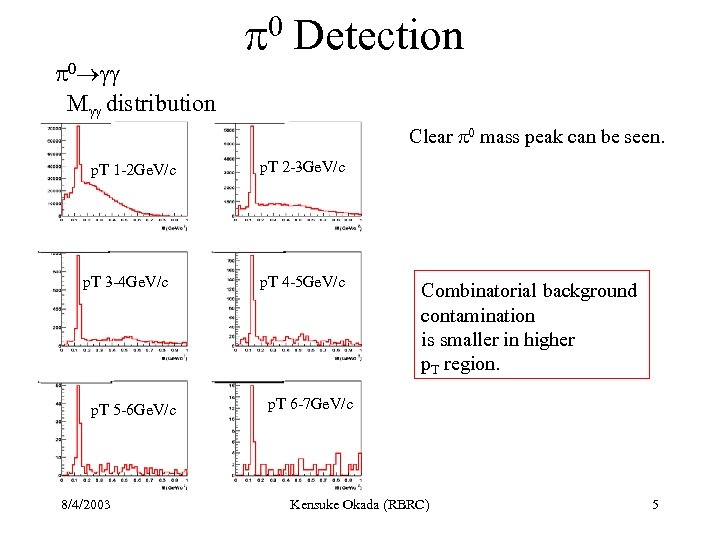 0 gg Mgg distribution 0 Detection Clear 0 mass peak can be seen. p. T 1 -2 Ge. V/c p. T 3 -4 Ge. V/c p. T 5 -6 Ge. V/c 8/4/2003 p. T 2 -3 Ge. V/c p. T 4 -5 Ge. V/c Combinatorial background contamination is smaller in higher p. T region. p. T 6 -7 Ge. V/c Kensuke Okada (RBRC) 5
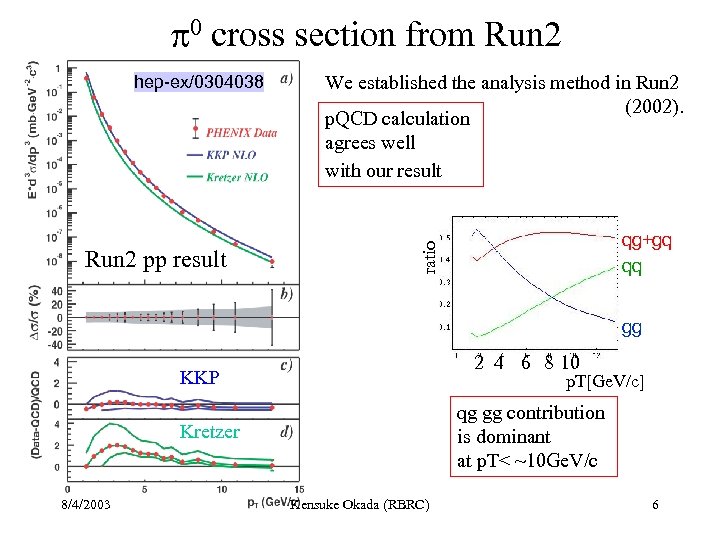 0 cross section from Run 2 pp result We established the analysis method in Run 2 (2002). p. QCD calculation agrees well with our result qg+gq qq ratio hep-ex/0304038 gg 2 4 6 8 10 KKP p. T[Ge. V/c] qg gg contribution is dominant at p. T< ~10 Ge. V/c Kretzer 8/4/2003 Kensuke Okada (RBRC) 6
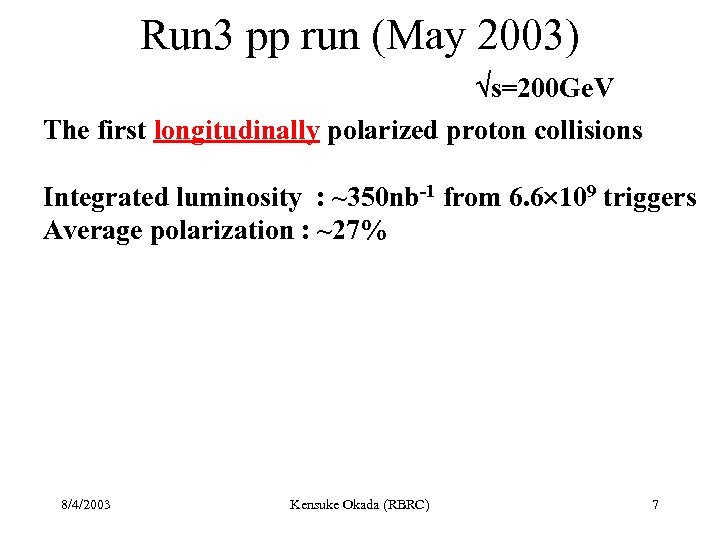 Run 3 pp run (May 2003) s=200 Ge. V The first longitudinally polarized proton collisions Integrated luminosity : ~350 nb-1 from 6. 6 109 triggers Average polarization : ~27% 8/4/2003 Kensuke Okada (RBRC) 7
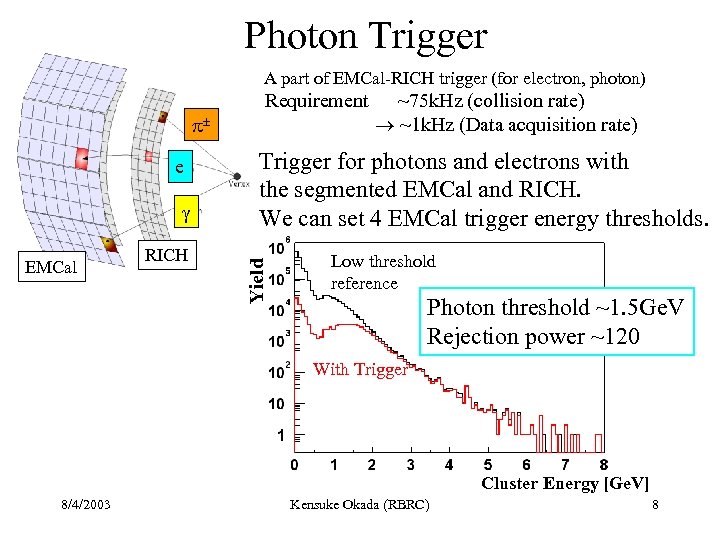 Photon Trigger A part of EMCal-RICH trigger (for electron, photon) Requirement g EMCal RICH Trigger for photons and electrons with the segmented EMCal and RICH. We can set 4 EMCal trigger energy thresholds. Yield e ~75 k. Hz (collision rate) ~1 k. Hz (Data acquisition rate) Low threshold reference Photon threshold ~1. 5 Ge. V Rejection power ~120 With Trigger Cluster Energy [Ge. V] 8/4/2003 Kensuke Okada (RBRC) 8
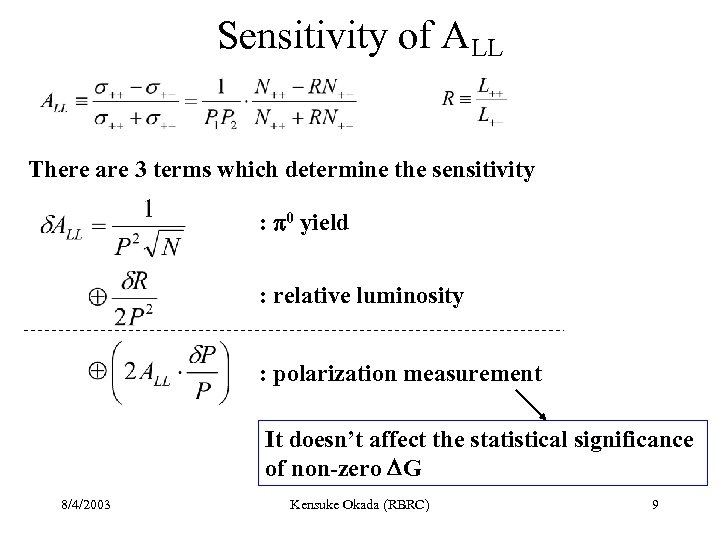 Sensitivity of ALL There are 3 terms which determine the sensitivity : p 0 yield : relative luminosity : polarization measurement It doesn’t affect the statistical significance of non-zero DG 8/4/2003 Kensuke Okada (RBRC) 9
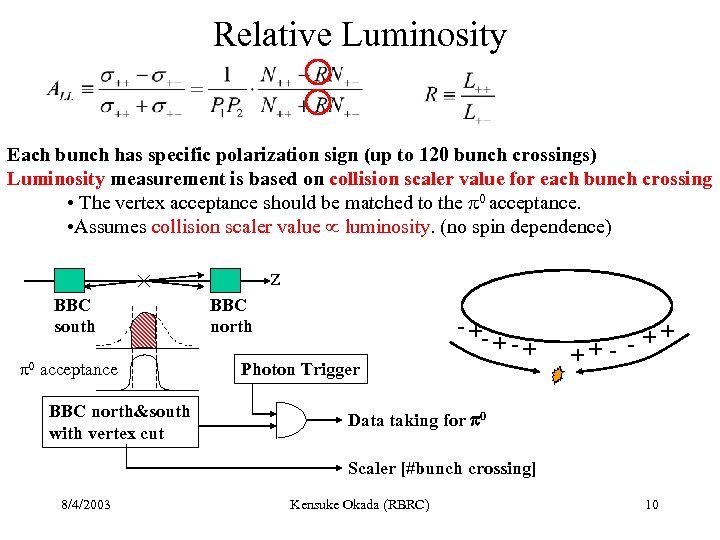 Relative Luminosity Each bunch has specific polarization sign (up to 120 bunch crossings) Luminosity measurement is based on collision scaler value for each bunch crossing • The vertex acceptance should be matched to the 0 acceptance. • Assumes collision scaler value luminosity. (no spin dependence) z BBC south 0 acceptance BBC north&south with vertex cut BBC north - +- Photon Trigger +-+ ++ - Data taking for p 0 Scaler [#bunch crossing] 8/4/2003 Kensuke Okada (RBRC) 10
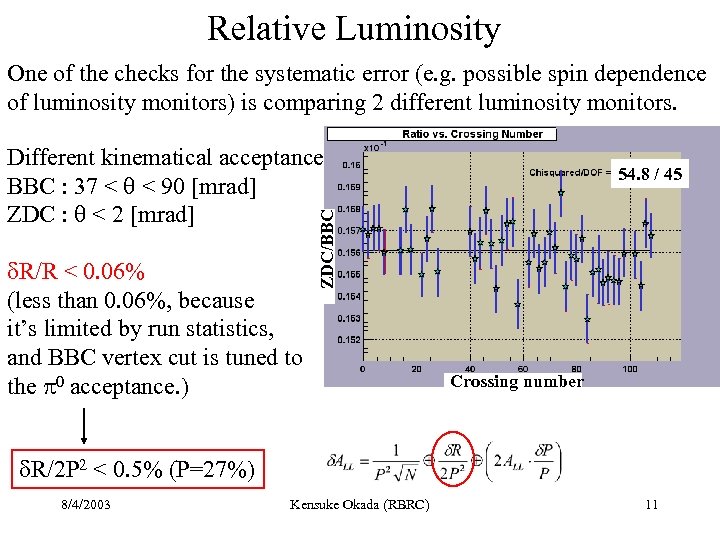 Relative Luminosity One of the checks for the systematic error (e. g. possible spin dependence of luminosity monitors) is comparing 2 different luminosity monitors. Different kinematical acceptances BBC : 37 < < 90 [mrad] ZDC : < 2 [mrad] ZDC/BBC d. R/R < 0. 06% (less than 0. 06%, because it’s limited by run statistics, and BBC vertex cut is tuned to the 0 acceptance. ) 54. 8 / 45 Crossing number d. R/2 P 2 < 0. 5% (P=27%) 8/4/2003 Kensuke Okada (RBRC) 11
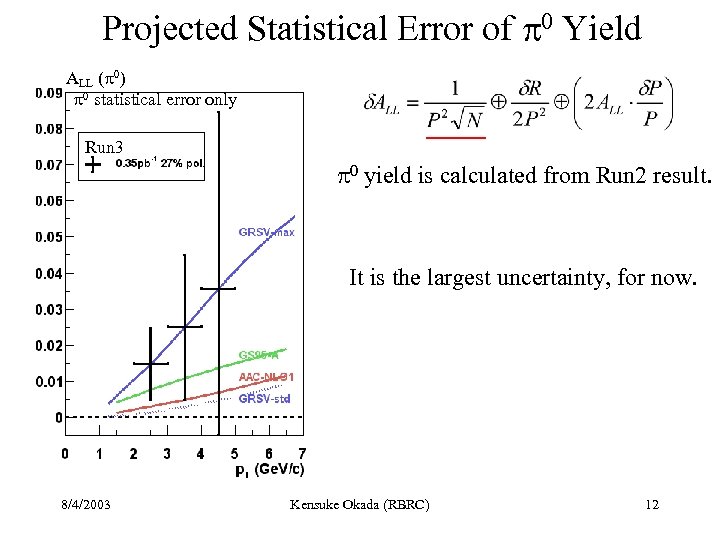 Projected Statistical Error of 0 Yield ALL ( 0) 0 statistical error only Run 3 0 yield is calculated from Run 2 result. It is the largest uncertainty, for now. 8/4/2003 Kensuke Okada (RBRC) 12
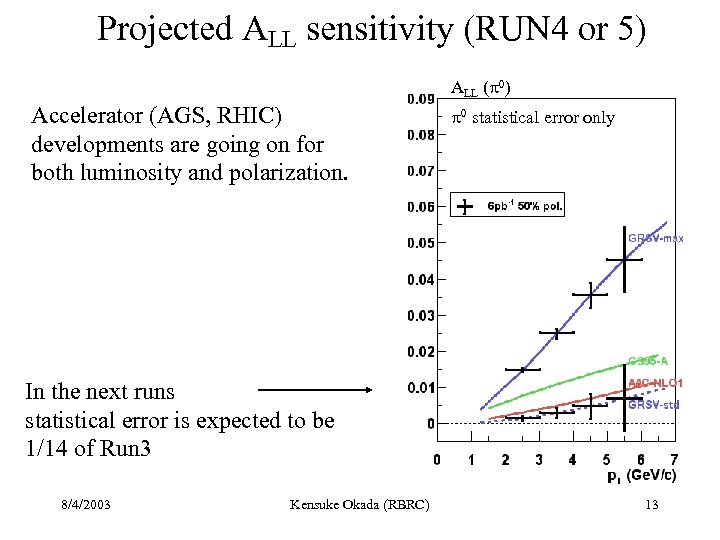 Projected ALL sensitivity (RUN 4 or 5) ALL ( 0) Accelerator (AGS, RHIC) developments are going on for both luminosity and polarization. 0 statistical error only In the next runs statistical error is expected to be 1/14 of Run 3 8/4/2003 Kensuke Okada (RBRC) 13
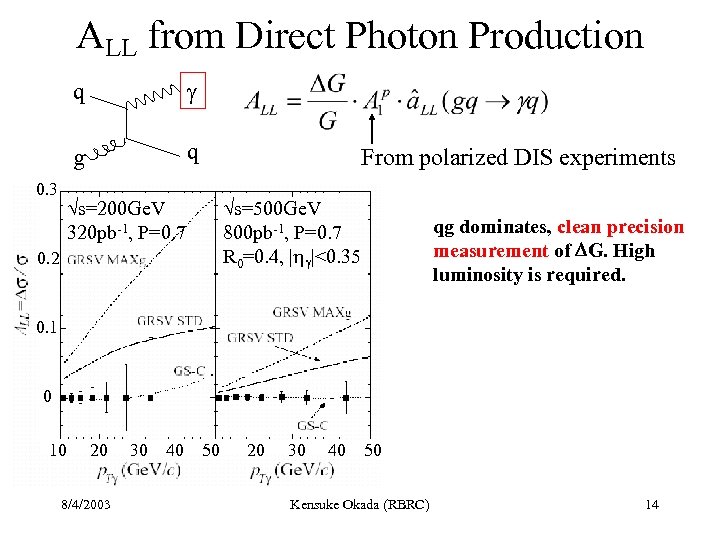 ALL from Direct Photon Production q g 0. 3 g q From polarized DIS experiments s=200 Ge. V 320 pb-1, P=0. 7 s=500 Ge. V 800 pb-1, P=0. 7 R 0=0. 4, |hg|<0. 35 0. 2 qg dominates, clean precision measurement of DG. High luminosity is required. 0. 1 0 10 20 8/4/2003 30 40 50 20 30 40 50 Kensuke Okada (RBRC) 14
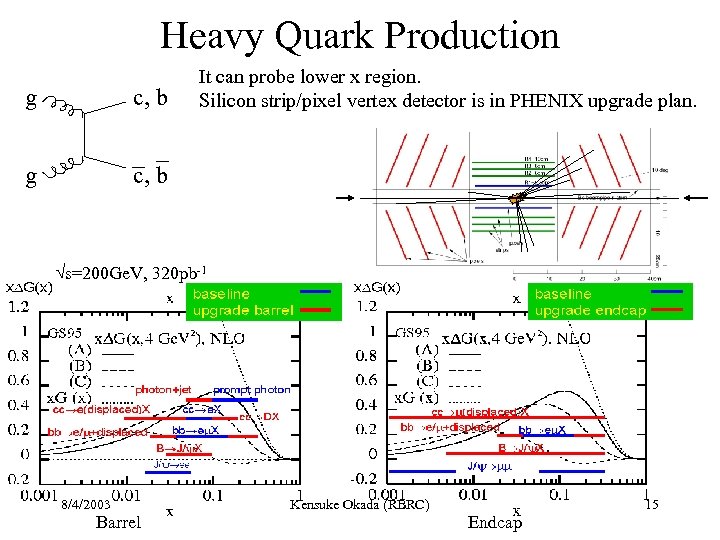 Heavy Quark Production g c, b g It can probe lower x region. Silicon strip/pixel vertex detector is in PHENIX upgrade plan. c, b s=200 Ge. V, 320 pb-1 8/4/2003 Barrel Kensuke Okada (RBRC) Endcap 15
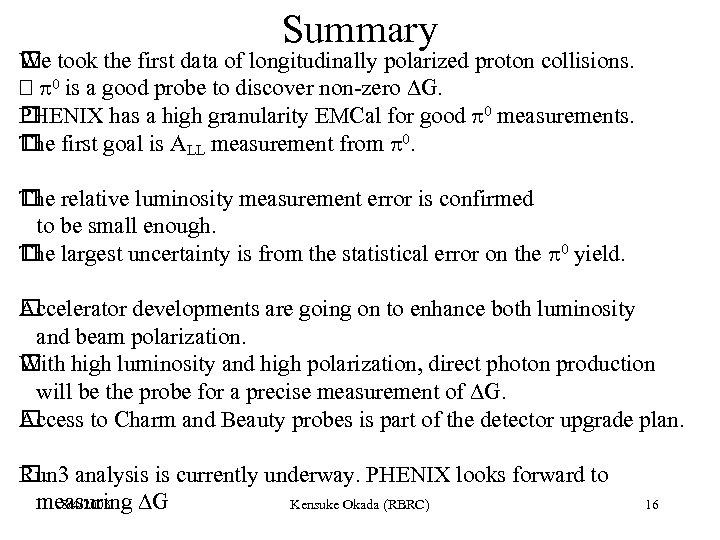 Summary W e took the first data of longitudinally polarized proton collisions. 0 is a good probe to discover non-zero DG. PHENIX has a high granularity EMCal for good 0 measurements. The first goal is ALL measurement from 0. The relative luminosity measurement error is confirmed to be small enough. The largest uncertainty is from the statistical error on the 0 yield. Accelerator developments are going on to enhance both luminosity and beam polarization. W ith high luminosity and high polarization, direct photon production will be the probe for a precise measurement of DG. Access to Charm and Beauty probes is part of the detector upgrade plan. Run 3 analysis is currently underway. PHENIX looks forward to 8/4/2003 Kensuke Okada (RBRC) measuring DG 16