 Скачать презентацию DG Enterprise industry Sustainable Mobility Automotive
df61da7835abe94a6d43a5c9c8620275.ppt
- Количество слайдов: 22



DG Enterprise & industry Sustainable Mobility & Automotive industry Unit Informal document GRB-57 -29 (57 th GRB, 5 -7 February 2013, agenda item 10) QRTV-IW-GTR Report of the 2 nd QRTV-IW-GTR meeting, Berlin 5 -7 December 2012 57 th GRB 5 -7 February 2013
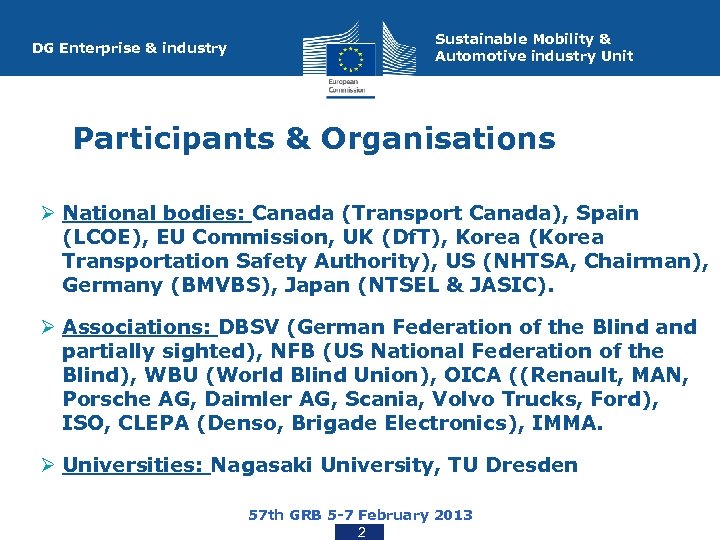
DG Enterprise & industry Sustainable Mobility & Automotive industry Unit Participants & Organisations Ø National bodies: Canada (Transport Canada), Spain (LCOE), EU Commission, UK (Df. T), Korea (Korea Transportation Safety Authority), US (NHTSA, Chairman), Germany (BMVBS), Japan (NTSEL & JASIC). Ø Associations: DBSV (German Federation of the Blind and partially sighted), NFB (US National Federation of the Blind), WBU (World Blind Union), OICA ((Renault, MAN, Porsche AG, Daimler AG, Scania, Volvo Trucks, Ford), ISO, CLEPA (Denso, Brigade Electronics), IMMA. Ø Universities: Nagasaki University, TU Dresden 57 th GRB 5 -7 February 2013 2
DG Enterprise & industry Sustainable Mobility & Automotive industry Unit Update on latest development in the regions Ø The US NPRM on Minimum Sound Requirements for Hybrid and Electric Vehicles was published on the 9 th January, including a draft Environmental Assessment Study and set of proposed sounds. Ø The NPRM was not available for assessment during the QRTV meeting. 57 th GRB 5 -7 February 2013 3
DG Enterprise & industry Sustainable Mobility & Automotive industry Unit ISO/SAE Status Report: Quiet Car; ISO (Doug Moore) Differences between both the proposed VOLPE/NHTSA test method and the current ISO 16254/SAE J 2889 -1 in terms of vehicle test conditions, measurements and information metrics, indoor and component testing and pitch shifting. For this purpose, 4 work packages for data collection were developed: Ø Measurement of vehicles at the conditions outlined by NHTSA/Volpe in the published research report. Measurements include both Indoor and Outdoor evaluations. Ø Measurement of interior sound (recordings and analysis), Evaluation of transmission loss. Ø 3: Correlation of detection and recognition to proposed levels. Ø 4: Measurement of frequency shifting at conditions outlined in NHTSA/VOLPE research report. 57 th GRB 5 -7 February 2013 4
DG Enterprise & industry Sustainable Mobility & Automotive industry Unit ISO/SAE Status Report: Quiet Car; ISO (Doug Moore) - Conclusions CONCLUSIONS: Ø The use of 1/3 octaves for the sole performance specification as proposed in the NHTSA/VOLPE research paper will require changes to the ISO/SAE test procedures to provide for the sound being measured to be available for a time of approximately 30 seconds. Correction of 1/3 octaves with background noise levels is not possible due to variation. Ø The test methods proved to be sensible against background noise so that indoor testing appears more promising in view of repeatable and reproducible results. This avoids the necessity for outdoor test facilities in extremely low noise areas as ‘ 2 m’ indoor-facilities with cut off frequencies below 200 Hz are widely available. 57 th GRB 5 -7 February 2013 5
DG Enterprise & industry Sustainable Mobility & Automotive industry Unit OICA Status Report: Quiet Car (HM Gerhard) Ø OICA is working on the same work packages as ISO. Up to today packages 1 and 2 have been investigated. Ø 97 non-quiet vehicles of the OICA database were analysed. All vehicles are sufficiently recognisable by pedestrians but almost none of them fulfil the VOLPE requirements. Ø Even sport cars don’t satisfy the combinations of 3 rd octave bands & SPLs as proposed. Ø Proposal: either reduce the number of minimum required 3 rd octave bands but keep the VOLPE proposed SPL levels or to keep the proposed 3 rd octave bands, however with reduced SPLs. It is also thinkable to prescribe a certain acoustic energy content that must be emitted with at least 2 of the proposed bands, but can also be distributed amongst more than 2. 57 th GRB 5 -7 February 2013 6
DG Enterprise & industry Sustainable Mobility & Automotive industry Unit OICA Status Report: Quiet Car (HM Gerhard) Ø The typical vehicle speed between 0 kph and 30 kph, hence AVAS would be active most of the time. RISK: driver and passenger annoyance from frequencies transmitting into the vehicle. Ø Ø Transmission loss between outside and inside of the vehicle decreases ~6 d. B per octave with frequencies becoming lower. Low frequency content is difficult to be attenuated and can only be realised by adding mass in form of insulation material. 57 th GRB 5 -7 February 2013 7
DG Enterprise & industry Sustainable Mobility & Automotive industry Unit OICA Status Report: Quiet Car (HM Gerhard) Ø Below 400 Hz is impossible to depress sound to not audible levels for vehicle passengers. EVs are designed under specific light weight aspects so to enable longer driving ranges. Additional insulation material necessary to reduce noises from AVAS penetrating into the passenger compartment would jeopardize these design strategies. Ø Proposal: restrict AVAS sounds to a level in SPL as well as to octave bands that are acceptable for the driver and the passengers to avoid distraction, annoyance and rejection. 57 th GRB 5 -7 February 2013 8
DG Enterprise & industry Sustainable Mobility & Automotive industry Unit Requirements of blind and partially sighted people in the view of DBSV Ø DBSV activities. Ø Impacts of silent cars on independent travelling and associated risk scenarios were presented. Ø The DBSV therefore proposes the following actions and measures to be taken so to ensure the safety of blind and partially sighted citizens: Ø Avoid natural and alarm sounds Ø Automatic operation 57 th GRB 5 -7 February 2013 9
DG Enterprise & industry Sustainable Mobility & Automotive industry Unit Requirements of blind and partially sighted people in the view of DBSV (H. Kaltwasser) DBSV therefore proposes the following actions and measures to be taken so to ensure the safety of blind and partially sighted citizens: Ø The AVAS system should be installed on all low sound level vehicles Ø The installation of the AVAS system should be mandatory Ø The sound produced by the AVAS system should be generated automatically at speeds of up to 30 km/h. 57 th GRB 5 -7 February 2013 10
DG Enterprise & industry Sustainable Mobility & Automotive industry Unit Requirements of blind and partially sighted people in the view of DBSV (H. Kaltwasser) DBSV therefore proposes the following actions and measures to be taken so to ensure the safety of blind and partially sighted citizens: Ø Ø No On/off switch Clear and easy indication of all modes of operation Avoid natural and alarm sounds Automatic operation 57 th GRB 5 -7 February 2013 11
Sustainable Mobility & Automotive industry Unit DG Enterprise & industry A study of AVAS on the QRTV – KATRI, J. Park This presentation compares the currently available test methods and boundary conditions with traffic situations typically occurring in Korea. From the findings, it is concluded that : • The test method should comprise a component under acceleration in addition to standstill and cruise-by (SAE J 2889 -1) • The necessary sound level of AVAS is 55~60 d. B(A) in cruise and 60~65 d. B(A) in acceleration. The proposed value for acceleration is considered as minimum. • The AVAS should be active up to a velocity of 25 km/h • Frequency shift measurement also can be conducted outdoor 57 th GRB 5 -7 February 2013 12
DG Enterprise & industry Sustainable Mobility & Automotive industry Unit Reaction of pedestrians to various vehicle exterior noises (TU Dresden, Dr. E. Altinsoy) This presentation reports about the findings from an extensive research on the evaluation of characteristics of acoustical signals in the surrounding of typical urban traffic situations. The research also determines the most important attributes to ensure their safe detectability of acoustic signal to be produced by AVAS. 57 th GRB 5 -7 February 2013 13
DG Enterprise & industry Sustainable Mobility & Automotive industry Unit Reaction of pedestrians to various vehicle exterior noises (TU Dresden, Dr. E. Altinsoy) The main conclusions drawn from the research are as follows: • Individual one-third-octave bands (low or high frequencies) being prominent ensure the detection of vehicles from ambient conditions. • Relatively few signal elements are used to detect the sound of internal combustion engine vehicles. • Low-frequency engine orders play an important role on the detection. 57 th GRB 5 -7 February 2013 14
Sustainable Mobility & Automotive industry Unit DG Enterprise & industry Reaction of pedestrians to various vehicle exterior noises (TU Dresden, Dr. E. Altinsoy) Essential parameters: • Tonality • Time variance (e. g. Modulation, impulsiveness etc. ) • Spectrum outside of the ambient 57 th GRB 5 -7 February 2013 15
DG Enterprise & industry Sustainable Mobility & Automotive industry Unit QRTV - France Positions and proposals: Measures ensuring the audibility of hybrid and electric vehicles The basic requirements from France are as follows: • Fitment of AVAS shall be mandatory • Requirements shall be based on RE 3 • The level of sound shall be levelled to be sufficiently detectable but not excessive. • Scope for AVAS EV & HEV • Sound shall fade out between 20 kph and [40 kph 57 th GRB 5 -7 February 2013 16
DG Enterprise & industry Sustainable Mobility & Automotive industry Unit QRTV - France Positions and proposals: Measures ensuring the audibility of hybrid and electric vehicles The basic requirements from France are as follows: • A qualification test derived from ISO 16254 shall detect applicability for individual vehicle types. • No sound at idle as this risks to be annoying • A minimum and a maximum sound level needs to be determined 57 th GRB 5 -7 February 2013 17
DG Enterprise & industry Sustainable Mobility & Automotive industry Unit Concept of QRTV GTR based on RE 3, (Dr. I. Sakamoto, JASIC) Japan presented its concept for a GTR that is based on the requirements from RE 3. There should be no sound when vehicle is stopped as these risks masking sounds from other (slowly moving) vehicles. This is not a concern of EV/HEV, but may also occur with ICEV. However, the risk of masking from AVAS is higher than from ICE. 57 th GRB 5 -7 February 2013 18
Sustainable Mobility & Automotive industry Unit DG Enterprise & industry EU Proposed Approach of QRTV GTR: A Qualitative approach towards the QRTV GTR drafting (Dr. N. Kakizis, EU Com) The presentation was on policy rather than on technical level. EU COM sets out its main prerequisites and boundary conditions. The new GTR needs to: • be flexible, simple and provide "one solution to fit all" with suitable provisions for future technological and scientific developments. • be innovation-friendly and not create market or trade constrictions. 57 th GRB 5 -7 February 2013 19
Sustainable Mobility & Automotive industry Unit DG Enterprise & industry EU Proposed Approach of QRTV GTR: A Qualitative approach towards the QRTV GTR drafting (Dr. N. Kakizis, EU Com) The new GTR needs to: • be "ready for adoption" or “attractive for adoption” by the contracting parties • take into consideration that EVs and HEVs are expected to grow exponentially in numbers over the next few years (cumulative effect, noise exposure levels, and disorientation effects in heavy traffic conditions). 57 th GRB 5 -7 February 2013 20

Sustainable Mobility & Automotive industry Unit DG Enterprise & industry Next meeting The next meeting is scheduled to take place from April 16 to 18 in Europe Venue: ACEA HQ, Brussels 57 th GRB 5 -7 February 2013 21
DG Enterprise & industry Sustainable Mobility & Automotive industry Unit Thank you for your attention! Nickolas Kakizis Ph. D. , Policy Officer DG ENTR, B 4: Sustainable Mobility & Automotive Industry nickolas. kakizis@ec. europa. eu 57 th GRB – 05 -07/February/2013
Скачать презентацию DG Enterprise industry Sustainable Mobility Automotive
df61da7835abe94a6d43a5c9c8620275.ppt