


 Скачать презентацию Deviance in sport pressures causing drug taking
fd4b5ee378b415a37c769050741fbb3e.ppt
- Количество слайдов: 20
 Deviance in sport – pressures causing drug taking. Pressures Causing Drug Taking
 DOPING IN SPORT • The use of banned performance-enhancing drugs in sport is commonly referred to as doping, particularly by those organisations that regulate competitions. • The use of drugs to enhance performance is considered unethical by most international sports organisations and especially the International Olympic Committee. • Although ethicists have argued that it is little different from the use of new materials in the construction of suits and sporting equipment, which similarly aid performance and can give competitors an unfair advantage over others. • The reasons for the ban are mainly the alleged health risks of performance-enhancing drugs, the equality of opportunity for athletes, and the alleged exemplary effect of "clean" ("dopingfree") sports for the public.
 Commonly Used Drugs in Sport: EPO - Erythropoietin EPO has a number of medical uses, although mainly to treat anaemia, secondary to other conditions such as; Renal failure, Cancer, HIV, Pre/Post-surgery to reduce the need for blood transfusion. Effects on Performance • EPO stimulates bone marrow to produce more red blood cells (RBC) and therefore haemoglobin. For this reason EPO is most commonly used amongst endurance athletes as a higher RBC count means better oxygen transportation and so a higher rate of aerobic respiration. The faster the rate of aerobic respiration, the higher the level at which the athlete can work without utilising the anaerobic systems which produce lactic acid and cause fatigue.
 Commonly Used Drugs in Sport: Human Growth Hormone? Human Growth hormone (h. GH) is also sometimes known as somatotrophic hormone or somatotrophin. It is produced by the pituitary gland is essential for normal growth and development. h. GH is anabolic, meaning it accelerates protein synthesis and also aids the metabolism (breaking down) of fat stores. Effects on Performance Athletes involved in powerful, strength demanding sports and events (weight lifting, body building, American football etc) are most likely to use h. GH due to its perceived anabolic effect: • Increased muscle mass • Decreased fat stores • Accelerated muscle recovery
 Commonly Used Drugs in Sport: ANABOLIC STEROIDS Sometimes also known as anabolic androgenic steroids (AAS’s), these are derivatives of the hormone testosterone. Effects on Performance • Steroids are most commonly used by athletes involved in power sports, for example weight lifting, throwing and sprinting events. Field sports such as American Football and Rugby also demonstrate a high incidence of use, as does body building. The perceived benefits of AAS use include: • Increased muscle bulk • Increased muscle strength • Faster muscle recovery • Reduced muscle catabolism (breakdown of muscle) following intense exercise which aids muscle recovery and development (not proven as yet)
 Medical Side Effects There is are major side-effects of using EPO which have proven to be fatal in previous cases: Increased viscosity (thickness) of the blood (which increases the risk of heart attack and stroke) Fever Seizures (fits) Nausea Headache Anxiety Legarthy Side-Effects of Anabolic Steroids Side-effects from the use of steroids are extremely common and can be quite significant. Most side-effects are reversible once the athlete stops usage although serious long-term side-effects and even death have occurred as a direct result of steroid use. Decreased sperm production and sex drive Increased aggression, irritability and mood swings Liver disorders Acne Baldness (alopecia) Hypertension (high blood pressure) Raised cholesterol Gynecomastia (development of over-sized mammary glands in males) Menstrual irregularities (in women) Hirsuitism (excessive hair growth occurring in females which follows the pattern of male hair growth, i. e. facial) Deepening of the voice Reduced immunity Possible development of tumors (wilm’s tumor, prostate carcinoma and leukemia have been reported, although a connection is not proven) The side-effects of h. GH are vast and some serious: Gigantism in younger athletes (or pituitary gigantism or giantism. Refers to abnormally excessive growth in height, considerably above average) Hypothyroidism (low production of the thyroid hormone which disrupts metabolic rate and protein production) Cardiomyopathy (disease of the cardiac muscle, increasing the risk of arrhythmia and sudden cardiac death) Cardiac failure Hypercholesterolemia (presence of high levels of cholesterol in the blood) Ischemic heart disease (a lack of blood to the heart often due to coronary artery disease) Myopathies (neuromuscular diseases affecting the function of muscle fibres) Arthritis Diabetes Impotence Osteoporosis Menstrual irregularities in women CJB (creutzfeldt-jakob disease or mad cow disease. This is only possible when the h. GH is maintained from cadavers (corpses) rather than synthetic production)
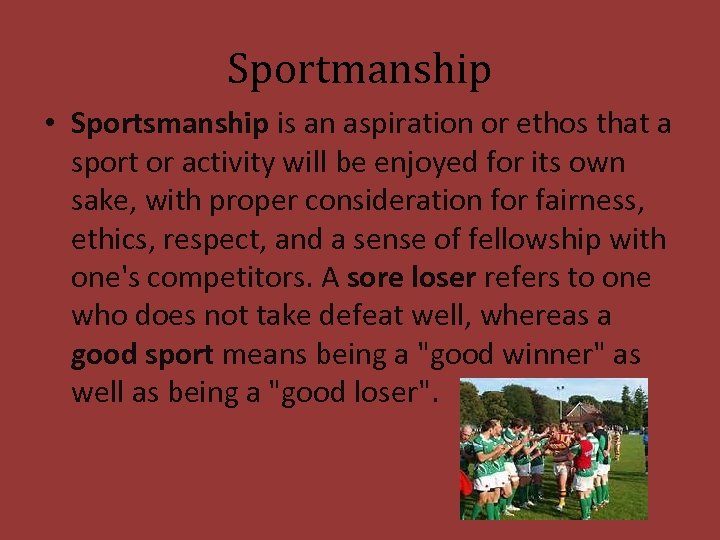 Sportmanship • Sportsmanship is an aspiration or ethos that a sport or activity will be enjoyed for its own sake, with proper consideration for fairness, ethics, respect, and a sense of fellowship with one's competitors. A sore loser refers to one who does not take defeat well, whereas a good sport means being a "good winner" as well as being a "good loser".
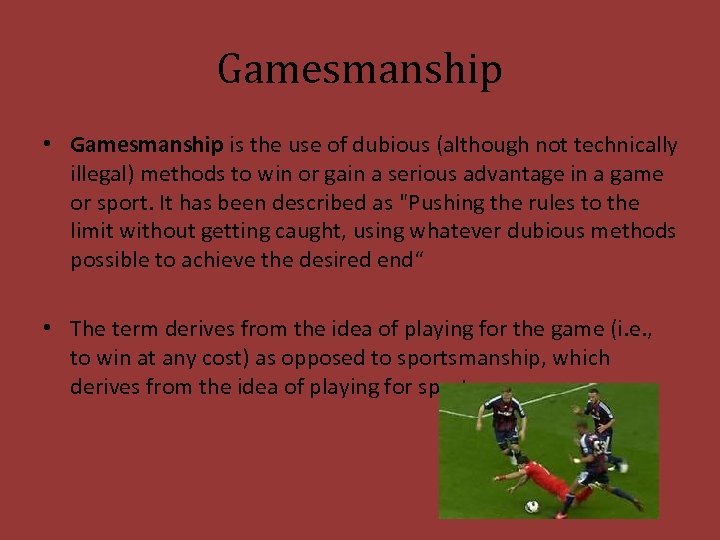 Gamesmanship • Gamesmanship is the use of dubious (although not technically illegal) methods to win or gain a serious advantage in a game or sport. It has been described as "Pushing the rules to the limit without getting caught, using whatever dubious methods possible to achieve the desired end“ • The term derives from the idea of playing for the game (i. e. , to win at any cost) as opposed to sportsmanship, which derives from the idea of playing for sport.
 WHY ? !? !?
 Why do athletes take drugs? mselves or er from the ucceed, eith ressure to s P Indian athletes such as Seema Antil, Neelam family Jaswant Singh and Anil Kumar were tested coaches/ Increasing numbers of elite British sports stars are falling victim to depression because of stress, leading psychologists warned this week. Pressure to perform at high levels, round-the-clock media attention and the huge amounts of money at stake have added to the mental and emotional toll, said Dr Barry Cripps, chairman of the sports and exercise division of the British Psychological Society. positive for steroids and stimulants that are banned by World Anti-Doping Agency (WADA). Weight lifters such as Satheesha Rai, Sanamacha Chanu and Kunjarani Devi were also found consuming drugs to increase their chances of winning a medal. d lan s and Eng Saracen l, flanker, fection in ting an in trac knee after con epression damaged cruciate e should vere d e t h ed from s ration to repair a is leg tha Hill suffer ope treating h t he rejected the wing an pecialist u 2005 follo was told by the s hing al sport. B rofession ng-term staff-coac ssed I . He ment rom p liga o ent f ow depre r retirem cepted a l n't know h d that I wasn't repare fo e to retire, and ac p "I did an dvic ow says: uld see it medical a ens. Hill n e who co Sarac ith o m contract w he people closest t t s was. It wa ery well. " it v handling il Richard H
 Why do athletes take drugs? • Belief that their competitors are taking drugs Ben Johnson, Seoul, 1988 • There were drug cheats before, and there have been drug cheats since. But it took the downfall of Ben Johnson to demonstrate the apparent ubiquity of banned substances at the very highest level of sport. • On the evening of 24 September, the Canadian sprinter set a new world record of 9. 79 seconds in the men's 100 m final, lifting his hand in triumph as he crossed the finish line ahead of arch rival Carl Lewis and Britain's Linford Christie, in what a BBC commentator declared "the greatest sprint race in history". • Three days later, it became the most tarnished. Johnson was stripped of his medal, and had his record expunged after a sample of his urine tested positive for stanozolol, an illegal steroid. He initially denied cheating, but later confessed – arguing that drug use was endemic in top-tier athletics. In a way, he had a point: six of the eight finalists in that famous 100 m race were at some point in their careers tainted by association with "juicing", and several, like him, served bans. But no one fell further, or harder, or more publicly than Ben Johnson. And somehow, the Olympic ideal would never feel quite the same.
 Why do athletes take drugs? ing and tst ard rew ial ce nc an ina orm • F erf p ou or The Italian Olympic Committee is the most s f Highest Paid Athletes in the World!! http: //www. forbes. com/athletes/list/ generous of any nation that finished in the top 10 at the Beijing Olympics, promising its gold medallists £ 116, 000, although they will have to pay tax on that. The sums become even more inflated when bonuses from private sponsors and individual federations are taken into account. Russia, expected to finish third in the London medal tally, will pay its Olympic medallists around £ 86, 000 but, depending on the sport and the generosity of oligarch benefactors, its victorious athletes could bank six-figure sums.
 Why do athletes take drugs? • Lack of access to, or funding for training facilities and additional support (nutrition, psychological support n it e xatio stimulat rela , Drug use is not exc e th stress. in) lusive to athletics, b and there have been incidents thro s can ope wi imes. co ughout other sport t drug t to c w. ib sing s that have i shocked the world for u tes use ttp: //ww. In 2007, former s tennis world ason (h thle number one Mart er re Some a weight ina Hingis tested p th O ositive for uce es. cocaine, leading to rovid dy or red her quitting the g p ame. She vowed o to contest the alle the b gations, a nd denied any knowledge of the d rug, but despite th is, she was given a two-year b an and never retu rned, leading to suspicions that sh e in fact knew tha t she was guilty Other reasons for using drugs can be the relaxation it provides. Some athletes use it to cope with stress, stimulate the body or reduce weight
 Why do athletes take drugs? s… s ce a nd medi unity a • Comm ns of suc o xpectati es and e attitud mpics in nt? ? !!) mer Oly e y won the Sum overnm ntry / G dden, at mpionships, the u u ha all of a s m the Co 2. Then, he 1994 Wold C ures fro ress l 199 i Team (p ing—unt als. Then, at t Asian t swimm ens Swim om he 1994 od a d med W gol y go us. give e at t Chinese eren’t an wim team won 4 ple got suspicio tosteron , they decided to re s ese w eo ihydrote he ics The Chin he women’s s to say, p tive for d he 1996 Olymp hips. This time t • osi , t dless p a e pions rs tested old at t Barcelon men’s titles. Ne old Cham o swimme m won only 1 g n w ea e 1998 W e wome 12 of 16 1 Chines. But when the t again before th e. ugh, 1 luggag caught Sure eno the jig was up • ey were one swimmer’s nd th Games, a ther try…and so e of HGH in no vil doping a itive tests and a os were 4 p Wales boss Rob Howley has called for fly-half Dan Biggar to be given time and space by a demanding Welsh rugby public when he makes his Six Nations debut on Saturday. Biggar will pull on the coveted Wales number 10 shirt – a jersey previously worn by legends like Barry John, Phil Bennett and Jonathan Davies – against Millennium Stadium visitors Ireland. Although the 23 -year-old Ospreys playmaker has won 11 caps, none have been collected in a pressure cooker atmosphere that Six Nations rugby creates. And Howley, interim head coach while Warren Gatland prepares for the British and Irish Lions tour to Australia later this year, accepts the heat will be on.
 Why do athletes take drugs? Sport will never win the fight against drug cheats, says John Fahey, president of the World Anti Doping Agency (Wada). The • hey But it also reflects the growing frustrations with the testing t t tha ef eli b "We do a fair amount of drug testing but we could do more, " said the US Open champion, who was bloodtested ahead of the Paris Masters last week. "A lot of it has been urine, not so many blood tests. I think it's important to make sure we have all of those bases covered. I think tennis is a clean sport but the more we can do to prove that all the time is good. " (Andy Murray) ugh ca get ’t on w !? ! t? system, highlighted by the way Armstrong and his teammates flouted the rules. By staying one step ahead of the doping control officers, who had no chance of detecting the sophisticated blood-spinning techniques, they were free to pursue their chemically enhanced careers. Danish cyclist Michael Rasmussen admits to 12 years of doping Danish cyclist Michael Rasmussen has admitted that he took performance-enhancing drugs between 1998 and 2010. Rasmussen has already served a two-year suspension for evading doping controls during the 2007 Tour de France. The 38 -year-old was sacked by his Rabobank team and withdrawn from that year's Tour de France after lying about his whereabouts.
 Lance Armstrong Case: Lance Armstrong has ended years of denials by admitting he used performance-enhancing drugs during all seven of his Tour de France wins. The 41 -year-old confessed during his interview with chat show host Oprah Winfrey in front of a worldwide television audience. "I view this situation as one big lie I repeated a lot of times, " he said. "I made those decisions, they were my mistake and I'm here to say sorry. " However the American denied it was "sport's biggest doping programme", saying "it was smart, but it was conservative, risk averse". The interview with Winfrey, 58, was broadcast on prime television on her OWN network in America, and was streamed worldwide through her website. The tens of millions watching saw Armstrong reveal: • he took performance-enhancing drugs in each of his Tour wins from 1999 -2005 • doping was "part of the process required to win the Tour" • he did not feel he was cheating at the time and viewed it as a "level playing field" • he did not fear getting caught • "all the fault and blame" should lie with him • he was a bully who "turned on" people he did not like • his cancer fight in the mid-1990 s gave him a "win-at-all costs" attitude • he would now co-operate with official inquiries into doping in cycling
 100% Me (UK Sport) • • http: //www. ukad. org. uk/athletes/100 percentme - What is 100% Me http: //www. ukad. org. uk/resources/video/100 -me - 100% Me Video
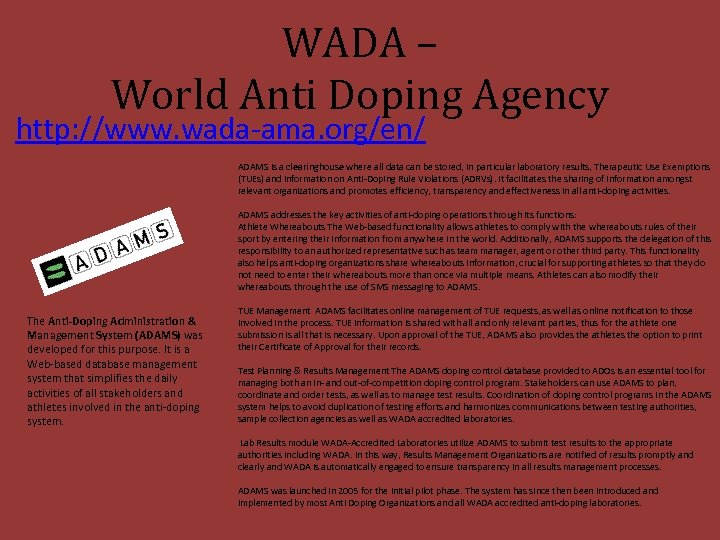 WADA – World Anti Doping Agency http: //www. wada-ama. org/en/ ADAMS is a clearinghouse where all data can be stored, in particular laboratory results, Therapeutic Use Exemptions (TUEs) and information on Anti-Doping Rule Violations (ADRVs). It facilitates the sharing of information amongst relevant organizations and promotes efficiency, transparency and effectiveness in all anti-doping activities. ADAMS addresses the key activities of anti-doping operations through its functions: Athlete Whereabouts The Web-based functionality allows athletes to comply with the whereabouts rules of their sport by entering their information from anywhere in the world. Additionally, ADAMS supports the delegation of this responsibility to an authorized representative such as team manager, agent or other third party. This functionality also helps anti-doping organizations share whereabouts information, crucial for supporting athletes so that they do not need to enter their whereabouts more than once via multiple means. Athletes can also modify their whereabouts through the use of SMS messaging to ADAMS. The Anti-Doping Administration & Management System (ADAMS) was developed for this purpose. It is a Web-based database management system that simplifies the daily activities of all stakeholders and athletes involved in the anti-doping system. TUE Management ADAMS facilitates online management of TUE requests, as well as online notification to those involved in the process. TUE information is shared with all and only relevant parties, thus for the athlete one submission is all that is necessary. Upon approval of the TUE, ADAMS also provides the athletes the option to print their Certificate of Approval for their records. Test Planning & Results Management The ADAMS doping control database provided to ADOs is an essential tool for managing both an in- and out-of-competition doping control program. Stakeholders can use ADAMS to plan, coordinate and order tests, as well as to manage test results. Coordination of doping control programs in the ADAMS system helps to avoid duplication of testing efforts and harmonizes communications between testing authorities, sample collection agencies as well as WADA accredited laboratories. Lab Results module WADA-Accredited Laboratories utilize ADAMS to submit test results to the appropriate authorities including WADA. In this way, Results Management Organizations are notified of results promptly and clearly and WADA is automatically engaged to ensure transparency in all results management processes. ADAMS was launched in 2005 for the initial pilot phase. The system has since then been introduced and implemented by most Anti Doping Organizations and all WADA accredited anti-doping laboratories.
 Should Drugs Be Allowed in Sport? Read this article: http: //bjsm. bmj. com/content/38/6/666. full The President of the Olympic committee, Juan Antonio Samaranch, has said that drugs should be allowed in competitive sport. Does this mean that athletes should be able to take whatever they like to improve their performance? With many recent incidents including the Tour de France and the American athlete's Dennis Mitchell and Randy Barnes testing positive, is it time to deregulate the sporting world? • Sporting authorities spend millions of pounds trying to discover drug cheats but it is thought that many slip through the net. Is it right to save money and let performers use drugs or are there other considerations? • Sports-people are influential role-models in society. Should sporting authorities keep up the fight against drugs to ensure that young people are aware about the harm that drugs can cause? • The audience has an interest in seeing the best performances possible – Factors making a performance more enjoyable for the audience include many that can be enhanced by drugs - like skill, strength and courage – Opponents argue: if an athlete has cheated we view him or her with less respect, which damages our enjoyment of the performance – As athletes approach the limit of what can be achieved with the unenhanced human body, any further improvement will require performance-enhancers • Admiration of a sport can even be reduced if the competitors could perform better on drugs • It is misleading to say it disadvantages poorer teams, because they are already disadvantaged by other factors - equipment, expertise and so on
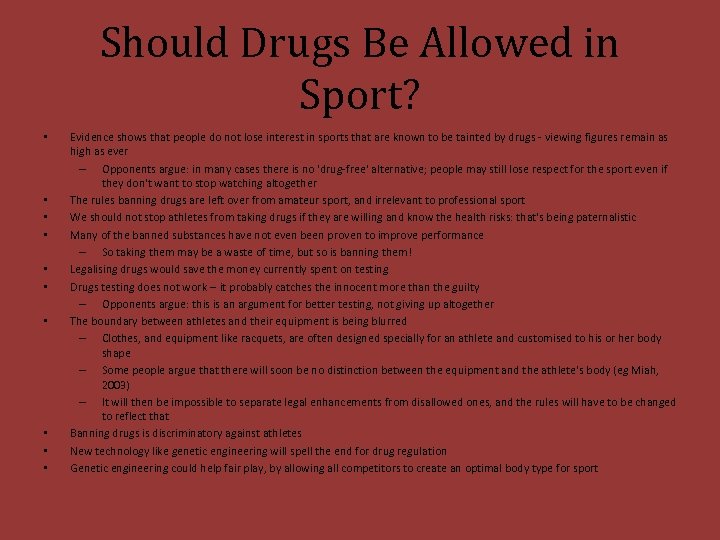 Should Drugs Be Allowed in Sport? • • • Evidence shows that people do not lose interest in sports that are known to be tainted by drugs - viewing figures remain as high as ever – Opponents argue: in many cases there is no 'drug-free' alternative; people may still lose respect for the sport even if they don't want to stop watching altogether The rules banning drugs are left over from amateur sport, and irrelevant to professional sport We should not stop athletes from taking drugs if they are willing and know the health risks: that's being paternalistic Many of the banned substances have not even been proven to improve performance – So taking them may be a waste of time, but so is banning them! Legalising drugs would save the money currently spent on testing Drugs testing does not work -- it probably catches the innocent more than the guilty – Opponents argue: this is an argument for better testing, not giving up altogether The boundary between athletes and their equipment is being blurred – Clothes, and equipment like racquets, are often designed specially for an athlete and customised to his or her body shape – Some people argue that there will soon be no distinction between the equipment and the athlete's body (eg Miah, 2003) – It will then be impossible to separate legal enhancements from disallowed ones, and the rules will have to be changed to reflect that Banning drugs is discriminatory against athletes New technology like genetic engineering will spell the end for drug regulation Genetic engineering could help fair play, by allowing all competitors to create an optimal body type for sport