


 Скачать презентацию Deviance and Social Control Summary of Topics l
fc16aa12f856c4b1d32cee19c8f03eed.ppt
- Количество слайдов: 36
 Deviance and Social Control Summary of Topics l Deviance and Social Control l Functionalism and Deviance l Symbolic Interactionism and Deviance l Conflict Theory and Deviance l Crime and Punishment 2 Click on a hyperlink to view a topic or click on the right arrow to proceed through the chapter
 Deviance and Social Control l Deviance is the violation of social norms. l It is difficult to define because not everyone agrees on what should be considered deviant behavior. 3
 The Nature of Deviance l Deviance is behavior that departs from societal or group norms. l Deviance is a matter of social definition–it can vary from group to group and society to society. l In a diverse society like that of the United States, it is often difficult to agree on what is or is not deviant behavior. 4
 The Nature of Deviance may be either positive or negative. l Negative deviance involves behavior that fails to meet accepted norms. l People expressing negative deviance either reject the norms, misinterpret the norms, or are unaware of the norms. l Positive deviance involves overconformity to norms. Positive deviants idealize group norms. l Positive deviance can be as disruptive and hard to manage as negative deviance. 5
 The Nature of Deviance l For a sociologist, a deviant is a person who has violated one or more of society’s most highly valued norms. l Reactions to deviants are usually negative and involve attempts to change or control the deviant behavior. 6
 Social Control l Without social control–ways to promote conformity to norms–social life would be unpredictable. l There are two broad types of social control: internal and external. 7
 What is internal social control? l This type of social control lies within the individual. l You are practicing internal social control when you do something because you know it is the right thing to do or when you don’t do something because you know it would be wrong. 8
 What is external social control? l External social control is based on social sanctions–rewards and punishments designed to encourage desired behavior. l Positive sanctions are used to encourage conformity. l Negative sanctions are intended to stop socially unacceptable behavior. l Sanctions may be formal or informal. 9
 What is a major problem sociologists have in defining deviance? Deviance is a matter of social definition and can vary from group to group and society to society. 10 Click the mouse button or press the space bar to display the answer.
 Functionalism and Deviance l Functionalists believe that some deviance can contribute to the smooth operation of society. l Deviance, therefore, has both negative and positive consequences for society. l Functionalism also forms the basis for two important theories of deviance: strain theory and control theory. 11
 What are some of the negative effects of deviance? l Deviance erodes trust. l Deviance can cause nonconforming behavior in others. l Deviant behavior is expensive. 12
 How does deviance benefit society? l Deviance clarifies norms by exercising social control to defend its values; society defines, adjusts, and reaffirms norms. l Deviance can be a temporary safety valve. l Deviance increases unity within a society or group. l Deviance promotes needed social change. 13
 Strain Theory l Anomie is a social condition in which norms are weak, conflicting, or absent. l Strain theory is theory that deviance is more likely to occur when a gap exists between cultural goals and the ability to achieve these goals by legitimate means. l Every society establishes some goals and socially approved ways of reaching them. l Conformity is when people accept the goal and the means to achieve it. l Innovation, ritualism, retreatism and rebellion are deviant responses to strain. 14
 Control Theory l According to control theory, conformity to social norms depends on the presence of strong bonds between individuals and society. l If those bonds are weak–if anomie is present– deviance occurs. l Social bonds control the behavior of people, preventing deviant acts. l People conform because they don’t want to “lose face. ” 15
 What are the basic elements of social bonds? l According to Hirschi, the social bond has four basic components: – Attachment – Commitment – Involvement – Belief l When social bonds are weak, the chances for deviance increase. 16
 Which of the following is NOT one of the benefits of deviance for society? a. It increases suspicion and mistrust among members of a society. b. It promotes social change. c. It increases social unity. d. It provides a safety valve. e. It promotes clarification of norms. b, c, d, and e are benefits of deviance 17 Click the mouse button or press the space bar to display the answer.
 Symbolic Interactionism and Deviance The symbolic interactionist perspective yields two theories of deviance: l Differential association theory AKA: Cultural Transmission Theory or Transmission Theory l Labeling theory 18
 Differential Association Theory l Differential association theory emphasizes the role of primary groups in transmitting deviance. l Just as we learn preferences in religion and politics from others we associate with closely, people can learn deviance by association. l The more that individuals are exposed to people who break the law, the more apt they are to become criminals. 19
 How is deviance learned? l the ratio of deviant to nondeviant individuals l whether the deviant behavior is practiced by significant others l the age of exposure 20
 Labeling Theory l Labeling theory explains why deviance is relative. l According to labeling theory, deviant behaviors are always a matter of social definition. l In this view, deviance exists when some members of a group or society label others as deviants. l Howard Becker was a pioneer of labeling theory. 21
 Are there degrees of deviance? l In cases of primary deviance, a person engages only in isolated acts of deviance; deviance is not a part of a person’s lifestyle or self-concept. l Secondary deviance refers to deviance as a lifestyle and as a personal identity. 22
 What are the consequences of labeling? l Labeling people as deviants can cause them pain and suffering, as well as determine the direction of their lives. l Erving Goffman wrote about stigma–an undesirable characteristic or label used by others to deny the deviant full social acceptance. 23
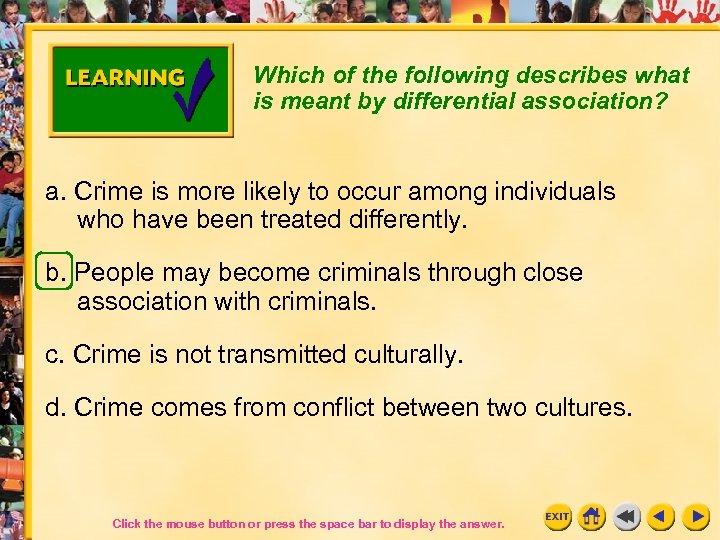 Which of the following describes what is meant by differential association? a. Crime is more likely to occur among individuals who have been treated differently. b. People may become criminals through close association with criminals. c. Crime is not transmitted culturally. d. Crime comes from conflict between two cultures. 24 Click the mouse button or press the space bar to display the answer.
 Conflict Theory and Deviance l The conflict perspective looks at deviance in terms of social inequality and power. l The most powerful members of a society determine who will be regarded as deviant. l Conflict theorists point to some disproportional statistical relationships between minorities and crime. 25
 Deviance in Industrial Society l Critics of industrial society are considered deviants because their beliefs challenge its economic, political, and social basis. l Industrial society requires a willing workforce, those who will not work are considered as deviants. l Those who threaten private property, especially that belonging to the rich, are prime targets for punishment. l Because of society’s need for respect of authority, people who show a lack of respect for authority are treated as deviants. l Certain activities are encouraged depending on how well they fit within industrial society. 26
 Race, Ethnicity, and Crime l Supporters of the conflict perspective believe that: l Minorities receive unequal treatment in the American criminal justice system. l Minorities generally do not have the economic resources to buy good legal services. l Society sees minority interests as less important than the interests of whites. l Victim discounting reduces the seriousness of crimes directed at members of lower social classes. 27
 White-Collar Crime l White-collar crime is any crime committed by respectable and high-status people in the course of their occupations. l According to the United States Department of Justice, the costs of white-collar crime are eighteen times higher than the costs of street crime. 28
 Which of the following is NOT one of the basic ways in which the culture of an industrial society defends itself in the face of deviance? a. People whose beliefs clash with those of industrial society are labeled deviants. b. Industrial society requires a willing work force. c. Innovation is rewarded. d. People who fail to show respect for authority are likely to be considered deviant. 29 Click the mouse button or press the space bar to display the answer.
 Crime and Punishment l Crime statistics in the United States come from the FBI and the Census Bureau. l Differences in statistics between the two agencies are due to differences in methods of collecting data. l Four approaches to crime control are deterrence, retribution, incarceration, and rehabilitation. 30
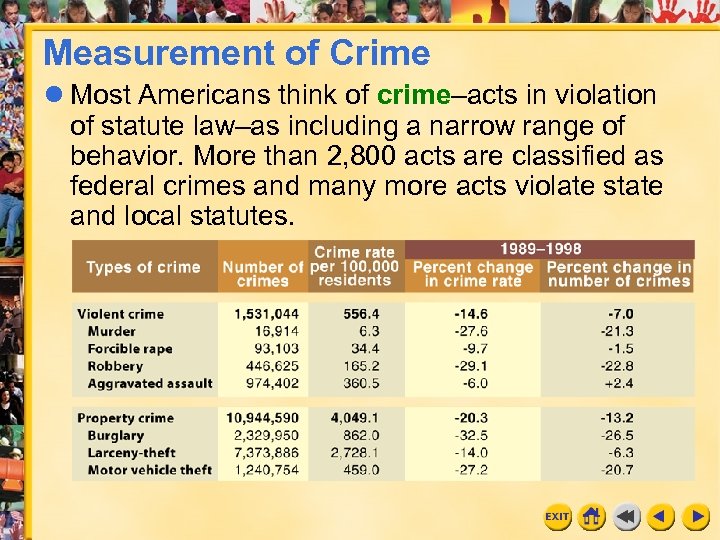 Measurement of Crime l Most Americans think of crime–acts in violation of statute law–as including a narrow range of behavior. More than 2, 800 acts are classified as federal crimes and many more acts violate state and local statutes. 31
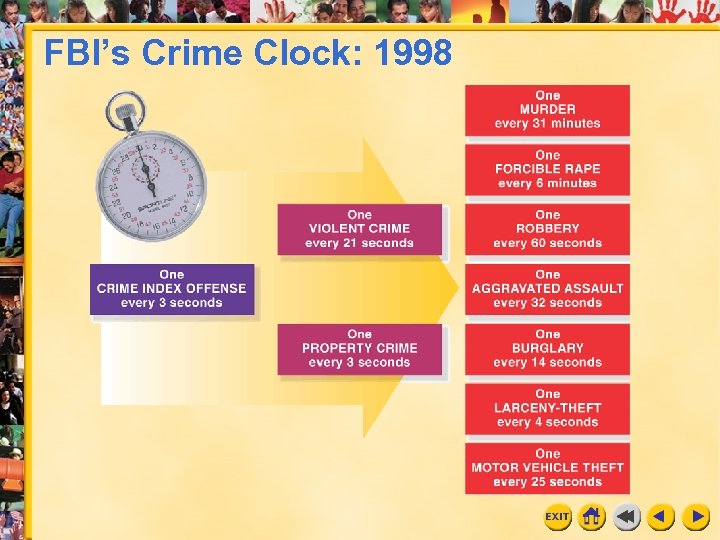 FBI’s Crime Clock: 1998 32
 Juvenile Crime l Juvenile crime refers to legal violations among those under 18. l Juvenile offenders are third largest category in the United States. l Juvenile delinquent behavior includes deviance that only the young can commit. 33
 Approaches to Crime Control l The criminal justice system is made up of the institutions and processes responsible for enforcing criminal statues. l It includes the police, courts, and correctional system. l A criminal justice system may draw on four approaches to control and punish lawbreakers– deterrence, retribution, incarceration, and rehabilitation. 34
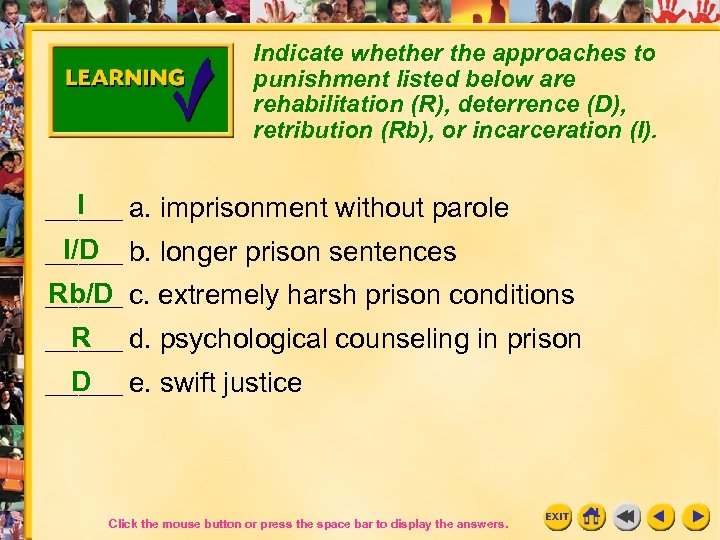 Indicate whether the approaches to punishment listed below are rehabilitation (R), deterrence (D), retribution (Rb), or incarceration (I). I _______ a. I/D _______ b. longer prison sentences Rb/D _______ c. extremely harsh prison conditions R _______ d. psychological counseling in prison D _______ e. 35 imprisonment without parole swift justice Click the mouse button or press the space bar to display the answers.
 Chapter Summary l Deviance is the violation of social norms. l According to functionalists, deviance has both negative and positive consequences for society. l Functionalism forms the basis for strain theory and control theory. l The symbolic interactionist perspective yields two theories of deviance: transmission theory and labeling theory. l The conflict perspective looks at deviance in terms of social inequality and power. l Four approaches to crime control are deterrence, retribution, incarceration, and rehabilitation. 36