 Скачать презентацию Development of the Process Based NH 3 Model
a5124aa6e26e1ef3a87668ea07db0ee2.ppt
- Количество слайдов: 45



Development of the Process Based NH 3 Model ISSRC University of California at Riverside University of California at Davis Environ Iowa State University Inter RPO Technical Workshop
Executive Summary • • • Project funded by the Lake Michigan Air Directors Consortium (LADCo) and Inter-RPO Funds. Goal – a processed based NH 3 model and 2002 national ammonia emissions inventory Duration – 12/01/03 ~ 03/31/05 Total Budget – $ 249, 910. 00 Deliverable: > Science document > Data document > Coding (design) document > Hands-on Training (March 17 -18, 2005, Chicago, IL) > Final project report > 2002 National ammonia emissions inventory
NH 3 Model Development Team • • ISSRC University of California, Davis > > > • Virginia Tech University > • Prof. Hongwei Xin Dr. Yi Liang ENVIRON International Corporation > > > • Prof. Jactone Arogo (formerly at North Carolina State University) Iowa State University > > • Prof. Ruihong Zhang Prof. James Fadel Prof. Tom Rumsey Dr. Gerard Mansell Stella Shepard Mike Masonjones University of California, Riverside > > > Zion Wang Yinqun Wang Gail Tonnesen
Additional Scientific Contributors • • • Ed De. Peters (UC Davis) Ralph Ernst (UC Davis) Kirk Klasing (UC Davis) Jim Oltjen (UC Davis) Kent Parker (UC Davis) Peter Robinson (UC Davis) Anders Strathe (Denmark) Jeff Lorimor (Iowa State Univ. ) Leo Timms (Iowa State Univ. ) Dan Meyer (Iowa State Univ. ) Charlie D. Fulhage (Univ. of Missouri) • • • Richard Koelsch (U. of Nebraska) Don D. Jones (Purdue Univ. ) Ted Funk (U. of Illinois) Larry Jacobson (U. of Minnesota) David Schmidt (U. of Minnesota) James P. Murphy (Kansas State Univ. ) Joseph Harner (Kansas State Univ. ) Harold Keener (Ohio State Univ. ) Dick Nicolai (South Dakota State Univ. ) Brian Holmes (Univ. of Wisconsin)
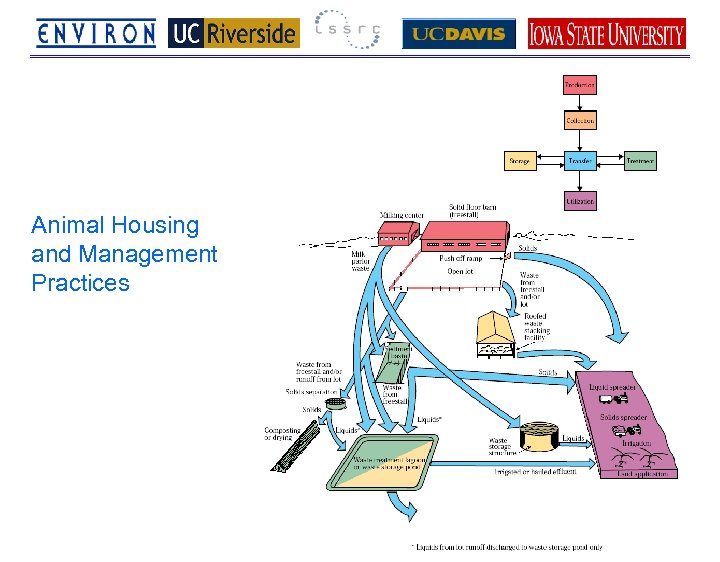
Animal Housing and Management Practices
Processes Involved in Ammonia Emissions • • Ammonia generation > Urea hydrolysis via enzymes > Organic nitrogen mineralization via bacteria > Aqueous chemical reactions Ammonia transfer from water phase to air phase > Diffusion > Convection mass transfer
Processed Based NH 3 Model w/ Fertilizer • • NH 3 Animal Allocation Processor NH 3 Farm Emissions Model: > Animal excretion model > Housing emissions model > Feedlot emissions model > Storage emissions model, and > Land emissions model Animal types considered: > Dairy cows > Beef cattle > Swine > Poultry (layers, broilers, and turkeys) Commercial Fertilizer
Process-based NH 3 Model Overview • Original Design > Discussed in the Coding (Design) document dated 11/14/04 > Farm Emissions Model > Statistical Model • Revised Design > Change in direction on 12/29/04 > Detail of the changes are described in the two memorandums attached to the email (“Status of the ammonia emissions model”) sent out on 01/05/2004 to the NH 3 listserv. > Animal Allocation Preprocessor > Farm Emissions Model
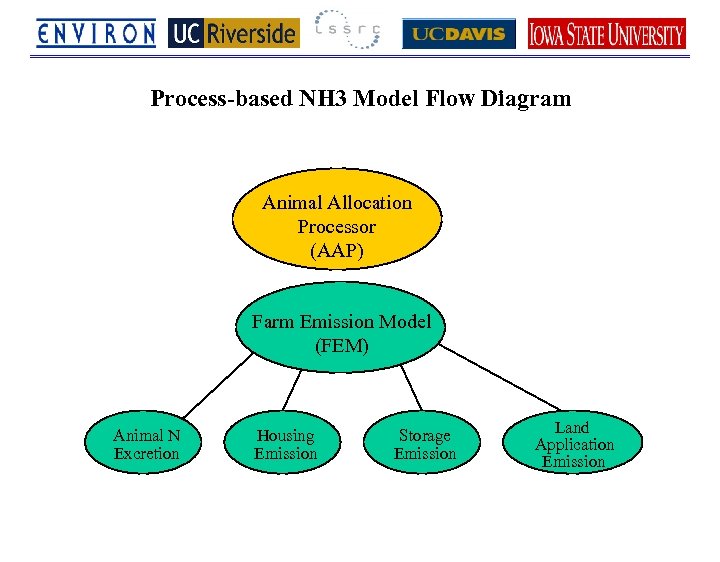
Process-based NH 3 Model Flow Diagram Animal Allocation Processor (AAP) Farm Emission Model (FEM) Animal N Excretion Housing Emission Storage Emission Land Application Emission
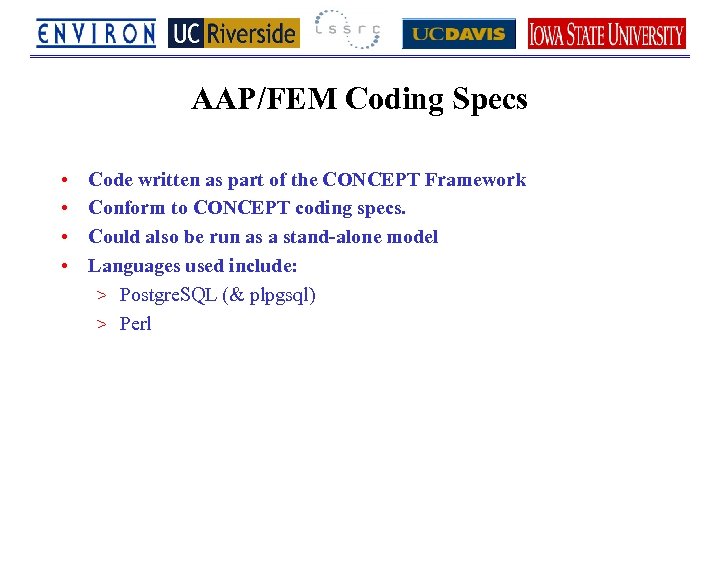
AAP/FEM Coding Specs • • Code written as part of the CONCEPT Framework Conform to CONCEPT coding specs. Could also be run as a stand-alone model Languages used include: > Postgre. SQL (& plpgsql) > Perl
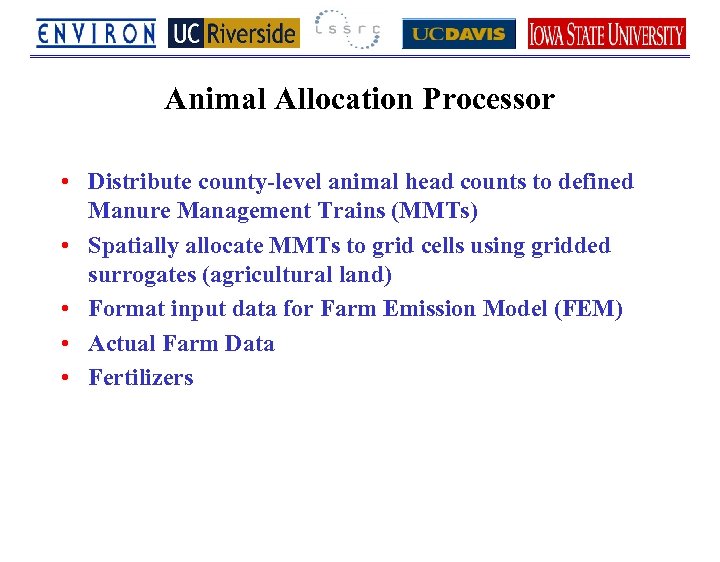
Animal Allocation Processor • Distribute county-level animal head counts to defined Manure Management Trains (MMTs) • Spatially allocate MMTs to grid cells using gridded surrogates (agricultural land) • Format input data for Farm Emission Model (FEM) • Actual Farm Data • Fertilizers
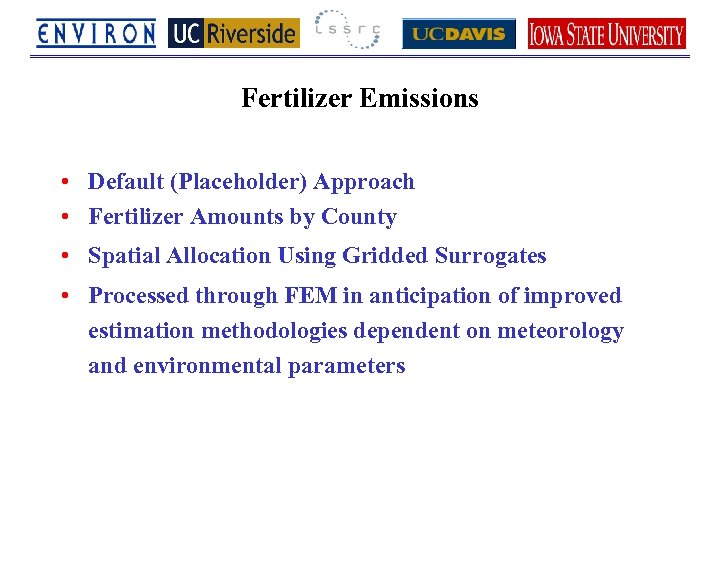
Fertilizer Emissions • Default (Placeholder) Approach • Fertilizer Amounts by County • Spatial Allocation Using Gridded Surrogates • Processed through FEM in anticipation of improved estimation methodologies dependent on meteorology and environmental parameters
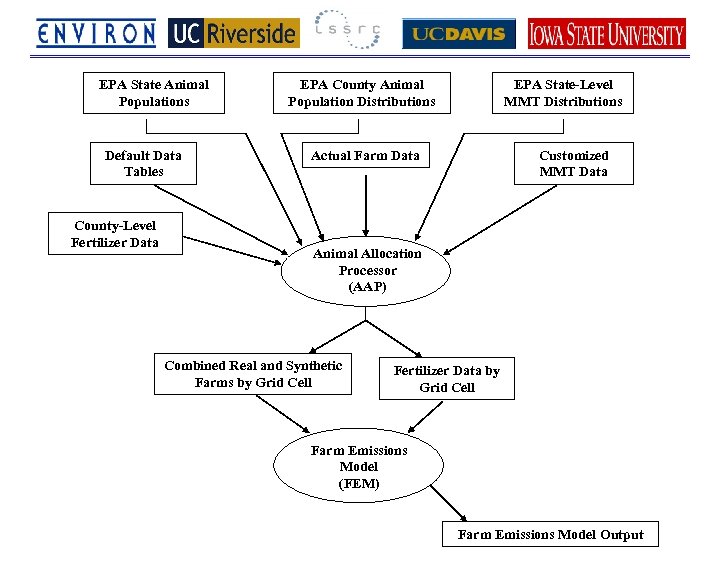
EPA State Animal Populations Default Data Tables County-Level Fertilizer Data EPA County Animal Population Distributions EPA State-Level MMT Distributions Customized MMT Data Actual Farm Data Animal Allocation Processor (AAP) Combined Real and Synthetic Farms by Grid Cell Fertilizer Data by Grid Cell Farm Emissions Model (FEM) Farm Emissions Model Output
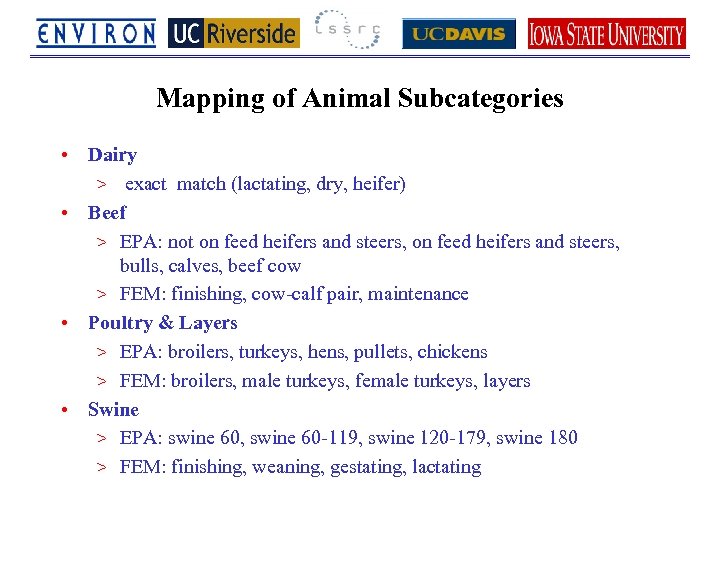
Mapping of Animal Subcategories • • Dairy > exact match (lactating, dry, heifer) Beef > EPA: not on feed heifers and steers, bulls, calves, beef cow > FEM: finishing, cow-calf pair, maintenance Poultry & Layers > EPA: broilers, turkeys, hens, pullets, chickens > FEM: broilers, male turkeys, female turkeys, layers Swine > EPA: swine 60, swine 60 -119, swine 120 -179, swine 180 > FEM: finishing, weaning, gestating, lactating
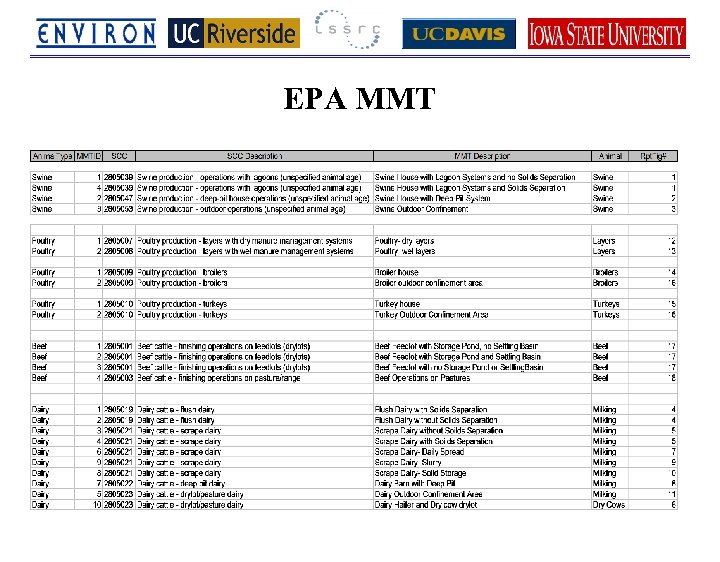
EPA MMT
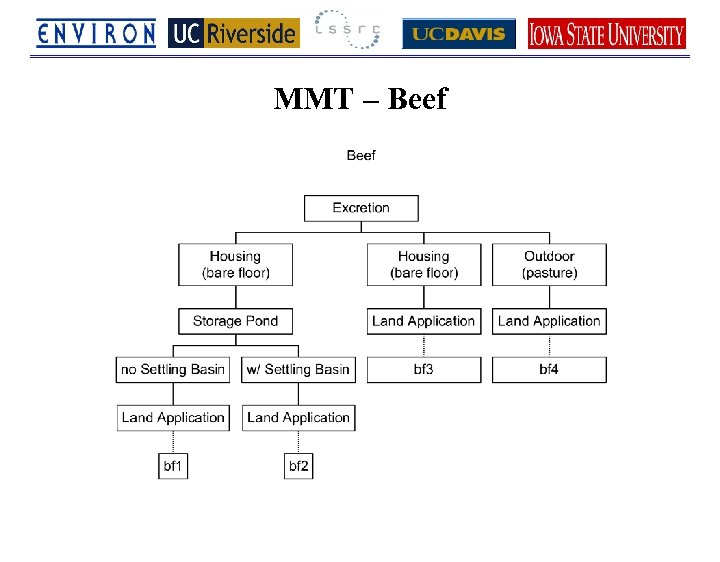
MMT – Beef
Scientific Approach • • • Consider and analyze all physical, chemical and biochemical processes and reactions that take place and influence ammonia emission rate, Employ processed based mechanistic and empirical models (new and existing), Keep mass balances for the flow of nitrogen through each component of an animal waste management system.
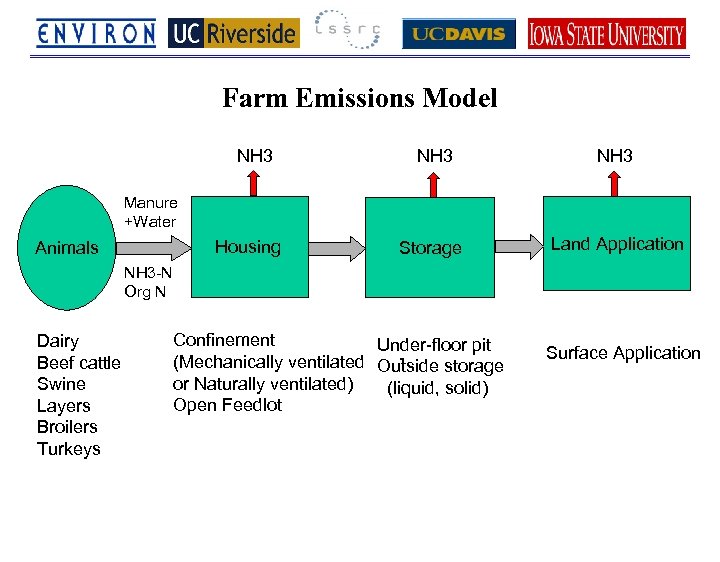
Farm Emissions Model NH 3 Storage Land Application Manure +Water Housing Animals NH 3 -N Org N Dairy Beef cattle Swine Layers Broilers Turkeys Confinement Under-floor pit (Mechanically ventilated Outside storage or Naturally ventilated) (liquid, solid) Open Feedlot Surface Application
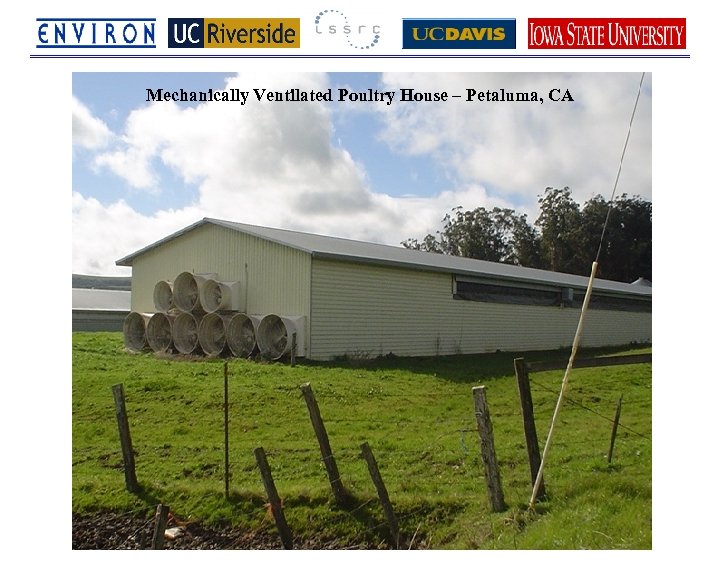
Mechanically Ventilated Poultry House – Petaluma, CA
Considerations for Housing Model Simulate variety of physical systems • Ventilation: mechanical or natural • In-house or outside manure storage • Animal population can vary with time Numerical solutions • Equation solvers available and fast Model parameters • Available from texts or literature
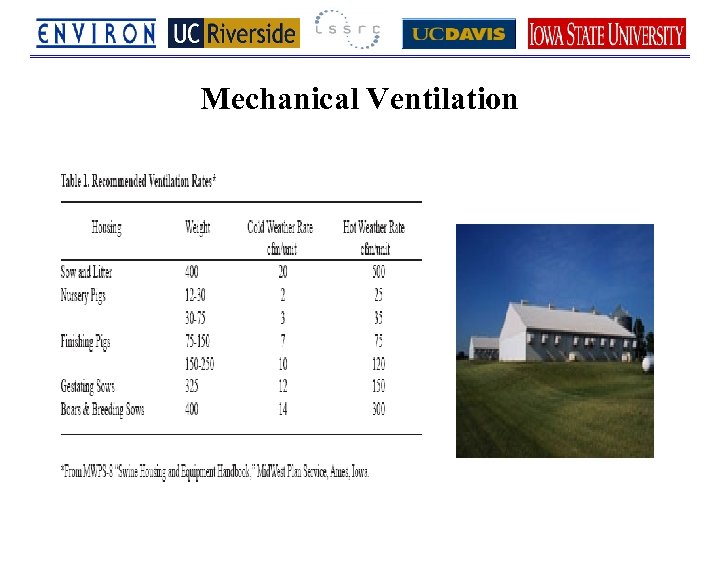
Mechanical Ventilation
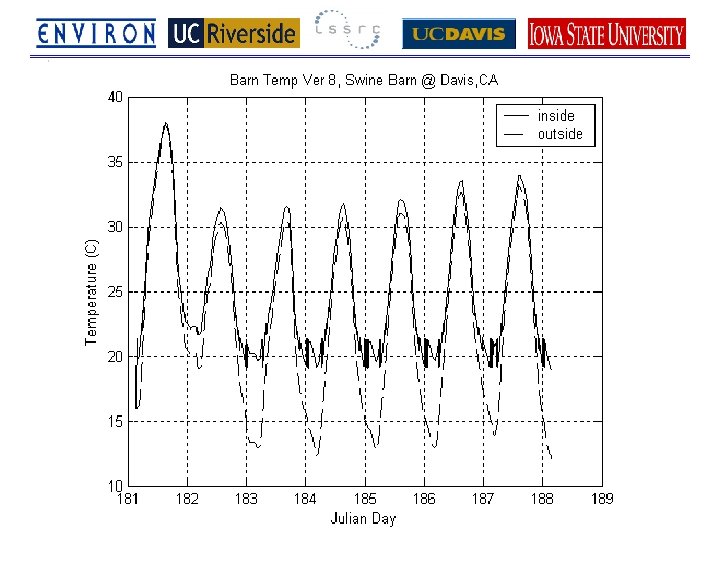
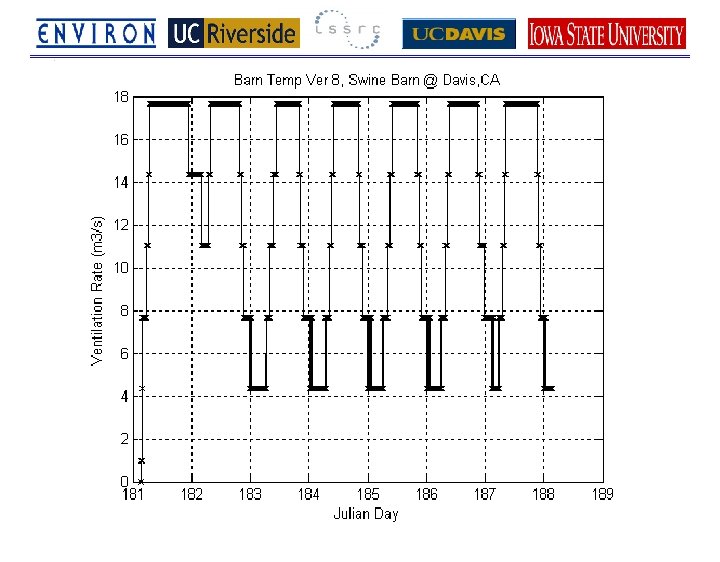
Mechanical Ventilation Model • • Assumes air is well mixed within barn. Calculates ventilation rate as function of time. Calculates indoor air temperature as function of time. Utilizes control scheme similar to those used by the industry.
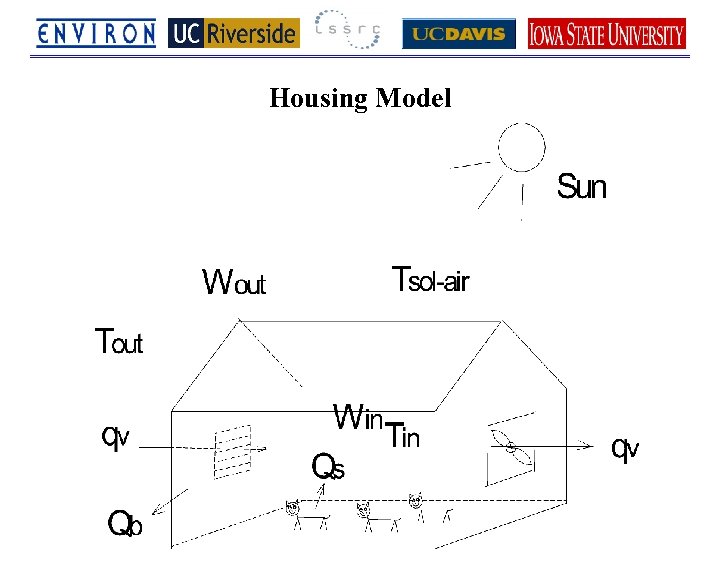
Housing Model
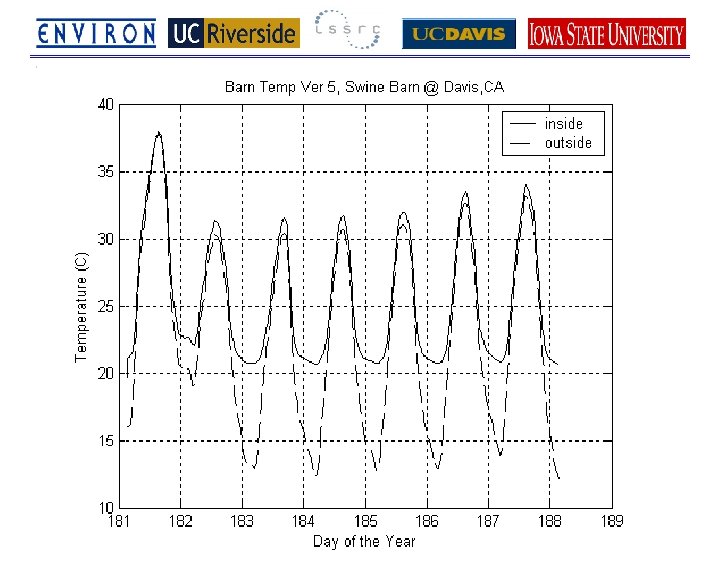
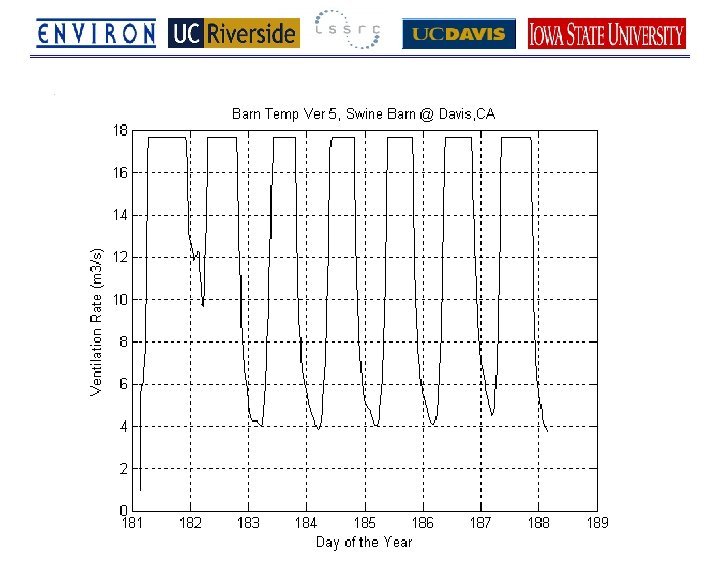
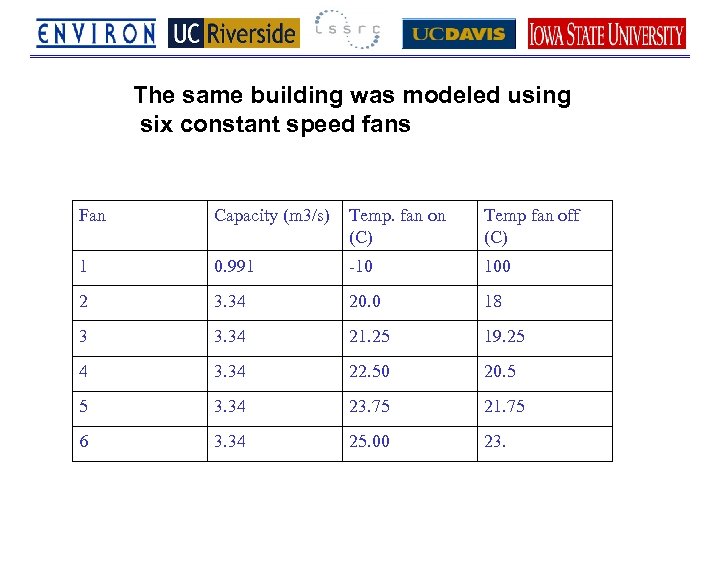
The same building was modeled using six constant speed fans Fan Capacity (m 3/s) Temp. fan on (C) Temp fan off (C) 1 0. 991 -10 100 2 3. 34 20. 0 18 3 3. 34 21. 25 19. 25 4 3. 34 22. 50 20. 5 5 3. 34 23. 75 21. 75 6 3. 34 25. 00 23.
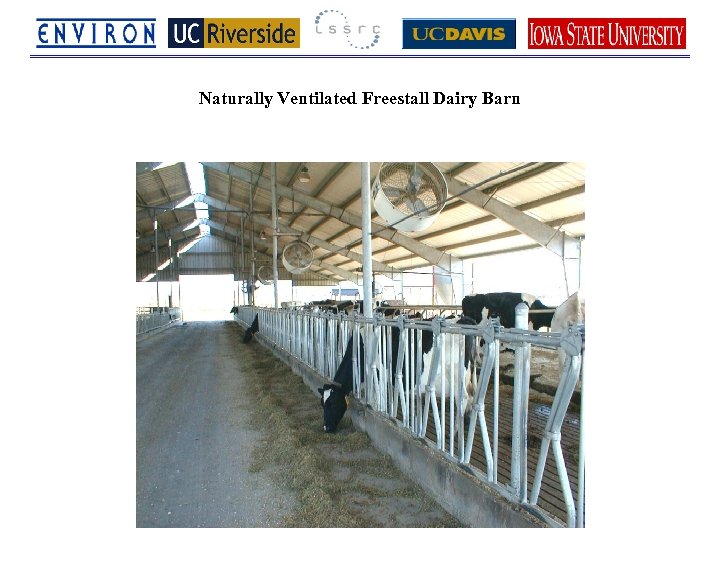
Naturally Ventilated Freestall Dairy Barn
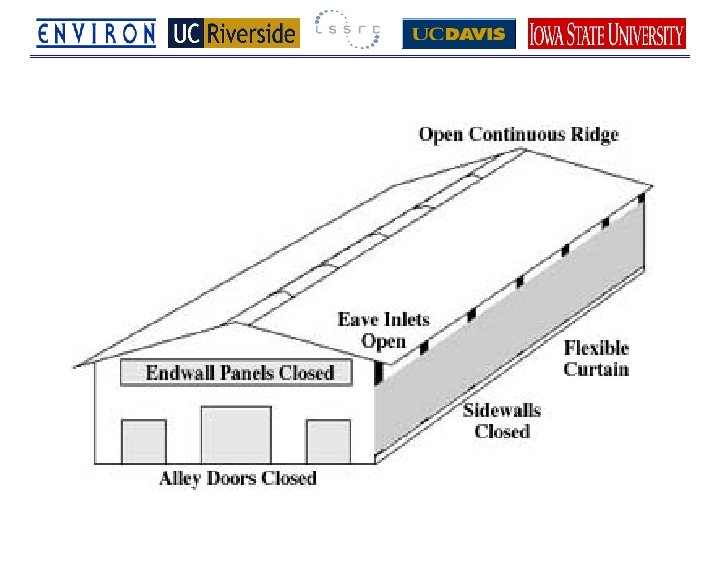
Natural Ventilation Model • Coupled steady state mass and energy balances to determine ventilation rate and indoor air temperature. • Uses hourly ambient air temperature and wind speed/direction as inputs. • Needs most of same building parameters as Mechanical ventilation (U values, animal sensible heat, etc. ).
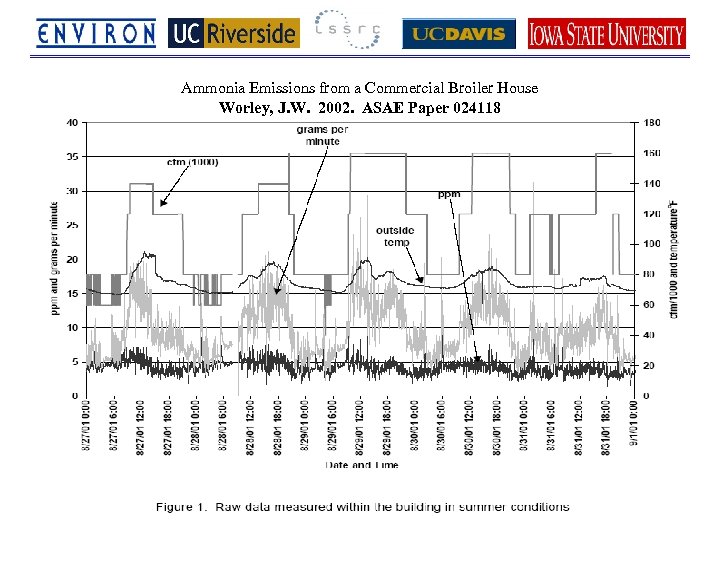
Ammonia Emissions from a Commercial Broiler House Worley, J. W. 2002. ASAE Paper 024118
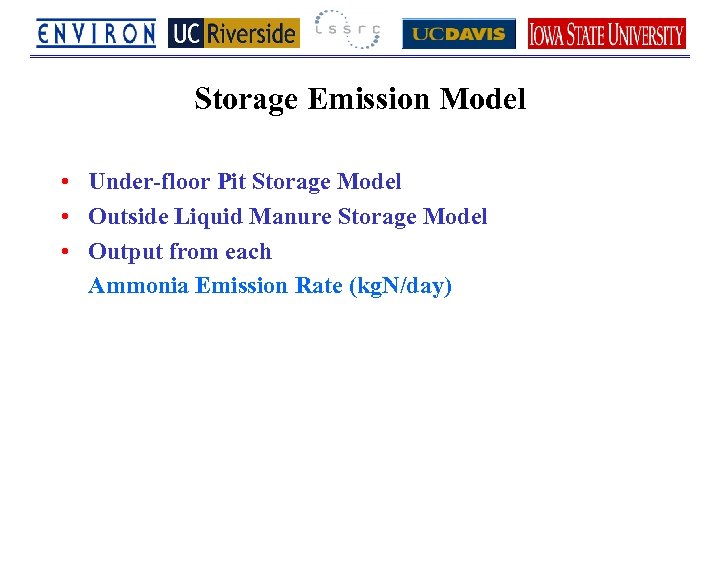
Storage Emission Model • Under-floor Pit Storage Model • Outside Liquid Manure Storage Model • Output from each Ammonia Emission Rate (kg. N/day)
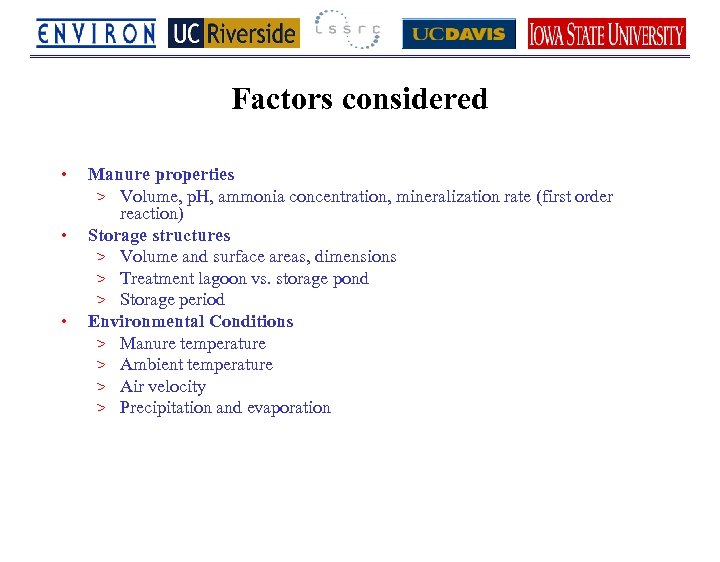
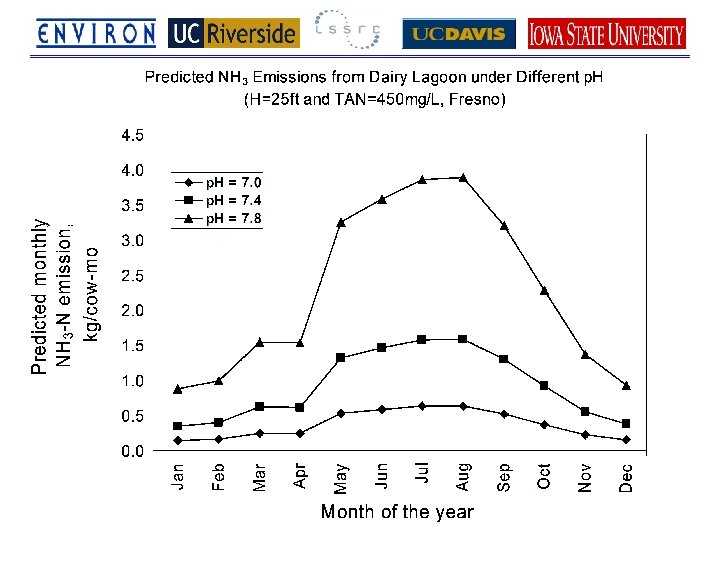
Factors considered • • • Manure properties > Volume, p. H, ammonia concentration, mineralization rate (first order reaction) Storage structures > Volume and surface areas, dimensions > Treatment lagoon vs. storage pond > Storage period Environmental Conditions > Manure temperature > Ambient temperature > Air velocity > Precipitation and evaporation
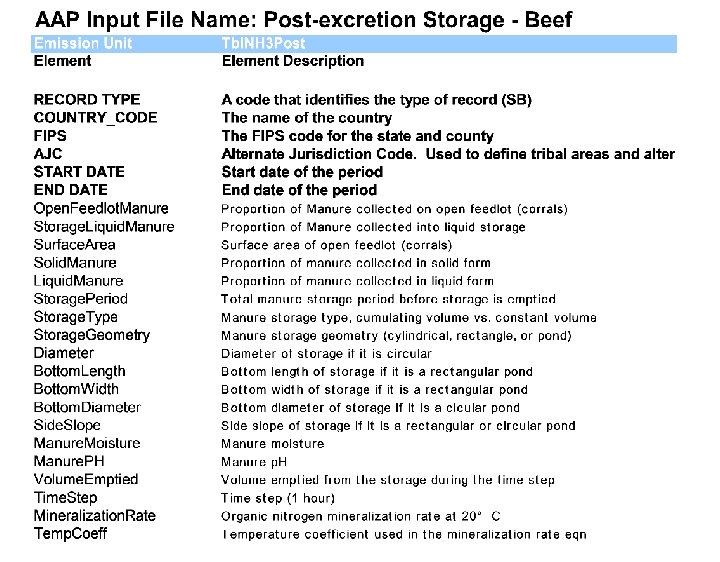
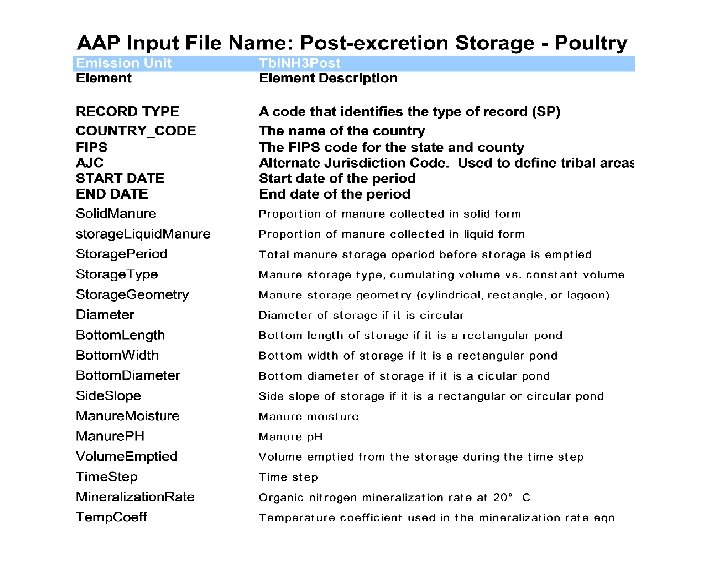
Land Application Emission Model • Surface application model • Output > Ammonia emission rate (kg. N/day)
Factors considered • • • Manure properties > Volume, p. H, ammonia concentration, mineralization rate (first order reaction) Land specifications > Crop type and N uptake rate > Dimensions > Manure application rate and time > Soil type and infiltration rate Environmental Conditions > Soil temperature > Ambient temperature > Air velocity > Precipitation and evaporation
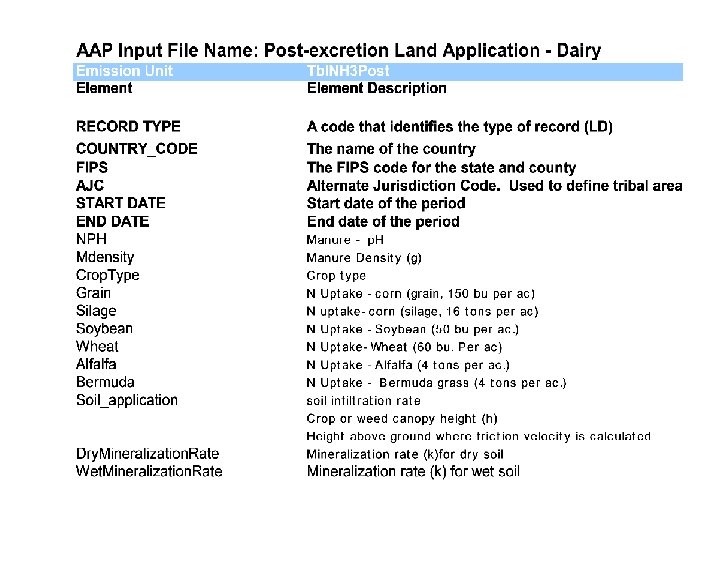
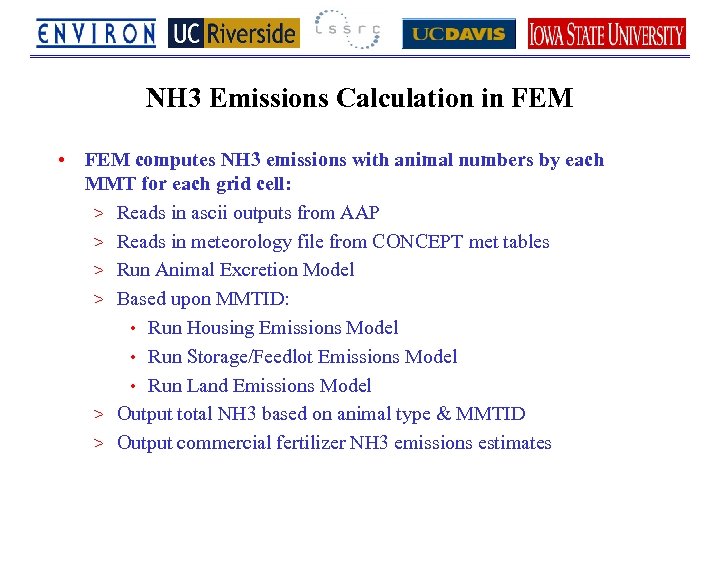
NH 3 Emissions Calculation in FEM • FEM computes NH 3 emissions with animal numbers by each MMT for each grid cell: > Reads in ascii outputs from AAP > Reads in meteorology file from CONCEPT met tables > Run Animal Excretion Model > Based upon MMTID: • Run Housing Emissions Model • Run Storage/Feedlot Emissions Model • Run Land Emissions Model > Output total NH 3 based on animal type & MMTID > Output commercial fertilizer NH 3 emissions estimates
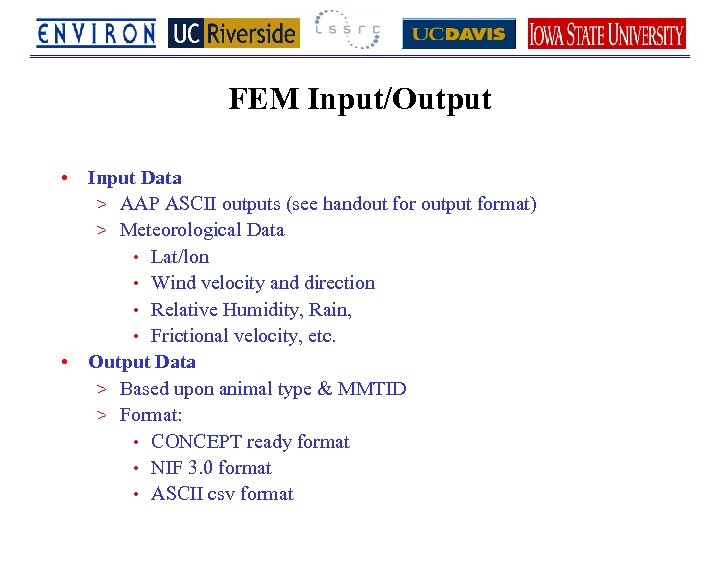
FEM Input/Output • • Input Data > AAP ASCII outputs (see handout for output format) > Meteorological Data • Lat/lon • Wind velocity and direction • Relative Humidity, Rain, • Frictional velocity, etc. Output Data > Based upon animal type & MMTID > Format: • CONCEPT ready format • NIF 3. 0 format • ASCII csv format
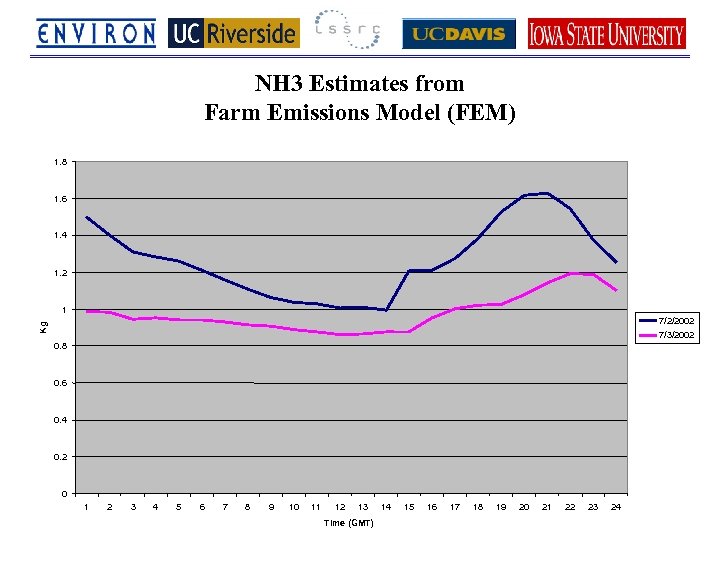
NH 3 Estimates from Farm Emissions Model (FEM) 1. 8 1. 6 1. 4 1. 2 1 Kg 7/2/2002 7/3/2002 0. 8 0. 6 0. 4 0. 2 0 1 2 3 4 5 6 7 8 9 10 11 12 13 Time (GMT) 14 15 16 17 18 19 20 21 22 23 24
Future Direction • More science is needed(Poultry Housing) Improved Science • Validation Work with Measurement Data. > Probems: Most Measurement studies do not collect the important variables. (only money from MWRPO) • Sensitivity analysis: Define the variables that are most influential over reasonable ranges. • Start Outreach and community comments. > Presentation to the AAQTF next week. > Outreach to MWRPO states USDA/State DA
Скачать презентацию Development of the Process Based NH 3 Model
a5124aa6e26e1ef3a87668ea07db0ee2.ppt