


 Скачать презентацию Development of the legal regulation on the territory
8a85502d87be050caeda1332e4de3fb2.ppt
- Количество слайдов: 43
 Development of the legal regulation on the territory of the Czechoslovak Republic in the 20 th century Ewolucja regulacji prawnej w RCZ w 20 wieku JUDr. Pavel Salák jr. , Ph. D.
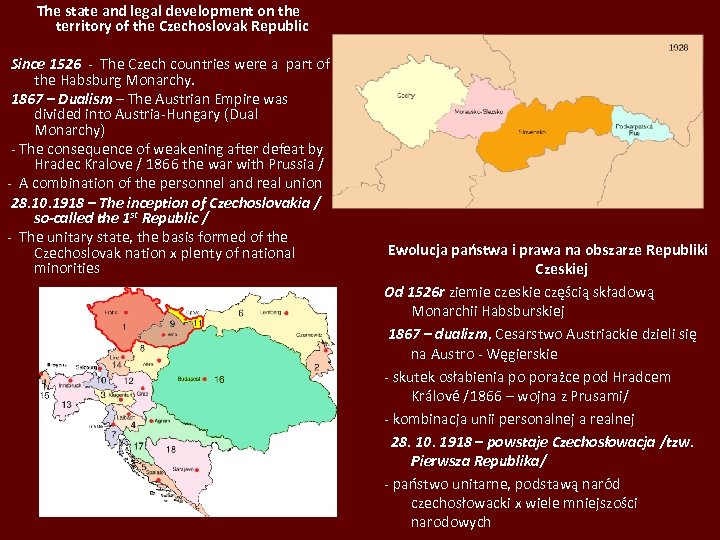 The state and legal development on the territory of the Czechoslovak Republic Since 1526 - The Czech countries were a part of the Habsburg Monarchy. 1867 – Dualism – The Austrian Empire was divided into Austria-Hungary (Dual Monarchy) - The consequence of weakening after defeat by Hradec Kralove / 1866 the war with Prussia / - A combination of the personnel and real union 28. 10. 1918 – The inception of Czechoslovakia / so called the 1 st Republic / - The unitary state, the basis formed of the Czechoslovak nation x plenty of national minorities Ewolucja państwa i prawa na obszarze Republiki Czeskiej Od 1526 r ziemie czeskie częścią składową Monarchii Habsburskiej 1867 – dualizm, Cesarstwo Austriackie dzieli się na Austro - Węgierskie - skutek osłabienia po porażce pod Hradcem Králové /1866 – wojna z Prusami/ - kombinacja unii personalnej a realnej 28. 10. 1918 – powstaje Czechosłowacja /tzw. Pierwsza Republika/ - państwo unitarne, podstawą naród czechosłowacki x wiele mniejszości narodowych
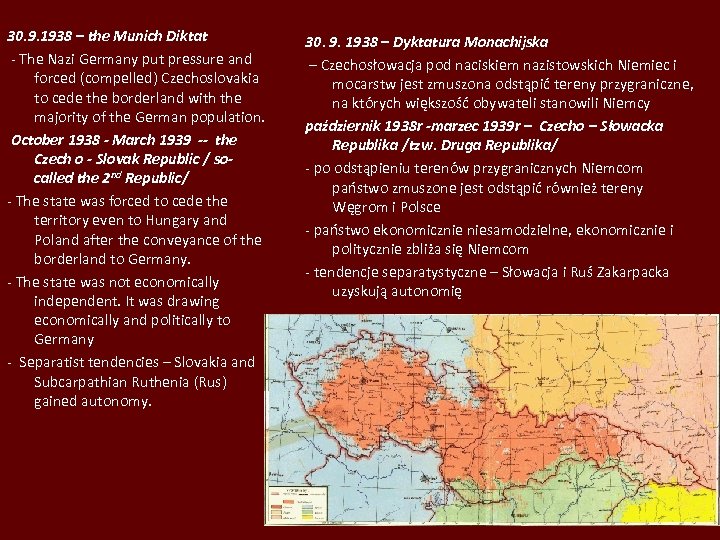 30. 9. 1938 – the Munich Diktat - The Nazi Germany put pressure and forced (compelled) Czechoslovakia to cede the borderland with the majority of the German population. October 1938 March 1939 the Czech o Slovak Republic / so called the 2 nd Republic/ - The state was forced to cede the territory even to Hungary and Poland after the conveyance of the borderland to Germany. - The state was not economically independent. It was drawing economically and politically to Germany - Separatist tendencies – Slovakia and Subcarpathian Ruthenia (Rus) gained autonomy. 30. 9. 1938 – Dyktatura Monachijska – Czechosłowacja pod naciskiem nazistowskich Niemiec i mocarstw jest zmuszona odstąpić tereny przygraniczne, na których większość obywateli stanowili Niemcy październik 1938 r marzec 1939 r – Czecho – Słowacka Republika /tzw. Druga Republika/ - po odstąpieniu terenów przygranicznych Niemcom państwo zmuszone jest odstąpić również tereny Węgrom i Polsce - państwo ekonomicznie niesamodzielne, ekonomicznie i politycznie zbliża się Niemcom - tendencje separatystyczne – Słowacja i Ruś Zakarpacka uzyskują autonomię
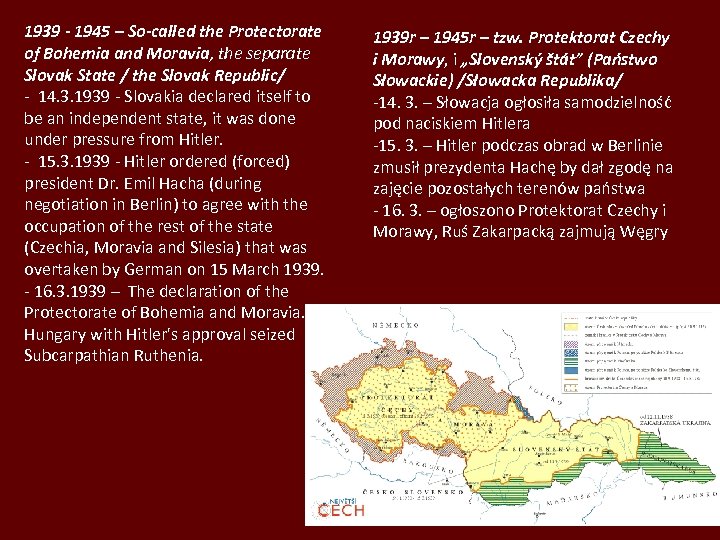 1939 1945 – So called the Protectorate of Bohemia and Moravia, the separate Slovak State / the Slovak Republic/ - 14. 3. 1939 - Slovakia declared itself to be an independent state, it was done under pressure from Hitler. - 15. 3. 1939 - Hitler ordered (forced) president Dr. Emil Hacha (during negotiation in Berlin) to agree with the occupation of the rest of the state (Czechia, Moravia and Silesia) that was overtaken by German on 15 March 1939. - 16. 3. 1939 – The declaration of the Protectorate of Bohemia and Moravia. Hungary with Hitler's approval seized Subcarpathian Ruthenia. 1939 r – 1945 r – tzw. Protektorat Czechy i Morawy, i „Slovenský štát” (Państwo Słowackie) /Słowacka Republika/ -14. 3. – Słowacja ogłosiła samodzielność pod naciskiem Hitlera -15. 3. – Hitler podczas obrad w Berlinie zmusił prezydenta Hachę by dał zgodę na zajęcie pozostałych terenów państwa - 16. 3. – ogłoszono Protektorat Czechy i Morawy, Ruś Zakarpacką zajmują Węgry
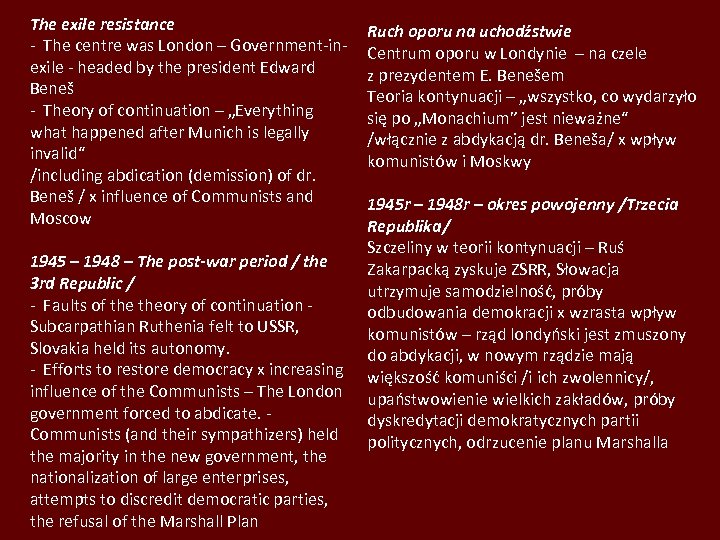 The exile resistance - The centre was London – Government-inexile - headed by the president Edward Beneš - Theory of continuation – „Everything what happened after Munich is legally invalid“ /including abdication (demission) of dr. Beneš / x influence of Communists and Moscow 1945 – 1948 – The post war period / the 3 rd Republic / - Faults of theory of continuation - Subcarpathian Ruthenia felt to USSR, Slovakia held its autonomy. - Efforts to restore democracy x increasing influence of the Communists – The London government forced to abdicate. - Communists (and their sympathizers) held the majority in the new government, the nationalization of large enterprises, attempts to discredit democratic parties, the refusal of the Marshall Plan Ruch oporu na uchodźstwie Centrum oporu w Londynie – na czele z prezydentem E. Benešem Teoria kontynuacji – „wszystko, co wydarzyło się po „Monachium” jest nieważne“ /włącznie z abdykacją dr. Beneša/ x wpływ komunistów i Moskwy 1945 r – 1948 r – okres powojenny /Trzecia Republika/ Szczeliny w teorii kontynuacji – Ruś Zakarpacką zyskuje ZSRR, Słowacja utrzymuje samodzielność, próby odbudowania demokracji x wzrasta wpływ komunistów – rząd londyński jest zmuszony do abdykacji, w nowym rządzie mają większość komuniści /i ich zwolennicy/, upaństwowienie wielkich zakładów, próby dyskredytacji demokratycznych partii politycznych, odrzucenie planu Marshalla
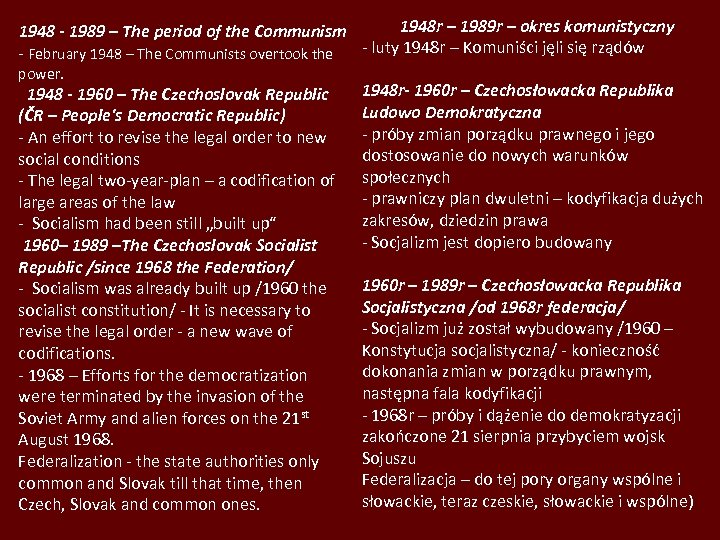 1948 r – 1989 r – okres komunistyczny 1948 1989 – The period of the Communism - February 1948 – The Communists overtook the - luty 1948 r – Komuniści jęli się rządów power. 1948 r 1960 r – Czechosłowacka Republika 1948 1960 – The Czechoslovak Republic Ludowo Demokratyczna (ČR – People's Democratic Republic) - próby zmian porządku prawnego i jego - An effort to revise the legal order to new dostosowanie do nowych warunków social conditions - The legal two-year-plan – a codification of społecznych - prawniczy plan dwuletni – kodyfikacja dużych large areas of the law zakresów, dziedzin prawa - Socialism had been still „built up“ - Socjalizm jest dopiero budowany 1960– 1989 –The Czechoslovak Socialist Republic /since 1968 the Federation/ 1960 r – 1989 r – Czechosłowacka Republika - Socialism was already built up /1960 the Socjalistyczna /od 1968 r federacja/ socialist constitution/ - It is necessary to - Socjalizm już został wybudowany /1960 – revise the legal order - a new wave of Konstytucja socjalistyczna/ - konieczność codifications. dokonania zmian w porządku prawnym, - 1968 – Efforts for the democratization następna fala kodyfikacji were terminated by the invasion of the - 1968 r – próby i dążenie do demokratyzacji Soviet Army and alien forces on the 21 st zakończone 21 sierpnia przybyciem wojsk August 1968. Sojuszu Federalization - the state authorities only Federalizacja – do tej pory organy wspólne i common and Slovak till that time, then słowackie, teraz czeskie, słowackie i wspólne) Czech, Slovak and common ones.
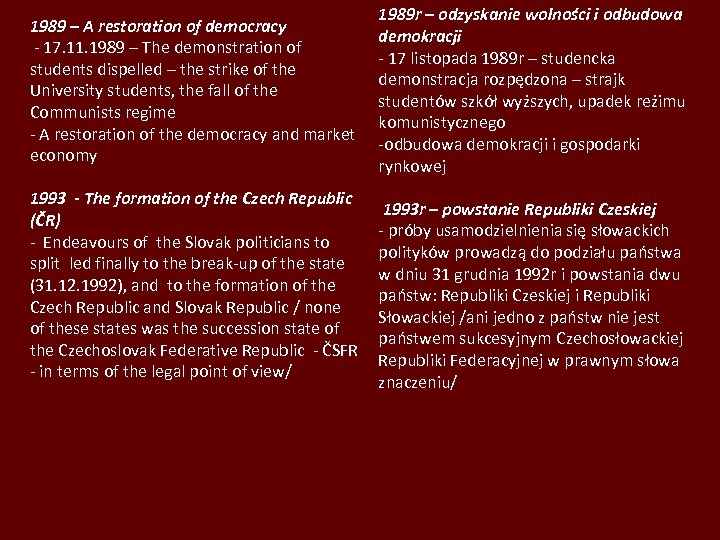 1989 – A restoration of democracy - 17. 11. 1989 – The demonstration of students dispelled – the strike of the University students, the fall of the Communists regime - A restoration of the democracy and market economy 1993 The formation of the Czech Republic (ČR) - Endeavours of the Slovak politicians to split led finally to the break-up of the state (31. 12. 1992), and to the formation of the Czech Republic and Slovak Republic / none of these states was the succession state of the Czechoslovak Federative Republic - ČSFR - in terms of the legal point of view/ 1989 r – odzyskanie wolności i odbudowa demokracji - 17 listopada 1989 r – studencka demonstracja rozpędzona – strajk studentów szkół wyższych, upadek reżimu komunistycznego -odbudowa demokracji i gospodarki rynkowej 1993 r – powstanie Republiki Czeskiej - próby usamodzielnienia się słowackich polityków prowadzą do podziału państwa w dniu 31 grudnia 1992 r i powstania dwu państw: Republiki Czeskiej i Republiki Słowackiej /ani jedno z państw nie jest państwem sukcesyjnym Czechosłowackiej Republiki Federacyjnej w prawnym słowa znaczeniu/
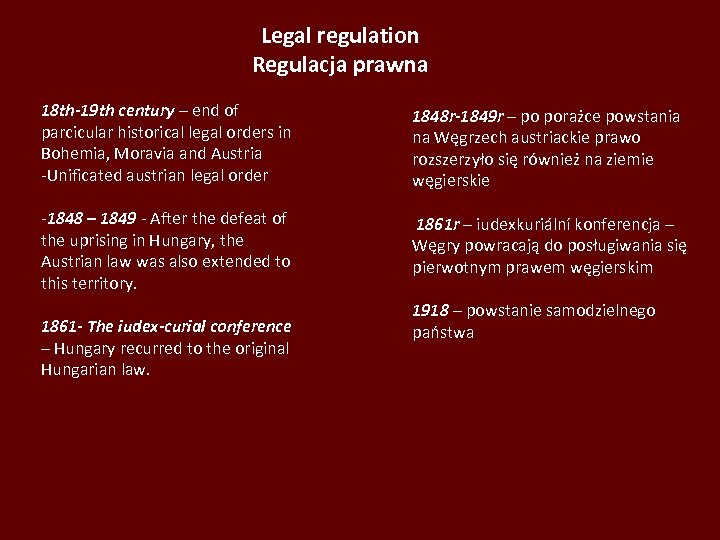 Legal regulation Regulacja prawna 18 th 19 th century – end of parcicular historical legal orders in Bohemia, Moravia and Austria -Unificated austrian legal order 1848 r 1849 r – po porażce powstania na Węgrzech austriackie prawo rozszerzyło się również na ziemie węgierskie -1848 – 1849 - After the defeat of the uprising in Hungary, the Austrian law was also extended to this territory. 1861 r – iudexkuriální konferencja – Węgry powracają do posługiwania się pierwotnym prawem węgierskim 1918 – powstanie samodzielnego państwa 1861 The iudex curial conference – Hungary recurred to the original Hungarian law.
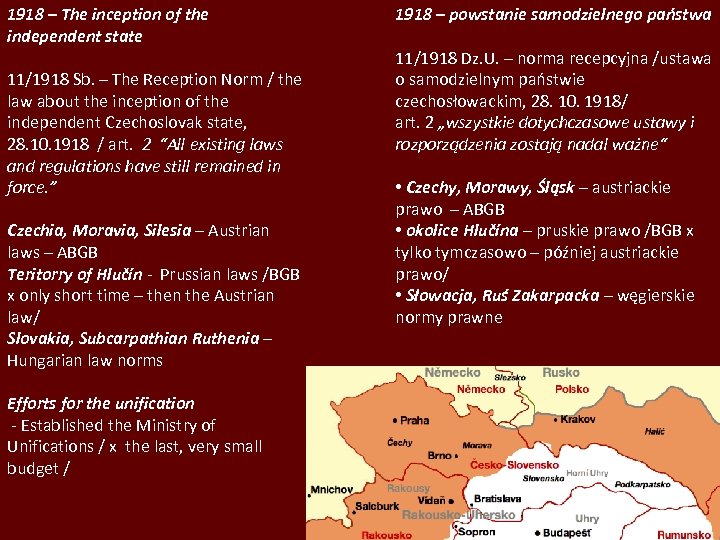 1918 – The inception of the independent state 11/1918 Sb. – The Reception Norm / the law about the inception of the independent Czechoslovak state, 28. 10. 1918 / art. 2 “All existing laws and regulations have still remained in force. ” Czechia, Moravia, Silesia – Austrian laws – ABGB Teritorry of Hlučín - Prussian laws /BGB x only short time – then the Austrian law/ Slovakia, Subcarpathian Ruthenia – Hungarian law norms Efforts for the unification - Established the Ministry of Unifications / x the last, very small budget / 1918 – powstanie samodzielnego państwa 11/1918 Dz. U. – norma recepcyjna /ustawa o samodzielnym państwie czechosłowackim, 28. 10. 1918/ art. 2 „wszystkie dotychczasowe ustawy i rozporządzenia zostają nadal ważne“ • Czechy, Morawy, Śląsk – austriackie prawo – ABGB • okolice Hlučína – pruskie prawo /BGB x tylko tymczasowo – później austriackie prawo/ • Słowacja, Ruś Zakarpacka – węgierskie normy prawne
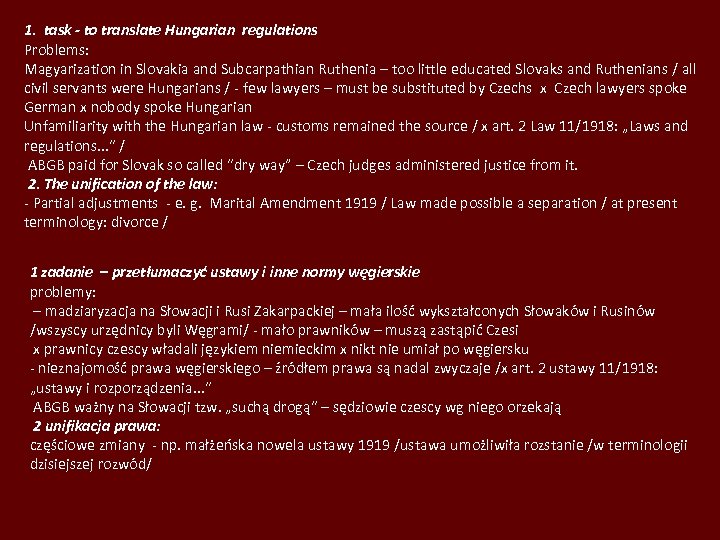 1. task to translate Hungarian regulations Problems: Magyarization in Slovakia and Subcarpathian Ruthenia – too little educated Slovaks and Ruthenians / all civil servants were Hungarians / - few lawyers – must be substituted by Czechs x Czech lawyers spoke German x nobody spoke Hungarian Unfamiliarity with the Hungarian law - customs remained the source / x art. 2 Law 11/1918: „Laws and regulations. . . “ / ABGB paid for Slovak so called “dry way” – Czech judges administered justice from it. 2. The unification of the law: - Partial adjustments - e. g. Marital Amendment 1919 / Law made possible a separation / at present terminology: divorce / 1 zadanie – przetłumaczyć ustawy i inne normy węgierskie problemy: – madziaryzacja na Słowacji i Rusi Zakarpackiej – mała ilość wykształconych Słowaków i Rusinów /wszyscy urzędnicy byli Węgrami/ - mało prawników – muszą zastąpić Czesi x prawnicy czescy władali językiem niemieckim x nikt nie umiał po węgiersku - nieznajomość prawa węgierskiego – źródłem prawa są nadal zwyczaje /x art. 2 ustawy 11/1918: „ustawy i rozporządzenia. . . “ ABGB ważny na Słowacji tzw. „suchą drogą“ – sędziowie czescy wg niego orzekają 2 unifikacja prawa: częściowe zmiany - np. małżeńska nowela ustawy 1919 /ustawa umożliwiła rozstanie /w terminologii dzisiejszej rozwód/
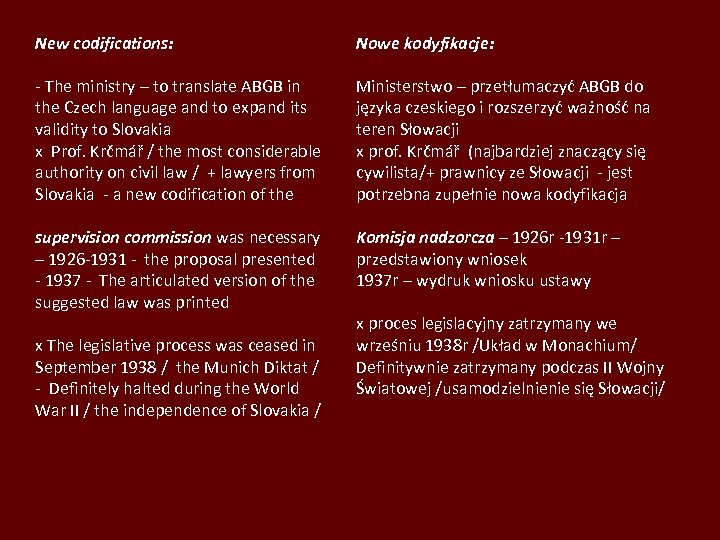 New codifications: Nowe kodyfikacje: - The ministry – to translate ABGB in the Czech language and to expand its validity to Slovakia x Prof. Krčmář / the most considerable authority on civil law / + lawyers from Slovakia - a new codification of the Ministerstwo – przetłumaczyć ABGB do języka czeskiego i rozszerzyć ważność na teren Słowacji x prof. Krčmář (najbardziej znaczący się cywilista/+ prawnicy ze Słowacji - jest potrzebna zupełnie nowa kodyfikacja supervision commission was necessary – 1926 -1931 - the proposal presented - 1937 - The articulated version of the suggested law was printed Komisja nadzorcza – 1926 r -1931 r – przedstawiony wniosek 1937 r – wydruk wniosku ustawy x The legislative process was ceased in September 1938 / the Munich Diktat / - Definitely halted during the World War II / the independence of Slovakia / x proces legislacyjny zatrzymany we wrześniu 1938 r /Układ w Monachium/ Definitywnie zatrzymany podczas II Wojny Światowej /usamodzielnienie się Słowacji/
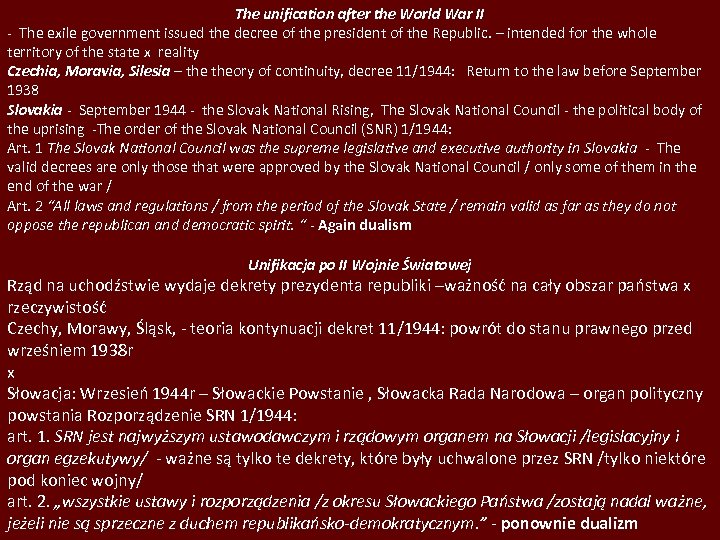 The unification after the World War II - The exile government issued the decree of the president of the Republic. – intended for the whole territory of the state x reality Czechia, Moravia, Silesia – theory of continuity, decree 11/1944: Return to the law before September 1938 Slovakia - September 1944 - the Slovak National Rising, The Slovak National Council - the political body of the uprising -The order of the Slovak National Council (SNR) 1/1944: Art. 1 The Slovak National Council was the supreme legislative and executive authority in Slovakia - The valid decrees are only those that were approved by the Slovak National Council / only some of them in the end of the war / Art. 2 “All laws and regulations / from the period of the Slovak State / remain valid as far as they do not oppose the republican and democratic spirit. “ - Again dualism Unifikacja po II Wojnie Światowej Rząd na uchodźstwie wydaje dekrety prezydenta republiki –ważność na cały obszar państwa x rzeczywistość Czechy, Morawy, Śląsk, - teoria kontynuacji dekret 11/1944: powrót do stanu prawnego przed wrześniem 1938 r x Słowacja: Wrzesień 1944 r – Słowackie Powstanie , Słowacka Rada Narodowa – organ polityczny powstania Rozporządzenie SRN 1/1944: art. 1. SRN jest najwyższym ustawodawczym i rządowym organem na Słowacji /legislacyjny i organ egzekutywy/ - ważne są tylko te dekrety, które były uchwalone przez SRN /tylko niektóre pod koniec wojny/ art. 2. „wszystkie ustawy i rozporządzenia /z okresu Słowackiego Państwa /zostają nadal ważne, jeżeli nie są sprzeczne z duchem republikańsko-demokratycznym. ” - ponownie dualizm
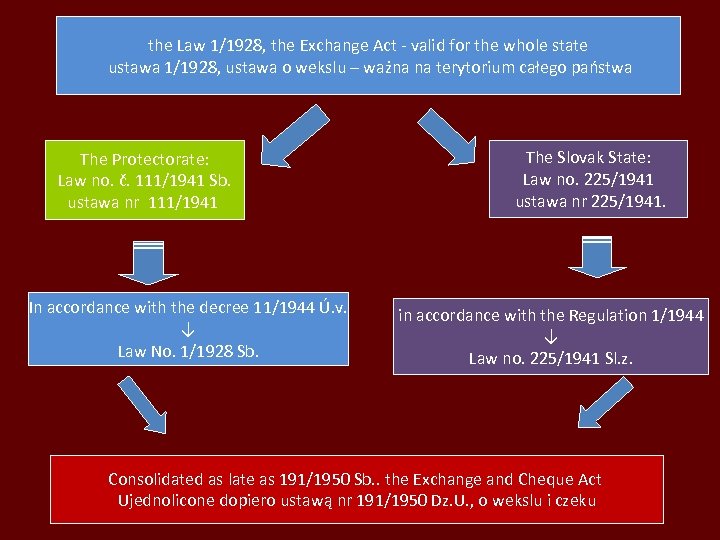 the Law 1/1928, the Exchange Act - valid for the whole state ustawa 1/1928, ustawa o wekslu – ważna na terytorium całego państwa The Protectorate: Law no. č. 111/1941 Sb. ustawa nr 111/1941 In accordance with the decree 11/1944 Ú. v. ↓ Law No. 1/1928 Sb. The Slovak State: Law no. 225/1941 ustawa nr 225/1941. in accordance with the Regulation 1/1944 ↓ Law no. 225/1941 Sl. z. Consolidated as late as 191/1950 Sb. . the Exchange and Cheque Act Ujednolicone dopiero ustawą nr 191/1950 Dz. U. , o wekslu i czeku
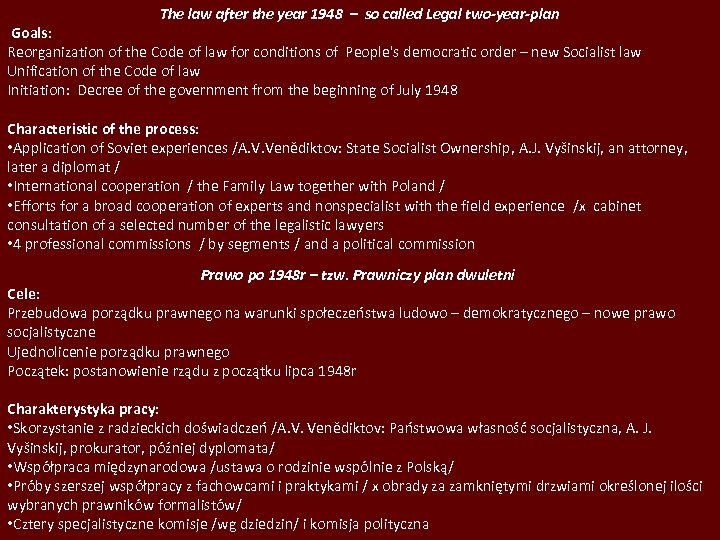 The law after the year 1948 – so called Legal two year plan Goals: Reorganization of the Code of law for conditions of People's democratic order – new Socialist law Unification of the Code of law Initiation: Decree of the government from the beginning of July 1948 Characteristic of the process: • Application of Soviet experiences /A. V. Venědiktov: State Socialist Ownership, A. J. Vyšinskij, an attorney, later a diplomat / • International cooperation / the Family Law together with Poland / • Efforts for a broad cooperation of experts and nonspecialist with the field experience /x cabinet consultation of a selected number of the legalistic lawyers • 4 professional commissions / by segments / and a political commission Prawo po 1948 r – tzw. Prawniczy plan dwuletni Cele: Przebudowa porządku prawnego na warunki społeczeństwa ludowo – demokratycznego – nowe prawo socjalistyczne Ujednolicenie porządku prawnego Początek: postanowienie rządu z początku lipca 1948 r Charakterystyka pracy: • Skorzystanie z radzieckich doświadczeń /A. V. Venědiktov: Państwowa własność socjalistyczna, A. J. Vyšinskij, prokurator, później dyplomata/ • Współpraca międzynarodowa /ustawa o rodzinie wspólnie z Polską/ • Próby szerszej współpracy z fachowcami i praktykami / x obrady za zamkniętymi drzwiami określonej ilości wybranych prawników formalistów/ • Cztery specjalistyczne komisje /wg dziedzin/ i komisja polityczna
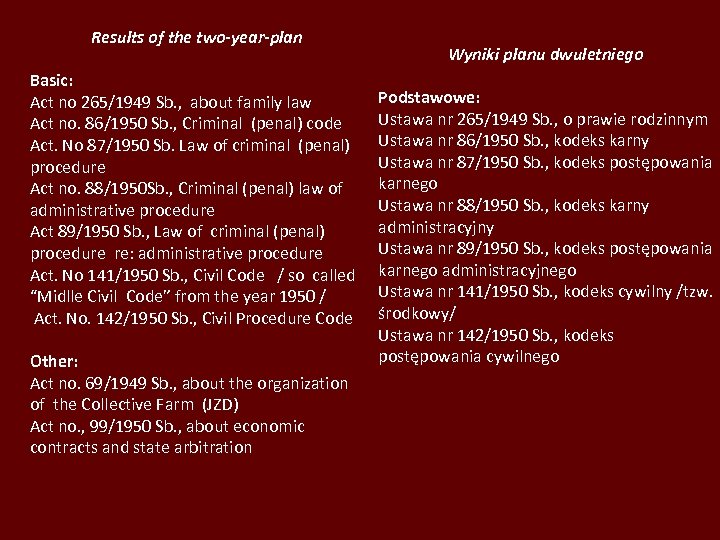 Results of the two year plan Basic: Act no 265/1949 Sb. , about family law Act no. 86/1950 Sb. , Criminal (penal) code Act. No 87/1950 Sb. Law of criminal (penal) procedure Act no. 88/1950 Sb. , Criminal (penal) law of administrative procedure Act 89/1950 Sb. , Law of criminal (penal) procedure re: administrative procedure Act. No 141/1950 Sb. , Civil Code / so called “Midlle Civil Code” from the year 1950 / Act. No. 142/1950 Sb. , Civil Procedure Code Other: Act no. 69/1949 Sb. , about the organization of the Collective Farm (JZD) Act no. , 99/1950 Sb. , about economic contracts and state arbitration Wyniki planu dwuletniego Podstawowe: Ustawa nr 265/1949 Sb. , o prawie rodzinnym Ustawa nr 86/1950 Sb. , kodeks karny Ustawa nr 87/1950 Sb. , kodeks postępowania karnego Ustawa nr 88/1950 Sb. , kodeks karny administracyjny Ustawa nr 89/1950 Sb. , kodeks postępowania karnego administracyjnego Ustawa nr 141/1950 Sb. , kodeks cywilny /tzw. środkowy/ Ustawa nr 142/1950 Sb. , kodeks postępowania cywilnego
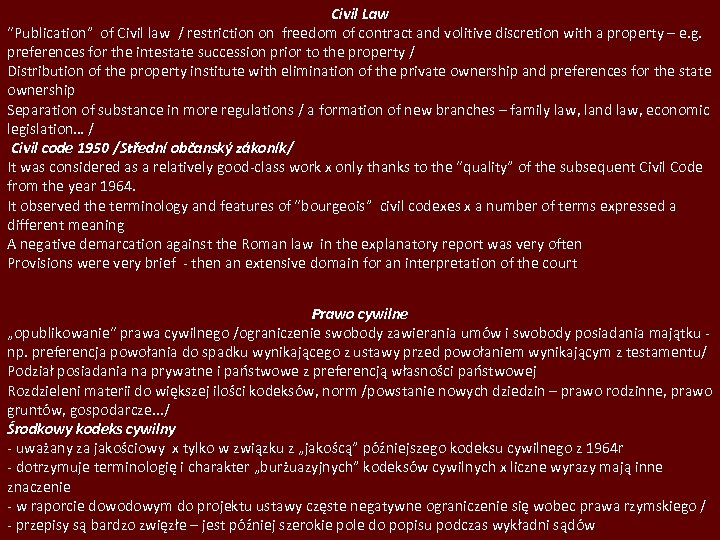 Civil Law “Publication” of Civil law / restriction on freedom of contract and volitive discretion with a property – e. g. preferences for the intestate succession prior to the property / Distribution of the property institute with elimination of the private ownership and preferences for the state ownership Separation of substance in more regulations / a formation of new branches – family law, land law, economic legislation… / Civil code 1950 /Střední občanský zákoník/ It was considered as a relatively good-class work x only thanks to the “quality” of the subsequent Civil Code from the year 1964. It observed the terminology and features of “bourgeois” civil codexes x a number of terms expressed a different meaning A negative demarcation against the Roman law in the explanatory report was very often Provisions were very brief - then an extensive domain for an interpretation of the court Prawo cywilne „opublikowanie“ prawa cywilnego /ograniczenie swobody zawierania umów i swobody posiadania majątku - np. preferencja powołania do spadku wynikającego z ustawy przed powołaniem wynikającym z testamentu/ Podział posiadania na prywatne i państwowe z preferencją własności państwowej Rozdzieleni materii do większej ilości kodeksów, norm /powstanie nowych dziedzin – prawo rodzinne, prawo gruntów, gospodarcze. . . / Środkowy kodeks cywilny - uważany za jakościowy x tylko w związku z „jakoścą” późniejszego kodeksu cywilnego z 1964 r - dotrzymuje terminologię i charakter „burżuazyjnych” kodeksów cywilnych x liczne wyrazy mają inne znaczenie - w raporcie dowodowym do projektu ustawy częste negatywne ograniczenie się wobec prawa rzymskiego / - przepisy są bardzo zwięzłe – jest później szerokie pole do popisu podczas wykładni sądów
 Legal Regulations after the year 1960 - The new Constitution from the year 1960 - Socialism had been already established – laws had to correspond to it New laws - 1960 -1965: Criminal (penal) regulations 140 and 141/1961 – Criminal code and Law of criminal procedure Family law 95/1963 Civil law 40/1964 - Civil code 65/1965 – Labour code Improvement – Criminal law, Labour law / It is possible a letter of resignation / Impairment – Civil law, Family law – major restriction in freedom of contract, increase of cogency Nowa konstytucja z 1960 r - Socjalizm jest już wybudowany – ustawy muszą temu odpowiadać Nowe ustawy – 1960 r 1965 r: • Kodeksy karne 140 a 141/1961 – kodeks karny i kodeks postępowania karnego • Prawo rodzinne 95/1963 • Prawo cywilne 40/1964 - kodeks cywilny • 65/1965 – kodeks pracy Poprawa – prawo karne, prawo pracy, /możliwość wypowiedzenia przez pracownika/ Pogorszenie – prawo cywilne, rodzinne – jeszcze większe ograniczenie wolności podmiotów prawnych, więcej kogentnych norm
 Civil Code from the year 1964 - It overtook with its character even the exemplary Soviet Civil Code - An absolute preference of the collective ownership /it did not manage to abolish a private ownership x Its modification was put aside from the rights in rem into the final provision. - The institute of possession (demesne) and usucaption was removed / bourgeois anachronism/ x The novel from 1982 introduced again due to the insistence of lawyers from field experience. Kodeks cywilny z 1964 r Swym socjalistycznym charakterem wyprzedził nawet i wzorowy radziecki kodeks cywilny Absolutna preferencja własności kolektywnej / własność prywatną nie udało się usunąć x jej regulacja jest przesunięta z części, w której są przepisy dotyczące praw rzeczowych, do postanowień końcowych/ Zniknęła dzierżawa a i zasiedzenie /przeżytek burżuazyjny/ x nowela z 1982 r znowu wprowadziła pod naciskiem prawników praktyków
 Correspondences and differences of Roman law and czechoslowak civil codes I. ABGB, Proposition 1937 Characteristics of the Law of Succession – cumulation of property, testator’s will preferred, fundamental institutes of the law of succession: testament, legacy, etc. X The law of succession has only proprietary features, new ground for succession – pact of succession, combination of grounds for succession possible /the principle Nemo pro parte testatus, pro parte intestatus decedere potest abandoned/, autonomy of testator’s will preferred /no Falcidian Portion concerning legacies/
 Correspondences and differences of Roman law and czechoslowak civil codes II. Act No 141/1950 Coll. Middle Civil Code Two grounds for succession /intestate and testamentary succession/, legacy, falcidian portion vs. in adversary position /legacies can not represent more than. ¼ of the decedent’s estate/, substitution of heir possible X preference of family relationship – the law of succession is in the legal regulation separated from real rights and placed behind the law of obligation, preference of intestate sucession over the testamentary one, no privileged testaments, no possibility of condictions in testament /apart from collation and creating a servitude/, position of forced heirs strenghtened Act No. 40/1964 Coll. Two grounds for succession – intestate and testamentary succession, posibility of collation X legacy and substitution of heir are no more possible, testament is de facto not binding – the treaty of all heirs is essential for the probate proceedings, even more formal /date required for validity of testament/
 Civil code 1950 – Act No. 141/1950 Coll. § 550 : Condition, restricting appointmet of an heir is void. Testamentary provision, stating that the heir shall acquire the decedent’s estate only temporarily or later than at the day of the testator’s death, as well as testamentary provision about person on whom the decedent’s estate shall pass after the death of the heir… is void. Civil Code 1964 Act. No. 40/1964 Coll. § 478: „Any condition attached to the testament have no legal consequences; it does not apply to the provision of § 484 sec. 1 sentence 2. “ (collation)
 After the year 1989 New codification of civil law was stopped, the priority was the codification of the comercial law Civil code 1964 was radically novelizated (act No. 509/1991 Coll. ) x but there are many relicts of the comunism New civil code New code was prepared by prof. Eliáš and published as act No. 89/2012 Coll. /end of march 2012/ Inspiration in: ABGB, Osnova 1937, BGB, ZGB, Code civil de Quebec Negativ of this act – many institutes no more known in czech law and not so necessary /e. g. About the bees/ x new czech terms /e. g. for email/, to many paragrafs /about 2000/
 The Principle „Superficies Solo Cedit“ in the Roman Law and in the Czechoslovak Law of the 20 th century „Superficies solo cedit” w prawie rzymskim i w czechosłowackim prawie 20 wieku Movables x immovables Rzeczy ruchome x nieruchome Lex XII Tabullarum – simply land /fundus/ and other things /cetera res/ “mobilia” - from Gaius Immovable (real property) – definitely from Justinian Inst. 2, 6, pr. „…si mobilis erat, anno ubique, si immobilis, bienno tantum…“ Nieruchomość – termin pochodzi od Justyniana / I 2, 6 pr. / – do tej pory tylko grunt /fundus/ i inne przedmioty /cetera res/, od Gaiusa termin „mobilia“
 The principle superficies solo cedit „. . . id, qoud in solo nostro ab aliquo aedificatus est, quamvis ille suo nomine aedificaverit, iure naturali nostrum fit, quia superficies solo cedit. “ /Gai 2, 73/, „Semper superficiem solo cedere. “ /Ulp. , D 43, 17, 3, 7/ Its meaning – it simplifies legal relations /conveyances of real estate/ + increases legal peace /namely in the absence or low quality of real estate records/ Zasada superficies solo cedit „. . . id, qoud in solo nostro ab aliquo aedificatus est, quamvis ille suo nomine aedificaverit, iure naturali nostrum fit, quia superficies solo cedit. “ /Gai 2, 73/ „Semper superficiem solo cedere. “ /Ulp. , D 43, 17, 3, 7/ jej znaczenie – upraszcza stosunki prawne /transfery nieruchomości/ + podwyższa się pewność prawna /przede wszystkim podczas absencji lub w przypadku niskiego poziomu ewidencji nieruchomości/
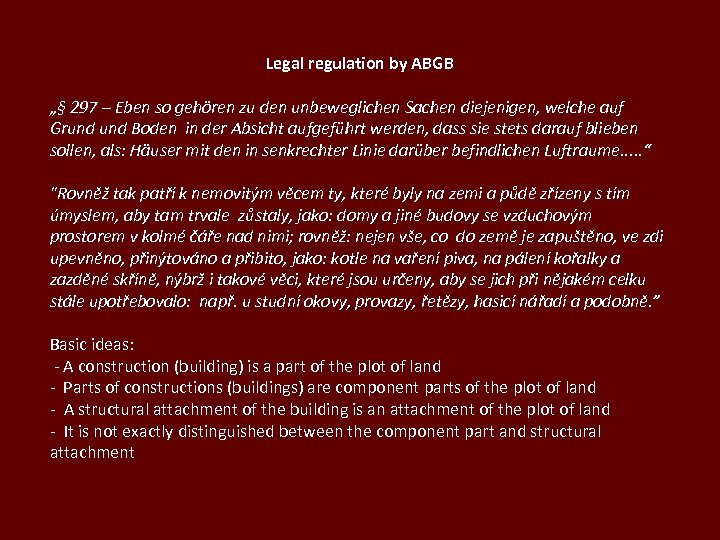 Legal regulation by ABGB „§ 297 – Eben so gehören zu den unbeweglichen Sachen diejenigen, welche auf Grund Boden in der Absicht aufgeführt werden, dass sie stets darauf blieben sollen, als: Häuser mit den in senkrechter Linie darüber befindlichen Luftraume. . . “ "Rovněž tak patří k nemovitým věcem ty, které byly na zemi a půdě zřízeny s tím úmyslem, aby tam trvale zůstaly, jako: domy a jiné budovy se vzduchovým prostorem v kolmé čáře nad nimi; rovněž: nejen vše, co do země je zapuštěno, ve zdi upevněno, přinýtováno a přibito, jako: kotle na vaření piva, na pálení kořalky a zazděné skříně, nýbrž i takové věci, které jsou určeny, aby se jich při nějakém celku stále upotřebovalo: např. u studní okovy, provazy, řetězy, hasicí nářadí a podobně. ” Basic ideas: - A construction (building) is a part of the plot of land - Parts of constructions (buildings) are component parts of the plot of land - A structural attachment of the building is an attachment of the plot of land - It is not exactly distinguished between the component part and structural attachment
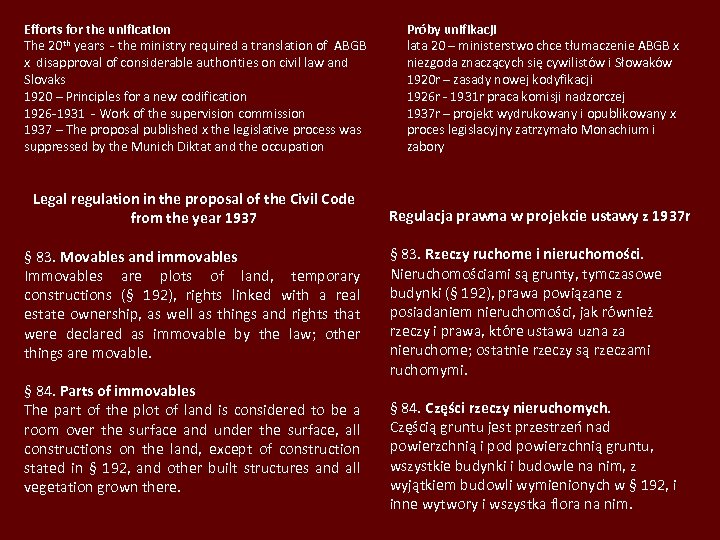 Efforts for the unification The 20 th years - the ministry required a translation of ABGB x disapproval of considerable authorities on civil law and Slovaks 1920 – Principles for a new codification 1926 -1931 - Work of the supervision commission 1937 – The proposal published x the legislative process was suppressed by the Munich Diktat and the occupation Legal regulation in the proposal of the Civil Code from the year 1937 § 83. Movables and immovables Immovables are plots of land, temporary constructions (§ 192), rights linked with a real estate ownership, as well as things and rights that were declared as immovable by the law; other things are movable. § 84. Parts of immovables The part of the plot of land is considered to be a room over the surface and under the surface, all constructions on the land, except of construction stated in § 192, and other built structures and all vegetation grown there. Próby unifikacji lata 20 – ministerstwo chce tłumaczenie ABGB x niezgoda znaczących się cywilistów i Słowaków 1920 r – zasady nowej kodyfikacji 1926 r - 1931 r praca komisji nadzorczej 1937 r – projekt wydrukowany i opublikowany x proces legislacyjny zatrzymało Monachium i zabory Regulacja prawna w projekcie ustawy z 1937 r § 83. Rzeczy ruchome i nieruchomości. Nieruchomościami są grunty, tymczasowe budynki (§ 192), prawa powiązane z posiadaniem nieruchomości, jak również rzeczy i prawa, które ustawa uzna za nieruchome; ostatnie rzeczy są rzeczami ruchomymi. § 84. Części rzeczy nieruchomych. Częścią gruntu jest przestrzeń nad powierzchnią i pod powierzchnią gruntu, wszystkie budynki i budowle na nim, z wyjątkiem budowli wymienionych w § 192, i inne wytwory i wszystka flora na nim.
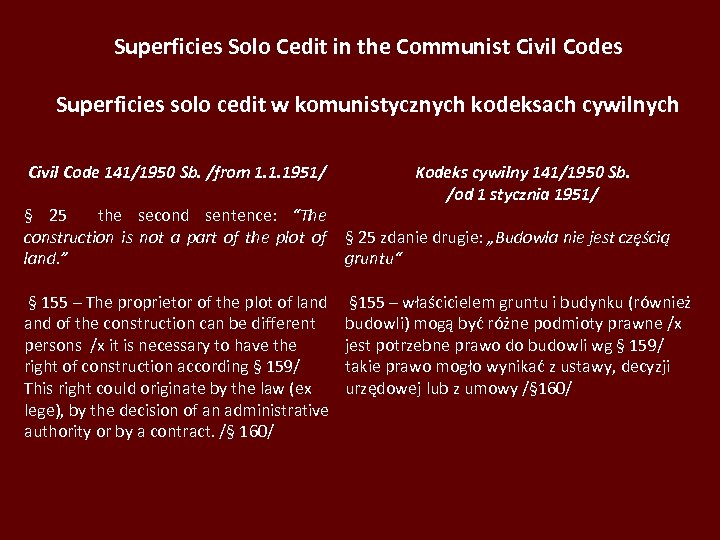 Superficies Solo Cedit in the Communist Civil Codes Superficies solo cedit w komunistycznych kodeksach cywilnych Civil Code 141/1950 Sb. /from 1. 1. 1951/ Kodeks cywilny 141/1950 Sb. /od 1 stycznia 1951/ § 25 the second sentence: “The construction is not a part of the plot of § 25 zdanie drugie: „Budowla nie jest częścią land. ” gruntu“ § 155 – The proprietor of the plot of land of the construction can be different persons /x it is necessary to have the right of construction according § 159/ This right could originate by the law (ex lege), by the decision of an administrative authority or by a contract. /§ 160/ § 155 – właścicielem gruntu i budynku (również budowli) mogą być różne podmioty prawne /x jest potrzebne prawo do budowli wg § 159/ takie prawo mogło wynikać z ustawy, decyzji urzędowej lub z umowy /§ 160/
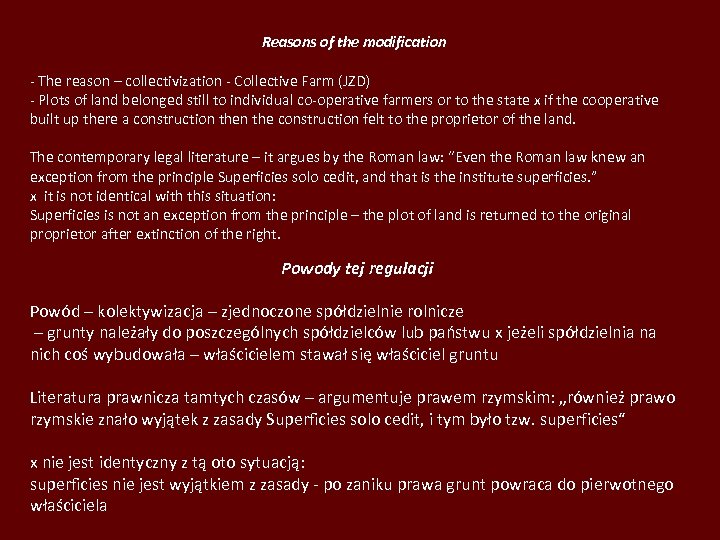 Reasons of the modification - The reason – collectivization - Collective Farm (JZD) - Plots of land belonged still to individual co-operative farmers or to the state x if the cooperative built up there a construction the construction felt to the proprietor of the land. The contemporary legal literature – it argues by the Roman law: “Even the Roman law knew an exception from the principle Superficies solo cedit, and that is the institute superficies. ” x it is not identical with this situation: Superficies is not an exception from the principle – the plot of land is returned to the original proprietor after extinction of the right. Powody tej regulacji Powód – kolektywizacja – zjednoczone spółdzielnie rolnicze – grunty należały do poszczególnych spółdzielców lub państwu x jeżeli spółdzielnia na nich coś wybudowała – właścicielem stawał się właściciel gruntu Literatura prawnicza tamtych czasów – argumentuje prawem rzymskim: „również prawo rzymskie znało wyjątek z zasady Superficies solo cedit, i tym było tzw. superficies“ x nie jest identyczny z tą oto sytuacją: superficies nie jest wyjątkiem z zasady - po zaniku prawa grunt powraca do pierwotnego właściciela
 - The building right in this form is known to the Austrian law and law of the First Republic /law no. 86/1912, then 88/1947 x The building right in the Civil code 1950 is different /§ 159 an/: - The construction established just like that passed never /even not later/ on the owner of the land. - The building right was possible to set up on the basis of the law (ex lege), by the decision of an administrative authority or by a contract x the contract required an approval of the people's committee -§ 158 of the Code – Socialist organizations that had used permanently not own plots of land were allowed to build there even without the building right. -- The building right may be established not only to a construction but also to a better economic utilization /a meadow changes into a garden/. - prawo zabudowy, w tej postaci znane również prawu austriackiemu i prawu Pierwszej Republiki /ustawa nr 86/1912, później 88/1947 x prawo budowania w środkowym kodeksie inne /§ 159 i nast. /: Budynek (budowla) tak powstała nigdy nie zmieniała właściciela /nawet później/ na właściciela gruntu Prawo zabudowy można było założyć na podstawie ustawy, decyzji urzędowej i umowy x umowa wymaga zgody komitetu narodowego § 158 ustawy - organizacje socjalistyczne, które trwale korzystają z cudzych gruntów, mogły na tych gruntach budować nawet bez prawa zabudowy Prawo zabudowy mogło być założone nie tylko w związku z budową, lecz również by np. grunt lepiej gospodarczo wykorzystać /łąka zmieni się na ogród/
 The Civil Code from 1964 Kodeks cywilny z 1964 r does not say it explicitly, however this principle remains valid. / A language interpretation - § 119 art. 2 of the Law/: § 119 (1) Things are movable or immovable. (2) Immovables are plots of land constructions connected with the ground by a firm foundation. § 120 The part of things is whatever belongs to it by its nature and cannot be separated without a devaluation of the thing. nie zawiera postanowienia o wykładni, nadal jednak jest ważna zasada wykładni językowej w postanowieniu § 119 ust. 2 ustawy: § 119 (1) Rzeczy są ruchome i nieruchome. (2) Nieruchomości to grunty, budynki i budowle połączone z ziemią trwałymi fundamentami. § 120 Częścią składową rzeczy jest wszystko, co do niej należy wg jej charakteru i nie można tego od niej oddzielić w taki sposób, by wartość rzeczy nie zmniejszyła się. The building right was abolished by the law from the year 1964 and was substituted by the institute of the individual usage of the land /§ 198/. Prawo zabudowy było kodeksem z 1964 r uchylone i zostało ono zastąpione poprzez prawo osobistego użytkowania gruntu /§ 198/. With a bit of exaggeration, it is possible to liken it to the split property – dominium utile. Z przesadą można by go przyrównać własności podzielonej – dominium utile.
 After the year 1989 The new Civil Code was not adopted – the priority was the Commercial Code x The Code was amended expressively no. 509/1991 Sb. - a renewal of the freedom of contract, preferences of the private ownership x the principle superficies solo cedit were not valid any more, and it was expressively stated /§ 120 art. 2/: § 119 (1)Things are movable or immovable. (2)Immovables are plots of land constructions connected with the ground by a firm foundation. § 120 (1) The part of things is whatever belongs to it by its nature and cannot be separated without a devaluation of the thing. (2) The construction is not a part of the plot of land. The institution of the individual usage converted to the property right (ownership right). Po 1989 r. Nowy kodeks cywilny nie został uchwalony – priorytetem był kodeks handlowy x ustawa była zasadniczo znowelizowana - nr 509/1991 Dz. U. – powrót do zasady wolności umownej, preferencja własności prywatnej, x zasada superficies solo cedit została zniesiona i jest to zawarte w § 120 odst. 2: § 119 (1)Rzeczy są ruchome i nieruchome. (2) Nieruchomości to grunty, budynki i budowle połączone z ziemią trwałymi fundamentami. § 120 (1) Częścią składową rzeczy jest wszystko, co do niej należy wg jej charakteru i nie można tego od niej oddzielić w taki sposób, by wartość rzeczy nie zmniejszyła się. (2) Budynek (budowla) nie jest częścią składową gruntu Prawo użytkowania osobistego zmieniło się na własność
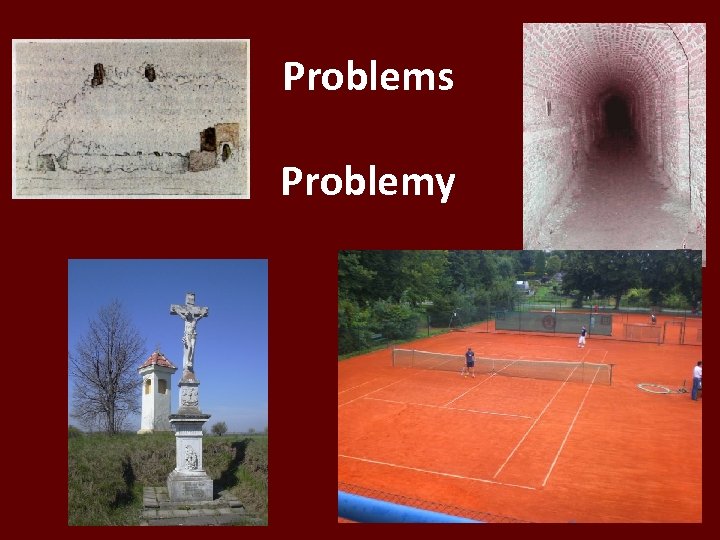 Problems Problemy
 What is the construction? - The term “construction” is not defined in the Civil Code. - “all built structures…” exist in the Construction Act x there is a construction understands dynamically /building activity/ x it is a definition for the Construction Act and it is not applicable for the Civil Code /the Supreme Court, ref. 22 from 26. 8. 2002 Cdo 1221/2002/, a construction is an outcome in the Civil Code /the Supreme Court 30. 9. 1998, ref. 33 Cdon 111/98/ The reasons of problems: restitutions – disputes between owners to whom the plots of land have been returned back and new owners who had built up there a construction/ Courts solved questions: What is a construction? – Swimming pool? Tennis court? Car parking place? A construction as an outcome is the construction in accordance with the Civil Code x if it cannot be separated in fact, not even economically from the land, and the construction is its part and forms with it one subject (thing) /car parking place – Cdon 1414/97 from 26. 10. 199, agricultural drain system, quarry/ Co je to budynek (budowla)? Pojęcie „budowli” ani „budynku” nie jest w KC zdefiniowane Istnieje w prawie budowlanym „wszystkie dzieła budowlane. . . “ x ten rozumie budowę dynamicznie /roboty budowlane – jakaś czynność/ x jest to definicja wykorzystywana w ustawie o budownictwie i nie można z niej skorzystać dla potrzeb KC / orzeczenie Sądu Najwyższego nr 22 z 26. 8. 2002 Cdo 1221/2002/, dla KC jest budynek wynikiem czegoś – trzeba rozumieć w pojęciu statycznym / Sąd Najwyższy 30. 9. 1998 , nr 33 Cdon 111/98 / Powód problemów: restytucje – kłótnie właścicieli, którym zostały grunty przywrócone z nowymi właścicielami, którzy na nich coś wybudowali Sąd rozwiązywał pytania: Co to jest budynek (budowla) – Basen, Boisko sportowe, Parking Budynek w sensie wyniku czynności jest budynkiem w znaczeniu KC x jeżeli nie można go oddzielić faktycznie i gospodarczo od gruntu i budynek z gruntem spływa, jest jego częścią i jest z nim jedną rzeczą /parking – Cdon 1414/97 z 26. 10. 1999, urządzenie melioracyjne, łom/
 From when a construction is possible to be considered as the construction? Od jakiego momentu można budynek (budowlę) uważać za budynek (budowlę)? A construction is understood as two different things according to the Construction Law and according to the Civil Code. Budynek w rozumieniu ustawy o budownictwie i kodeksu cywilnego to dwie różne rzeczy – For the Civil Code, there is the decisive reason from when is possible to consider the construction as the independent thing. - A fixed practice of the court (judicature) – from the moment when the disposition of the 1 st /ground/ floor is evident / Field works are not sufficient, the activity must be qualitatively higher /NS sp. Zn. from 11. 1992 CDO 111/92. 1/ W rozumieniu KC jest decydujące, czy można budynek (budowlę) uważać za samodzielną rzecz - orzecznictwo – od momentu, gdy jest widoczna dyspozycja pierwszego piętra nadziemnego / nie wystarcza tylko uporządkowanie terenu, lecz musi dojść do czynności kwalitatywnie wyższych / SN nr. 3 z 11. 1992 Cdo 111/92. 1/
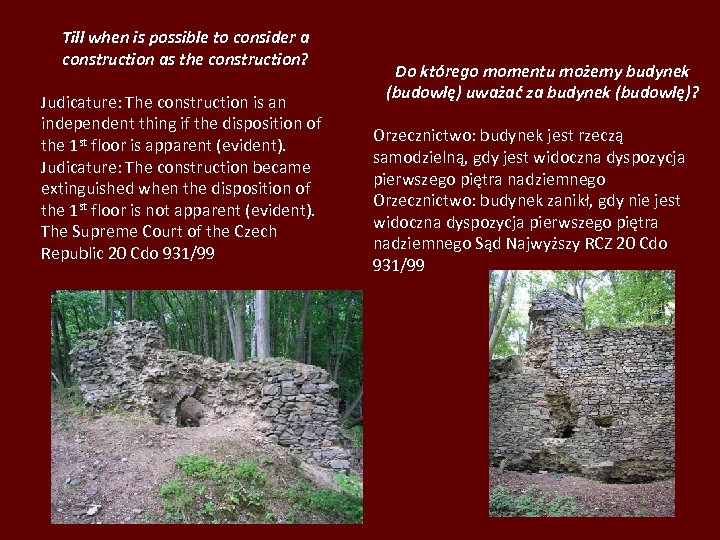 Till when is possible to consider a construction as the construction? Judicature: The construction is an independent thing if the disposition of the 1 st floor is apparent (evident). Judicature: The construction became extinguished when the disposition of the 1 st floor is not apparent (evident). The Supreme Court of the Czech Republic 20 Cdo 931/99 Do którego momentu możemy budynek (budowlę) uważać za budynek (budowlę)? Orzecznictwo: budynek jest rzeczą samodzielną, gdy jest widoczna dyspozycja pierwszego piętra nadziemnego Orzecznictwo: budynek zanikł, gdy nie jest widoczna dyspozycja pierwszego piętra nadziemnego Sąd Najwyższy RCZ 20 Cdo 931/99
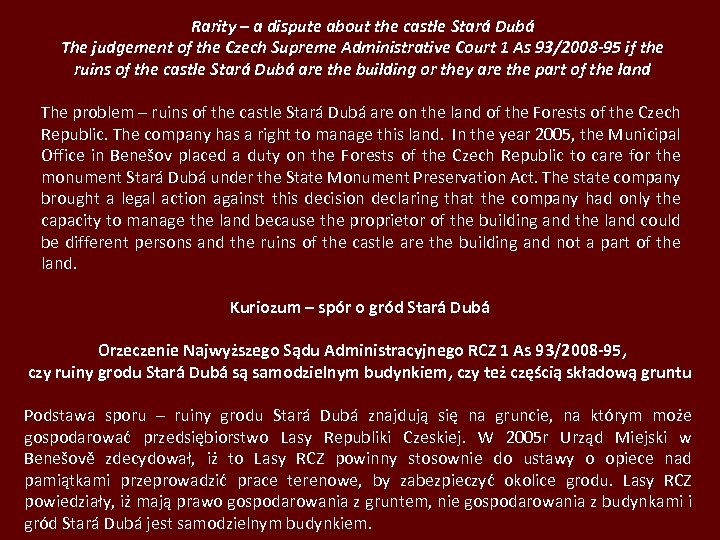 Rarity – a dispute about the castle Stará Dubá The judgement of the Czech Supreme Administrative Court 1 As 93/2008 95 if the ruins of the castle Stará Dubá are the building or they are the part of the land The problem – ruins of the castle Stará Dubá are on the land of the Forests of the Czech Republic. The company has a right to manage this land. In the year 2005, the Municipal Office in Benešov placed a duty on the Forests of the Czech Republic to care for the monument Stará Dubá under the State Monument Preservation Act. The state company brought a legal action against this decision declaring that the company had only the capacity to manage the land because the proprietor of the building and the land could be different persons and the ruins of the castle are the building and not a part of the land. Kuriozum – spór o gród Stará Dubá Orzeczenie Najwyższego Sądu Administracyjnego RCZ 1 As 93/2008 -95, czy ruiny grodu Stará Dubá są samodzielnym budynkiem, czy też częścią składową gruntu Podstawa sporu – ruiny grodu Stará Dubá znajdują się na gruncie, na którym może gospodarować przedsiębiorstwo Lasy Republiki Czeskiej. W 2005 r Urząd Miejski w Benešově zdecydował, iż to Lasy RCZ powinny stosownie do ustawy o opiece nad pamiątkami przeprowadzić prace terenowe, by zabezpieczyć okolice grodu. Lasy RCZ powiedziały, iż mają prawo gospodarowania z gruntem, nie gospodarowania z budynkami i gród Stará Dubá jest samodzielnym budynkiem.
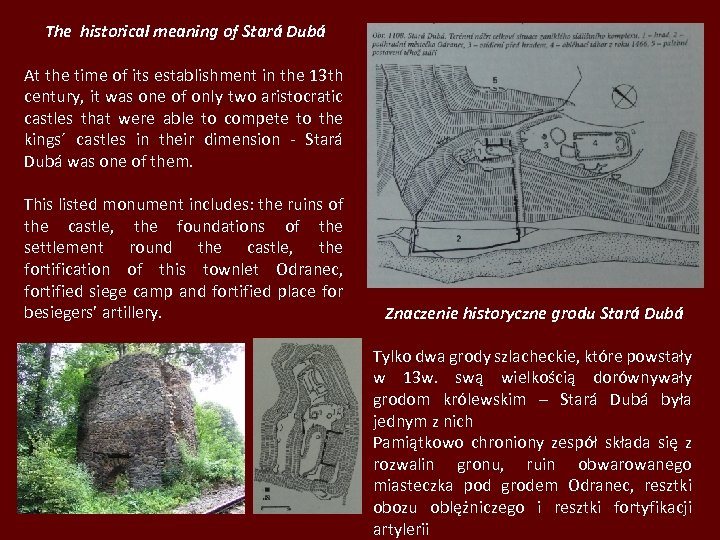 The historical meaning of Stará Dubá At the time of its establishment in the 13 th century, it was one of only two aristocratic castles that were able to compete to the kings´ castles in their dimension - Stará Dubá was one of them. This listed monument includes: the ruins of the castle, the foundations of the settlement round the castle, the fortification of this townlet Odranec, fortified siege camp and fortified place for besiegers’ artillery. Znaczenie historyczne grodu Stará Dubá Tylko dwa grody szlacheckie, które powstały w 13 w. swą wielkością dorównywały grodom królewskim – Stará Dubá była jednym z nich Pamiątkowo chroniony zespół składa się z rozwalin gronu, ruin obwarowanego miasteczka pod grodem Odranec, resztki obozu oblężniczego i resztki fortyfikacji artylerii
 The judgement of the Czech Supreme Administrative Court 1 As 93/2008 -95 The ruins of the castle Stará Dubá cannot be considered as an individual building as they are so rare that the whole disposition or the inner arrangement alone is not evident. Moreover, the whole area is covered with trees and the ruins merged naturally with the terrain. Anyway, the castle is registered as a „Castle Stará Dubá - ruins of the castle and archaeological traces“ and it emphasises much more its connection with the land. Orzeczenie Najwyższego Sądu Administracyjnego RCZ 1 As 93/2008 -95, Resztki grodu Stará Dubá nie można uważać za samodzielną budowlę, dlatego że są tak nieznaczne, iż nie jest widoczna dyspozycja całości, tym bardziej dyspozycja wnętrz. Do tego cały areał jest pokryty lasem, czyli już bez jakichkolwiek wątpliwości można powiedzieć, iż ruiny spłynęły z terenem. Do tego gród jest prowadzony w ewidencji pod oznaczeniem: „Gród Stará Dubá – ruiny grodu i stopy archeologiczne“, co jeszcze bardziej podkreśla jego związek z gruntem
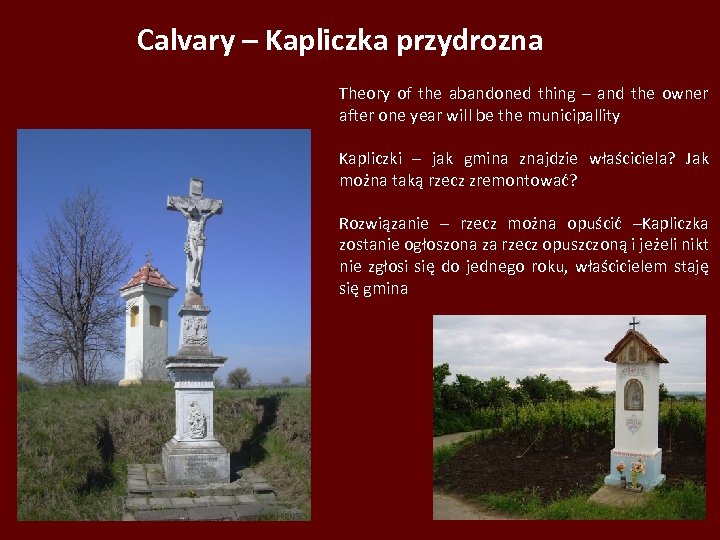 Calvary – Kapliczka przydrozna Theory of the abandoned thing – and the owner after one year will be the municipallity Kapliczki – jak gmina znajdzie właściciela? Jak można taką rzecz zremontować? Rozwiązanie – rzecz można opuścić –Kapliczka zostanie ogłoszona za rzecz opuszczoną i jeżeli nikt nie zgłosi się do jednego roku, właścicielem staję się gmina
 Ground cover - Porost Plants belong to the owner of land X Co-operative Law No. 49/1959 Coll. , on Unified Agricultural Co-operatives § 24 3) Right of „co-operative use“ entitles the co-operativeto to use the land in the same extent as this right would belong to the owner of land… Therefore everything on the land belongs to the co-operative. Law No. 123/1975 Coll. , on Use of Land Other Agricultural Property to Ensure Production § 2 (3) All the ground cover on the land, used by a state agricultural organization, is property of the state. All the ground cover on the land, used by a unified agricultural organisation, is property of this organisation. Rośliny należą do właściciela gruntu x spółdzielnia ustawa nr 49/1959. , prawo zjednoczonych spółdzielni rolnych § 24 Ust. 3. – Prawo do korzystania ze spółdzielczej własności gruntu uprawnia spółdzielnię do korzystania z niego v takim samym stopniu, jak korzystał by z niego właściciel… Do spółdzielni należy przede wszystkim wszystko, co na nim wzejdzie. Ustawa nr 123/1975 Sb. , prawo korzystania z gruntów i innego majątku rolnego w celu zapewnienia produkcji § 2 ust. 3 – Wszelkie porosty znajdujące się na gruntach, z których korzysta państwowa organizacja rolna, są własnością państwa. Wszelkie porosty znajdujące się na gruntach, z których korzysta spółdzielnia rolna, są jej własnością.
 Law No. 229/1991 Coll. , on Regulation of Proprietary Rights in Land Other Agricultural Property. Permanent ground cover – owner of the land Other than permanent ground cover – property of the person that uses the land on contractual bases If the land is used by a co-operative – ground cover belongs to the cooperative. ustawa nr 229/1991 Sb. , regulacja posiadania gruntów i innego majątku rolnego trwały porost – właściciel gruntu inny rodzaj aniżeli trwały porost – własność tego, kto korzysta z gruntu na podstawie umowy spółdzielnia korzysta z gruntu – porost należy spółdzielni
 Upcoming legal correction No. 89/2012 Coll. We return again to the principle Superficies Solo Cedit in the prepared codification of the civil law x it will be fully valid only in the case that the person is identical. The problem – there exist a different ownership of the construction and the plot of land: Temporary institutions were inspired by the German regulation /the updating of the introductory law BGB upon the unification of Germany/ - the legal first option to the owner of the land to build up there, and the legal first option to the owner of the construction to buy the land, eventually its part /if it is possible to divide functionally/ If the construction is not registered in the real estate register (cadastre), the purchaser of the land can suppose in good faith (bona fide) that assumes a right to the land construction x the present owner of the construction has to be compensated by the alienor. If the construction is situated on more plots of land, the above mentioned approach is valid only for the plot of land where the main part of the construction is situated, and the regulation about additional (annex) constructions on the other plots of land is applied. Przygotowywana regulacja prawna W przygotowywanej kodyfikacji prawa cywilnego znów powrót do zasady „suprficies solo cedit“ x w pełni będzie ważna tylko w przypadku, gdy podmioty są zgodne Problem – istniejąca różna własność budynków i gruntów: Inspiracja niemiecką regulacją prawną w postanowieniach przejściowych /nowelizacja ustawy wprowadzającej BGB w procesie zjednoczenia Niemiec/ - ustawowe prawo pierwokupu budynku właścicielowi gruntu a właścicielowi budynku prawo pierwokupu gruntu, czy też jego części /jeżeli można rozdzielić/ Jeżeli budynek nie jest prowadzony w ewidencji Katastru, może być nabywca gruntu w dobrej wierze, iż nabywa prawo własności jak gruntu, tak również budynku x dotychczasowy właściciel budynku musi zostać odszkodowany nabywcą.
 Thank You for your attention Pavel Salák jr. Pictures: www. wikipedia. cz www. stramberk. cz www. hrady. cz www. me. hrady. cz www. richard-1. com www. hka. cz autor