


 Скачать презентацию Development of NWS Satellite User Readiness Mike Johnson
72e4faf73201daa3a33a053097ba5dd2.ppt
- Количество слайдов: 13
 Development of NWS Satellite User Readiness Mike Johnson NWS/OST November 4, 2009
 Overview • Satellite Products in Context of Broader Strategic Goal • Preparing NWS for Future Satellite Products • NWS User-System Readiness for GOES-R
 Satellite Products in Context of Broader Strategic Goal (Slide 1) • Strategic Goal: Develop a fully integrated observation system (e. g. , satellite, radar, upper air, etc), along with (automated? ) analysis tools to fully exploit data and enable strategic warn-onforecast stretch goals – Forecaster increasingly won’t have time to analyze growing amounts of observational & model data – Need to assimilate observations from multiple platforms into products that directly address forecast & warning needs (e. g. convective initiation giving specific convective threat, icing threat, flood potential - versus – perceptible water observation, surface moisture & snow cover observations, freezing level observation) – End-State Objective: System automatically analyzes the data and determines when the forecaster needs to react
 Satellite Products in Context of Broader Strategic Goal (Slide 2) • Strategic Goal is end-state objective – We will likely not be there at Day-1 GOES-R But…. • We need to be moving in that direction • There are things we should be pursuing now and the satellite community can and should be leading the way!
 Near-Term Satellite Challenges • Bandwidth – How and what satellite products will be available to Users? – Push-Pull, Product integration, AWIPS development. How will GAS work (details)? – How do requirements differ between WFO’s, Centers – How do requirements differ regionally, seasonally, how to handle localized products • Training – How do we prepare users for this explosion of data and implications to warning processes near term (day 1) • How do we systematically progress towards our strategic goal
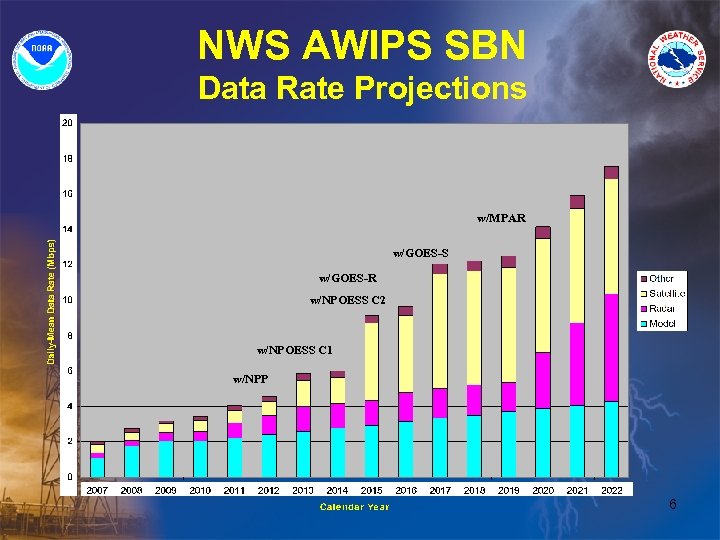 NWS AWIPS SBN Data Rate Projections w/MPAR w/GOES-S w/GOES-R w/NPOESS C 2 w/NPOESS C 1 w/NPP 6
 Preparing NWS for Future Satellite Products • GOES-R Proving Ground (PG) Activities guided by Proving Ground Plan • NWS User-Readiness & Infrastructure Planning Studies • NWS User Readiness Working Group Formed to develop userreadiness – feed back to PG activities – Initially, group is small internal NWS member group which will grow incrementally as topic matures & user coordination expands
 Preparing NWS for Future Satellite Products (NWS User Readiness Working Group) • Formed to address NWS User Readiness Risk associated with impact that GOES-R, NPOESS, other-satellites, AWIPS development, rapid increases in data volume, & changes to data delivery will have on NWS Users. • Effort to examine in an integrated way: – the products that GOES-R, NPOESS, and other satellite programs are expected to deliver to NWS & when. – Corresponding development of communications pathways and AWIPS Extended – User guided discussions on push-pull trades and optimum achievable product deliveries. – Identify systematic high-level pathway to achieve strategic goals (merged observing system) • User-coordinated / senior approved initial position / roadmap available late Spring 2010 – Expectation to present to May 10 SRSST Meeting
 Conclusion • GOES Users’ Conference offers a great opportunity to get user feedback on the transition to the GOES-R era – Breakout sessions are specifically focused on this • We plan to take the results of these breakout sessions to – Help define the framework and milestones for the way ahead
 Backup Slides
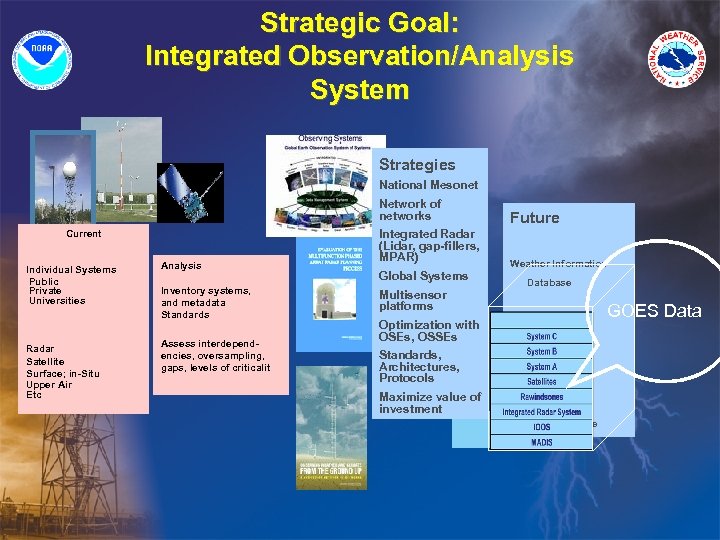 Strategic Goal: Integrated Observation/Analysis System Strategies National Mesonet Network of networks Current Individual Systems Public Private Universities Radar Satellite Surface; in-Situ Upper Air Etc Analysis Inventory systems, and metadata Standards Assess interdependencies, oversampling, gaps, levels of criticalit Integrated Radar (Lidar, gap-fillers, MPAR) Global Systems Future Weather Information Database Multisensor platforms GOES Data Optimization with OSEs, OSSEs Standards, Architectures, Protocols Maximize value of investment Open Architecture
 NWS User-System Readiness for GOES-R and Other Environmental Satellite Missions Task • NWS/OST Systems Engineering Center leading this task • The goal of this task is to design an architecture that will support future mission data and to develop a roadmap for implementing this design • The new series of GOES satellites (GOES-R) and POES satellites (NPOESS) will have increased data rates, new data formats, and new products
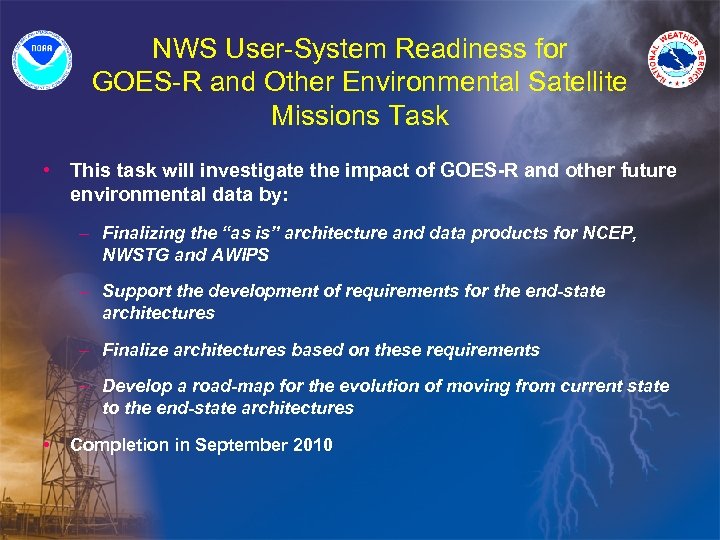 NWS User-System Readiness for GOES-R and Other Environmental Satellite Missions Task • This task will investigate the impact of GOES-R and other future environmental data by: – Finalizing the “as is” architecture and data products for NCEP, NWSTG and AWIPS – Support the development of requirements for the end-state architectures – Finalize architectures based on these requirements – Develop a road-map for the evolution of moving from current state to the end-state architectures • Completion in September 2010