


 Скачать презентацию Development of international conventions and rules ACS Conference
e9ee4de0d637916e6713a891b48970d9.ppt
- Количество слайдов: 31
 Development of international conventions and rules ACS Conference on Shipping and Shipbuilding 2012 -8 -22 Hochiminh City
 Contents 1 Introduction 2 Overview of major international maritime conventions up to 2015 3 Layout of international maritime quality supervision 4 Conclusions
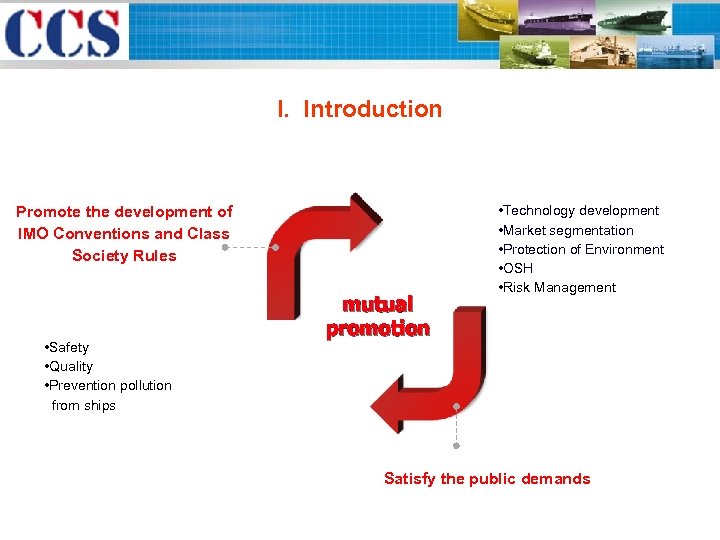 I. Introduction Promote the development of IMO Conventions and Class Society Rules • Safety • Quality • Prevention pollution from ships mutual promotion • Technology development • Market segmentation • Protection of Environment • OSH • Risk Management Satisfy the public demands
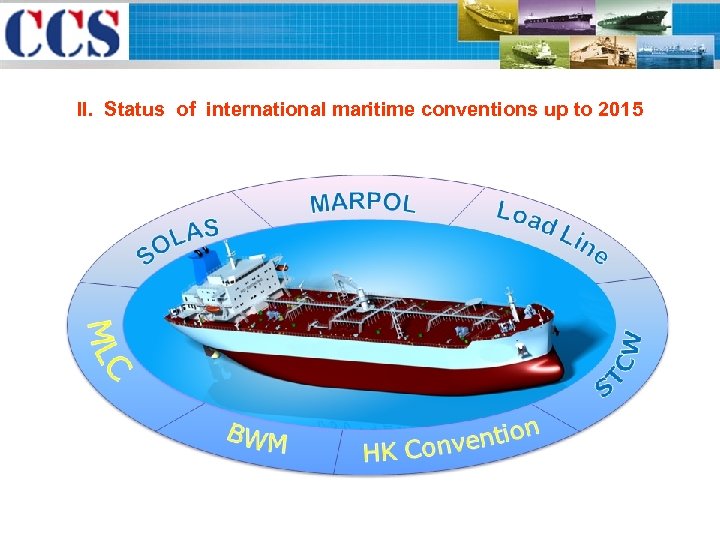 II. Status of international maritime conventions up to 2015 12345678 123 456 123 56 234 561 456 12 34 56 78 12 3 4 12345 61234 56 87897 1234567
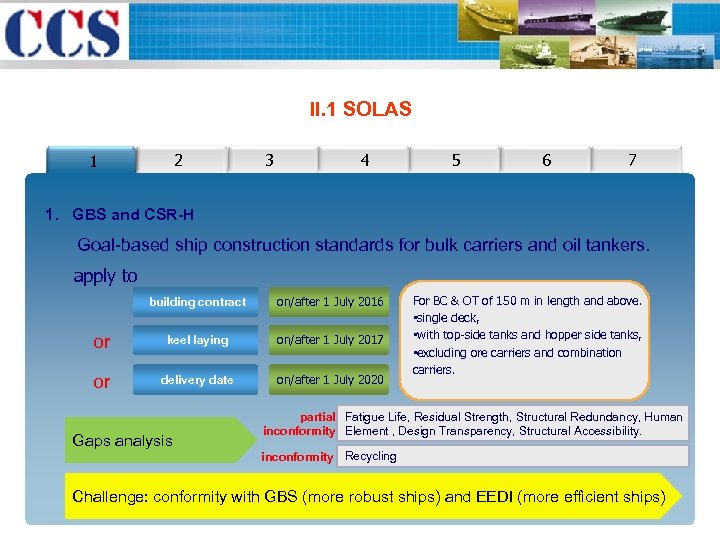 II. 1 SOLAS 2 1 3 4 5 6 7 1. GBS and CSR-H Goal-based ship construction standards for bulk carriers and oil tankers. apply to building contract on/after 1 July 2016 or keel laying on/after 1 July 2017 or delivery date on/after 1 July 2020 Gaps analysis For BC & OT of 150 m in length and above. • single deck, • with top-side tanks and hopper side tanks, • excluding ore carriers and combination carriers. partial Fatigue Life, Residual Strength, Structural Redundancy, Human inconformity Element , Design Transparency, Structural Accessibility. inconformity Recycling Challenge: conformity with GBS (more robust ships) and EEDI (more efficient ships)
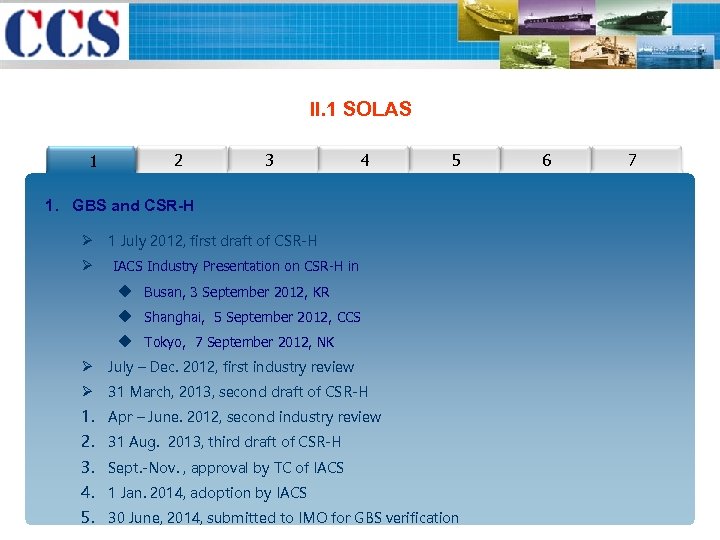 II. 1 SOLAS 1 2 3 4 5 1. GBS and CSR-H Ø 1 July 2012, first draft of CSR-H Ø IACS Industry Presentation on CSR-H in u Busan, 3 September 2012, KR u Shanghai, 5 September 2012, CCS u Tokyo, 7 September 2012, NK Ø July – Dec. 2012, first industry review Ø 31 March, 2013, second draft of CSR-H 1. Apr – June. 2012, second industry review 2. 31 Aug. 2013, third draft of CSR-H 3. Sept. -Nov. , approval by TC of IACS 4. 1 Jan. 2014, adoption by IACS 5. 30 June, 2014, submitted to IMO for GBS verification 6 7
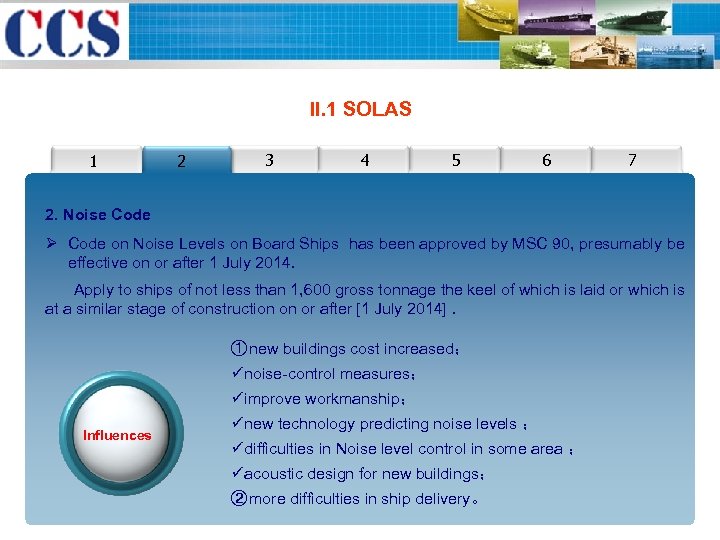 II. 1 SOLAS 1 2 3 4 5 6 7 2. Noise Code Ø Code on Noise Levels on Board Ships has been approved by MSC 90, presumably be effective on or after 1 July 2014. Apply to ships of not less than 1, 600 gross tonnage the keel of which is laid or which is at a similar stage of construction on or after [1 July 2014]. ① new buildings cost increased; ünoise-control measures; üimprove workmanship; Influences ünew technology predicting noise levels ; üdifficulties in Noise level control in some area ; üacoustic design for new buildings; ② more difficulties in ship delivery。
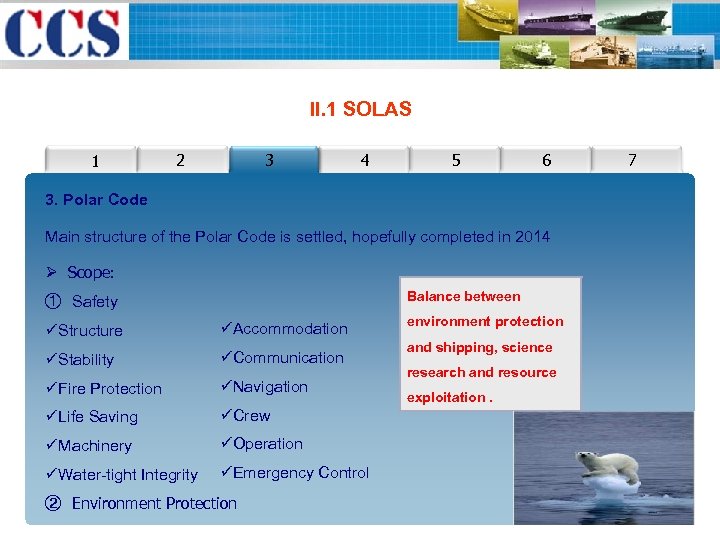 II. 1 SOLAS 1 2 3 4 5 6 3. Polar Code Main structure of the Polar Code is settled, hopefully completed in 2014 Ø Scope: Balance between ① Safety üStructure üAccommodation üStability üCommunication üFire Protection üNavigation üLife Saving üCrew üMachinery üOperation üWater-tight Integrity üEmergency Control ② Environment Protection environment protection and shipping, science research and resource exploitation. 7
 II. 1 SOLAS 1 22 3 4 5 6 7 4. E-Navigation Ø E-navigation is the harmonized collection, integration, exchange, presentation and analysis of marine information on board and ashore by electronic means to enhance berth to berth navigation and related services for safety and security at sea and protection of the marine environment. Ø Purpose: meet present and future needs through harmonization of marine navigation systems and supporting shore services.
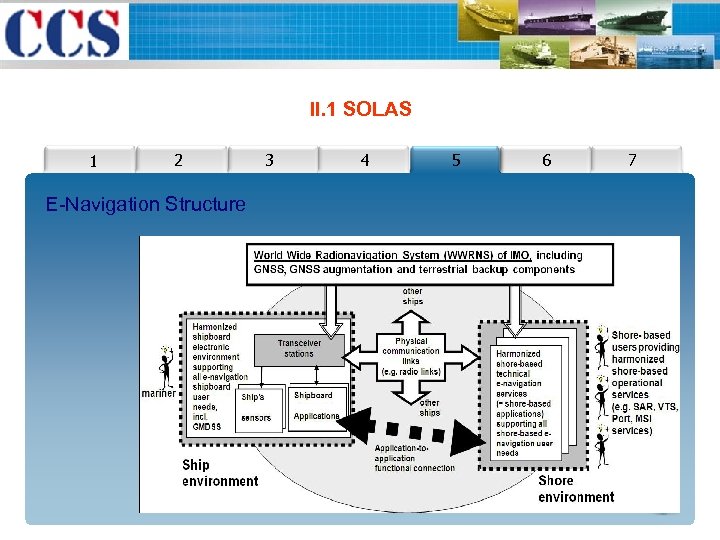 II. 1 SOLAS 1 22 E-Navigation Structure 3 4 5 6 7
 II. 1 SOLAS 1 22 3 4 5 6 7 5. Asbestos Ø “From 1 January 2011, for all ships, new installation of materials which contain asbestos shall be prohibited. ” Ø (Two key questions): 1. How to verify? IACS issued UI SC 249 to unify the way of implementation of this SOLAS regulation by ROs, which was approved by MSC 90. 2. Threshold of asbestos 1% or 0. 1%
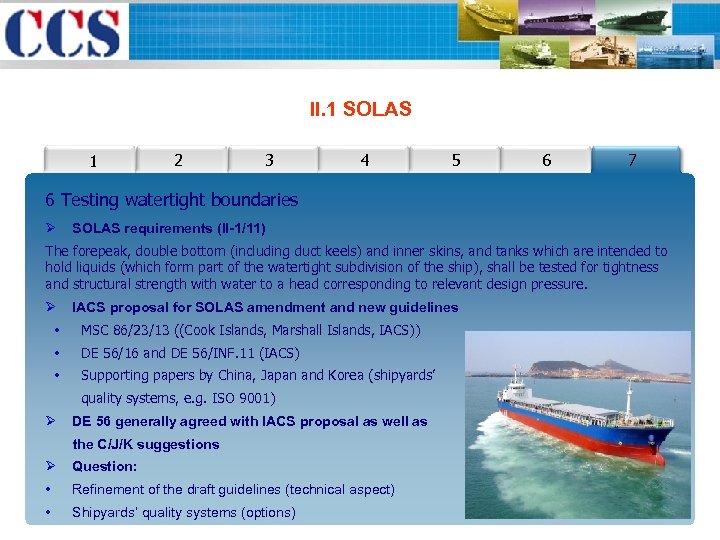 II. 1 SOLAS 1 22 3 4 5 6 7 6 Testing watertight boundaries Ø SOLAS requirements (II-1/11) The forepeak, double bottom (including duct keels) and inner skins, and tanks which are intended to hold liquids (which form part of the watertight subdivision of the ship), shall be tested for tightness and structural strength with water to a head corresponding to relevant design pressure. Ø IACS proposal for SOLAS amendment and new guidelines • MSC 86/23/13 ((Cook Islands, Marshall Islands, IACS)) • DE 56/16 and DE 56/INF. 11 (IACS) • Supporting papers by China, Japan and Korea (shipyards’ quality systems, e. g. ISO 9001) Ø DE 56 generally agreed with IACS proposal as well as the C/J/K suggestions Ø Question: • Refinement of the draft guidelines (technical aspect) • Shipyards’ quality systems (options)
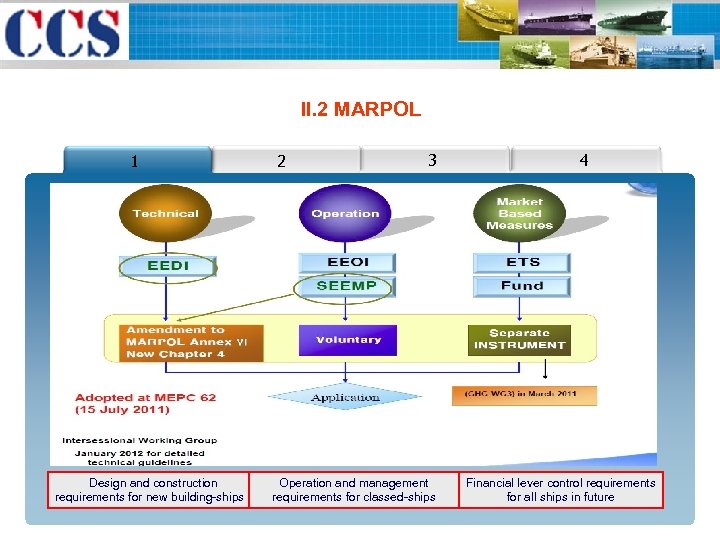 II. 2 MARPOL 1 Design and construction requirements for new building-ships ) 2 3 3 Operation and management requirements for classed-ships 4 Financial lever control requirements for all ships in future
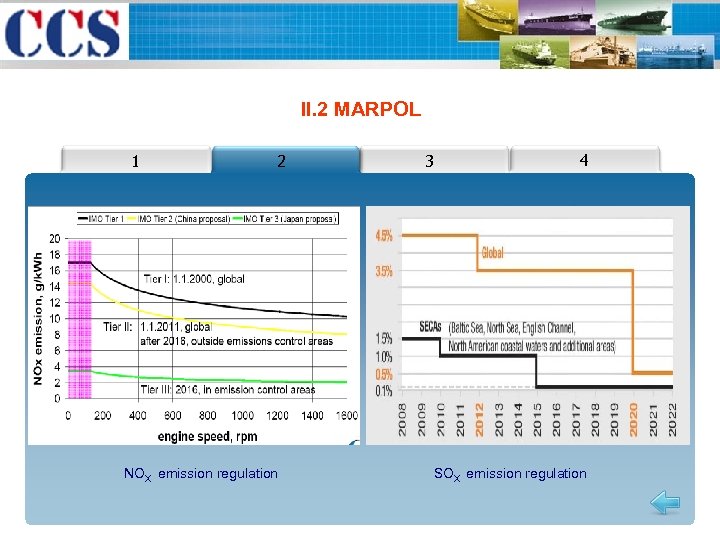 II. 2 MARPOL 1 2 NOX emission regulation 3 4 SOX emission regulation
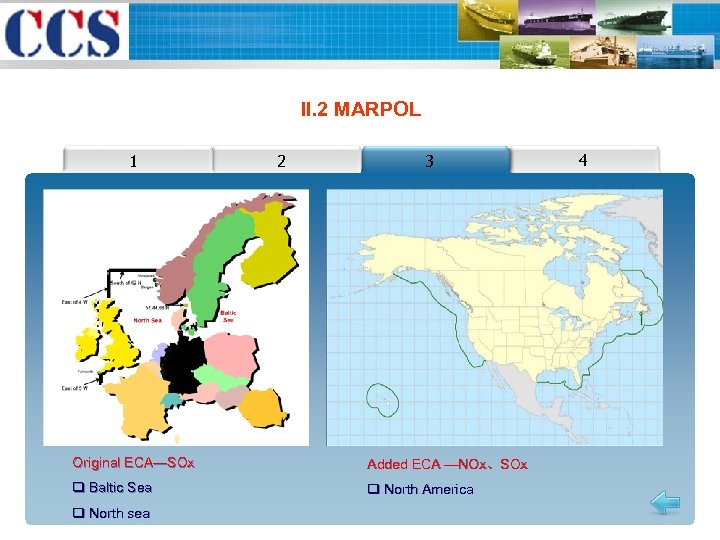 II. 2 MARPOL 1 2 3 Original ECA—SOx Added ECA —NOx、SOx q Baltic Sea q North America q North sea 4
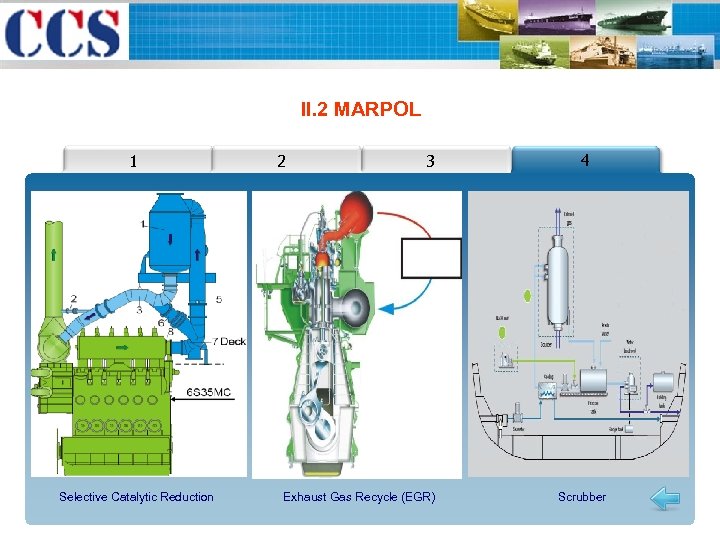 II. 2 MARPOL 1 Selective Catalytic Reduction 2 3 Exhaust Gas Recycle (EGR) 4 Scrubber
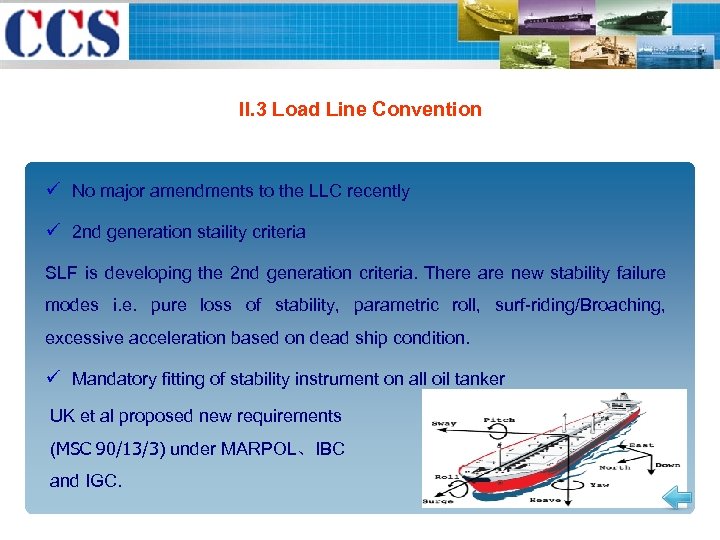 II. 3 Load Line Convention ü No major amendments to the LLC recently ü 2 nd generation staility criteria SLF is developing the 2 nd generation criteria. There are new stability failure modes i. e. pure loss of stability, parametric roll, surf-riding/Broaching, excessive acceleration based on dead ship condition. ü Mandatory fitting of stability instrument on all oil tanker UK et al proposed new requirements (MSC 90/13/3) under MARPOL、IBC and IGC.
 II. 4 STCW Convention) ü Manila Amendments to the STCW Convention, adopted at Manila Diplomatic Conference 21 -25 June 2010, entered into force on 1 st January 2012,5 -year transition period. ü Strengthened the requirements for issue and registration of certificates, and registration/hours of rest/medicine and alcohol control etc. , and added the responsibilities of shipping company, designate works to competent seafarers who have undergone trainings for knowledge update. There’re large number of seafarers in Asia training/certificate/registration process again. who should go through
 II. 5 Hong Kong Convention 1 2 3 Entry into force shall subject to the following: 1. Ratifications by no less than 15 States; 2. The combined merchant fleets of these States constitute not less than 417 million gross tonnage; 3. Combined maximum annual ship recycling volume of the States mentioned above during the preceding 10 years constitutes not less than 12, 500, 000 gross tonnage; 4. Enter into force: twenty-four months after meeting the above-mentioned requirements (expected: around 2016).
 II. 5 Hong Kong Convention 1 2 3 ü Shipyard: Improve the management and control on supply chain to deal with the potential legal and economic risks. To prevent risks such as claim and ship abandonment caused by installation of unqualified products onboard. ü Ship in service: IHM shall be updated throughout the service of the ship. ü Ship to be recycled: Hazardous Materials shall be recycled and environmentally soundly dealt with by the approved recycling facilities as per the requirements of the Convention and IHM.
 II. 5 Hong Kong Convention 1 2 3 EU new regulation: ① PSC Inspection Guidelines, developed on May 2011. ② Draft EU Regulation on Ship Recycling, expected to enter into force in 2014. ③ Ban on the Use of Asbestos on Board ships, released by Netherlands Administration, December 2011.
 II. 6 BWM 1 2 ü The condition for entry-into-force of BWM: n 30 States; n 35% of the gross tonnage of the world’s merchant shipping; n Effective twelve months after the condition is met. ü Status as of 31 July 2012: n 35 States, n 27. 95% of the gross tonnage of the world’s merchant shipping. The condition for entry-into-force is about to be met with a few major flag States signing in.
 II. 6 BWM 1 2 ü Major problems: ü Very small percentage of world fleet has installed the BWMS onboard; ü No transition period for ships of certain category; ü The uncertainty of the sampling and analysis method on BWMS used during port State inspection discourages ship owners from early installation before the entry into force of BWM Convention; ü Whilst the uncertainty of entry into force of the BWM Convention still remains, an early installation of BWMS will mean additional cost and relatively lower function; ü Alternative methods of ballast water treatment are also under development.
 II. 7 MLC 1 2 ü The condition for entry-into-force of MLC: n 30 ILO members; n 33% of the gross tonnage of ships; n twelve months after the date of registered ratifications。 ü current condition: n 29 ILO members, n 58. 5% of the gross tonnage of the world’s merchant shipping。 ü Estimate: n 30 ILO members by 2012; n the Convention will enter into force by 2013.
 II. 7 MLC 1 2 ü The Convention covers fair treatment of crew for their work, safe and sound work/live environment, welfares including safety protection and health care etc. ü The shipbuilding and shipping industry should pay attention to: - Updating company/shipboard management systems (incl. wages/welfares); - training - seafarers’ accommodation and prevention of noise and vibration for new ships - Unclearness in the implementation of MLC due to different work mechanism in between ILO and IMO
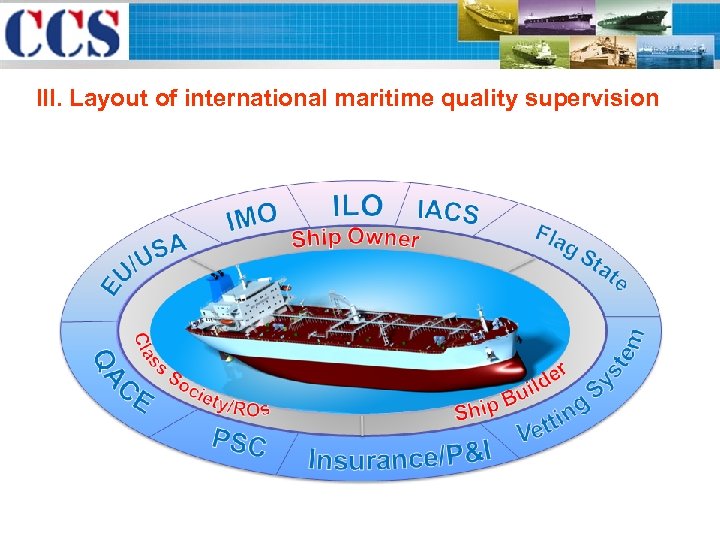 III. Layout of international maritime quality supervision
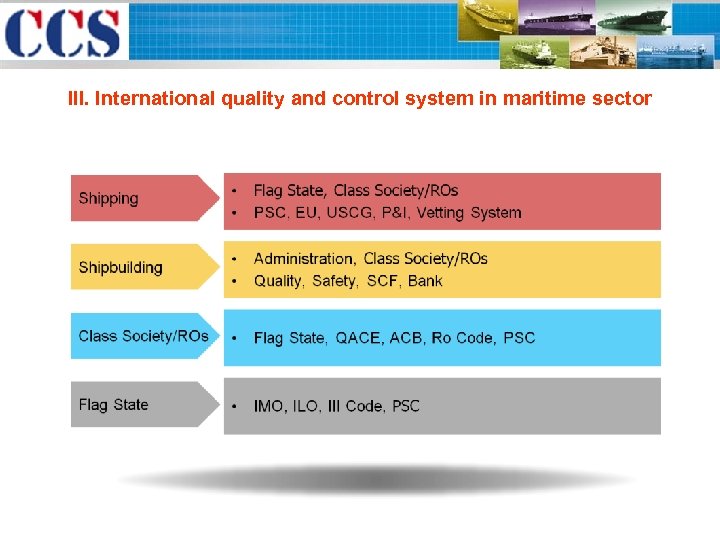 III. International quality and control system in maritime sector
 III. International quality and control system in maritime sector Ø Who is the administration of shipyard? Flag State or Shipyard’ s country? Ø ISO 9000 not adequate(need ISO 14000/18000); Ø Safety of surveyors; Ø Regional requirement (EU and others); Ø SCF , Information transparency and IPR; Ø Future development and EFQM.
 IV. Conclusions From technical aspect : Technology • Driving force of the market. • From government and exterior driven to self-driven. • Independent research and development, Innovation of science and technology. • Identify the target , new generation ship type development, market segmentation. • ship types matched the market demands is the key point to the purchase order. From quality aspect : Quality • The highest practical standard. • From being regulated to self-regulated. • Production process optimization. • Process management, high-quality ships. • Pursuit of excellence(EFQM)
 Ø Stronger Asian voice and influence on the development of international maritime conventions and rules is necessary , doable and on the way. Ø Essential for a healthy and sustainable development of world shipping and shipbuilding industry
 Thank you for your kind attention!