 Скачать презентацию Development of gis-based input data generation program for
7338d51da9e5cf6efbac65d1c50d54f2.ppt
- Количество слайдов: 22



Development of gis-based input data generation program for qual 2 e modeling Asia Geospatial Forum 2011 Hotel Mulia Senayan, Jakarta, Indonesia 2011. 10. 18 Cholyoung Lee*, Kyehyun Kim, Yonggil Park Dept. of Geoinformatic Engineering Inha University, S. Korea (khsakura 82@inhaian. net)
Contents Background Objective Methodology Results & Discussion Conclusion -2 - Dept of Geoinformatic Engineering, GIS Lab.
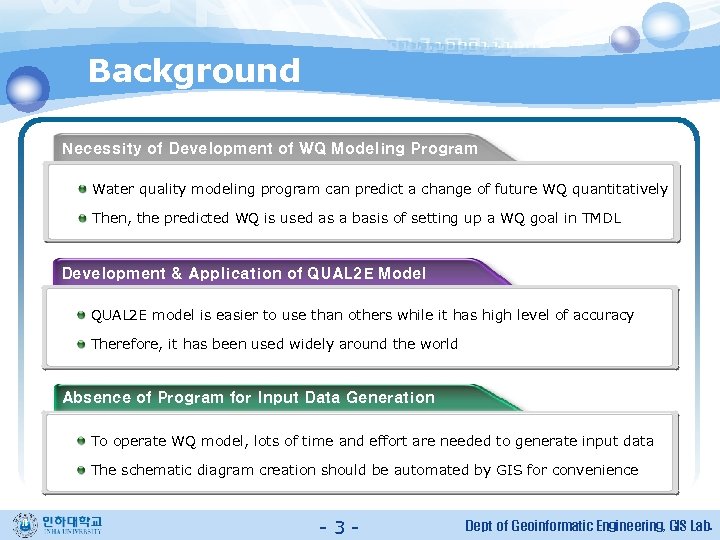
Background Necessity of Development of WQ Modeling Program Water quality modeling program can predict a change of future WQ quantitatively Then, the predicted WQ is used as a basis of setting up a WQ goal in TMDL Development & Application of QUAL 2 E Model QUAL 2 E model is easier to use than others while it has high level of accuracy Therefore, it has been used widely around the world Absence of Program for Input Data Generation To operate WQ model, lots of time and effort are needed to generate input data The schematic diagram creation should be automated by GIS for convenience -3 - Dept of Geoinformatic Engineering, GIS Lab.
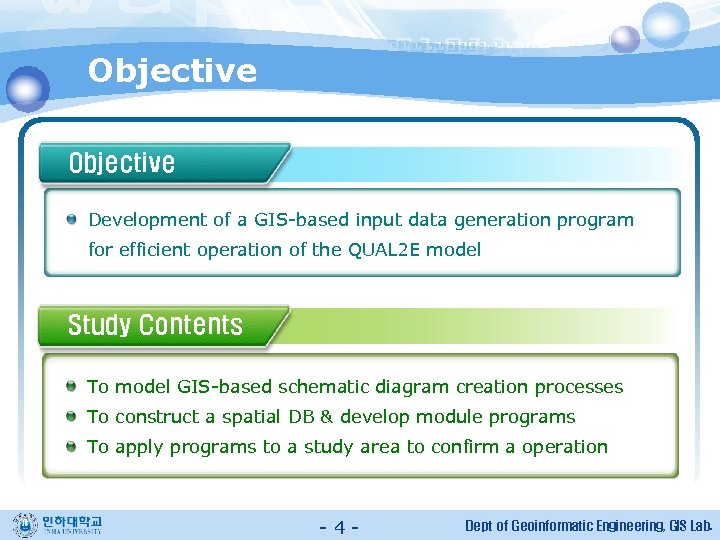
Objective Development of a GIS-based input data generation program for efficient operation of the QUAL 2 E model Study Contents To model GIS-based schematic diagram creation processes To construct a spatial DB & develop module programs To apply programs to a study area to confirm a operation -4 - Dept of Geoinformatic Engineering, GIS Lab.
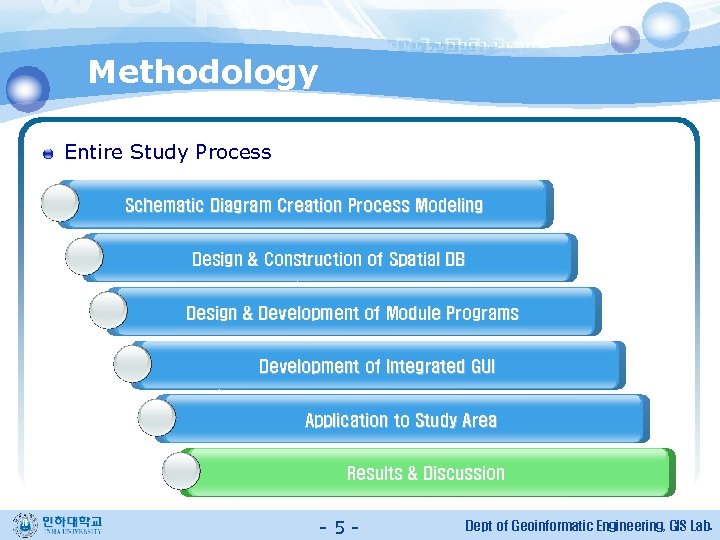
Methodology Entire Study Process Schematic Diagram Creation Process Modeling Design & Construction of Spatial DB Design & Development of Module Programs Development of Integrated GUI Application to Study Area Results & Discussion -5 - Dept of Geoinformatic Engineering, GIS Lab.
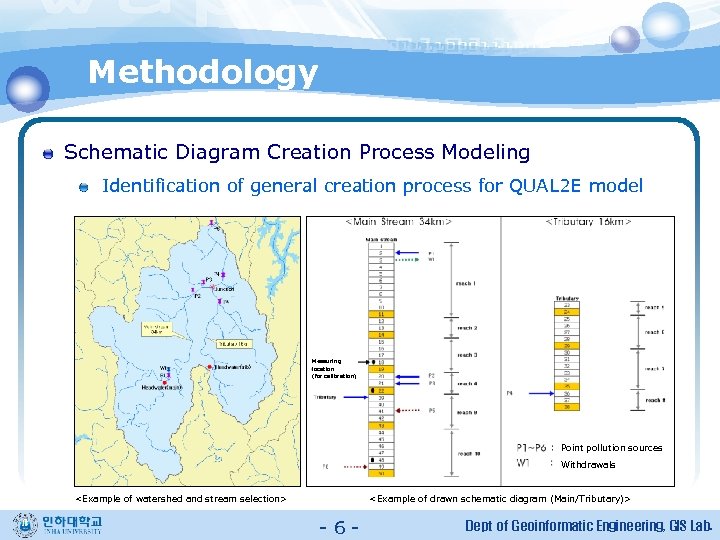
Methodology Schematic Diagram Creation Process Modeling Identification of general creation process for QUAL 2 E model Measuring location (for calibration) Point pollution sources Withdrawals <Example of watershed and stream selection> <Example of drawn schematic diagram (Main/Tributary)> -6 - Dept of Geoinformatic Engineering, GIS Lab.
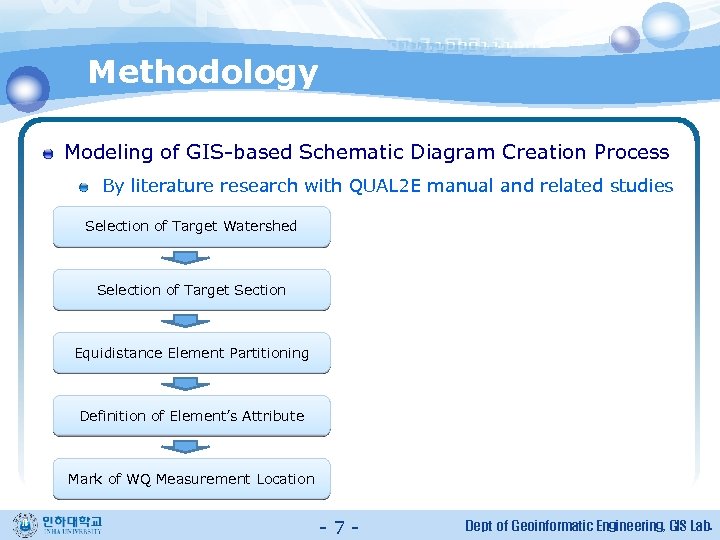
Methodology Modeling of GIS-based Schematic Diagram Creation Process By literature research with QUAL 2 E manual and related studies Selection of Target Watershed Selection of Target Section Equidistance Element Partitioning Definition of Element’s Attribute Mark of WQ Measurement Location -7 - Dept of Geoinformatic Engineering, GIS Lab.
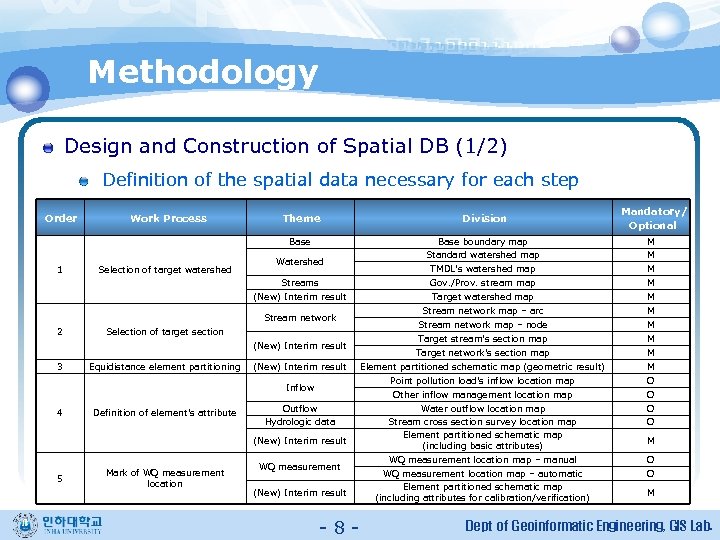
Methodology Design and Construction of Spatial DB (1/2) Definition of the spatial data necessary for each step Order Mandatory/ Optional Division Base boundary map Standard watershed map M M TMDL’s watershed map M Streams Gov. /Prov. stream map M (New) Interim result Selection of target watershed Theme Base 1 Work Process Target watershed map M Watershed Stream network map – arc 2 Selection of target section Equidistance element partitioning Target stream’s section map M M Element partitioned schematic map (geometric result) M Point pollution load’s inflow location map (New) Interim result O Inflow 4 Definition of element’s attribute Other inflow management location map O Outflow Water outflow location map O Hydrologic data Stream cross section survey location map Element partitioned schematic map (including basic attributes) O (New) Interim result 5 Mark of WQ measurement location M Target network’s section map (New) Interim result 3 M Stream network map – node Stream network WQ measurement (New) Interim result -8 - M WQ measurement location map – manual O WQ measurement location map – automatic O Element partitioned schematic map (including attributes for calibration/verification) M Dept of Geoinformatic Engineering, GIS Lab.
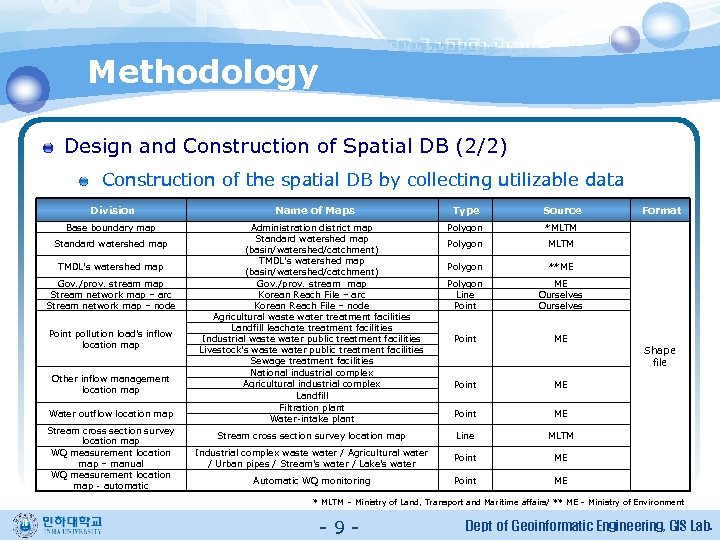
Methodology Design and Construction of Spatial DB (2/2) Construction of the spatial DB by collecting utilizable data Division Base boundary map Standard watershed map TMDL’s watershed map Gov. /prov. stream map Stream network map – arc Stream network map – node Point pollution load’s inflow location map Other inflow management location map Water outflow location map Stream cross section survey location map WQ measurement location map – manual WQ measurement location map - automatic Name of Maps Type Source Administration district map Standard watershed map (basin/watershed/catchment) TMDL’s watershed map (basin/watershed/catchment) Gov. /prov. stream map Korean Reach File – arc Korean Reach File – node Agricultural waste water treatment facilities Landfill leachate treatment facilities Industrial waste water public treatment facilities Livestock’s waste water public treatment facilities Sewage treatment facilities National industrial complex Agricultural industrial complex Landfill Filtration plant Water-intake plant Polygon *MLTM Polygon **ME Polygon Line Point ME Ourselves Point Format ME Shape file Point ME Stream cross section survey location map Line MLTM Industrial complex waste water / Agricultural water / Urban pipes / Stream’s water / Lake’s water Point ME Automatic WQ monitoring Point ME * MLTM – Ministry of Land, Transport and Maritime affairs/ ** ME – Ministry of Environment -9 - Dept of Geoinformatic Engineering, GIS Lab.
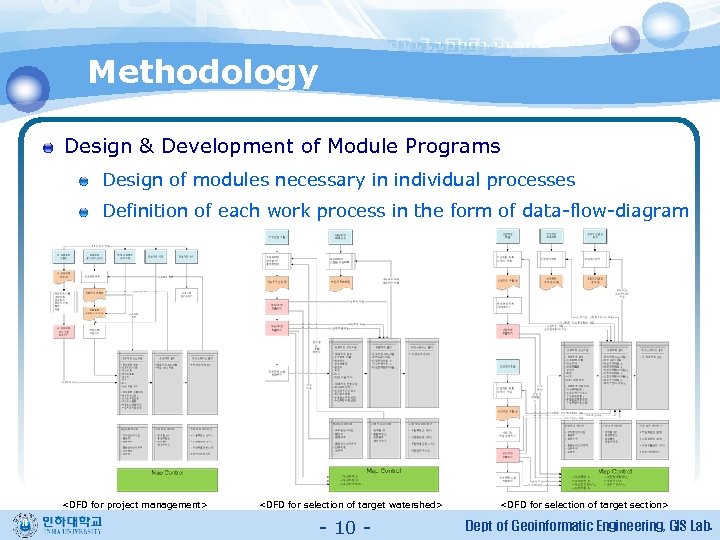
Methodology Design & Development of Module Programs Design of modules necessary in individual processes Definition of each work process in the form of data-flow-diagram <DFD for project management> <DFD for selection of target watershed> - 10 - <DFD for selection of target section> Dept of Geoinformatic Engineering, GIS Lab.
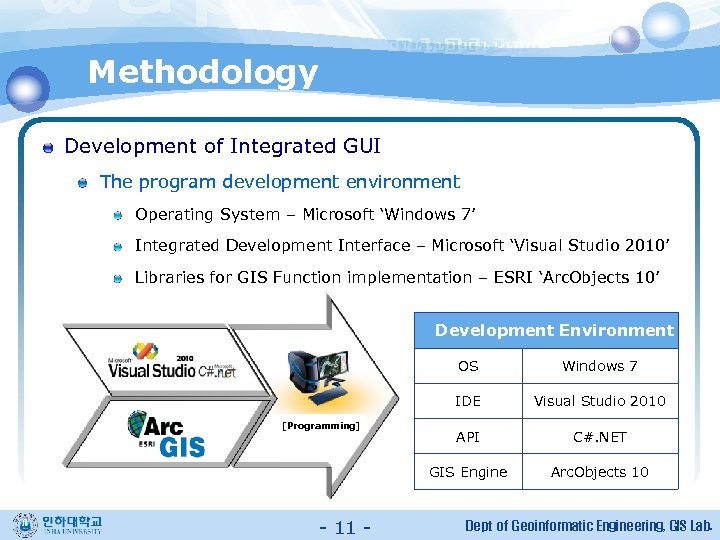
Methodology Development of Integrated GUI The program development environment Operating System – Microsoft ‘Windows 7’ Integrated Development Interface – Microsoft ‘Visual Studio 2010’ Libraries for GIS Function implementation – ESRI ‘Arc. Objects 10’ Development Environment OS IDE - 11 - Visual Studio 2010 API C#. NET GIS Engine [Programming] Windows 7 Arc. Objects 10 Dept of Geoinformatic Engineering, GIS Lab.
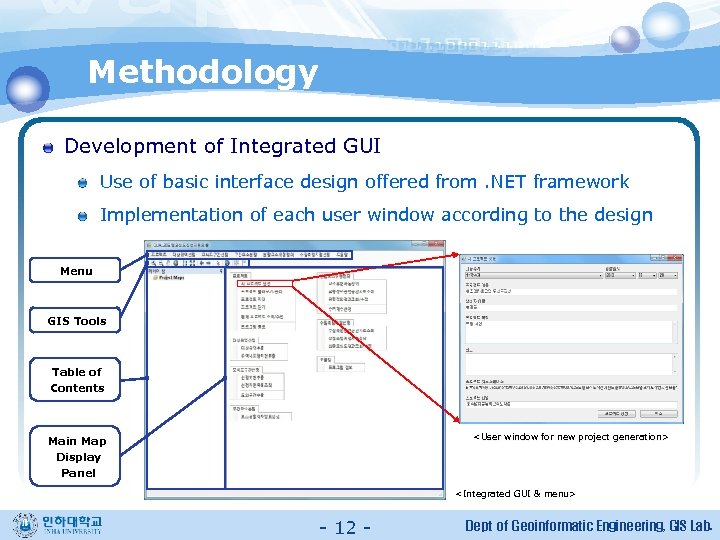
Methodology Development of Integrated GUI Use of basic interface design offered from. NET framework Implementation of each user window according to the design Menu GIS Tools Table of Contents <User window for new project generation> Main Map Display Panel <Integrated GUI & menu> - 12 - Dept of Geoinformatic Engineering, GIS Lab.
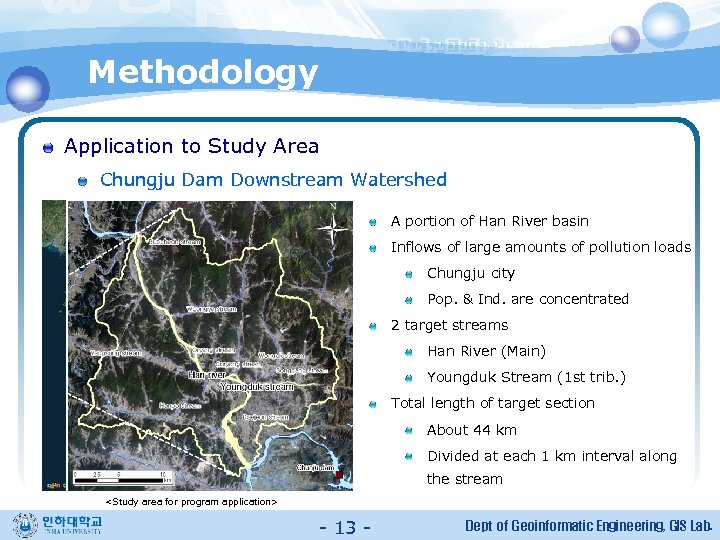
Methodology Application to Study Area Chungju Dam Downstream Watershed A portion of Han River basin Inflows of large amounts of pollution loads Chungju city Pop. & Ind. are concentrated 2 target streams Han River (Main) Youngduk Stream (1 st trib. ) Total length of target section About 44 km Divided at each 1 km interval along the stream <Study area for program application> - 13 - Dept of Geoinformatic Engineering, GIS Lab.
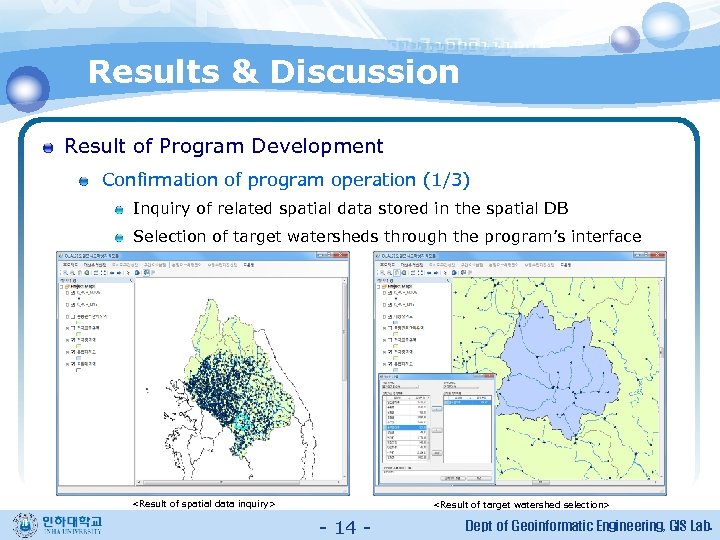
Results & Discussion Result of Program Development Confirmation of program operation (1/3) Inquiry of related spatial data stored in the spatial DB Selection of target watersheds through the program’s interface <Result of spatial data inquiry> <Result of target watershed selection> - 14 - Dept of Geoinformatic Engineering, GIS Lab.
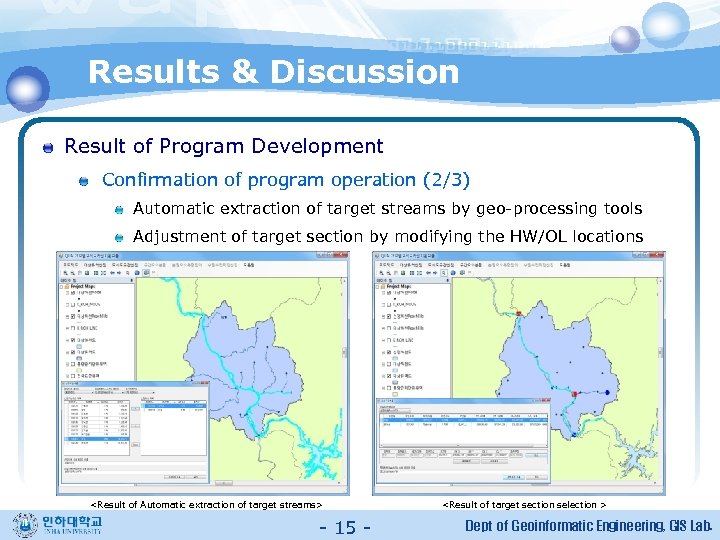
Results & Discussion Result of Program Development Confirmation of program operation (2/3) Automatic extraction of target streams by geo-processing tools Adjustment of target section by modifying the HW/OL locations <Result of Automatic extraction of target streams> - 15 - <Result of target section selection > Dept of Geoinformatic Engineering, GIS Lab.
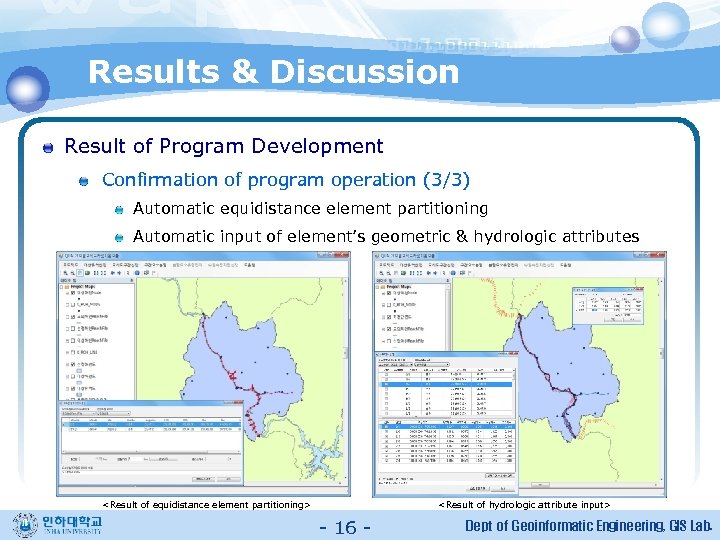
Results & Discussion Result of Program Development Confirmation of program operation (3/3) Automatic equidistance element partitioning Automatic input of element’s geometric & hydrologic attributes <Result of equidistance element partitioning> <Result of hydrologic attribute input> - 16 - Dept of Geoinformatic Engineering, GIS Lab.
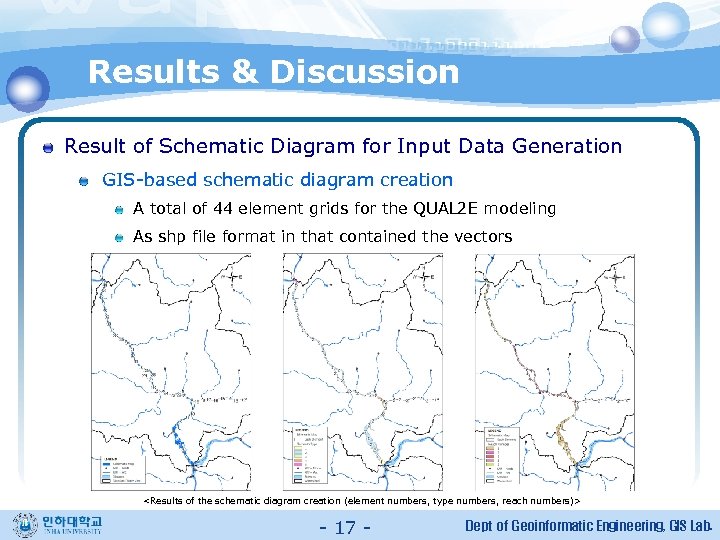
Results & Discussion Result of Schematic Diagram for Input Data Generation GIS-based schematic diagram creation A total of 44 element grids for the QUAL 2 E modeling As shp file format in that contained the vectors <Results of the schematic diagram creation (element numbers, type numbers, reach numbers)> - 17 - Dept of Geoinformatic Engineering, GIS Lab.
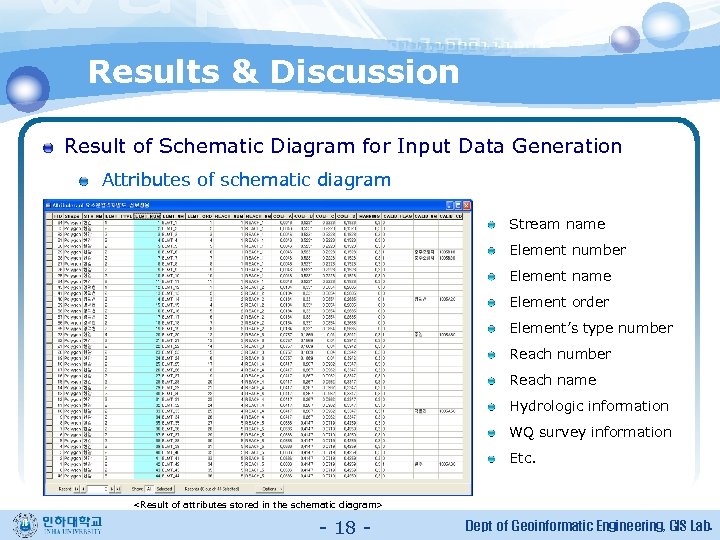
Results & Discussion Result of Schematic Diagram for Input Data Generation Attributes of schematic diagram Stream name Element number Element name Element order Element’s type number Reach name Hydrologic information WQ survey information Etc. <Result of attributes stored in the schematic diagram> - 18 - Dept of Geoinformatic Engineering, GIS Lab.
Results & Discussion on Result Enhancement of convenience It could be created with simple manipulation on the GIS-based GUI It is expected to decrease investment of manpower and budget Improvement of accuracy The result can be easily linked with other GIS-based related data Also, it is possible to define the exact element type by an overlay It is expected to create more accurate and practical input data Confidence of WQ modeling result in TMDL work will be increased - 19 - Dept of Geoinformatic Engineering, GIS Lab.
Results & Discussion Limitation of Study Revision of program errors Program errors occurred in which stream shapes are irregular It is needed to be stabilized through inspections on various test-bed Expansion of spatial DB The spatial DB should be extended for applications on other sites Some of spatial data should be newly created (ex. KRF, etc. ) The existing data should be verified to assure the accuracy Full automation of input data generation processes It is needed to develop an automatic linkage method between the developed program and pollution sources/loads DB - 20 - Dept of Geoinformatic Engineering, GIS Lab.
Conclusion GIS-based input data generation program for QUAL 2 E modeling The input data generation program was developed Through process modeling, design and implementation Convenience & accuracy of input data generation will be enhanced Efficiency of TMDL work might be increased by using the program In the future study, Revision of the program errors to improve performance Expansion of the spatial DB for applications on various sites Development of linkage and generation methods for full automation - 21 - Dept of Geoinformatic Engineering, GIS Lab.
 Скачать презентацию Development of gis-based input data generation program for
7338d51da9e5cf6efbac65d1c50d54f2.ppt