


 Скачать презентацию Development of Cryogenic Tracking Detectors for Lowenergy Solar
c83eb6bf69c77fe8896169008046cdda.ppt
- Количество слайдов: 43
 Development of Cryogenic Tracking Detectors for Lowenergy Solar Neutrinos Physics Seminar Southern Methodist University Monday, March 26 th, 2007 Raphael Galea Columbia University/Nevis Laboratories R. Galea (Columbia University) March 26 th, 2007 Columbia/Nevis: J. Dodd, R. Galea, W. Willis BNL: R. Hackenburg, D. Lissauer, V. Radeka, M. Rehak, P. Rehak, J. Sondericker, P. Takacs, V. Tcherniatine Budker: A. Bondar, A. Buzulutskov, D. Pavlyuchenko, R. Snopkov, Y. Tikhonov SMU: A. Liu, R. Stroynowski SMU Physics Seminar
 Outline • Accessing the low energy solar neutrino spectrum • The Electron Bubble TPC concept • R&D progress • Next steps: towards a cubic-meter prototype R. Galea (Columbia University) March 26 th, 2007 SMU Physics Seminar
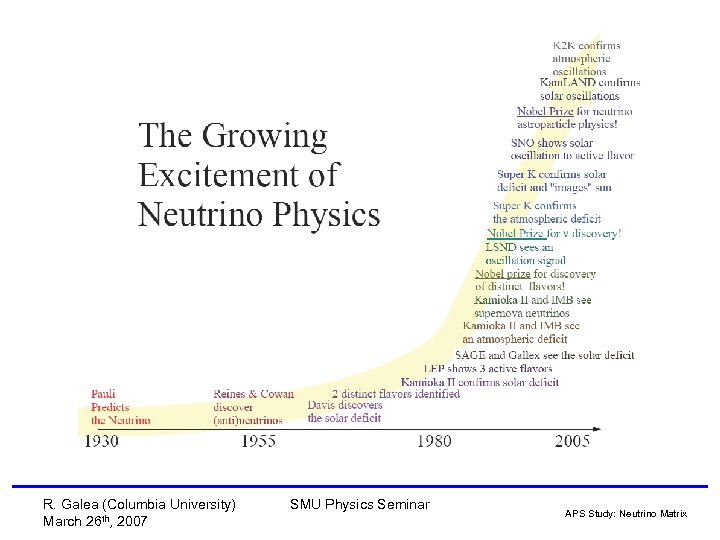 R. Galea (Columbia University) March 26 th, 2007 SMU Physics Seminar APS Study: Neutrino Matrix
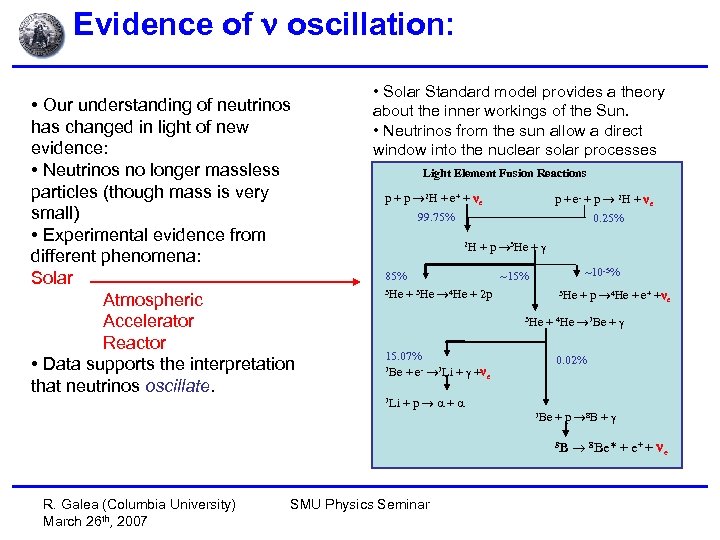 Evidence of oscillation: • Our understanding of neutrinos has changed in light of new evidence: • Neutrinos no longer massless particles (though mass is very small) • Experimental evidence from different phenomena: Solar Atmospheric Accelerator Reactor • Data supports the interpretation that neutrinos oscillate. • Solar Standard model provides a theory about the inner workings of the Sun. • Neutrinos from the sun allow a direct window into the nuclear solar processes Light Element Fusion Reactions p + p 2 H + e + + e p + e - + p 2 H + e 99. 75% 0. 25% 2 H + p 3 He + 85% 3 He ~10 -5% ~15% + 3 He 4 He + 2 p 3 He + 4 He 7 Be + 15. 07% 7 Be + e- 7 Li + + e 7 Li 0. 02% +p + 7 Be + p 8 B + 8 B R. Galea (Columbia University) March 26 th, 2007 SMU Physics Seminar + p 4 He + e+ + e 8 Be* + e+ + e
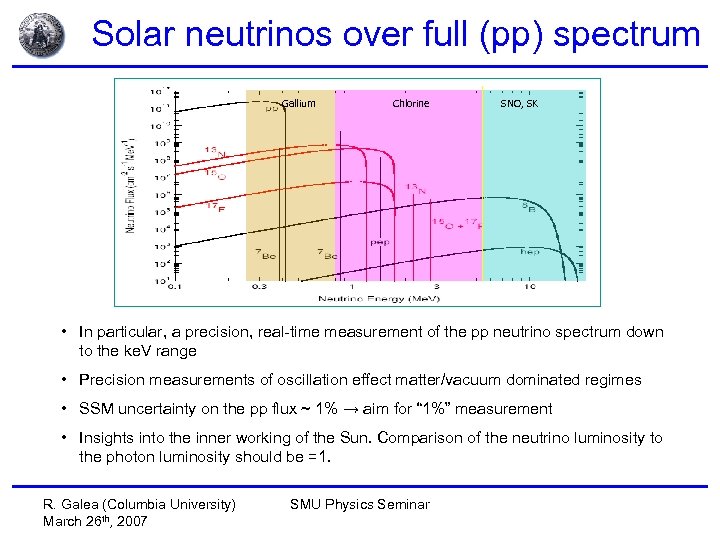 Solar neutrinos over full (pp) spectrum Gallium Chlorine SNO, SK • In particular, a precision, real-time measurement of the pp neutrino spectrum down to the ke. V range • Precision measurements of oscillation effect matter/vacuum dominated regimes • SSM uncertainty on the pp flux ~ 1% → aim for “ 1%” measurement • Insights into the inner working of the Sun. Comparison of the neutrino luminosity to the photon luminosity should be =1. R. Galea (Columbia University) March 26 th, 2007 SMU Physics Seminar
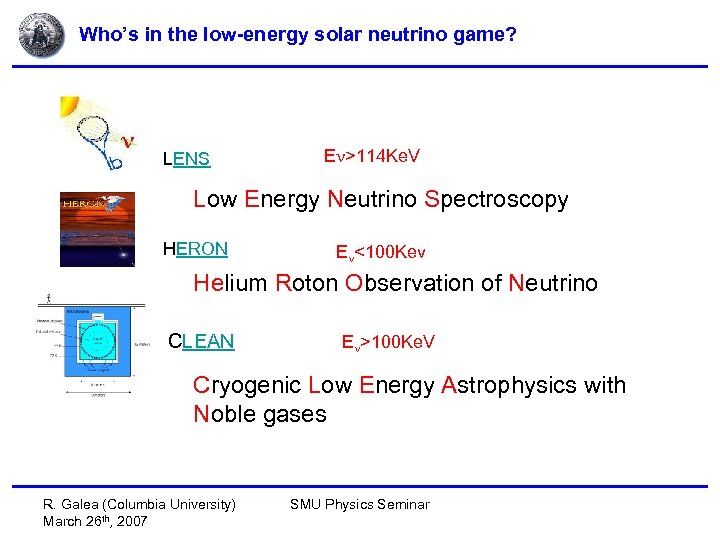 Who’s in the low-energy solar neutrino game? LENS En>114 Ke. V Low Energy Neutrino Spectroscopy HERON En<100 Kev Helium Roton Observation of Neutrino CLEAN En>100 Ke. V Cryogenic Low Energy Astrophysics with Noble gases R. Galea (Columbia University) March 26 th, 2007 SMU Physics Seminar
 Physics Motivation cont’d Physics Program • Physics Focus is the real-time, full spectrum measurement of pp fusion solar neutrinos • “light” Dark Matter scattering on modest target mass, for example Ge. V mass neutralino Signal Sources Ordered by visible energy of track, EX • EX = 10 -30 Me. V; isolated and “upward-going” electrons; presumably from supernovae. Little background, a single event, with n direction measured to ~1 degree, is meaningful, at least as a trigger to look elsewhere at associated phenomena. • EX<10 Me. V proton; from scattering of neutrons on the ~1% hydrogen quenching dopant, very useful feature of our detector, since this is an important background for DM experiments without high resolution tracking: the neutrons-proton scatter cross section is large and the track clearly identified, typically centimeters long and densely ionizing • EX <228 Ke. V electron; from scattering of pp fusion neutrino, EX<50 Kev electrons are sensitive to neutrino flavor • EX<40 Ke. V nuclear recoil from WIMP, range very different from electron, very different coherent scattering on helium and neon, and spectrum depends on WIMP mass (and is measurable for masses even below 1 Ge. V, unlike scattering on Ge and Xe) R. Galea (Columbia University) March 26 th, 2007 SMU Physics Seminar
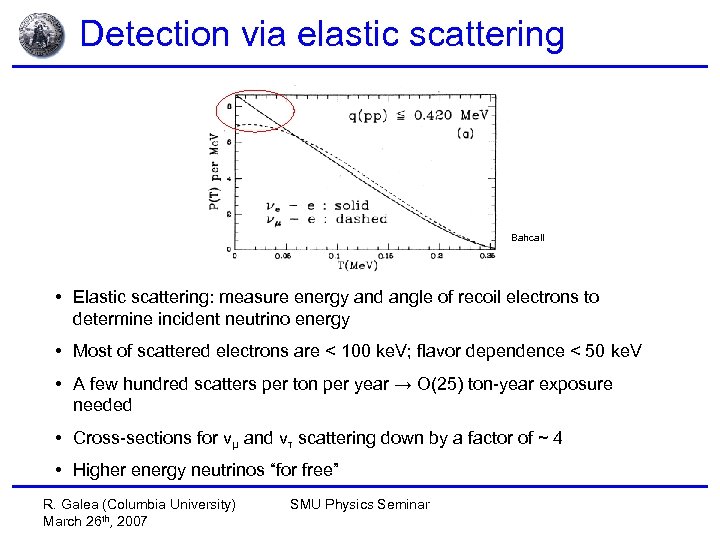 Detection via elastic scattering Bahcall • Elastic scattering: measure energy and angle of recoil electrons to determine incident neutrino energy • Most of scattered electrons are < 100 ke. V; flavor dependence < 50 ke. V • A few hundred scatters per ton per year → O(25) ton-year exposure needed • Cross-sections for νμ and ντ scattering down by a factor of ~ 4 • Higher energy neutrinos “for free” R. Galea (Columbia University) March 26 th, 2007 SMU Physics Seminar
 Detector requirements • ~ O(10) tons fiducial mass • “Condensed” phase target medium to give reasonable volume for this mass • Excellent (sub-mm) spatial resolution for low energy tracks → range, electron ID, plus pointing, at least for higher energy recoils • To maintain this resolution if drifting over long distances, need very low diffusion • Good energy resolution • Very high purity → long drifts, and low background from medium • Goal of reaching ke. V level implies need for some gain, presumably in gas phase • (Self-) shielding • Excellent background rejection, in particular of γ’s via Compton cluster ID • Ideally, a slow drift to ease readout of large number of volumes → feasible in principle in low-background environment underground R. Galea (Columbia University) March 26 th, 2007 SMU Physics Seminar
 Detection medium: helium/neon • In liquid phase, these low-Z materials offer good compromise between volume-to-mass consideration and desire to minimize multiple scattering • Very low boiling points → excellent purity, since impurities freeze out • In the case of thermal charge carriers, diffusion is proportional to √T, so low temperature is very advantageous • In liquid phase and in dense, cold gas, electrons are localized in nanoscale electron bubbles • Bubble size leads to low mobilities, of order 10 -3 -10 -2 cm 2 sec-1 V-1, and slow drifts • Electron bubbles remain thermal for E fields up to ~ 40 k. V/cm, and field-ionize around 400 k. V/cm • In two-phase system, bubbles are trapped at the liquid-vapor interface, before tunneling out on a timescale dependent on T and E R. Galea (Columbia University) March 26 th, 2007 SMU Physics Seminar
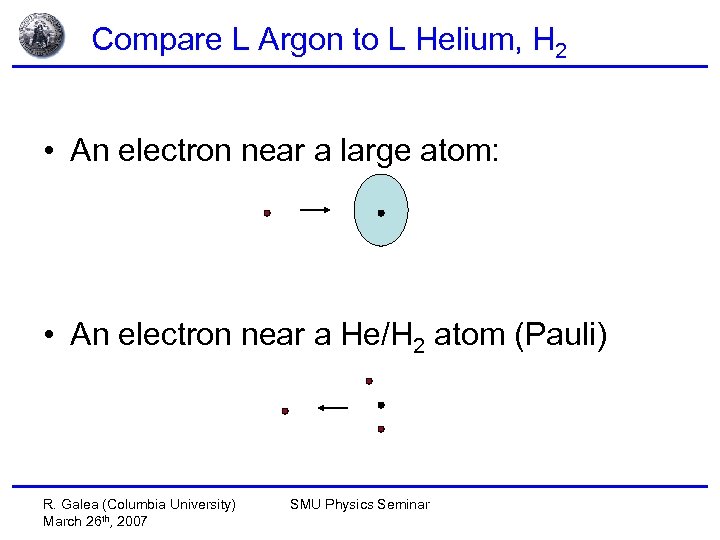 Compare L Argon to L Helium, H 2 • An electron near a large atom: • An electron near a He/H 2 atom (Pauli) R. Galea (Columbia University) March 26 th, 2007 SMU Physics Seminar
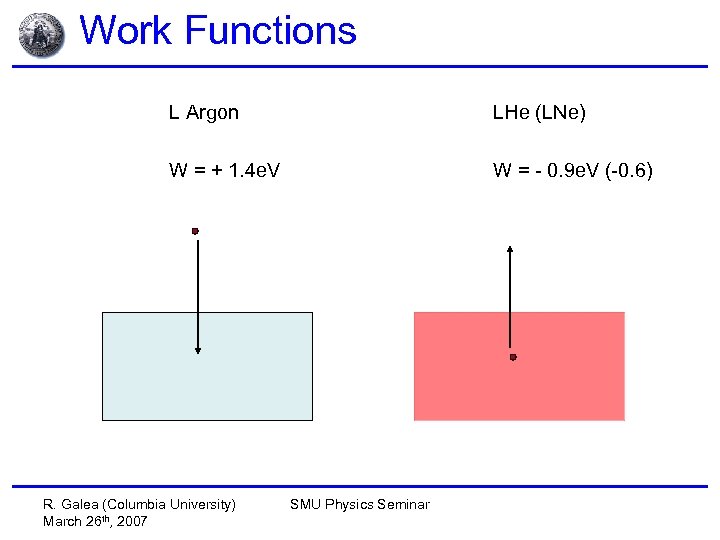 Work Functions L Argon LHe (LNe) W = + 1. 4 e. V W = - 0. 9 e. V (-0. 6) R. Galea (Columbia University) March 26 th, 2007 SMU Physics Seminar
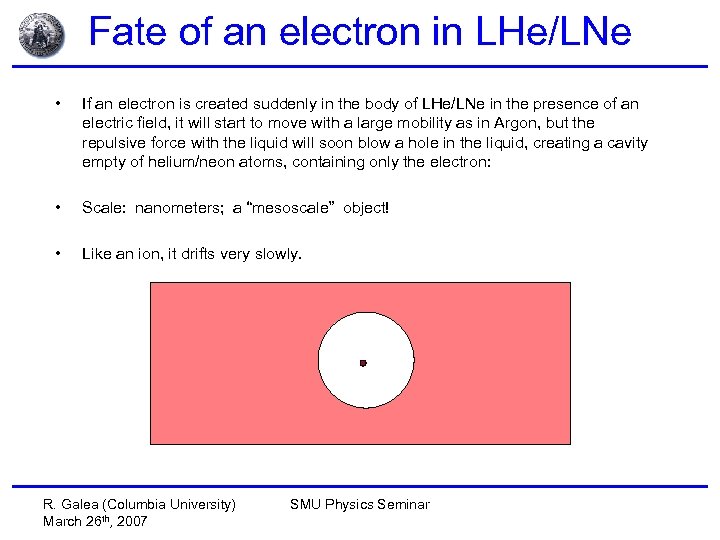 Fate of an electron in LHe/LNe • If an electron is created suddenly in the body of LHe/LNe in the presence of an electric field, it will start to move with a large mobility as in Argon, but the repulsive force with the liquid will soon blow a hole in the liquid, creating a cavity empty of helium/neon atoms, containing only the electron: • Scale: nanometers; a “mesoscale” object! • Like an ion, it drifts very slowly. R. Galea (Columbia University) March 26 th, 2007 SMU Physics Seminar
 Experimental approach: an electron bubble TPC • For a homogeneous medium, one dimension must use a drift → Time Projection technique • Slow drift (e. g. 10 cm/sec) of electron bubbles in these fluids allows high resolution in drift direction with moderate data rate • Signals “stored” in detector volume, and read out one plane at a time in drift direction, at a rate of 10’s-100’s Hz • Zero suppression in low-rate, low-background environment gives further large reduction in data rate • Depth measurement from diffusion broadening of track width s=sqrt(2 k. Td/e. E) • Need gain if we are to access ke. V energies → we have chosen Gas Electron Multipliers (GEMs) as the most promising avenue for our R&D program • Avalanche process in the GEMs offers both charge and light as potential bases for readout schemes – we are focusing on optical readout R. Galea (Columbia University) March 26 th, 2007 SMU Physics Seminar
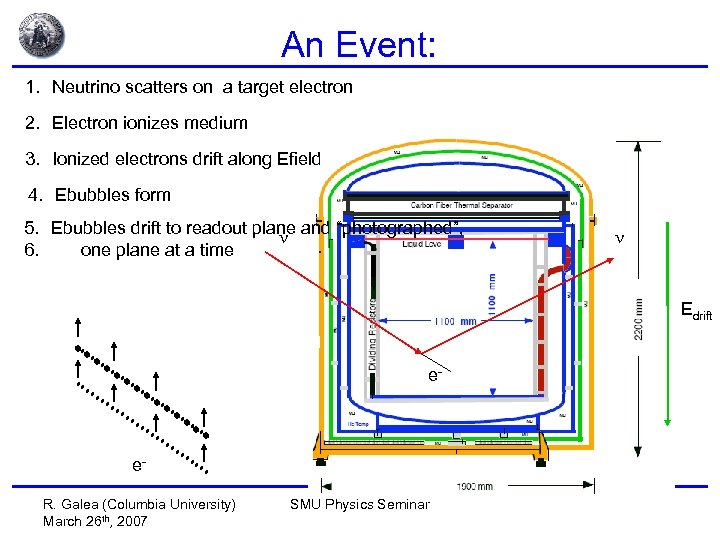 An Event: 1. Neutrino scatters on a target electron 2. Electron ionizes medium 3. Ionized electrons drift along Efield 4. Ebubbles form 5. Ebubbles drift to readout plane and “photographed”, n 6. one plane at a time n Edrift e- e. R. Galea (Columbia University) March 26 th, 2007 SMU Physics Seminar
 Backgrounds • No radioactive isotopes in detector medium • No solubility of heavier molecules in LHe, whereas H 2 dissolves in LNe (useful!) → impurities freeze out • Micropore filters shown to be effective in removing “dust” • Good energy and spatial resolution give powerful capability for recognizing “Compton clusters” of several scattered electrons from external γ’s in the Me. V range • Each secondary photon from successive scatters has a lower energy, and a decreased absorption length, leading to events with a number of scattering vertices easily recognized as a Compton cluster • Calculations indicate rejection factors of order 100’s – 1000’s, depending on the source and the fiducial cut → ongoing studies • Irreducible background from Me. V γ’s with (improbable) single scatters in the ke. V range in fiducial volume • Self-shielding, in LNe, effective for lower energy γ’s • 3 D-reconstruction defines fiducial volume – track width from diffusion gives reasonable depth measurement, in particular at top, where backgrounds from the readout plane can be cut R. Galea (Columbia University) March 26 th, 2007 SMU Physics Seminar
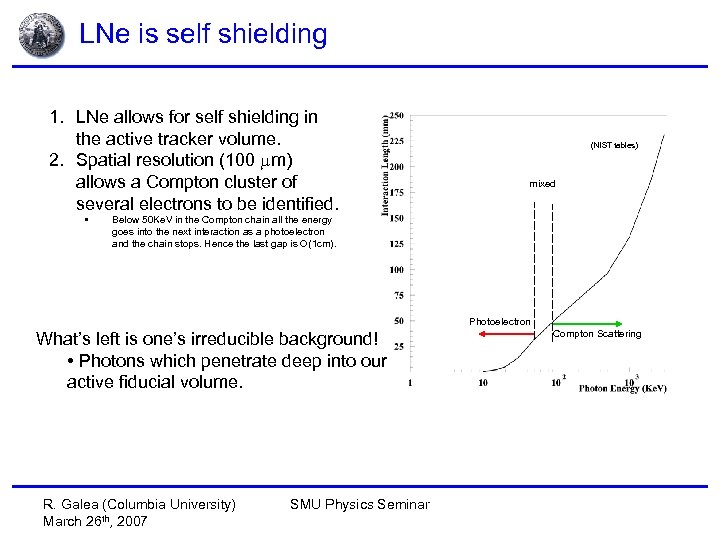 LNe is self shielding 1. LNe allows for self shielding in the active tracker volume. 2. Spatial resolution (100 mm) allows a Compton cluster of several electrons to be identified. • (NIST tables) mixed Below 50 Ke. V in the Compton chain all the energy goes into the next interaction as a photoelectron and the chain stops. Hence the last gap is O(1 cm). Photoelectron What’s left is one’s irreducible background! • Photons which penetrate deep into our active fiducial volume. R. Galea (Columbia University) March 26 th, 2007 SMU Physics Seminar Compton Scattering
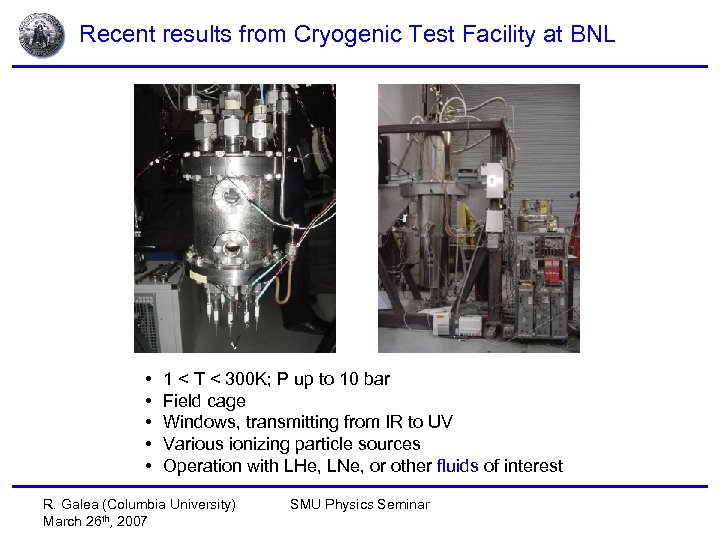 Recent results from Cryogenic Test Facility at BNL • • • 1 < T < 300 K; P up to 10 bar Field cage Windows, transmitting from IR to UV Various ionizing particle sources Operation with LHe, LNe, or other fluids of interest R. Galea (Columbia University) March 26 th, 2007 SMU Physics Seminar
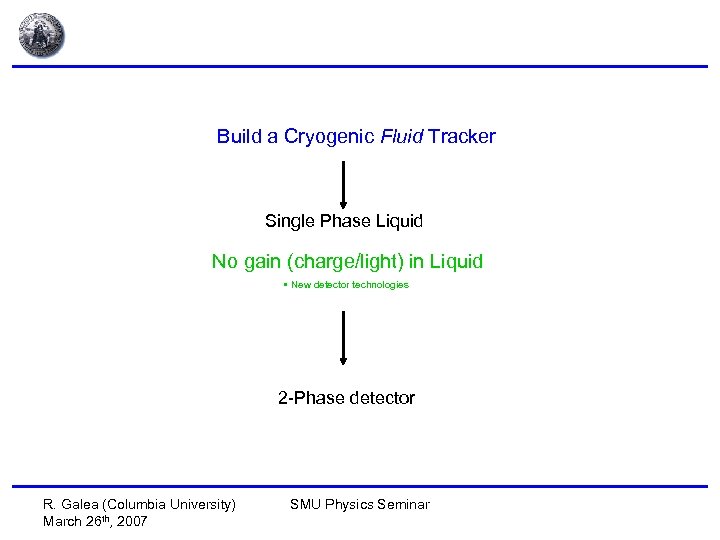 Build a Cryogenic Fluid Tracker Single Phase Liquid No gain (charge/light) in Liquid • New detector technologies 2 -Phase detector R. Galea (Columbia University) March 26 th, 2007 SMU Physics Seminar
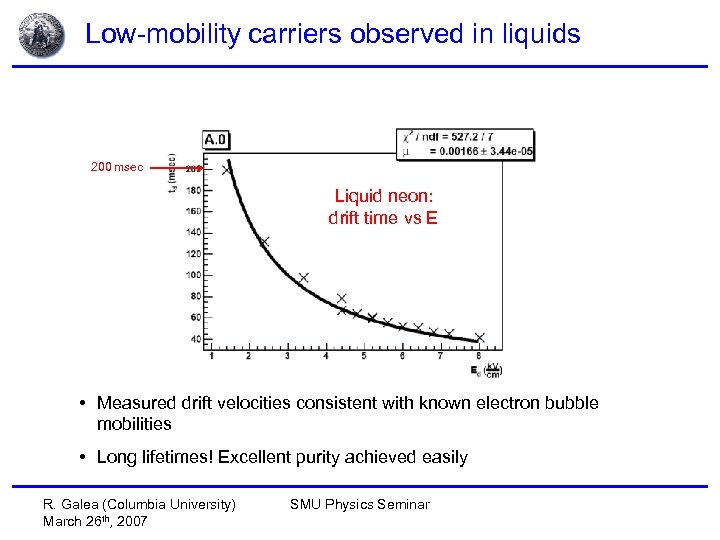 Low-mobility carriers observed in liquids 200 msec Liquid neon: drift time vs E • Measured drift velocities consistent with known electron bubble mobilities • Long lifetimes! Excellent purity achieved easily R. Galea (Columbia University) March 26 th, 2007 SMU Physics Seminar
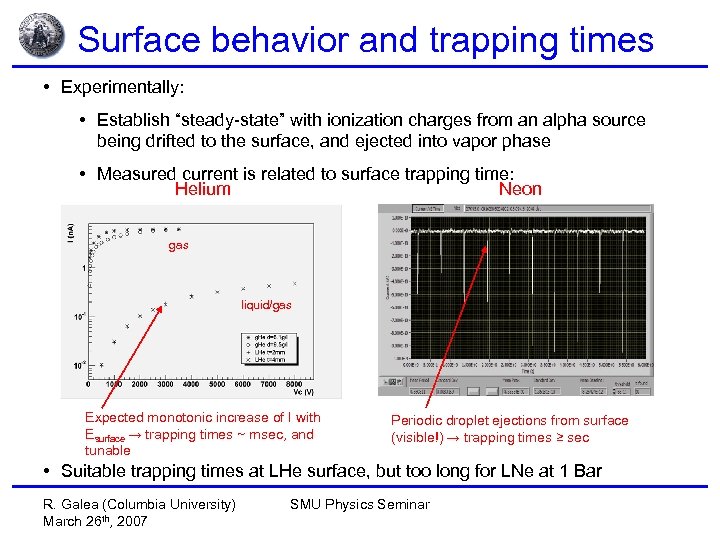 Surface behavior and trapping times • Experimentally: • Establish “steady-state” with ionization charges from an alpha source being drifted to the surface, and ejected into vapor phase • Measured current is related to surface trapping time: Helium Neon gas liquid/gas Expected monotonic increase of I with Esurface → trapping times ~ msec, and tunable Periodic droplet ejections from surface (visible!) → trapping times ≥ sec • Suitable trapping times at LHe surface, but too long for LNe at 1 Bar R. Galea (Columbia University) March 26 th, 2007 SMU Physics Seminar
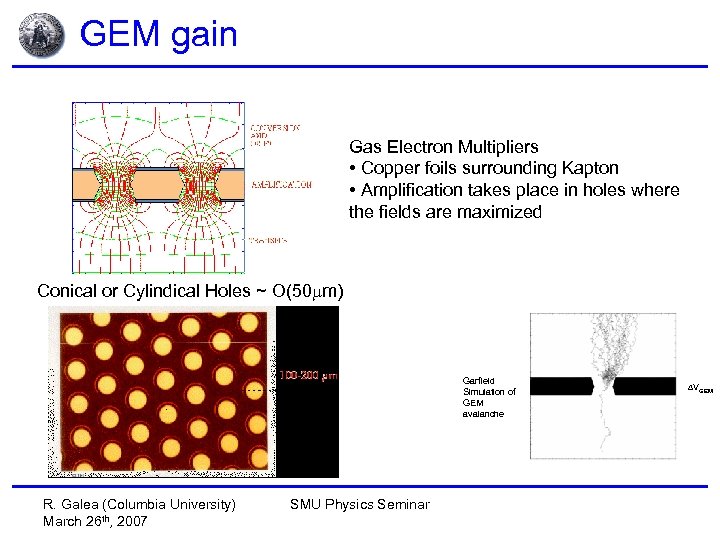 GEM gain Gas Electron Multipliers • Copper foils surrounding Kapton • Amplification takes place in holes where the fields are maximized Conical or Cylindical Holes ~ O(50 mm) Garfield Simulation of GEM avalanche R. Galea (Columbia University) March 26 th, 2007 SMU Physics Seminar DVGEM
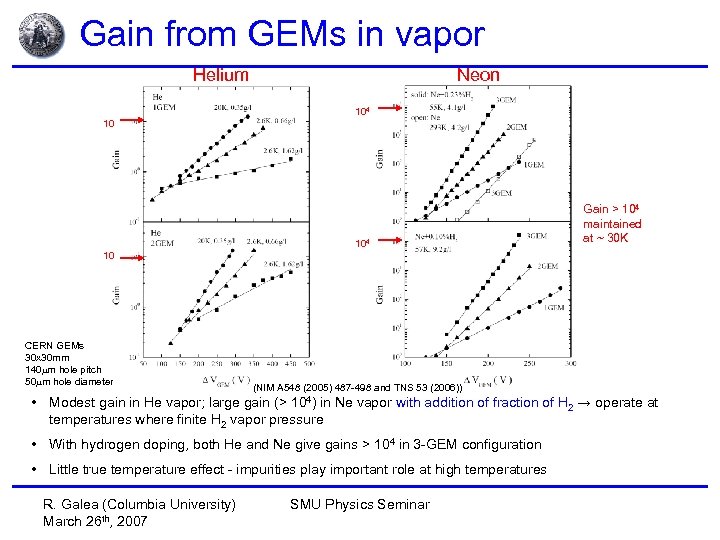 Gain from GEMs in vapor Helium Neon 104 10 104 Gain > 104 maintained at ~ 30 K 10 CERN GEMs 30 x 30 mm 140 mm hole pitch 50 mm hole diameter (NIM A 548 (2005) 487 -498 and TNS 53 (2006)) • Modest gain in He vapor; large gain (> 104) in Ne vapor with addition of fraction of H 2 → operate at temperatures where finite H 2 vapor pressure • With hydrogen doping, both He and Ne give gains > 104 in 3 -GEM configuration • Little true temperature effect - impurities play important role at high temperatures R. Galea (Columbia University) March 26 th, 2007 SMU Physics Seminar
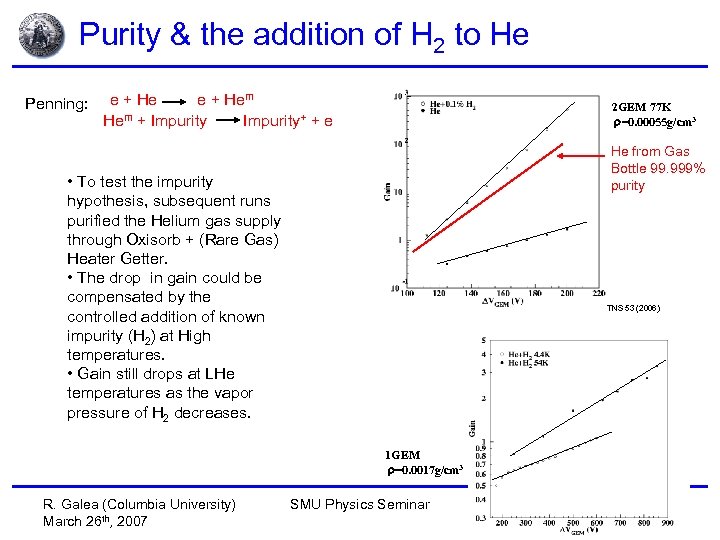 Purity & the addition of H 2 to He Penning: e + Hem Hem + Impurity+ + e 2 GEM 77 K r=0. 00055 g/cm 3 He from Gas Bottle 99. 999% purity • To test the impurity hypothesis, subsequent runs purified the Helium gas supply through Oxisorb + (Rare Gas) Heater Getter. • The drop in gain could be compensated by the controlled addition of known impurity (H 2) at High temperatures. • Gain still drops at LHe temperatures as the vapor pressure of H 2 decreases. TNS 53 (2006) 1 GEM r=0. 0017 g/cm 3 R. Galea (Columbia University) March 26 th, 2007 SMU Physics Seminar
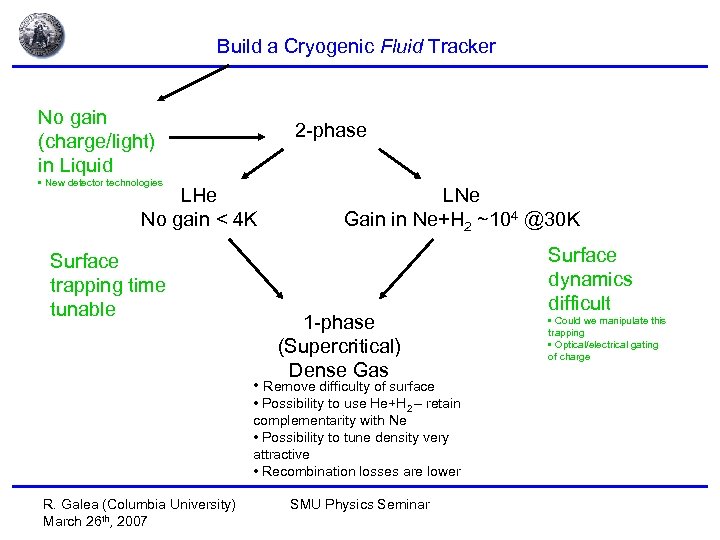 Build a Cryogenic Fluid Tracker No gain (charge/light) in Liquid • New detector technologies 2 -phase LHe No gain < 4 K Surface trapping time tunable LNe Gain in Ne+H 2 ~104 @30 K 1 -phase (Supercritical) Dense Gas • Remove difficulty of surface • Possibility to use He+H 2 – retain complementarity with Ne • Possibility to tune density very attractive • Recombination losses are lower R. Galea (Columbia University) March 26 th, 2007 SMU Physics Seminar Surface dynamics difficult • Could we manipulate this trapping • Optical/electrical gating of charge
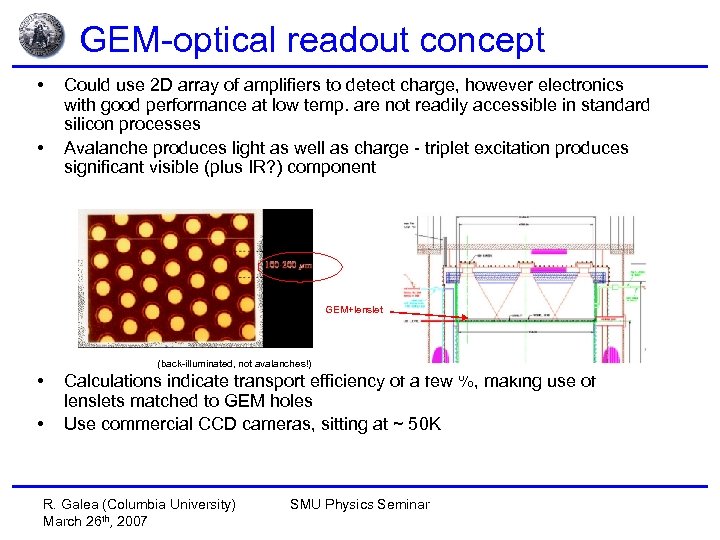 GEM-optical readout concept • • Could use 2 D array of amplifiers to detect charge, however electronics with good performance at low temp. are not readily accessible in standard silicon processes Avalanche produces light as well as charge - triplet excitation produces significant visible (plus IR? ) component GEM+lenslet (back-illuminated, not avalanches!) • • Calculations indicate transport efficiency of a few %, making use of lenslets matched to GEM holes Use commercial CCD cameras, sitting at ~ 50 K R. Galea (Columbia University) March 26 th, 2007 SMU Physics Seminar
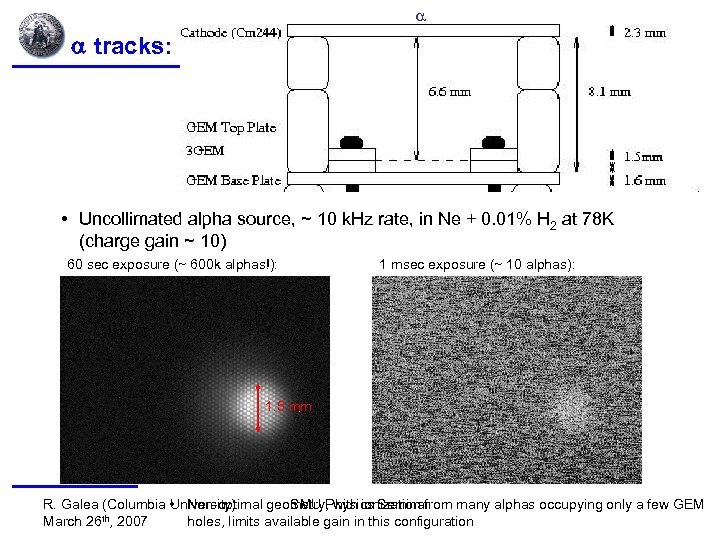 a tracks: • Uncollimated alpha source, ~ 10 k. Hz rate, in Ne + 0. 01% H 2 at 78 K (charge gain ~ 10) 60 sec exposure (~ 600 k alphas!): 1 msec exposure (~ 10 alphas): 1. 5 mm R. Galea (Columbia • Non-optimal geometry, with ionization from many alphas occupying only a few GEM University) SMU Physics Seminar th, 2007 March 26 holes, limits available gain in this configuration
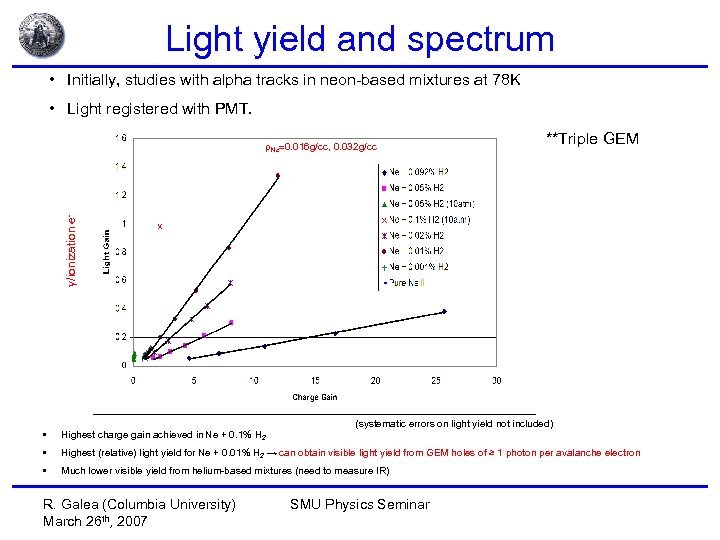 Light yield and spectrum • Initially, studies with alpha tracks in neon-based mixtures at 78 K • Light registered with PMT. **Triple GEM γ/ionization e- r. Ne=0. 016 g/cc, 0. 032 g/cc (systematic errors on light yield not included) • Highest charge gain achieved in Ne + 0. 1% H 2 • Highest (relative) light yield for Ne + 0. 01% H 2 → can obtain visible light yield from GEM holes of ≥ 1 photon per avalanche electron • Much lower visible yield from helium-based mixtures (need to measure IR) R. Galea (Columbia University) March 26 th, 2007 SMU Physics Seminar
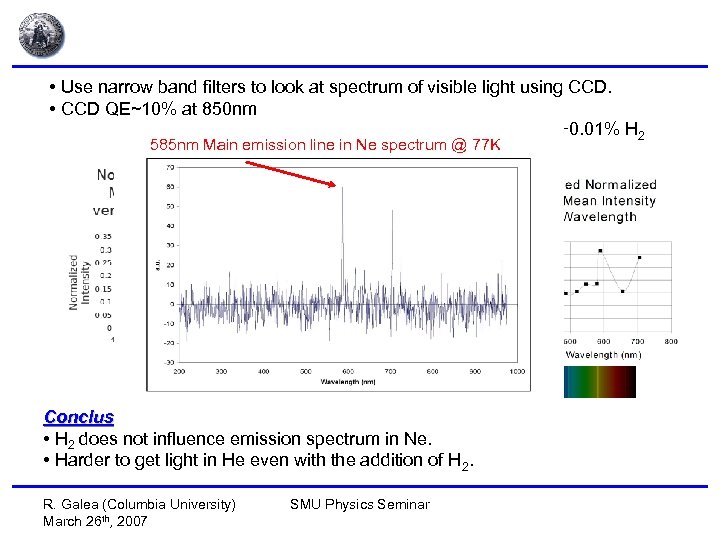 • Use narrow band filters to look at spectrum of visible light using CCD. • CCD QE~10% at 850 nm Ne+0. 1% H 2 Ne+0. 01% H 2 He+0. 01% H 2 585 nm Main emission line in Ne spectrum @ 77 K Conclusions: • H 2 does not influence emission spectrum in Ne. • Harder to get light in He even with the addition of H 2. R. Galea (Columbia University) March 26 th, 2007 SMU Physics Seminar
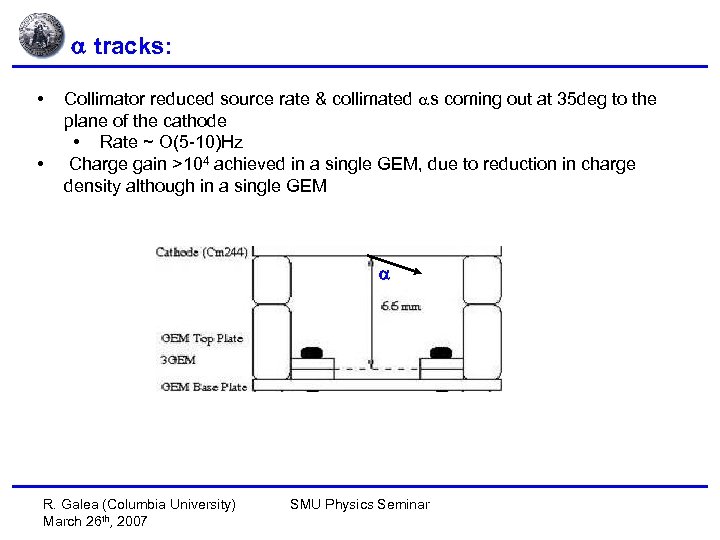 a tracks: • • Collimator reduced source rate & collimated s coming out at 35 deg to the plane of the cathode • Rate ~ O(5 -10)Hz Charge gain >104 achieved in a single GEM, due to reduction in charge density although in a single GEM a R. Galea (Columbia University) March 26 th, 2007 SMU Physics Seminar
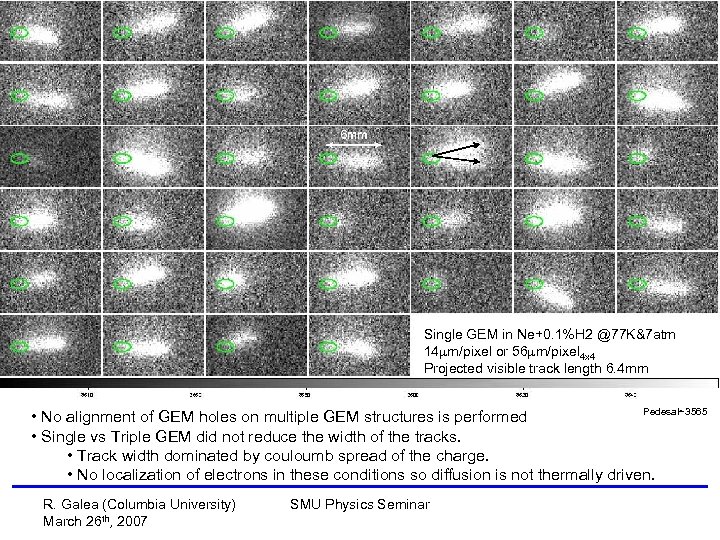 Single GEM in Ne+0. 1%H 2 @77 K&7 atm 14 mm/pixel or 56 mm/pixel 4 x 4 Projected visible track length 6. 4 mm Pedesal~3565 • No alignment of GEM holes on multiple GEM structures is performed • Single vs Triple GEM did not reduce the width of the tracks. • Track width dominated by couloumb spread of the charge. • No localization of electrons in these conditions so diffusion is not thermally driven. R. Galea (Columbia University) March 26 th, 2007 SMU Physics Seminar
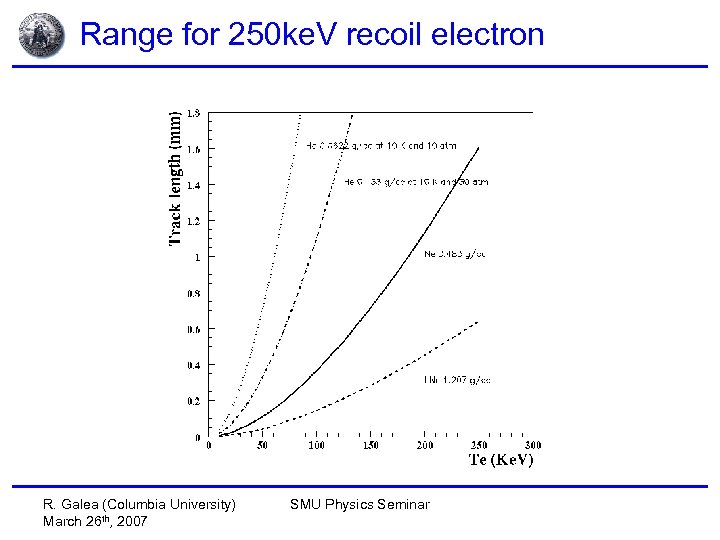 Range for 250 ke. V recoil electron R. Galea (Columbia University) March 26 th, 2007 SMU Physics Seminar
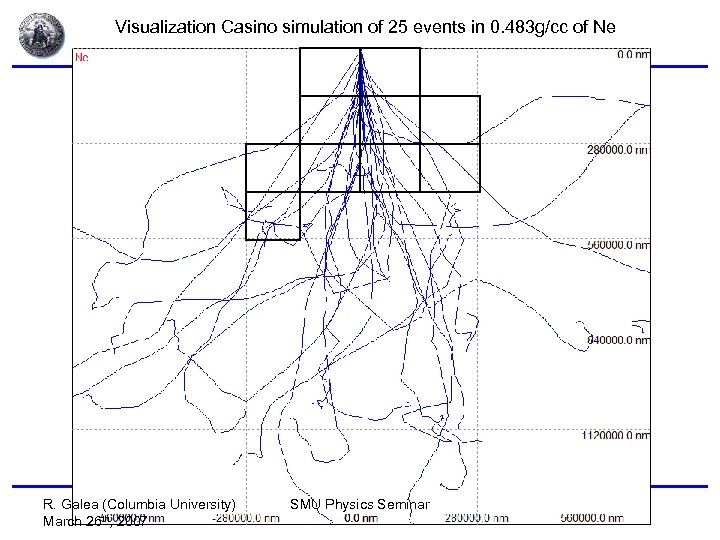 Visualization Casino simulation of 25 events in 0. 483 g/cc of Ne R. Galea (Columbia University) March 26 th, 2007 SMU Physics Seminar
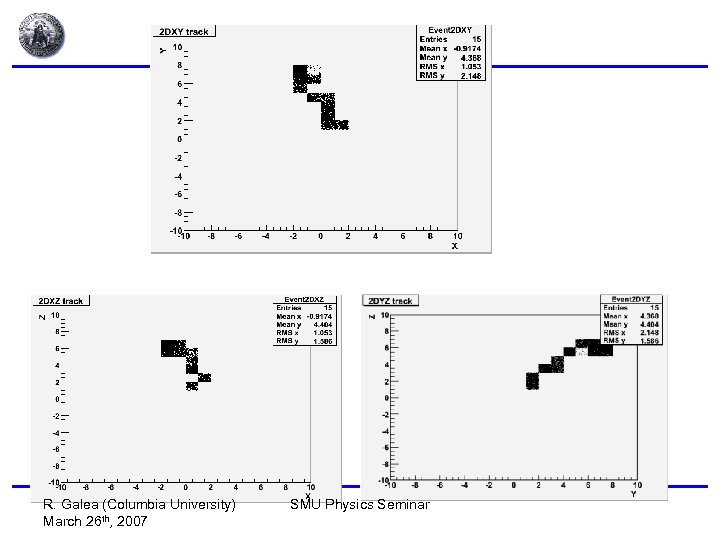
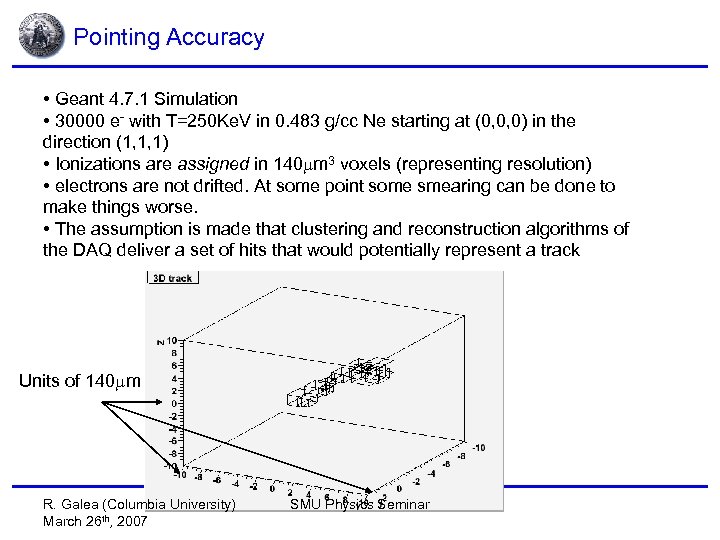 Pointing Accuracy • Geant 4. 7. 1 Simulation • 30000 e- with T=250 Ke. V in 0. 483 g/cc Ne starting at (0, 0, 0) in the direction (1, 1, 1) • Ionizations are assigned in 140 mm 3 voxels (representing resolution) • electrons are not drifted. At some point some smearing can be done to make things worse. • The assumption is made that clustering and reconstruction algorithms of the DAQ deliver a set of hits that would potentially represent a track Units of 140 mm R. Galea (Columbia University) March 26 th, 2007 SMU Physics Seminar
 R. Galea (Columbia University) March 26 th, 2007 SMU Physics Seminar
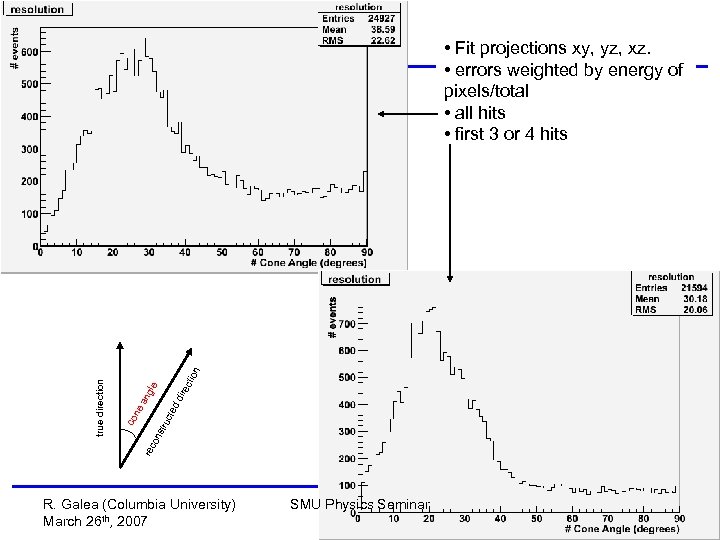 tio ec on str uc ted dir gle an ne rec co true direction n • Fit projections xy, yz, xz. • errors weighted by energy of pixels/total • all hits • first 3 or 4 hits R. Galea (Columbia University) March 26 th, 2007 SMU Physics Seminar
 Summary of R&D results to date • Localized carriers observed in LHe, LNe – long drift times (at least 200 msec) measured, confirming high purity of fluids • Measurements of surface transfer show suitable trapping times for LHe, but inconveniently long times for LNe, at least at 27 K → higher temperatures, or single-phase medium if Ne • Large, stable gains, up to 104, available in GEM structures, with small fraction (0. 01 – 0. 1%) of H 2 → operating temperatures above ~ 10 K → single-phase medium if He • Can achieve visible photon yields of > 1 photon per avalanche electron from GEM holes in neon-based gas mixtures • Visible light yields from helium-based mixtures lower – need to measure IR yield (normal helium discharge has a bright line at ~ 1 μm) • Successful initial CCD imaging of alpha tracks at cryogenic temperatures – individual track images very soon, followed by verification with electron tracks at T ~ 30 -40 K R. Galea (Columbia University) March 26 th, 2007 SMU Physics Seminar
 Baseline: supercritical neon • Initial ideas based on two-phase detector: • Insufficient gain in vapor phase for He • Trapping time at surface too long for Ne at 1 Bar • Single-phase supercritical fluid: • Electrons are still localized and thermal • Removes difficulties of surface • Ability to tune density very attractive • Recombination losses lower • Supercritical neon: • Density ~ 0. 48 g/cc (T ~ 45 K, P ~ 26 bar) → electron mobility ~ 6 x 10 -2 cm 2 sec-1 V-1 • Recoil track lengths for pp neutrinos up to ~ 2 mm • Keep option to run with supercritical helium: longer/straighter tracks, pointing for lower energies, systematic checks; but smaller target mass and reduced self- shielding R. Galea (Columbia University) March 26 th, 2007 SMU Physics Seminar
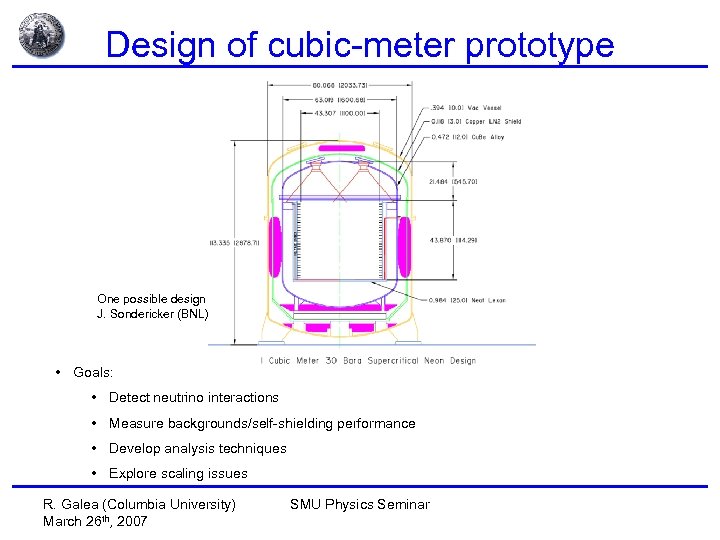 Design of cubic-meter prototype One possible design J. Sondericker (BNL) • Goals: • Detect neutrino interactions • Measure backgrounds/self-shielding performance • Develop analysis techniques • Explore scaling issues R. Galea (Columbia University) March 26 th, 2007 SMU Physics Seminar
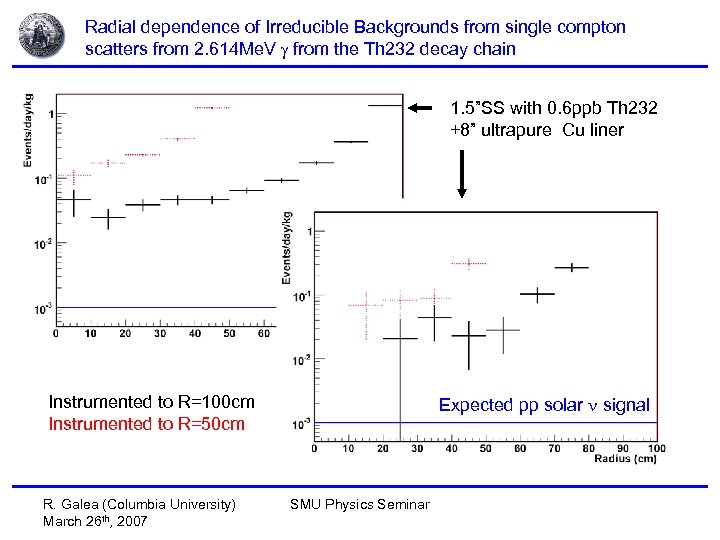 Radial dependence of Irreducible Backgrounds from single compton scatters from 2. 614 Me. V from the Th 232 decay chain 1. 5”SS with 0. 6 ppb Th 232 +8” ultrapure Cu liner Instrumented to R=100 cm Instrumented to R=50 cm R. Galea (Columbia University) March 26 th, 2007 Expected pp solar n signal SMU Physics Seminar
 Conclusions • Good progress in measuring fundamental parameters for an electron bubble TPC detector • Next steps: • Measurements and imaging in supercritical Ne (He) • Supercritical Ne will require an upgrade to existing infrastructure • But existing Test Chamber can demonstrate ebubble behavior in GEM avalanche in critical density He • Continued R&D on optical readout based on lenslets and CCD camera → goal is full 3 D track reconstruction with electron bubbles/slow drift • Ongoing development of the cubic-meter prototype – small enough to be transportable, with test phase at BNL before move to an underground site • Techniques we are developing may be useful for a range of other applications requiring measurement (tracking) of very small signals in large volume detectors • Dark Matter • Coherent neutrino scattering • Double Beta decay R. Galea (Columbia University) March 26 th, 2007 SMU Physics Seminar
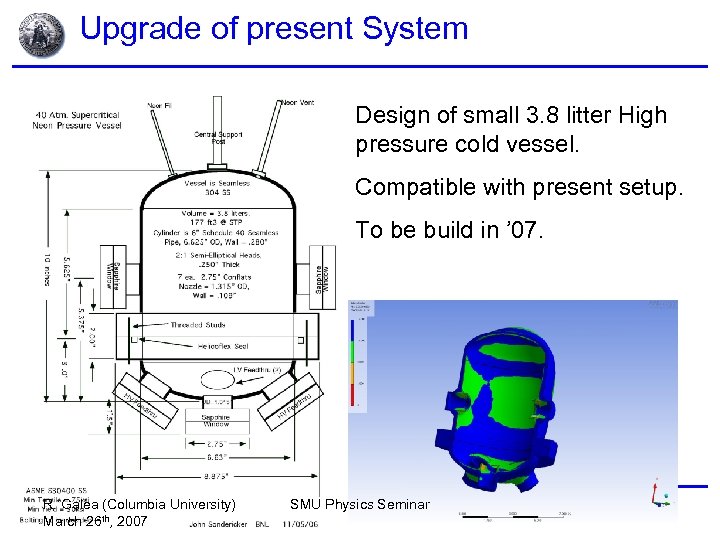 Upgrade of present System Design of small 3. 8 litter High pressure cold vessel. Compatible with present setup. To be build in ’ 07. R. Galea (Columbia University) March 26 th, 2007 SMU Physics Seminar
 R. Galea (Columbia University) March 26 th, 2007 SMU Physics Seminar