


 Скачать презентацию Development of a UHF Passive RFID System LSCM
5ff26bce0981ca7f53527c785d5aab9e.ppt
- Количество слайдов: 37
 Development of a UHF Passive RFID System LSCM Technology Transfer Forum Science Park, Cyber Port Edward Kai-Ning Yung City University of Hong Kong 25 August, 2010 1
 Budget Innovation and Technology Fund, Hong Kong SAR Government April 2005 - March 2007 : $4, 600, 000 Industrial Sponsorship: $500, 000 City University of Hong Kong: $920, 000 2
 Industrial Sponsors Surface Mount Technology Company Limited, Hong Kong Gold. Tel Electronics Company Limited, Shenzhen 3
 Aims Ø Strengthen Hong Kong as the center of logistics management in the region Ø Demonstrate that Hong Kong is also a worldclass center of technological innovation Ø Resurrect Hong Kong as a premium center of engineering supports 4
 RFID Era RFID has been identified by the national government as an area of intensive development RFID has also been identified by the federal government of USA as an area of intensive development RFID is the technology driver in the coming decades, similar to telephone, computer, network, and mobile phone in the last century 5
 From Strength to Strength Ø Electronic article surveillance system for retail outlets: passive, 143. 2 k. Hz, 1 -bit Ø Autotoll system, semi-active system, 2450 MHz Ø Octopus system: passive, 13. 56 MHz Ø Container port & containers: active, 433 MHz Ø Baggage handling system in the Hong Kong Airport: passive, 900 MHz 6
 Hi-Tech in Hong Kong Ø Hong Kong is an ideal site for field-testing novel applications of new technologies, such as RFID Ø Although all technologies are imported, some of the home-grown RFID systems have been recognized as the pioneer and the world leader in their respective areas Ø Without a home-grown technology, it is very difficult to export our system and recover part of the cost of development 7
 Objectives Ø Tailor-make a new RFID system for libraries Ø Develop a RFID reader with unique features Ø Design the needed antennas and other critical components/devices Ø Devise value-added features for libraries 8
 Design from Scratch Develop a new RFID system from scratch with Ø in-house developed critical components Ø innovative modules with discrete components Ø some of the key circuits packaged in RFIC Ø system integration Ø implementation, and Ø in-situ field testing 9
 RFID Library Ø Books and multi-media disks are relatively homogeneous in nature and in size, it is easier to implement a RFID system, comparatively Ø These items are not very expensive, a few errors are tolerable Ø They are not very cheap; thus, the high cost of implementation is justified Ø New features developed for libraries could be applied in other areas of logistics management 10
 Edges in Competition Besides an import replacement, our design is Ø affordable, efficient, reliable, robust, userfriendly, and culturally independent Ø environmental friendly physically and psychologically safe downward and laterally compatible Ø Ø Most important of all, there ample rooms left for modification; thus, it could easily be adopted in other applications 11
 UHF verses HF Ø UHF and HF technologies are equally mature Ø High-gain resonant UHF antenna is feasible Ø Unlike UHF ones, HF RFID tag could only be used for gaining access Ø With a longer range of coverage, UHF RFID makes detection, trace-and-track, real-time location/search, surveillance, eavesdropping, and other processes possible. Compared with a HF system, it is a role-reversal 12
 Active verses Passive Compared with an active one, the pros and cons of a passive RFID system are: Ø its tags are smaller, lighter, and cheaper; they could be used indefinitely without change of battery Ø its reader is large and very expensive Ø its range of coverage is relatively short Ø its operation decrees a strong EM field and the feedback signal is vulnerable to noises; thus, it allows little room for modification 13
 UHF RFID Mandate With a unique ID number, UHF passive RFID is the natural extension of the popular bar-code system; it has been adopted by the EPC of the United States: Ø A passive tag is required in every pallet to be shipped to the States Ø The requirement is later extended to every carton Ø Eventually, a tag must be embedded in every item to be sold in retail stores 14
 Market Survey Ø The readers are very expensive Ø Most readers are very large, so are the antennas Ø The take-it-or-leave-it reader allows no room for alteration Ø Early tags could not meet the market demands; they are frequently upgraded Ø New reader must be bought for every upgrade 15
 Potential Health Hazard Ø Without license, the output power of a reader could be as high as 4 W for a range of 8 meters Ø For detection, the reader must be turned on at all time; thus, operators working in a library are subject to prolonged exposure to a strong nonionization radiation Ø With the proliferation of wireless gadgets, the public is annoyed by the sight of many antennas and psychological illnesses are resulted 16
 Observations Ø Some of the FCC requirements may have been overspecified for applications in Hong Kong, such as the capacity of 200 tags and the speed of 30 tags/sec Ø Most readers use one antenna for transmitting a high power for energizing the tags and for picking up the feedback signals. To separate the out-going and the in-coming signals of >60 d. B in rating, an expensive isolator is needed Ø As the waves scattered from the tags are very difficult to predict, the signal picked up by one antenna is not reliable 17
 Interferences Ø For convenience, most readers are put on-top of a desk or installed on the wall of an entrance; thus, it is vulnerable to intra-system and intersystem interferences Ø Interruption of services may arise from the fixed-wire connection in terms of surge currents and static charges 18
 Access Control 19
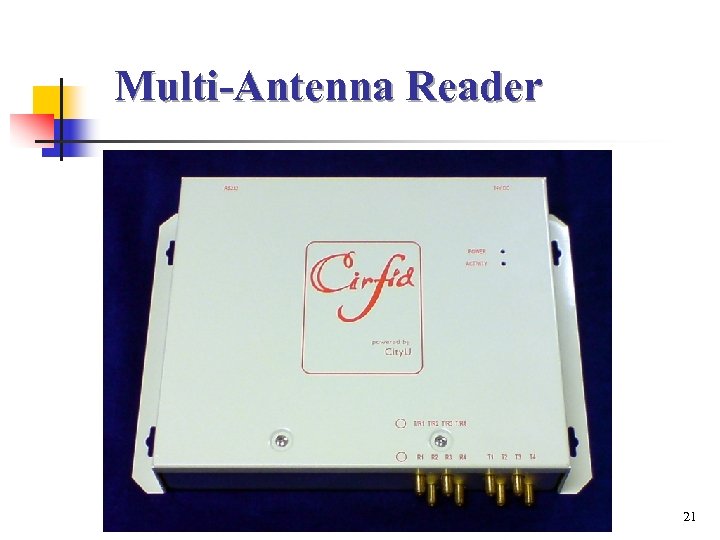
 Remedy Ø A reader is custom-designed to handle the less demanding capacity and the slower speed of detection Ø The paths of transmission and feedback are separated after the synchronization process Ø While one antenna is used for energizing the tags, multiple antennas are strategically installed around the tag-to-be-detected for picking up the scattered signals, collectively 20
 Multi-Antenna Reader 21
 Critical Components Ø Expensive components such as the high power voltage-controlled oscillator are custom-designed in an application-specific RFIC Ø An efficient low-noise amplifier and other frontend components are packaged in another RFIC for installation near the pick-up antenna Ø Instead of putting all circuits in one RFIC, discrete components are used strategically such that later modifications are made possible 22
 New Configuration Ø The antenna is installed upside down Ø In this orientation, interferences from mobile phones and other wireless gadgets are reduced Ø The antenna is camouflaged as a decorative lighting for relieving the operator’s anxiety Ø The reader is turned on by a motion detector 23
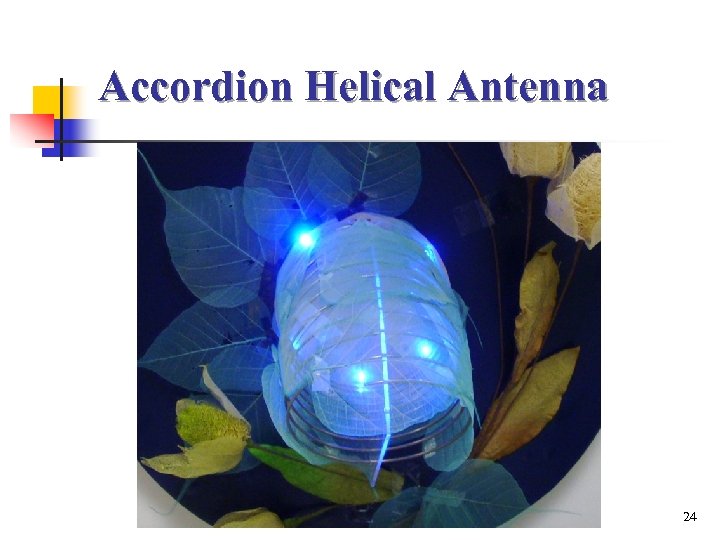 Accordion Helical Antenna 24
 Interference Containment Ø High gain helical antenna with small side lobes is used to contain intra-system interference Ø Ferrite tiles are placed under the antenna to absorb the excessive electromagnetic waves Ø A middleware is included inside every reader for buffering the computer network in the library and our network of RFID readers 25
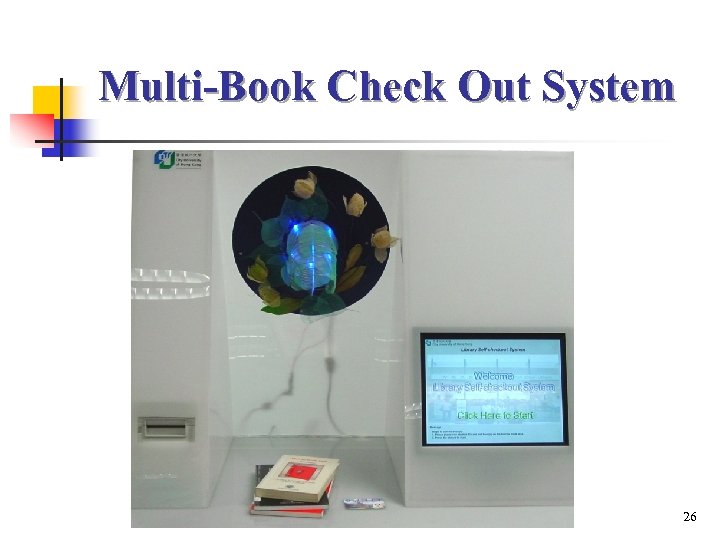 Multi-Book Check Out System 26
 Handheld Reader Ø A handheld reader is used to read tags missed by the array of fixed antennas Ø Communication between the principle reader and a handheld reader is established via a blue-tooth link Ø As the handheld reader provides no power of excitation, the required battery pack could be significantly reduced, and the resultant device is light in weight 27
 Value-added Services Ø Multiple-book check out system Ø Multiple-book return Ø Book sorter Ø Self service library Ø Smart book shelf/book bin Ø Compact book storage system 28
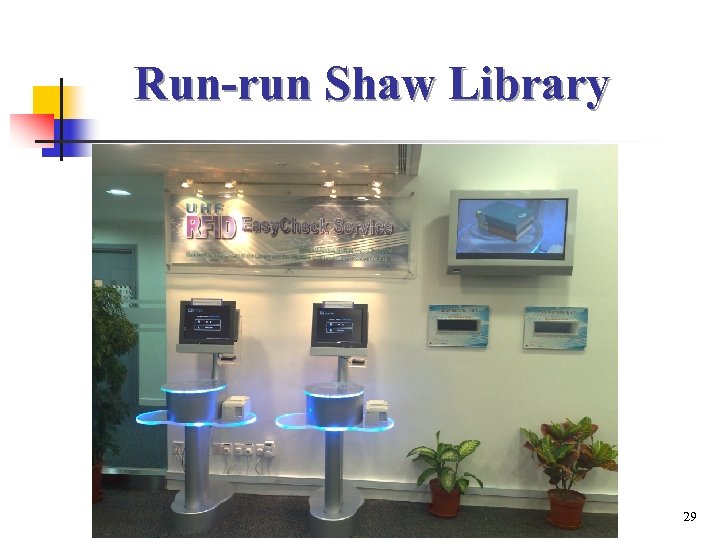 Run-run Shaw Library 29
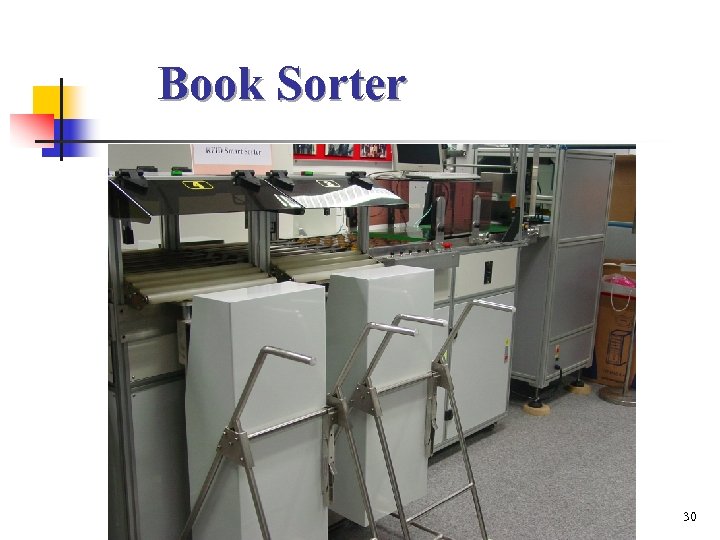 Book Sorter 30
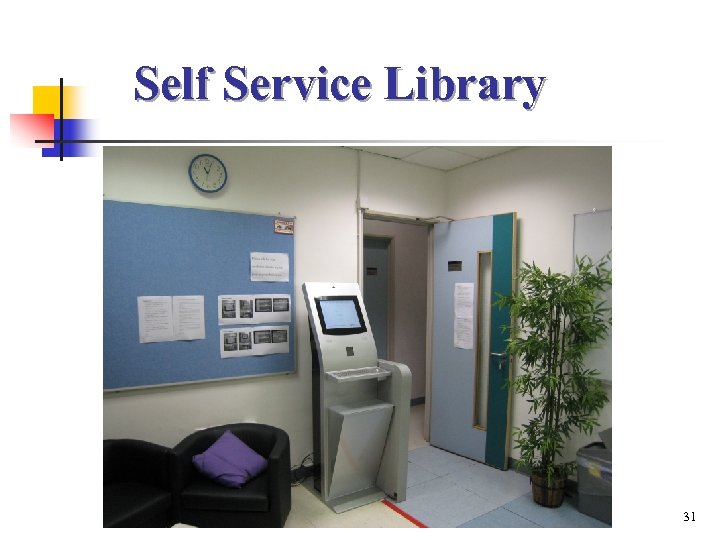 Self Service Library 31
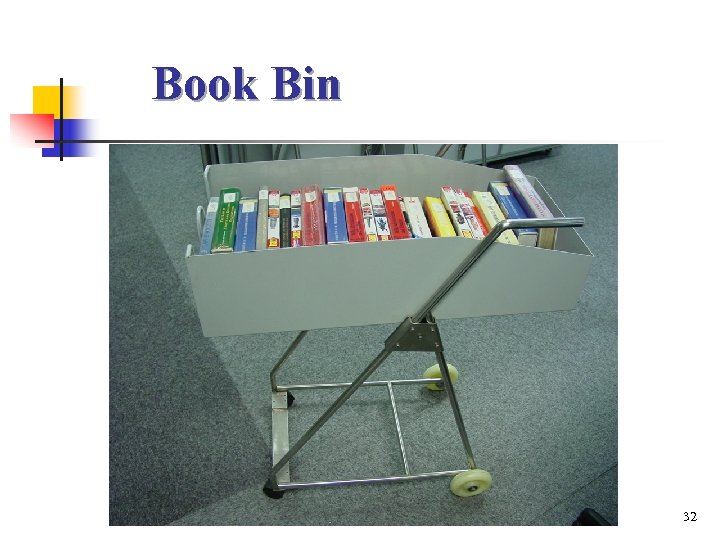 Book Bin 32
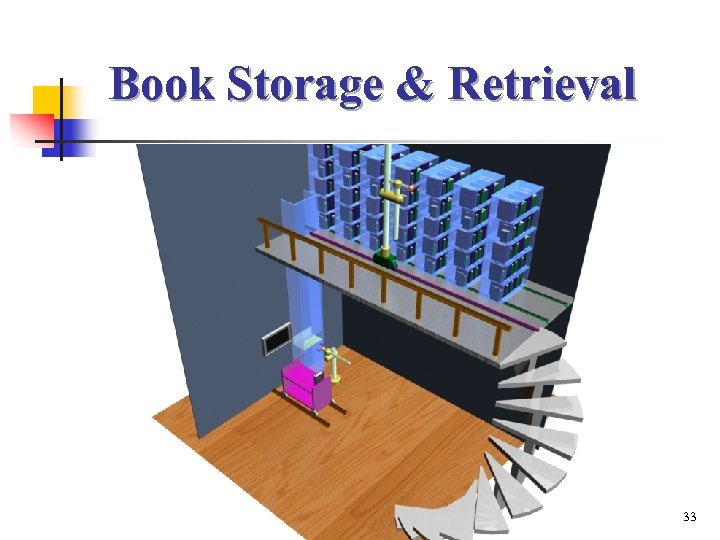 Book Storage & Retrieval 33
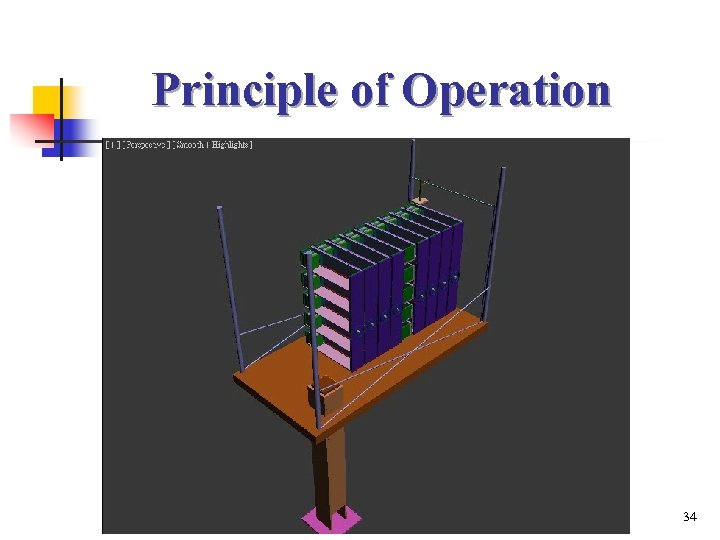 Principle of Operation 34
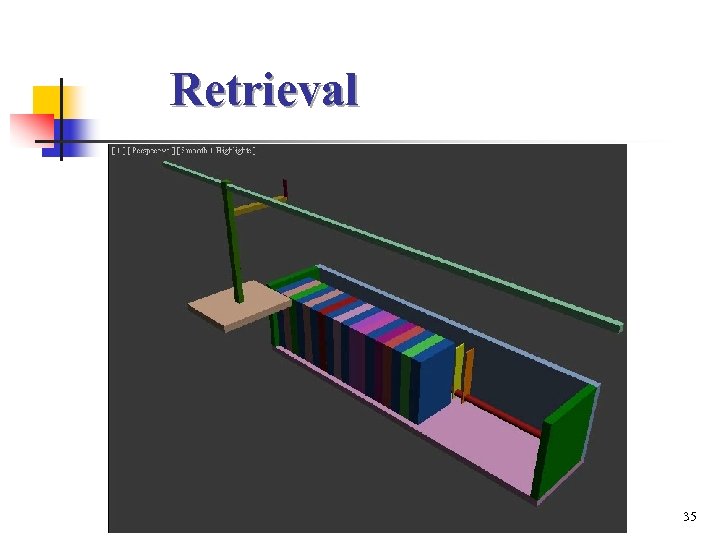 Retrieval 35
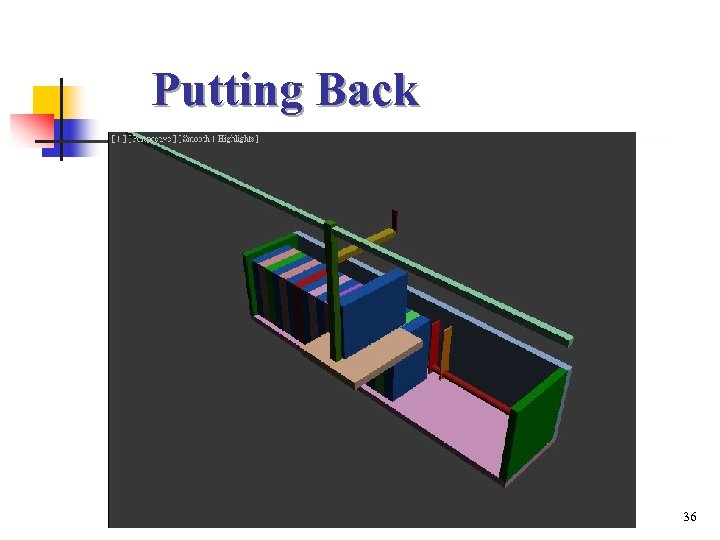 Putting Back 36
 Thank You Questions & Answers 37