


 Скачать презентацию Development of a Transit Model Incorporating the Effects
7f89f283474e9e766d523be43b958107.ppt
- Количество слайдов: 29
 Development of a Transit Model Incorporating the Effects of Accessibility and Connectivity 9 th Conference on the Application of Transportation Planning Methods Baton Rouge, Louisiana April 6 -10, 2003
 Research Team Ø Ram M. Pendyala Dept of Civil & Environmental Engineering, Univ of South Florida, Tampa Ø Steve Polzin & Xuehao Chu Center for Urban Trans Research (CUTR), Univ of South Florida, Tampa Ø Seongsoon Yun Gannett Fleming, Inc. , Tampa Ø Fadi Nassar Keith & Schnars PA, Fort Lauderdale Ø Project Manager: Ike Ubaka Public Transit Office, Florida Dept of Transportation, Tallahassee Ø Programming Services: Gannett Fleming, Inc.
 Outline Ø Background Ø History of transit model development in Florida Ø BEST 3. 0: Third generation transit model system Ø Role of accessibility and connectivity Ø BEST 3. 0 methodology Ø Accessibility/connectivity methodology Ø Model development v Data v Estimation v Application
 Background Ø Transit systems planning and analysis v Accessibility v Availability v Quality of Service v Ridership v Temporal Characteristics v Transfers v Route/Network Design v Fare Policies and Structure v Alternative Modal Options/Technologies/Route Types v Disaggregate Stop-Level Analysis
 History of Transit Model Development Ø FDOT Public Transit Office very proactive in transit planning tool development Ø TLOS, FTIS, and INTDAS examples of transit planning and information tools Ø Transit ridership modeling tools v ITSUP: Integrated Transit Demand & Supply Model v RTFAST: Regional Transit Feasibility Analysis & Simulation Tool Ø Powerful stop-level ridership forecasting models
 Stop-Level Ridership Forecasting Ø First generation ITSUP sensitive to demographic variables and frequency and fare of service Ø Second generation RTFAST accounted also for network connectivity (destination possibilities) Ø Desire transit ridership forecasting model that accurately accounts for accessibility/connectivity Ø Third generation model called BEST 3. 0 v Boardings Estimation and Simulation Tool
 BEST 3. 0 Ø Model estimates number of boardings at stop by: v Route v Direction v Time period Ø Model estimates two types of boardings: v Direct Boardings: Walk and Bike Access v Transfer Boardings: Transit Access
 Separating Direct and Transfer Boardings Ø Consider two types of stops, i. e. , stops with no transfer possibility and transfer stops Ø Estimate direct boardings model using data from non-transfer stops Ø Apply direct boardings model to transfer stops to estimate direct boardings at transfer stops Ø Subtract estimated direct boardings from total boardings to estimate transfer boardings Ø Then estimate transfer boardings model
 Role of Accessibility and Connectivity Ø Transit ridership strongly affected b y: v Destination accessibility v Temporal availability v Network connectivity Ø Desire to have BEST 3. 0 sensitive to all three aspects of transit accessibility Ø Ability to test effects of alternative route and network design configurations on transit boardings Ø Sophisticated methodology incorporated into BEST 3. 0
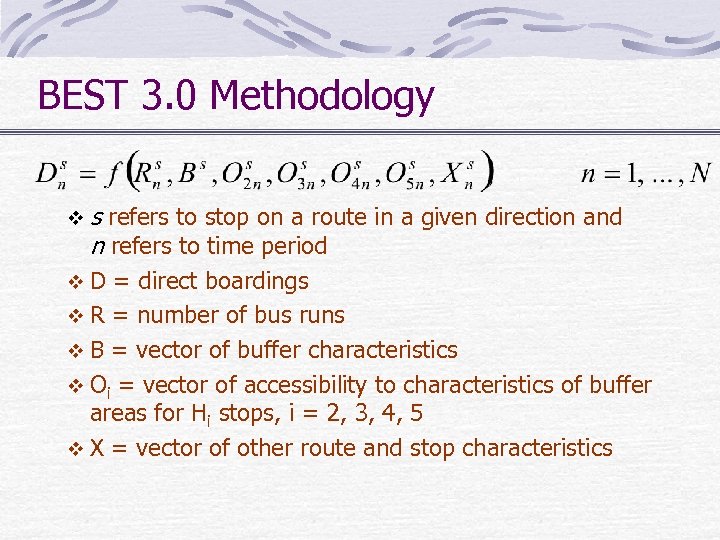 BEST 3. 0 Methodology vs refers to stop on a route in a given direction and n refers to time period v D = direct boardings v R = number of bus runs v B = vector of buffer characteristics v Oi = vector of accessibility to characteristics of buffer areas for Hi stops, i = 2, 3, 4, 5 v X = vector of other route and stop characteristics
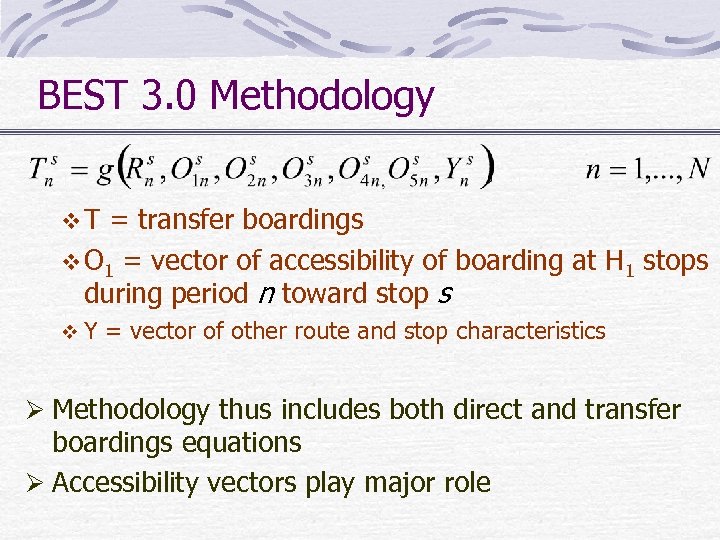 BEST 3. 0 Methodology v. T = transfer boardings v O 1 = vector of accessibility of boarding at H 1 stops during period n toward stop s v. Y = vector of other route and stop characteristics Ø Methodology thus includes both direct and transfer boardings equations Ø Accessibility vectors play major role
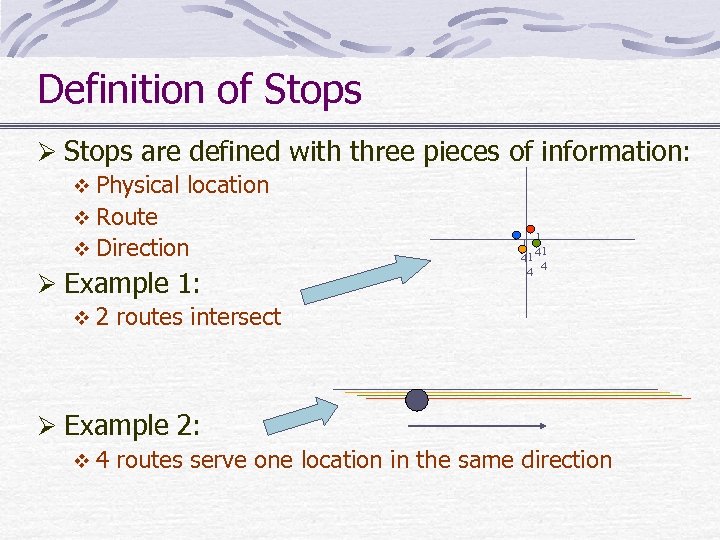 Definition of Stops Ø Stops are defined with three pieces of information: v Physical location v Route v Direction Ø Example 1: v 2 1 1 41 41 4 4 routes intersect Ø Example 2: v 4 routes serve one location in the same direction
 Neighboring Stops Ø N 1 = Neighboring stops along the same route Ø N 2 = Stops along the same route but in the opposite direction that lead to different destinations providing the same opportunities. Ø N 3 = Neighboring stops along other routes that lead to different destinations providing access to opportunities for the same activities. Ø N 4 = Neighboring stops along other routes that lead to the same destinations. These routes may or may not share the same roads with the particular route in question
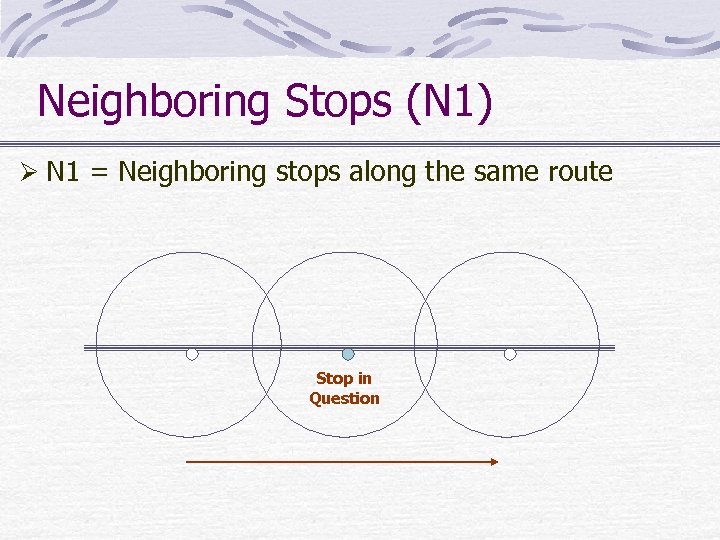 Neighboring Stops (N 1) Ø N 1 = Neighboring stops along the same route Stop in Question
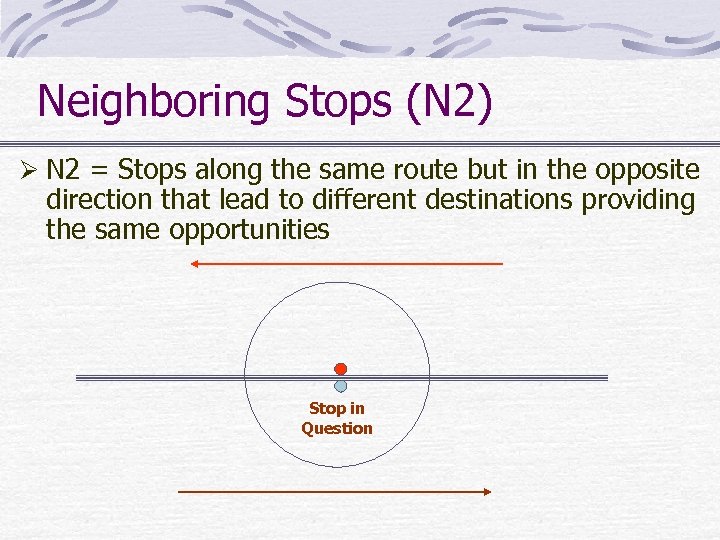 Neighboring Stops (N 2) Ø N 2 = Stops along the same route but in the opposite direction that lead to different destinations providing the same opportunities Stop in Question
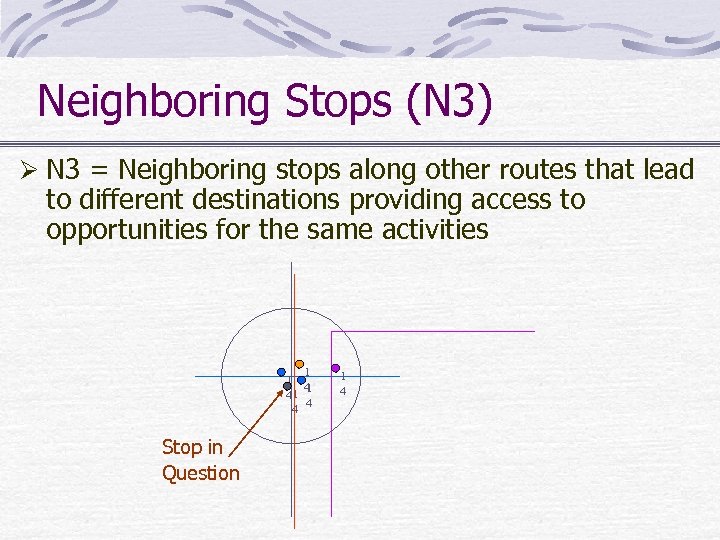 Neighboring Stops (N 3) Ø N 3 = Neighboring stops along other routes that lead to different destinations providing access to opportunities for the same activities 1 1 41 4 4 Stop in Question 1 4
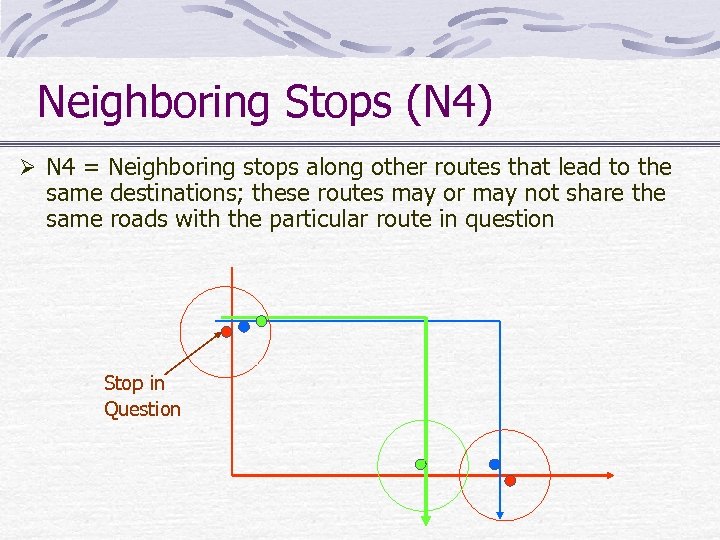 Neighboring Stops (N 4) Ø N 4 = Neighboring stops along other routes that lead to the same destinations; these routes may or may not share the same roads with the particular route in question Stop in Question
 Competing Routes/Stops Ø Notion of neighboring stops effectively captures effects of competing routes/stops Ø Riders may choose alternative stops, routes, destinations for pursuing activities Ø Need to identify and define upstream and downstream stops that can be reached using neighboring stops Ø Define series of stops, H 1 through H 5, identified by network connectivity
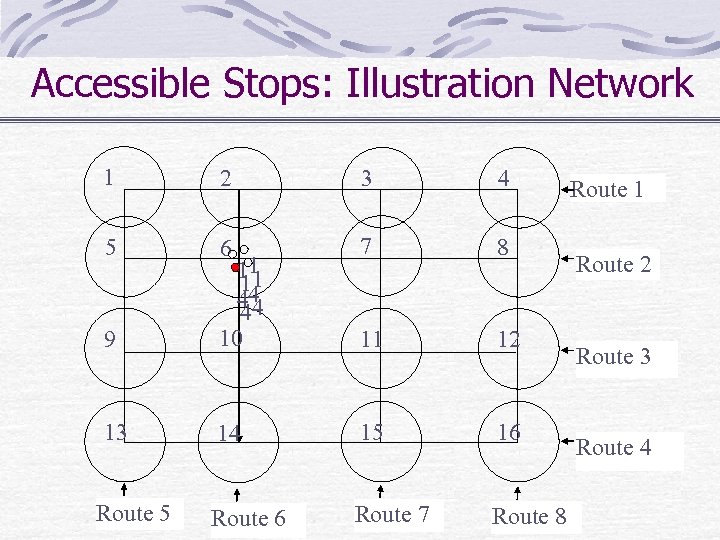 Accessible Stops: Illustration Network 1 2 3 4 5 6 7 8 11 12 9 11 1 14 44 4 10 13 14 15 16 Route 7 Route 8 Route 5 Route 1 Route 2 Route 3 Route 4
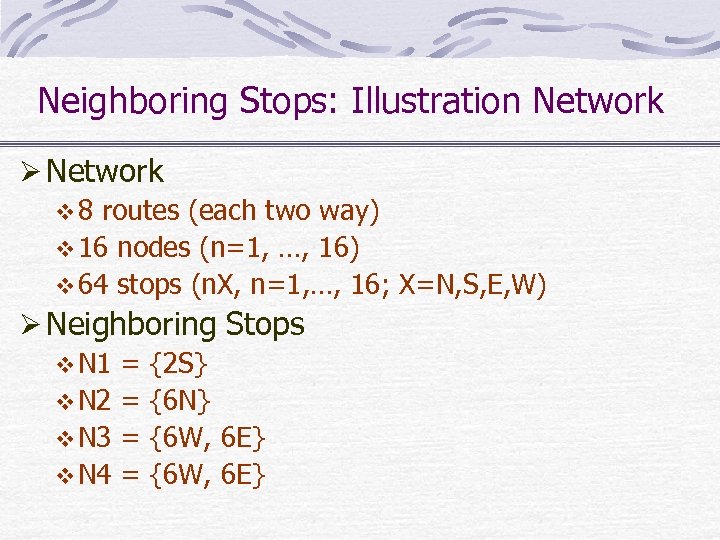 Neighboring Stops: Illustration Network Ø Network v 8 routes (each two way) v 16 nodes (n=1, …, 16) v 64 stops (n. X, n=1, …, 16; X=N, S, E, W) Ø Neighboring Stops v N 1 = {2 S} v N 2 = {6 N} v N 3 = {6 W, 6 E} v N 4 = {6 W, 6 E}
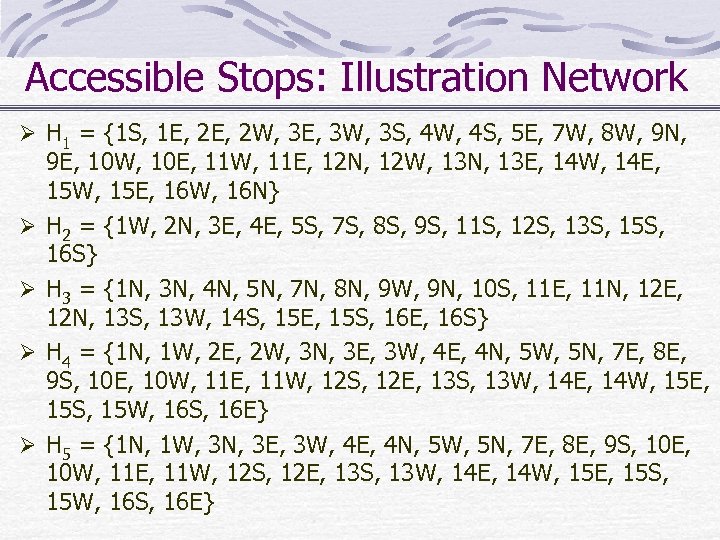 Accessible Stops: Illustration Network Ø H 1 = {1 S, 1 E, 2 W, 3 E, 3 W, 3 S, 4 W, 4 S, 5 E, 7 W, 8 W, 9 N, Ø Ø 9 E, 10 W, 10 E, 11 W, 11 E, 12 N, 12 W, 13 N, 13 E, 14 W, 14 E, 15 W, 15 E, 16 W, 16 N} H 2 = {1 W, 2 N, 3 E, 4 E, 5 S, 7 S, 8 S, 9 S, 11 S, 12 S, 13 S, 15 S, 16 S} H 3 = {1 N, 3 N, 4 N, 5 N, 7 N, 8 N, 9 W, 9 N, 10 S, 11 E, 11 N, 12 E, 12 N, 13 S, 13 W, 14 S, 15 E, 15 S, 16 E, 16 S} H 4 = {1 N, 1 W, 2 E, 2 W, 3 N, 3 E, 3 W, 4 E, 4 N, 5 W, 5 N, 7 E, 8 E, 9 S, 10 E, 10 W, 11 E, 11 W, 12 S, 12 E, 13 S, 13 W, 14 E, 14 W, 15 E, 15 S, 15 W, 16 S, 16 E} H 5 = {1 N, 1 W, 3 N, 3 E, 3 W, 4 E, 4 N, 5 W, 5 N, 7 E, 8 E, 9 S, 10 E, 10 W, 11 E, 11 W, 12 S, 12 E, 13 S, 13 W, 14 E, 14 W, 15 E, 15 S, 15 W, 16 S, 16 E}
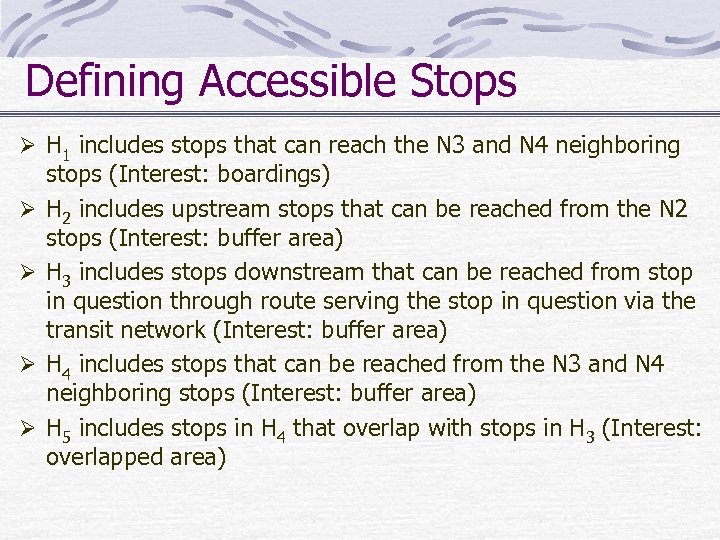 Defining Accessible Stops Ø H 1 includes stops that can reach the N 3 and N 4 neighboring Ø Ø stops (Interest: boardings) H 2 includes upstream stops that can be reached from the N 2 stops (Interest: buffer area) H 3 includes stops downstream that can be reached from stop in question through route serving the stop in question via the transit network (Interest: buffer area) H 4 includes stops that can be reached from the N 3 and N 4 neighboring stops (Interest: buffer area) H 5 includes stops in H 4 that overlap with stops in H 3 (Interest: overlapped area)
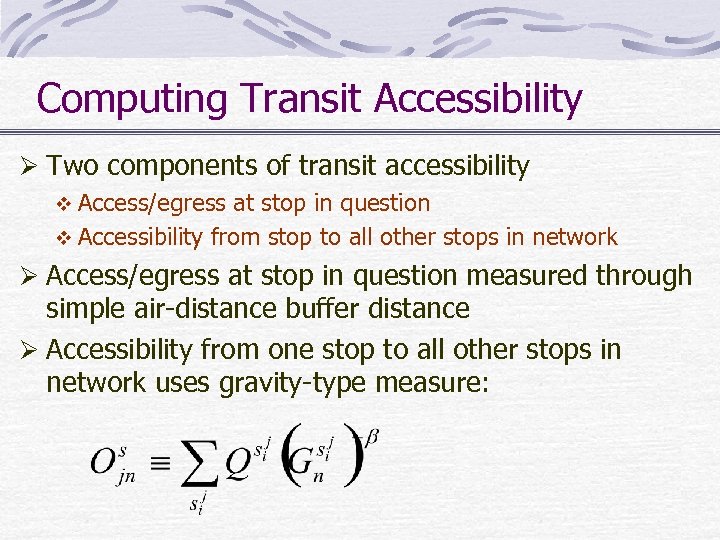 Computing Transit Accessibility Ø Two components of transit accessibility v Access/egress at stop in question v Accessibility from stop to all other stops in network Ø Access/egress at stop in question measured through simple air-distance buffer distance Ø Accessibility from one stop to all other stops in network uses gravity-type measure:
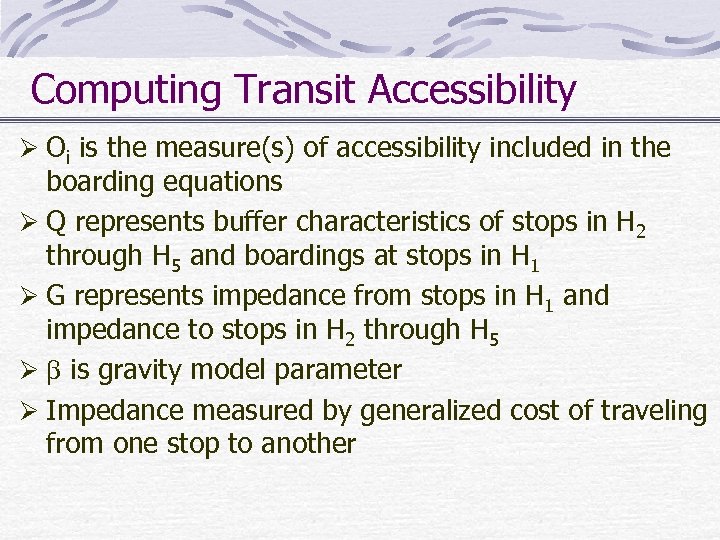 Computing Transit Accessibility Ø Oi is the measure(s) of accessibility included in the boarding equations Ø Q represents buffer characteristics of stops in H 2 through H 5 and boardings at stops in H 1 Ø G represents impedance from stops in H 1 and impedance to stops in H 2 through H 5 Ø b is gravity model parameter Ø Impedance measured by generalized cost of traveling from one stop to another
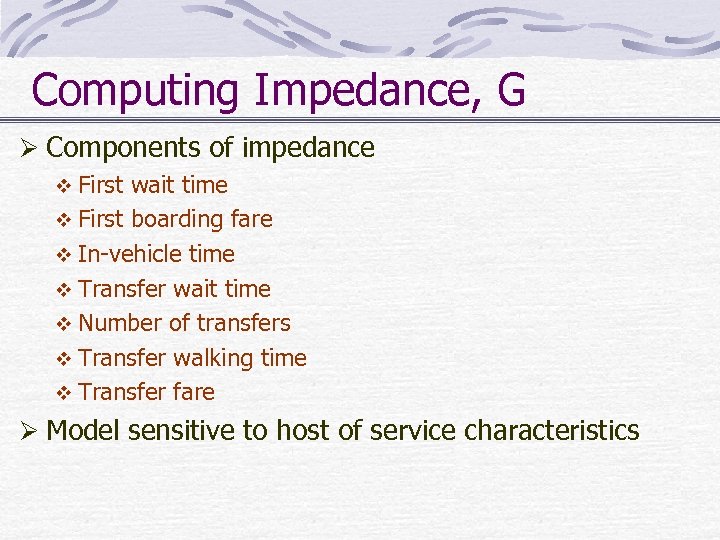 Computing Impedance, G Ø Components of impedance v First wait time v First boarding fare v In-vehicle time v Transfer wait time v Number of transfers v Transfer walking time v Transfer fare Ø Model sensitive to host of service characteristics
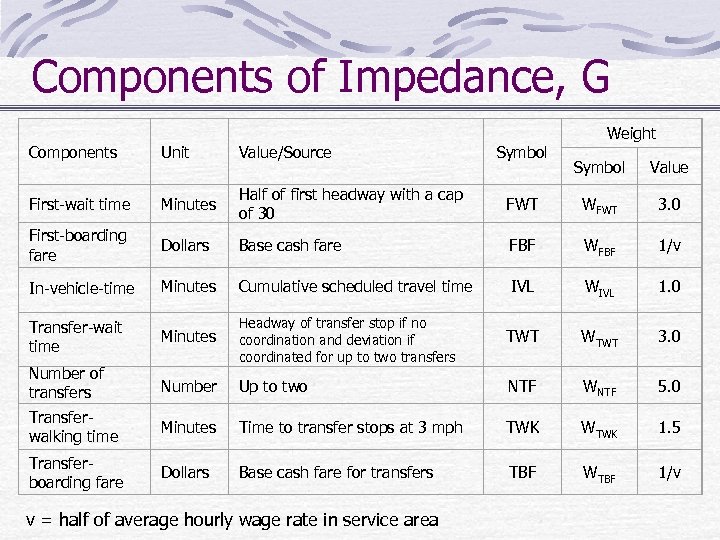 Components of Impedance, G Components Unit Value/Source First-wait time Minutes Half of first headway with a cap of 30 First-boarding fare Dollars In-vehicle-time Symbol Weight Symbol Value FWT WFWT 3. 0 Base cash fare FBF WFBF 1/v Minutes Cumulative scheduled travel time IVL WIVL 1. 0 Transfer-wait time Minutes TWT WTWT 3. 0 Number of transfers Headway of transfer stop if no coordination and deviation if coordinated for up to two transfers Number Up to two NTF WNTF 5. 0 Transferwalking time Minutes Time to transfer stops at 3 mph TWK WTWK 1. 5 Transferboarding fare Dollars Base cash fare for transfers TBF WTBF 1/v v = half of average hourly wage rate in service area
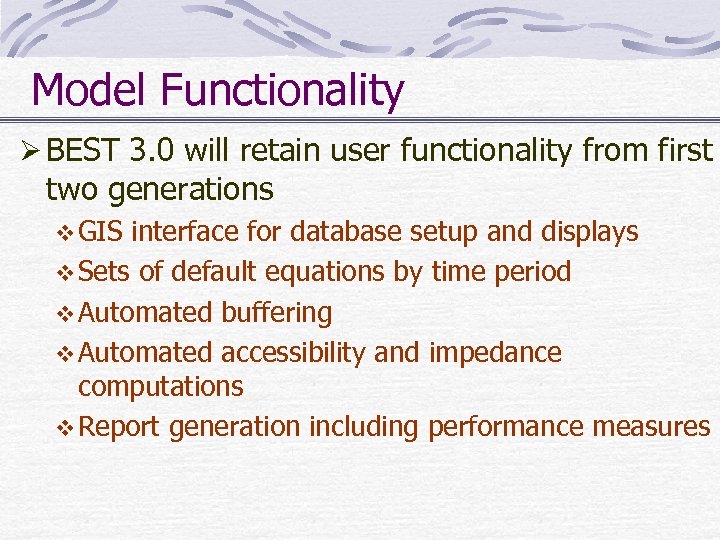 Model Functionality Ø BEST 3. 0 will retain user functionality from first two generations v GIS interface for database setup and displays v Sets of default equations by time period v Automated buffering v Automated accessibility and impedance computations v Report generation including performance measures
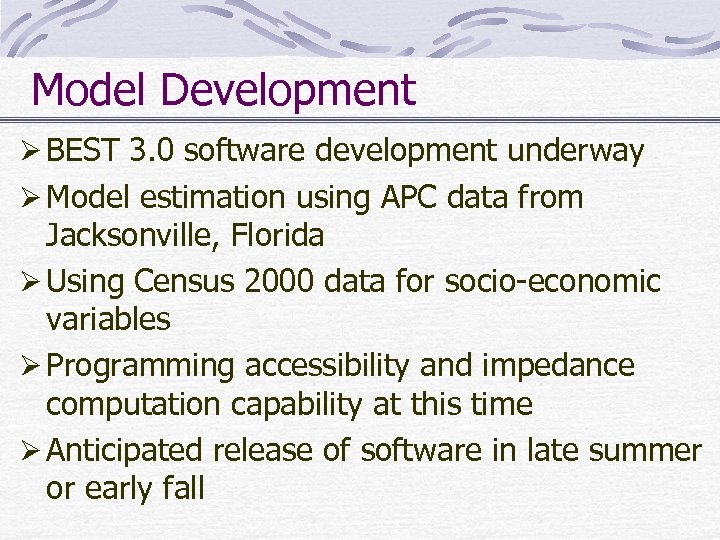 Model Development Ø BEST 3. 0 software development underway Ø Model estimation using APC data from Jacksonville, Florida Ø Using Census 2000 data for socio-economic variables Ø Programming accessibility and impedance computation capability at this time Ø Anticipated release of software in late summer or early fall
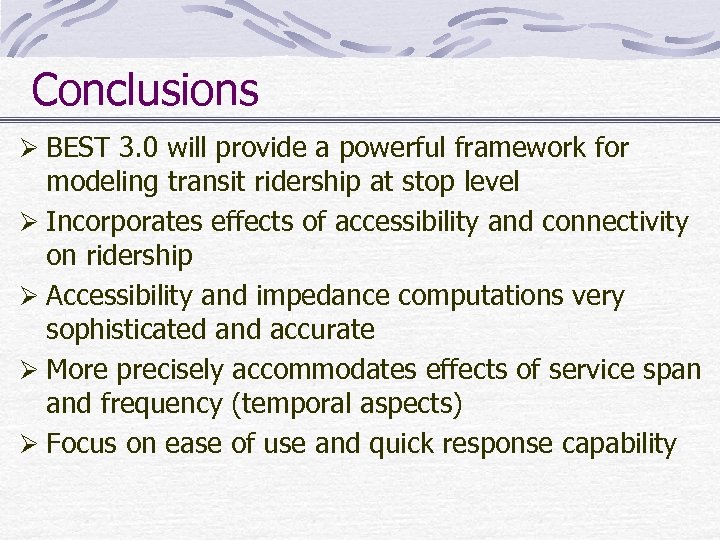 Conclusions Ø BEST 3. 0 will provide a powerful framework for modeling transit ridership at stop level Ø Incorporates effects of accessibility and connectivity on ridership Ø Accessibility and impedance computations very sophisticated and accurate Ø More precisely accommodates effects of service span and frequency (temporal aspects) Ø Focus on ease of use and quick response capability