


 Скачать презентацию Development of a NQF for HE from a
eec80207c76ad60da2c151ac156846f7.ppt
- Количество слайдов: 30
 Development of a NQF for HE from a European perspective TEMPUS-Project 2 nd Bitola Workshop Feb. 24 -25 2010 gehmlich@wi. fhosnabrueck. de 1
 Qualifications frameworks are good for helping make academic processes and judgements transparent, explicit and fair. gehmlich@wi. fh-osnabrueck. de 2
 Learning Outcomes = Qualification • Qualification is the formal standard, which is defined as being the „end“ of a learning path (credential). • It depicts those Learning Outcomes which have been achieved on this pathway (formal learning) • Learning Outcomes are what the student should know and is able to do gehmlich@wi. fh-osnabrueck. de 3
 Challenge at Programme level In outcome-based education the educational outcomes are clearly and unambiguously specified. These determine the curriculum content and its organisation, the teaching methods and strategies, the courses offered, the assessment process, the educational environment and the curriculum timetable. They also provide a framework for curriculum evaluation. (Harden et al. , 1999 a) 4
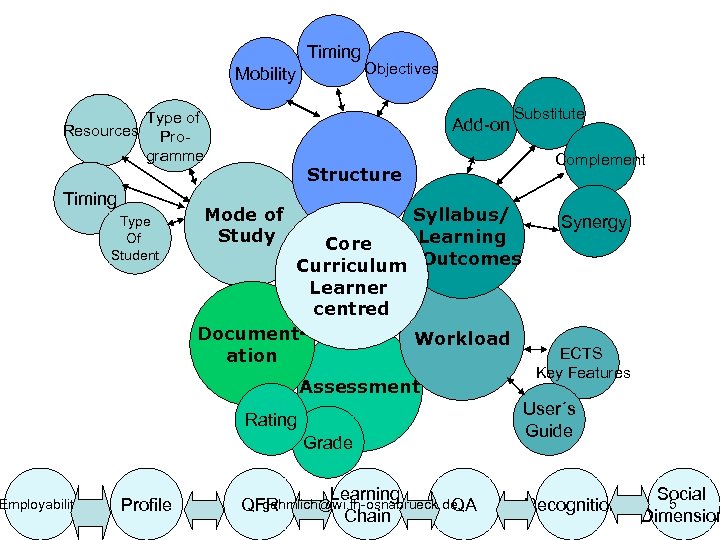 Timing Mobility Type of Resources Programme Timing Employability Type Of Student Objectives Add-on Structure Mode of Study Syllabus/ Learning Core Curriculum Outcomes Learner centred Document. Workload ation Assessment Rating Grade Profile Substitute Learning gehmlich@wi. fh-osnabrueck. de QFR QA Chain Complement Synergy ECTS Key Features User´s Guide Recognition Social 5 Dimension
 How can this be developed? • Policy level – Challenge: HE institutions ensure that academic principles and values are respected and the processes correctly implemented • Institutional level – Promote shared values and attitudes – rather than simply managerial processes – Balance: national / international external accountability requirements gehmlich@wi. fh-osnabrueck. de 6
 There is no single way I did it my way Cassius Clay Melody gehmlich@wi. fh-osnabrueck. de 7
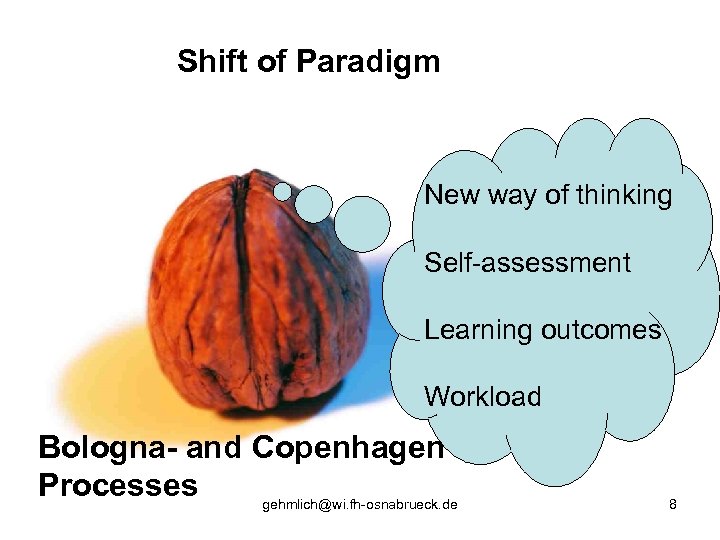 Shift of Paradigm New way of thinking Self-assessment Learning outcomes Workload Bologna- and Copenhagen Processes gehmlich@wi. fh-osnabrueck. de 8
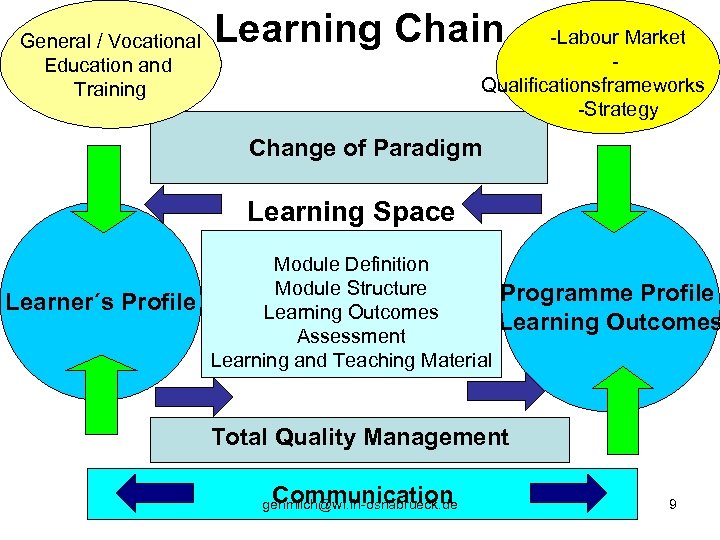 General / Vocational Education and Training Learning Chain -Labour Market Qualificationsframeworks -Strategy Change of Paradigm Learning Space Learner´s Profile Module Definition Module Structure Learning Outcomes Assessment Learning and Teaching Material Programme Profile Learning Outcomes Total Quality Management Communication gehmlich@wi. fh-osnabrueck. de 9
 To be decided: Profile gehmlich@wi. fh-osnabrueck. de 10
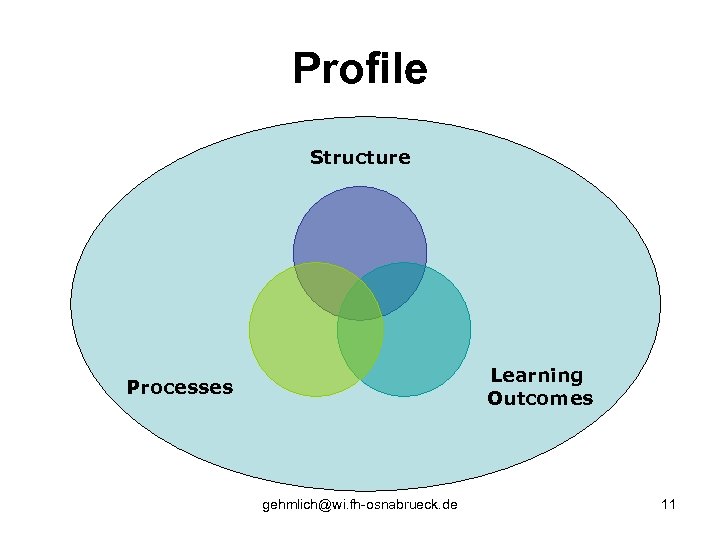 Profile Structure Learning Outcomes Processes gehmlich@wi. fh-osnabrueck. de 11
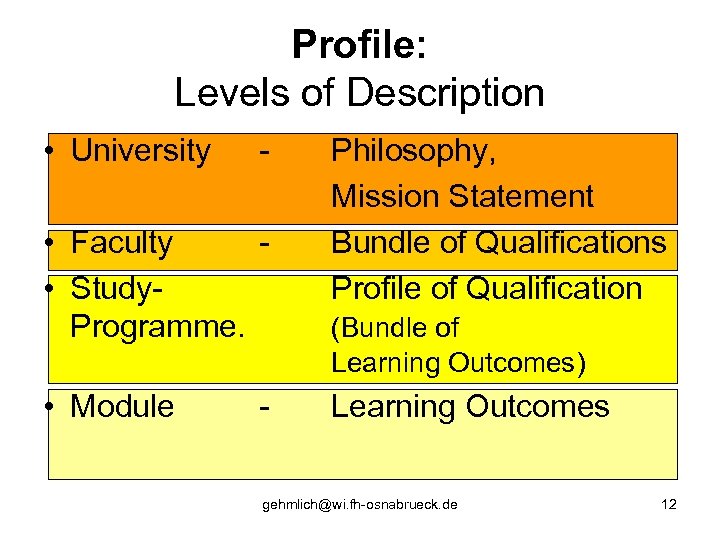 Profile: Levels of Description • University - • Faculty • Study. Programme. • Module - Philosophy, Mission Statement Bundle of Qualifications Profile of Qualification (Bundle of Learning Outcomes) Learning Outcomes gehmlich@wi. fh-osnabrueck. de 12
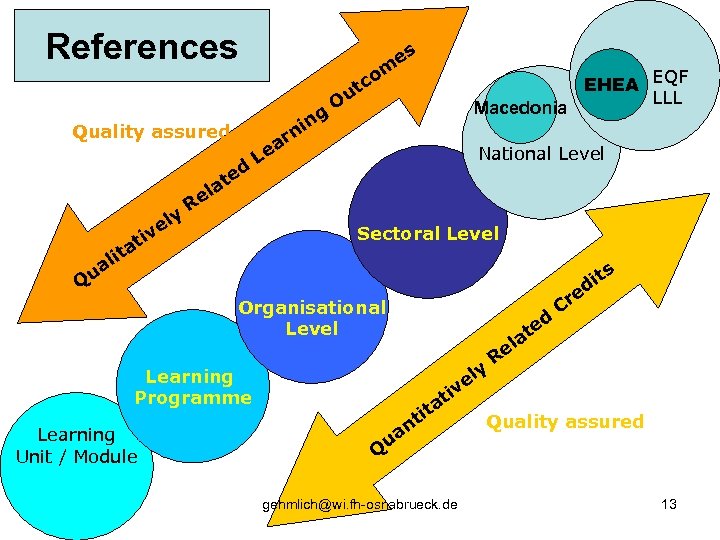 References Quality assured d te a y el tiv es m ni r ea L ng o tc Ou Macedonia National Level el R Sectoral Level a lit a Qu its d e Organisational Level d te a y l ve i at it Learning Programme Learning Unit / Module EHEA EQF LLL nt a u Q gehmlich@wi. fh-osnabrueck. de Cr el R Quality assured 13
 We need evidence of outcomes! We promise! Internal / External QA gehmlich@wi. fh-osnabrueck. de 14
 YES, WE CAN find eviden ce gehmlich@wi. fh-osnabrueck. de 15
 But before… We have to Work hard – Play hard gehmlich@wi. fh-osnabrueck. de 16
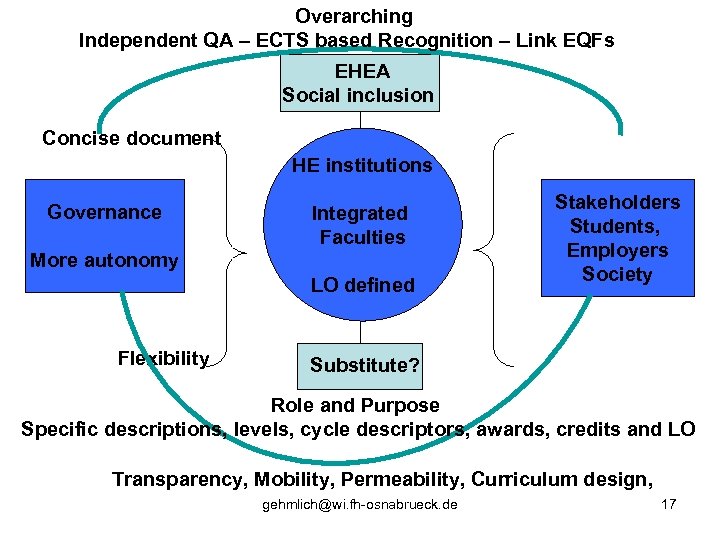 Overarching Independent QA – ECTS based Recognition – Link EQFs EHEA Social inclusion Concise document HE institutions Governance Integrated Faculties More autonomy LO defined Flexibility Stakeholders Students, Employers Society Substitute? Role and Purpose Specific descriptions, levels, cycle descriptors, awards, credits and LO Transparency, Mobility, Permeability, Curriculum design, gehmlich@wi. fh-osnabrueck. de 17
 Germany – External QA • Accreditation Board (Foundation): – To contribute to the development in the quality of teaching and learning in Germany – To cooperate in the realisation of the European Higher Education Area – takes care that the agencies act in line with the highest degree of quality, comparability and transparency. gehmlich@wi. fh-osnabrueck. de 18
 Who can perfrom accreditation? • Agencies which have been accredited by the German Accreditation Board • Will be re-accredited regularly (after 8 years at the latest) • Seven agencies exist – 3 general – 4 sector specific gehmlich@wi. fh-osnabrueck. de 19
 What do universities have to do? They submit • Application to an Accreditation Agency They get • Advice • Site Visit Decision made • Accreditation Committee • Reaccreditation…. . a circle gehmlich@wi. fh-osnabrueck. de 20
 Accreditation Agencies • European Standards and Guidelines • European Register • Site visits by Peers – Professors (according to discipline, at least 1 from traditional universities, 1 from „new“ ones) – Expert from industry – Student – Agency representative gehmlich@wi. fh-osnabrueck. de 21
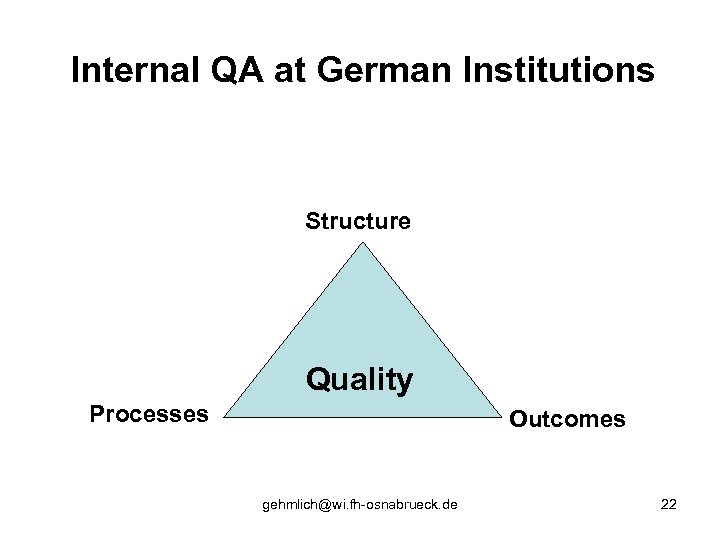 Internal QA at German Institutions Structure Quality Processes Outcomes gehmlich@wi. fh-osnabrueck. de 22
 Internal Quality Assurance • Evaluation sheets – Based on questionnaires given to students / staff • Continuous Feedback • Evaluate all information • Consequences? gehmlich@wi. fh-osnabrueck. de 23
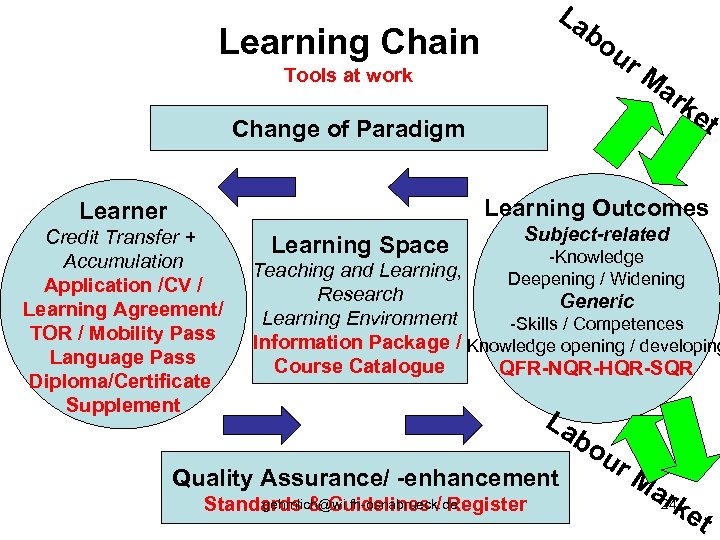 La bo u Learning Chain r. M ar Tools at work Change of Paradigm ke t Learning Outcomes Learner Credit Transfer + Accumulation Application /CV / Learning Agreement/ TOR / Mobility Pass Language Pass Diploma/Certificate Supplement Learning Space Subject-related -Knowledge Deepening / Widening Teaching and Learning, Research Generic Learning Environment -Skills / Competences Information Package / Knowledge opening / developing Course Catalogue QFR-NQR-HQR-SQR La bo Quality Assurance/ -enhancement gehmlich@wi. fh-osnabrueck. de Standards & Guidelines / Register ur Ma rk et 24
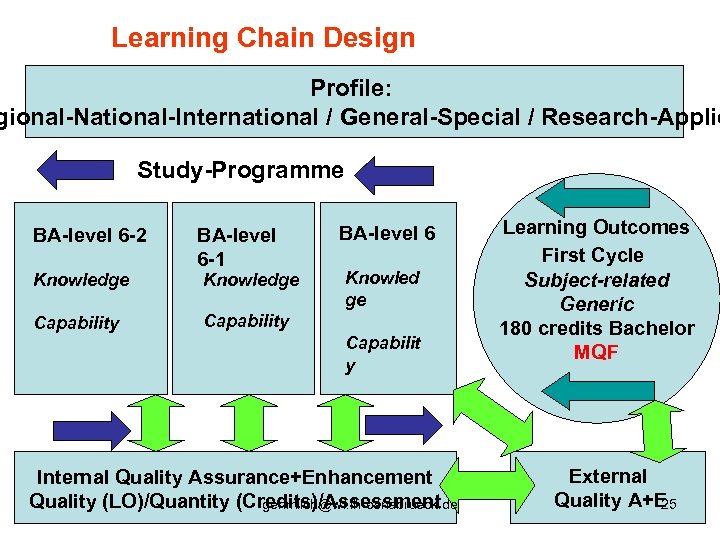 Learning Chain Design Profile: gional-National-International / General-Special / Research-Applie Study-Programme BA-level 6 -2 Knowledge Capability BA-level 6 -1 Knowledge BA-level 6 Knowled ge Capability Capabilit y Internal Quality Assurance+Enhancement Quality (LO)/Quantity (Credits)/Assessment gehmlich@wi. fh-osnabrueck. de Learning Outcomes First Cycle Subject-related Generic 180 credits Bachelor MQF External Quality A+E 25
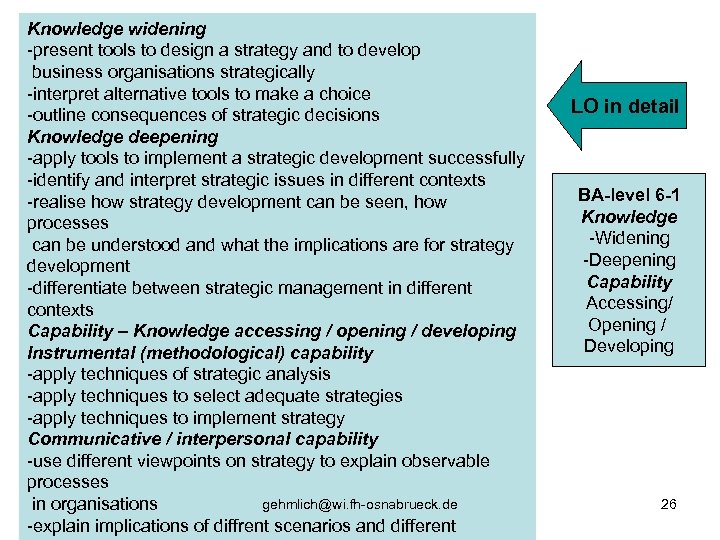 Knowledge widening -present tools to design a strategy and to develop business organisations strategically -interpret alternative tools to make a choice -outline consequences of strategic decisions Knowledge deepening -apply tools to implement a strategic development successfully -identify and interpret strategic issues in different contexts -realise how strategy development can be seen, how processes can be understood and what the implications are for strategy development -differentiate between strategic management in different contexts Capability – Knowledge accessing / opening / developing Instrumental (methodological) capability -apply techniques of strategic analysis -apply techniques to select adequate strategies -apply techniques to implement strategy Communicative / interpersonal capability -use different viewpoints on strategy to explain observable processes gehmlich@wi. fh-osnabrueck. de in organisations -explain implications of diffrent scenarios and different LO in detail BA-level 6 -1 Knowledge -Widening -Deepening Capability Accessing/ Opening / Developing 26
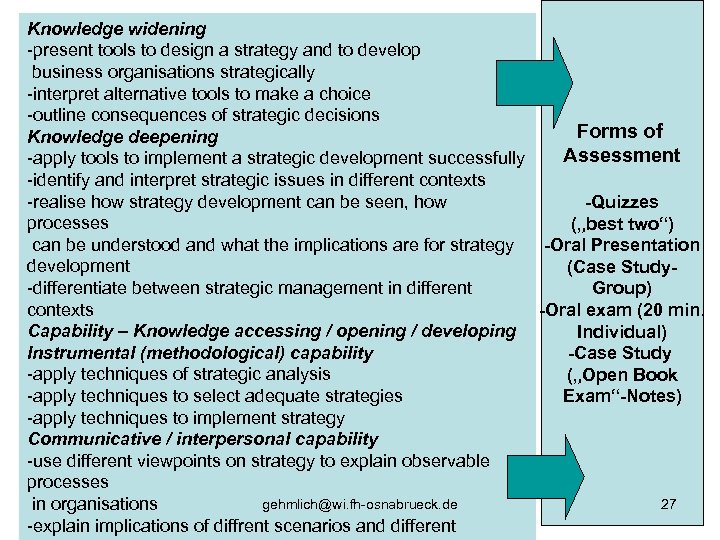 Knowledge widening -present tools to design a strategy and to develop business organisations strategically -interpret alternative tools to make a choice -outline consequences of strategic decisions Forms of Knowledge deepening Assessment -apply tools to implement a strategic development successfully -identify and interpret strategic issues in different contexts -realise how strategy development can be seen, how -Quizzes processes („best two“) can be understood and what the implications are for strategy -Oral Presentation development (Case Study-differentiate between strategic management in different Group) contexts -Oral exam (20 min. Capability – Knowledge accessing / opening / developing Individual) Instrumental (methodological) capability -Case Study -apply techniques of strategic analysis („Open Book -apply techniques to select adequate strategies Exam“-Notes) -apply techniques to implement strategy Communicative / interpersonal capability -use different viewpoints on strategy to explain observable processes gehmlich@wi. fh-osnabrueck. de 27 in organisations -explain implications of diffrent scenarios and different
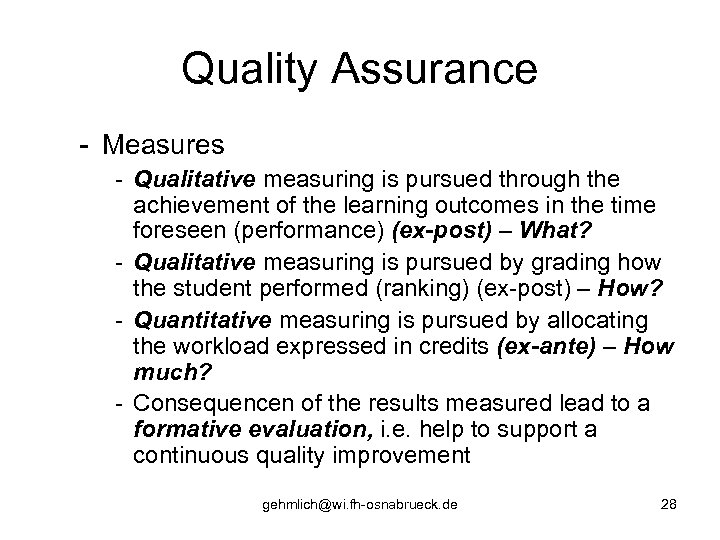 Quality Assurance - Measures - Qualitative measuring is pursued through the achievement of the learning outcomes in the time foreseen (performance) (ex-post) – What? - Qualitative measuring is pursued by grading how the student performed (ranking) (ex-post) – How? - Quantitative measuring is pursued by allocating the workload expressed in credits (ex-ante) – How much? - Consequencen of the results measured lead to a formative evaluation, i. e. help to support a continuous quality improvement gehmlich@wi. fh-osnabrueck. de 28
 But changing education and training is a slow process! It may take more than a life-time gehmlich@wi. fh-osnabrueck. de More than we can 29 stomach? ?
 Enjoy your meal – quality assured gehmlich@wi. fh-osnabrueck. de 30