Скачать презентацию Development of a High Pressure Xenon Imager with
b16b230b300f1ca2393f3f02d12774f7.ppt
- Количество слайдов: 52
 Development of a High Pressure Xenon Imager with Optimal Energy Resolution Azriel Goldschmidt on work with David Nygren Instrumentation Series Seminar LBNL, March 2009
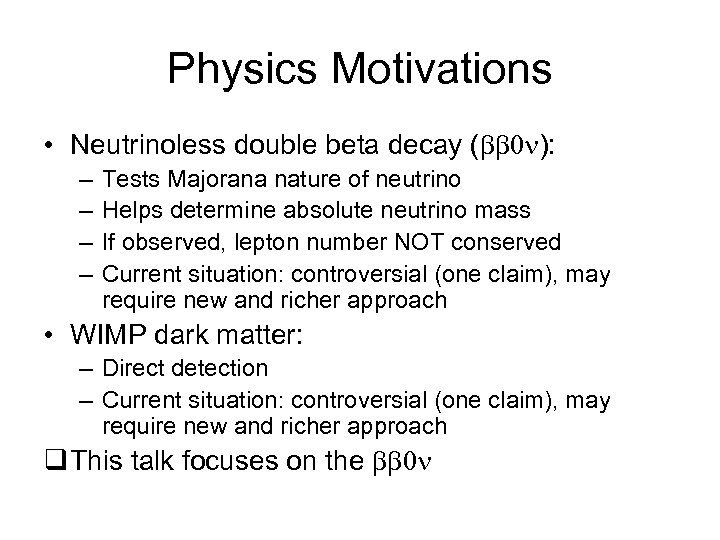 Physics Motivations • Neutrinoless double beta decay ( 0 ): – – Tests Majorana nature of neutrino Helps determine absolute neutrino mass If observed, lepton number NOT conserved Current situation: controversial (one claim), may require new and richer approach • WIMP dark matter: – Direct detection – Current situation: controversial (one claim), may require new and richer approach q This talk focuses on the 0
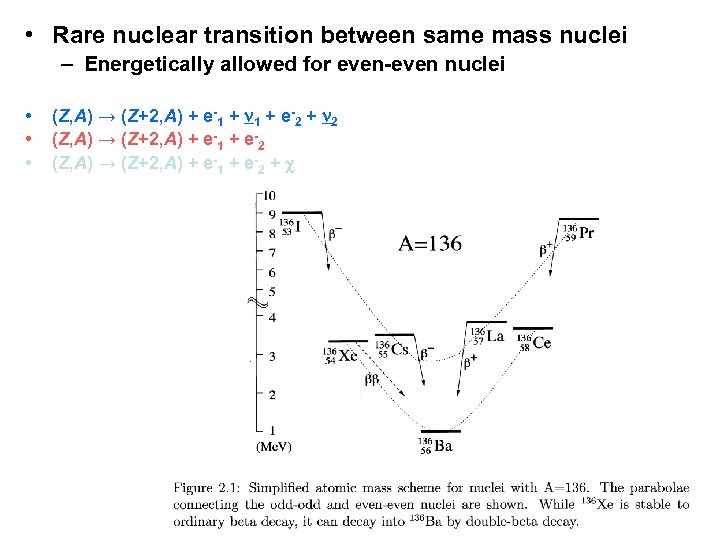 • Rare nuclear transition between same mass nuclei – Energetically allowed for even-even nuclei • • • (Z, A) → (Z+2, A) + e-1 + e-2 + 2 (Z, A) → (Z+2, A) + e-1 + e-2 + c
 Double Beta Decay Spectra
 H-M Claim Inverted Normal 50 me. V Or ~ 1027 yr
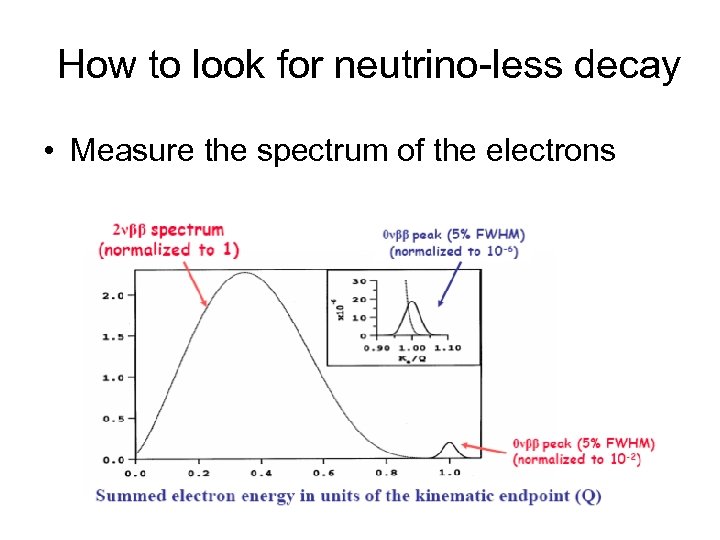 How to look for neutrino-less decay • Measure the spectrum of the electrons
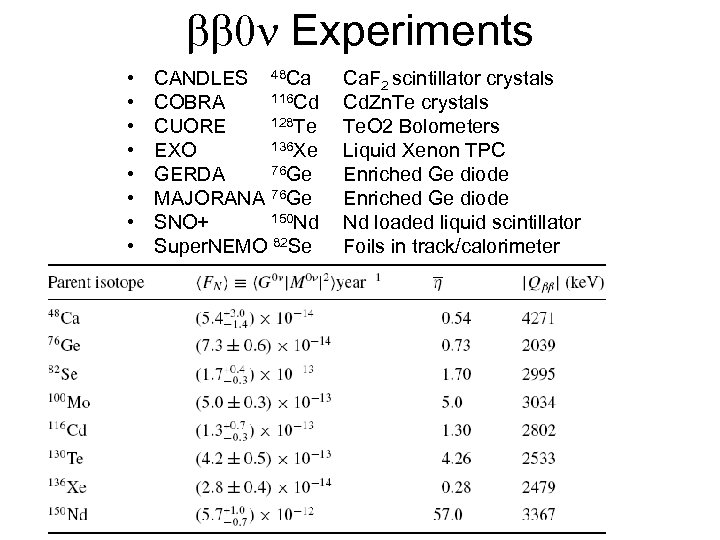 0 Experiments • • CANDLES 48 Ca 116 Cd COBRA 128 Te CUORE 136 Xe EXO 76 Ge GERDA MAJORANA 76 Ge 150 Nd SNO+ Super. NEMO 82 Se Ca. F 2 scintillator crystals Cd. Zn. Te crystals Te. O 2 Bolometers Liquid Xenon TPC Enriched Ge diode Nd loaded liquid scintillator Foils in track/calorimeter
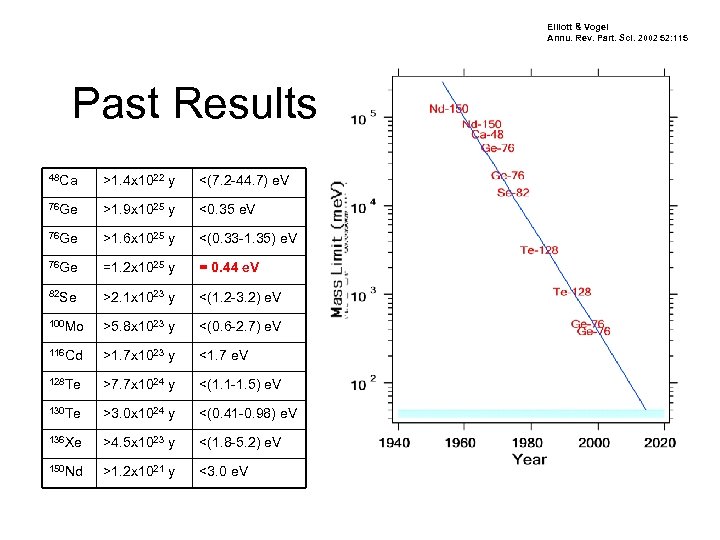 Elliott & Vogel Annu. Rev. Part. Sci. 2002 52: 115 Past Results 48 Ca >1. 4 x 10²² y <(7. 2 -44. 7) e. V 76 Ge >1. 9 x 1025 y <0. 35 e. V 76 Ge >1. 6 x 1025 y <(0. 33 -1. 35) e. V 76 Ge =1. 2 x 1025 y = 0. 44 e. V 82 Se >2. 1 x 10²³ y <(1. 2 -3. 2) e. V 100 Mo >5. 8 x 10²³ y <(0. 6 -2. 7) e. V 116 Cd >1. 7 x 10²³ y <1. 7 e. V 128 Te >7. 7 x 1024 y <(1. 1 -1. 5) e. V 130 Te >3. 0 x 1024 y <(0. 41 -0. 98) e. V 136 Xe >4. 5 x 10²³ y <(1. 8 -5. 2) e. V 150 Nd >1. 2 x 10²¹ y <3. 0 e. V
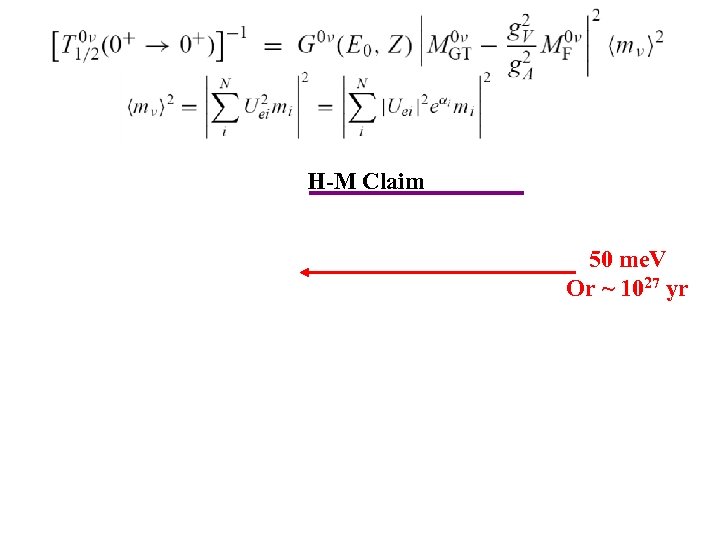
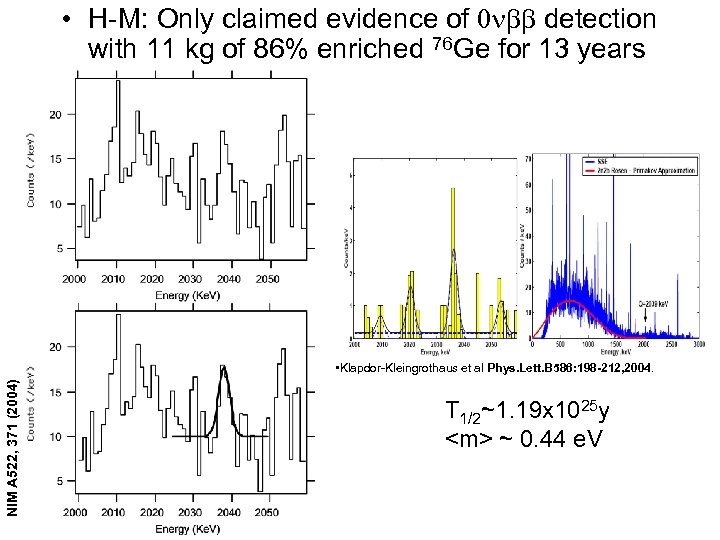 • H-M: Only claimed evidence of 0 detection with 11 kg of 86% enriched 76 Ge for 13 years NIM A 522, 371 (2004) • Klapdor-Kleingrothaus et al Phys. Lett. B 586: 198 -212, 2004. T 1/2~1. 19 x 1025 y
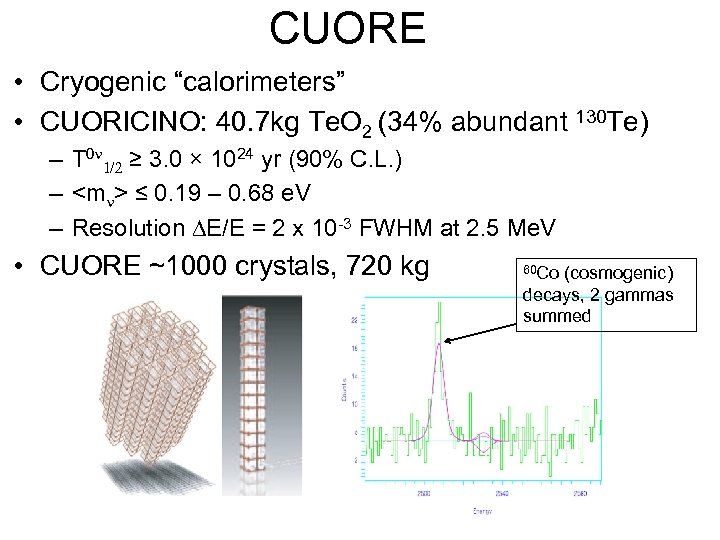 CUORE • Cryogenic “calorimeters” • CUORICINO: 40. 7 kg Te. O 2 (34% abundant 130 Te) – T 0 1/2 ≥ 3. 0 × 1024 yr (90% C. L. ) –
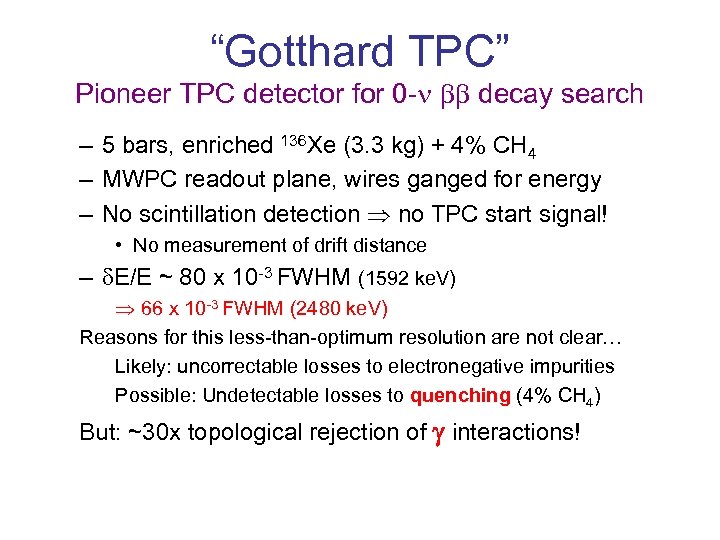 “Gotthard TPC” Pioneer TPC detector for 0 - decay search – 5 bars, enriched 136 Xe (3. 3 kg) + 4% CH 4 – MWPC readout plane, wires ganged for energy – No scintillation detection no TPC start signal! • No measurement of drift distance – E/E ~ 80 x 10 -3 FWHM (1592 ke. V) 66 x 10 -3 FWHM (2480 ke. V) Reasons for this less-than-optimum resolution are not clear… Likely: uncorrectable losses to electronegative impurities Possible: Undetectable losses to quenching (4% CH 4) But: ~30 x topological rejection of interactions!
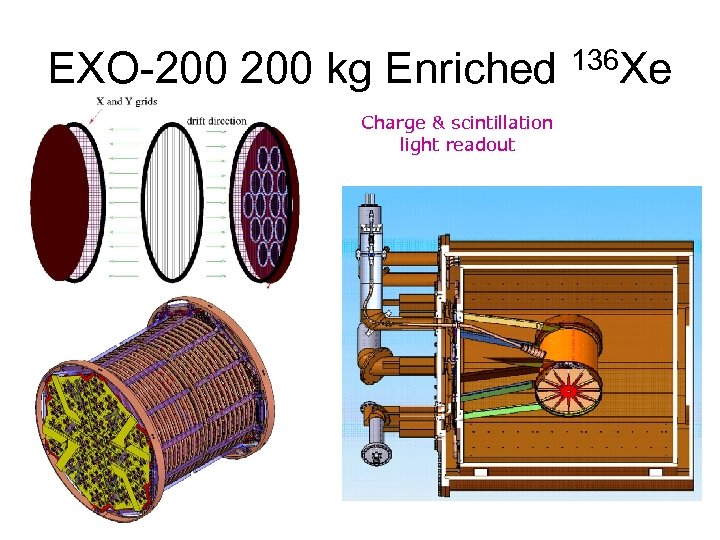 EXO-200 kg Enriched 136 Xe Charge & scintillation light readout
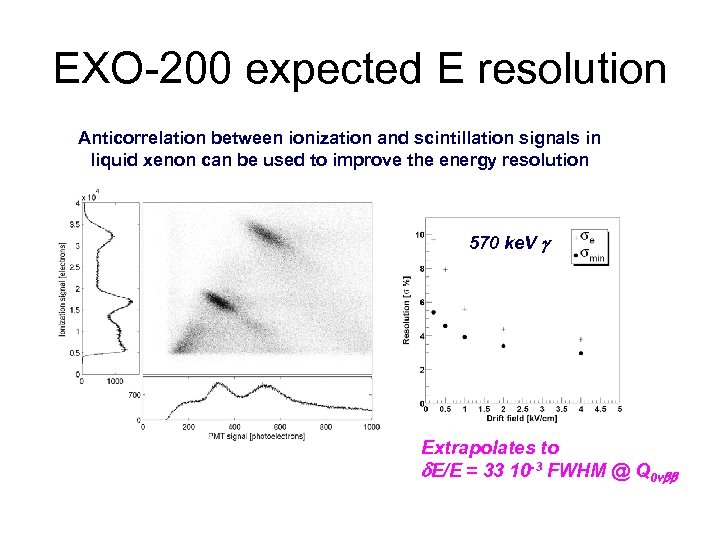 EXO-200 expected E resolution Anticorrelation between ionization and scintillation signals in liquid xenon can be used to improve the energy resolution 570 ke. V g Extrapolates to d. E/E = 33 10 -3 FWHM @ Q 0 nbb
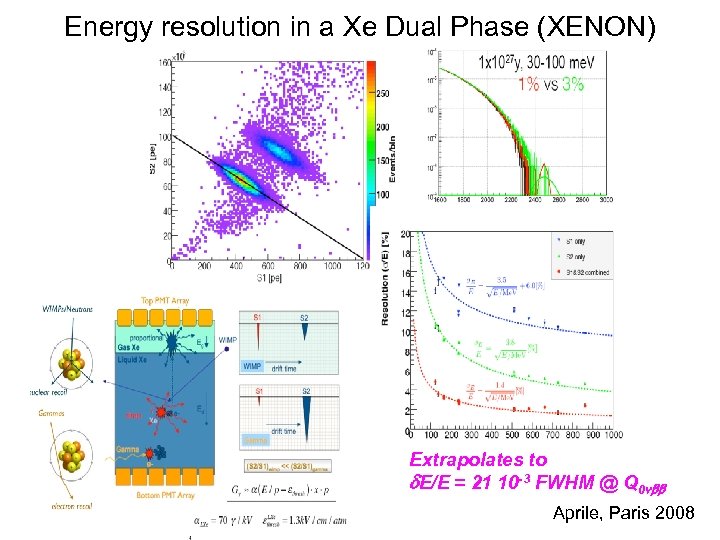 Energy resolution in a Xe Dual Phase (XENON) Extrapolates to d. E/E = 21 10 -3 FWHM @ Q 0 nbb Aprile, Paris 2008
 What’s needed… • Long lifetimes (>1025 years) require: – Large Mass of relevant isotope (>100 kg) – Small or No background: • Clean materials • Underground, away from cosmic rays • Background rejection methods: – – Energy resolution Event topology Particle identification Identification of daughter nucleus – Years of data-taking
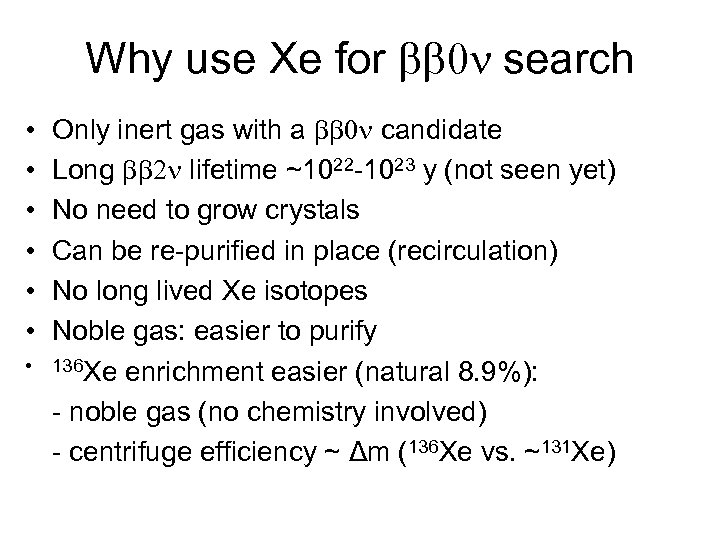 Why use Xe for 0 search • • Only inert gas with a 0 candidate Long 2 lifetime ~1022 -1023 y (not seen yet) No need to grow crystals Can be re-purified in place (recirculation) No long lived Xe isotopes Noble gas: easier to purify 136 Xe enrichment easier (natural 8. 9%): - noble gas (no chemistry involved) - centrifuge efficiency ~ Δm (136 Xe vs. ~131 Xe)
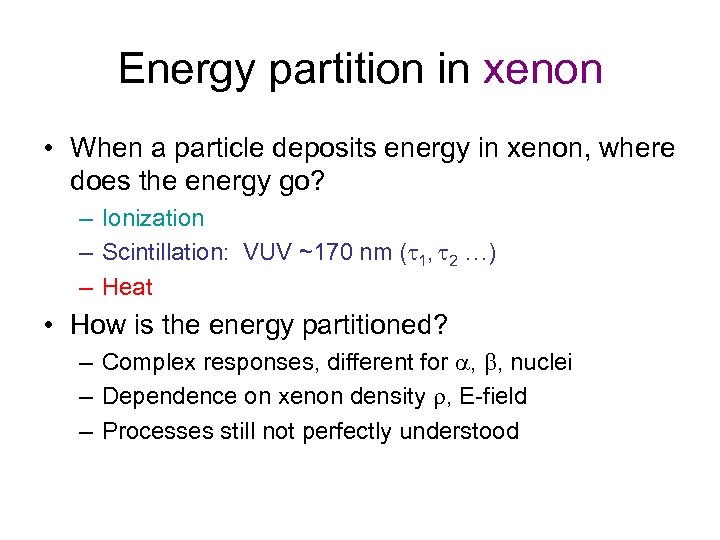 Energy partition in xenon • When a particle deposits energy in xenon, where does the energy go? – Ionization – Scintillation: VUV ~170 nm ( 1, 2 …) – Heat • How is the energy partitioned? – Complex responses, different for , , nuclei – Dependence on xenon density , E-field – Processes still not perfectly understood
 LXe or HPXe? With high-pressure xenon (HPXe) A measurement of ionization alone is sufficient to obtain good energy resolution…
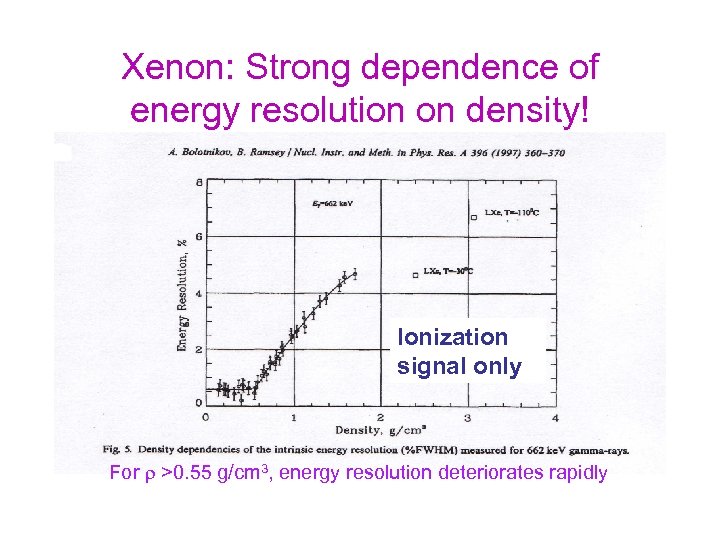 Xenon: Strong dependence of energy resolution on density! Ionization signal only For >0. 55 g/cm 3, energy resolution deteriorates rapidly
 DE/E ~ 1 -2 10 -3 FWHM DE/E ~ 35 10 -3 FWHM

 What is this factor “G”? • In a very real sense: G is a measure of the precision with which a single electron (from an ionizing track) can be counted.
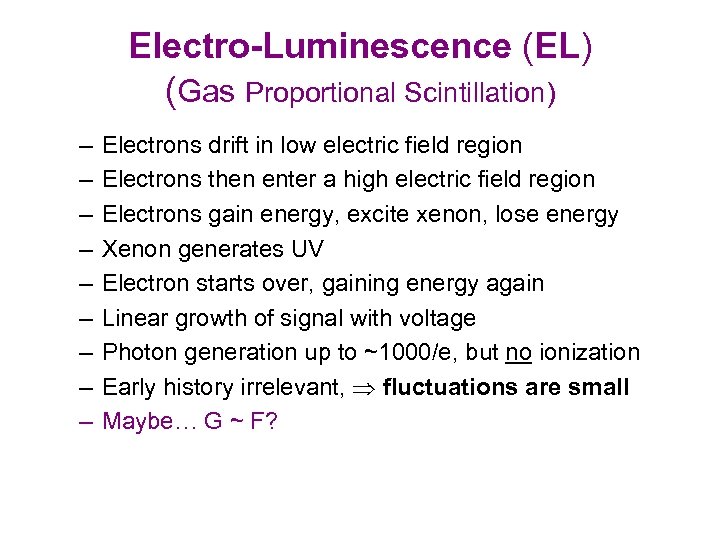 Electro-Luminescence (EL) (Gas Proportional Scintillation) – – – – – Electrons drift in low electric field region Electrons then enter a high electric field region Electrons gain energy, excite xenon, lose energy Xenon generates UV Electron starts over, gaining energy again Linear growth of signal with voltage Photon generation up to ~1000/e, but no ionization Early history irrelevant, fluctuations are small Maybe… G ~ F?
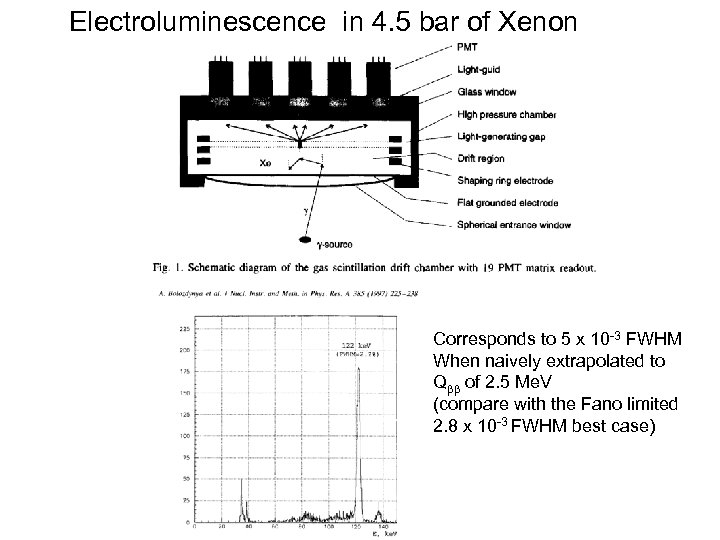 Electroluminescence in 4. 5 bar of Xenon Corresponds to 5 x 10 -3 FWHM When naively extrapolated to Q of 2. 5 Me. V (compare with the Fano limited 2. 8 x 10 -3 FWHM best case)
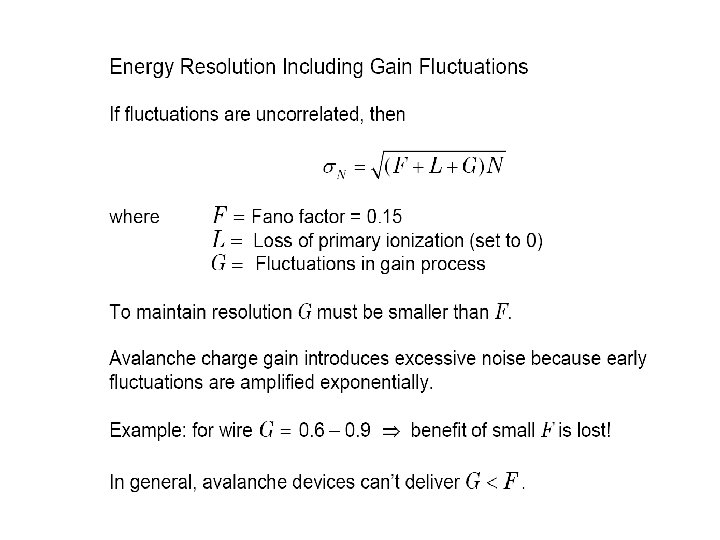
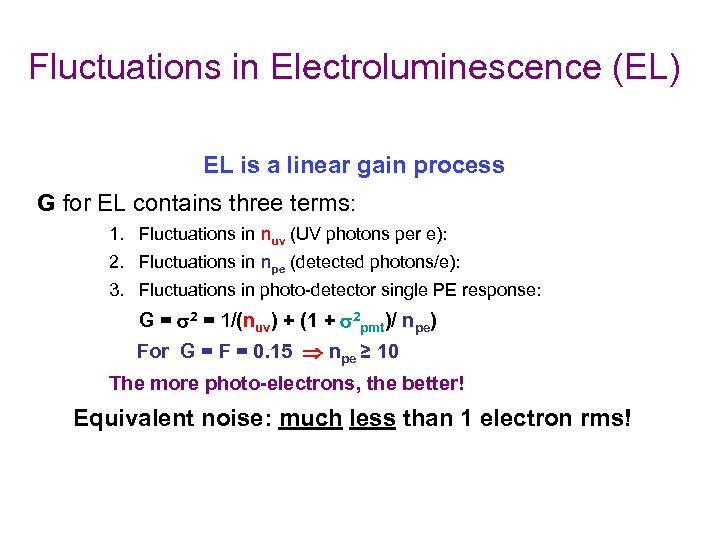 Fluctuations in Electroluminescence (EL) EL is a linear gain process G for EL contains three terms: 1. Fluctuations in nuv (UV photons per e): 2. Fluctuations in npe (detected photons/e): 3. Fluctuations in photo-detector single PE response: G = 2 = 1/(nuv) + (1 + 2 pmt)/ npe) For G = F = 0. 15 npe ≥ 10 The more photo-electrons, the better! Equivalent noise: much less than 1 electron rms!
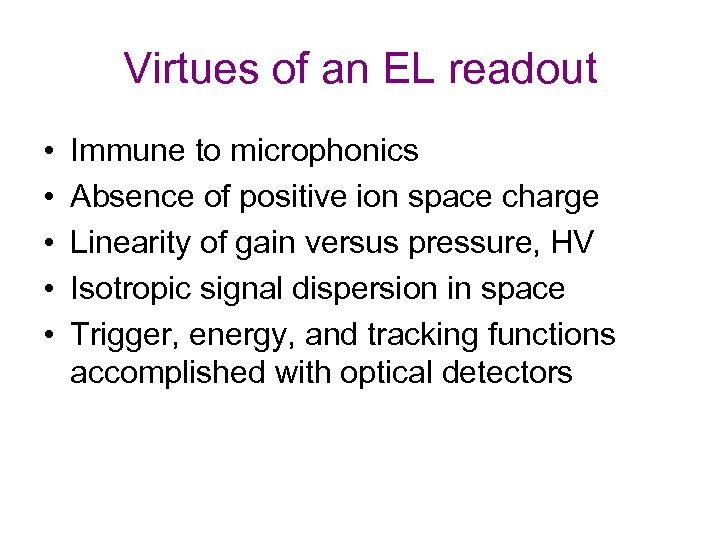 Virtues of an EL readout • • • Immune to microphonics Absence of positive ion space charge Linearity of gain versus pressure, HV Isotropic signal dispersion in space Trigger, energy, and tracking functions accomplished with optical detectors
 Detector Concept • Use enriched High Pressure Xenon • TPC to provide image of the decay particles • Design to also get an energy measurement as close to the intrinsic resolution as possible
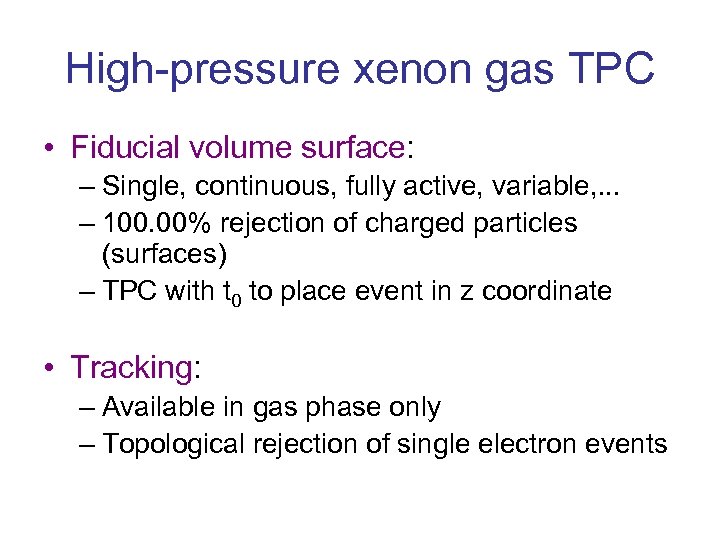 High-pressure xenon gas TPC • Fiducial volume surface: – Single, continuous, fully active, variable, . . . – 100. 00% rejection of charged particles (surfaces) – TPC with t 0 to place event in z coordinate • Tracking: – Available in gas phase only – Topological rejection of single electron events
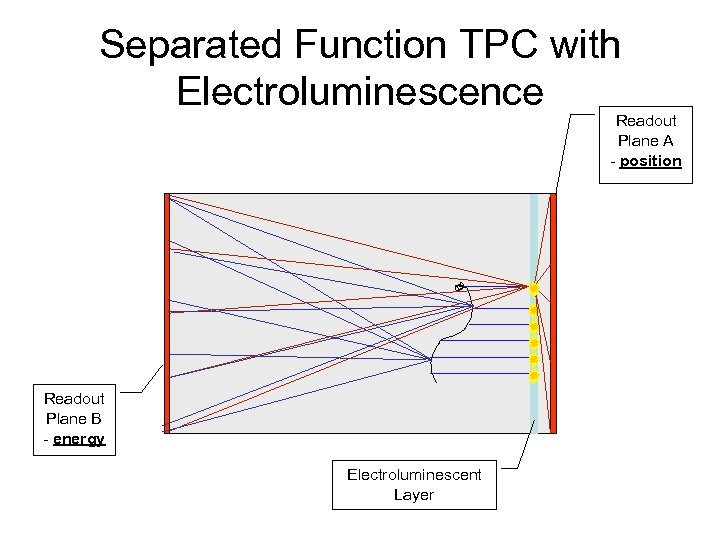 Separated Function TPC with Electroluminescence Readout Plane A - position Readout Plane B - energy Electroluminescent Layer
 Electro-Luminescent Readout For optimal energy resolution, 105 e- * 10 pe/e- = 106 photoelectrons need to be detected! Energy readout plane is a PMT array • electron (secondary) drift is very slow: ~1 mm/ s • This spreads out the arriving signal in time - up to 100 s for many events • The signal is spread out over the entire readout cathodeside, 100’s of PMTs • These two factors greatly reduce the dynamic range needed for readout of the signals No problem to read out <5 kev to >5000 ke. V
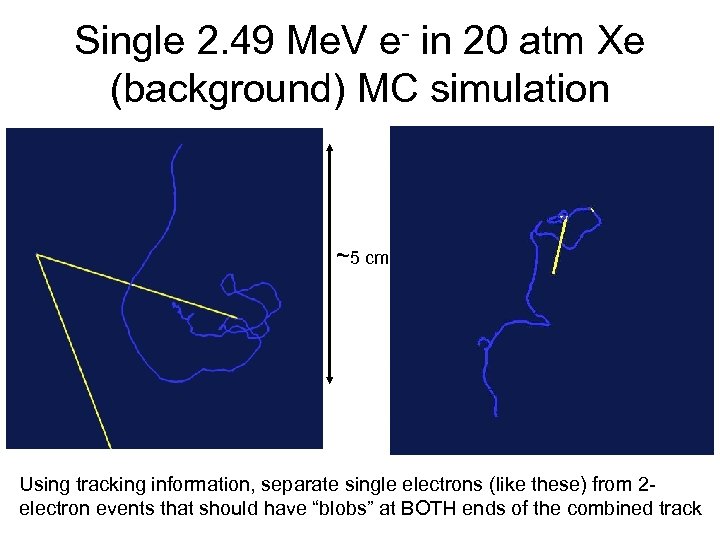 Single 2. 49 Me. V e- in 20 atm Xe (background) MC simulation ~5 cm Using tracking information, separate single electrons (like these) from 2 electron events that should have “blobs” at BOTH ends of the combined track
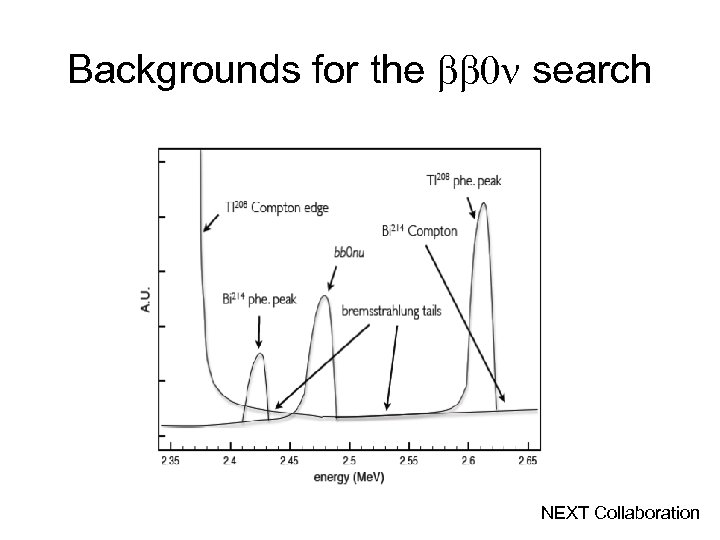 Backgrounds for the 0 search NEXT Collaboration
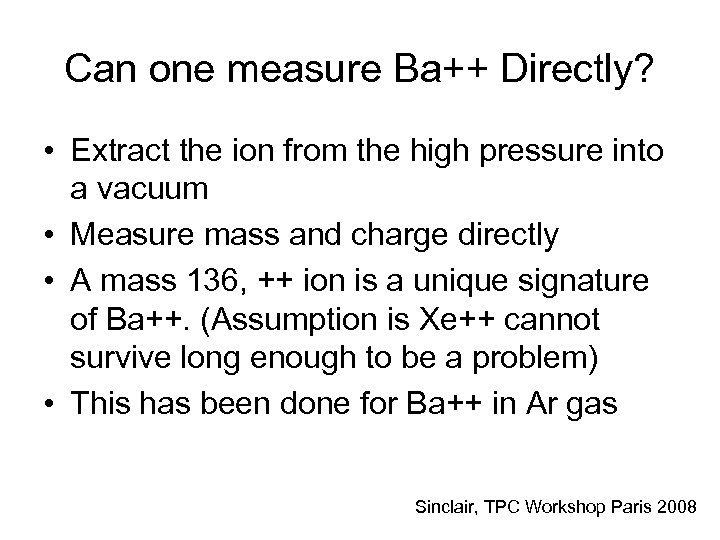 Can one measure Ba++ Directly? • Extract the ion from the high pressure into a vacuum • Measure mass and charge directly • A mass 136, ++ ion is a unique signature of Ba++. (Assumption is Xe++ cannot survive long enough to be a problem) • This has been done for Ba++ in Ar gas Sinclair, TPC Workshop Paris 2008
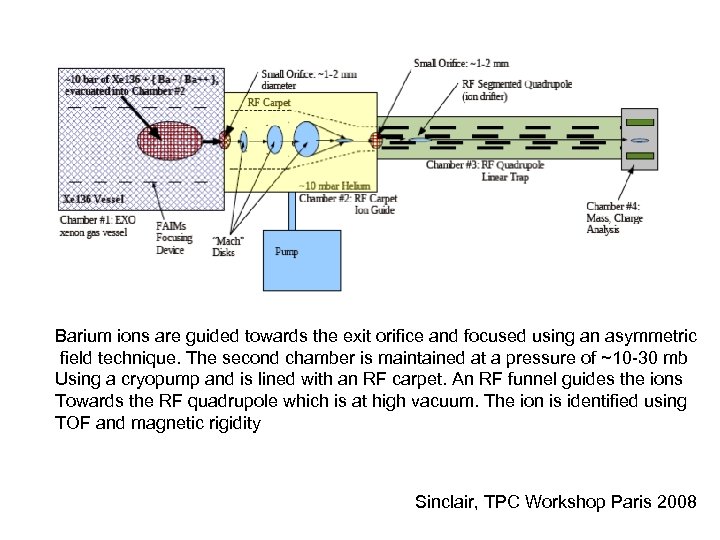 Barium ions are guided towards the exit orifice and focused using an asymmetric field technique. The second chamber is maintained at a pressure of ~10 -30 mb Using a cryopump and is lined with an RF carpet. An RF funnel guides the ions Towards the RF quadrupole which is at high vacuum. The ion is identified using TOF and magnetic rigidity Sinclair, TPC Workshop Paris 2008
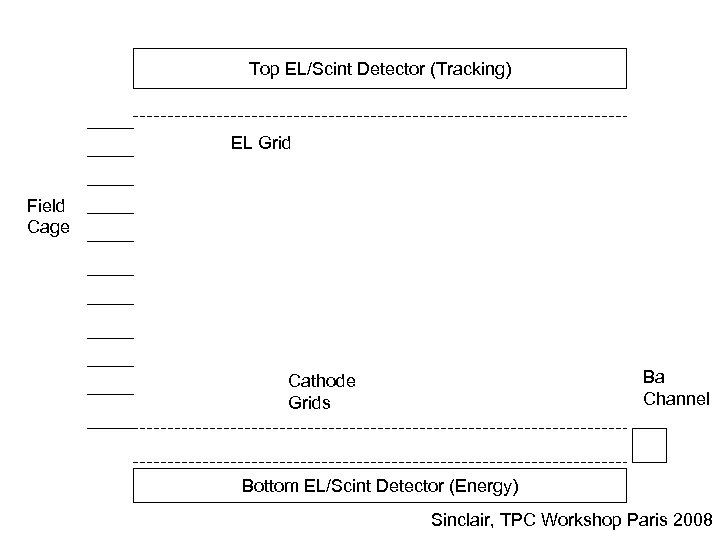 Top EL/Scint Detector (Tracking) EL Grid Field Cage Ba Channel Cathode Grids Bottom EL/Scint Detector (Energy) Sinclair, TPC Workshop Paris 2008
 HPXe and the Dark Matter search • Liquid Xenon has the lead on this (since energy resolution is not critical), however • HPXe offers better discrimination between nuclear recoils and electrons • There are ideas that would enable a lower threshold in the gas phase (useful for testing the DAMA/LIBRA positive result) – Challenge at low recoil energy for both LXe and HPXe is that the primary scintillation signal (for trigger ing and fiducialization) is Tiny
 Big Impact for WIMP Search in LXe Scintillation (S 1) & Ionization (S 2) are the signals used to reject electron recoils: S 2/S 1 But, in LXe: S 2/S 1 fluctuations are anomalously large Bad news for discrimination power in LXe… (though may be not critical in the presence of self shielding)
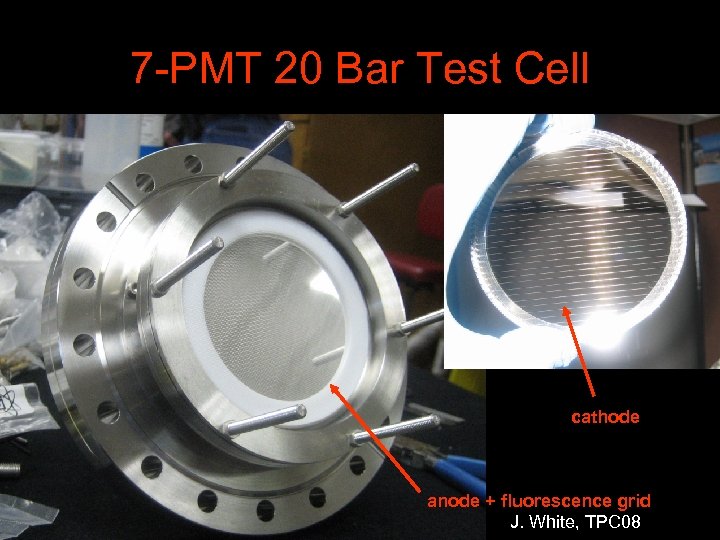 7 -PMT 20 Bar Test Cell cathode anode + fluorescence grid J. White, TPC 08
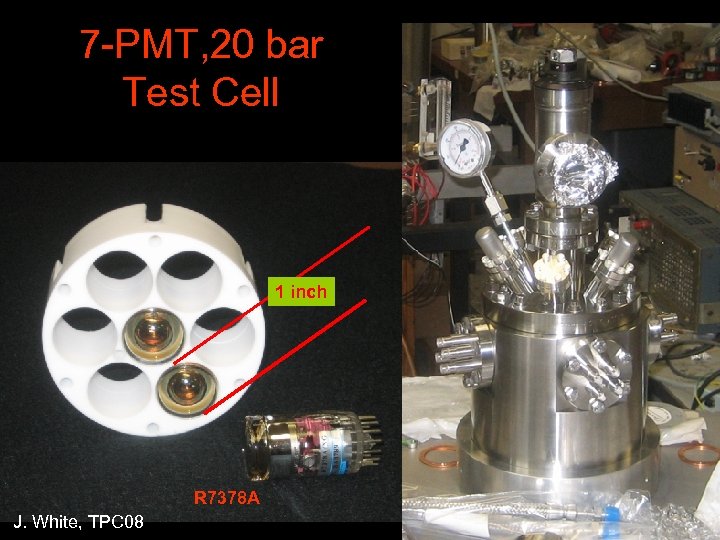 7 -PMT, 20 bar Test Cell 1 inch R 7378 A J. White, TPC 08
 Going from concept to an R&D program at LBNL • Build a test detector large enough to demonstrate ~ DE/E ~ 5 * 10 -3 at ~2. 5 Me. V – – Gas system (to take out electronegative impurities) Energy side readout (PMTs most likely) Enough “tracking-side” sensors to achieve energy resolution 50 cm size chamber to house ~20 Atm of Xe • Monte Carlo simulation for detector optimization ongoing (2 students and 0. 25*yours-truly) • Groups in Canada/US (part or EXO) and in Spain (NEXT collaboration) pursuing this line of research as well –both healthy competition and collaboration- Stay tuned…and thanks for listening!
 Other possible uses of HPXe imagers with optimal resolution • Nuclear safeguards Check fuel content of fuel rods • Homeland security Directional information from “Compton camera” to identify U and Pu isotopes from a “source”
 Summary
 Backup Slides
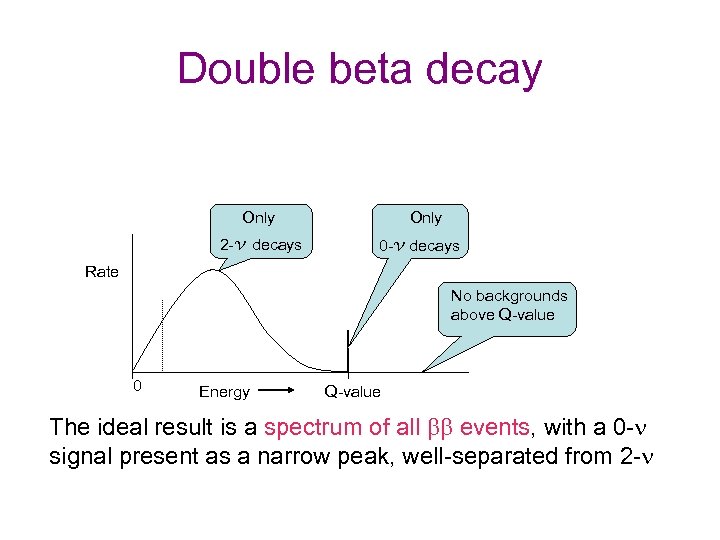 Double beta decay Only 2 -v decays Only 0 -v decays Rate No backgrounds above Q-value 0 Energy Q-value The ideal result is a spectrum of all events, with a 0 - signal present as a narrow peak, well-separated from 2 -
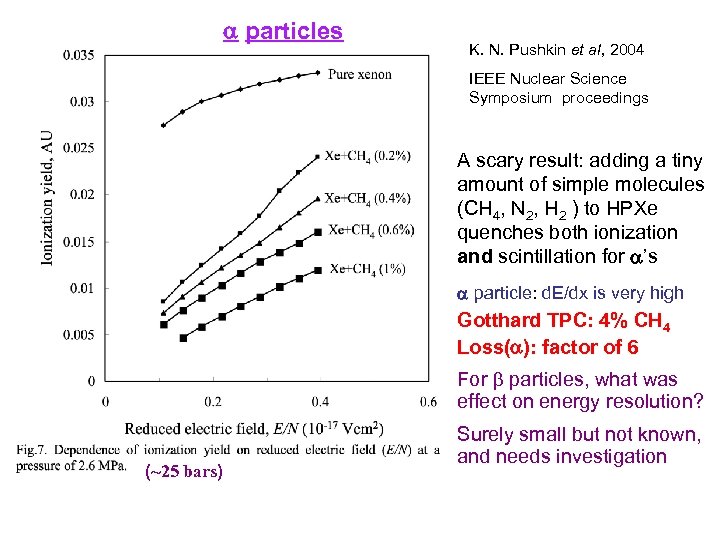 particles K. N. Pushkin et al, 2004 IEEE Nuclear Science Symposium proceedings A scary result: adding a tiny amount of simple molecules (CH 4, N 2, H 2 ) to HPXe quenches both ionization and scintillation for ’s particle: d. E/dx is very high Gotthard TPC: 4% CH 4 Loss( ): factor of 6 For particles, what was effect on energy resolution? (~25 bars) Surely small but not known, and needs investigation
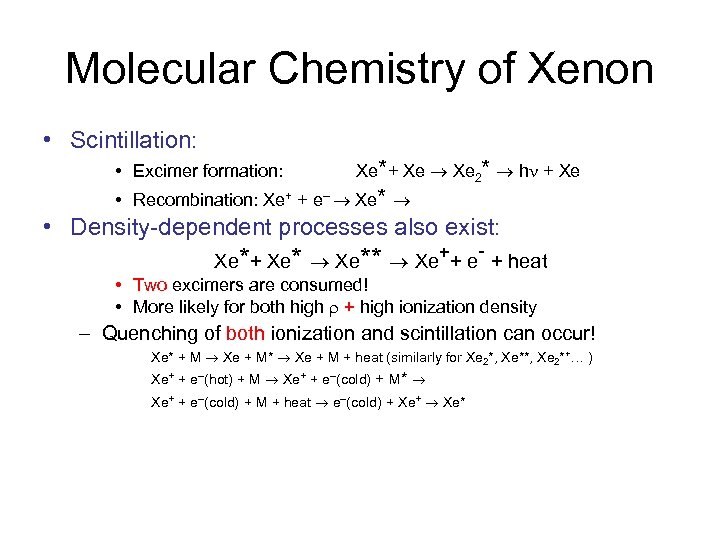 Molecular Chemistry of Xenon • Scintillation: • Excimer formation: Xe*+ Xe 2* h + Xe • Recombination: Xe+ + e– Xe* • Density-dependent processes also exist: Xe*+ Xe** Xe++ e- + heat • Two excimers are consumed! • More likely for both high + high ionization density – Quenching of both ionization and scintillation can occur! Xe* + M Xe + M* Xe + M + heat (similarly for Xe 2*, Xe**, Xe 2*+… ) Xe+ + e–(hot) + M Xe+ + e–(cold) + M* Xe+ + e–(cold) + M + heat e–(cold) + Xe+ Xe*
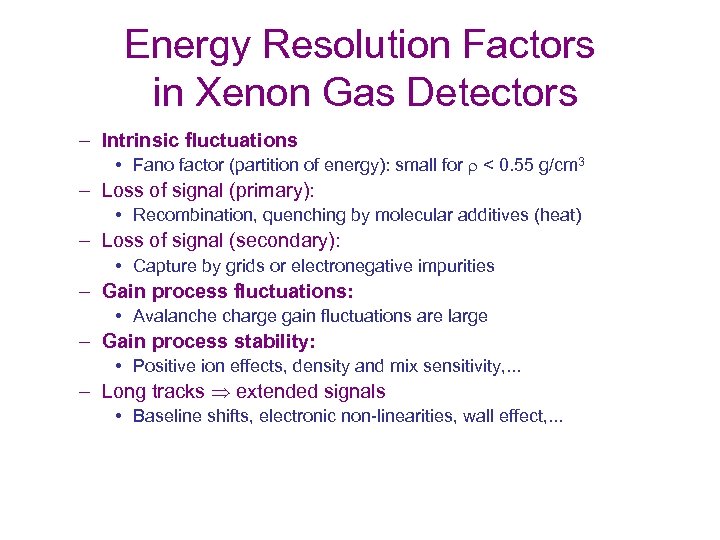 Energy Resolution Factors in Xenon Gas Detectors – Intrinsic fluctuations • Fano factor (partition of energy): small for < 0. 55 g/cm 3 – Loss of signal (primary): • Recombination, quenching by molecular additives (heat) – Loss of signal (secondary): • Capture by grids or electronegative impurities – Gain process fluctuations: • Avalanche charge gain fluctuations are large – Gain process stability: • Positive ion effects, density and mix sensitivity, . . . – Long tracks extended signals • Baseline shifts, electronic non-linearities, wall effect, . . .
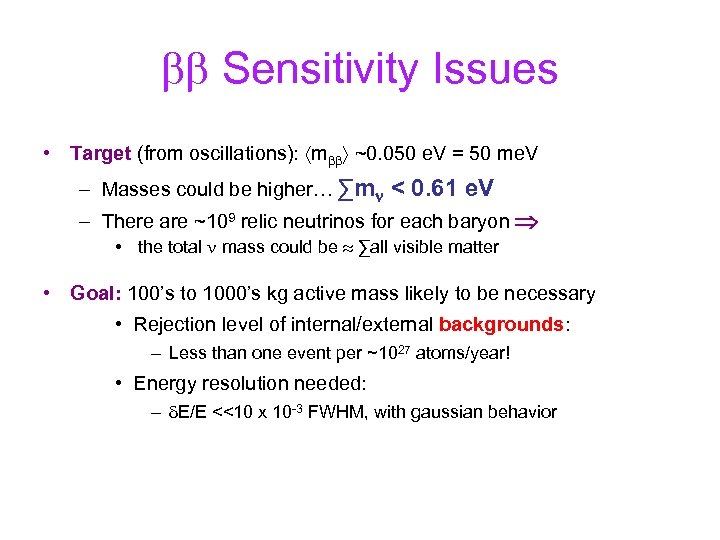 Sensitivity Issues • Target (from oscillations): m ~0. 050 e. V = 50 me. V – Masses could be higher… ∑m < 0. 61 e. V – There are ~109 relic neutrinos for each baryon • the total mass could be ∑all visible matter • Goal: 100’s to 1000’s kg active mass likely to be necessary • Rejection level of internal/external backgrounds: – Less than one event per ~1027 atoms/year! • Energy resolution needed: – E/E <<10 x 10 -3 FWHM, with gaussian behavior
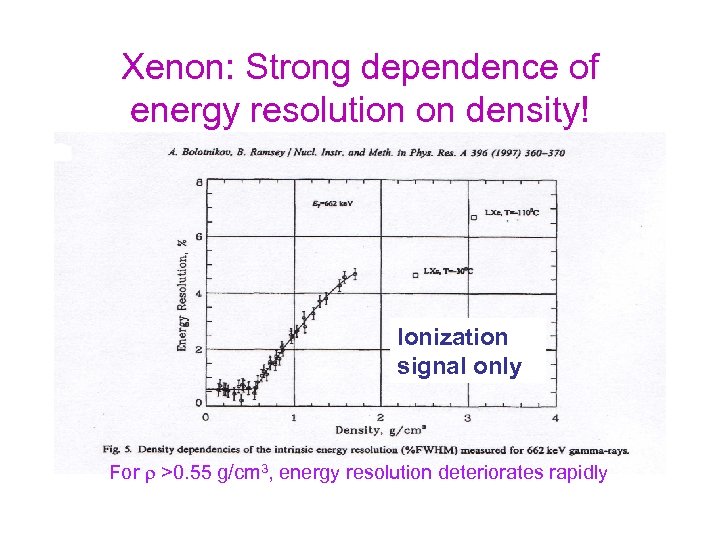 Xenon: Strong dependence of energy resolution on density! Ionization signal only For >0. 55 g/cm 3, energy resolution deteriorates rapidly
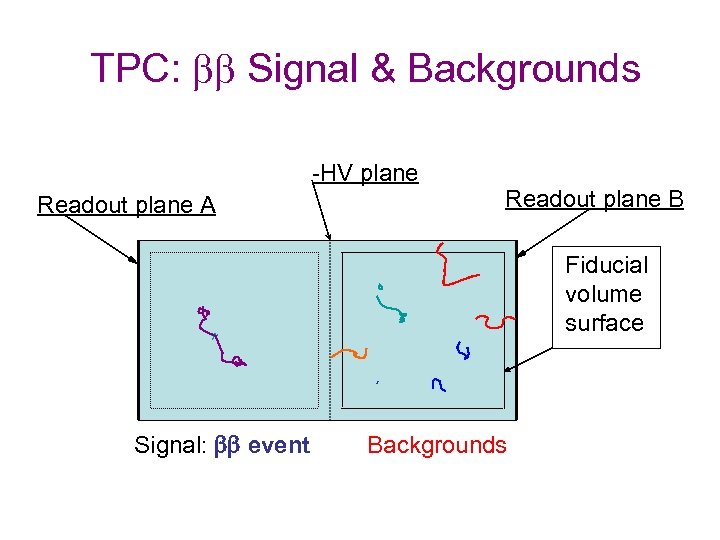 TPC: Signal & Backgrounds -HV plane Readout plane A Readout plane B Fiducial volume surface . * electrons ions Signal: event Backgrounds