 Скачать презентацию Development of a billing framework for D Grid
03507a7abf2a9ee4b239a8cf75a3f2b9.ppt
- Количество слайдов: 11



Development of a billing framework for D Grid Prof. Dr. Gabriele von Voigt, Dr. Claus Peter Rückemann, Wolfgang Müller Cracow Grid Workshop 2006 (CGW 2006) 15 th-18 th October 2006
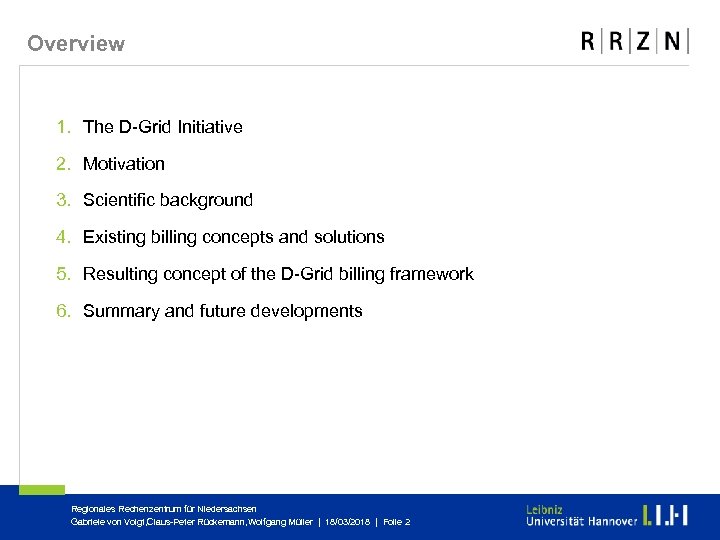
Overview 1. The D-Grid Initiative 2. Motivation 3. Scientific background 4. Existing billing concepts and solutions 5. Resulting concept of the D-Grid billing framework 6. Summary and future developments Regionales Rechenzentrum für Niedersachsen Gabriele von Voigt, Claus-Peter Rückemann, Wolfgang Müller | 18/03/2018 | Folie 2
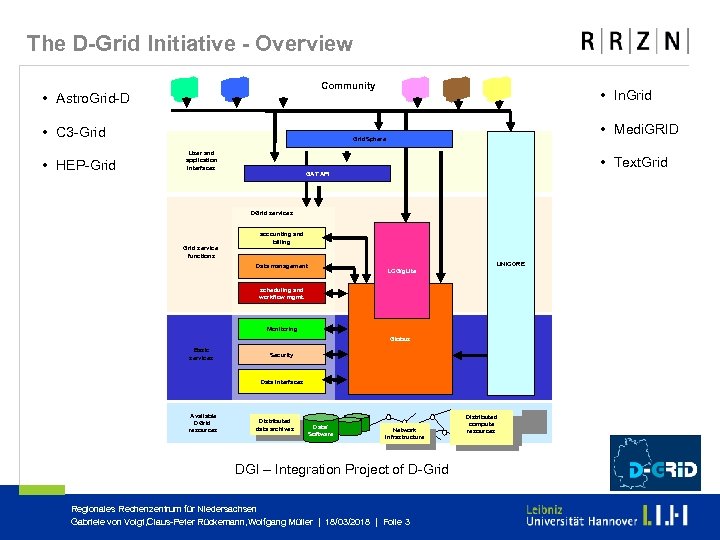
The D Grid Initiative Overview Community • Astro. Grid-D • C 3 -Grid • HEP-Grid • In. Grid • Medi. GRID Grid. Sphere User and application interfaces • Text. Grid GAT API D rid services G accounting and billing Grid service functions UNICORE Data management LCG/g. Lite scheduling and workflow mgmt. Monitoring Globus Basic services Security Data interfaces Available D rid G resources Distributed data archives Data/ Software Network infrastructure DGI – Integration Project of D-Grid Regionales Rechenzentrum für Niedersachsen Gabriele von Voigt, Claus-Peter Rückemann, Wolfgang Müller | 18/03/2018 | Folie 3 Distributed compute resources
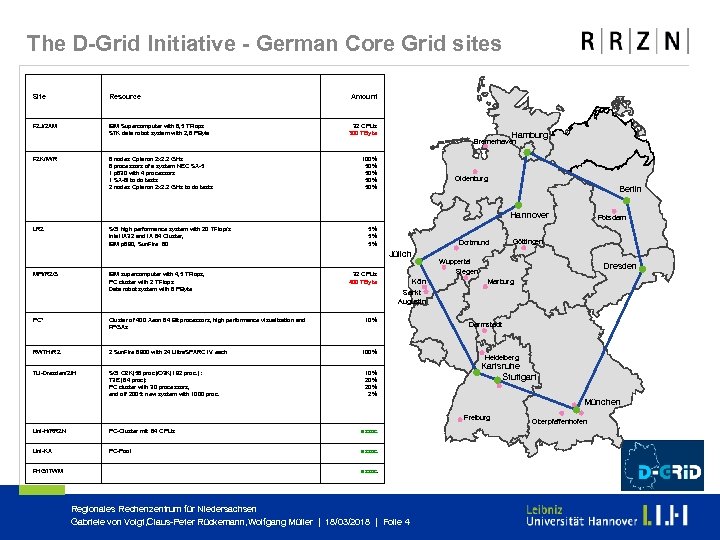
The D Grid Initiative German Core Grid sites Site Resource FZJ/ZAM IBM Supercomputer with 8, 5 TFlops STK data robot system with 2, 8 PByte Amount 32 CPUs 300 TByte Hamburg Bremerhaven FZK/IWR 8 nodes Opteron 2 x 2. 2 GHz 8 processors of a system NEC SX-5 1 p 630 with 4 processors 1 SX-6 i to do tests 2 nodes Opteron 2 x 2. 2 GHz to do tests 100% 50% 50% Oldenburg Berlin Hannover LRZ SGI high performance system with 20 TFlop/s Intel IA 32 and IA 64 Cluster, IBM p 690, Sun. Fire 80 5% 5% 5% Dortmund Jülich MPI/RZG IBM supercomputer with 4, 5 TFlops, PC cluster with 2 TFlops Data robot system with 8 PByte PC² Cluster of 400 Xeon 64 Bit processors, high performance visualization and FPGAs RWTH/RZ 2 Sun. Fire 6900 with 24 Ultra. SPARC IV each TU-Dresden/ZIH SGI O 2 K(56 proc)/O 3 K(192 proc. ) : T 3 E (64 proc): PC cluster with 30 processors, end off 2005: new system with 1000 proc. 32 CPUs 400 TByte Göttingen Wuppertal Siegen Köln Dresden Marburg Sankt Augustin 10% 10% 20% 2% Darmstadt Heidelberg Karlsruhe Stuttgart München Freiburg Uni-H/RRZN PC-Cluster mit 64 CPUs assoc. Uni-KA PC-Pool assoc. FHG/ITWM Potsdam assoc. Regionales Rechenzentrum für Niedersachsen Gabriele von Voigt, Claus-Peter Rückemann, Wolfgang Müller | 18/03/2018 | Folie 4 Oberpfaffenhofen
Motivation Even scientific environments aim at sustainability and refinancing resource provision (especially after the funding period). For the owners of grid resources it is essential to: n generate incentives for the constant provision of grid services to meet the needs of grid resource consumers, n enabling them to quest offers of resources of other providers when their own capacities are insufficient, n allowing them to maximize their resource utilization by offering a competitive service access price in order to attract consumers, and as a consequence, n reducing their total costs of ownership (TCO). The users (resource consumers) have the option of choosing n the providers that best meet their requirements or n between rental or self-procurement of computing resources. Regionales Rechenzentrum für Niedersachsen Gabriele von Voigt, Claus-Peter Rückemann, Wolfgang Müller | 18/03/2018 | Folie 5
Scientific background Elements of the billing procedure 1. step: n receiving the usage data provided by the accounting 2. step: n pricing of the single entity of the accounting data based on the contract between resource provider and resource user (rating, tariff management, account management, contract management) 3. step: n determination of the overall price for the resource usage and presenting the invoice to the resource user (bill presentment) Regionales Rechenzentrum für Niedersachsen Gabriele von Voigt, Claus-Peter Rückemann, Wolfgang Müller | 18/03/2018 | Folie 6
Existing billing concepts and solutions n „Data Grid Accounting System“ (DGAS) J decentralised banking structure J checking the creditability of the user by his bank account before job submission J the resource provider can apply various pricing metrics (such as wall clock time, CPU time, memory, storage, network traffic) J each resource provider can choose the preferable metric according to his pricing policy L uses only grid credits as a virtual currency, provides no interface to common automated payment mechanisms (such as Paypal or Netcash) L uses only g. Lite as a middleware Regionales Rechenzentrum für Niedersachsen Gabriele von Voigt, Claus-Peter Rückemann, Wolfgang Müller | 18/03/2018 | Folie 7
Existing billing concepts and solutions n „Swe. Grid Accounting System“ (SGAS) J decentralised banking structure J checking the creditability of the user by his bank account before job submission J creating holds on the bank account while job processing in order to avoid overspending of grid credits J implemented within Swe. Grid and running within a production environment L uses only grid credits as a virtual currency, provides no interface to common automated payment mechanisms L uses only Globus toolkit as a middleware L only one nearly homogenous resource type is used within the Swe. Grid L only one metric (wall clock time per node) is used for pricing Regionales Rechenzentrum für Niedersachsen Gabriele von Voigt, Claus-Peter Rückemann, Wolfgang Müller | 18/03/2018 | Folie 8
Existing billing concepts and solutions n „Grid. Bank/GASA” framework in the context of the Australian GRIDBUS project J checking the creditability of the user by his bank account before job submission J creating holds on the bank account while job processing in order to avoid overspending of grid credits J the resource provider can apply various pricing metrics (such as wall clock time, CPU time, memory, storage, network traffic) J uses virtual and real currencies J open interface to existing payment handling systems J enables different payment strategies (such as pay before use, pay as you go, post-payment) L centralised grid bank server L Globus toolkit as a middleware L developed within the scope of the project but no production phase yet Regionales Rechenzentrum für Niedersachsen Gabriele von Voigt, Claus-Peter Rückemann, Wolfgang Müller | 18/03/2018 | Folie 9
Resulting concept of the D Grid billing framework n Inquiry among the D-Grid resource provider and resource user (D-Grid communities and the German Core Grid Sites) The major features are: n payment after job submission but guaranteeing sufficient user’s funds before job submission n necessary security from job submission up to payment between user, resource broker, resource provider and clearing institution n various mechanisms of price building for resource providers n ability to handle various currencies n existence of clearing institutions (bank service, account management) n installation of a procedure for the settlement of disputes and conflicts n independent of the utilized middleware n special emphasis on virtual currency for spending funded budgets Regionales Rechenzentrum für Niedersachsen Gabriele von Voigt, Claus-Peter Rückemann, Wolfgang Müller | 18/03/2018 | Folie 10
Summary and future developments D-Grid needs an extended interpretation of billing up to the full payment process and has to take into account the German federal funding policy. A comprehensive billing solution for the mutual provision and usage of grid resources will be developed and implemented. A transparent and comprehensible billing framework for grid computing is going to be established. The aim is to supply a multiplicity of users, both from the scientific range and from the economy. Services will be offered by a multiplicity of providers. The project is funded by www. d-grid. de Regionales Rechenzentrum für Niedersachsen Gabriele von Voigt, Claus-Peter Rückemann, Wolfgang Müller | 18/03/2018 | Folie 11 Thank you for your attention.
Скачать презентацию Development of a billing framework for D Grid
03507a7abf2a9ee4b239a8cf75a3f2b9.ppt