


 Скачать презентацию Development in the Asia Pacific Region Asia Rapporteur s
f2bdf848c61fabdc27faafc1495972a1.ppt
- Количество слайдов: 14
 Development in the Asia Pacific Region Asia Rapporteur’s Report to the 14 th Plenary Sep. 16 -17, 2008 17. Sep. 2008 UN/CEFACT Rapporteur for Asia
 Contents 1. AFACT 2. Collaboration with APEC UN/CEFACT Rapporteur for Asia 17 Sep. 2008
 AFACT (Asia Pacific Council for Trade Facilitation & e-Business) UN/CEFACT Rapporteur for Asia 17 Sep. 2008
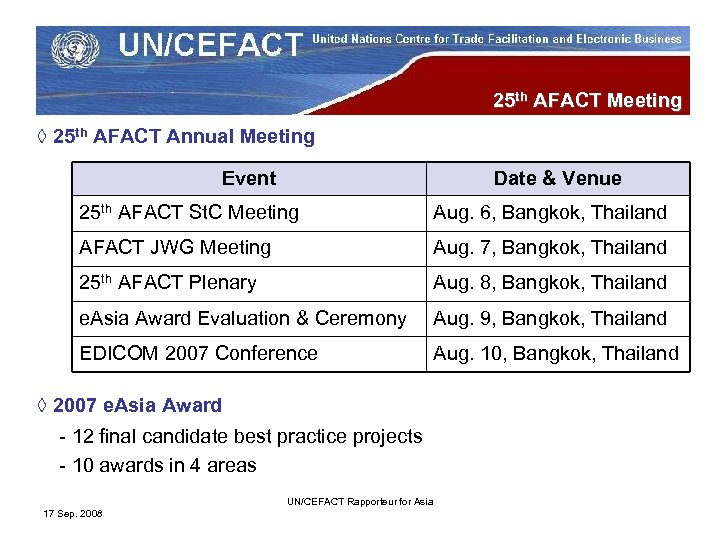 25 th AFACT Meeting ◊ 25 th AFACT Annual Meeting Event Date & Venue 25 th AFACT St. C Meeting Aug. 6, Bangkok, Thailand AFACT JWG Meeting Aug. 7, Bangkok, Thailand 25 th AFACT Plenary Aug. 8, Bangkok, Thailand e. Asia Award Evaluation & Ceremony Aug. 9, Bangkok, Thailand EDICOM 2007 Conference Aug. 10, Bangkok, Thailand ◊ 2007 e. Asia Award - 12 final candidate best practice projects - 10 awards in 4 areas UN/CEFACT Rapporteur for Asia 17 Sep. 2008
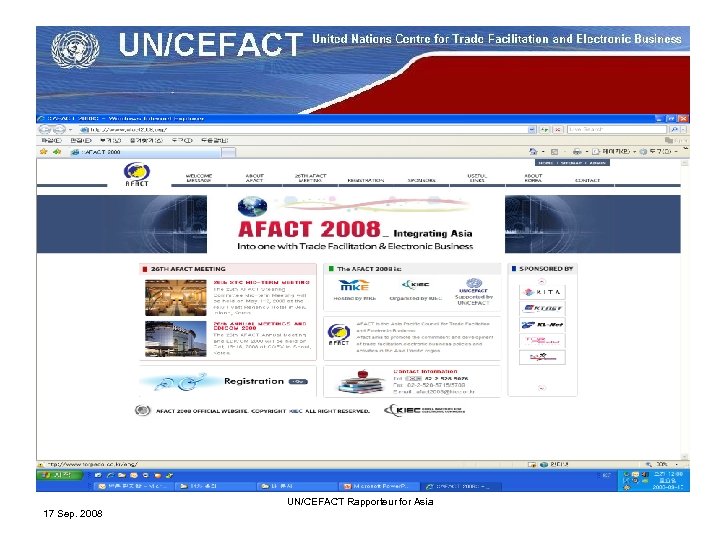
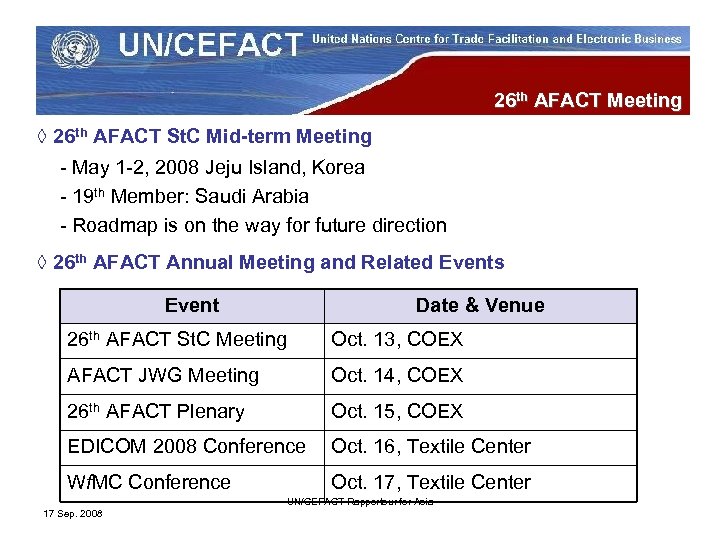 26 th AFACT Meeting ◊ 26 th AFACT St. C Mid-term Meeting - May 1 -2, 2008 Jeju Island, Korea - 19 th Member: Saudi Arabia - Roadmap is on the way for future direction ◊ 26 th AFACT Annual Meeting and Related Events Event Date & Venue 26 th AFACT St. C Meeting Oct. 13, COEX AFACT JWG Meeting Oct. 14, COEX 26 th AFACT Plenary Oct. 15, COEX EDICOM 2008 Conference Oct. 16, Textile Center Wf. MC Conference Oct. 17, Textile Center UN/CEFACT Rapporteur for Asia 17 Sep. 2008
 UN/CEFACT Rapporteur for Asia 17 Sep. 2008
 Collaboration with APEC (Asia Pacific Economic Cooperation) UN/CEFACT Rapporteur for Asia 17 Sep. 2008
 Under the auspices of APEC Electronic Commerce Steering Group & UN/CEFACT May 26 – 28, 2008 Seoul, Korea UN/CEFACT Rapporteur for Asia 17 Sep. 2008
 ◊ Symposium Participants 160 stakeholders from 22 economies (14 economies from APEC) UNECE UN/CEFACT Rapporteur for Asia 17 Sep. 2008
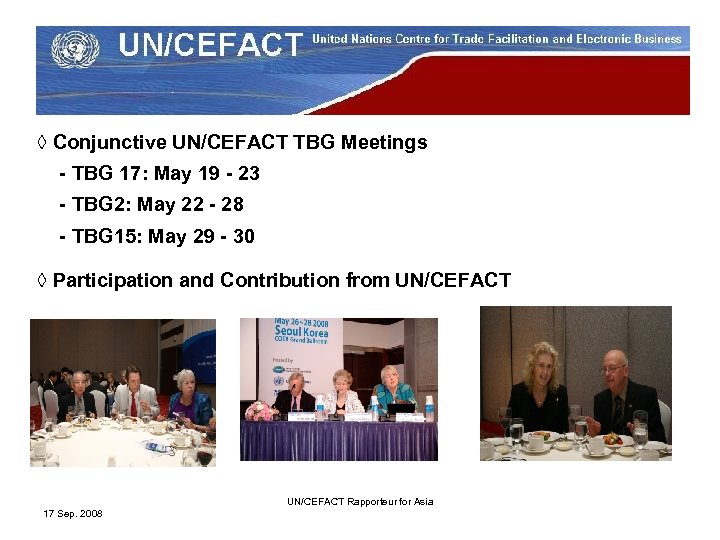 ◊ Conjunctive UN/CEFACT TBG Meetings - TBG 17: May 19 - 23 - TBG 2: May 22 - 28 - TBG 15: May 29 - 30 ◊ Participation and Contribution from UN/CEFACT Rapporteur for Asia 17 Sep. 2008
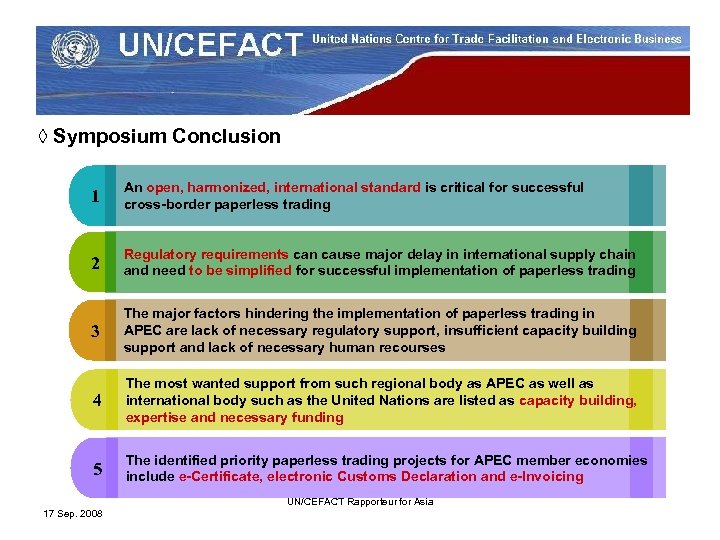 ◊ Symposium Conclusion 1 An open, harmonized, international standard is critical for successful cross-border paperless trading 2 Regulatory requirements can cause major delay in international supply chain and need to be simplified for successful implementation of paperless trading 3 The major factors hindering the implementation of paperless trading in APEC are lack of necessary regulatory support, insufficient capacity building support and lack of necessary human recourses 4 The most wanted support from such regional body as APEC as well as international body such as the United Nations are listed as capacity building, expertise and necessary funding 5 The identified priority paperless trading projects for APEC member economies include e-Certificate, electronic Customs Declaration and e-Invoicing UN/CEFACT Rapporteur for Asia 17 Sep. 2008
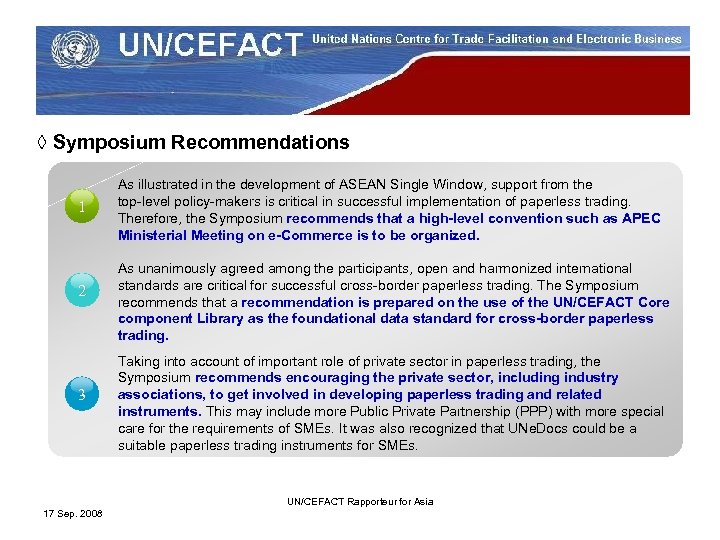 ◊ Symposium Recommendations 1 2 3 As illustrated in the development of ASEAN Single Window, support from the top-level policy-makers is critical in successful implementation of paperless trading. Therefore, the Symposium recommends that a high-level convention such as APEC Ministerial Meeting on e-Commerce is to be organized. As unanimously agreed among the participants, open and harmonized international standards are critical for successful cross-border paperless trading. The Symposium recommends that a recommendation is prepared on the use of the UN/CEFACT Core component Library as the foundational data standard for cross-border paperless trading. Taking into account of important role of private sector in paperless trading, the Symposium recommends encouraging the private sector, including industry associations, to get involved in developing paperless trading and related instruments. This may include more Public Private Partnership (PPP) with more special care for the requirements of SMEs. It was also recognized that UNe. Docs could be a suitable paperless trading instruments for SMEs. UN/CEFACT Rapporteur for Asia 17 Sep. 2008
 4 The finding of the survey result reinforces that APEC economies need more capacity building support for paperless trading. They Symposium recommends that APEC and UN regional bodies such as UNECE, UNESCAP and UNECLAC to collaborate and develop joint capacity building program. As a first step, it was suggested that a proper communication channel is to be set up. Another proposal was the introduction of mentoring program in paperless trading capacity building project in its e. BGT project. 5 It was pointed out during the Symposium that the outreach and presence of both APEC and UN is not enough in certain region such as Latin America. The Symposium recommends both APEC and UN to increase its outreach and promotional activities in paperless trading. 6 Single Window is a good candidate to be a paperless trading instruments for facilitating cross-border trade. However, for many economies, implementing a Single Window can pose many obstacles caused by regulatory requirements, business practices, technical incompetence, etc. The Symposium recommends UN/CEFACT to consider requests for developing recommendations related to the Single Window to facilitate its implementation. 7 Recognizing the respective strengths of APEC and UN/CEFACT in facilitating paperless trading in the region and globally, the Symposium recommends forming a joint task force. The joint task force will develop common mission and statement, convincing business model for paperless trading and necessary resolution to implement the agreed UN/CEFACT Rapporteur for Asia Symposium recommendations. 17 Sep. 2008
 Thank you ! Sangwon Lim UN/CEFACT Rapporteur for Asia Tel. : 82 -2 -528 -5020 Fax: 82 -2 -528 -5719 email: swlim@KIEC. or. kr UN/CEFACT Rapporteur for Asia 17 Sep. 2008