


 Скачать презентацию Development and testing of in-vessel magnetic sensors for
415f764fa22511a6aa13b6750e40f5bc.ppt
- Количество слайдов: 32
 Development and testing of in-vessel magnetic sensors for ITER progress on in-Vessel pick-up coils presented by G. Chitarin (Univ. of Padova and Consorzio RFX) acknowledgements to: S. Dal. Bello, S. Peruzzo, C. Taccon L. Lotto, L. Ranzato, A. Sottocornola G. Chitarin 12 th Meeting of the ITPA Topical group on Diagnostics, 29 March 2007 pag 1
 Outline • background on magnetic measurements at RFX • design targets for ITER in-Vessel pick-up coils • proposed design concept for equilibrium pick-up coils • design rationale & weak points • prototype construction procedure • prototype tests procedure & results • present alternatives and conclusions • experience with JET-EP Halo sensors G. Chitarin 12 th Meeting of the ITPA Topical group on Diagnostics, 29 March 2007 pag 2
 background on magnetic diagnostics design at RFX JET-EP (Enhancement Projects): • JET Magnetics Enhancements (2002 -2006) : • in-Vessel sensors (upper coils and outer poloidal limiter coils) • ex-Vessel sensors (pick-up coils, Hall probes, flux sensors) • JET Halo Current measurement system: (2001 -2006) • Halo rogowski coils (behind first wall CFC tiles) • Halo TF pick-up coils (behind first wall CFC tiles) ITER : • Re-evaluation and optimization of the sub-system for measuring Halo currents in ITER (2004) • Design study of the ITER magnetics diagnostic (2005) • Inner-vessel tangential and normal coils • External flux loops • Halo current sensors • Steady-state sensors • Development and testing of Magnetic Sensors (2006) • Inner-vessel tangential and normal coils • Blanket and Divertor Halo rogowski sensors G. Chitarin 12 th Meeting of the ITPA Topical group on Diagnostics, 29 March 2007 pag 3
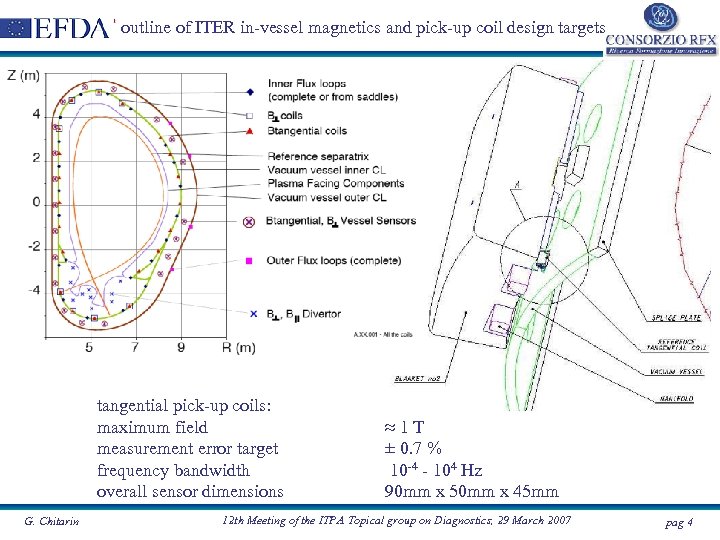 outline of ITER in-vessel magnetics and pick-up coil design targets tangential pick-up coils: maximum field measurement error target frequency bandwidth overall sensor dimensions G. Chitarin ≈1 T ± 0. 7 % 10 -4 - 104 Hz 90 mm x 50 mm x 45 mm 12 th Meeting of the ITPA Topical group on Diagnostics, 29 March 2007 pag 4
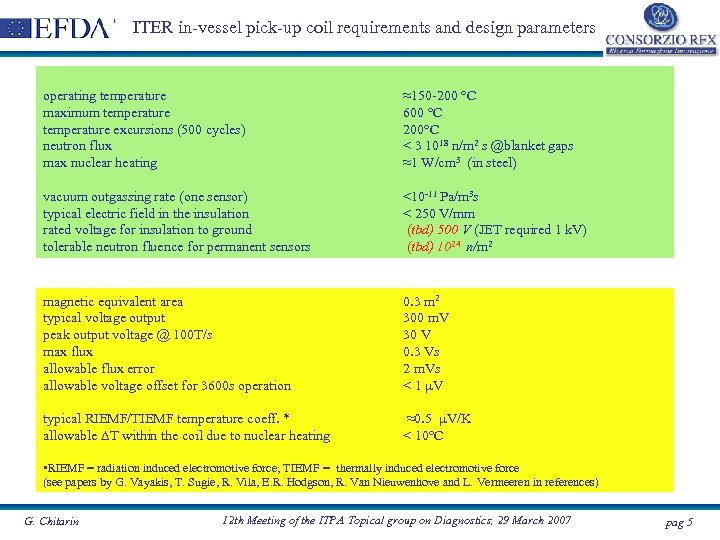 ITER in-vessel pick-up coil requirements and design parameters operating temperature maximum temperature excursions (500 cycles) neutron flux max nuclear heating ≈150 -200 °C 600 °C 200°C < 3 1018 n/m 2 s @blanket gaps ≈1 W/cm 3 (in steel) vacuum outgassing rate (one sensor) typical electric field in the insulation rated voltage for insulation to ground tolerable neutron fluence for permanent sensors <10 -11 Pa/m 3 s < 250 V/mm (tbd) 500 V (JET required 1 k. V) (tbd) 1024 n/m 2 magnetic equivalent area typical voltage output peak output voltage @ 100 T/s max flux allowable flux error allowable voltage offset for 3600 s operation 0. 3 m 2 300 m. V 30 V 0. 3 Vs 2 m. Vs < 1 V typical RIEMF/TIEMF temperature coeff. * allowable T within the coil due to nuclear heating ≈0. 5 V/K < 10°C • RIEMF = radiation induced electromotive force; TIEMF = thermally induced electromotive force (see papers by G. Vayakis, T. Sugie, R. Vila, E. R. Hodgson, R. Van Nieuwenhove and L. Vermeeren in references) G. Chitarin 12 th Meeting of the ITPA Topical group on Diagnostics, 29 March 2007 pag 5
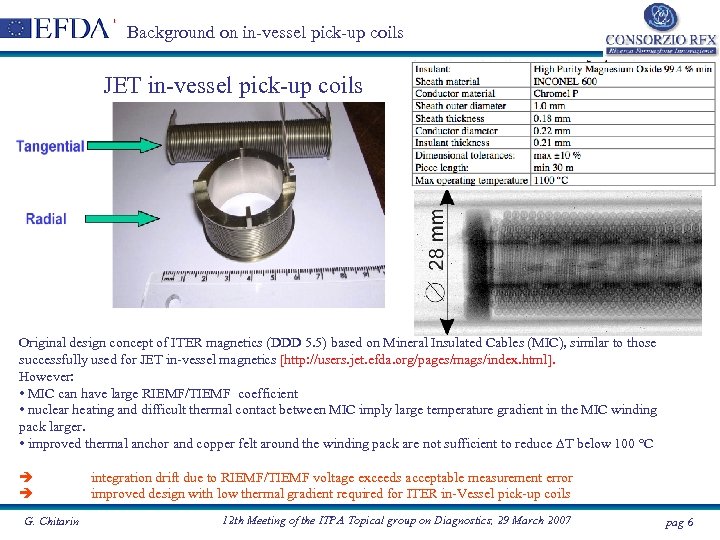 Background on in-vessel pick-up coils JET in-vessel pick-up coils Original design concept of ITER magnetics (DDD 5. 5) based on Mineral Insulated Cables (MIC), similar to those successfully used for JET in-vessel magnetics [http: //users. jet. efda. org/pages/mags/index. html]. However: • MIC can have large RIEMF/TIEMF coefficient • nuclear heating and difficult thermal contact between MIC imply large temperature gradient in the MIC winding pack larger. • improved thermal anchor and copper felt around the winding pack are not sufficient to reduce T below 100 °C G. Chitarin integration drift due to RIEMF/TIEMF voltage exceeds acceptable measurement error improved design with low thermal gradient required for ITER in-Vessel pick-up coils 12 th Meeting of the ITPA Topical group on Diagnostics, 29 March 2007 pag 6
 Qualitative analysis for thermally improved in-vessel pick-up coil worth being tested first G. Chitarin 12 th Meeting of the ITPA Topical group on Diagnostics, 29 March 2007 pag 7
 Outline of the improved ITER in-Vessel pick-up coil Rationale: reduce RITES/TIEMF voltage, which is directly related to thermal gradient in the coil, caused by nuclear heating • avoid vacuum spaces between conductors • select materials for high thermal conductivity and low TIEMF cables • reduce paths to thermal sink (ITER vacuum vessel) • reduce coil and reel mass (in order to reduce the nuclear power generated) Implementation concepts: • Fluid ceramic filling ("potting") for improved thermal conductivity between turns and to the external case • Flexible ceramic-coated conductors (thin inter-turn insulation) • thin stainless-steel or machinable ceramic reel • copper external Case and Endplate providing good thermal anchor to the vessel • ground insulation only if necessary (plasma sprayed or fibreglass tape) G. Chitarin 12 th Meeting of the ITPA Topical group on Diagnostics, 29 March 2007 pag 8
 Expected advantages / disadvantages of the design based on potted flexible ceramic-coated conductors Expected advantages: • better thermal conductivity of the winding pack (conductor volume/total volume ratio ~10 times larger ) • larger conductor cross-section, lower coil resistance and larger signal with the same sensor volume • expected lower RIEMF/TIEMF in comparison with MIC conductors (to be confirmed) • porous ceramic insulation constitutes a good surface for the adhesion of the fluid ceramic • Insulation withstand voltage and reliability expected to improve with potting Expected disadvantages: • conductor insulation layer is very thin (< 0. 1 mm) and potentially delicate • insulation rated voltage is < 600 V at best (lower than usually required for insulation in JET) supplementary ground insulation is necessary if this level is considered not large enough • conductor insulation is porous and can absorb moisture from the air or dirt during handling, bakeout in vacuum necessary • transition to other kind of conductor inside the pick-up coil copper Case is necessary G. Chitarin 12 th Meeting of the ITPA Topical group on Diagnostics, 29 March 2007 pag 9
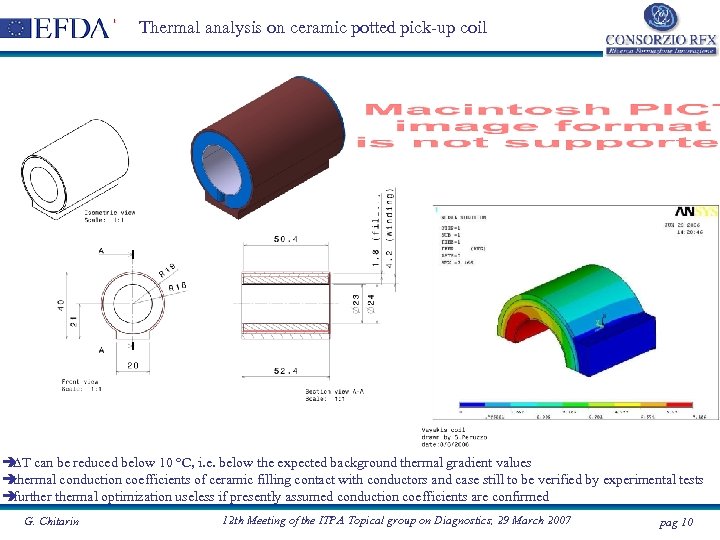 Thermal analysis on ceramic potted pick-up coil can be reduced below 10 °C, i. e. below the expected background thermal gradient values T thermal conduction coefficients of ceramic filling contact with conductors and case still to be verified by experimental tests furthermal optimization useless if presently assumed conduction coefficients are confirmed G. Chitarin 12 th Meeting of the ITPA Topical group on Diagnostics, 29 March 2007 pag 10
 Choice of ceramic-coated flexible conductors Two types of cables have been proposed for the prototype tests (manufacturer's specifications): Both are worth being tested G. Chitarin 12 th Meeting of the ITPA Topical group on Diagnostics, 29 March 2007 pag 11
 Choice of potting fluid ceramics A large number of fluid ceramic compounds is available on the market based on previous experience with JET magnetics, two types of fluid ceramic have been proposed for the ITER prototype tests: a protective & insulating ceramic paint (Corr. Paint from Aremco) has also been tested, but abandoned because of large grain size G. Chitarin 12 th Meeting of the ITPA Topical group on Diagnostics, 29 March 2007 pag 12
 Critical issues of the potted ceramic-coated conductors 1. Viscosity of the fluid ceramic and complete filling of the winding pack during potting process 2. Adhesion of solidified ceramic to ceramic conductors, stainless steel and copper 3. Formation of cracks and cavities in ceramics during solidification (affecting equivalent thermal conductivity of winding pack) 4. Effect of potting fluid on conductor coating (affecting/increasing withstand voltage of insulation) 5. Different thermal expansion of solidified ceramics, copper and stainless steel, behavior under thermal cycling 6. Degassing rate of potted winding pack 7. RIEMF/TIEMF properties of ceramic-coated conductors 8. chemical compatibility of ceramic coating with ITER in-vessel environment, behavior of ceramic insulation material under neutron radiation, 1. 2. Prototype construction and test necessary Tests on prototypes are in progress at Consorzio RFX for issues 1 -6 in the frame of EFDA task. G. Chitarin 12 th Meeting of the ITPA Topical group on Diagnostics, 29 March 2007 pag 13
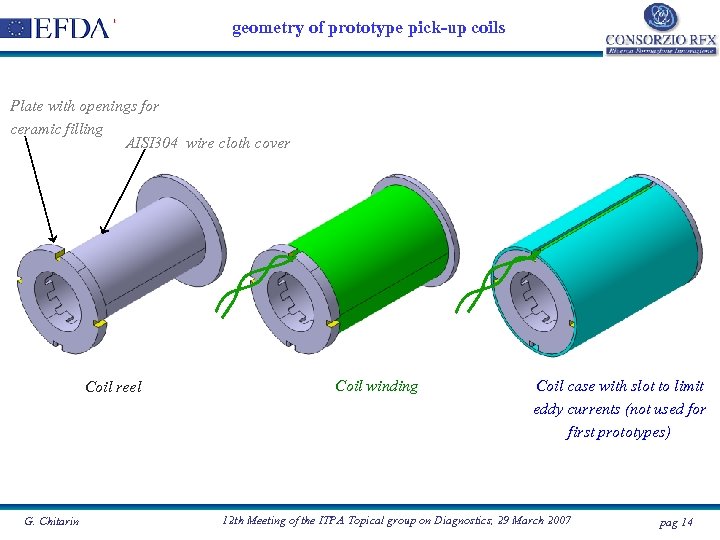 geometry of prototype pick-up coils Plate with openings for ceramic filling AISI 304 wire cloth cover Coil reel G. Chitarin Coil winding Coil case with slot to limit eddy currents (not used for first prototypes) 12 th Meeting of the ITPA Topical group on Diagnostics, 29 March 2007 pag 14
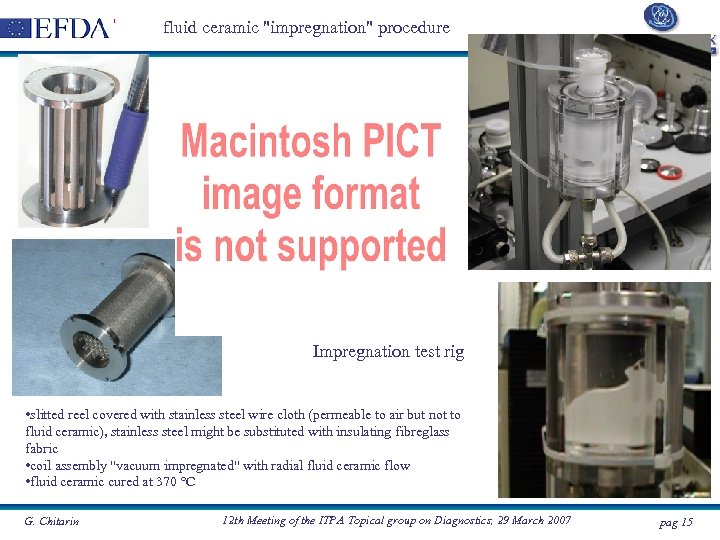 fluid ceramic "impregnation" procedure Impregnation test rig • slitted reel covered with stainless steel wire cloth (permeable to air but not to fluid ceramic), stainless steel might be substituted with insulating fibreglass fabric • coil assembly "vacuum impregnated" with radial fluid ceramic flow • fluid ceramic cured at 370 °C G. Chitarin 12 th Meeting of the ITPA Topical group on Diagnostics, 29 March 2007 pag 15
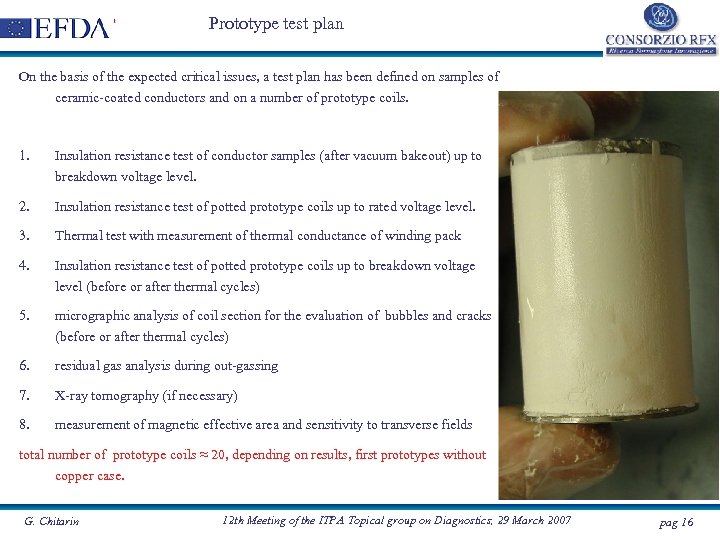 Prototype test plan On the basis of the expected critical issues, a test plan has been defined on samples of ceramic-coated conductors and on a number of prototype coils. 1. Insulation resistance test of conductor samples (after vacuum bakeout) up to breakdown voltage level. 2. Insulation resistance test of potted prototype coils up to rated voltage level. 3. Thermal test with measurement of thermal conductance of winding pack 4. Insulation resistance test of potted prototype coils up to breakdown voltage level (before or after thermal cycles) 5. micrographic analysis of coil section for the evaluation of bubbles and cracks (before or after thermal cycles) 6. residual gas analysis during out-gassing 7. X-ray tomography (if necessary) 8. measurement of magnetic effective area and sensitivity to transverse fields total number of prototype coils ≈ 20, depending on results, first prototypes without copper case. G. Chitarin 12 th Meeting of the ITPA Topical group on Diagnostics, 29 March 2007 pag 16
 (original) workplan for in-vessel pick-up coils R&D 1. 2. 3. 4. 5. 6. 7. 8. perform test cycle on initial series of prototypes evaluate first test results define transition and connections to MIC or Sulzer cables update design and drawings on the basis of the first experimental results prepare technical specifications for construction of new prototypes proceed with second test cycle evaluate second test cycle results assess performances of optimal design G. Chitarin 12 th Meeting of the ITPA Topical group on Diagnostics, 29 March 2007 pag 17
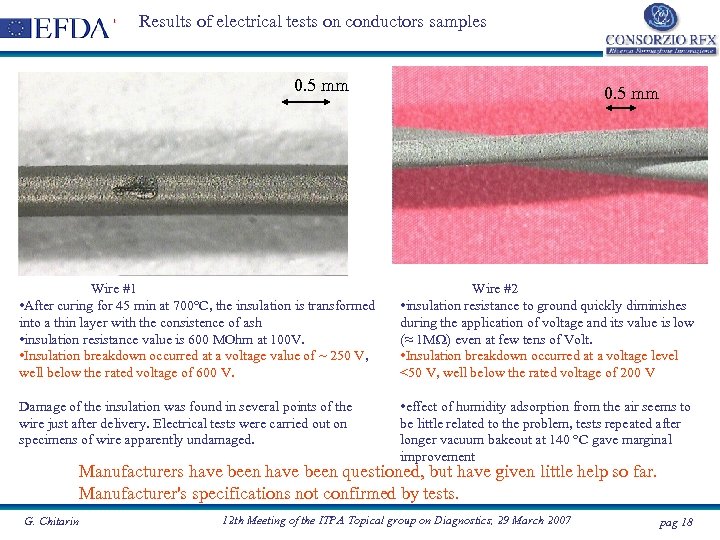 Results of electrical tests on conductors samples 0. 5 mm Wire #1 • After curing for 45 min at 700°C, the insulation is transformed into a thin layer with the consistence of ash • insulation resistance value is 600 MOhm at 100 V. • Insulation breakdown occurred at a voltage value of ~ 250 V, well below the rated voltage of 600 V. Wire #2 • insulation resistance to ground quickly diminishes during the application of voltage and its value is low (≈ 1 M ) even at few tens of Volt. • Insulation breakdown occurred at a voltage level <50 V, well below the rated voltage of 200 V Damage of the insulation was found in several points of the wire just after delivery. Electrical tests were carried out on specimens of wire apparently undamaged. • effect of humidity adsorption from the air seems to be little related to the problem, tests repeated after longer vacuum bakeout at 140 °C gave marginal improvement Manufacturers have been questioned, but have given little help so far. Manufacturer's specifications not confirmed by tests. G. Chitarin 12 th Meeting of the ITPA Topical group on Diagnostics, 29 March 2007 pag 18
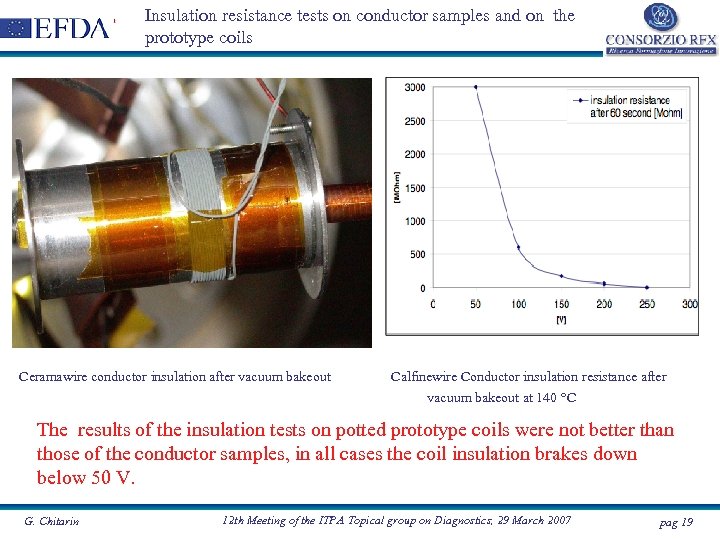 Insulation resistance tests on conductor samples and on the prototype coils Ceramawire conductor insulation after vacuum bakeout Calfinewire Conductor insulation resistance after vacuum bakeout at 140 °C The results of the insulation tests on potted prototype coils were not better than those of the conductor samples, in all cases the coil insulation brakes down below 50 V. G. Chitarin 12 th Meeting of the ITPA Topical group on Diagnostics, 29 March 2007 pag 19
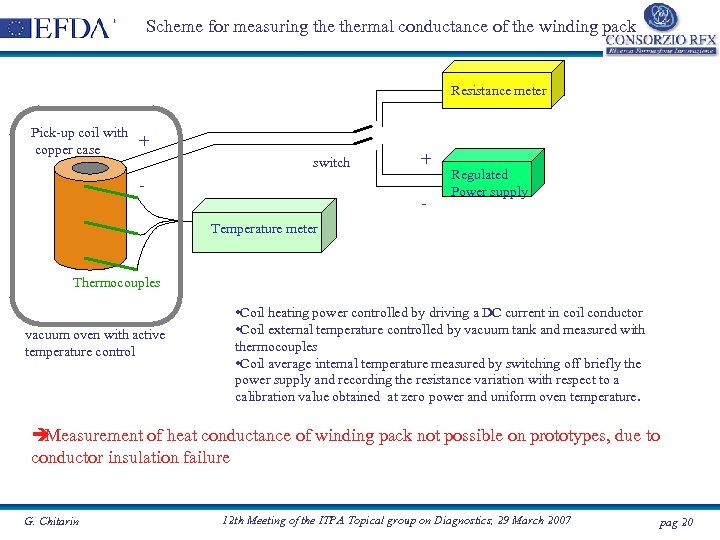 Scheme for measuring thermal conductance of the winding pack Resistance meter Pick-up coil with copper case + switch - + - Regulated Power supply Temperature meter Thermocouples vacuum oven with active temperature control • Coil heating power controlled by driving a DC current in coil conductor • Coil external temperature controlled by vacuum tank and measured with thermocouples • Coil average internal temperature measured by switching off briefly the power supply and recording the resistance variation with respect to a calibration value obtained at zero power and uniform oven temperature. Measurement of heat conductance of winding pack not possible on prototypes, due to conductor insulation failure G. Chitarin 12 th Meeting of the ITPA Topical group on Diagnostics, 29 March 2007 pag 20
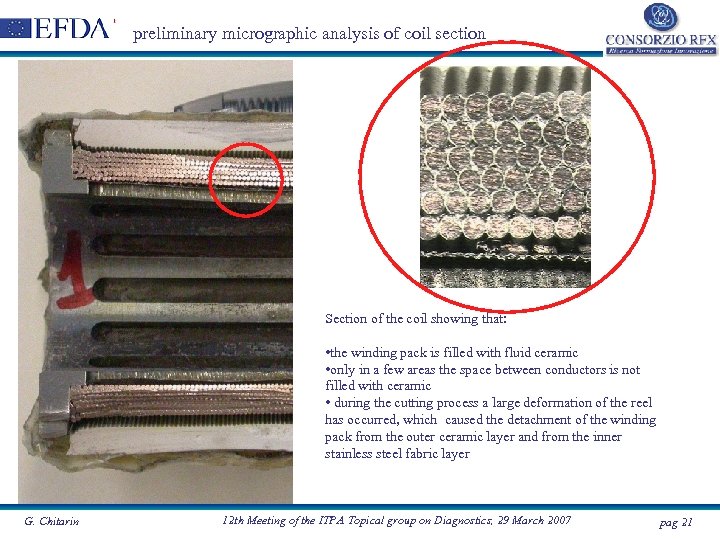 preliminary micrographic analysis of coil section Section of the coil showing that: • the winding pack is filled with fluid ceramic • only in a few areas the space between conductors is not filled with ceramic • during the cutting process a large deformation of the reel has occurred, which caused the detachment of the winding pack from the outer ceramic layer and from the inner stainless steel fabric layer G. Chitarin 12 th Meeting of the ITPA Topical group on Diagnostics, 29 March 2007 pag 21
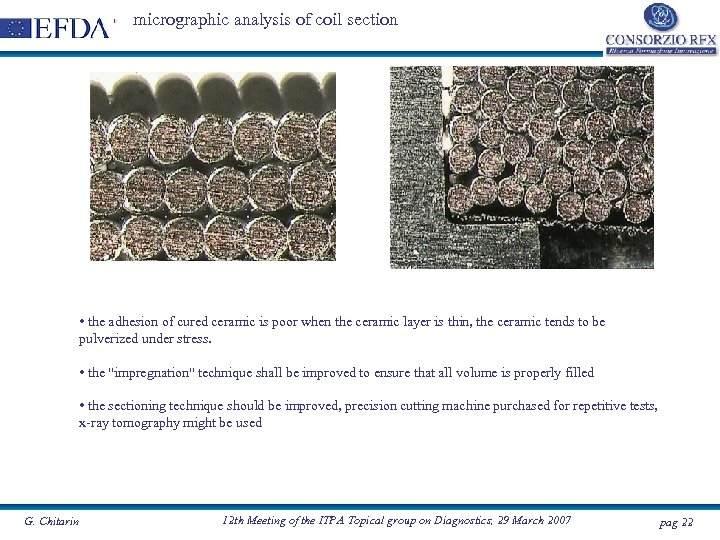 micrographic analysis of coil section • the adhesion of cured ceramic is poor when the ceramic layer is thin, the ceramic tends to be pulverized under stress. • the "impregnation" technique shall be improved to ensure that all volume is properly filled • the sectioning technique should be improved, precision cutting machine purchased for repetitive tests, x-ray tomography might be used G. Chitarin 12 th Meeting of the ITPA Topical group on Diagnostics, 29 March 2007 pag 22
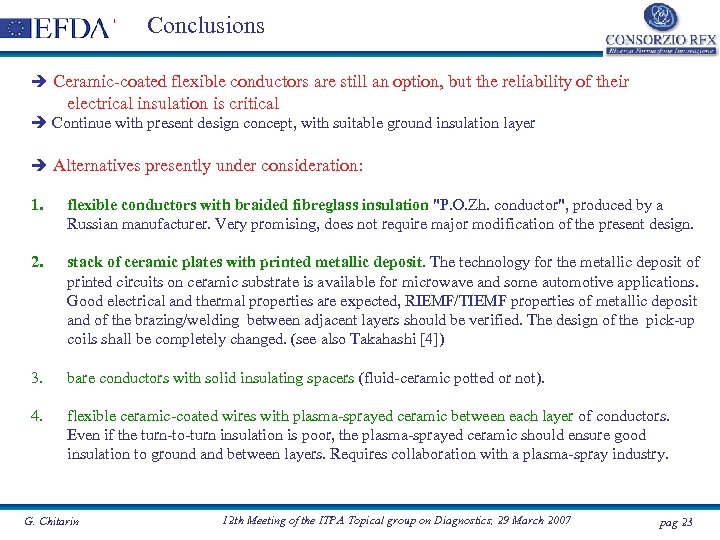 Conclusions Ceramic-coated flexible conductors are still an option, but the reliability of their electrical insulation is critical Continue with present design concept, with suitable ground insulation layer Alternatives presently under consideration: 1. flexible conductors with braided fibreglass insulation "P. O. Zh. conductor", produced by a Russian manufacturer. Very promising, does not require major modification of the present design. 2. stack of ceramic plates with printed metallic deposit. The technology for the metallic deposit of printed circuits on ceramic substrate is available for microwave and some automotive applications. Good electrical and thermal properties are expected, RIEMF/TIEMF properties of metallic deposit and of the brazing/welding between adjacent layers should be verified. The design of the pick-up coils shall be completely changed. (see also Takahashi [4]) 3. bare conductors with solid insulating spacers (fluid-ceramic potted or not). 4. flexible ceramic-coated wires with plasma-sprayed ceramic between each layer of conductors. Even if the turn-to-turn insulation is poor, the plasma-sprayed ceramic should ensure good insulation to ground and between layers. Requires collaboration with a plasma-spray industry. G. Chitarin 12 th Meeting of the ITPA Topical group on Diagnostics, 29 March 2007 pag 23
![references [1] G. Vayakis, T. Sugie, at al. “Radiation-induced thermoelectric sensitivity (RITES) in ITER](https://present5.com/presentation/415f764fa22511a6aa13b6750e40f5bc/image-24.jpg "references [1] G. Vayakis, T. Sugie, at al. “Radiation-induced thermoelectric sensitivity (RITES) in ITER") references [1] G. Vayakis, T. Sugie, at al. “Radiation-induced thermoelectric sensitivity (RITES) in ITER prototype magnetic sensors” Review of Scientific Instruments Volume 75, Number 10 October 2004 [2] R. Vila, E. R. Hodgson: “RIEMF in Mg. O and Al 2 O 3 insulated MI cable ITER magnetic diagnostic coils” , Journal of Nuclear Materials 329– 333 (2004) [3] R. Van Nieuwenhove and L. Vermeeren, “Experimental study of radiation induced electromotive force effects on mineral insulated cables”, Review of Scientific Instruments Volume 74, No 11 November 2003 [4] H. Takahashi, S. Sakakibara, Y. Kubota, H. Yanada "Magnetic probe construction using thick-film technology " Rev. Sci. Instrum vol 2, n 8 2001 [5] Design study of the ITER magnetics diagnostic TW 4 -TPDS-DIASUP, EFDA 04 -1210 contract, D 6. 2 Final Report (Association Euratom-ENEA, Consorzio RFX, Padova, Italy) Jun 2006. [6] Thermo-mechanical tests for ITER in-vessel tangential pick-up coil prototypes (RFX internal report IP-NT-159) 6/11/2006 [7] Procedure of electrical tests on ceramic coated conductors and on prototype in-vessel coils for ITER (RFX internal report SM-NT-278) 7/11/2006 [8] Results of electrical tests on ceramic coated wires (Calfinewire) (RFX internal report SM-NT-279) 07/12/2006 [9] Results of electrical tests on ceramic coated wires (Ceramawire) (RFX internal report SM-NT-280) 25/1/2007 G. Chitarin 12 th Meeting of the ITPA Topical group on Diagnostics, 29 March 2007 pag 24
references [1] G. Vayakis, T. Sugie, at al. “Radiation-induced thermoelectric sensitivity (RITES) in ITER prototype magnetic sensors” Review of Scientific Instruments Volume 75, Number 10 October 2004 [2] R. Vila, E. R. Hodgson: “RIEMF in Mg. O and Al 2 O 3 insulated MI cable ITER magnetic diagnostic coils” , Journal of Nuclear Materials 329– 333 (2004) [3] R. Van Nieuwenhove and L. Vermeeren, “Experimental study of radiation induced electromotive force effects on mineral insulated cables”, Review of Scientific Instruments Volume 74, No 11 November 2003 [4] H. Takahashi, S. Sakakibara, Y. Kubota, H. Yanada "Magnetic probe construction using thick-film technology " Rev. Sci. Instrum vol 2, n 8 2001 [5] Design study of the ITER magnetics diagnostic TW 4 -TPDS-DIASUP, EFDA 04 -1210 contract, D 6. 2 Final Report (Association Euratom-ENEA, Consorzio RFX, Padova, Italy) Jun 2006. [6] Thermo-mechanical tests for ITER in-vessel tangential pick-up coil prototypes (RFX internal report IP-NT-159) 6/11/2006 [7] Procedure of electrical tests on ceramic coated conductors and on prototype in-vessel coils for ITER (RFX internal report SM-NT-278) 7/11/2006 [8] Results of electrical tests on ceramic coated wires (Calfinewire) (RFX internal report SM-NT-279) 07/12/2006 [9] Results of electrical tests on ceramic coated wires (Ceramawire) (RFX internal report SM-NT-280) 25/1/2007 G. Chitarin 12 th Meeting of the ITPA Topical group on Diagnostics, 29 March 2007 pag 24
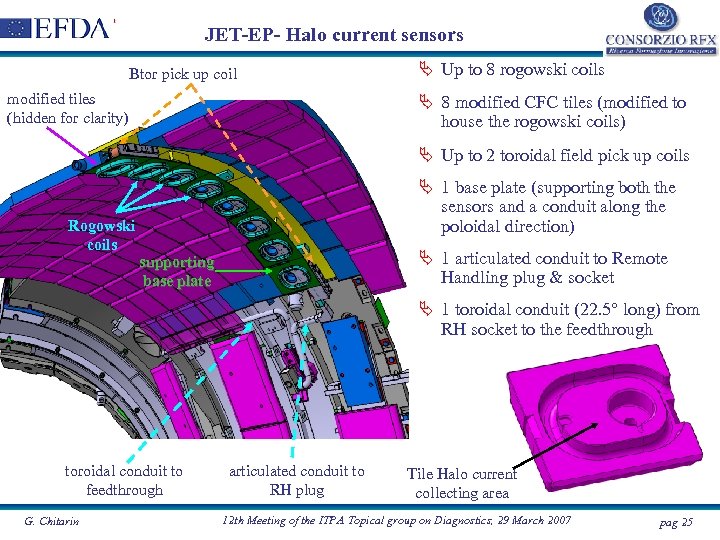 JET-EP- Halo current sensors Btor pick up coil modified tiles (hidden for clarity) Ä Up to 8 rogowski coils Ä 8 modified CFC tiles (modified to house the rogowski coils) Ä Up to 2 toroidal field pick up coils Rogowski coils Ä 1 base plate (supporting both the sensors and a conduit along the poloidal direction) Ä 1 articulated conduit to Remote Handling plug & socket supporting base plate Ä 1 toroidal conduit (22. 5° long) from RH socket to the feedthrough toroidal conduit to feedthrough G. Chitarin articulated conduit to RH plug Tile Halo current collecting area 12 th Meeting of the ITPA Topical group on Diagnostics, 29 March 2007 pag 25
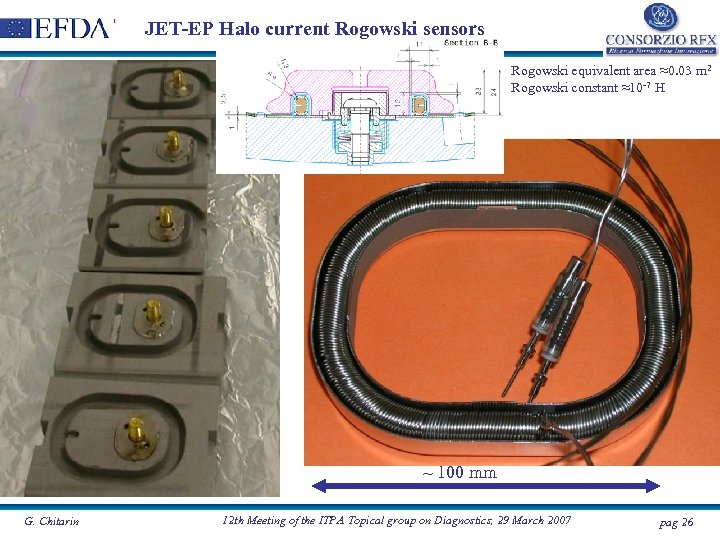 JET-EP Halo current Rogowski sensors Rogowski equivalent area ≈0. 03 m 2 Rogowski constant ≈10 -7 H ~ 100 mm G. Chitarin 12 th Meeting of the ITPA Topical group on Diagnostics, 29 March 2007 pag 26
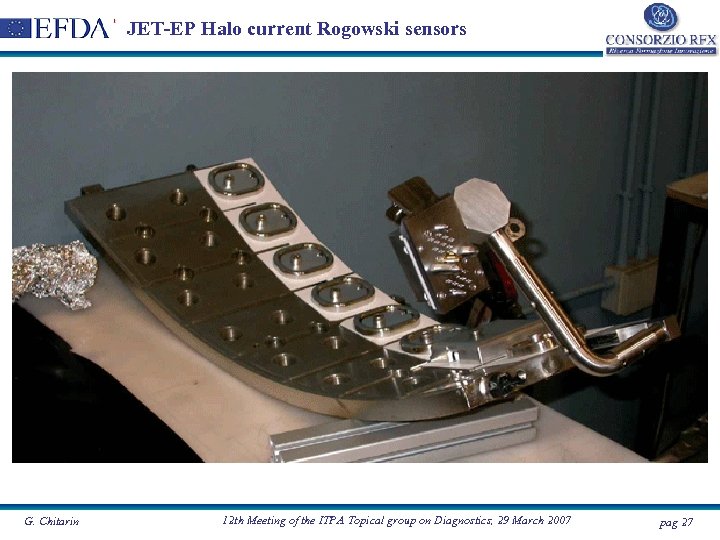 JET-EP Halo current Rogowski sensors G. Chitarin 12 th Meeting of the ITPA Topical group on Diagnostics, 29 March 2007 pag 27
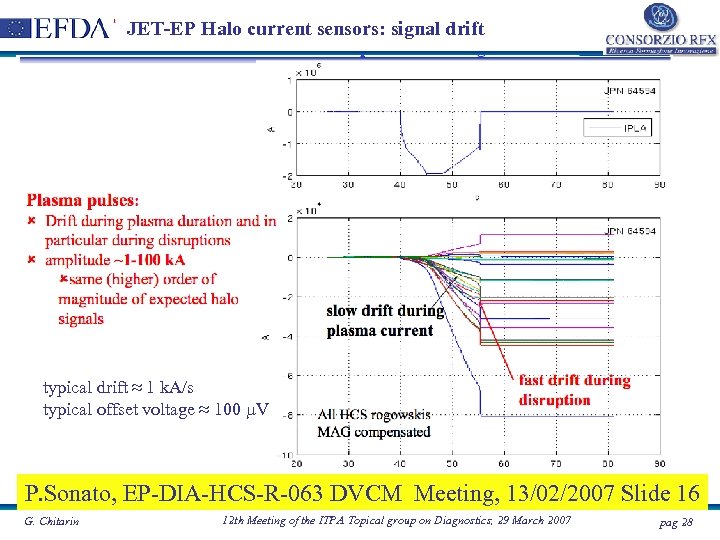 JET-EP Halo current sensors: signal drift typical drift ≈ 1 k. A/s typical offset voltage ≈ 100 V P. Sonato, EP-DIA-HCS-R-063 DVCM Meeting, 13/02/2007 Slide 16 G. Chitarin 12 th Meeting of the ITPA Topical group on Diagnostics, 29 March 2007 pag 28
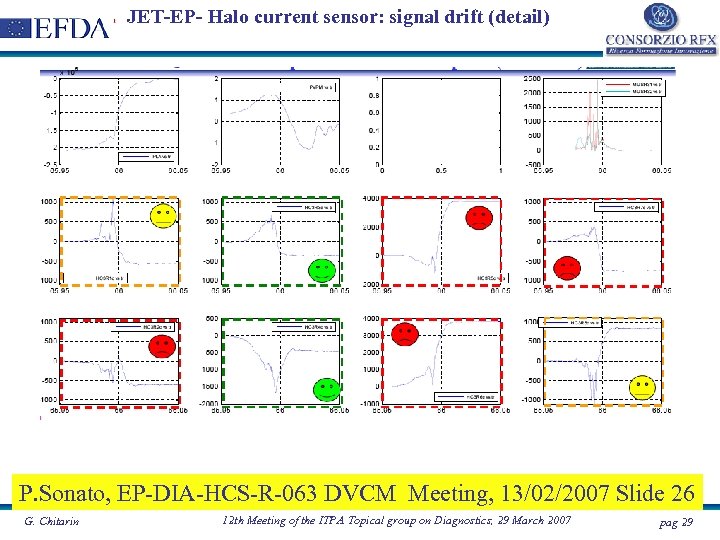 JET-EP- Halo current sensor: signal drift (detail) P. Sonato, EP-DIA-HCS-R-063 DVCM Meeting, 13/02/2007 Slide 26 G. Chitarin 12 th Meeting of the ITPA Topical group on Diagnostics, 29 March 2007 pag 29
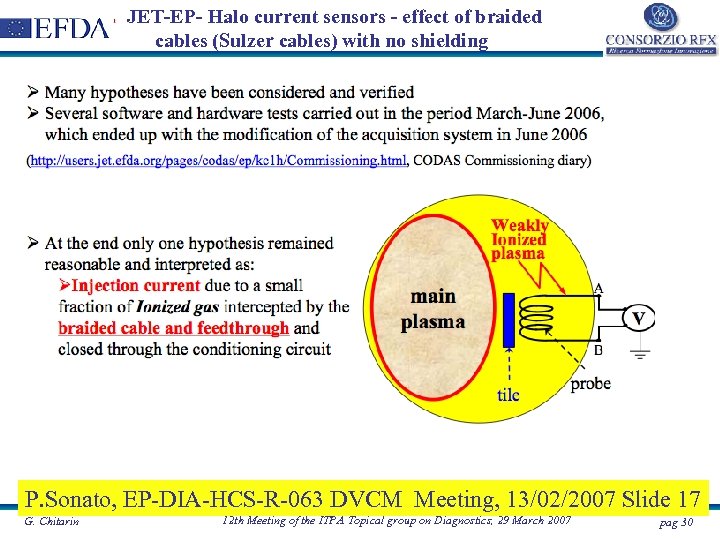 JET-EP- Halo current sensors - effect of braided cables (Sulzer cables) with no shielding P. Sonato, EP-DIA-HCS-R-063 DVCM Meeting, 13/02/2007 Slide 17 G. Chitarin 12 th Meeting of the ITPA Topical group on Diagnostics, 29 March 2007 pag 30
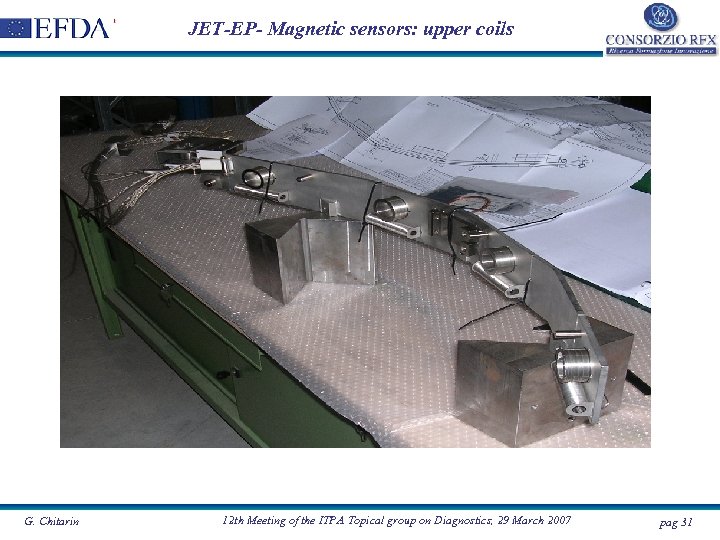 JET-EP- Magnetic sensors: upper coils G. Chitarin 12 th Meeting of the ITPA Topical group on Diagnostics, 29 March 2007 pag 31
 Thank you for your attention G. Chitarin 12 th Meeting of the ITPA Topical group on Diagnostics, 29 March 2007 pag 32