


 Скачать презентацию Development and Psychometric Properties of the Child Self-Report
e822031d9454eda460377cb67a61d8f6.ppt
- Количество слайдов: 44
 Development and Psychometric Properties of the Child Self-Report Multidimensional Neglectful Behavior Scale (MNBS-CR) Glenda Kaufman Kantor, Ph. D. Funded by N. I. C. H. D. Grant # RO 1 MD 39144 -01 Grant No. 2002 -JW-BX-0002 (OJJDP)
 Prior Child Report Measures of Neglect • Few child measures • Young children rarely source of data in instruments measuring neglect • Some measure just one or two components of neglect • Varying definitions
 Measurement Issues • • • Omission Chronicity Causal factors separate from acts Acts vs. Injury Cultural Boundaries
 Challenges in Measurement • • • Children’s terminology Language development, grammar Cultural aspects of language Reliability Age of child Distractibility Cognitive ability Response Sets Recall Bias Desire to please
 Central Aims of the Study • Develop a standardized instrument to measure neglect based on Child Self. Report • Describe the relationship of neglect to child behavior problems & family characteristics
 Assessment of Child Neglect in Community and Clinical Samples: Development of the Multidimensional Neglectful Behavior Scale for Child Self. Report Glenda Kaufman Kantor & Murray Straus, Family Research Lab; Carolyn Mebert, UNH, Wendy Brown, FRL, Crystal Macallum & Todd Flannery, Westat
 Methods
 Clinical Sample • Spurwink Child Abuse Program • Maine DHS • NH DCYF
 Eligibility • Inclusionary Criteria- 6 -15 yrs old • Lived in foster care < 6 months (age 6 -9) • Lived in foster care < 1 year (age 10 -15) • Exclusionary Criteria • Visually impaired • Hearing impaired • No spoken language ability • Non-English speaking • Formal diagnosis of mental retardation • Deemed “not interviewable” by clinician
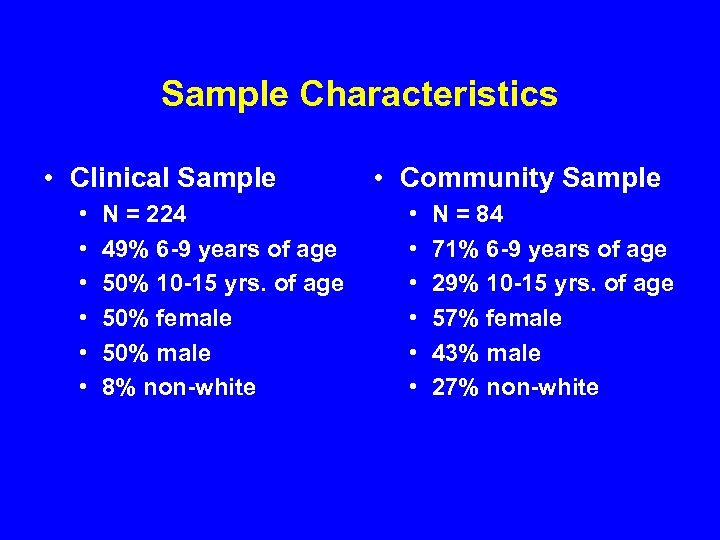 Sample Characteristics • Clinical Sample • • • N = 224 49% 6 -9 years of age 50% 10 -15 yrs. of age 50% female 50% male 8% non-white • Community Sample • • • N = 84 71% 6 -9 years of age 29% 10 -15 yrs. of age 57% female 43% male 27% non-white
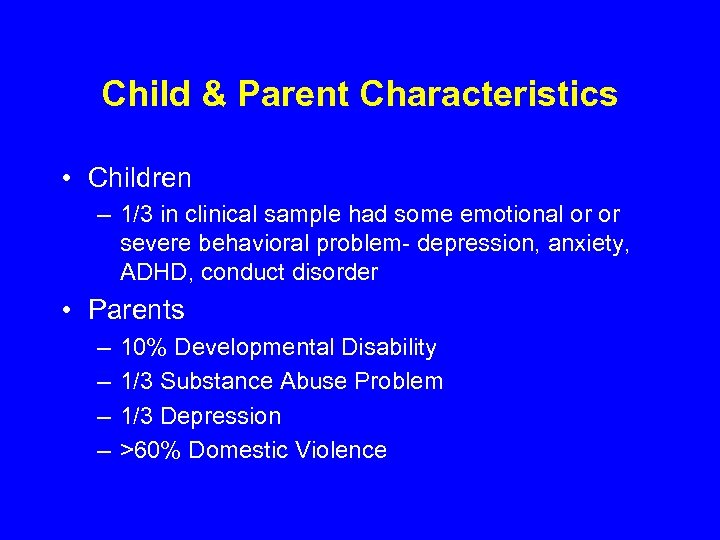 Child & Parent Characteristics • Children – 1/3 in clinical sample had some emotional or or severe behavioral problem- depression, anxiety, ADHD, conduct disorder • Parents – – 10% Developmental Disability 1/3 Substance Abuse Problem 1/3 Depression >60% Domestic Violence
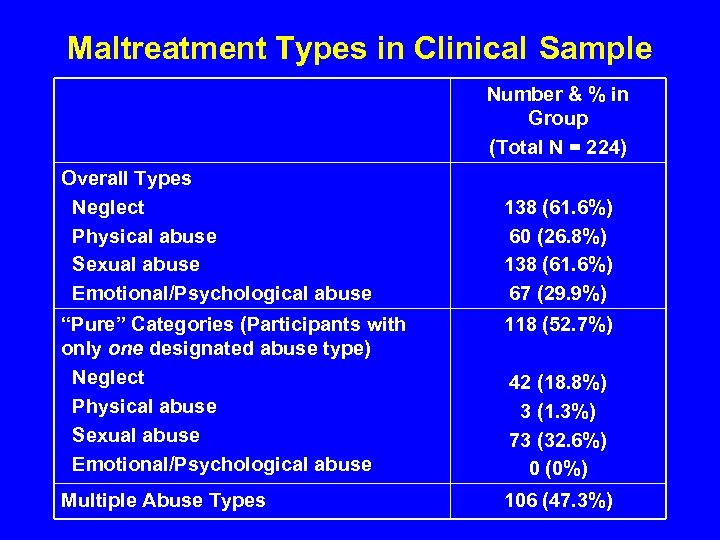 Maltreatment Types in Clinical Sample Number & % in Group (Total N = 224) Overall Types Neglect Physical abuse Sexual abuse Emotional/Psychological abuse 138 (61. 6%) 60 (26. 8%) 138 (61. 6%) 67 (29. 9%) “Pure” Categories (Participants with only one designated abuse type) Neglect Physical abuse Sexual abuse Emotional/Psychological abuse 118 (52. 7%) Multiple Abuse Types 106 (47. 3%) 42 (18. 8%) 3 (1. 3%) 73 (32. 6%) 0 (0%)
 Measures Child Report Clinician Caretaker
 Child Self Report Neglect Scale • Measures cognitive, emotional, supervision, and physical neglect • Includes subscales on: Child Endangerment: exposure to parental conflict & violence, abandonment, and parental alcohol abuse; • Includes subscale on child’s general feelings or appraisals of each domain
 ACASI • Audio enhanced version of the Computer Assisted Self-Administered Interview • Uses an audio system and touch screen to interview child • Tutorial • Scale version adapted by Age and Gender of the Child and Gender of the Primary Caretaker • Interactive program • Older children can take Independently • Computer game break
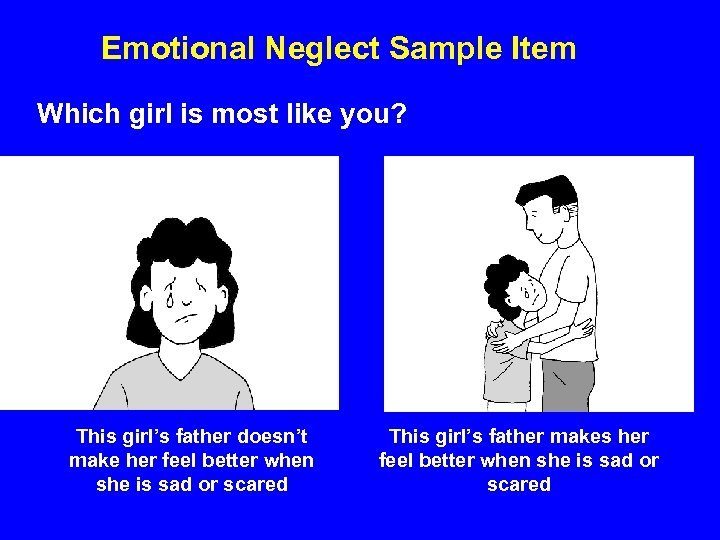 Emotional Neglect Sample Item Which girl is most like you? This girl’s father doesn’t make her feel better when she is sad or scared This girl’s father makes her feel better when she is sad or scared
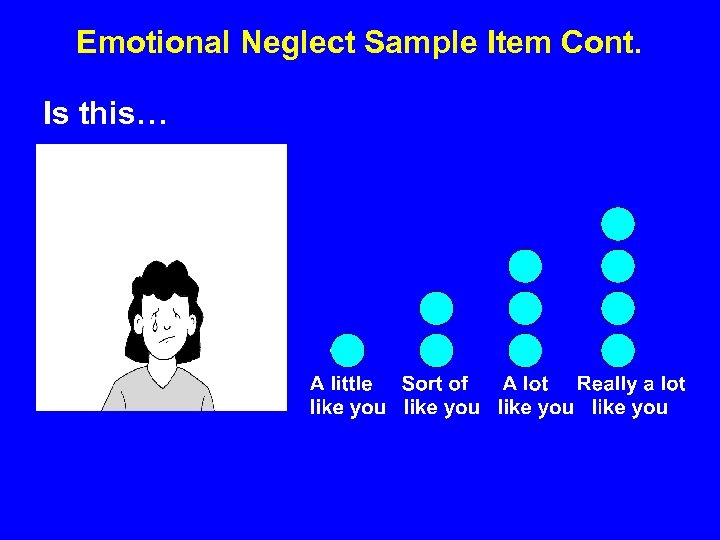 Emotional Neglect Sample Item Cont. Is this…
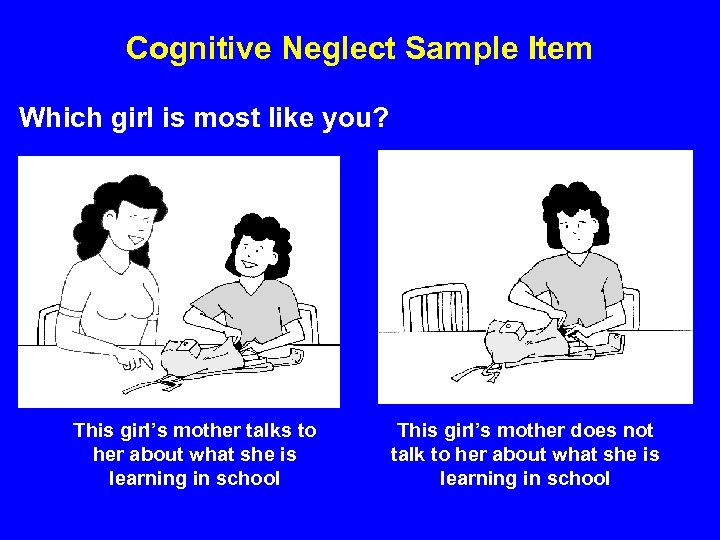 Cognitive Neglect Sample Item Which girl is most like you? This girl’s mother talks to her about what she is learning in school This girl’s mother does not talk to her about what she is learning in school
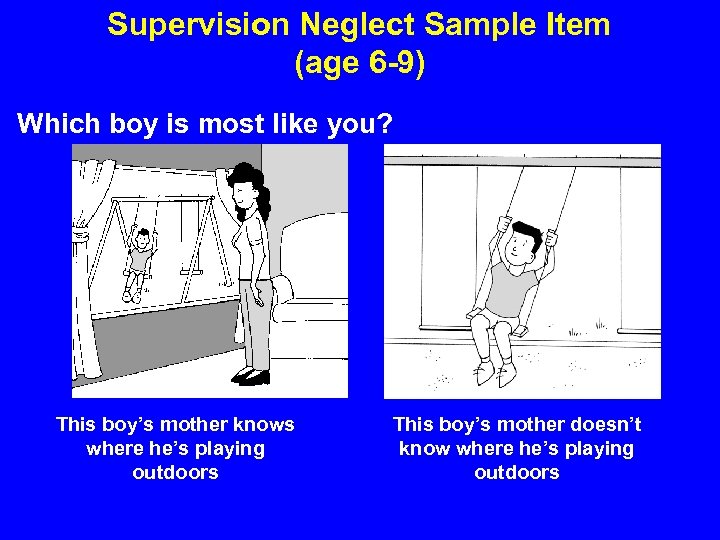 Supervision Neglect Sample Item (age 6 -9) Which boy is most like you? This boy’s mother knows where he’s playing outdoors This boy’s mother doesn’t know where he’s playing outdoors
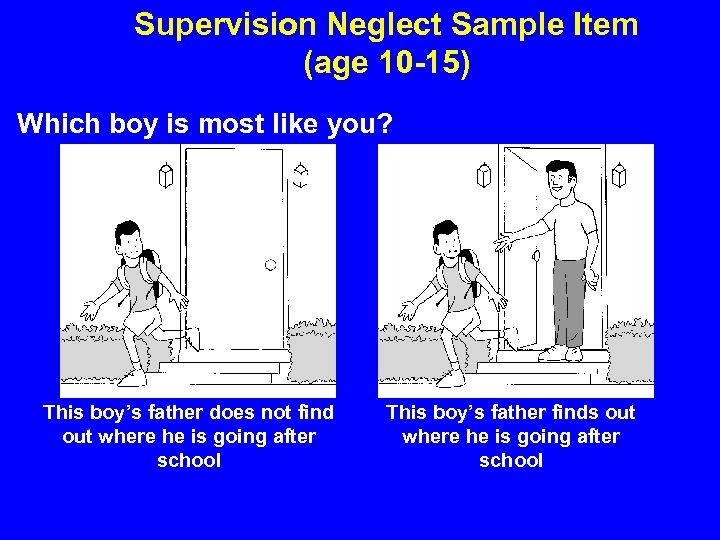 Supervision Neglect Sample Item (age 10 -15) Which boy is most like you? This boy’s father does not find out where he is going after school This boy’s father finds out where he is going after school
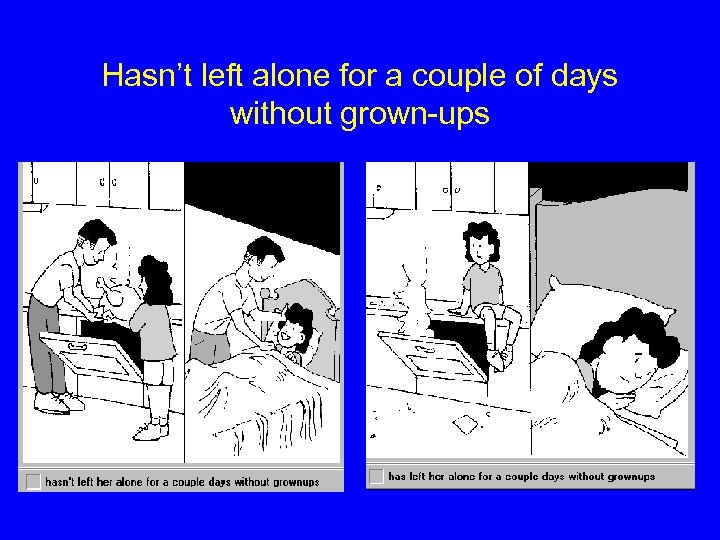 Hasn’t left alone for a couple of days without grown-ups
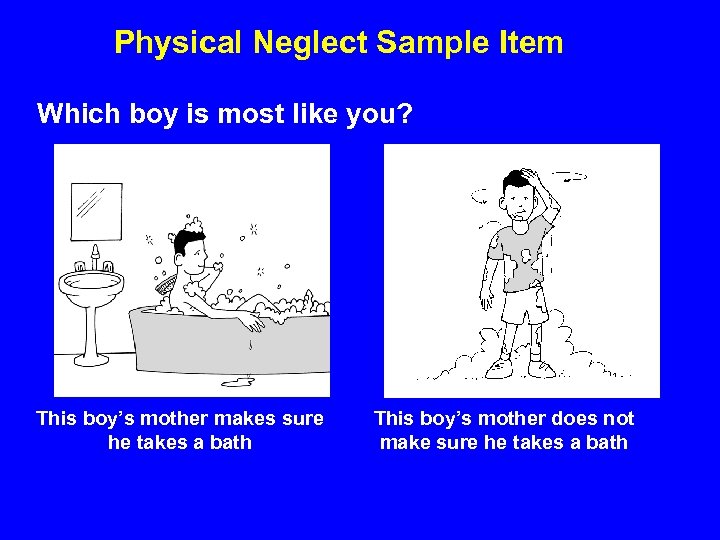 Physical Neglect Sample Item Which boy is most like you? This boy’s mother makes sure he takes a bath This boy’s mother does not make sure he takes a bath
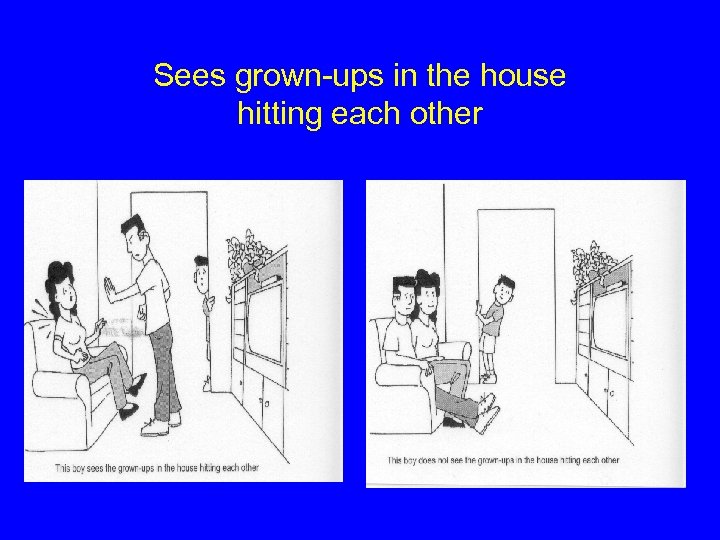 Sees grown-ups in the house hitting each other
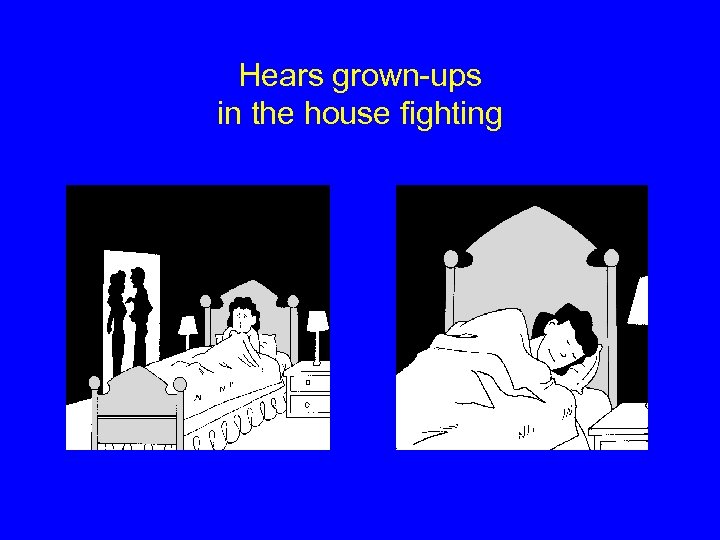 Hears grown-ups in the house fighting
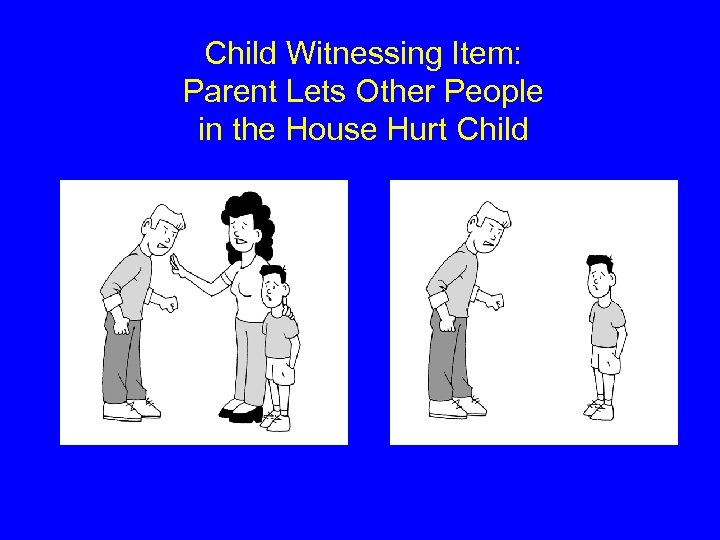 Child Witnessing Item: Parent Lets Other People in the House Hurt Child
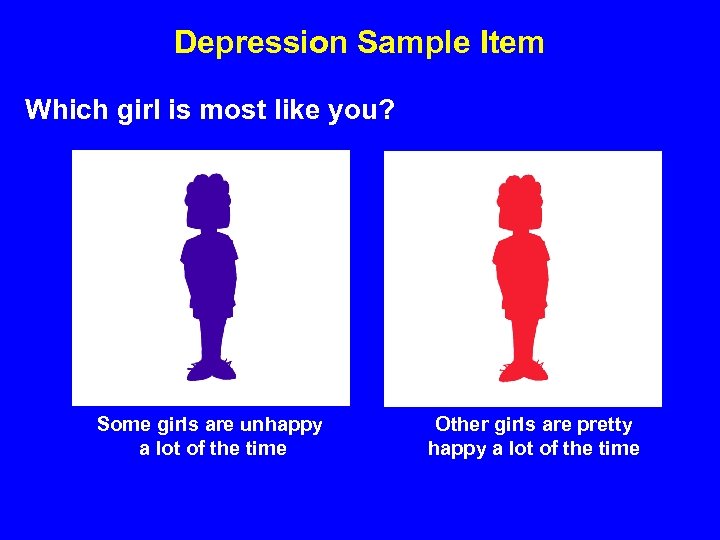 Depression Sample Item Which girl is most like you? Some girls are unhappy a lot of the time Other girls are pretty happy a lot of the time
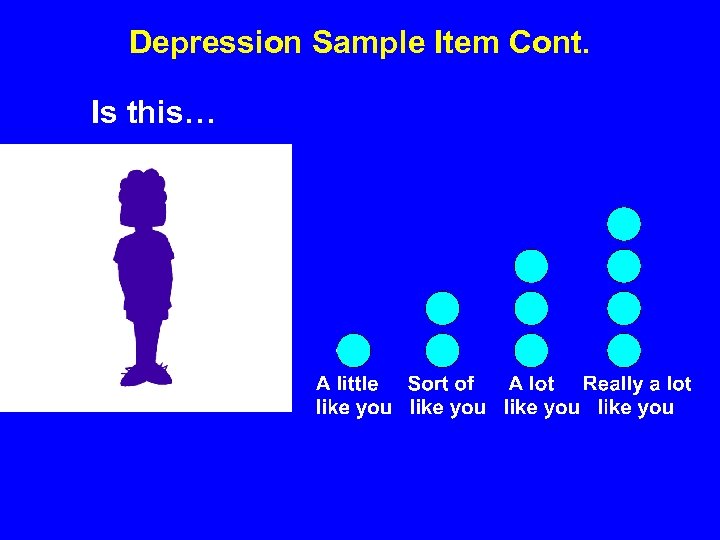 Depression Sample Item Cont. Is this…
 Results
 Reliability and Validity • Full Scale Alpha Older Children =. 94 • Full Scale Alpha Young Children. 76 • Emotional Subscale- highest alphas for both young and older children
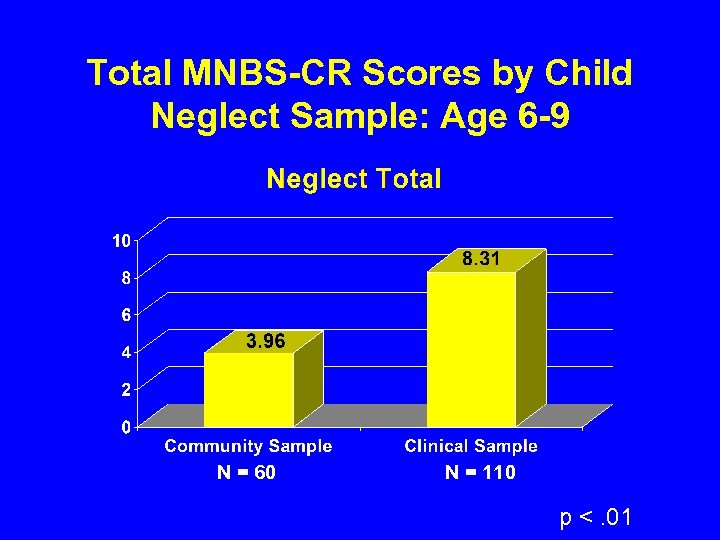 Total MNBS-CR Scores by Child Neglect Sample: Age 6 -9 N = 60 N = 110 p <. 01
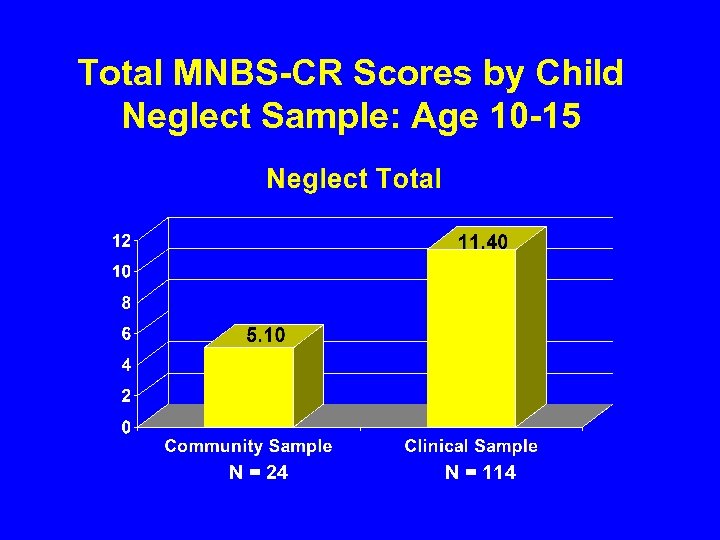 Total MNBS-CR Scores by Child Neglect Sample: Age 10 -15 N = 24 N = 114
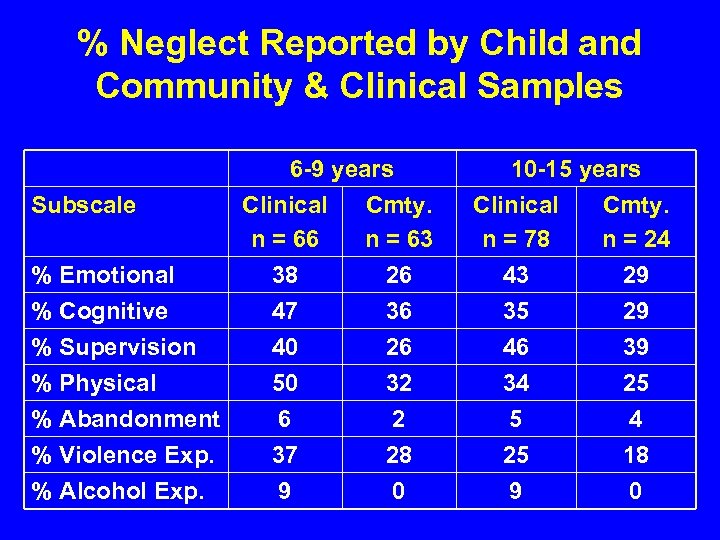 % Neglect Reported by Child and Community & Clinical Samples Subscale % Emotional % Cognitive % Supervision % Physical % Abandonment % Violence Exp. % Alcohol Exp. 6 -9 years Clinical Cmty. n = 66 n = 63 38 26 47 40 50 6 37 9 36 26 32 2 28 0 10 -15 years Clinical Cmty. n = 78 n = 24 43 29 35 46 34 5 25 9 29 39 25 4 18 0
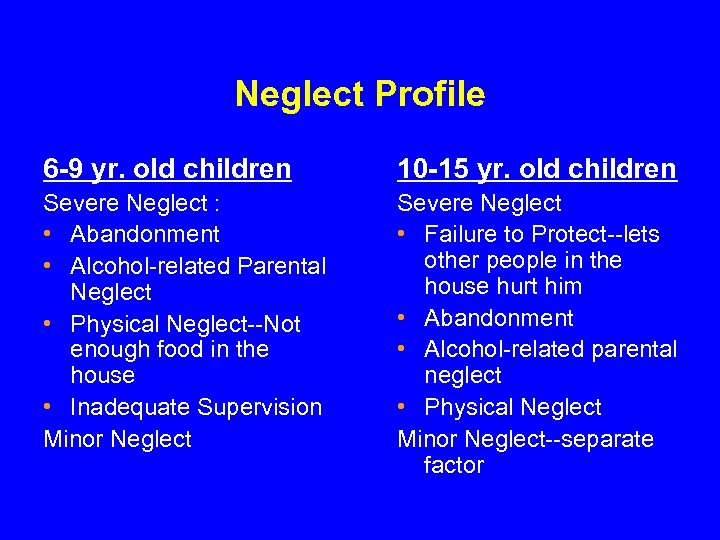 Neglect Profile 6 -9 yr. old children 10 -15 yr. old children Severe Neglect : • Abandonment • Alcohol-related Parental Neglect • Physical Neglect--Not enough food in the house • Inadequate Supervision Minor Neglect Severe Neglect • Failure to Protect--lets other people in the house hurt him • Abandonment • Alcohol-related parental neglect • Physical Neglect Minor Neglect--separate factor
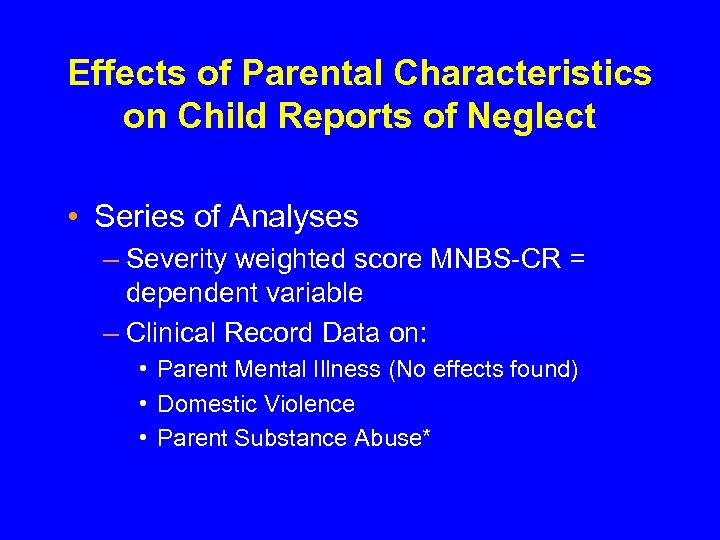 Effects of Parental Characteristics on Child Reports of Neglect • Series of Analyses – Severity weighted score MNBS-CR = dependent variable – Clinical Record Data on: • Parent Mental Illness (No effects found) • Domestic Violence • Parent Substance Abuse*
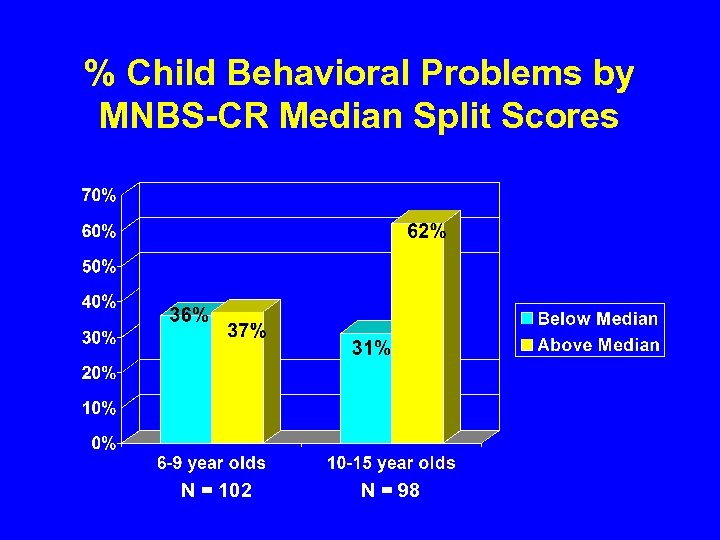 % Child Behavioral Problems by MNBS-CR Median Split Scores N = 102 N = 98
 DV, Victimization and Child Depression • Among young children, self-reported depression is not associated with their reports of exposure to conflict/violence. – But Exposure to conflict/violence is significantly correlated with their self-reports of emotional neglect • Among older children, self-reports of exposure to conflict/violence are associated with significantly more self-reported depression.
 DV, Victimization and Child Behavior Problems: Summary of Analysis Results 6 -9 Year Olds • No significant effects of DV, Sex of Caretaker, or self reports of severe Neglect on CBCL scores 10 -15 Year Olds • No significant effects of DV or sex of caretaker on CBCL scores • Severe Neglect is a significant predictor of CBCL scores: • Beta=. 336, t=2. 101, p=. 04
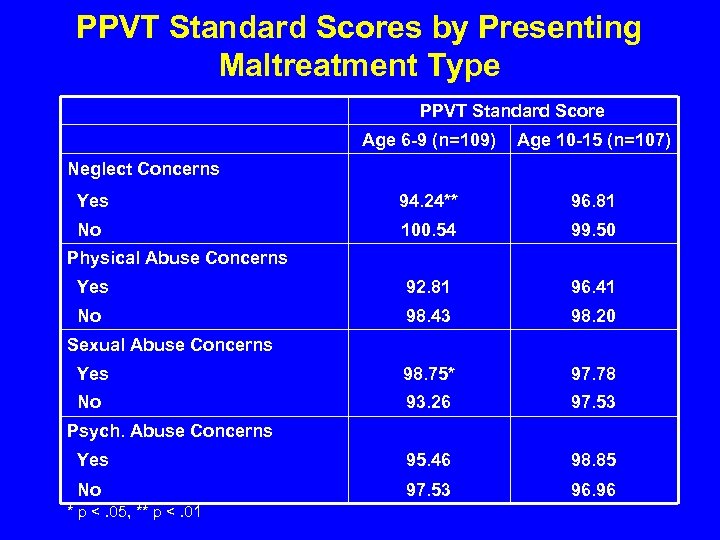 PPVT Standard Scores by Presenting Maltreatment Type PPVT Standard Score Age 6 -9 (n=109) Age 10 -15 (n=107) Yes 94. 24** 96. 81 No 100. 54 99. 50 Yes 92. 81 96. 41 No 98. 43 98. 20 Yes 98. 75* 97. 78 No 93. 26 97. 53 Yes 95. 46 98. 85 No 97. 53 96. 96 Neglect Concerns Physical Abuse Concerns Sexual Abuse Concerns Psych. Abuse Concerns * p <. 05, ** p <. 01
 Relation between MNBS-CR Scores & Parent/Child Characteristics: 6 -9 • Higher neglect total & appraisal scores were related to more child self-reported depression • Child Reports of supervisory neglect significantly correlated with Clinical Reports of Parental drug abuse • Child reports of emotional neglect significantly correlated with their reports of conflict/violence exposure • Higher appraisal scores were associated with lower Parent IQ scores
 Sibling Concordance • Tested 83 pairs of siblings – 61 pairs in clinical sample – 22 pairs in community • Results of Analysis – If one sibling reported neglect, other sibs had 78% chance of also reporting neglect – Children in Clinical sample reported greater similarity in neglect than those in community – Gender significant predictor of concordance (girls more concordant than boys)
 Relation between MNBS-CR Scores & Parent/Child Characteristics: 10 -15 (1) • Higher neglect total & appraisal scores were related to more child self-reported depression & more severe child behavioral problems • Greater perceptions of neglect were associated with more child-reported social, thought, & attention problems and aggressive behavior • Higher alcohol exposure scores were related to more child-reported delinquency, thought problems, & aggressive behaviors • Greater perceptions of neglect were associated with lower parent IQ and more parental substance abuse
 Conclusions • Children, particularly older children report patterns of severe neglect that are consistent with typical CPS cases • Neglect multidimensional phenomenon • Parental Substance major component of Child Neglect • No significant effects of Domestic Violence or Parental Mental Illness • But parental failure to protect the child from being hurt, or to keep the child safe, are associated with a severe dimension of neglect
 Conclusions • MNBS-CR is promising measure – Strong Discriminant Validity – Substantial Evidence of Construct Validity – High Reliability for Older Children – Moderate Reliability for Younger Children – Important tool for screening, assessment, target interventions – Multiple measures best
 Next Steps • • • Test modified items Social Desirability Scale Follow-up Study Develop cutting points Immediate Score Reports