


 Скачать презентацию Development and Climate Financing Challenges Alan Miller Principal
b287907723bc3201cea4c903261f9b21.ppt
- Количество слайдов: 24
 Development and Climate: Financing Challenges Alan Miller Principal Project Officer September 2006
 Observation (1): Financing Not Primarily a Liquidity Problem -- for Mitigation • Most GHG emission growth is in countries with good access to investment capital and attractive conditions for FDI • Large capital intensive projects are being privately financed • Making credit available per se rarely sufficient: under utilized loan programs • Financial markets are not static, perception of risk-adjusted return constantly in flux 2
 Observation (2): Financing Energy Efficiency is Biggest Opportunity • Relative to supply-side mitigation, EE has greatest development benefits (localized economic, environmental, social benefits) • Access to financing is more frequently a barrier to energy efficiency investments • Problem is least amenable to centralized, uniform solutions – “energy efficiency is everywhere” 3
 Observation (3): “Financing” is About More Than Money – Diverse Challenges • Changing erroneous perceptions of risk (energy efficiency, some renewables) • Reducing high costs of funding nonuniform small transactions – Ex’s: mortgage market, credit cards • Subsidies usually not sustainable – But accepted to bring down costs of new technology – Also as publicly supported social programs 4
 Question: Can CDM Provide Core Financing Needs? • From a market perspective, very transactionally intensive • Link to “sustainable development”? • Unlikely to support new technology risk • Is beginning to tap creativity of financial market, e. g. , new products to address project delivery risk 5
 Four Challenges in Financial Markets 1. SMEs, consumer finance 2. New technology commercialization 3. Small scale new technologies 4. Adaptation But aside from carbon trading, largely outside international agreements 6
 Financing for SMEs & Consumers • High transaction costs – Aggregation potential (CDM? ) • Particularly important for energy efficiency much of which is diffused throughout the economy – buildings, smaller industry • Partially amenable to policy solution (efficiency standards, manuf agreement) • Successful financial intermediation projects 7
 One Success Story: IFC Financing for Clean Energy Lending • Targeted use of Technical Assistance (training) and Credit Enhancement (partial risk guarantees) – No losses to date • $54 million GEF/donor funding, $351 mil IFC credit, $570 mil clean energy projects • Half non-grant (PRGs) • Increasing leverage with experience: IFC proposing scale-up to $500 mil/annually 8
 Not a panacea but significant scale-up possibilities • Started in well developed financial markets in Hungary, extended to eastern Europe, Russia, China, Philippines • Locally specific, responds to individual bank interests (markets and bus. strategy) – Market assessment, hands-on management • Potential for link to carbon finance • Scaling Up: multi-IFI, $10 billion program? 9
 Financing Small Scale Enterprise • Donor projects provide seed capital, hands on support • Targeted to countries, niche markets with high development value • Example: UNEP REED programmes – $9. 4 million from diverse donors – External non-profit fund manager (E+Co) – 20 to 50 cents costs per dollar invested 10
 Commercializing New Technology • Risk – reward problem (public good) • Financial markets increasingly able to handle large projects – If rewarded • Technology diffusion mechanisms an issue – country risk compounds tech risk -- South led technology development emerging, ethanol example 11
 Donor Projects Have Mixed Record • GEF solar thermal and fuel cell bus projects: $260 million, 8 years, few results • GEF largely giving up • Greater success in ozone context • Most progress where multiple tech suppliers, commercial approach • Relevance to G 8 Process, IGCC and CCS 12
 Small scale, new technology • Some high development value products, efficient lighting, small solar systems • Cell phone example: new business model • New technology risk and consumer finance problems • Many projects, few sustainable results – markets poisoned by subsidies • Innovative approaches focus on reducing transaction costs, small bus finance 13
 Finance for Adaptation • A subset of development lending? • Insurance instruments being explored, most promising for agriculture with established credit and risk mitigation • IFC, other international banks have insurance departments -- for their risks • But insurance sector and necessary mechanisms often inadequate • G 8 Report highlights 14
 Building Local Financial Capacity Through Local Institutions • Local commercial lenders – Partially addresses transaction costs – If profitable, sustainable and self-replicating – SME lending the biggest gap • Utilities – Can be a partner for mkt aggregation and EE – Already subject to social contract – China ex: gas utility marketing locally financed energy efficiency 15
 WBG, “Clean Energy Investment Framework” I § Responds to G 8 Gleneagles Summit (July 2005) § Target for Agreed Plan: Japan G 8 meeting 2008 § “Clean Energy and Development: Towards an Investment Framework” (available on-line) § WB Development Committee review April 2006 § Progress Report September 2006 (Fall Meetings) § 3 Pillars: Energy Access, Transition to Low Carbon Economy, Adaptation to Climate Change § Identifies $80 - $110 billion/yr funding gap 16
 WBG, “Clean Energy Investment Framework” II § Focus on financing climate friendly technology § Key position of coal sector in China and India § IGCC with carbon capture and sequestration § Need for additional concessional resources – but where will the money come from? ? § § 17 Carbon finance – but post 2012 uncertainty Increased donor funding (e. g. , GEF) “Voluntary” actions Use of Bank equity – Clean Energy Financing Vehicle
 Thank You! For Further Information: Alan Miller amiller 2@ifc. org
 Clean Energy for Low Income Consumers: Lighting the Bottom of the Pyramid § Partner with the private sector to bring modern offgrid lighting to non-electrified populations § Bring modern off-grid products on commercial terms to gradually displace fuel-based lighting § Strong incentives across value-chain – manufacturers, distributors, retailers, end-users § Energy as a “consumer good” rather a “service” 19
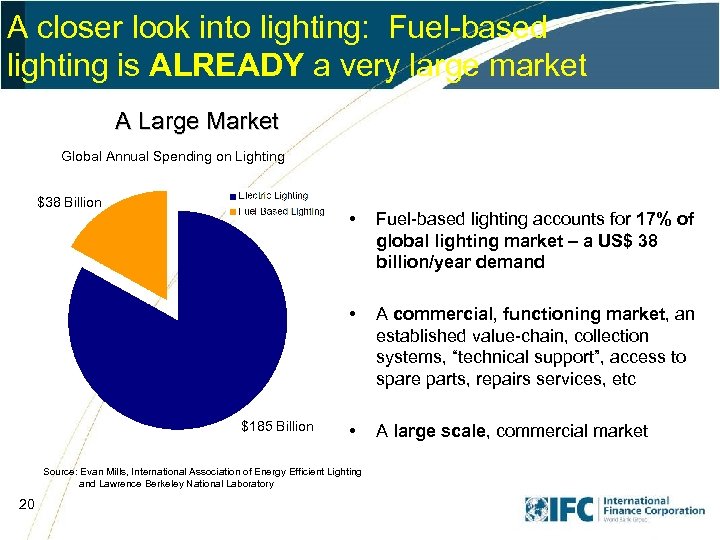 A closer look into lighting: Fuel-based lighting is ALREADY a very large market A Large Market Global Annual Spending on Lighting $38 Billion • • $185 Billion Fuel-based lighting accounts for 17% of global lighting market – a US$ 38 billion/year demand A commercial, functioning market, an established value-chain, collection systems, “technical support”, access to spare parts, repairs services, etc • A large scale, commercial market Source: Evan Mills, International Association of Energy Efficient Lighting and Lawrence Berkeley National Laboratory 20
 Portfolio Approach to Distributed Generation Opportunities § Concept: a “white goods” portfolio approach to support sustainable distributed energy sources § Identify small to medium sized technologies to deliver modern energy to small industrial and commercial establishments, communities § Technologies: mini-hydro plants, grid connected and standalone PV, stationary fuel cells, advanced cogen § 21 Initially risk sharing, later an asset-backed securities approach to scale-up, and replicate the model However, scale-up and mainstreaming of such efforts continues to pose challenges
 DG: Some Underlying Assumptions § Different customers value different characteristics, and have different requirements and payment capacities § A host of energy technologies exist in different sizes, costs, service requirements and other characteristics § Potential new players to the energy/power sector §Players with fewer institutional requirements, modular investment models, and a larger reliance on market pull for their products (White Goods) § BUT critical need for supportive regulatory and enterprenuerial environment for sucess IFC Role: “Honest Broker” or “Market Maker” 22
 Activities Involved in being a “Market Maker” § Develop industry standards for product quality and service, environmental performance § Design “master agreements” for financing end-users, financial intermediaries, and manufacturers § Target a geography with appropriate “enabling environment” and market size for a pilot initiative § Create a menu of options to attract customers, donors, manufacturers, and financial intermediaries Become an aggregator and valuer of risks for small power assets, while simultaneously minimizing transaction costs and risks through standardization 23
 Path Forward: Choosing the appropriate country/region for a pilot § Sri Lanka and Philippines are current pilots; open to considering other countries § Activities include: § Review of regulatory and local institutional capabilities § Assessing market size and speed of market penetration § Designing an initial menu of options based on the geography § Exploring partnering opportunities with developers, manufacturers and servicing companies through certification § Develop tie-ins with regional banks and financial § institutions through “master agreements” § Seek partners such as AES in developing this further, especially in countries that may be of particular interest 24