


 Скачать презентацию Developing Utility Scale PV Solar Installations on Closed
fc9d5d3d03c5d21a6f822378e6064972.ppt
- Количество слайдов: 23
 Developing Utility Scale PV Solar Installations on Closed Landfills Presentation in “Renewable Energy on Brownfields Sites” Session Oklahoma Brownfields Conference May 22 -23, 2012. Oklahoma City, OK Ian A. Webster, Sc. D. , PV Navigator, LLC, Brea, CA SUNLIGHT + LAND = POWER www. pvnavigator. com WEST COAST 1 Pointe Drive, Suite 320 Brea, CA 92821 714. 388. 1800 EAST COAST 5 Great Valley Parkway, Suite 350 Malvern, PA 19355 610. 251. 6851 GULF COAST 10497 Town and Country Way, Suite 830 Houston, TX 77024 713. 468. 5886
 Project Navigator, Ltd. ’s, PV Navigator, L. L. C. Has Grown a Landfill-Specific, Solar Power Development Group Since 2007. What Where § § § PVN develops MW-scale, PV installations on landfills and Brownfields sites Typically fixed-tilt, rack-mounted, selfballasted installations Approximately 50 MW of site capacity under Option More than 300 MW in overall PVN pipeline Who § § § PVN is a wholly-owned subsidiary of Project Navigator, Ltd. (www. Project. Navigator. com) Internally financed (to date) Staffed by engineers, land development and power experts 4 year growth and branding effort Relationships with Enel, Gestamp and Chevron Energy Solutions | 2 Projects primarily in CA and NJ Caribbean expansion goals How § § § § Detailed sites/landfill locations knowledge Knowledge of Fortune 500 boneyard acreage Excellent regulatory relationships Landfill post closure PV permitting expertise Leverage proven PV technologies and apply to landfills (e. g. PVN’s California Energy Commission Grant) Growing brand recognition
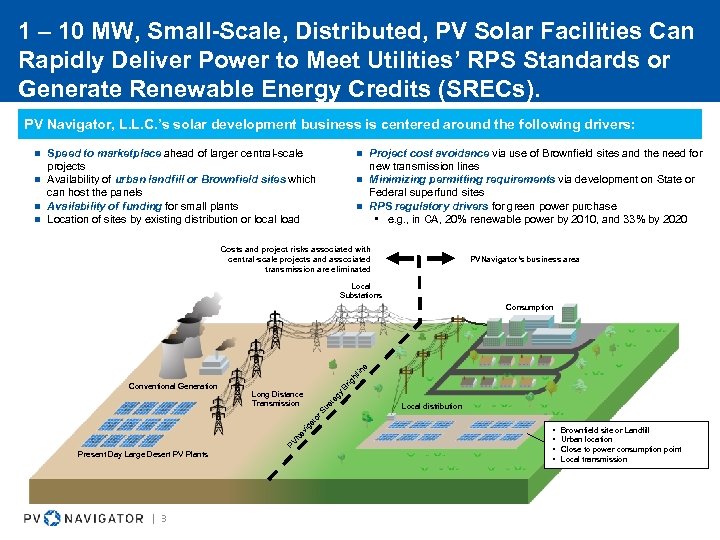 1 – 10 MW, Small-Scale, Distributed, PV Solar Facilities Can Rapidly Deliver Power to Meet Utilities’ RPS Standards or Generate Renewable Energy Credits (SRECs). PV Navigator, L. L. C. ’s solar development business is centered around the following drivers: n n n Project cost avoidance via use of Brownfield sites and the need for new transmission lines Minimizing permitting requirements via development on State or Federal superfund sites RPS regulatory drivers for green power purchase • e. g. , in CA, 20% renewable power by 2010, and 33% by 2020 Costs and project risks associated with central-scale projects and associated transmission are eliminated PVNavigator’s business area Local Substations Br ra te gy Long Distance Transmission Local distribution or St Conventional Generation ig ht lin e Consumption at n vig n Na n Speed to marketplace ahead of larger central-scale projects Availability of urban landfill or Brownfield sites which can host the panels Availability of funding for small plants Location of sites by existing distribution or local load PV n Present Day Large Desert PV Plants | 3 • • Brownfield site or Landfill Urban location Close to power consumption point Local transmission
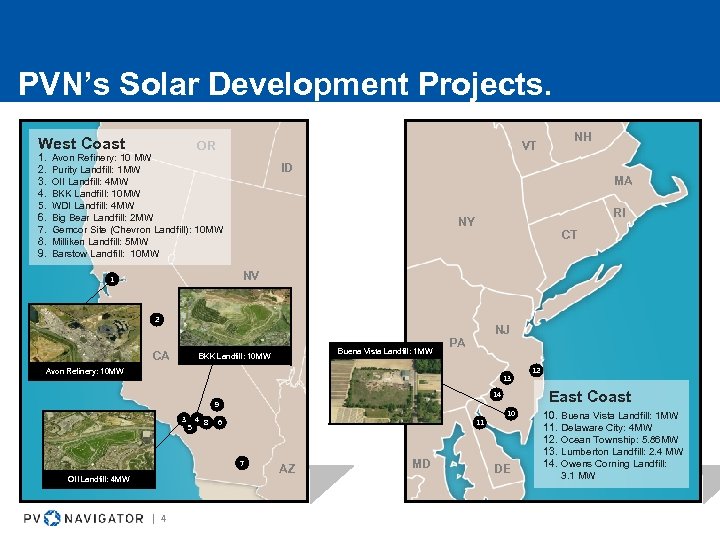 PVN’s Solar Development Projects. West Coast 1. 2. 3. 4. 5. 6. 7. 8. 9. OR NH VT Avon Refinery: 10 MW Purity Landfill: 1 MW OII Landfill: 4 MW BKK Landfill: 10 MW WDI Landfill: 4 MW Big Bear Landfill: 2 MW Gemcor Site (Chevron Landfill): 10 MW Milliken Landfill: 5 MW Barstow Landfill: 10 MW ID MA RI NY CT NV 1 2 CA Buena Vista Landfill: 1 MW BKK Landfill: 10 MW NJ PA Avon Refinery: 10 MW 13 East Coast 14 9 3 5 4 8 6 11 7 OII Landfill: 4 MW | 4 AZ MD 12 10 DE 10. 11. 12. 13. 14. Buena Vista Landfill: 1 MW Delaware City: 4 MW Ocean Township: 5. 86 MW Lumberton Landfill: 2. 4 MW Owens Corning Landfill: 3. 1 MW
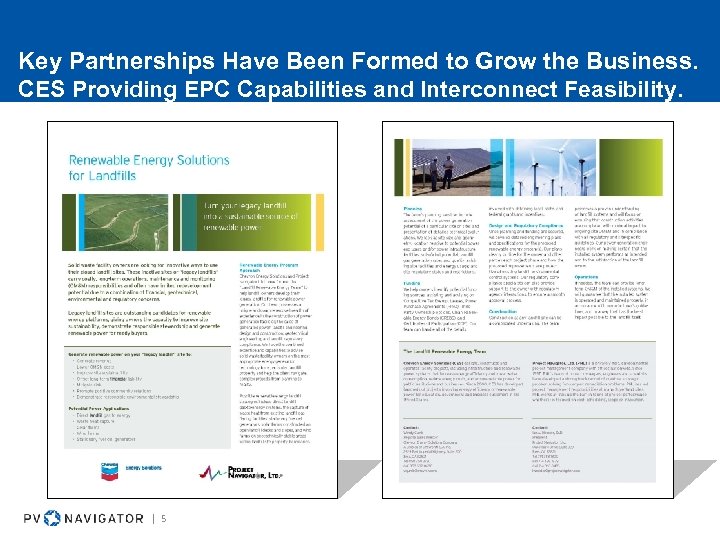 Key Partnerships Have Been Formed to Grow the Business. CES Providing EPC Capabilities and Interconnect Feasibility. | 5
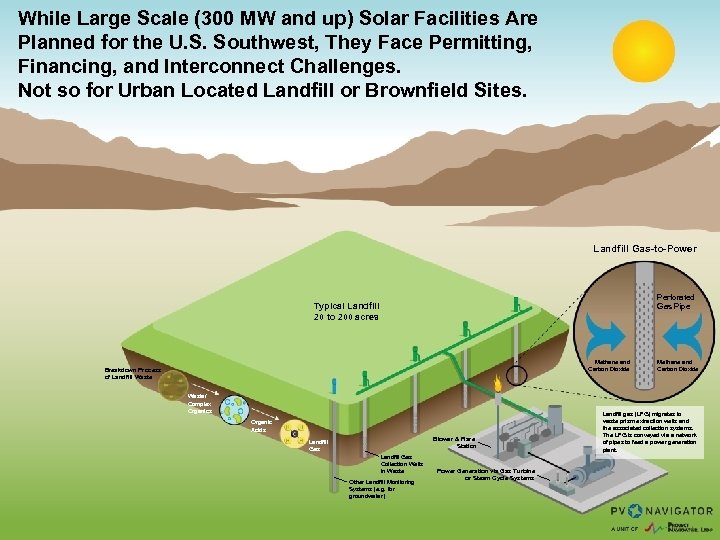 While Large Scale (300 MW and up) Solar Facilities Are Planned for the U. S. Southwest, They Face Permitting, Financing, and Interconnect Challenges. Not so for Urban Located Landfill or Brownfield Sites. Landfill Gas-to-Power Perforated Gas Pipe Typical Landfill 20 to 200 acres Methane and Carbon Dioxide Breakdown Process of Landfill Waste/ Complex Organics Organic Acids Blower & Flare Station Landfill Gas Collection Wells in Waste Other Landfill Monitoring Systems (e. g. for groundwater) Power Generation via Gas Turbine or Steam Cycle Systems Methane and Carbon Dioxide Landfill gas (LFG) migrates to waste prism extraction wells and the associated collection systems. The LFG is conveyed via a network of pipes to feed a power generation plant.
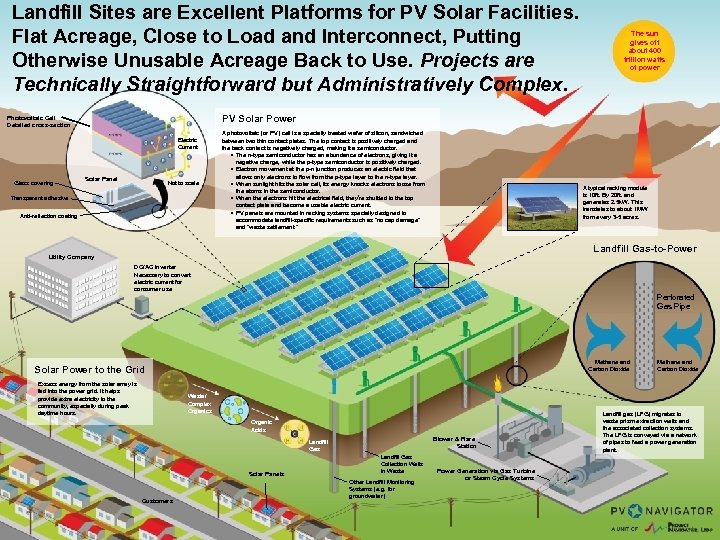 Landfill Sites are Excellent Platforms for PV Solar Facilities. Flat Acreage, Close to Load and Interconnect, Putting Otherwise Unusable Acreage Back to Use. Projects are Technically Straightforward but Administratively Complex. PV Solar Power Photovoltaic Cell Detailed cross-section Electric Current Glass covering The sun gives off about 400 trillion watts of power Solar Panel Not to scale Transparent adhesive Anti-reflection coating A photovoltaic (or PV) cell is a specially treated wafer of silicon, sandwiched between two thin contact plates. The top contact is positively charged and the back contact is negatively charged, making it a semiconductor. • The n-type semiconductor has an abundance of electrons, giving it a negative charge, while the p-type semiconductor is positively charged. • Electron movement at the p-n junction produces an electric field that allows only electrons to flow from the p-type layer to the n-type layer. • When sunlight hits the solar cell, its energy knocks electrons loose from the atoms in the semiconductor. • When the electrons hit the electrical field, they’re shuttled to the top contact plate and become a usable electric current. • PV panels are mounted in racking systems specially designed to accommodate landfill-specific requirements such as “no cap damage” and “waste settlement. ” A typical racking module is 10 ft. By 20 ft. and generates 2. 5 k. W. This translates to about 1 MW from every 3 -5 acres. Landfill Gas-to-Power Utility Company DC/AC Inverter Necessary to convert electric current for consumer use Perforated Gas Pipe Methane and Carbon Dioxide Solar Power to the Grid Excess energy from the solar array is fed into the power grid. It helps provide extra electricity to the community, especially during peak daytime hours. Waste/ Complex Organics Organic Acids Blower & Flare Station Landfill Gas Solar Panels Customers Landfill Gas Collection Wells in Waste Other Landfill Monitoring Systems (e. g. for groundwater) Power Generation via Gas Turbine or Steam Cycle Systems Methane and Carbon Dioxide Landfill gas (LFG) migrates to waste prism extraction wells and the associated collection systems. The LFG is conveyed via a network of pipes to feed a power generation plant.
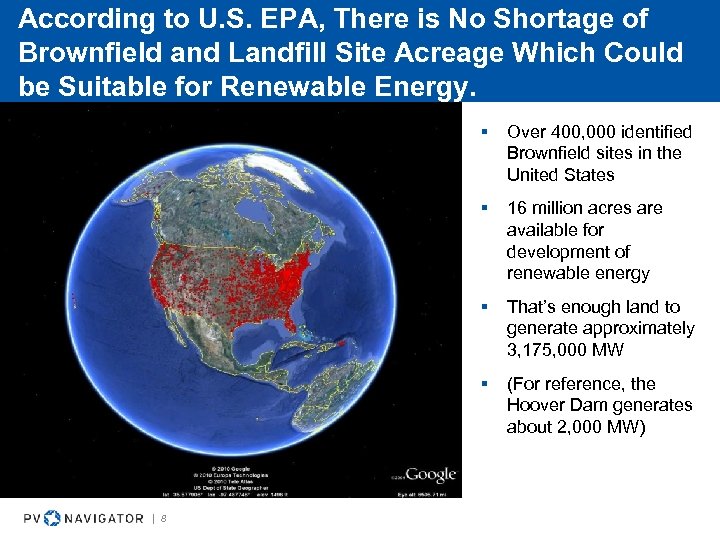 According to U. S. EPA, There is No Shortage of Brownfield and Landfill Site Acreage Which Could be Suitable for Renewable Energy. § § 16 million acres are available for development of renewable energy § That’s enough land to generate approximately 3, 175, 000 MW § | 8 Over 400, 000 identified Brownfield sites in the United States (For reference, the Hoover Dam generates about 2, 000 MW)
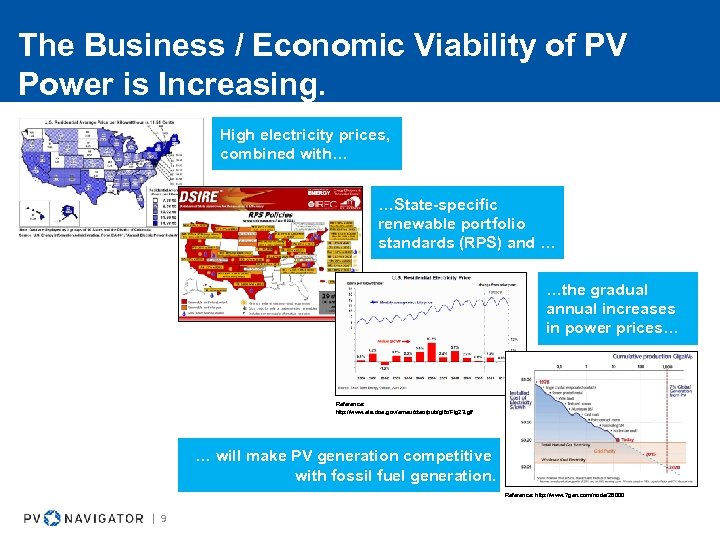 The Business / Economic Viability of PV Power is Increasing. High electricity prices, combined with… …State-specific renewable portfolio standards (RPS) and … …the gradual annual increases in power prices… Reference: http: //www. eia. doe. gov/emeu/steo/pub/gifs/Fig 23. gif … will make PV generation competitive with fossil fuel generation. Reference: http: //www. 7 gen. com/node/26000 | 9
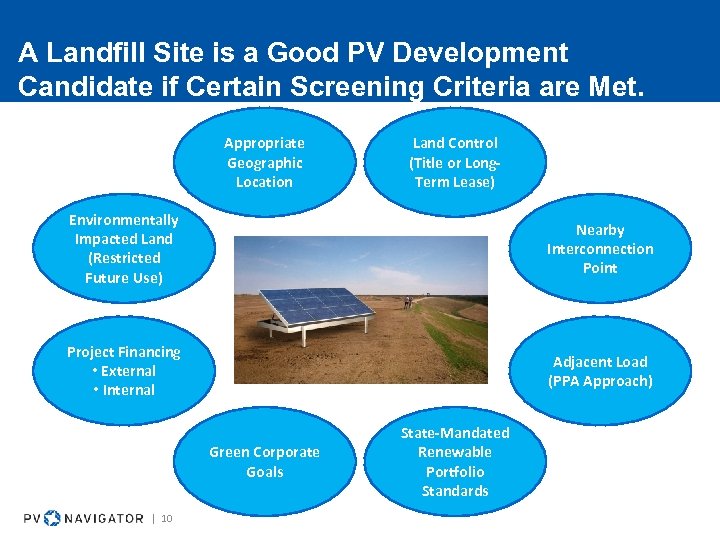 A Landfill Site is a Good PV Development Candidate if Certain Screening Criteria are Met. Appropriate Geographic Location Land Control (Title or Long. Term Lease) Environmentally Impacted Land (Restricted Future Use) Nearby Interconnection Point Project Financing • External • Internal Adjacent Load (PPA Approach) Green Corporate Goals | 10 State-Mandated Renewable Portfolio Standards
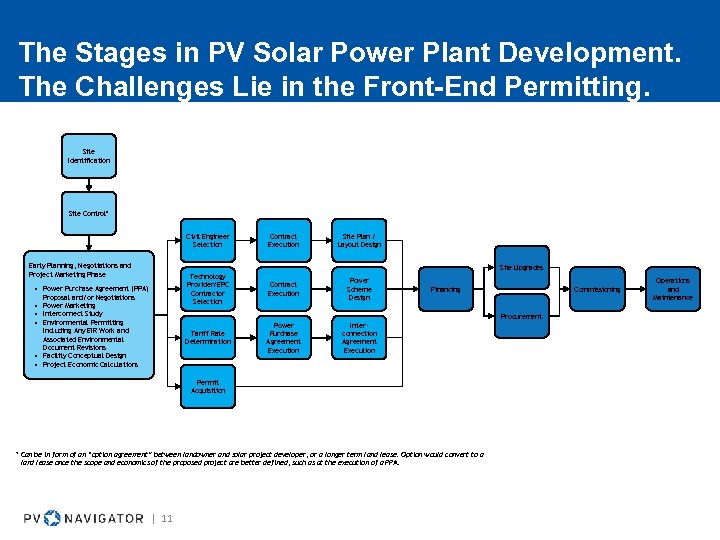 The Stages in PV Solar Power Plant Development. The Challenges Lie in the Front-End Permitting. Site Identification Site Control* Civil Engineer Selection Site Plan / Layout Design Technology Provider/EPC Contractor Selection Contract Execution Power Scheme Design Tariff Rate Determination Early Planning, Negotiations and Project Marketing Phase Contract Execution Power Purchase Agreement Execution Interconnection Agreement Execution Site Upgrades • Power Purchase Agreement (PPA) Proposal and/or Negotiations • Power Marketing • Interconnect Study • Environmental Permitting Financing Commissioning Procurement Including Any EIR Work and Associated Environmental Document Revisions • Facility Conceptual Design • Project Economic Calculations Permit Acquisition * Can be in form of an “option agreement” between landowner and solar project developer, or a longer term land lease. Option would convert to a land lease once the scope and economics of the proposed project are better defined, such as at the execution of a PPA. | 11 Operations and Maintenance
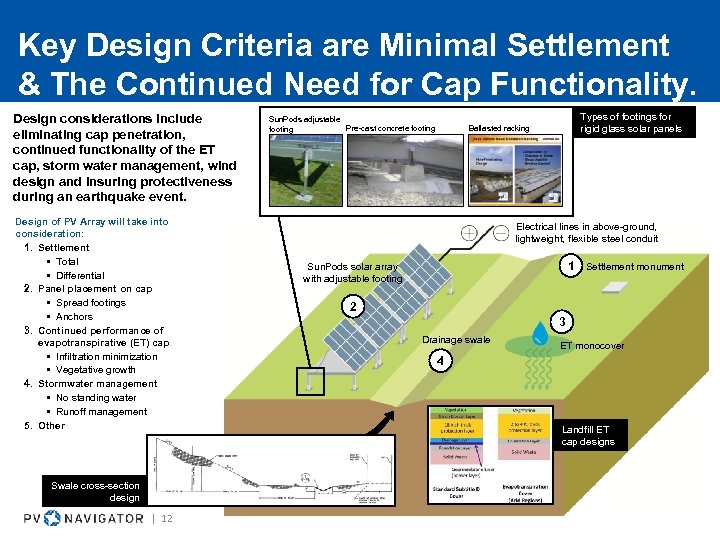 Key Design Criteria are Minimal Settlement & The Continued Need for Cap Functionality. Design considerations include eliminating cap penetration, continued functionality of the ET cap, storm water management, wind design and insuring protectiveness during an earthquake event. Design of PV Array will take into consideration: 1. Settlement • Total • Differential 2. Panel placement on cap • Spread footings • Anchors 3. Continued performance of evapotranspirative (ET) cap • Infiltration minimization • Vegetative growth 4. Stormwater management • No standing water • Runoff management 5. Other Swale cross-section design | 12 Sun. Pods adjustable Pre-cast concrete footing Types of footings for rigid glass solar panels Ballasted racking Electrical lines in above-ground, lightweight, flexible steel conduit 1 Settlement monument Sun. Pods solar array with adjustable footing 2 3 Drainage swale ET monocover 4 Landfill ET cap designs
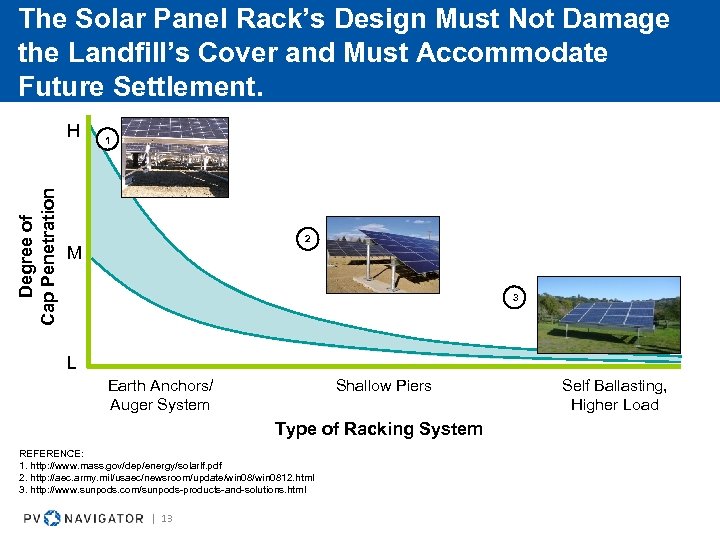 The Solar Panel Rack’s Design Must Not Damage the Landfill’s Cover and Must Accommodate Future Settlement. Degree of Cap Penetration H 1 2 M 3 L Earth Anchors/ Auger System Shallow Piers Type of Racking System REFERENCE: 1. http: //www. mass. gov/dep/energy/solarlf. pdf 2. http: //aec. army. mil/usaec/newsroom/update/win 0812. html 3. http: //www. sunpods. com/sunpods-products-and-solutions. html | 13 Self Ballasting, Higher Load
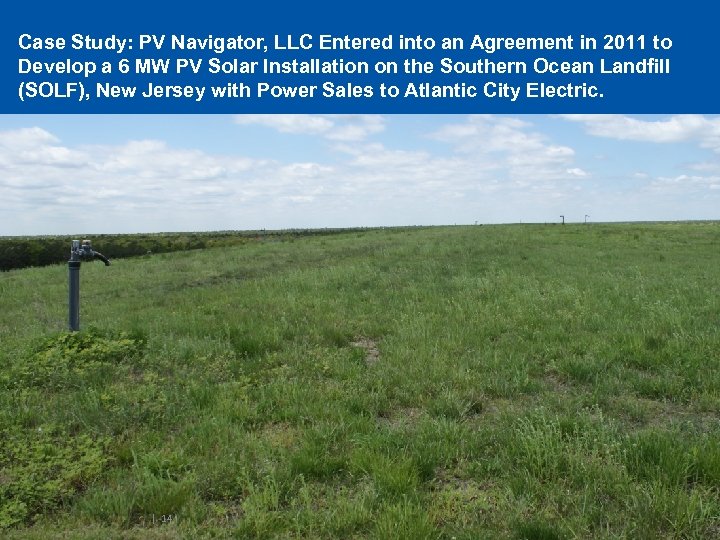 Case Study: PV Navigator, LLC Entered into an Agreement in 2011 to Develop a 6 MW PV Solar Installation on the Southern Ocean Landfill (SOLF), New Jersey with Power Sales to Atlantic City Electric. | 14
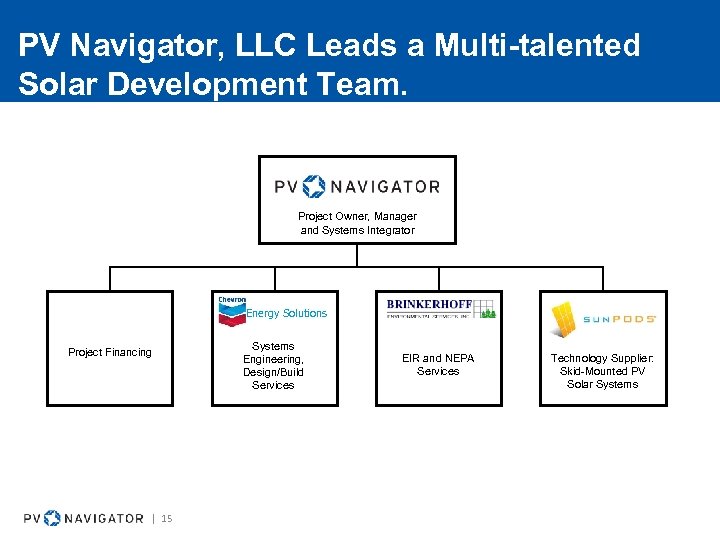 PV Navigator, LLC Leads a Multi-talented Solar Development Team. Project Owner, Manager and Systems Integrator Energy Solutions Project Financing | 15 Systems Engineering, Design/Build Services EIR and NEPA Services Technology Supplier: Skid-Mounted PV Solar Systems
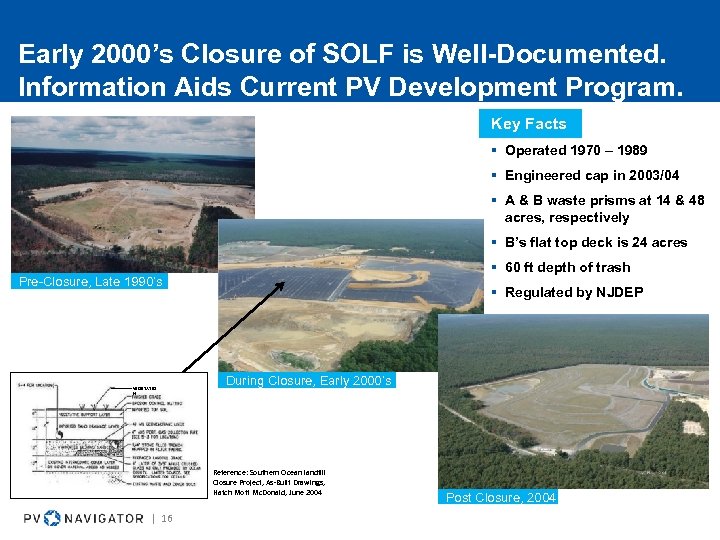 Early 2000’s Closure of SOLF is Well-Documented. Information Aids Current PV Development Program. Key Facts § Operated 1970 – 1989 § Engineered cap in 2003/04 § A & B waste prisms at 14 & 48 acres, respectively § B’s flat top deck is 24 acres § 60 ft depth of trash Pre-Closure, Late 1990’s VEGETATIO N § Regulated by NJDEP During Closure, Early 2000’s Reference: Southern Ocean landfill Closure Project, As-Built Drawings, Hatch Mott Mc. Donald, June 2004 | 16 Post Closure, 2004
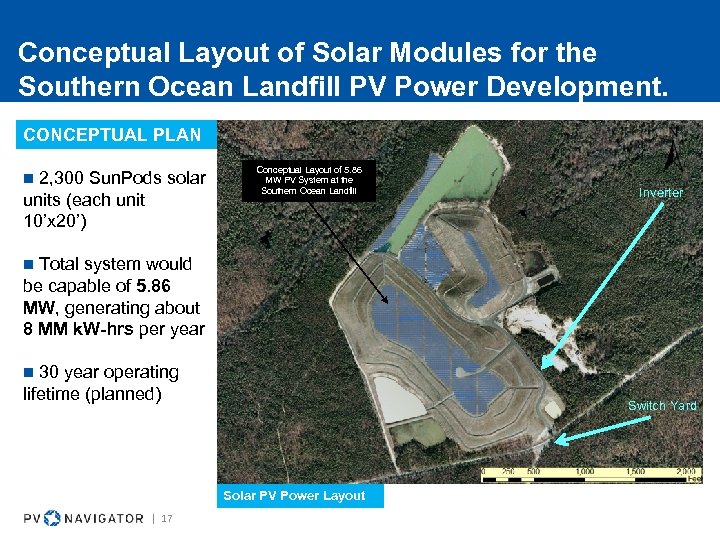 Conceptual Layout of Solar Modules for the Southern Ocean Landfill PV Power Development. CONCEPTUAL PLAN 2, 300 Sun. Pods solar units (each unit 10’x 20’) n Conceptual Layout of 5. 86 MW PV System at the Southern Ocean Landfill Inverter Total system would be capable of 5. 86 MW, generating about 8 MM k. W-hrs per year n 30 year operating lifetime (planned) n Switch Yard Solar PV Power Layout | 17
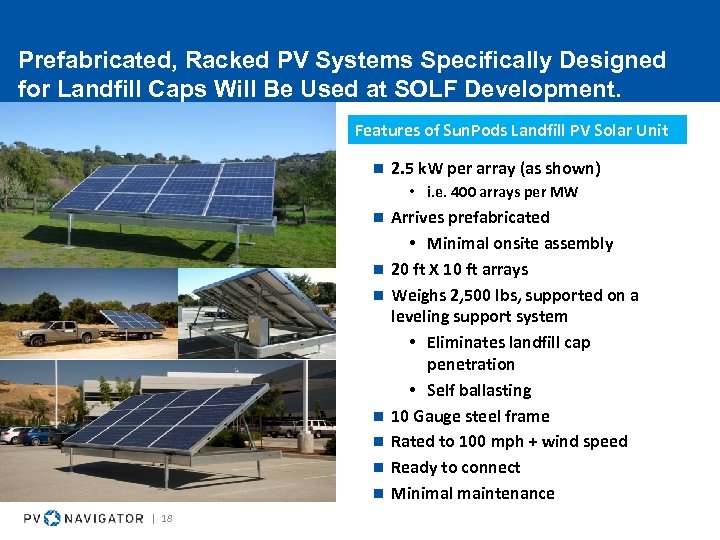 Prefabricated, Racked PV Systems Specifically Designed for Landfill Caps Will Be Used at SOLF Development. Features of Sun. Pods Landfill PV Solar Unit n 2. 5 k. W per array (as shown) • i. e. 400 arrays per MW n n n n | 18 Arrives prefabricated • Minimal onsite assembly 20 ft X 10 ft arrays Weighs 2, 500 lbs, supported on a leveling support system • Eliminates landfill cap penetration • Self ballasting 10 Gauge steel frame Rated to 100 mph + wind speed Ready to connect Minimal maintenance
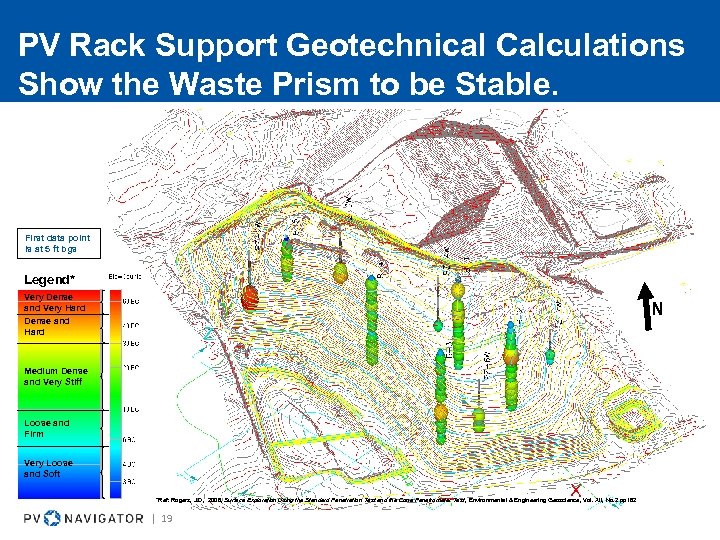 PV Rack Support Geotechnical Calculations Show the Waste Prism to be Stable. First data point is at 5 ft bgs Legend* Very Dense and Very Hard N Dense and Hard Medium Dense and Very Stiff Loose and Firm Very Loose and Soft *Ref: Rogers, J. D, 2006, Surface Exploration Using the Standard Penetration Test and the Cone Penetrometer Test , Environmental & Engineering Geoscience, Vol. XII, No. 2 pp 162 | 19
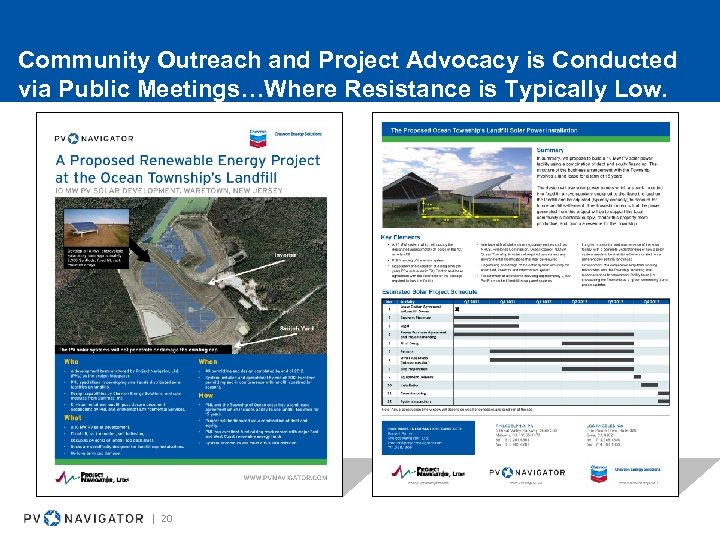 Community Outreach and Project Advocacy is Conducted via Public Meetings…Where Resistance is Typically Low. | 20
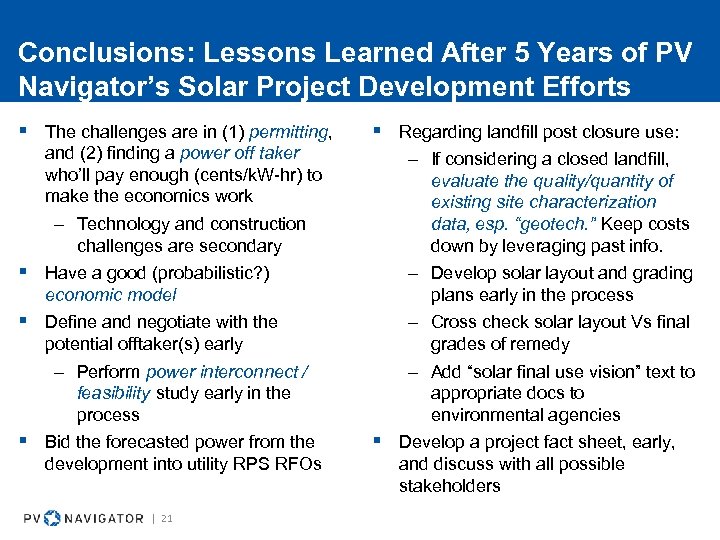 Conclusions: Lessons Learned After 5 Years of PV Navigator’s Solar Project Development Efforts § The challenges are in (1) permitting, and (2) finding a power off taker who’ll pay enough (cents/k. W-hr) to make the economics work – Technology and construction challenges are secondary § Have a good (probabilistic? ) economic model § Define and negotiate with the potential offtaker(s) early – Perform power interconnect / feasibility study early in the process § Bid the forecasted power from the development into utility RPS RFOs | 21 § Regarding landfill post closure use: – If considering a closed landfill, evaluate the quality/quantity of existing site characterization data, esp. “geotech. ” Keep costs down by leveraging past info. – Develop solar layout and grading plans early in the process – Cross check solar layout Vs final grades of remedy – Add “solar final use vision” text to appropriate docs to environmental agencies § Develop a project fact sheet, early, and discuss with all possible stakeholders
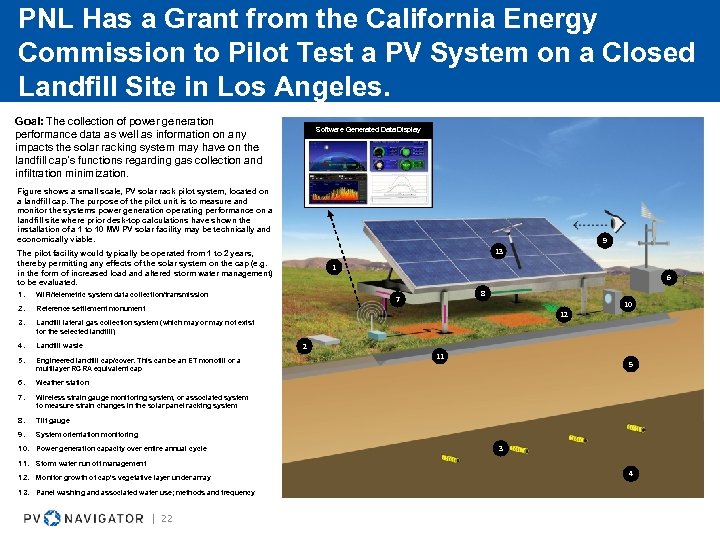 PNL Has a Grant from the California Energy Commission to Pilot Test a PV System on a Closed Landfill Site in Los Angeles. Goal: The collection of power generation performance data as well as information on any impacts the solar racking system may have on the landfill cap’s functions regarding gas collection and infiltration minimization. Software Generated Data Display Figure shows a small scale, PV solar rack pilot system, located on a landfill cap. The purpose of the pilot unit is to measure and monitor the systems power generation operating performance on a landfill site where prior desk-top calculations have shown the installation of a 1 to 10 MW PV solar facility may be technically and economically viable. 9 13 The pilot facility would typically be operated from 1 to 2 years, thereby permitting any effects of the solar system on the cap (e. g. in the form of increased load and altered storm water management) to be evaluated. 1. Landfill lateral gas collection system (which may or may not exist for the selected landfill) 4. Landfill waste 5. Engineered landfill cap/cover. This can be an ET monofill or a multilayer RCRA equivalent cap 6. Weather station 7. Wireless strain gauge monitoring system, or associated system to measure strain changes in the solar panel racking system 8. Tilt gauge 9. System orientation monitoring 10. Power generation capacity over entire annual cycle 11. Storm water run off management 12. Monitor growth of cap’s vegetative layer under array 13. Panel washing and associated water use; methods and frequency 8 Reference settlement monument 3. 6 Wi. Fi/telemetric system data collection/transmission 2. 1 7 10 12 2 | 22 11 5 3 4
 | 23
| 23