 Скачать презентацию Developing the Self-Calibrating Palmer Drought Severity Index Is
c09662a0da324ebbbaf86ce5dcf5fbf2.ppt
- Количество слайдов: 41



Developing the Self-Calibrating Palmer Drought Severity Index Is this computer science or climatology? Steve Goddard Computer Science & Engineering, UNL
Outline 1. What is Drought? 2. The PDSI 3. Self-Calibrating the PDSI 4. Summary
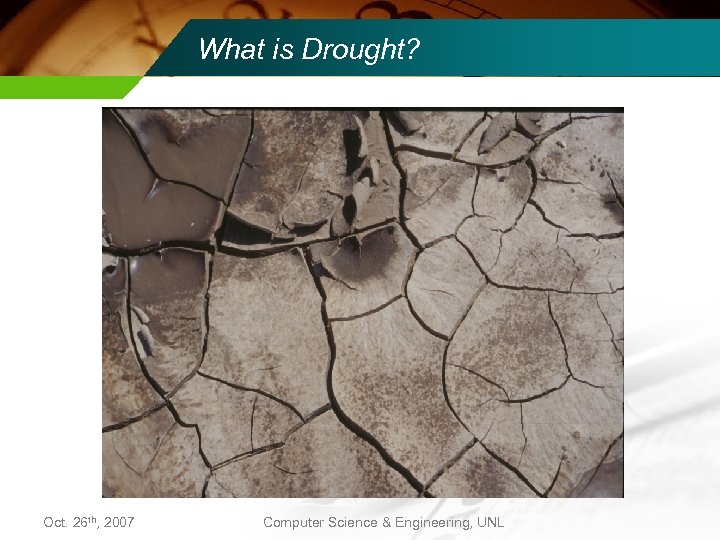
What is Drought? Oct. 26 th, 2007 Computer Science & Engineering, UNL
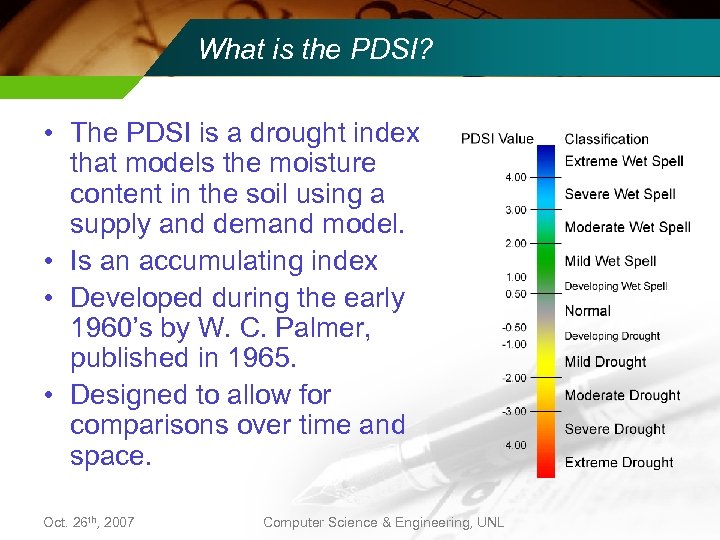
What is the PDSI? • The PDSI is a drought index that models the moisture content in the soil using a supply and demand model. • Is an accumulating index • Developed during the early 1960’s by W. C. Palmer, published in 1965. • Designed to allow for comparisons over time and space. Oct. 26 th, 2007 Computer Science & Engineering, UNL
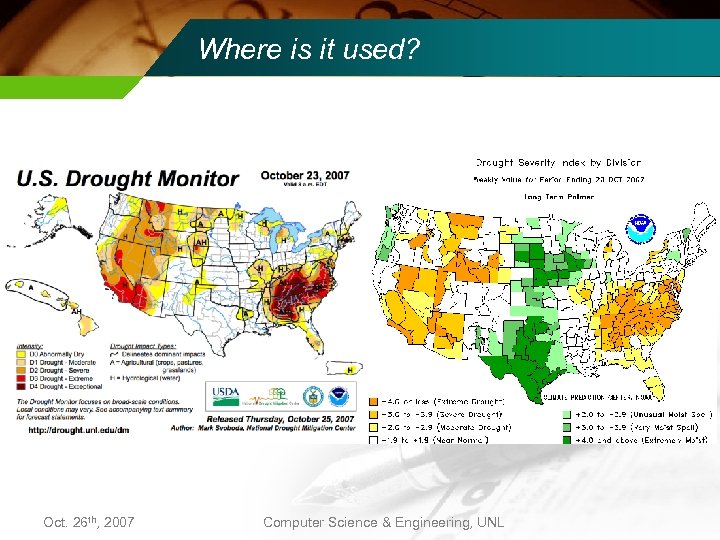
Where is it used? Oct. 26 th, 2007 Computer Science & Engineering, UNL
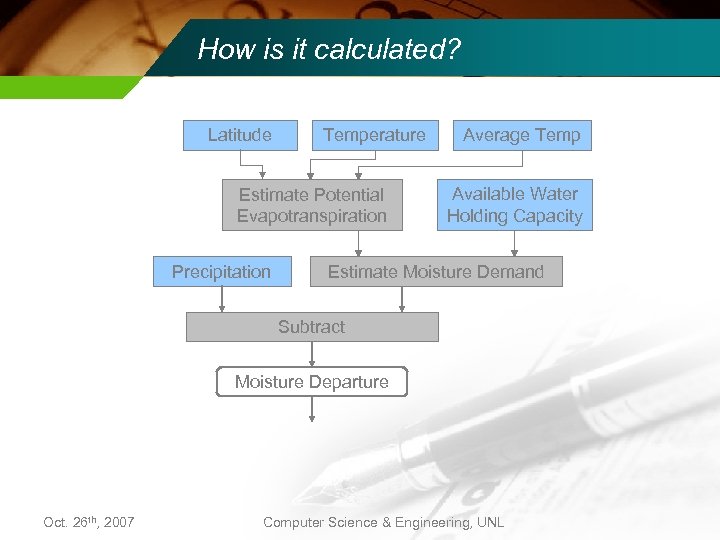
How is it calculated? Latitude Temperature Estimate Potential Evapotranspiration Precipitation Average Temp Available Water Holding Capacity Estimate Moisture Demand Subtract Moisture Departure Oct. 26 th, 2007 Computer Science & Engineering, UNL
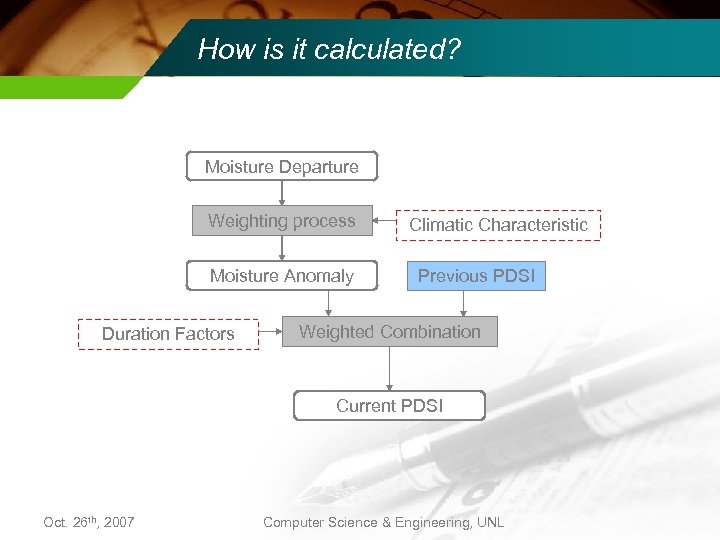
How is it calculated? Moisture Departure Weighting process Moisture Anomaly Duration Factors Climatic Characteristic Previous PDSI Weighted Combination Current PDSI Oct. 26 th, 2007 Computer Science & Engineering, UNL
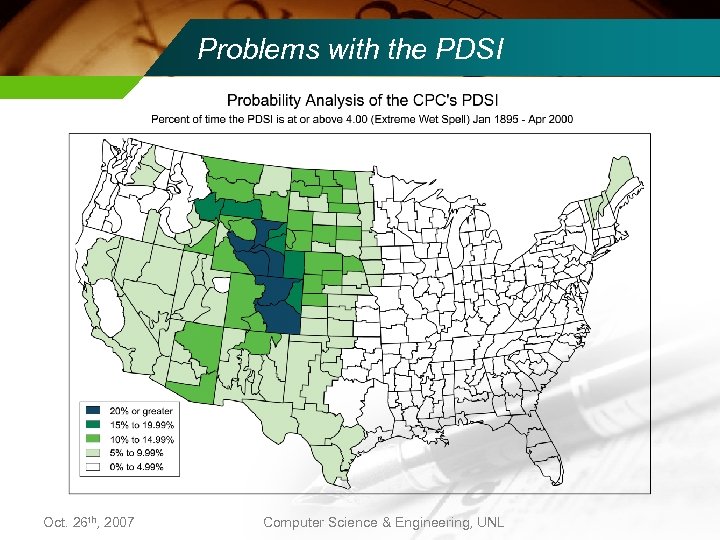
Problems with the PDSI Oct. 26 th, 2007 Computer Science & Engineering, UNL
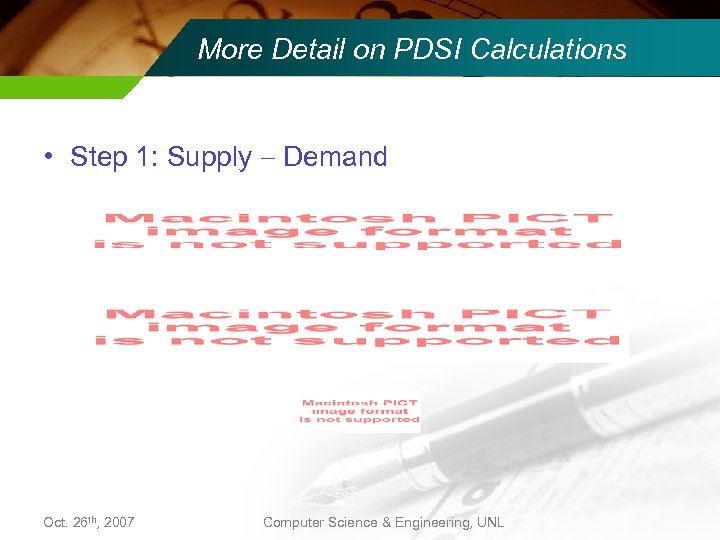
More Detail on PDSI Calculations • Step 1: Supply Demand Oct. 26 th, 2007 Computer Science & Engineering, UNL
Moisture Departure: d • The moisture departure represents the excess or shortage of moisture. • The same value of d may have a different effect at different places, as well as at different times. – Examples: • A shortage of 1” will matter more during the growing season than during winter. • An excess of 1” will be more important in a desert region than in a region that historically receives several inches of rain each month. Oct. 26 th, 2007 Computer Science & Engineering, UNL
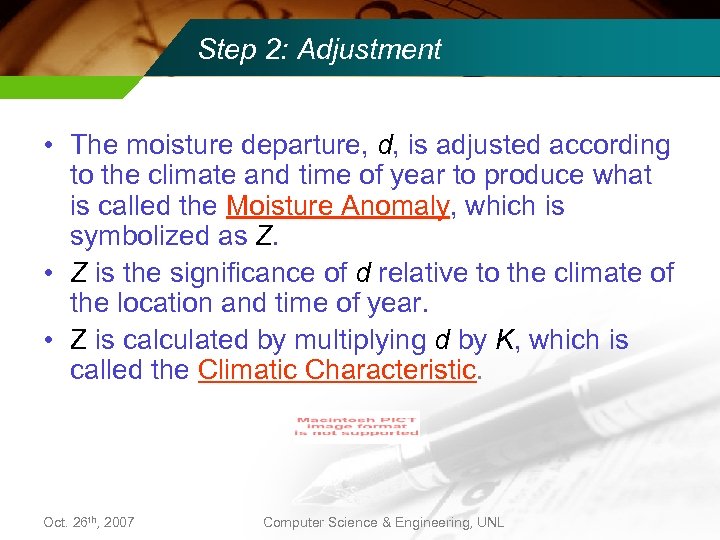
Step 2: Adjustment • The moisture departure, d, is adjusted according to the climate and time of year to produce what is called the Moisture Anomaly, which is symbolized as Z. • Z is the significance of d relative to the climate of the location and time of year. • Z is calculated by multiplying d by K, which is called the Climatic Characteristic. Oct. 26 th, 2007 Computer Science & Engineering, UNL
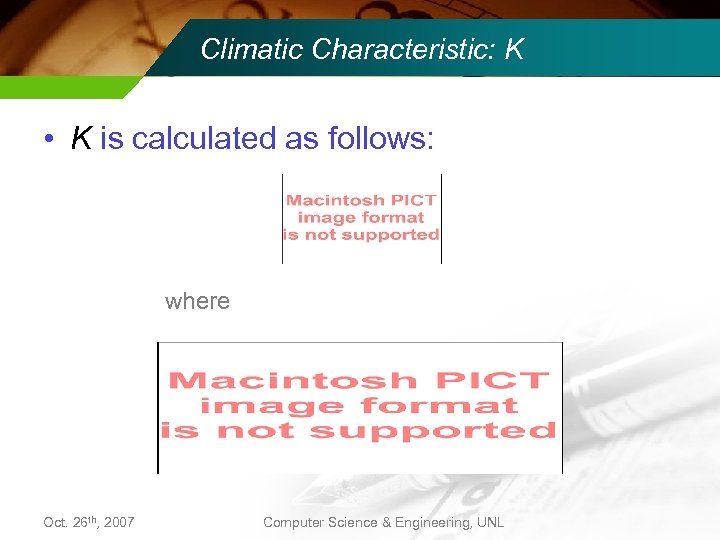
Climatic Characteristic: K • K is calculated as follows: where Oct. 26 th, 2007 Computer Science & Engineering, UNL
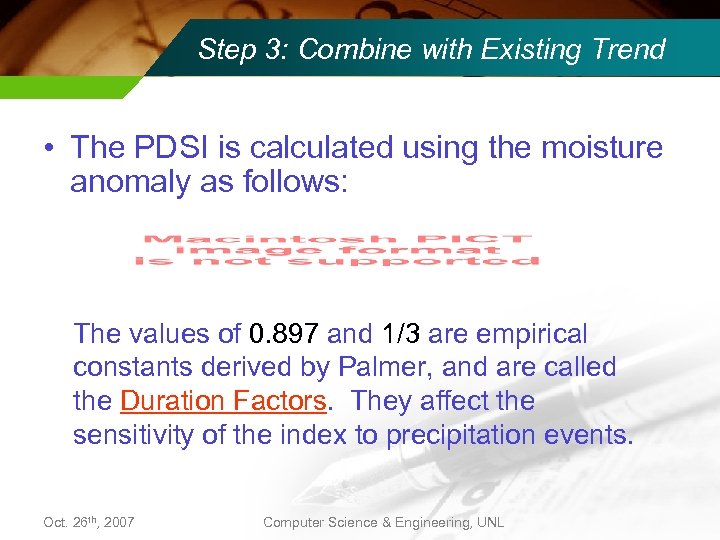
Step 3: Combine with Existing Trend • The PDSI is calculated using the moisture anomaly as follows: The values of 0. 897 and 1/3 are empirical constants derived by Palmer, and are called the Duration Factors. They affect the sensitivity of the index to precipitation events. Oct. 26 th, 2007 Computer Science & Engineering, UNL
Self-Calibration Improving the spatial and temporal resolution of the index requires automatic calibration of: • Duration Factors • Climatic Characteristic Oct. 26 th, 2007 Computer Science & Engineering, UNL
Duration Factors • The Duration Factors are the values of 0. 897 and 1/3 that are used to calculate the PDSI. • They affect the sensitivity of the index to precipitation as well as the lack of precipitation. Oct. 26 th, 2007 Computer Science & Engineering, UNL
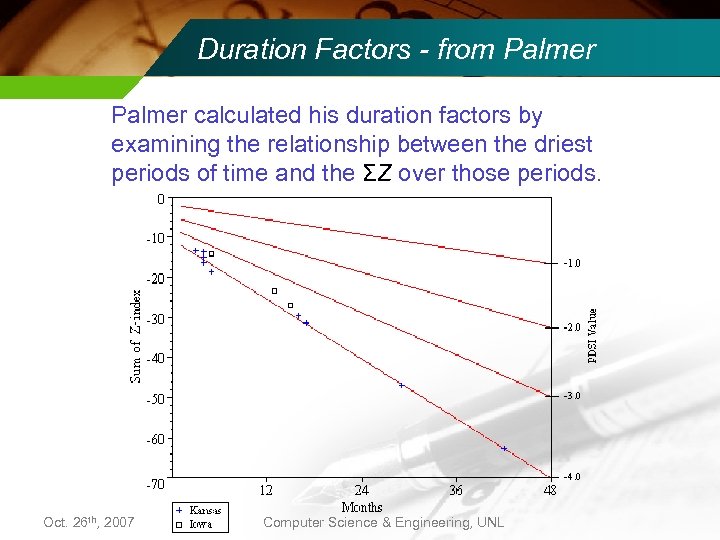
Duration Factors - from Palmer calculated his duration factors by examining the relationship between the driest periods of time and the ΣZ over those periods. Oct. 26 th, 2007 Computer Science & Engineering, UNL
Duration Factors - from Palmer The equation for this linear relationship is: Let b = -10. 764 and m = -1. 236. Then the duration factors can be found as follows: Oct. 26 th, 2007 Computer Science & Engineering, UNL
Duration Factors - Wet and Dry • Most locations respond differently to a deficiency of moisture and an excess of moisture. • Calculate separate duration factors for wet and dry periods by repeating Palmer’s process and examining extremely wet periods. Oct. 26 th, 2007 Computer Science & Engineering, UNL
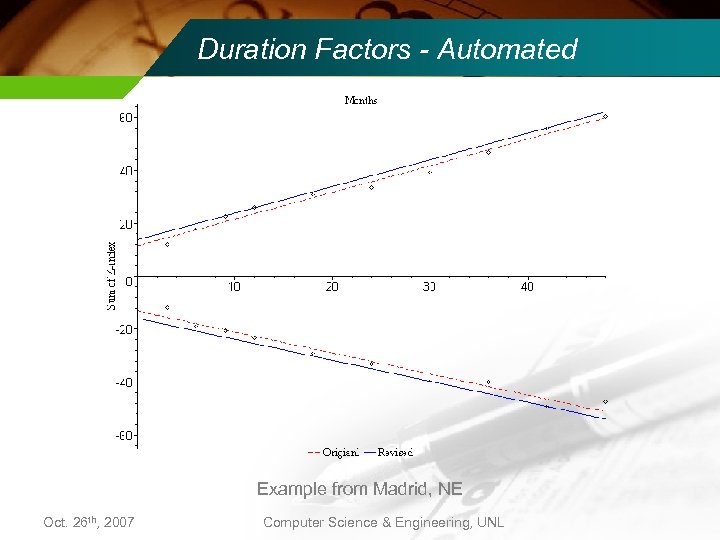
Duration Factors - Automated Example from Madrid, NE Oct. 26 th, 2007 Computer Science & Engineering, UNL
Climatic Characteristic • The climatic characteristic adjusts d so that it is comparable between different time periods and different locations. • The resulting value is the Moisture Anomaly, or the Z-index. • This process can be broken up into two steps. Oct. 26 th, 2007 Computer Science & Engineering, UNL
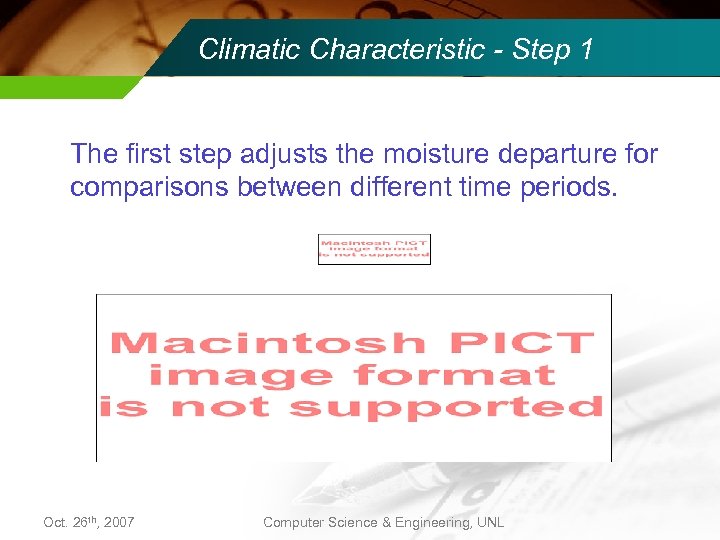
Climatic Characteristic - Step 1 The first step adjusts the moisture departure for comparisons between different time periods. Oct. 26 th, 2007 Computer Science & Engineering, UNL
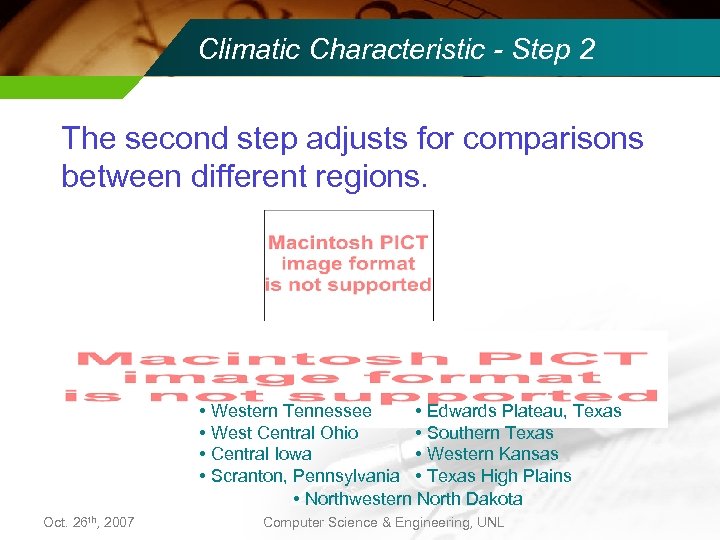
Climatic Characteristic - Step 2 The second step adjusts for comparisons between different regions. • Western Tennessee • Edwards Plateau, Texas • West Central Ohio • Southern Texas • Central Iowa • Western Kansas • Scranton, Pennsylvania • Texas High Plains • Northwestern North Dakota Oct. 26 th, 2007 Computer Science & Engineering, UNL
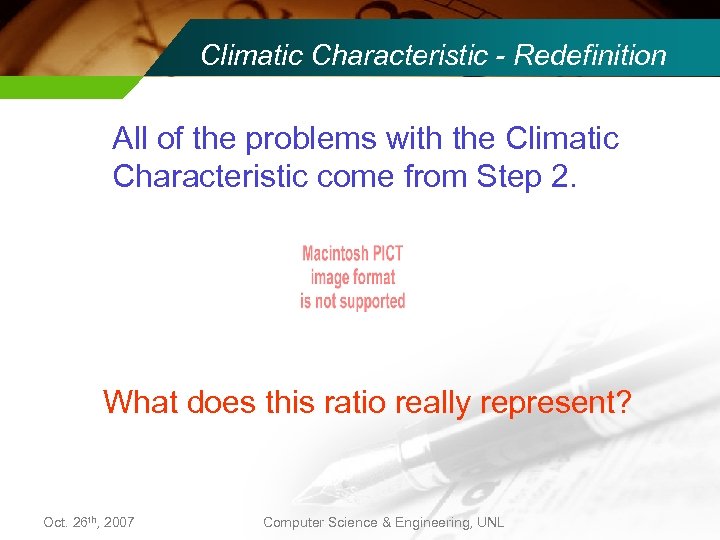
Climatic Characteristic - Redefinition All of the problems with the Climatic Characteristic come from Step 2. What does this ratio really represent? Oct. 26 th, 2007 Computer Science & Engineering, UNL
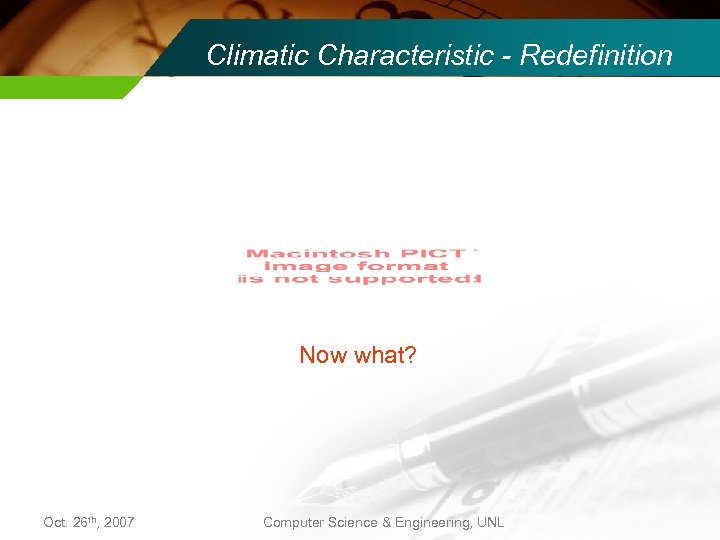
Climatic Characteristic - Redefinition Now what? Oct. 26 th, 2007 Computer Science & Engineering, UNL
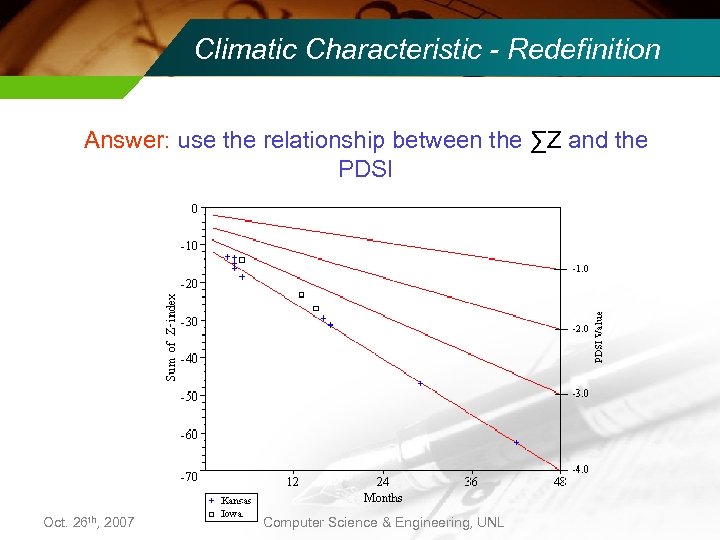
Climatic Characteristic - Redefinition Answer: use the relationship between the ∑Z and the PDSI Oct. 26 th, 2007 Computer Science & Engineering, UNL
Climatic Characteristic - Redefinition What is the “expected average” PDSI? If there is one, it would be zero. Now what? Oct. 26 th, 2007 Computer Science & Engineering, UNL
Climatic Characteristic - Redefinition • From a user’s point of view, what are the expected characteristics of the PDSI? • Besides zero, what other benchmarks does the PDSI have? Answer: A user would expect “extreme” values to be extremely rare. The only other benchmarks are the maximum and minimum of the range. Oct. 26 th, 2007 Computer Science & Engineering, UNL
Climatic Characteristic - Redefinition • If extreme values are truly going to be considered extreme, they should occur at the same low frequency everywhere. • What should this frequency be? – There should be one extreme drought per generation. • Frequency of extreme droughts about 2% • 12 months of extreme drought every 50 years. Oct. 26 th, 2007 Computer Science & Engineering, UNL
Climatic Characteristic - Redefinition • Consider both extremely wet and dry periods: – To make the lowest 2% of the PDSI values fall below -4. 00, map the 2 nd percentile to -4. 00. – To make the highest 2% of the PDSI values fall above +4. 00, map the 98 th percentile to +4. 00. Oct. 26 th, 2007 Computer Science & Engineering, UNL
Climatic Characteristic - Final Redefinition Wait a second…. Isn’t K used to calculate the PDSI? How can the PDSI be used to calculate K? Oct. 26 th, 2007 Computer Science & Engineering, UNL
Calibration Technique Oct. 26 th, 2007 Computer Science & Engineering, UNL
Calibration Technique - Summary – Dynamically calculate the duration factors, following Palmer’s method and adjusting for poor correlation and abnormal precipitation. – Redefine the climatic characteristic to achieve a regular frequency of extremely wet and dry readings by mapping the 2 nd percentile to -4. 00 and the 98 th to +4. 00 Oct. 26 th, 2007 Computer Science & Engineering, UNL
Calibration Technique • Effects: – The index is now calibrated for both wet and dry periods. – Almost all stations have about the same frequency of extreme values. – The same basic algorithm can be used to calculate a PDSI over multiple time periods. Oct. 26 th, 2007 Computer Science & Engineering, UNL
Multiple Time Periods • Why? – To more easily correlate the PDSI with another type of climate data such as tree rings, or satellite data. • Valid monthly periods are divisors of 12: – Single month, 2 -month, 3 -month, 4 -month, 6 -month. • Valid weekly periods are divisors of 52: – Single week, 2 -week, 4 -week, 13 -week, 26 -week. Oct. 26 th, 2007 Computer Science & Engineering, UNL
Analysis • How do we evaluate the Self-Calibrated PDSI? – Best way Try to correlate the Self-Calibrated PDSI to actual conditions. – Easy way Simply compare the Self-Calibrated PDSI to the original PDSI. – Computer Science way: Write a few number-crunching scripts to do the work; performing any number of statistical examinations of the Self-Calibrated PDSI. Oct. 26 th, 2007 Computer Science & Engineering, UNL
Statistical Analysis • What to look for in the statistical analysis. – Frequency of extreme values – Stations that are wet more often than dry and vice versa. – Average range of PDSI values Oct. 26 th, 2007 Computer Science & Engineering, UNL
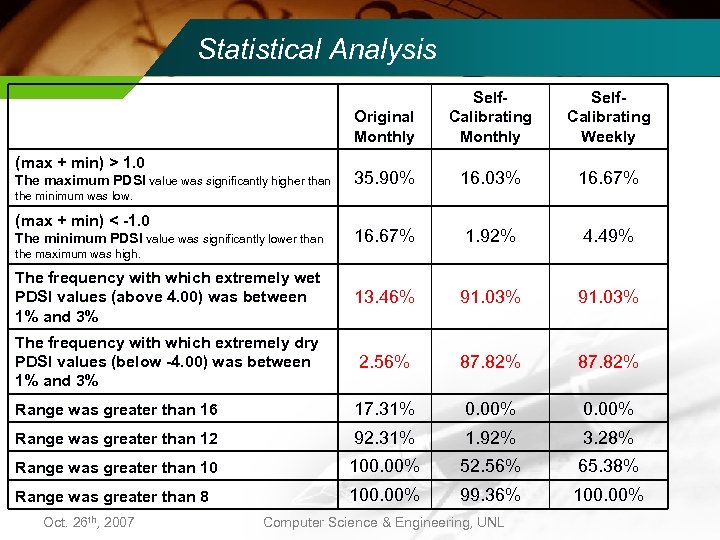
Statistical Analysis Original Monthly Self. Calibrating Weekly 35. 90% 16. 03% 16. 67% 1. 92% 4. 49% The frequency with which extremely wet PDSI values (above 4. 00) was between 1% and 3% 13. 46% 91. 03% The frequency with which extremely dry PDSI values (below -4. 00) was between 1% and 3% 2. 56% 87. 82% Range was greater than 16 17. 31% 0. 00% Range was greater than 12 92. 31% 1. 92% 3. 28% Range was greater than 10 100. 00% 52. 56% 65. 38% Range was greater than 8 100. 00% 99. 36% 100. 00% (max + min) > 1. 0 The maximum PDSI value was significantly higher than the minimum was low. (max + min) < -1. 0 The minimum PDSI value was significantly lower than the maximum was high. Oct. 26 th, 2007 Computer Science & Engineering, UNL
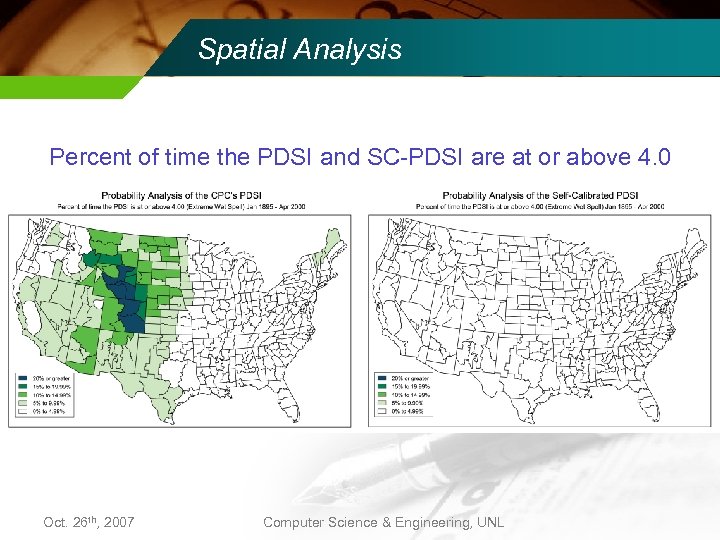
Spatial Analysis Percent of time the PDSI and SC-PDSI are at or above 4. 0 Oct. 26 th, 2007 Computer Science & Engineering, UNL
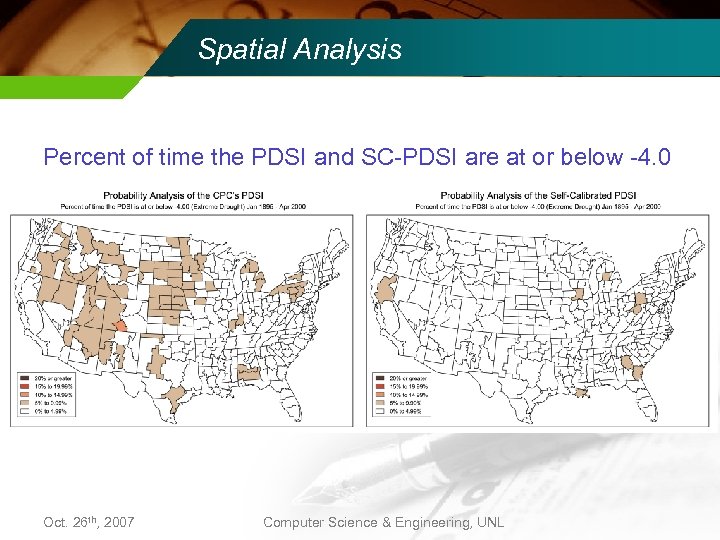
Spatial Analysis Percent of time the PDSI and SC-PDSI are at or below -4. 0 Oct. 26 th, 2007 Computer Science & Engineering, UNL
Conclusion • The SC-PDSI is now used throughout the world. • Increased spatial and temporal resolution than feasible with PDSI. • It is more spatially comparable than PDSI • Performs the way we believe Palmer meant his drought index to perform, and the way he would have implemented it if computers were as readily available as they are today. • Well, that is what we tell the climatologist anyway… Oct. 26 th, 2007 Computer Science & Engineering, UNL

Questions Oct. 26 th, 2007 Computer Science & Engineering, UNL
Скачать презентацию Developing the Self-Calibrating Palmer Drought Severity Index Is
c09662a0da324ebbbaf86ce5dcf5fbf2.ppt