 Скачать презентацию Developing the Business Case for IT Investment Bradley
af5c86ec24f2fd72c4adc57442e8eca0.ppt
- Количество слайдов: 19




Developing the Business Case for IT Investment Bradley C. Wheeler Kelley School of Business Indiana University bwheeler@indiana. edu
Bounded Rationality Ø Conceptualized by Herbert Simon in early 1960’s ü He won the Nobel prize so he must know something Ø People try to behave rationally within the limits of their information processing capabilities and within the context of their attitudes and emotions ü they engage in restricted searches for information; ü have limited information processing capabilities ü rely on familiar sources of information » biases and heuristics ü construct simplified models of reality; . . . and then they make decisions using those models!
Simon’s definition. . . The capacity of the human mind formulating and solving complex problems is very small compared with the size of the problems whose solution is required for objectively rational behavior in the real world - or even for a reasonable approximation of such objective rationality.
Cognitive Limitations Ø Human decision makers can retain only a few bits of information in short-term memory ü 7 plus or minus 2 Ø Those who think in concrete rather than abstract terms tend to be somewhat limited in their ability to process information ü inside versus outside the box Ø Propensity for risk may limit the amount of information needed to arrive at a decision ü risk takers may require less information than risk avoiders
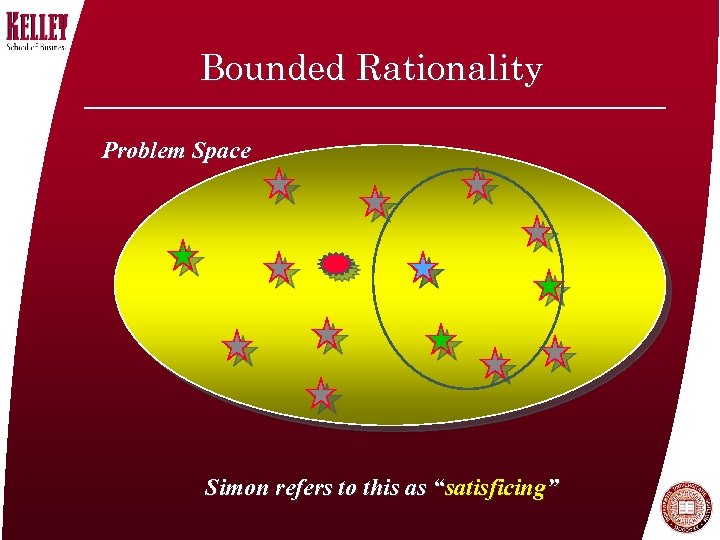
Bounded Rationality Problem Space Simon refers to this as “satisficing”
Bounded Rationality Ø Ø Ø We all suffer from it There is no cure So how do we deal with it? Ø We rely on structured problem solving methods to help us minimize or overcome the effects of bounded rationality. Ø Business cases are one of those methods.
Business Case Examples Ø Consumer Products International ü Strengths? ü Concerns? ü Should this business case be funded? Ø Biogenetica ü Strengths? ü Weaknesses ü Should this business case be funded?
Why Write Business Cases? Ø Disciplined Exercise ü Make tacit assumptions explicit ü Provides basis for allocating capital Ø Communication Tool ü Essential investment in building the relationship asset ü Defines what the project is (and is not)
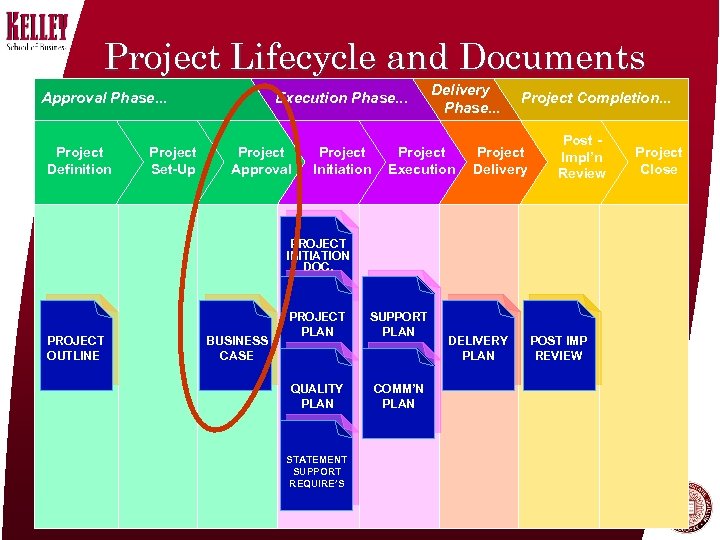
Project Lifecycle and Documents Approval Phase. . . Project Definition Project Set-Up Execution Phase. . . Project Approval Project Initiation Delivery Phase. . . Project Execution Project Completion. . . Project Delivery Post Impl’n Review PROJECT INITIATION DOC. PROJECT OUTLINE BUSINESS CASE PROJECT PLAN SUPPORT PLAN QUALITY PLAN COMM’N PLAN STATEMENT SUPPORT REQUIRE’S DELIVERY PLAN POST IMP REVIEW Project Close
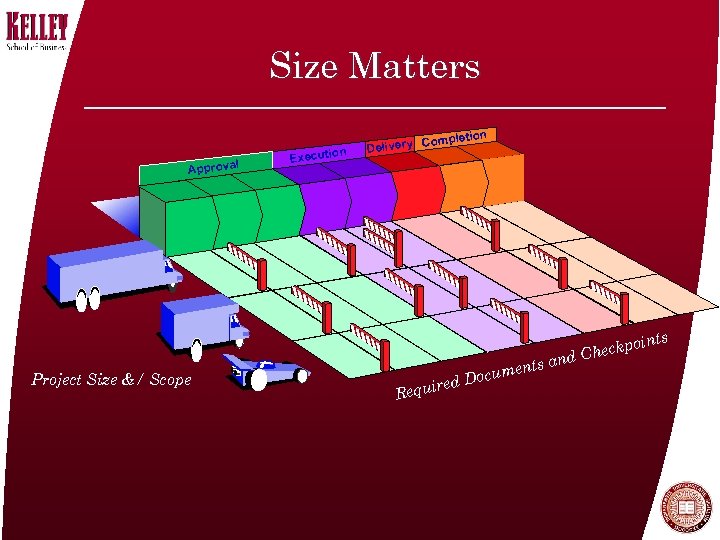
Size Matters tion Approval Project Size &/ Scope n Executio Comple Delivery d re Requi ts an en Docum ints eckpo d Ch
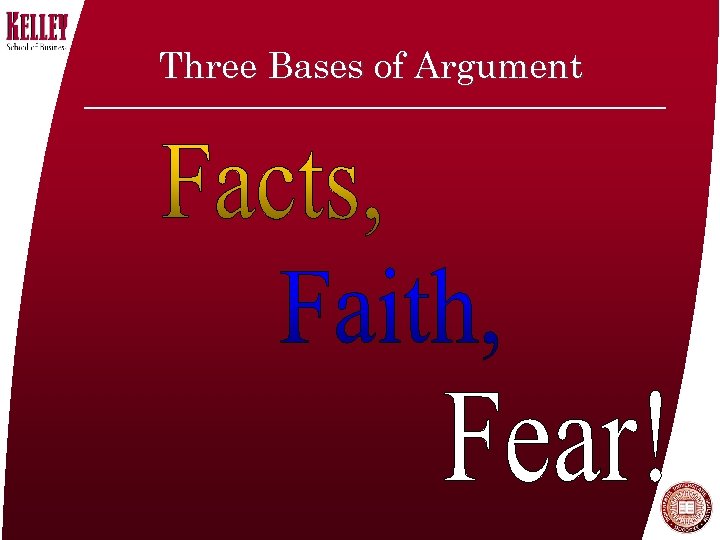
Three Bases of Argument
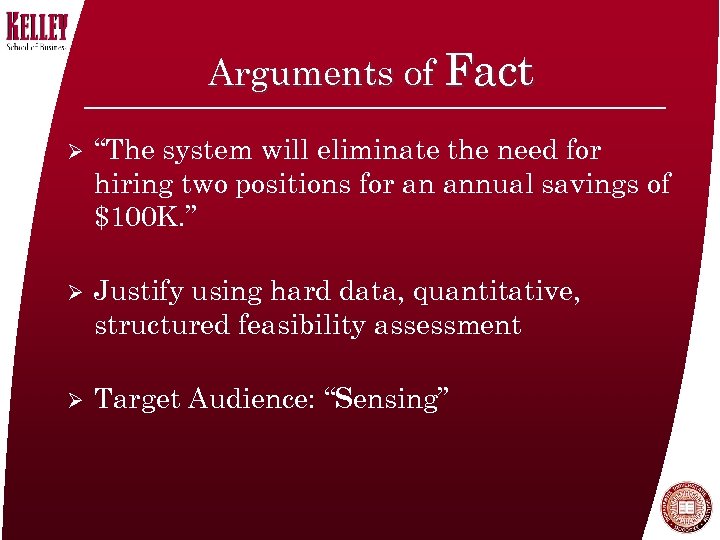
Arguments of Fact Ø “The system will eliminate the need for hiring two positions for an annual savings of $100 K. ” Ø Justify using hard data, quantitative, structured feasibility assessment Ø Target Audience: “Sensing”
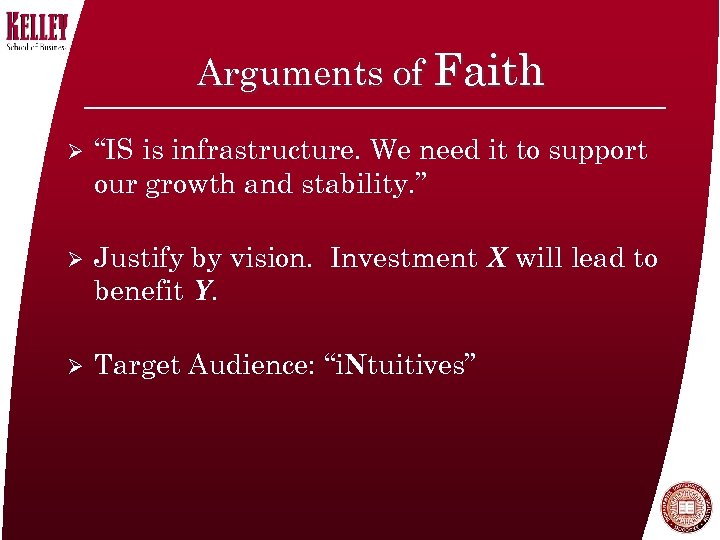
Arguments of Faith Ø “IS is infrastructure. We need it to support our growth and stability. ” Ø Justify by vision. Investment X will lead to benefit Y. Ø Target Audience: “i. Ntuitives”
Arguments of Fear Ø “If we don’t do this we may be eaten alive by our competition. ” Ø Justify by perception of events. Ø Target Audience: “i. Ntuitives”
Collaborative Exercise Color code arguments of üFacts üFaith üFear
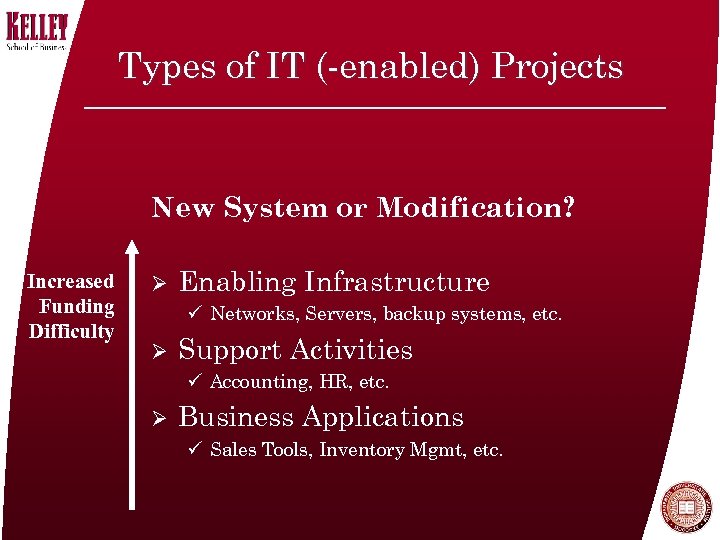
Types of IT (-enabled) Projects New System or Modification? Increased Funding Difficulty Ø Enabling Infrastructure ü Networks, Servers, backup systems, etc. Ø Support Activities ü Accounting, HR, etc. Ø Business Applications ü Sales Tools, Inventory Mgmt, etc.
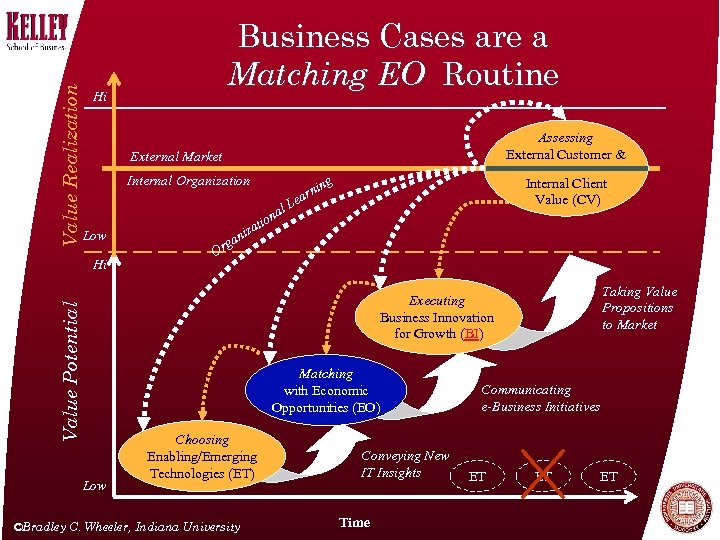
Value Realization Business Cases are a Matching EO Routine Hi Assessing External Customer & External Market Internal Organization Low Hi al ion t ng rni ea Internal Client Value (CV) L iza n rga O Taking Value Propositions to Market Value Potential Executing Business Innovation for Growth (BI) Matching with Economic Opportunities (EO) Low Choosing Enabling/Emerging Technologies (ET) ©Bradley C. Wheeler, Indiana University Conveying New IT Insights Time Communicating e-Business Initiatives ET ET ET
Review Ø Business Cases. . . ü Are essential part of project selecting & scoping ü Require making assumptions explicit ü Use arguments of Facts, Faith, & Fear ü Set the direction & support for projects ü Establish business ownership ü Set boundaries ü Strongly influence the Relationship Asset

Developing the Business Case for IT Investment Bradley C. Wheeler Kelley School of Business Indiana University bwheeler@indiana. edu
Скачать презентацию Developing the Business Case for IT Investment Bradley
af5c86ec24f2fd72c4adc57442e8eca0.ppt