


 Скачать презентацию Developing markets and capacities for organic products The
b98a656d6610fc365a7e47ad0743033b.ppt
- Количество слайдов: 15
 Developing markets and capacities for organic products The EPOPA experience Bo van Elzakker www. epopa. info 1 EXPORT PROMOTION OF ORG ANIC PRODUCTS FROM AFRICA
 History Started with a desk study, 1 product, cotton, Uganda Became pilot project Became EPOPA phase 1 (3 years) An extension (1 year) EPOPA phase 2 (3 years) EPOPA prolongation (3 years) Tendered twice, consultant remained the same Three program documents; concept was allowed to evolve and mature § Has seen changes in programme focus, in number of countries, within the donor § § § § 2 EXPORT PROMOTION OF ORG ANIC PRODUCTS FROM AFRICA
 A programme § To initiate and facilitate export of organic products from Africa in order to increase income for farmers while exposing the country to sustainable agricultural practices § Is a private sector programme § Implemented by two specialist and dedicated organic consultancies § Local offices with support from NL and S offices § From farm to fork (strong marketing component) § Exports plus capacity building and institutional development (CBs and national movements) 3 EXPORT PROMOTION OF ORG ANIC PRODUCTS FROM AFRICA
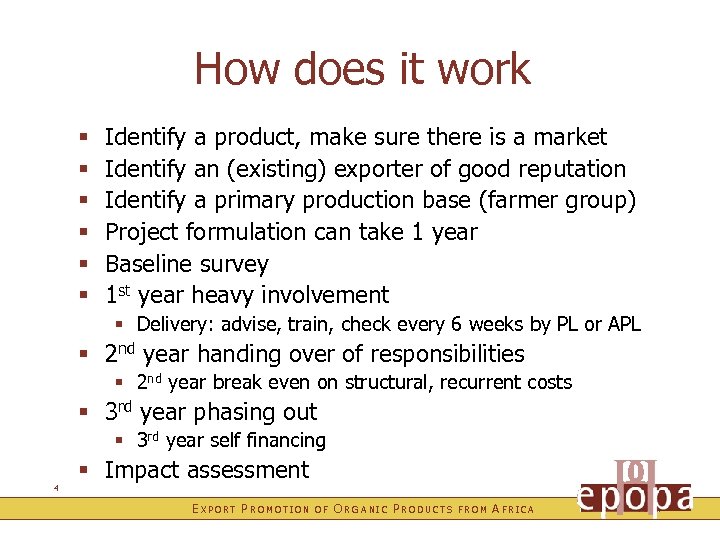 How does it work § § § Identify a product, make sure there is a market Identify an (existing) exporter of good reputation Identify a primary production base (farmer group) Project formulation can take 1 year Baseline survey 1 st year heavy involvement § Delivery: advise, train, check every 6 weeks by PL or APL § 2 nd year handing over of responsibilities § 2 nd year break even on structural, recurrent costs § 3 rd year phasing out § 3 rd year self financing § Impact assessment 4 EXPORT PROMOTION OF ORG ANIC PRODUCTS FROM AFRICA
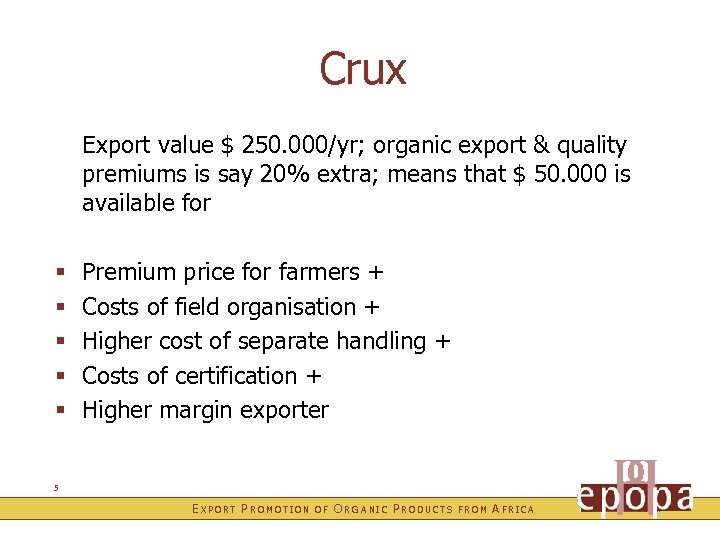 Crux Export value $ 250. 000/yr; organic export & quality premiums is say 20% extra; means that $ 50. 000 is available for § § § Premium price for farmers + Costs of field organisation + Higher cost of separate handling + Costs of certification + Higher margin exporter 5 EXPORT PROMOTION OF ORG ANIC PRODUCTS FROM AFRICA
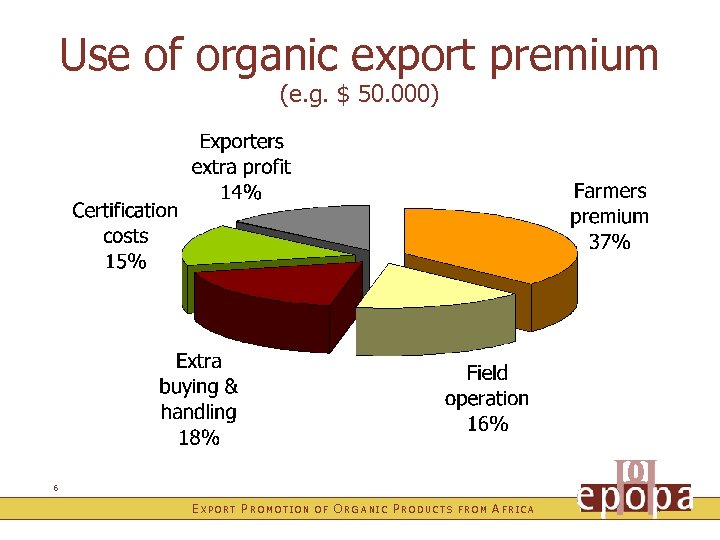 Use of organic export premium (e. g. $ 50. 000) 6 EXPORT PROMOTION OF ORG ANIC PRODUCTS FROM AFRICA
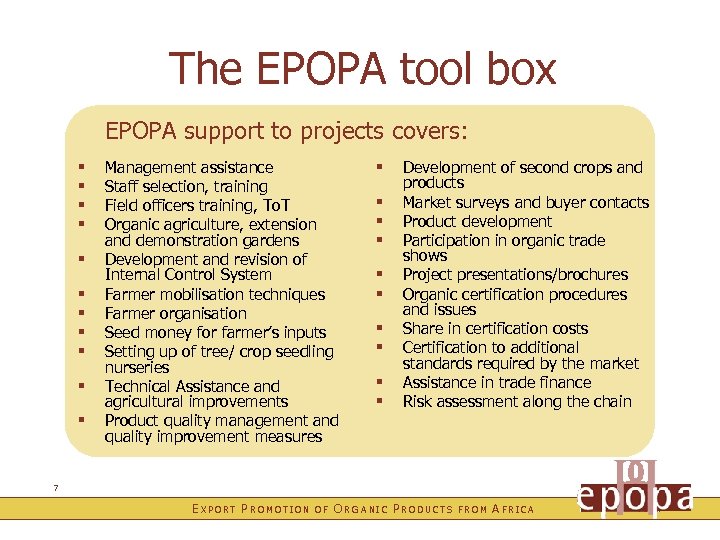 The EPOPA tool box EPOPA support to projects covers: § § § Management assistance Staff selection, training Field officers training, To. T Organic agriculture, extension and demonstration gardens Development and revision of Internal Control System Farmer mobilisation techniques Farmer organisation Seed money for farmer’s inputs Setting up of tree/ crop seedling nurseries Technical Assistance and agricultural improvements Product quality management and quality improvement measures § § § § § Development of second crops and products Market surveys and buyer contacts Product development Participation in organic trade shows Project presentations/brochures Organic certification procedures and issues Share in certification costs Certification to additional standards required by the market Assistance in trade finance Risk assessment along the chain 7 EXPORT PROMOTION OF ORG ANIC PRODUCTS FROM AFRICA
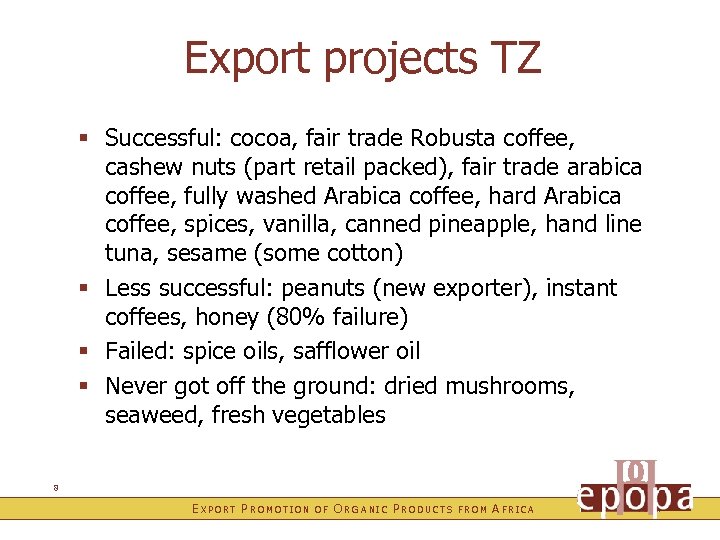 Export projects TZ § Successful: cocoa, fair trade Robusta coffee, cashew nuts (part retail packed), fair trade arabica coffee, fully washed Arabica coffee, hard Arabica coffee, spices, vanilla, canned pineapple, hand line tuna, sesame (some cotton) § Less successful: peanuts (new exporter), instant coffees, honey (80% failure) § Failed: spice oils, safflower oil § Never got off the ground: dried mushrooms, seaweed, fresh vegetables 8 EXPORT PROMOTION OF ORG ANIC PRODUCTS FROM AFRICA
 Export projects UG § Successful: cotton-sesame-chillies, various Arabica coffees incl. fair trade, Robusta coffee, cocoavanilla, cardamom, hibiscus, fresh & dried fruits, essential oils-herbal teas, bark cloth § Less successful: honey, shea nut oil, candied fruit, Nile perch/tilapia fillets § Failed: papain § Never off the ground: crayfish, ecotourism 9 EXPORT PROMOTION OF ORG ANIC PRODUCTS FROM AFRICA
 The exporter It is difficult to find good exporters The drama of the cooperative unions The drama of what came after the unions Work with existing exporters Exporter is responsible for the (field) organisation of the project § Worked with 3 Cooperative Unions, 1 Primary Society/own exports, 9 local entrepreneurs, 7 Indian owned, 8 EU expat owned, 5 local/expat joint ventures, 4 branches of international trading houses § § § 10 EXPORT PROMOTION OF ORG ANIC PRODUCTS FROM AFRICA
 Exporter continued § Majority is exporter-contract farmer relation § Interest in PO improving but fragile § Exporter employs field staff, responsible for information, extension, experimentation, quality mgt, organic Internal Control System § Smallholders can participate only because of group certification 11 EXPORT PROMOTION OF ORG ANIC PRODUCTS FROM AFRICA
 Strengths-weaknesses The organic market is there, quality and quantity African farmers can supply Communication exporter-importer difficult Not so successful in longer term trade relationships Field supervisor/prod. manager is critical person Exporter responsible for extension has its limitations (no interest in production increase) § Exporters have a problem with cost of certification, like to save on farmer premium and on own staff § No direct financial support to exporter needed § Inspection & certification take a lot of time, is expensive, but pays back § § § 12 EXPORT PROMOTION OF ORG ANIC PRODUCTS FROM AFRICA
 13 EXPORT PROMOTION OF ORG ANIC PRODUCTS FROM AFRICA
 Some additional points § Effects on income: In 4 coffee projects (2005): § 28, 21, 18 and 7% higher incomes realised § Annual income becomes 135, 290, 267, 235 $/yr In 3 fruit projects (2005): § 7, 18 and 21% higher incomes § Annual income becomes 850, 685, 574 $/yr § Conclusion: organic certification helps but does not necessarily mean high income 14 EXPORT PROMOTION OF ORG ANIC PRODUCTS FROM AFRICA
 Otherwise § Organic certification is a trigger for change, motivation to farm better § It is not difficult for farmers to comply; it is far more difficult to demonstrate compliance § Relatively easy to add on additional certifications (like E-GAP) § Short term sustainability is very good 15 EXPORT PROMOTION OF ORG ANIC PRODUCTS FROM AFRICA