 Скачать презентацию Developing Independent Problem-Solving Skills at Key Stage One
37b9ab6bb99d3dea6fdc66c2f143fd65.ppt
- Количество слайдов: 16



Developing Independent Problem-Solving Skills at Key Stage One Moredon Primary and Nursery School Rodbourne Cheney Primary School Wroughton Infants School
Ice Breaker Problem On your table, shake hands with each other once. How many handshakes are there altogether? If everyone in the room shakes hand with each other once, how many handshakes would there be altogether?

Handshakes feedback • Did you get an answer? • How confident are you with your answer? • What strategies did you use?

The background to our project The session will look at research done by 3 schools into developing an independent approach to problem-solving through the teaching of heuristics to Year 2 pupils. Delegates will see how the children responded at the beginning, middle and end of the project and the impact of teaching them how to solve problems for themselves through a range of strategies.
The first problem We devised a problem for a Year 2 class from each school – each class had the same problem. No teaching was done before the problems were given out. The children were put into mixed ability groups of 3.

You have three ice cream flavours: Chocolate Apple Strawberry And you have a triple cornet. How many different ways can you order the flavours in your cornet?
• These videos showed the children struggling to cope with this task. • A 13 second ‘tumbleweed’ moment was noted before the first child (A BA child) spoke. • They spent too much of their time writing out their answers in sentences, then editing them. • Children were not really working as a team – they tended to do their bit then pass the problem on to someone else. • Equipment was provided but not used.
After having a go… • We praised the children for trying 100% with their problems. • We then let them watch their own videos along with the videos from other schools. This enabled them to realise that everyone had the same word problem and had similar difficulties in tackling them.
The next step… • All the teachers met to watch, share and discuss the videos. • We then identified the AT 1 levels that they were working and the main difficulties that they faced. • Then we identified three heuristics to teach before doing the problem again.
The Three Heuristics • Work together and share ideas • Use tables to organise workings • Use diagrams or pictures We then gave them the same problem again and the following videos shows the progress that they made. Again, no help was given during the task.
• These videos showed a marked improvement in the children’s ability and confidence to solve these word problems. • Equipment were used. • Children talked a lot more. • They were all doing something as part of a team. • The ‘Literacy’ focus was removed and they were using symbols or colours. • Tables were drawn to improve the layout. • They checked their results more this time.
So what other heuristics can be taught? • • • Have you seen a similar problem before? Try and be systematic Guess and improve Try extreme cases - start small or large Have you tried all the possibilities? Use equipment provided Will you use any of these for your next activity?
Our final step… In order to take their learning and confidence forward, we met again and decided on the following heuristics to teach: • Be systematic • It’s OK to use equipment The children were given a different problem to solve.
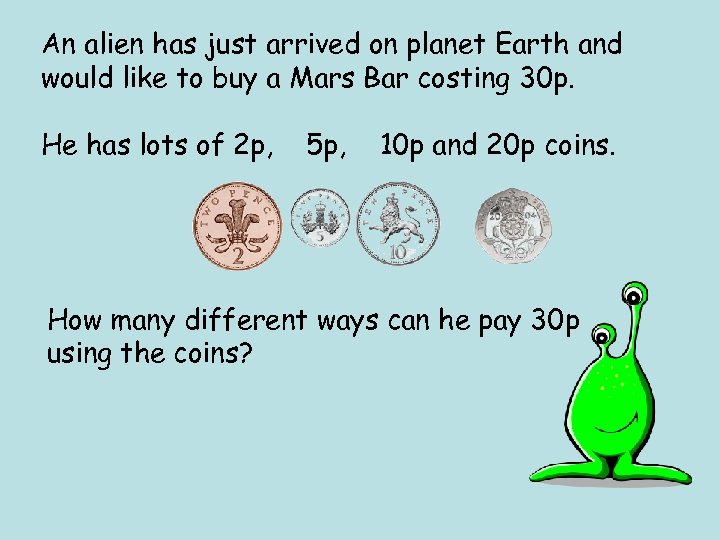
An alien has just arrived on planet Earth and would like to buy a Mars Bar costing 30 p. He has lots of 2 p, 5 p, 10 p and 20 p coins. How many different ways can he pay 30 p using the coins?
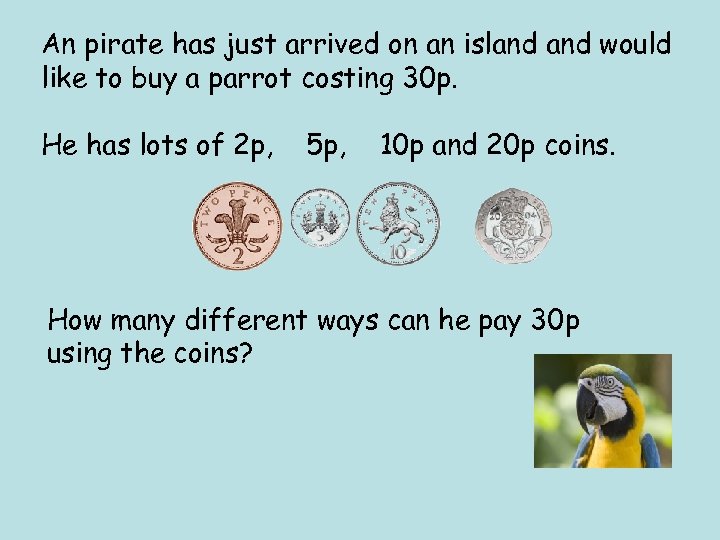
An pirate has just arrived on an island would like to buy a parrot costing 30 p. He has lots of 2 p, 5 p, 10 p and 20 p coins. How many different ways can he pay 30 p using the coins?
Rounding up… Benefits from this project: • Children are now more confident in being able to tackle a problem, not just in Numeracy. • They are now more aware of the heuristics they could apply to help with solving problems. So what do the children have to say about this?
Скачать презентацию Developing Independent Problem-Solving Skills at Key Stage One
37b9ab6bb99d3dea6fdc66c2f143fd65.ppt