 Скачать презентацию Developing BPO Clusters in Bangladesh What Can We
4523a677df7d35b67679f918e0c89a76.ppt
- Количество слайдов: 39



Developing BPO Clusters in Bangladesh: What Can We Learn from Indian Experiences? Dr. Sougata Ray Indian Institute of Management Calcutta SOFTEXPO 2005 Bangladesh Association of Software & Information Services (BASIS)
IT & ITES (BPO) – Some Facts & Trends
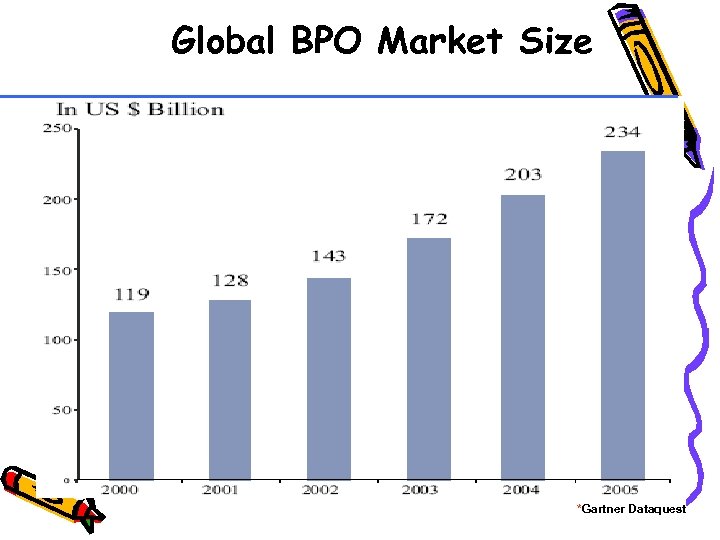
Global BPO Market Size *Gartner Dataquest
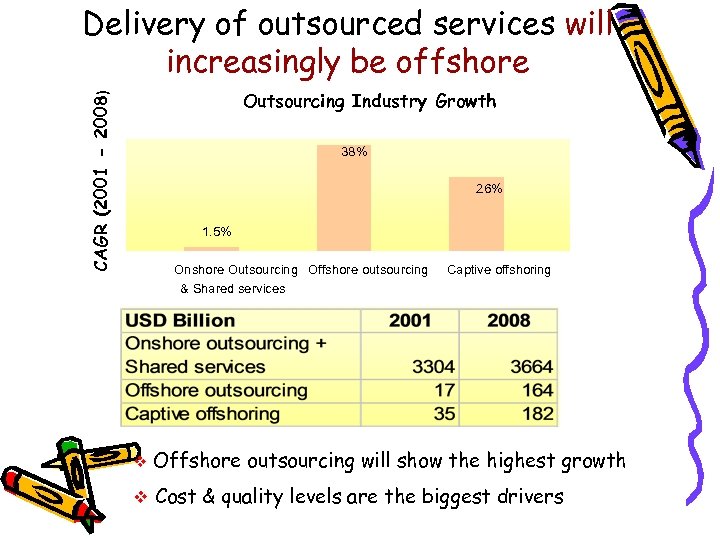
Delivery of outsourced services will increasingly be offshore CAGR (2001 - 2008) Outsourcing Industry Growth 38% 26% 1. 5% Onshore Outsourcing Offshore outsourcing & Shared services v Captive offshoring Offshore outsourcing will show the highest growth v Cost & quality levels are the biggest drivers
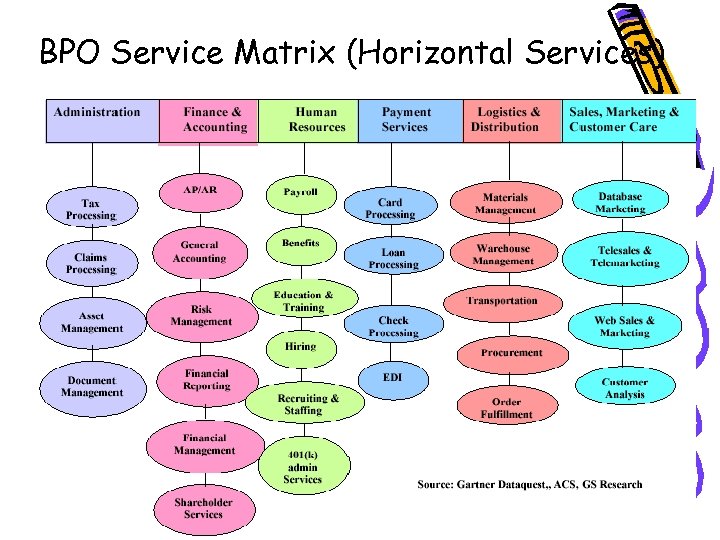
BPO Service Matrix (Horizontal Services)
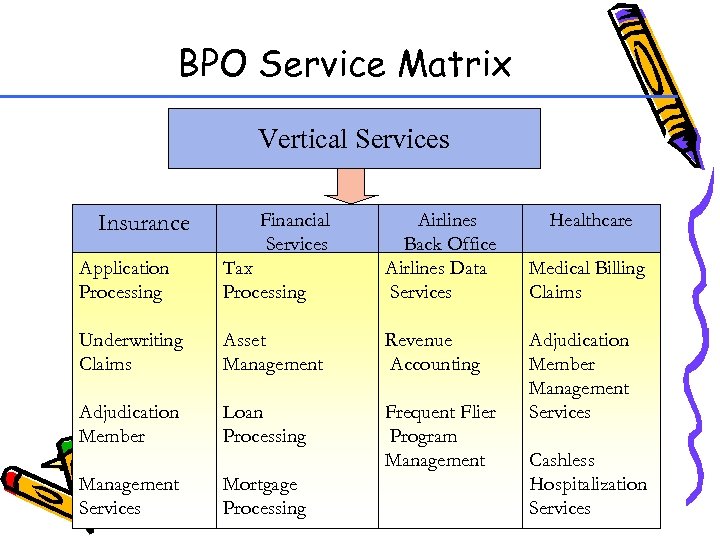
BPO Service Matrix Vertical Services Application Processing Tax Processing Airlines Back Office Airlines Data Services Underwriting Claims Asset Management Revenue Accounting Adjudication Member Loan Processing Frequent Flier Program Management Insurance Management Services Financial Services Mortgage Processing Healthcare Medical Billing Claims Adjudication Member Management Services Cashless Hospitalization Services
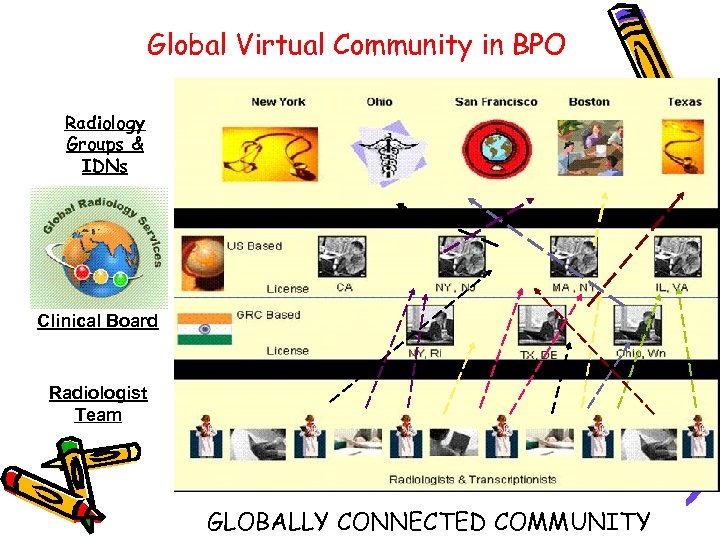
Global Virtual Community in BPO Radiology Groups & IDNs Clinical Board Radiologist Team GLOBALLY CONNECTED COMMUNITY
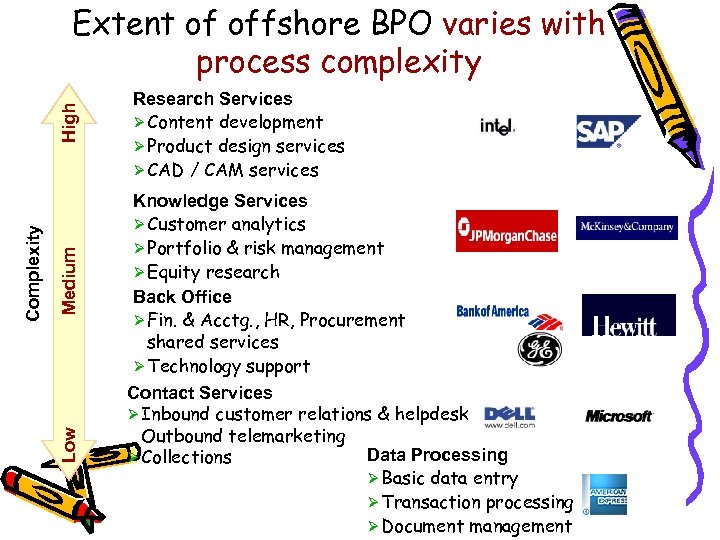
Medium Low Complexity High Extent of offshore BPO varies with process complexity Research Services Ø Content development Ø Product design services Ø CAD / CAM services Knowledge Services Ø Customer analytics Ø Portfolio & risk management Ø Equity research Back Office Ø Fin. & Acctg. , HR, Procurement shared services Ø Technology support Contact Services Ø Inbound customer relations & helpdesk Outbound telemarketing Data Processing Ø Collections Ø Basic data entry Ø Transaction processing Ø Document management
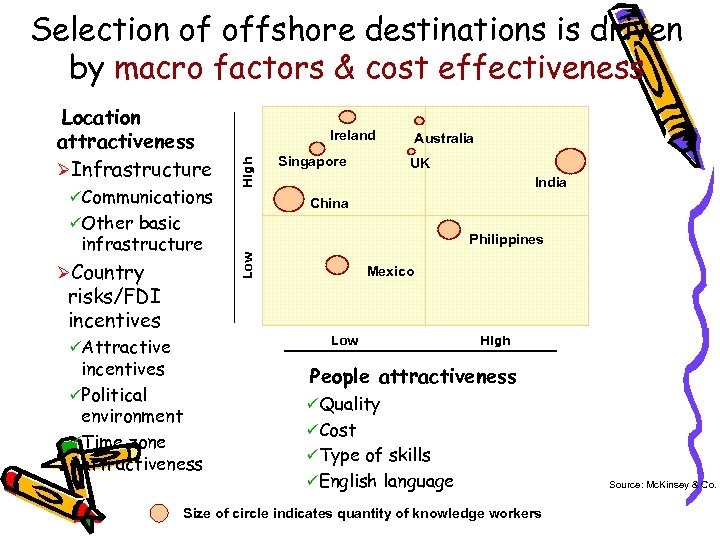
Selection of offshore destinations is driven by macro factors & cost effectiveness üCommunications Ireland High Location attractiveness ØInfrastructure India Philippines Low ØCountry UK China üOther basic infrastructure Singapore Australia Mexico risks/FDI incentives üAttractive Low incentives üPolitical environment üTime zone attractiveness High People attractiveness üQuality üCost üType of skills üEnglish language Size of circle indicates quantity of knowledge workers Source: Mc. Kinsey & Co.
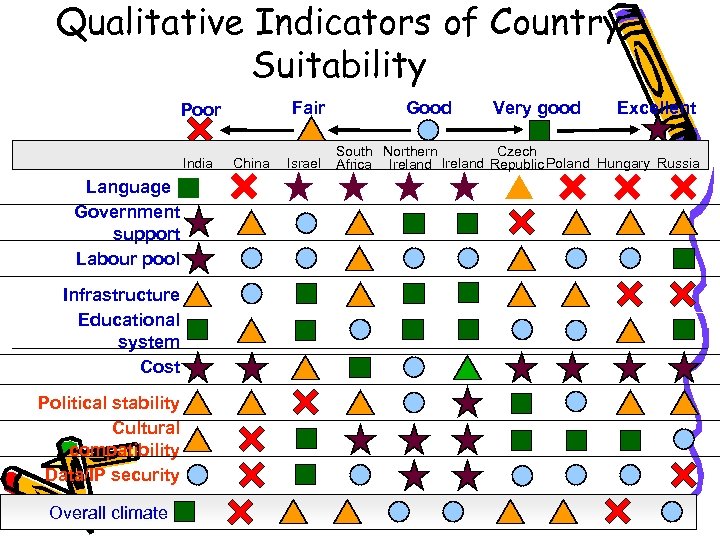
Qualitative Indicators of Country Suitability Fair Poor India Language Government support Labour pool Infrastructure Educational system Cost Political stability Cultural compatibility Data/IP security Overall climate China Israel Good Very good Excellent South Northern Czech Africa Ireland Republic Poland Hungary Russia
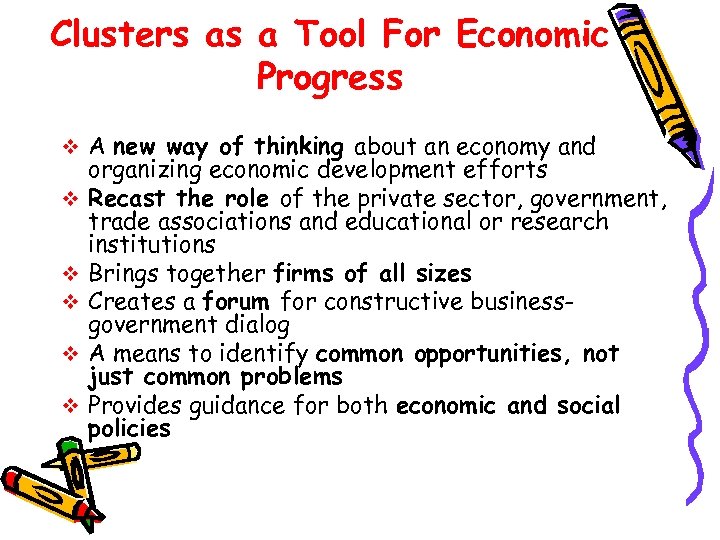
Clusters as a Tool For Economic Progress v A new way of thinking about an economy and v v v organizing economic development efforts Recast the role of the private sector, government, trade associations and educational or research institutions Brings together firms of all sizes Creates a forum for constructive businessgovernment dialog A means to identify common opportunities, not just common problems Provides guidance for both economic and social policies
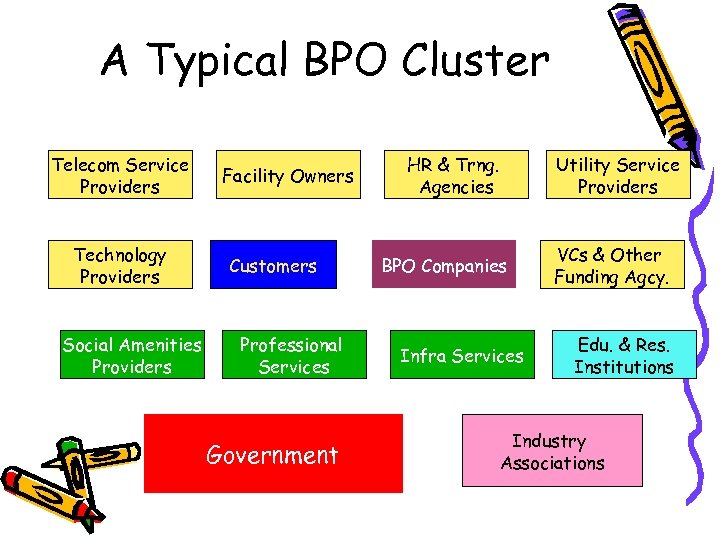
A Typical BPO Cluster Telecom Service Providers Technology Providers Social Amenities Providers Facility Owners Customers Professional Services Government HR & Trng. Agencies Utility Service Providers BPO Companies Infra Services VCs & Other Funding Agcy. Edu. & Res. Institutions Industry Associations
Why Clusters Matter v Clusters Increase Productivity / Efficiency Ø Efficient access to specialized inputs, services, employees, information, institutions, and “public goods” (e. g. training programs) Ø Ease of coordination and transactions across firms Ø Rapid diffusion of best practices Ø Ongoing, visible performance comparisons and strong incentives to improve vs. local rivals v Clusters Stimulate and Enable Innovations Ø Enhanced ability to perceive innovation opportunities Ø Presence of multiple suppliers and institutions to assist in knowledge creation
Why Clusters Matter v Clusters Facilitate Commercialization Ø Opportunities for new companies and new lines of established business are more apparent Ø Commercializing new products and starting new companies is easier because of available skills, suppliers, buyers, etc. Clusters reflect the fundamental influence of externalities / linkages across firms and associated institutions in competition
Indian Study v Nation-wide study of all major IT and ITES clusters v Detail case studies of three cities in different stages of development cycle Ø Bangalore: first mover, already established (US $ 4. 5 b) Ø Hyderabad: late mover, early growth stage (US $ 1. 2 b) Ø Kolkata: late mover, past glory, trying revival (US $ 0. 5 b) Why successful IT and ITES clusters are formed only in some cities
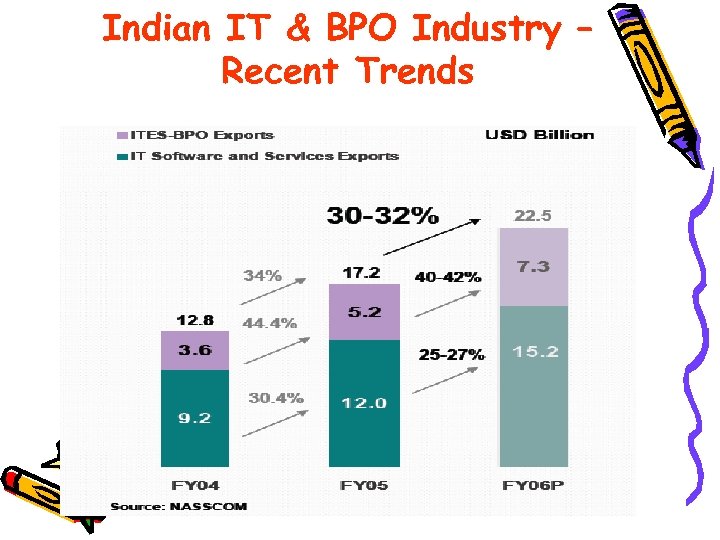
Indian IT & BPO Industry – Recent Trends
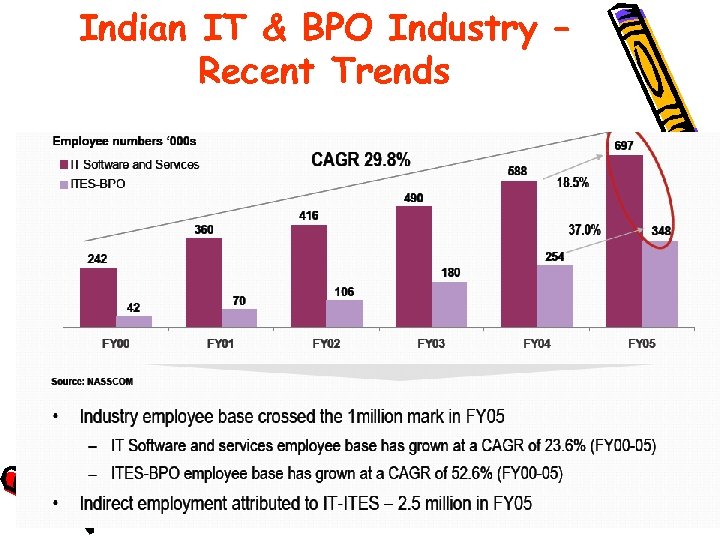
Indian IT & BPO Industry – Recent Trends
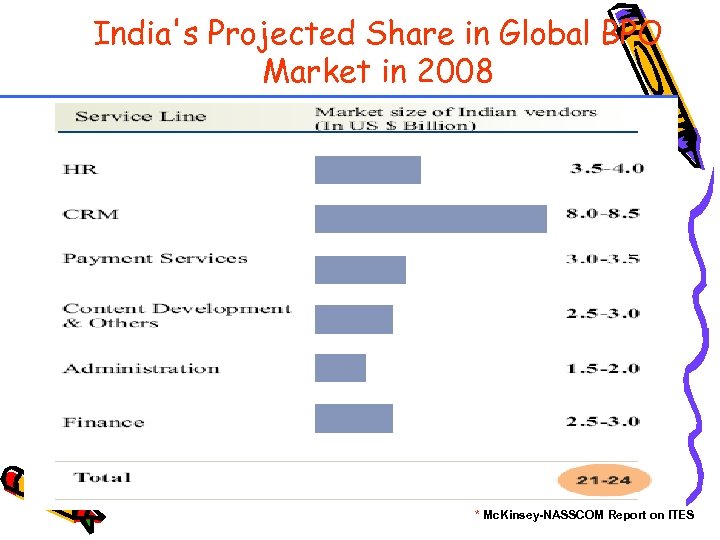
India's Projected Share in Global BPO Market in 2008 * Mc. Kinsey-NASSCOM Report on ITES
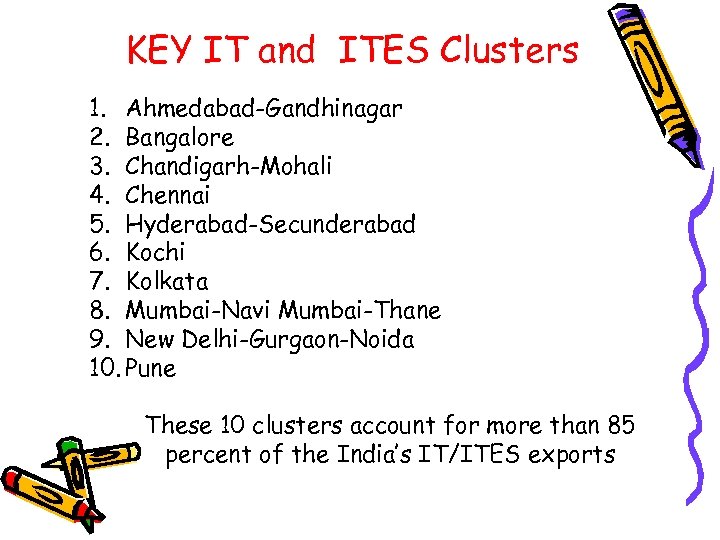
KEY IT and ITES Clusters 1. Ahmedabad-Gandhinagar 2. Bangalore 3. Chandigarh-Mohali 4. Chennai 5. Hyderabad-Secunderabad 6. Kochi 7. Kolkata 8. Mumbai-Navi Mumbai-Thane 9. New Delhi-Gurgaon-Noida 10. Pune These 10 clusters account for more than 85 percent of the India’s IT/ITES exports
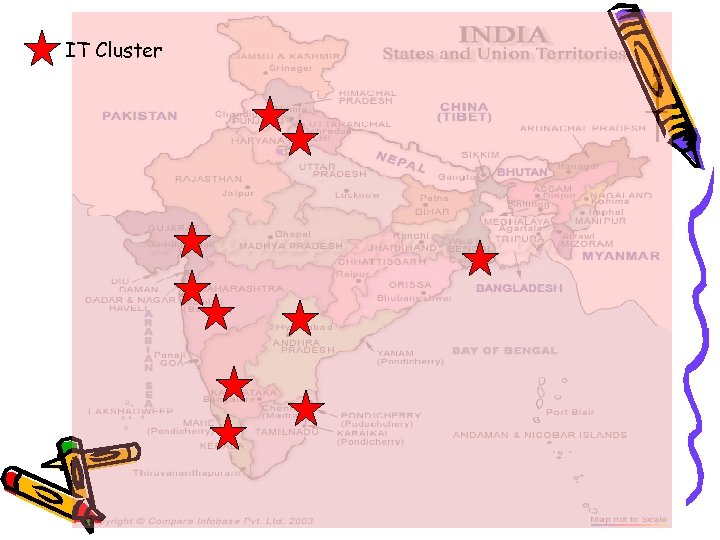
IT Cluster
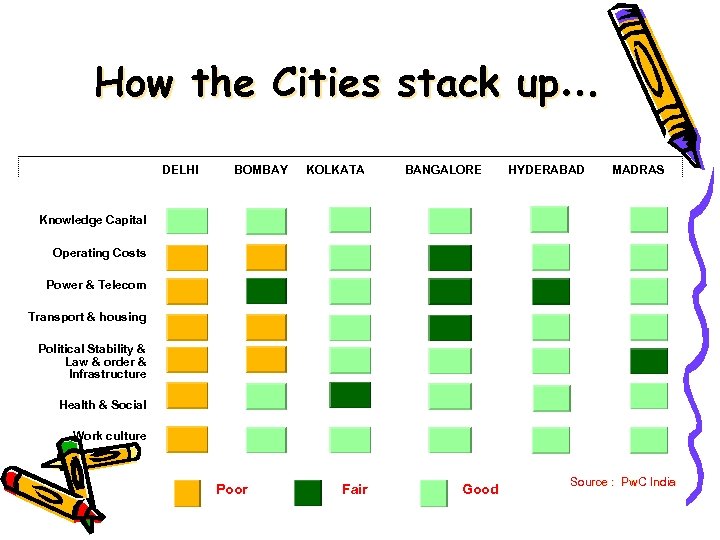
How the Cities stack up… DELHI BOMBAY KOLKATA BANGALORE HYDERABAD MADRAS Knowledge Capital Operating Costs Power & Telecom Transport & housing Political Stability & Law & order & Infrastructure Health & Social Work culture Poor Fair Good Source : Pw. C India
Case 1 - Bangalore v 1985: 13 firms; 2004: 1200+ firms, 100, 000+ professionals v Fourth largest hub of technology innovation in the world v Early factor advantages Ø Science/technology institutional support Ø Hi-tech PSUs Ø Pool of high quality professionals Ø Largest number of engineering colleges Ø Excellent climate
Case 1 - Bangalore v Local entrepreneurs kick started the Cluster v Electronics MNCs preferred location (TI: 1984) v IT majors created entrepreneur pool v Growing cooperation and competition among firms v ICT infrastructure development facilitated off-shoring and BPO v Brand building by the Industry Association v State: indifferent to benign neglect to intermittent active facilitation
Case 2 - Hyderabad v STPI – 1991 -92; Gained momentum from the late 1990 s, 150 plus firms in 2004 v Moderate – Hot weather v Modest infrastructure to start v Modest pool of talent to start v Large number of engineering colleges
Case 2 - Hyderabad v Entrepreneurial leadership of state Ø Naidu as CM (1996 -2004) Ø Microsoft Development Centre Ø E-governance to attract IT investments Ø WB funded infrastructure development Ø Hi-tech City Ø City beautification; green cover up Ø IT policy (1999); ITES policy (2002) Ø Indian School of Business Ø Brand Building Ø High Quality educational and research facilities
Case 2 - Hyderabad v Home proximity as location factor v Local entrepreneur pool waiting for infrastructural support v State admin shed bureaucracy and turned entrepreneurial v All IT majors came in, expanding now v IT majors feeding to the local entrepreneur pool now v Traditional manufacturing companies exploring BPO (contract research, logistic services, etc. )
Case 3 - Kolkata v First major industrial city, Best educational and research institutions once upon a time v Communist strong hold, persistent labour unrest, sick units, higher % of low skilled employment and regular influx of migrant population v New CM, Buddhadeb (2000) Ø Perform or perish! Ø Many initiatives similar to Hyderabad (e-govt, infrastructure, branding, road shows, Elect. City) Ø IT Policy 2001 and ITES Policy 2002 Ø New investments – local, NRB and others Ø Attracting investment in other sectors too- Balancing Act to reduce social divide – learning from Naidu’s debacle
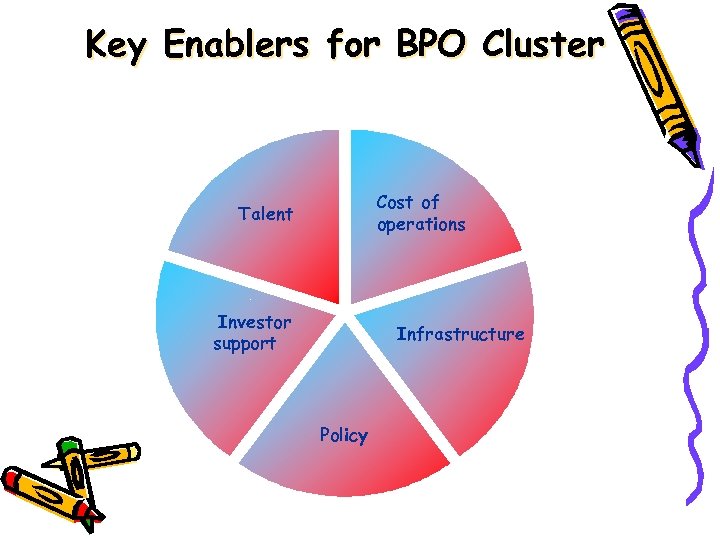
Key Enablers for BPO Cluster Cost of operations Talent Investor support Infrastructure Policy
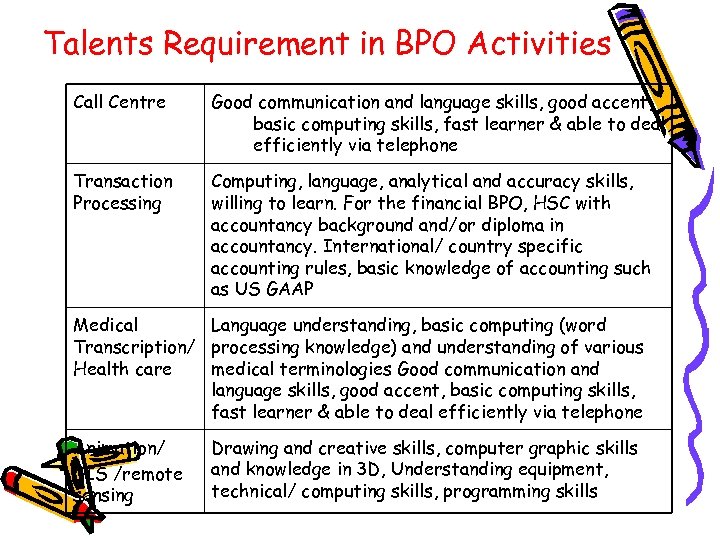
Talents Requirement in BPO Activities Call Centre Good communication and language skills, good accent, basic computing skills, fast learner & able to deal efficiently via telephone Transaction Processing Computing, language, analytical and accuracy skills, willing to learn. For the financial BPO, HSC with accountancy background and/or diploma in accountancy. International/ country specific accounting rules, basic knowledge of accounting such as US GAAP Medical Language understanding, basic computing (word Transcription/ processing knowledge) and understanding of various Health care medical terminologies Good communication and language skills, good accent, basic computing skills, fast learner & able to deal efficiently via telephone Animation/ GIS /remote sensing Drawing and creative skills, computer graphic skills and knowledge in 3 D, Understanding equipment, technical/ computing skills, programming skills
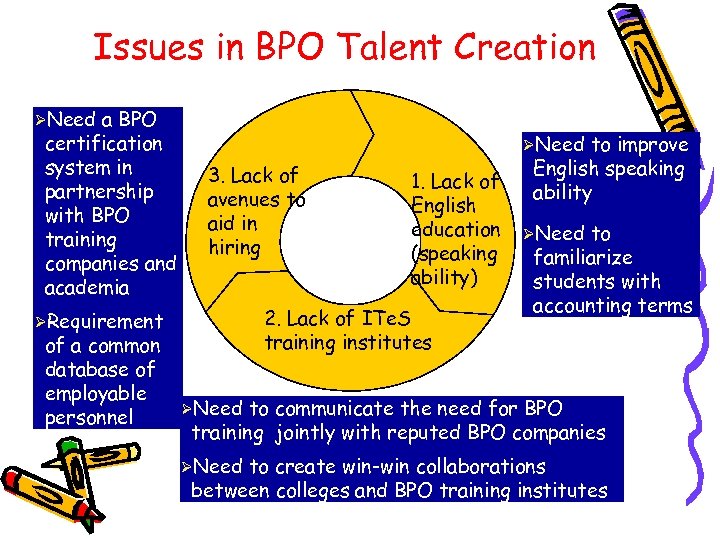
Issues in BPO Talent Creation ØNeed a BPO certification system in partnership with BPO training companies and academia ØNeed 3. Lack of avenues to aid in hiring 1. Lack of English education (speaking ability) 2. Lack of ITe. S training institutes ØRequirement to improve English speaking ability ØNeed to familiarize students with accounting terms of a common database of employable ØNeed to communicate the need for BPO personnel training jointly with reputed BPO companies ØNeed to create win-win collaborations between colleges and BPO training institutes
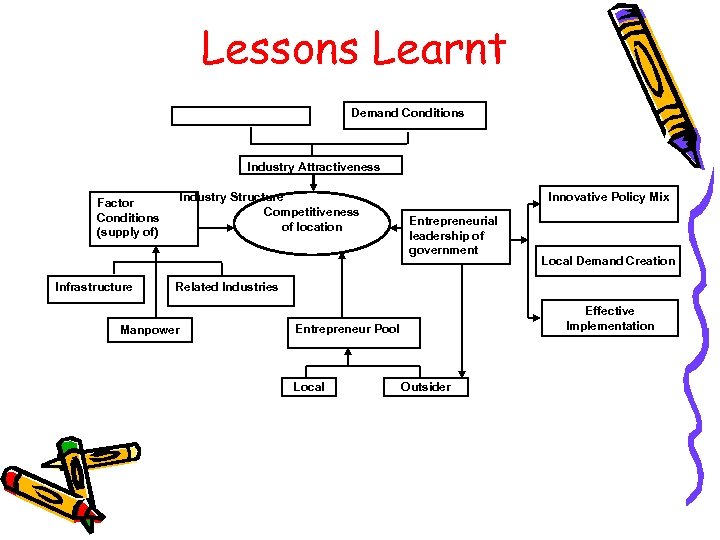
Lessons Learnt Demand Conditions Industry Attractiveness Factor Conditions (supply of) Infrastructure Industry Structure Competitiveness of location Innovative Policy Mix Entrepreneurial leadership of government Local Demand Creation Related Industries Manpower Effective Implementation Entrepreneur Pool Local Outsider
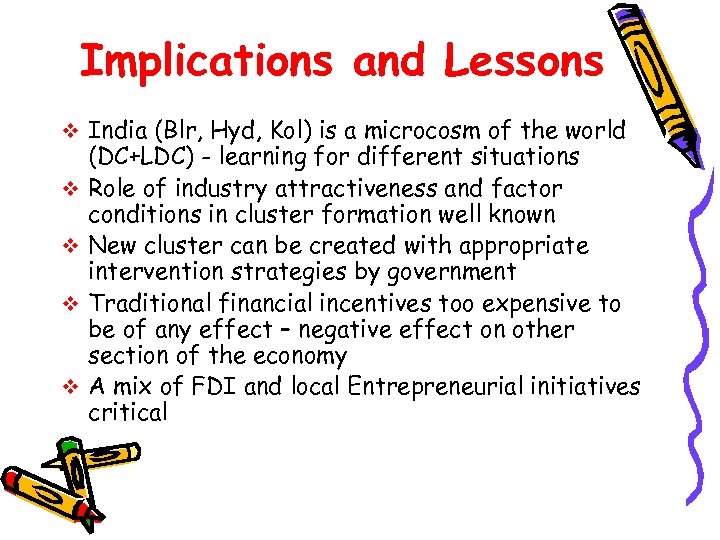
Implications and Lessons v India (Blr, Hyd, Kol) is a microcosm of the world v v (DC+LDC) - learning for different situations Role of industry attractiveness and factor conditions in cluster formation well known New cluster can be created with appropriate intervention strategies by government Traditional financial incentives too expensive to be of any effect – negative effect on other section of the economy A mix of FDI and local Entrepreneurial initiatives critical
Implications and Agenda v Government has to act as an entrepreneur (not bureaucrat) and facilitator (not controller) v Support creation and development of a local pool of entrepreneurs; identify a few horses with winning chances to be role models v Work relentlessly to attract some key Outsiders – other will follow v Build and Nurture Synergy among Industry Attractiveness, Factor Conditions, Local Pool of Entrepreneurs and State as an Entrepreneur
Private Investors in Cluster Development – Roles & Responsibilities v A company’s competitive advantage is partly the result of the local environment v Company membership in a cluster offers collective benefits v Private investment in “public goods” is justified
Private Investors in Cluster Development – Roles & Responsibilities v Take an active role in upgrading the local v v infrastructure Nurture local suppliers and attract new supplier investments Work closely with local educational and research institutions to upgrade quality and create specialized programs addressing cluster needs Provide government with information and substantive input on regulatory issues and constraints bearing on cluster development Focus corporate philanthropy on enhancing the local business environment
New Roles of Business and Industry Associations v Negotiate with government-Trade and regulations v Information collection and dissemination Ø E. g. regular benchmarking v Joint marketing Ø E. g. trade fairs, missions v Training Ø E. g. curriculum for managers-Close collaboration with outside educational institutions-Sponsoring of targeted scholarships v Research Ø E. g university partnerships-Standard setting and testing. Specialized research institutes v Procurement Ø E. g. joint purchasing programs v Environmental Ø E. g. demonstration projects-Research sponsorship
Can Bangladesh emerge as the most Preferred BPO Destination in 2015? As the country advantage starts shifting from India & other countries Bangladesh has a huge potential in IT Services & BPO. To realise the same the political and economic leadership of the country needs a plenty of Ø Ambition & Imagination ØCourage & Conviction ØPassion & Drive ØLuck
Bangladesh – the most Preferred BPO Destination in 2015? v To make the dream a reality, the country needs to embark on widespread, determined and sustained programs for IT and ITES Cluster Development v Building a globally competitive cluster is a marathon, not a sprint v Rapid progress on cluster development as a late mover will also require a new model of joint private-public efforts rather than a government-driven model only v Bangladesh has the best opportunity to develop a larger section of the population as knowledge workers; the country can’t afford to squander this opportunity
 Скачать презентацию Developing BPO Clusters in Bangladesh What Can We
4523a677df7d35b67679f918e0c89a76.ppt