


 Скачать презентацию Developing Applications with ECLi PSe H Simonis
8283ceebdd5cb661ae371dff6feb9fcc.ppt
- Количество слайдов: 26
 Developing Applications with ECLi. PSe H. Simonis
 Overview • How to develop large applications in ECLi. PSe • Software development issues for Prolog • This is essential for large applications – but it may show benefits already for small programs • This is not about problem solving, but the “boring bits” of application development © 2002 Parc Technologies Limited 31 -July-2002, #2
 Disclaimer • This is not ‘holy writ’ – but it works! • This is a team issue – people working together must agree – come up with a local style guide • Consistency is not optional – every shortcut must be paid for later on • This is an appetizer only – the real story is in the tutorial Developing Applications with ECLi. PSe (part of the ECLi. PSe documentation) © 2002 Parc Technologies Limited 31 -July-2002, #3
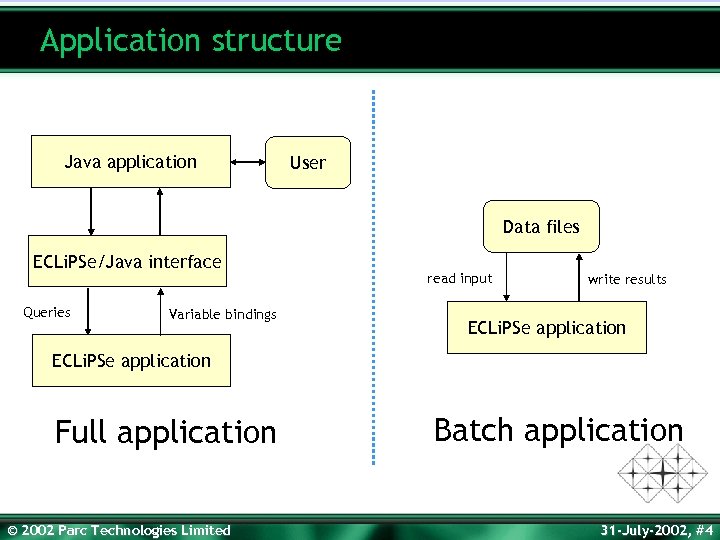 Application structure Java application User Data files ECLi. PSe/Java interface Queries Variable bindings read input write results ECLi. PSe application Full application © 2002 Parc Technologies Limited Batch application 31 -July-2002, #4
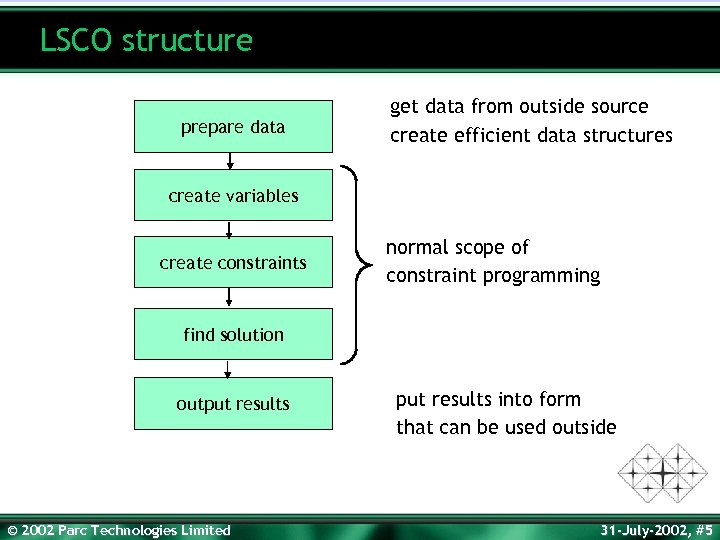 LSCO structure prepare data get data from outside source create efficient data structures create variables create constraints normal scope of constraint programming find solution output results © 2002 Parc Technologies Limited put results into form that can be used outside 31 -July-2002, #5
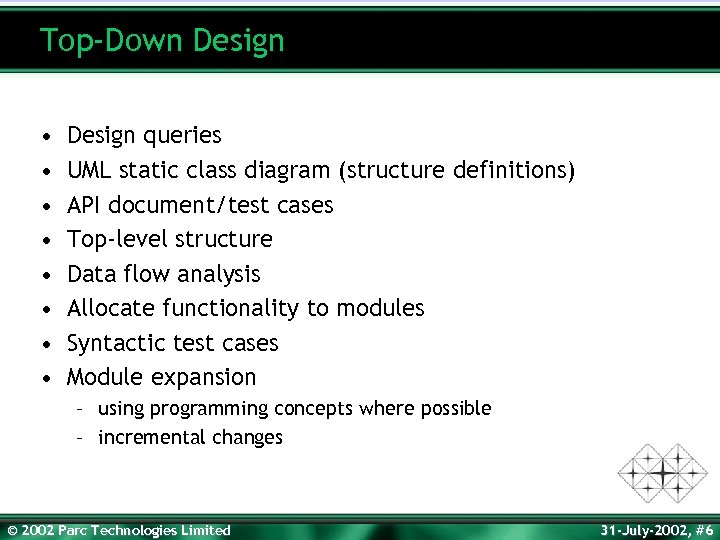 Top-Down Design • • Design queries UML static class diagram (structure definitions) API document/test cases Top-level structure Data flow analysis Allocate functionality to modules Syntactic test cases Module expansion – using programming concepts where possible – incremental changes © 2002 Parc Technologies Limited 31 -July-2002, #6
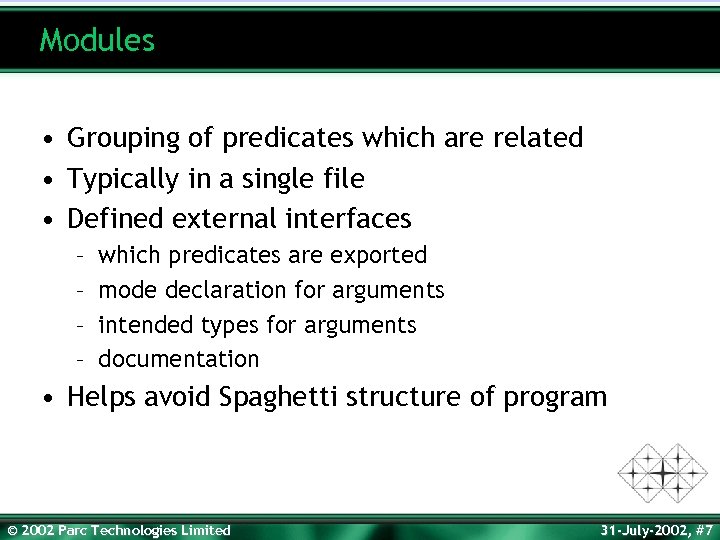 Modules • Grouping of predicates which are related • Typically in a single file • Defined external interfaces – – which predicates are exported mode declaration for arguments intended types for arguments documentation • Helps avoid Spaghetti structure of program © 2002 Parc Technologies Limited 31 -July-2002, #7
 Creating Documentation • Your program can be documented in the same way as ECLi. PSe library predicates • comment directives in source code • Tools to extract comments and produce HTML documentation with hyper-links • Quality depends on effort put into comments • Every module interface should be documented © 2002 Parc Technologies Limited 31 -July-2002, #8
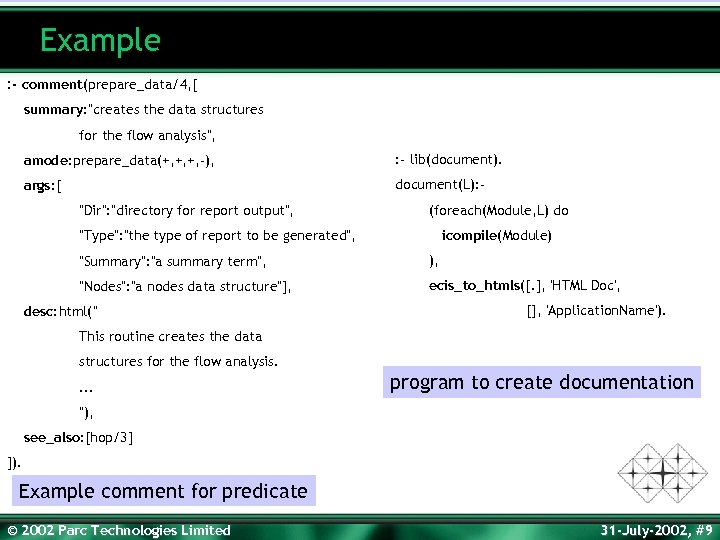 Example : - comment(prepare_data/4, [ summary: "creates the data structures for the flow analysis", amode: prepare_data(+, +, +, -), : - lib(document). args: [ document(L): "Dir": "directory for report output", (foreach(Module, L) do icompile(Module) "Type": "the type of report to be generated", "Summary": "a summary term", ), "Nodes": "a nodes data structure"], ecis_to_htmls([. ], 'HTML Doc', desc: html(" [], 'Application. Name'). This routine creates the data structures for the flow analysis. . program to create documentation "), see_also: [hop/3] ]). Example comment for predicate © 2002 Parc Technologies Limited 31 -July-2002, #9
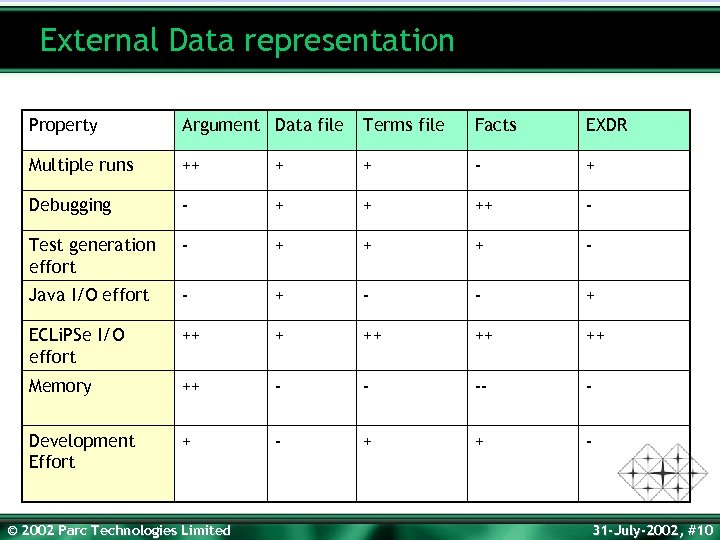 External Data representation Property Argument Data file Terms file Facts EXDR Multiple runs ++ + + - + Debugging - + + ++ - Test generation effort - + + + - Java I/O effort - + - - + ECLi. PSe I/O effort ++ ++ ++ Memory ++ - - -- - Development Effort + - + + - © 2002 Parc Technologies Limited 31 -July-2002, #10
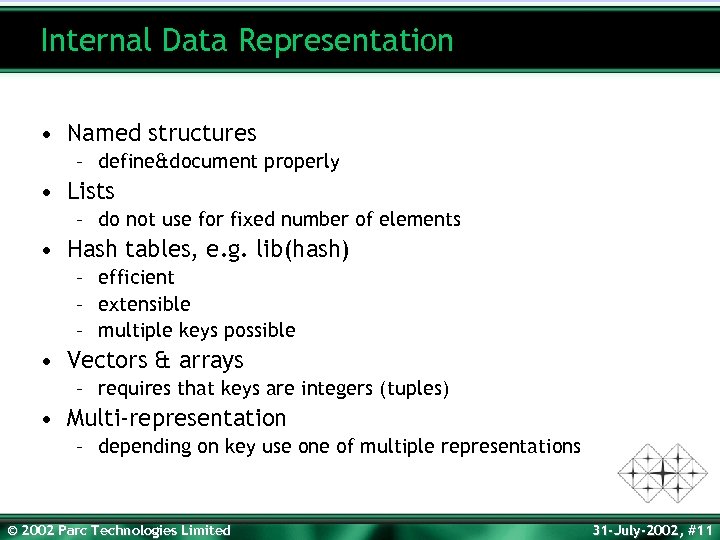 Internal Data Representation • Named structures – define&document properly • Lists – do not use for fixed number of elements • Hash tables, e. g. lib(hash) – efficient – extensible – multiple keys possible • Vectors & arrays – requires that keys are integers (tuples) • Multi-representation – depending on key use one of multiple representations © 2002 Parc Technologies Limited 31 -July-2002, #11
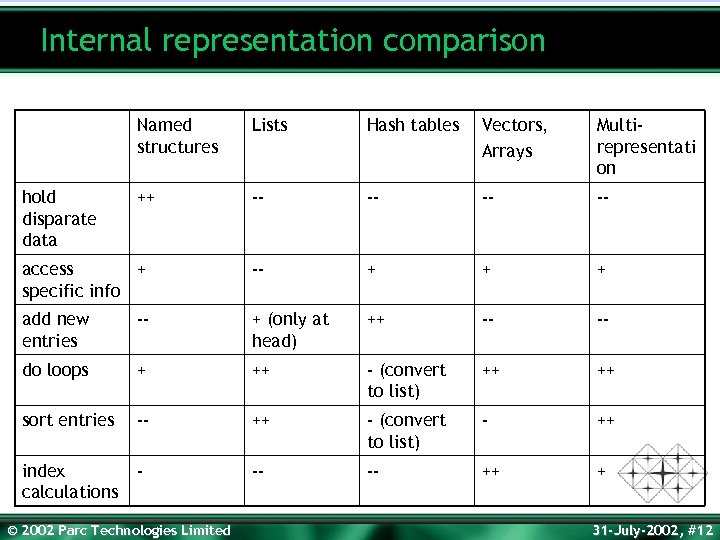 Internal representation comparison Named structures Lists Hash tables Vectors, Arrays Multirepresentati on ++ -- -- access + specific info -- + + + add new entries -- + (only at head) ++ -- -- do loops + ++ - (convert to list) ++ ++ sort entries -- ++ - (convert to list) - ++ index calculations - -- -- ++ + hold disparate data © 2002 Parc Technologies Limited 31 -July-2002, #12
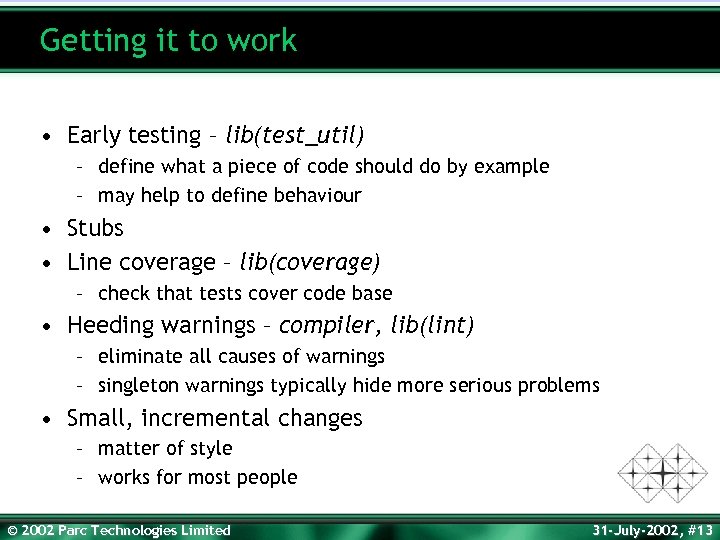 Getting it to work • Early testing – lib(test_util) – define what a piece of code should do by example – may help to define behaviour • Stubs • Line coverage – lib(coverage) – check that tests cover code base • Heeding warnings – compiler, lib(lint) – eliminate all causes of warnings – singleton warnings typically hide more serious problems • Small, incremental changes – matter of style – works for most people © 2002 Parc Technologies Limited 31 -July-2002, #13
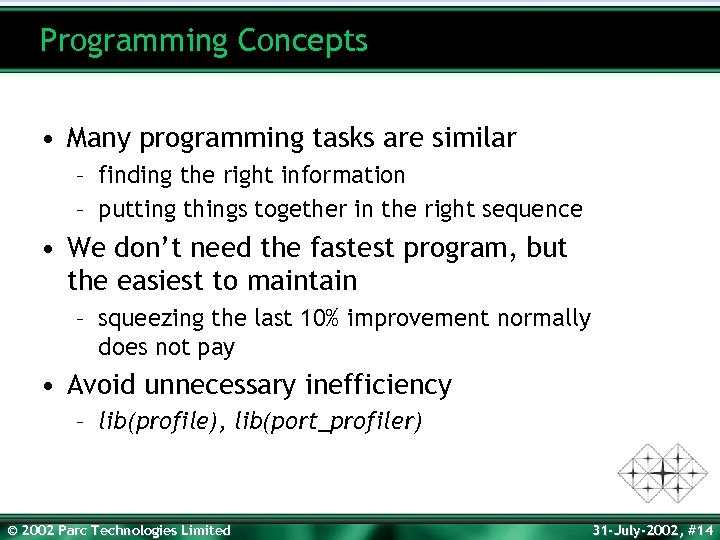 Programming Concepts • Many programming tasks are similar – finding the right information – putting things together in the right sequence • We don’t need the fastest program, but the easiest to maintain – squeezing the last 10% improvement normally does not pay • Avoid unnecessary inefficiency – lib(profile), lib(port_profiler) © 2002 Parc Technologies Limited 31 -July-2002, #14
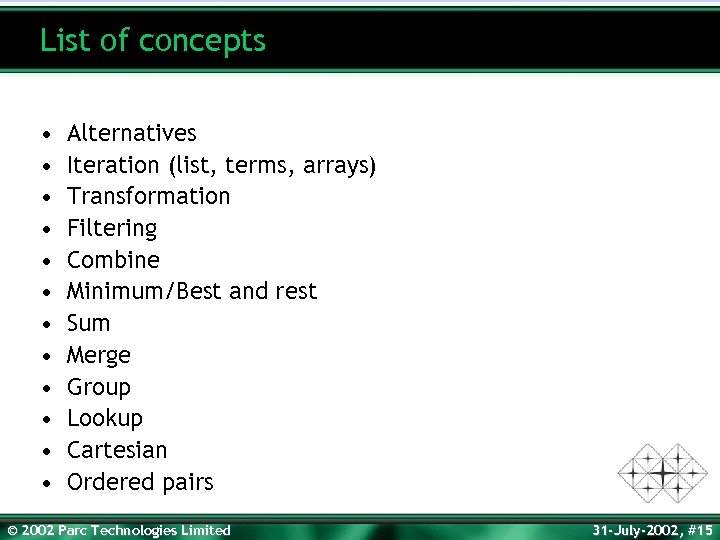 List of concepts • • • Alternatives Iteration (list, terms, arrays) Transformation Filtering Combine Minimum/Best and rest Sum Merge Group Lookup Cartesian Ordered pairs © 2002 Parc Technologies Limited 31 -July-2002, #15
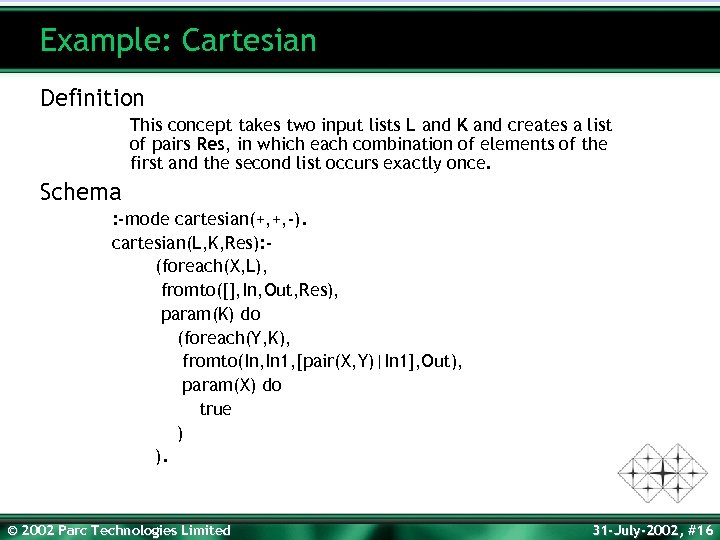 Example: Cartesian Definition This concept takes two input lists L and K and creates a list of pairs Res, in which each combination of elements of the first and the second list occurs exactly once. Schema : -mode cartesian(+, +, -). cartesian(L, K, Res): (foreach(X, L), fromto([], In, Out, Res), param(K) do (foreach(Y, K), fromto(In, In 1, [pair(X, Y)|In 1], Out), param(X) do true ) ). © 2002 Parc Technologies Limited 31 -July-2002, #16
 Input/Output • Section on DCG use – Grammars for parsing and generating text formats • XML parser in ECLi. PSe 5. 4 – lib(xml) • EXDR format to avoid quoting/escaping problems • Tip: – Generate hyper-linked HTML/SVG output to present data/results as development aid © 2002 Parc Technologies Limited 31 -July-2002, #17
 If it doesn’t work • Understand what happens – Which program point should be reached with which information? – Why do we not reach this point? – Which data is wrong/missing? • Do not trace through program! • Debugging is like solving puzzles – pick up clues – deduce what is going on – do not simulate program behaviour! © 2002 Parc Technologies Limited 31 -July-2002, #18
 Correctness and Performance • Testing • Profiling • Code Reviews – makes sure things are up to a certain standard – don’t expect reviewing to find bugs • Things to watch out for – – unwanted choice points open streams modified global state delayed goals © 2002 Parc Technologies Limited 31 -July-2002, #19
 Did I mention testing? • Single most important/neglected activity • Re-test directly after every change – identifies faulty modification – avoids lengthy debugging session after making 100 s of changes • Independent verification – check results by hand (? ) – by other program (? ? ) – use constraint solver as checker © 2002 Parc Technologies Limited 31 -July-2002, #20
 Style Guide • Rules that should be satisfied by finished program • Things may be relaxed during prototyping • Often, choice among valid alternatives is made arbitrarily, so that a consistent way is defined • If you don’t like it, change it! – But: better a bad rule than no rule at all! © 2002 Parc Technologies Limited 31 -July-2002, #21
 Style Guide Examples • There is one directory containing all code and its documentation (using sub-directories). • Filenames are of form [a-z][a-z_]+ with extension. ecl. • One file per module, one module per file. • Each module is documented with comment directives. • . . . • Don't use ', '/2 to make tuples. • Don't use lists to make tuples. • Avoid append/3 where possible, use accumulators instead. © 2002 Parc Technologies Limited 31 -July-2002, #22
 Layout rules • How to format ECLi. PSe programs • Pretty-printer format • Eases – – exchange of programs code reviews bug fixes avoids extra reformatting work © 2002 Parc Technologies Limited 31 -July-2002, #23
 Core Predicates List • Alphabetical predicate index lists 2400 entries – you can’t possibly learn all of them – do you really want to know what set_typed_pool_constraints/3 does? • List of Prolog predicates you need to know – 69 entries, more manageable • Ignores all solver libraries • If you don’t know what an entry does, find out about it – what does write_exdr/2 do? • If you use something not on the list, start to wonder. . . © 2002 Parc Technologies Limited 31 -July-2002, #24
 Other sources • CHIC-2 methodology – http: //www. icparc. ic. ac. uk/chic 2/methodology • The Craft of Prolog – R. O’Keefe, MIT Press • Object Technology Series – http: //www. awl. com/cseng/otseries © 2002 Parc Technologies Limited 31 -July-2002, #25
 Conclusions • Large scale applications can be built with ECLi. PSe • Software engineering is not that different for Prolog • Many tasks are similar regardless of solver used • Correctness of program is useful even for research work © 2002 Parc Technologies Limited 31 -July-2002, #26