


 Скачать презентацию Developing and Maintaining an Impaired Student Recovery Area
fae9c2904f4d05ceef5bab20b11b3343.ppt
- Количество слайдов: 15
 Developing and Maintaining an Impaired Student Recovery Area on Campus Carl Shaner, Student Health Center Director Elliott Strickland, Special Assistant for Student Affairs & Student Development ACHA 2010 Annual Meeting Philadelphia, PA June 3, 2010
 Session Overview • • • Overview of how it works Explain our ISRA and its impact Discuss the benefits Discuss liability issues Assessment
 Facilitator Model • Peter Lake and Robert Bickel -The Rights and Responsibilities of the Modern University – be proactive about safety and riskmanagement – to develop organization environments that are reasonably safe, educationally relevant, and developmentally sound.
 Mission • To offer a safe and secure environment for impaired students • To prevent impaired students from jeopardizing their health and wellbeing • To prevent impaired students roommates/friends from having to provide care and oversight (or risking that they won’t)
 Initial Contact • • Intoxicated student is identified Initial PBT Test is given After 20 -30 minutes, 2 nd PBT is given Student will be taken to the ISRA if: – BAC is. 15 and climbing and/or – Students safety or health is a concern
 ISRA Objectives • • • Monitoring of vital signs Delivery of basic medical care Oral hydration of the student Complete Health History and Assessment Breath Alcohol Rechecks Access and transport to emergency care if needed
 ISRA Protocol • Upon arrival audio and video recording begins • Detailed health and substance abuse history is taken • Basic physical exam is completed and documented • Student is placed on a cardiac monitor to trend vital signs • PBT readings are retaken
 ISRA Follow-Up • College judicial process • BASICS (Brief Alcohol Screening & Intervention of College Students) • Counseling meeting • Criminal charges
 Impact of ISRA on College and Community • Reduced impact on roommates and friends • Decreased number of ED visits on an already taxed service • Decreased use of magistrates for arraignment • Decreased vandalism and property damage
 Benefit of ISRA on Individual, College and Community • Increased counseling outreach efforts • Better rehabilitation potential • Identification of high risk factors of alcohol misuse and abuse
 ISRA Liability Issues • Doing too much compared to not enough • ED releasing students too early • Burden placed on ISRA workers not roommates – Certified EMTs with medical training – In-house training on equipments • Video and audio recording
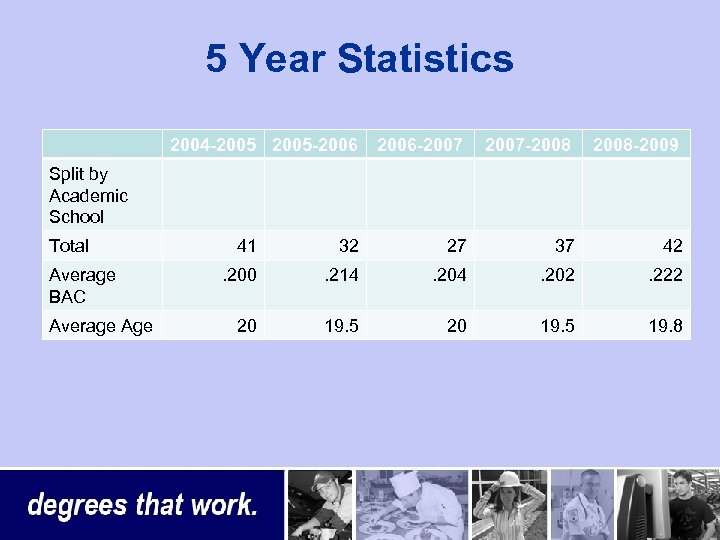 5 Year Statistics 2004 -2005 -2006 -2007 -2008 -2009 Split by Academic School Total Average BAC Average Age 41 32 27 37 42 . 200 . 214 . 202 . 222 20 19. 5 19. 8
 3 Year Statistics • 9% per year are incarcerated • 17% are repeat offenders • 19% are on Academic Probation (<2. 0 GPA) • 15% are Academically Dismissed at the end of that academic year • 72% 1 st Year; 23% 2 nd Year; 3% 3 rd Year; 2% 4 th Year +
 Direct Costs • ISRA/EMT = $7, 182 (18 hrs/wk @ $10. 50/hr x 38 weeks) • Revenue = $3, 580 per year on average
 Questions?