


 Скачать презентацию Developing and leading an audacious and vivid vision
dc1564997a49c356f44a782bb67d5746.ppt
- Количество слайдов: 96
 Developing and leading an audacious and vivid vision for children in school now. Children who will be 22 nd century citizens. Pete Hall Jones
 Discuss What were you going to do as a headteacher?
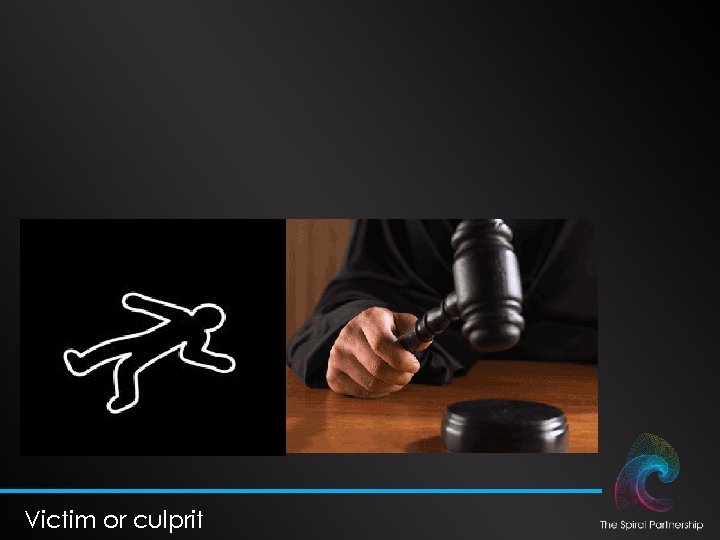 Victim or culprit
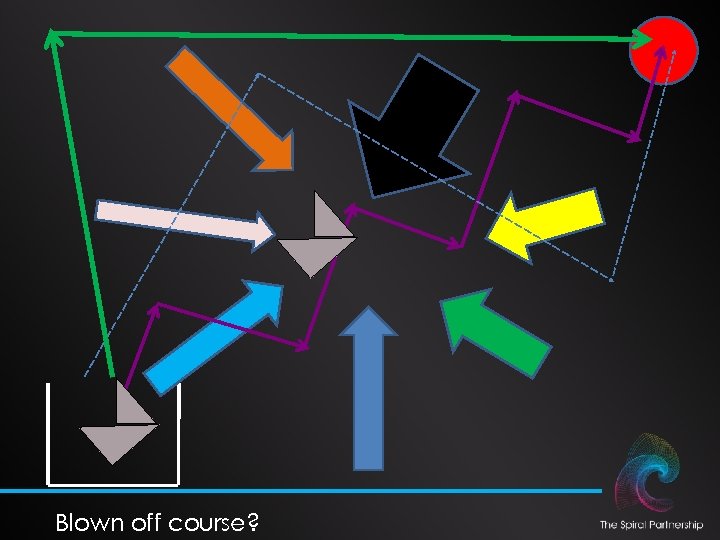 Blown off course?
 Discuss What pressures are your responding to?
 Sell it to me
 Irresistible
 Keeping all the balls in the air?
 Which way do you ping?
 What have we allowed ourselves to get used to?
 I guess that’s just the way it is?
 In or out?
 What have we allowed ourselves to get used to?
 What might we allow ourselves to get used to?
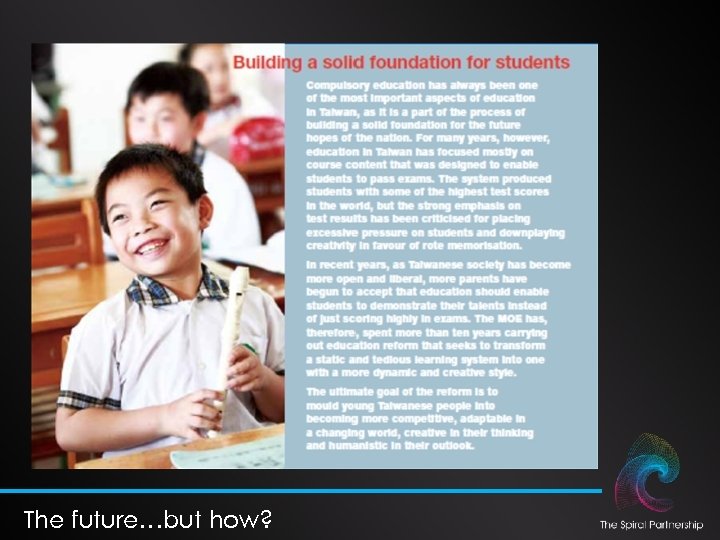 The future…but how?
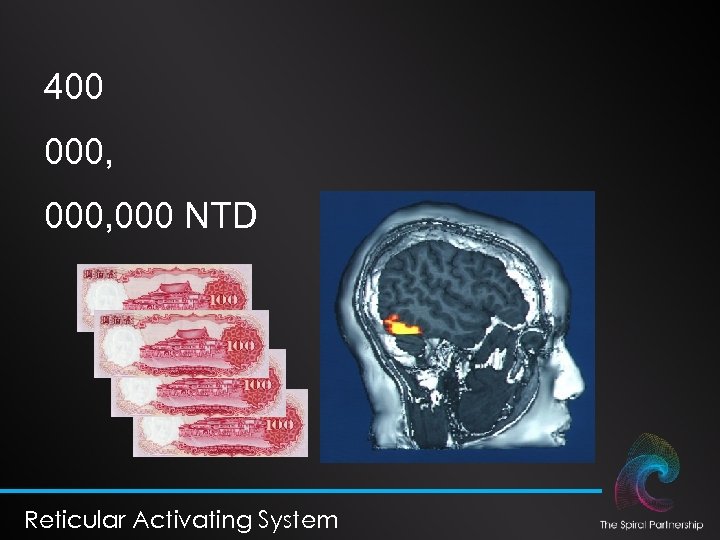 400 000, 000 NTD Reticular Activating System
 How do we organise the learning factory? How do we do it at now?
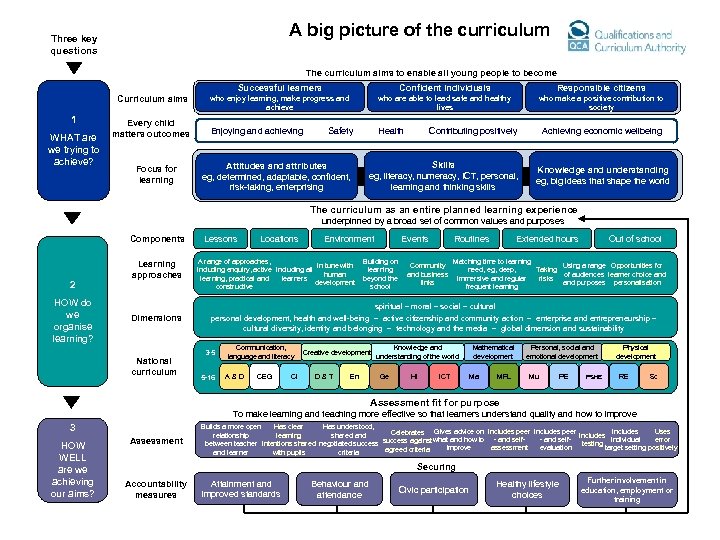 A big picture of the curriculum Three key questions The curriculum aims to enable all young people to become Successful learners Curriculum aims 1 WHAT are we trying to achieve? Every child matters outcomes Focus for learning Confident individuals Responsible citizens who enjoy learning, make progress and achieve who are able to lead safe and healthy lives who make a positive contribution to society Enjoying and achieving Health Safety Contributing positively Skills eg, literacy, numeracy, ICT, personal, learning and thinking skills Attitudes and attributes eg, determined, adaptable, confident, risk-taking, enterprising Achieving economic wellbeing Knowledge and understanding eg, big ideas that shape the world The curriculum as an entire planned learning experience underpinned by a broad set of common values and purposes Components 2 HOW do we organise learning? Learning approaches Lessons Locations Environment A range of approaches, In tune with including enquiry, active Including all human learners learning, practical and development constructive Events Building on learning beyond the school Routines Community and business links Extended hours Out of school Matching time to learning Using a range Opportunities for need, eg, deep, Taking of audiences learner choice and risks immersive and regular and purposes personalisation frequent learning spiritual – moral – social – cultural Dimensions National curriculum personal development, health and well-being – active citizenship and community action – enterprise and entrepreneurship – cultural diversity, identity and belonging – technology and the media – global dimension and sustainability 3 -5 5 -16 Communication, language and literacy A&D CEG Ci Creative development D&T En Knowledge and understanding of the world Ge Hi ICT Mathematical development Ma MFL Personal, social and emotional development Mu PE PSHE Physical development RE Sc Assessment fit for purpose To make learning and teaching more effective so that learners understand quality and how to improve 3 HOW WELL are we achieving our aims? Assessment Builds a more open Has clear Has understood, Uses Celebrates Gives advice on Includes peer Includes relationship learning shared and what and how to - and selfindividual error between teacher intentions shared negotiated success against testing improve assessment evaluation target setting positively agreed criteria and learner with pupils criteria Securing Accountability measures Attainment and improved standards Behaviour and attendance Civic participation Healthy lifestyle choices Further involvement in education, employment or training
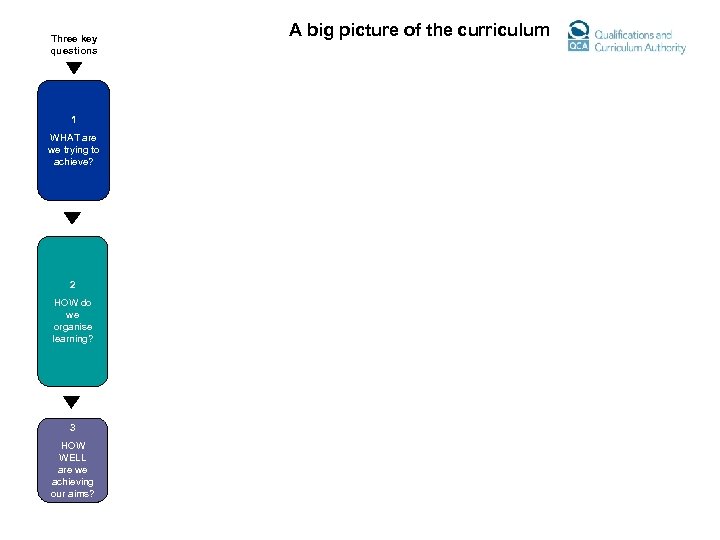 Three key questions 1 WHAT are we trying to achieve? 2 HOW do we organise learning? 3 HOW WELL are we achieving our aims? A big picture of the curriculum
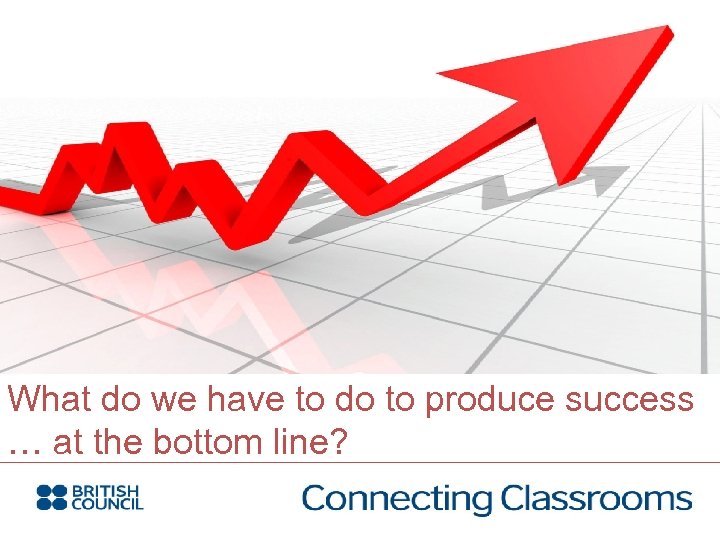 • joint – bilateral or trilateral • mutually beneficial • shared outcomes • shared programme of activities • clear, realistic, achievable • embedded in the curriculum What do we have to do to produce success • continuously evaluated … at the bottom line?
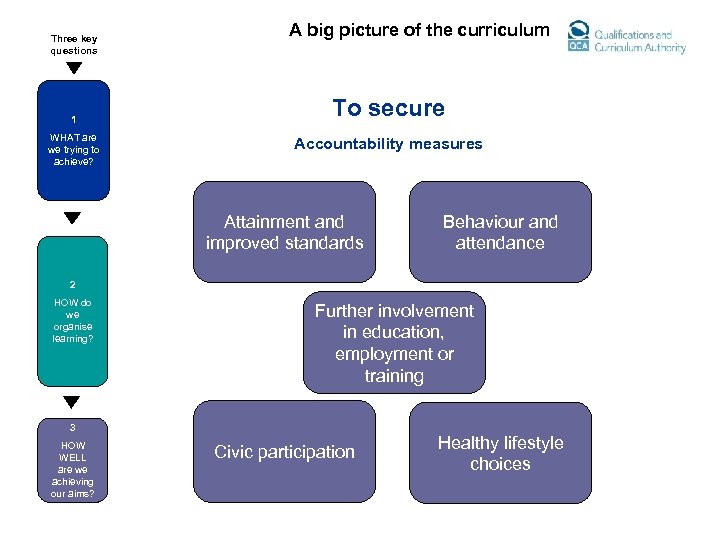 Three key questions 1 WHAT are we trying to achieve? A big picture of the curriculum To secure Accountability measures Attainment and improved standards Behaviour and attendance 2 HOW do we organise learning? Further involvement in education, employment or training 3 HOW WELL are we achieving our aims? Civic participation Healthy lifestyle choices
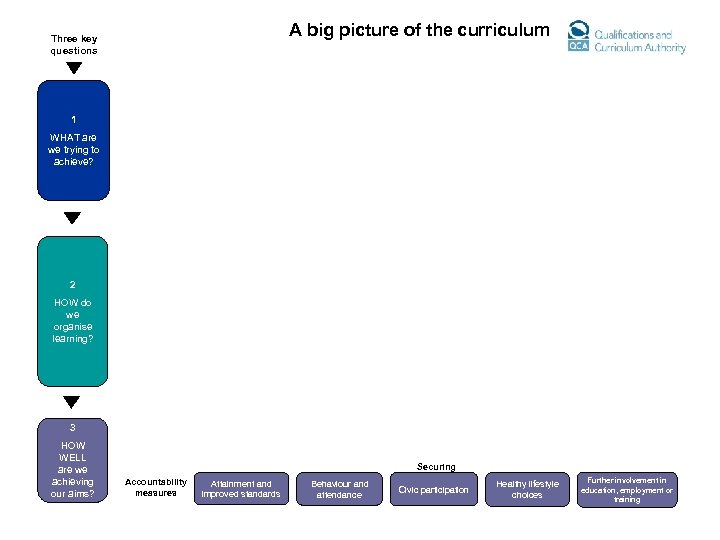 A big picture of the curriculum Three key questions 1 WHAT are we trying to achieve? 2 HOW do we organise learning? 3 HOW WELL are we achieving our aims? Securing Accountability measures Attainment and improved standards Behaviour and attendance Civic participation Healthy lifestyle choices Further involvement in education, employment or training
 Discuss • joint – bilateral or trilateral • mutually beneficial • shared outcomes • shared programme of activities • clear, realistic, achievable • embedded in the curriculum What are our we trying to build, what are we What are school/ countries aims… what are our • continuously trying to build? evaluated school aims?
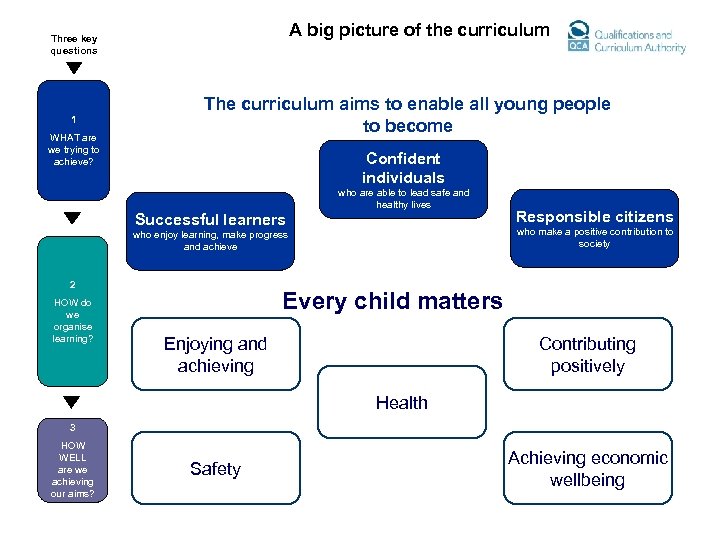 A big picture of the curriculum Three key questions 1 WHAT are we trying to achieve? The curriculum aims to enable all young people to become Confident individuals who are able to lead safe and healthy lives Successful learners who make a positive contribution to society who enjoy learning, make progress and achieve 2 HOW do we organise learning? Responsible citizens Every child matters Enjoying and achieving Contributing positively Health 3 HOW WELL are we achieving our aims? Safety Achieving economic wellbeing
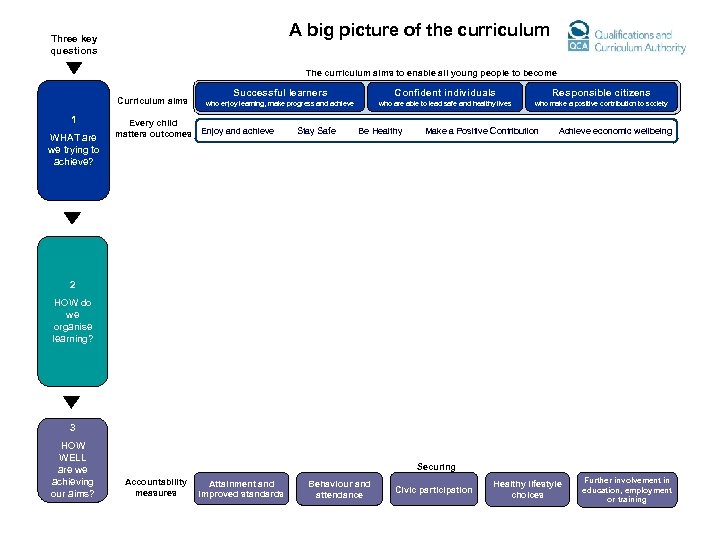 A big picture of the curriculum Three key questions The curriculum aims to enable all young people to become Curriculum aims 1 WHAT are we trying to achieve? Successful learners Confident individuals Responsible citizens who enjoy learning, make progress and achieve who are able to lead safe and healthy lives who make a positive contribution to society Every child matters outcomes Enjoy and achieve Stay Safe Be Healthy Make a Positive Contribution Achieve economic wellbeing 2 HOW do we organise learning? 3 HOW WELL are we achieving our aims? Securing Accountability measures Attainment and improved standards Behaviour and attendance Civic participation Healthy lifestyle choices Further involvement in education, employment or training
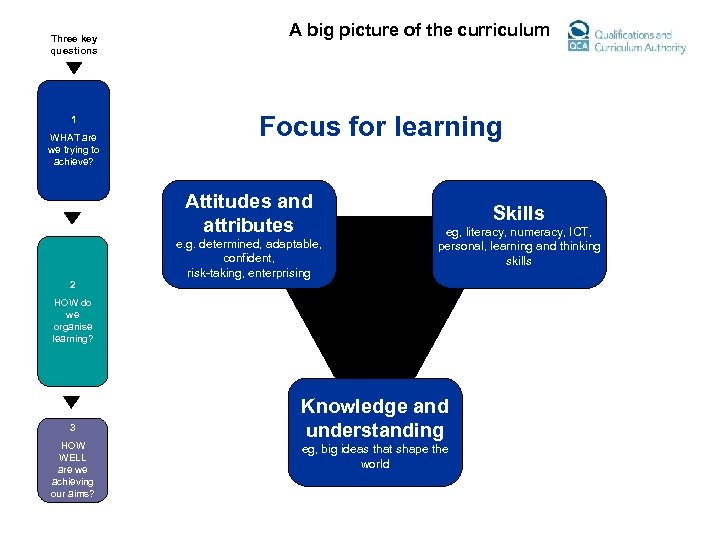 Three key questions 1 WHAT are we trying to achieve? A big picture of the curriculum Focus for learning Attitudes and attributes 2 e. g. determined, adaptable, confident, risk-taking, enterprising Skills eg, literacy, numeracy, ICT, personal, learning and thinking skills HOW do we organise learning? 3 HOW WELL are we achieving our aims? Knowledge and understanding eg, big ideas that shape the world
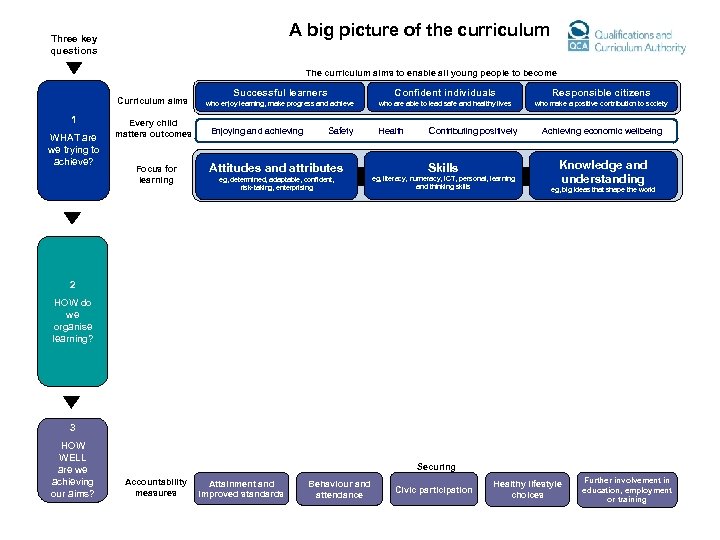 A big picture of the curriculum Three key questions The curriculum aims to enable all young people to become Curriculum aims 1 WHAT are we trying to achieve? Every child matters outcomes Focus for learning Successful learners Confident individuals Responsible citizens who enjoy learning, make progress and achieve who are able to lead safe and healthy lives who make a positive contribution to society Enjoying and achieving Safety Attitudes and attributes eg, determined, adaptable, confident, risk-taking, enterprising Health Contributing positively Skills eg, literacy, numeracy, ICT, personal, learning and thinking skills Achieving economic wellbeing Knowledge and understanding eg, big ideas that shape the world 2 HOW do we organise learning? 3 HOW WELL are we achieving our aims? Securing Accountability measures Attainment and improved standards Behaviour and attendance Civic participation Healthy lifestyle choices Further involvement in education, employment or training
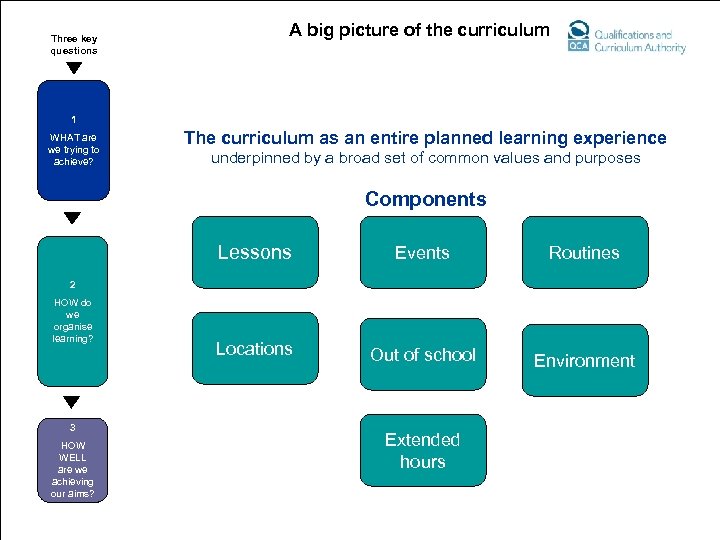 Three key questions A big picture of the curriculum 1 WHAT are we trying to achieve? The curriculum as an entire planned learning experience underpinned by a broad set of common values and purposes Components Lessons Events Routines Locations Out of school Environment 2 HOW do we organise learning? 3 HOW WELL are we achieving our aims? Extended hours
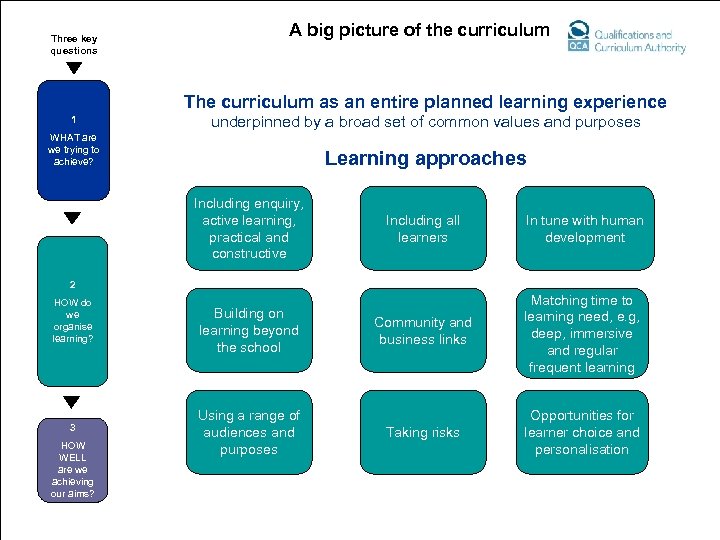 Three key questions A big picture of the curriculum The curriculum as an entire planned learning experience 1 underpinned by a broad set of common values and purposes WHAT are we trying to achieve? Learning approaches Including enquiry, active learning, practical and constructive Including all learners In tune with human development Community and business links Matching time to learning need, e. g, deep, immersive and regular frequent learning Taking risks Opportunities for learner choice and personalisation 2 HOW do we organise learning? 3 HOW WELL are we achieving our aims? Building on learning beyond the school Using a range of audiences and purposes
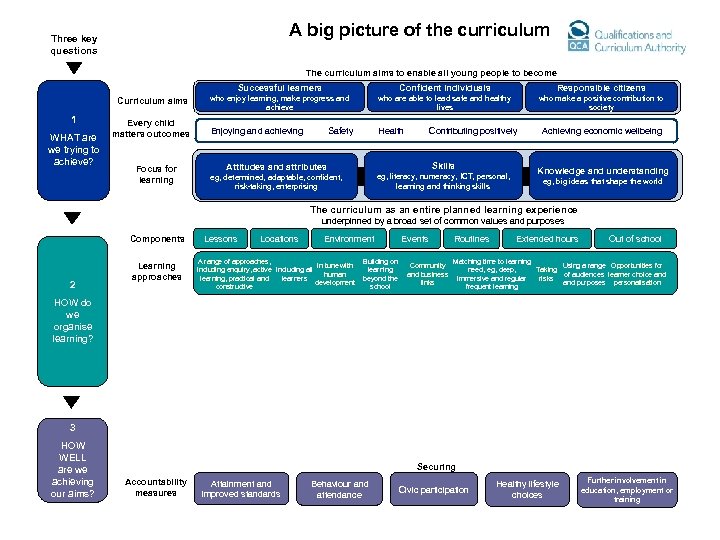 A big picture of the curriculum Three key questions The curriculum aims to enable all young people to become Successful learners Curriculum aims 1 WHAT are we trying to achieve? Every child matters outcomes Focus for learning Confident individuals Responsible citizens who enjoy learning, make progress and achieve who are able to lead safe and healthy lives who make a positive contribution to society Enjoying and achieving Health Safety Attitudes and attributes eg, determined, adaptable, confident, risk-taking, enterprising Contributing positively Skills eg, literacy, numeracy, ICT, personal, learning and thinking skills Achieving economic wellbeing Knowledge and understanding eg, big ideas that shape the world The curriculum as an entire planned learning experience underpinned by a broad set of common values and purposes Components 2 Learning approaches Lessons Locations Environment Events Routines Extended hours Out of school A range of approaches, Building on Matching time to learning In tune with Community Using a range Opportunities for A range of approaches, time includingactive learning, including. Includingall In tune with human Building on learning Community and Matching immersive and regulareg, Taking risks Using a range of Opportunities for learner enquiry, active learning need, to learning need, eg, deep, Taking Including all enquiry, practical deep, audiences and human of audiences choice and learner personalisation learners development beyond the school and business links learners risks learning, practical and beyond the immersive and regular and constructive frequent learning development links andpurposes personalisation constructive school frequent learning HOW do we organise learning? 3 HOW WELL are we achieving our aims? Securing Accountability measures Attainment and improved standards Behaviour and attendance Civic participation Healthy lifestyle choices Further involvement in education, employment or training
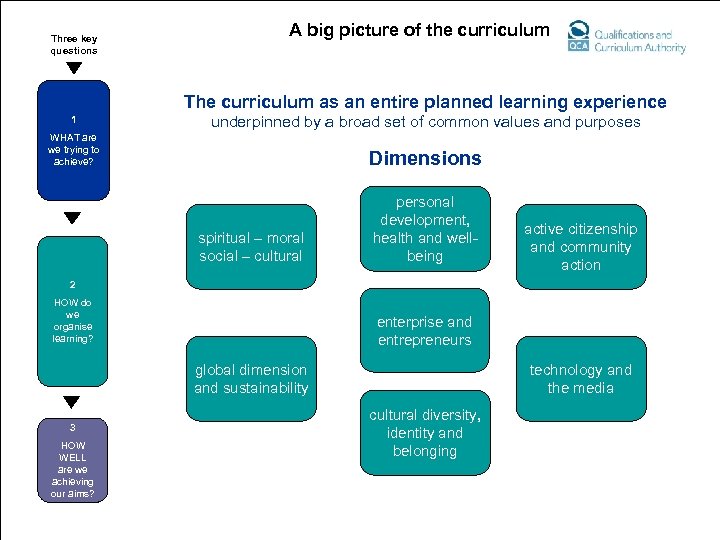 Three key questions A big picture of the curriculum The curriculum as an entire planned learning experience 1 underpinned by a broad set of common values and purposes WHAT are we trying to achieve? Dimensions spiritual – moral social – cultural personal development, health and wellbeing active citizenship and community action 2 HOW do we organise learning? enterprise and entrepreneurs global dimension and sustainability 3 HOW WELL are we achieving our aims? technology and the media cultural diversity, identity and belonging
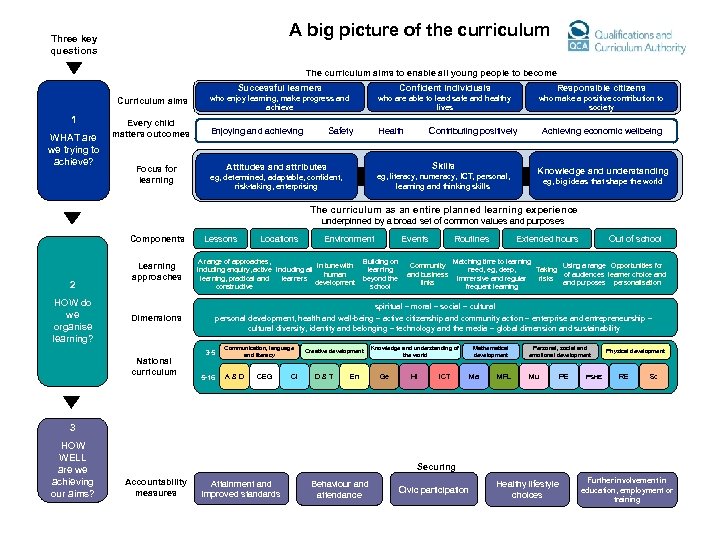 A big picture of the curriculum Three key questions The curriculum aims to enable all young people to become Successful learners Curriculum aims 1 WHAT are we trying to achieve? Every child matters outcomes Focus for learning Confident individuals Responsible citizens who enjoy learning, make progress and achieve who are able to lead safe and healthy lives who make a positive contribution to society Enjoying and achieving Health Safety Contributing positively Skills Attitudes and attributes eg, literacy, numeracy, ICT, personal, learning and thinking skills eg, determined, adaptable, confident, risk-taking, enterprising Achieving economic wellbeing Knowledge and understanding eg, big ideas that shape the world The curriculum as an entire planned learning experience underpinned by a broad set of common values and purposes Components 2 HOW do we organise learning? Learning approaches Lessons Locations Environment A range of approaches, In tune with including enquiry, active Including all human learners learning, practical and development constructive Events Building on learning beyond the school Routines Community and business links Extended hours Out of school Matching time to learning Using a range Opportunities for need, eg, deep, Taking of audiences learner choice and risks immersive and regular and purposes personalisation frequent learning spiritual – moral – social – cultural Dimensions National curriculum personal development, health and well-being – active citizenship and community action – enterprise and entrepreneurship – cultural diversity, identity and belonging – technology and the media – global dimension and sustainability 3 -5 5 -16 Communication, language and literacy A&D CEG Ci Creative development D&T En Knowledge and understanding of the world Ge Hi ICT Mathematical development Ma MFL Personal, social and emotional development Mu PE PSHE Physical development RE Sc 3 HOW WELL are we achieving our aims? Securing Accountability measures Attainment and improved standards Behaviour and attendance Civic participation Healthy lifestyle choices Further involvement in education, employment or training
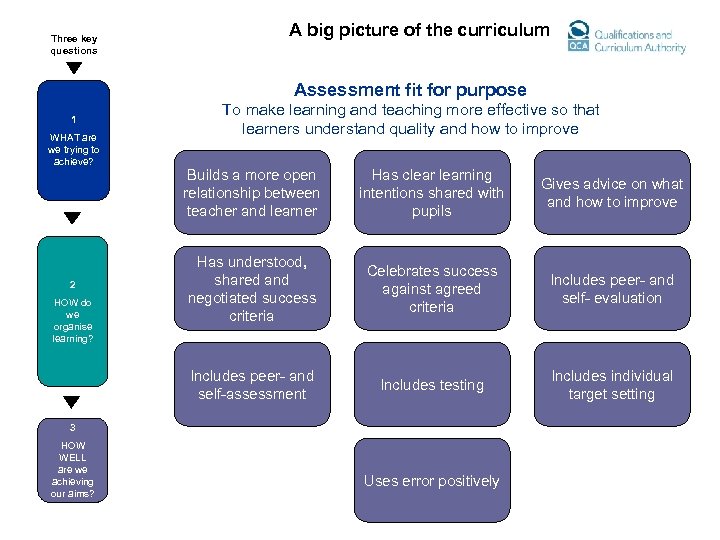 Three key questions A big picture of the curriculum Assessment fit for purpose 1 WHAT are we trying to achieve? To make learning and teaching more effective so that learners understand quality and how to improve HOW do we organise learning? Has clearning intentions shared with pupils Gives advice on what and how to improve Has understood, shared and negotiated success criteria Celebrates success against agreed criteria Includes peer- and self- evaluation Includes peer- and self-assessment 2 Builds a more open relationship between teacher and learner Includes testing Includes individual target setting 3 HOW WELL are we achieving our aims? Uses error positively
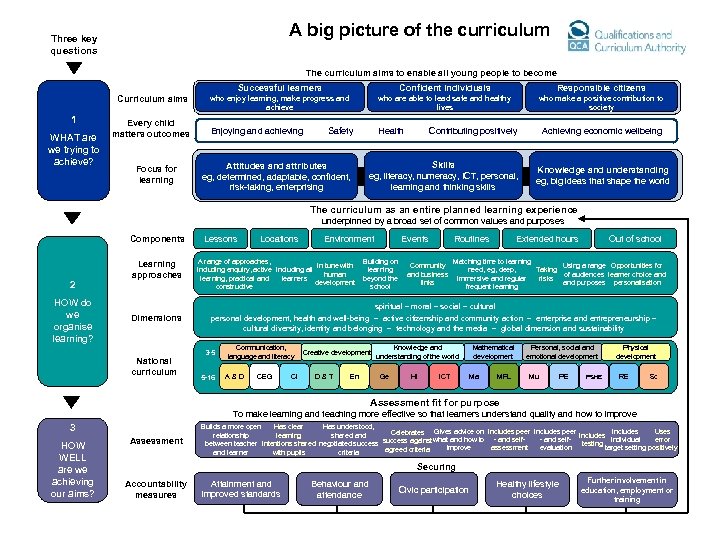 A big picture of the curriculum Three key questions The curriculum aims to enable all young people to become Successful learners Curriculum aims 1 WHAT are we trying to achieve? Every child matters outcomes Focus for learning Confident individuals Responsible citizens who enjoy learning, make progress and achieve who are able to lead safe and healthy lives who make a positive contribution to society Enjoying and achieving Health Safety Contributing positively Skills eg, literacy, numeracy, ICT, personal, learning and thinking skills Attitudes and attributes eg, determined, adaptable, confident, risk-taking, enterprising Achieving economic wellbeing Knowledge and understanding eg, big ideas that shape the world The curriculum as an entire planned learning experience underpinned by a broad set of common values and purposes Components 2 HOW do we organise learning? Learning approaches Lessons Locations Environment A range of approaches, In tune with including enquiry, active Including all human learners learning, practical and development constructive Events Building on learning beyond the school Routines Community and business links Extended hours Out of school Matching time to learning Using a range Opportunities for need, eg, deep, Taking of audiences learner choice and risks immersive and regular and purposes personalisation frequent learning spiritual – moral – social – cultural Dimensions National curriculum personal development, health and well-being – active citizenship and community action – enterprise and entrepreneurship – cultural diversity, identity and belonging – technology and the media – global dimension and sustainability 3 -5 5 -16 Communication, language and literacy A&D CEG Ci Creative development D&T En Knowledge and understanding of the world Ge Hi ICT Mathematical development Ma MFL Personal, social and emotional development Mu PE PSHE Physical development RE Sc Assessment fit for purpose To make learning and teaching more effective so that learners understand quality and how to improve 3 HOW WELL are we achieving our aims? Assessment Builds a more open Has clear Has understood, Uses Celebrates Gives advice on Includes peer Includes relationship learning shared and what and how to - and selfindividual error between teacher intentions shared negotiated success against testing improve assessment evaluation target setting positively agreed criteria and learner with pupils criteria Securing Accountability measures Attainment and improved standards Behaviour and attendance Civic participation Healthy lifestyle choices Further involvement in education, employment or training
 What would the big curriculum picture look like in your school? Discuss
 Irresistible?
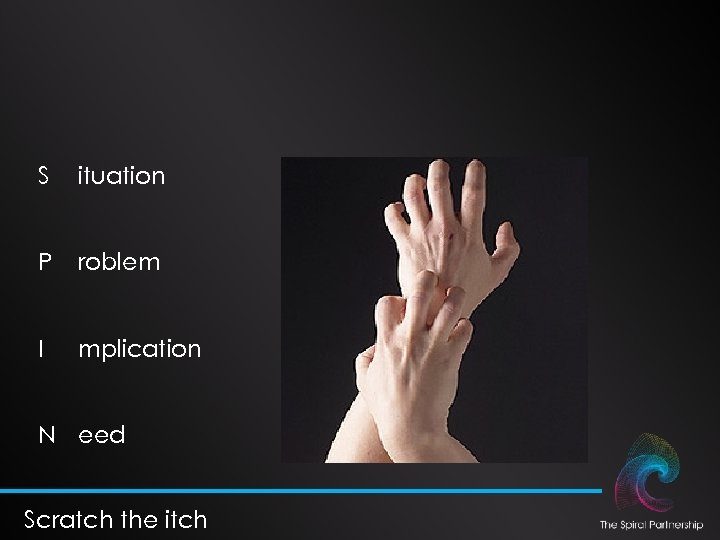 S ituation P roblem I mplication N eed Scratch the itch
 Do your challenges cause sufficient itch to ‘buy? the cream?
 Your features are only of benefit to me when I have a need How to sell
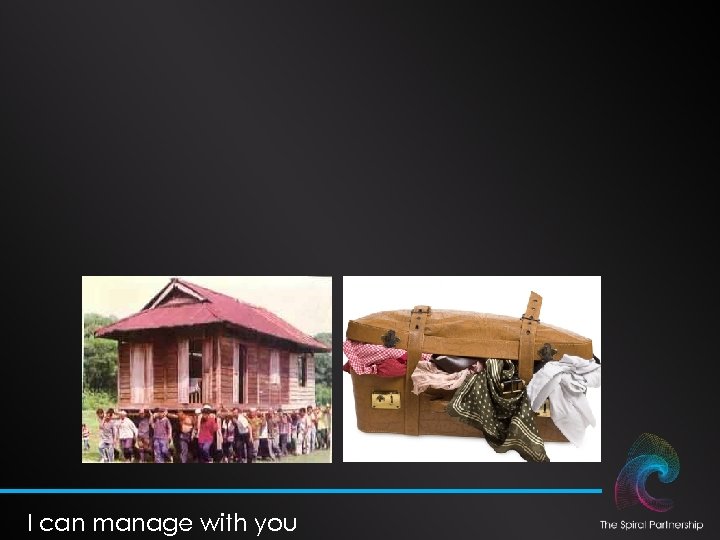 I can manage with you
 T. G. I. F.
 How would you?
 Ignorance is bliss?
 Leading, managing and orchestrating teachers, community and life long learning.
 Thumbs up for change?
 Are we there yet?
 Are you leading or managing… just? Discuss Just pedal faster
 There really is more than one way to do it
 Accentuate the positive
 Orchestrating the talents
 School of the future
 All ages, customer focussed
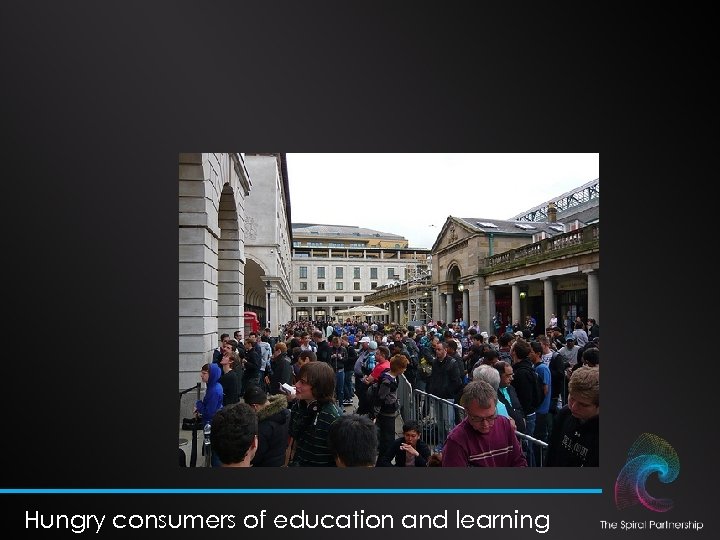 Hungry consumers of education and learning
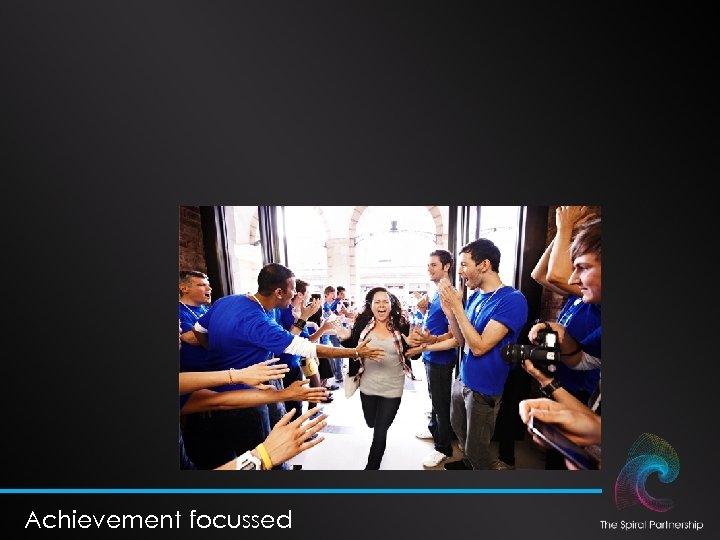 Achievement focussed
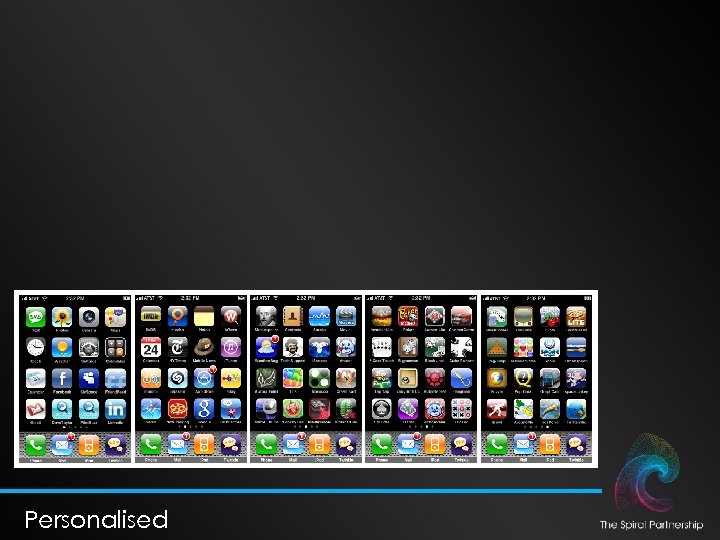 Personalised
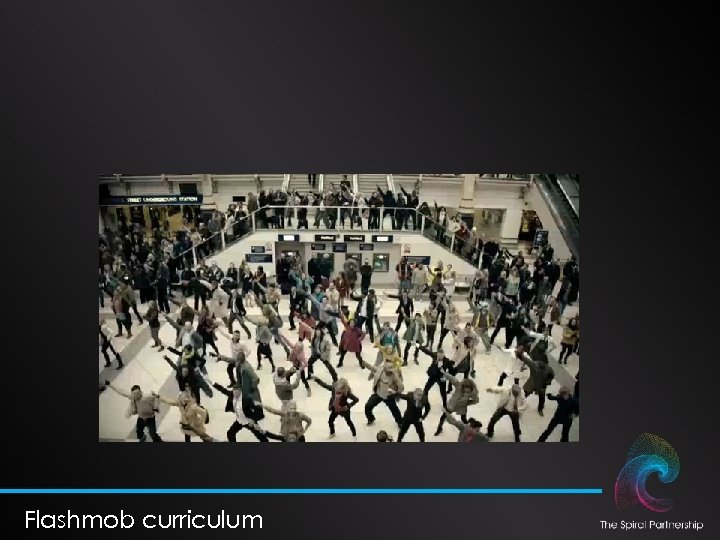 Flashmob curriculum
 Whose knowledge?
 Personalised as and when needed
 World class learning for global citizens and the international context
 Where have you been recently?
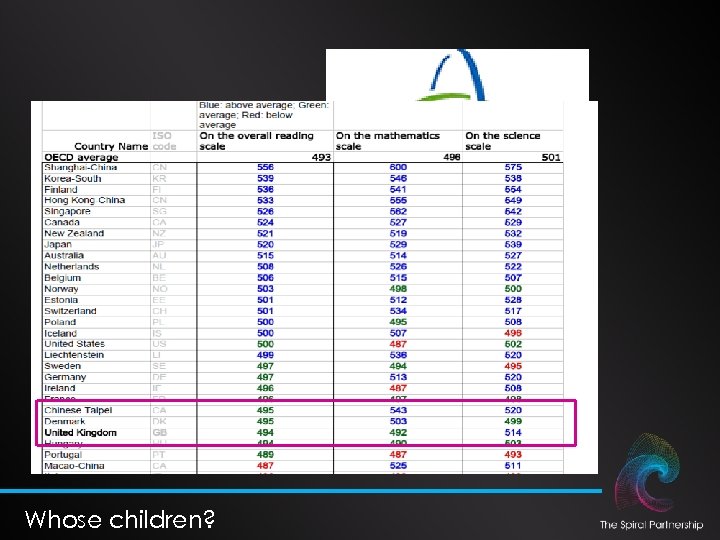 Whose children?
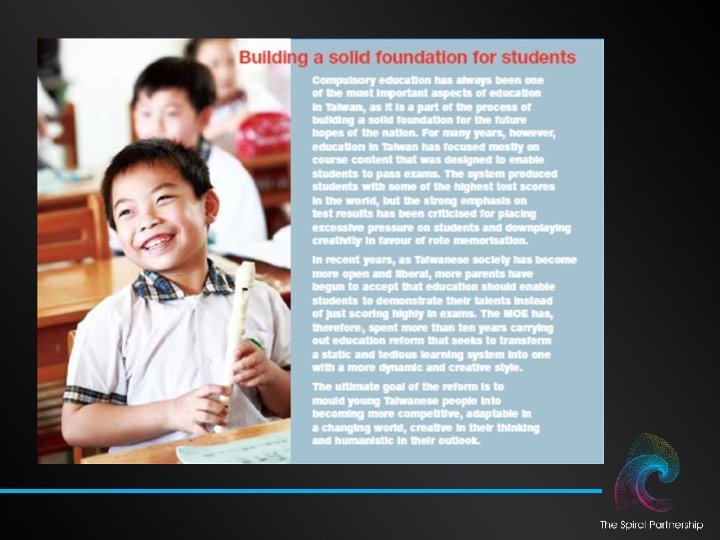
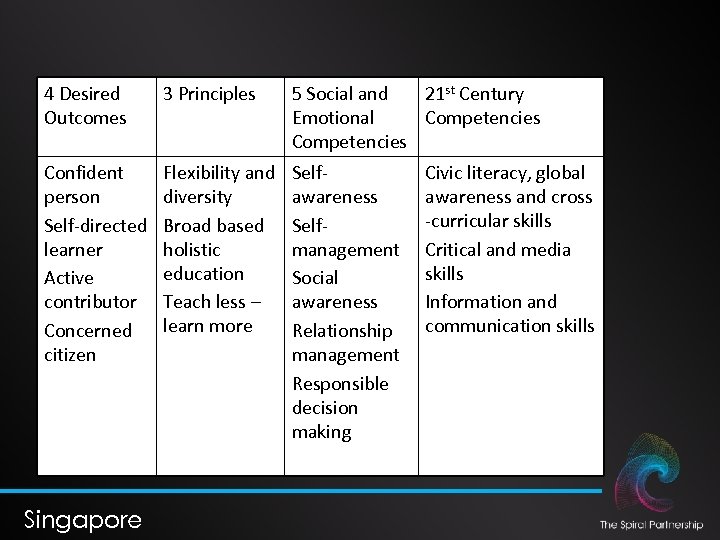 4 Desired Outcomes 3 Principles 5 Social and 21 st Century Emotional Competencies Confident person Self-directed learner Active contributor Concerned citizen Flexibility and diversity Broad based holistic education Teach less – learn more Selfawareness Selfmanagement Social awareness Relationship management Responsible decision making Singapore Civic literacy, global awareness and cross -curricular skills Critical and media skills Information and communication skills
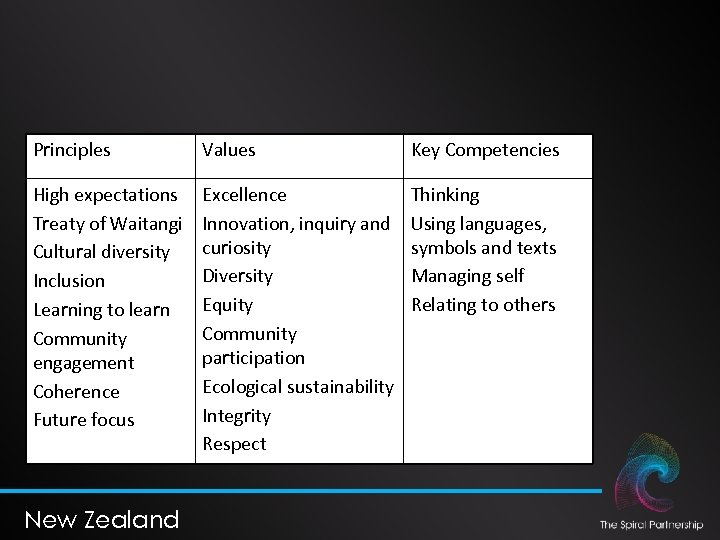 Principles Values Key Competencies High expectations Treaty of Waitangi Cultural diversity Inclusion Learning to learn Community engagement Coherence Future focus Excellence Innovation, inquiry and curiosity Diversity Equity Community participation Ecological sustainability Integrity Respect Thinking Using languages, symbols and texts Managing self Relating to others New Zealand
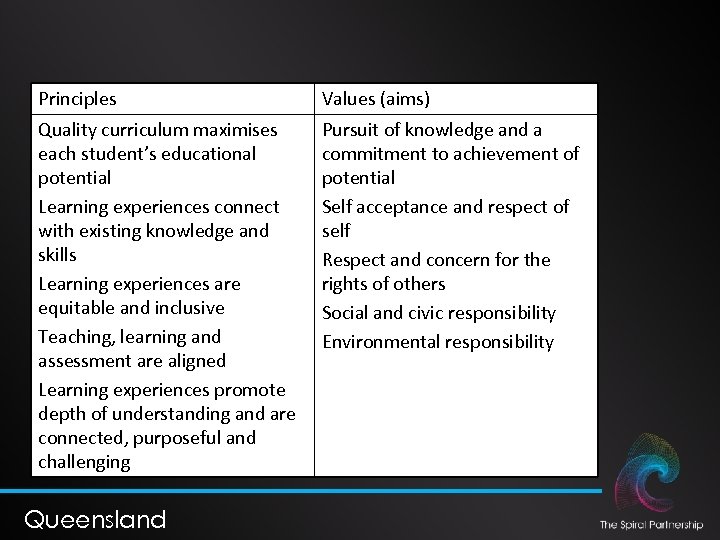 Principles Values (aims) Quality curriculum maximises each student’s educational potential Learning experiences connect with existing knowledge and skills Learning experiences are equitable and inclusive Teaching, learning and assessment are aligned Learning experiences promote depth of understanding and are connected, purposeful and challenging Pursuit of knowledge and a commitment to achievement of potential Self acceptance and respect of self Respect and concern for the rights of others Social and civic responsibility Environmental responsibility Queensland
 How do these ‘World Class Models … from top performing countries compare to your curriculum/ teaching model? Discuss
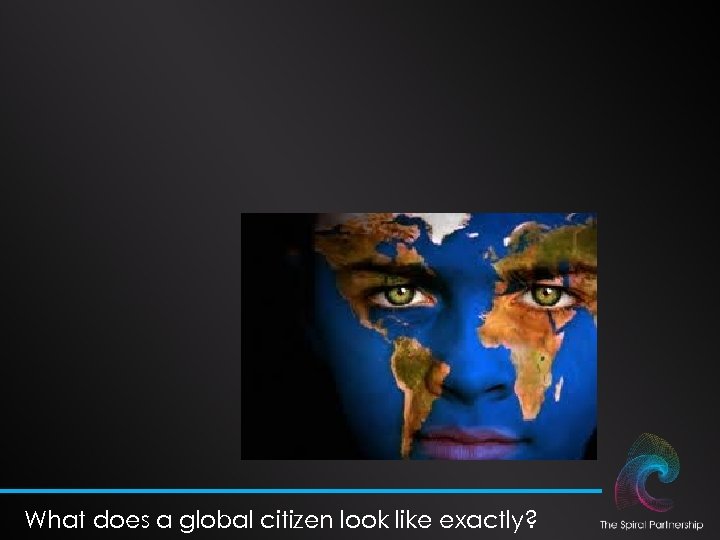 What does a global citizen look like exactly?
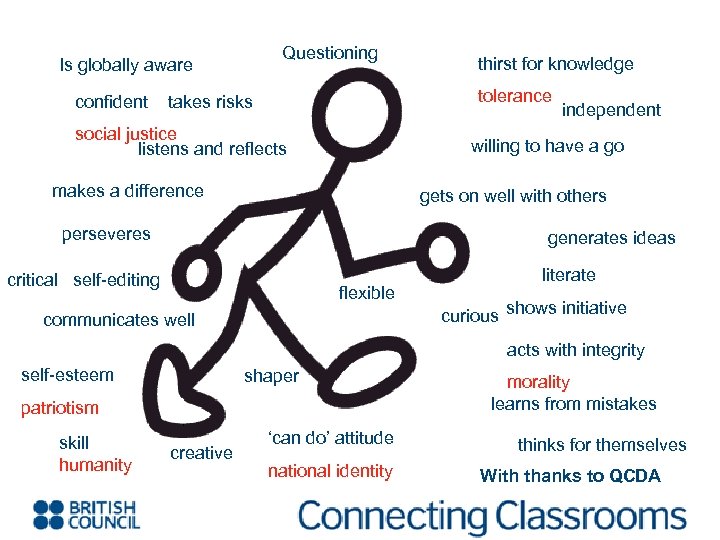 Questioning Is globally aware confident thirst for knowledge tolerance takes risks social justice listens and reflects independent willing to have a go makes a difference gets on well with others perseveres generates ideas critical self-editing flexible communicates well literate curious shows initiative acts with integrity self-esteem shaper patriotism skill humanity creative ‘can do’ attitude national identity morality learns from mistakes thinks for themselves With thanks to QCDA
 Which skills?
 The whole curriculum as experienced
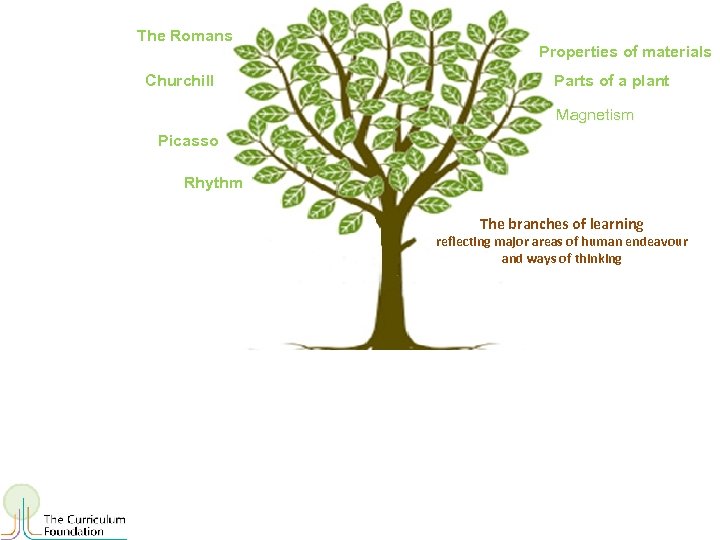 The Romans Properties of materials Churchill Parts of a plant Magnetism Picasso Rhythm The branches of learning reflecting major areas of human endeavour and ways of thinking Thinking skills Social skills Personal skills Essential lit, num & ICT L 2 L skills Enquiry skills Creativity Independence Enterprise
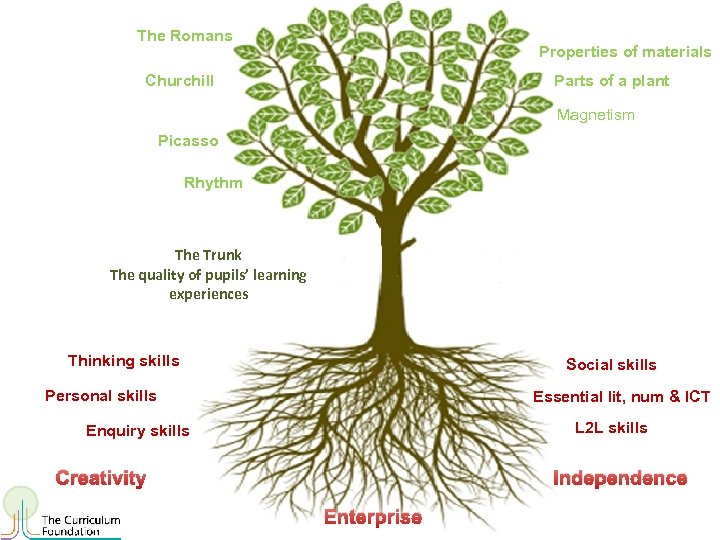 The Romans Properties of materials Churchill Parts of a plant Magnetism Picasso Rhythm The Trunk The quality of pupils’ learning experiences Thinking skills Social skills Personal skills Essential lit, num & ICT L 2 L skills Enquiry skills Creativity Independence Enterprise
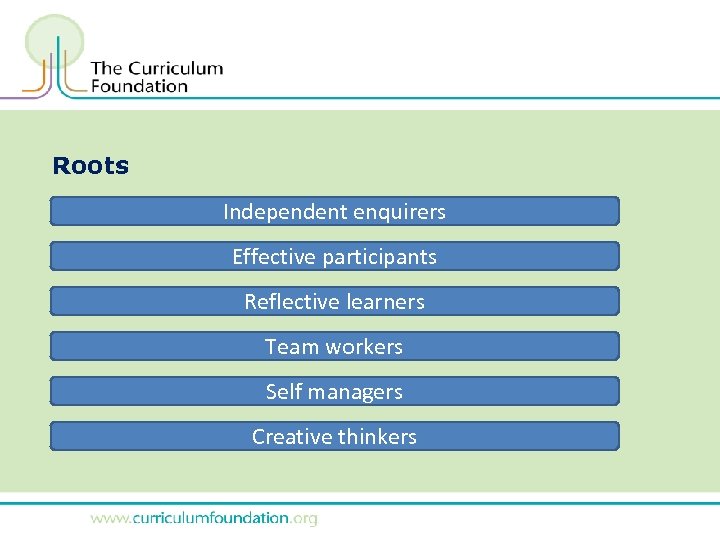 Roots Independent enquirers Effective participants Reflective learners Team workers Self managers Creative thinkers
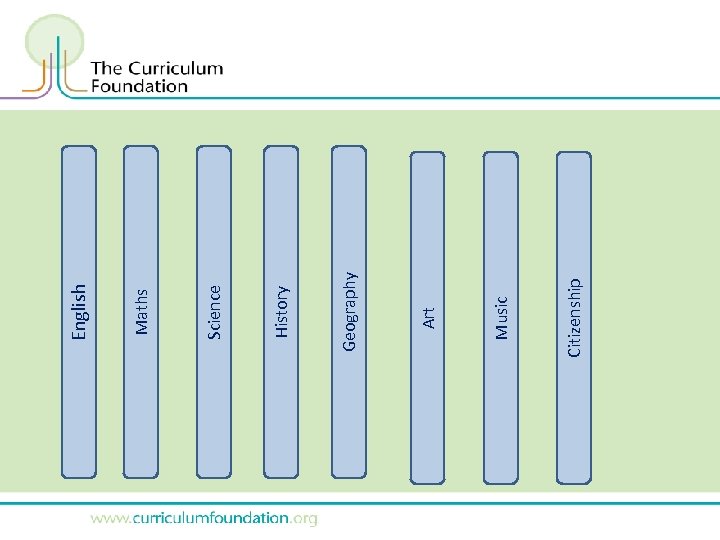 Citizenship Music Art Geography History Science Maths English
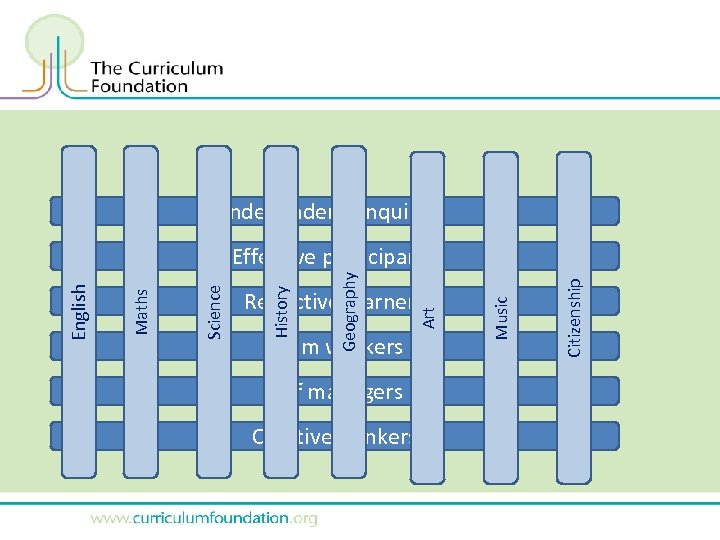 Independent enquirers Team workers Self managers Creative thinkers Citizenship Art Reflective learners Music Geography History Science Maths English Effective participants
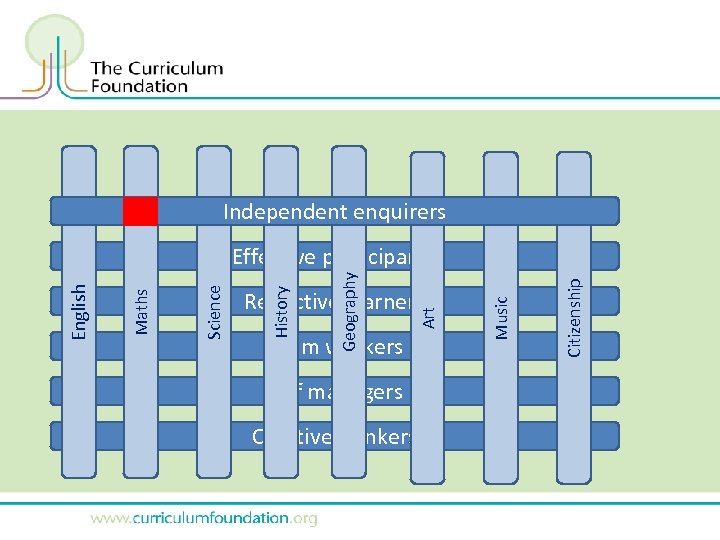 Independent enquirers Team workers Self managers Creative thinkers Citizenship Art Reflective learners Music Geography History Science Maths English Effective participants
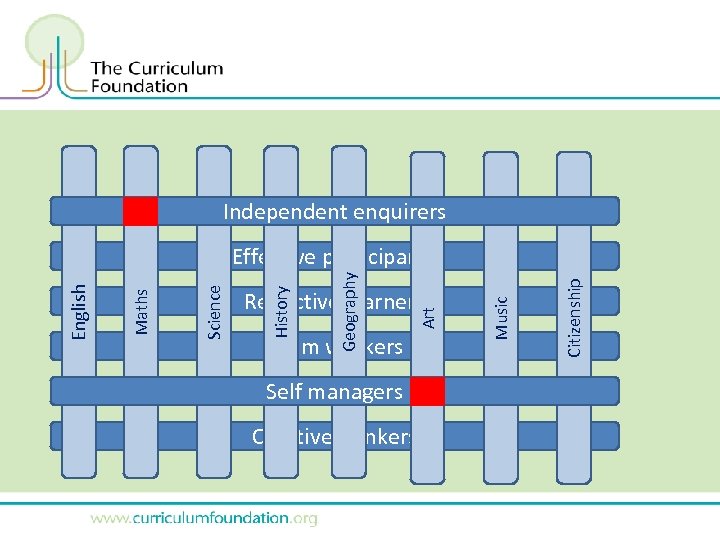 Independent enquirers Team workers Self managers Creative thinkers Citizenship Art Reflective learners Music Geography History Science Maths English Effective participants
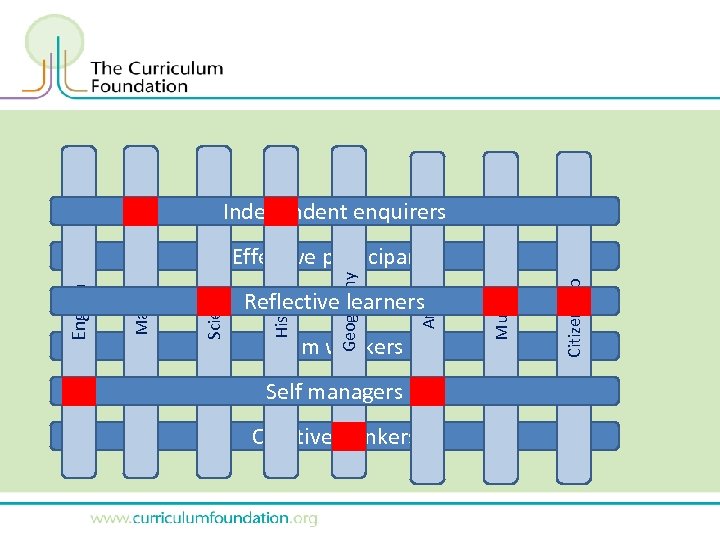 Independent enquirers Team workers Self managers Creative thinkers Citizenship Art Reflective learners Music Geography History Science Maths English Effective participants
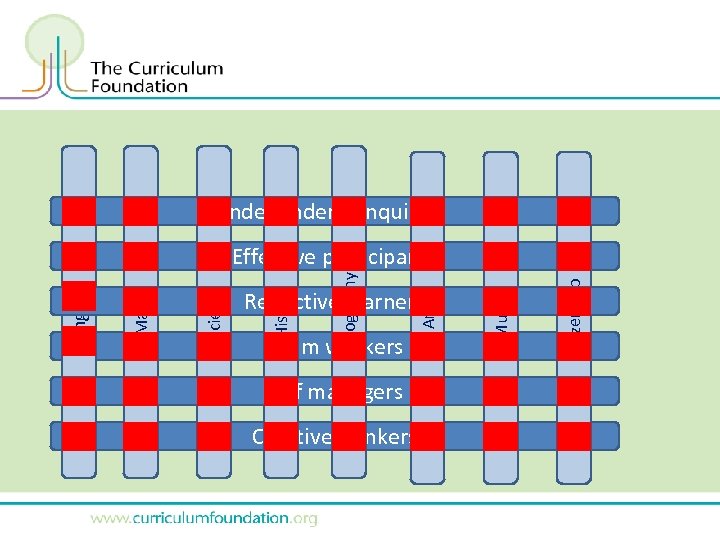 Independent enquirers Team workers Self managers Creative thinkers Citizenship Art Reflective learners Music Geography History Science Maths English Effective participants
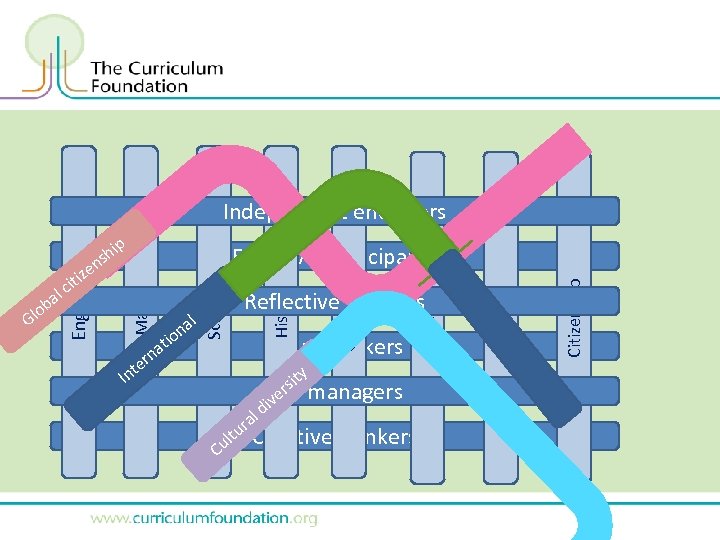 Independent enquirers hip s Team workers y sit managers r Self ve i ld In Cu a ur Creative lt thinkers Citizenship Art Reflective learners Music Geography History t na r te l na io Science Effective participants Maths i English lob G c al n ize t
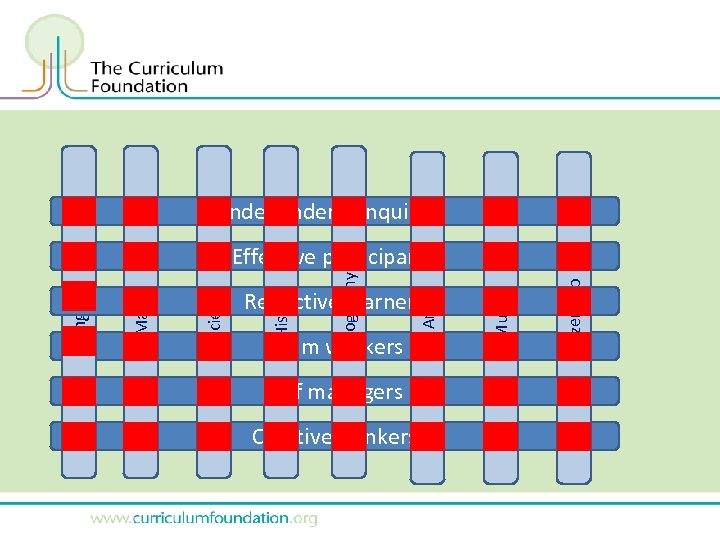 Independent enquirers Team workers Self managers Creative thinkers Citizenship Art Reflective learners Music Geography History Science Maths English Effective participants
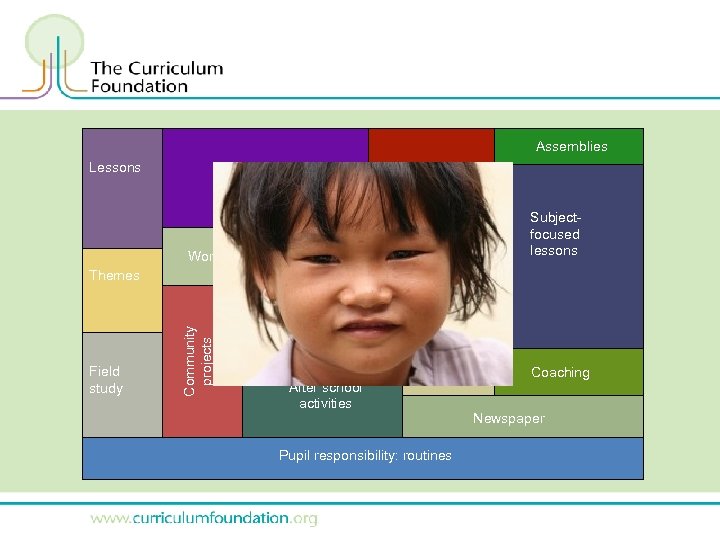 Assemblies Lessons Local study Working with artist School garden Subjectfocused lessons Residential Visit Themes Field study Community projects Museum Visits Expertise of staff After school activities Pupil responsibility: routines Coaching Newspaper
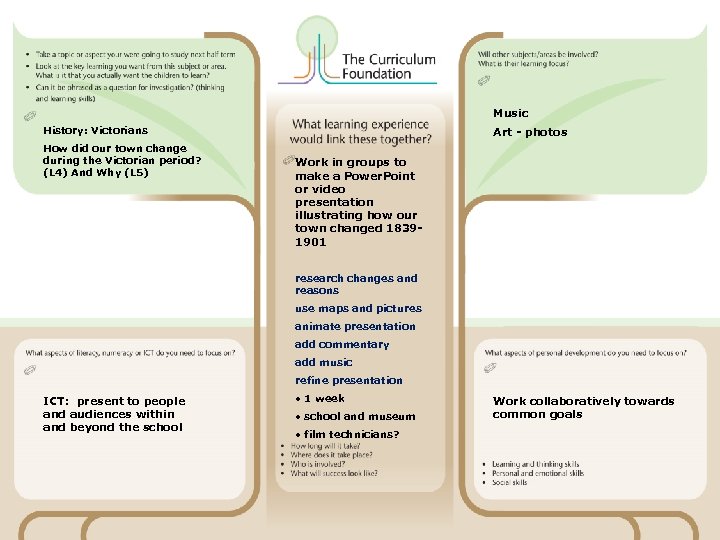 Music History: Victorians How did our town change during the Victorian period? (L 4) And Why (L 5) Art - photos Work in groups to make a Power. Point or video presentation illustrating how our town changed 18391901 research changes and reasons use maps and pictures animate presentation add commentary add music refine presentation ICT: present to people and audiences within and beyond the school • 1 week • school and museum • film technicians? Work collaboratively towards common goals
 Make one change …
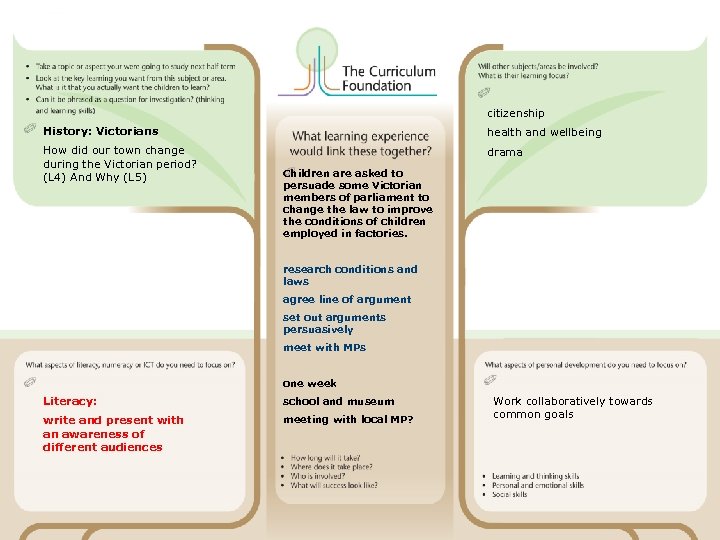 citizenship History: Victorians health and wellbeing How did our town change during the Victorian period? (L 4) And Why (L 5) drama Children are asked to persuade some Victorian members of parliament to change the law to improve the conditions of children employed in factories. research conditions and laws agree line of argument set out arguments persuasively meet with MPs one week Literacy: school and museum write and present with an awareness of different audiences meeting with local MP? Work collaboratively towards common goals
 Accountable, brave, passionate and inspirational learning and leading in Taiwan
 Who or what will I see or hear where That makes me go… YES!
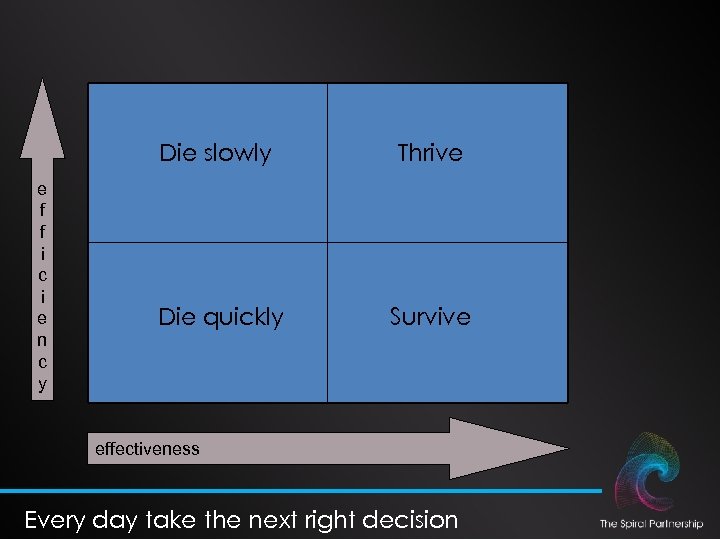 Die slowly e f f i c i e n c y Thrive Die quickly Survive effectiveness Every day take the next right decision
 Hands up for change
 Focus on the point
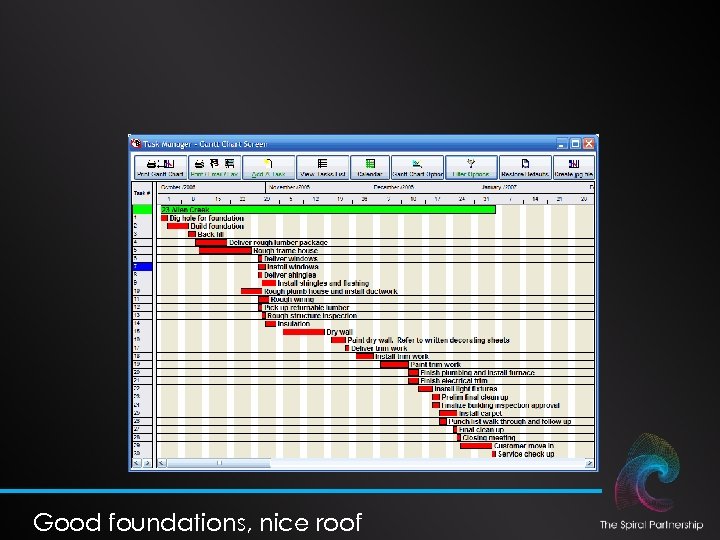 Good foundations, nice roof
 Legacy?
 Pete Hall Jones The Spiral Partnership The Curriculum Foundation educere
 Newton’s law
 Equal and opposite?
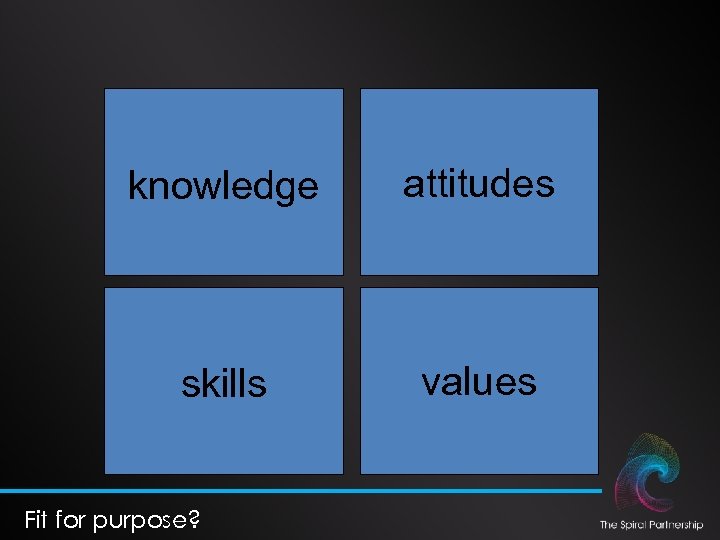 knowledge attitudes skills values Fit for purpose?