


 Скачать презентацию Developing a responsive curriculum Professor Freda Tallantyre Senior
1ee9c8723949be3e9cd23f5a0ba9dbb3.ppt
- Количество слайдов: 17
 Developing a responsive curriculum Professor Freda Tallantyre Senior Associate Higher Education Academy Manchester Metropolitan University November 5 th 2009
 What is driving the agenda? Global economic integration : competition from e. g. China, India Raising UK productivity and competitiveness to create a sustainable economy by 2020 Rapid demographic change -16. 2% 18 yr olds across UK by 2020 Impact of recession
 Some implications of recession • • Graduate destinations eroded and placements impacted Training budgets reduced Traditional professions hit e. g. financial services Unemployment increases and needs to retrain Value businesses prosper Export increases Companies need support to reorient and upskill HE Participation rates increase
 Motivation for employees and employers Validate and formalise experience Open up opportunities for progression Develop specialist knowledge/expertise Develop practical skills for performance Recruit staff who can hit the ground running Develop existing staff knowledge, skills, expertise Support staff retention Extend in-house training Invest in biggest asset
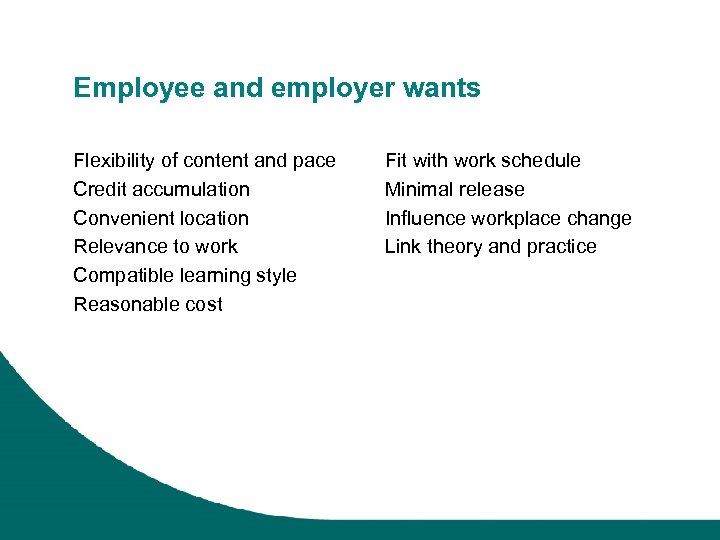 Employee and employer wants Flexibility of content and pace Credit accumulation Convenient location Relevance to work Compatible learning style Reasonable cost Fit with work schedule Minimal release Influence workplace change Link theory and practice
 Lifelong learning “Lifelong learning, by contrast, connotes a world of active learners constructing their own knowledge, and seeking out learning resources as and when they need them, in response to the changing circumstances of life and work. ” Ben Knights Director: English Subject Centre Higher Education Academy Exchange, Issue 6, Summer 07, p 3
 Lifelong learning curriculum “The development of a lifelong learning curriculum in higher education might possibly lead to a reconfiguration of the map of academic knowledge, and a change to the dominance of the academic discipline. ” Professor John Annette Pro-Vice Master Birkbeck College, University of London Academy Exchange, Issue 6, Summer 07, p 19
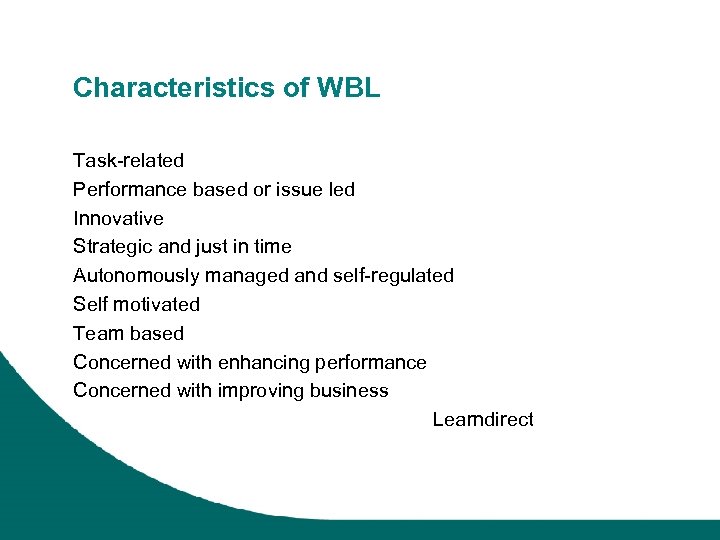 Characteristics of WBL Task-related Performance based or issue led Innovative Strategic and just in time Autonomously managed and self-regulated Self motivated Team based Concerned with enhancing performance Concerned with improving business Learndirect
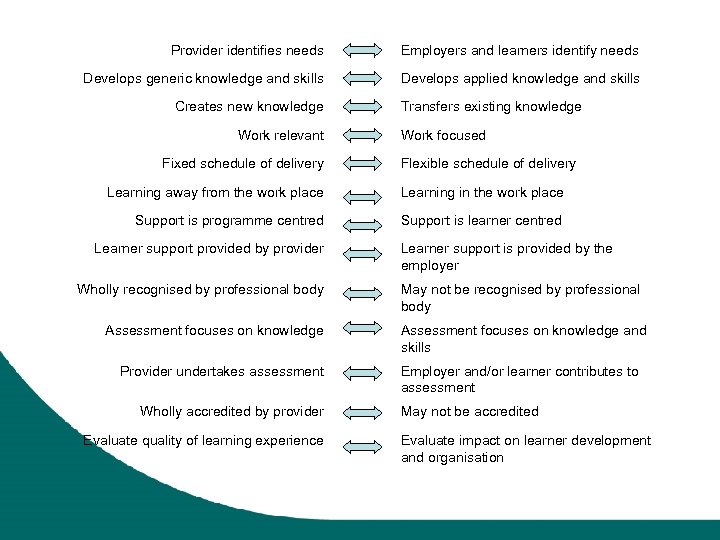 Provider identifies needs Employers and learners identify needs Develops generic knowledge and skills Develops applied knowledge and skills Creates new knowledge Work relevant Fixed schedule of delivery Transfers existing knowledge Work focused Flexible schedule of delivery Learning away from the work place Learning in the work place Support is programme centred Support is learner centred Learner support provided by provider Wholly recognised by professional body Assessment focuses on knowledge Provider undertakes assessment Wholly accredited by provider Evaluate quality of learning experience Learner support is provided by the employer May not be recognised by professional body Assessment focuses on knowledge and skills Employer and/or learner contributes to assessment May not be accredited Evaluate impact on learner development and organisation
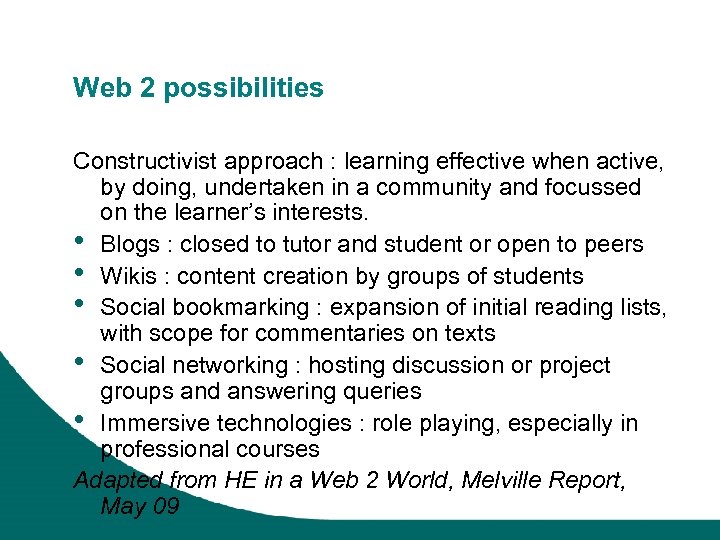 Web 2 possibilities Constructivist approach : learning effective when active, by doing, undertaken in a community and focussed on the learner’s interests. • Blogs : closed to tutor and student or open to peers • Wikis : content creation by groups of students • Social bookmarking : expansion of initial reading lists, with scope for commentaries on texts • Social networking : hosting discussion or project groups and answering queries • Immersive technologies : role playing, especially in professional courses Adapted from HE in a Web 2 World, Melville Report, May 09
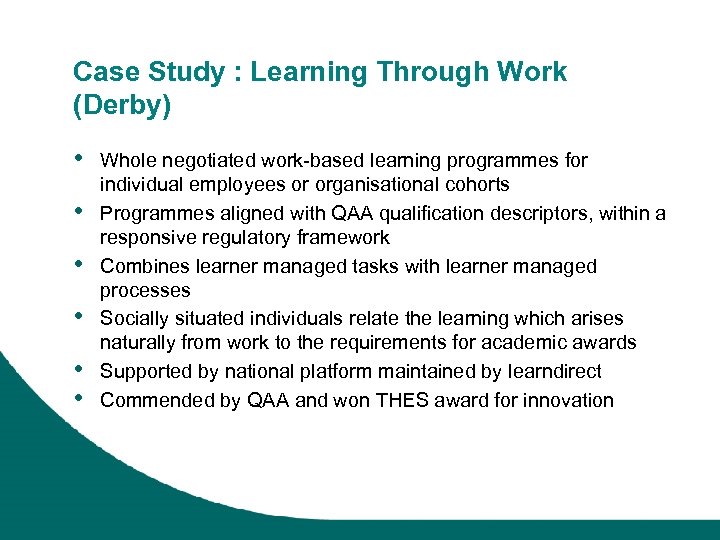 Case Study : Learning Through Work (Derby) • • • Whole negotiated work-based learning programmes for individual employees or organisational cohorts Programmes aligned with QAA qualification descriptors, within a responsive regulatory framework Combines learner managed tasks with learner managed processes Socially situated individuals relate the learning which arises naturally from work to the requirements for academic awards Supported by national platform maintained by learndirect Commended by QAA and won THES award for innovation
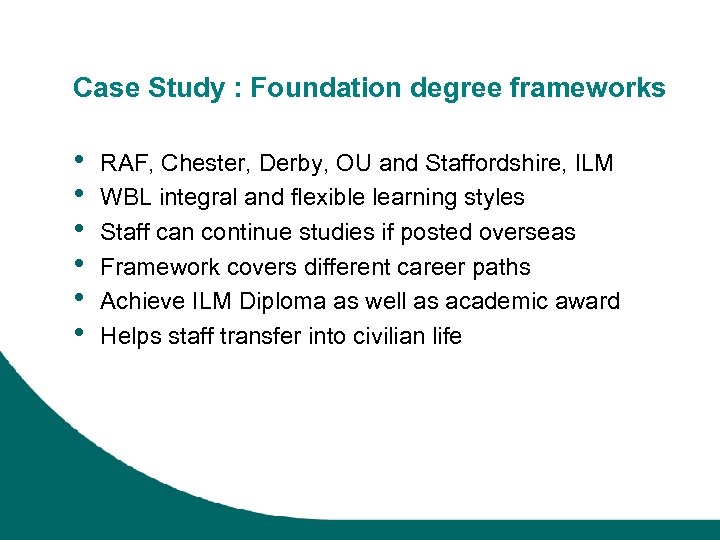 Case Study : Foundation degree frameworks • • • RAF, Chester, Derby, OU and Staffordshire, ILM WBL integral and flexible learning styles Staff can continue studies if posted overseas Framework covers different career paths Achieve ILM Diploma as well as academic award Helps staff transfer into civilian life
 Case Study : Business facing universities • • • Focus on “professional teaching, user-driven research and problem-solving with local and regional companies “ – Sainsbury report Hertfordshire operates county business link with 50 k businesses Increase in applied research, pdp progs, student placements amd employability skills Innovation Centre supports student and staff enterprise Biopark supporting SMEs in bioscience and health technology, including 2 spin-outs from University. Staff and students engage in the businesses.
 Case Study : Employer Engagement Surrey and Sussex SHA supported practice development facilitator roles Innovative ways of delivering CPD in practice setting Honorary contracts with University of Surrey Combine strategic, clinical, interpersonal and educational functions Critically evaluate practice to stimulate development and sustainability of best practice Develop learning initiatives to meet service requirements Integrate policy aims with specific ward culture Design learning capable of university accreditation High learner satisfaction and positive impact on patient care
 Quality assurance adjustments Partnerships : clear delineation roles and responsibilities; joint steering committees; support and training for mentors Assessment : learner agreements; innovative forms; support for employer input; academic oversight Negotiated learning : criteria for assessment include word count, effort, complexity, innovation, reflection. Rapid response : frameworks for accelerated validation, proportionate attention for bitesize, short awards
 Benefits to employees Personal Increased confidence Higher aspirations/motivation Raised personal status Greater self awareness Learning to think and challenge assumptions Understanding of specific issues New and enhanced skills Reflection on performance Professional Improved performance Greater responsibility Changed jobs/promotion Salary increase Able to see wider points of view Positive change in ways of thinking at work Reduce stress and increase contentment Able to coach others Professional recognition and membership
 Benefits to employers Clearer direction of travel for organisation Develop new/improved policies, standards, contracts Improved quality and service provision Increased innovation More self sufficient employees Positive attitudinal/behavioural change External recognition and prestige