 Скачать презентацию Developed by Introduction to HACCP Agenda
d45c18e9a543f4a398254ee6acfd24b3.ppt
- Количество слайдов: 34



Developed by Introduction to HACCP
Agenda • • • Food safety Responsibilities HACCP Prerequisite programs HACCP plans Control measures and CCPs
Food Safety Prevention of hazards in foods • Physical • Biological • Chemical – Allergens
Responsibility for food safety • • • Producer/grower Manufacturer Distributor Transporter Retailer Consumer
Industry Responses • Consumer education • HACCP and HACCP based Food safety programs for all sectors
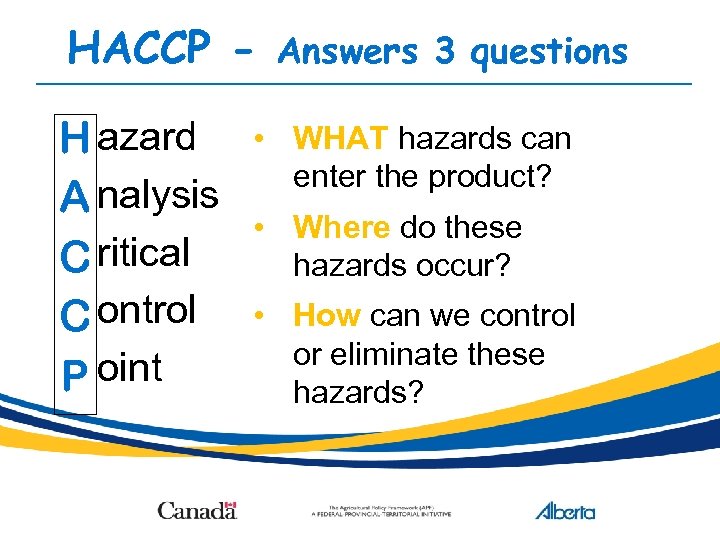
HACCP - Answers 3 questions H azard A nalysis C ritical C ontrol P oint • WHAT hazards can enter the product? • Where do these hazards occur? • How can we control or eliminate these hazards?
HACCP • Science based • Step wise process: – Identifies hazards – Installs preventative measures to eliminate or reduce hazards in foods • Proactive rather than reactive • Risk based
HACCP • Does not rely on end product testing – hazards not be evenly distributed and can be missed in sampling – need to test large quantities – product would need to be destroyed or reworked
HACCP • Starts from the beginning of the process – Receiving of ingredients, packaging • through process steps • to final product and shipping
Pillsbury “come as close to 100% assurance as possible that food products would not be contaminated with pathogens. ” “needed control over raw materials, environment and people as early in the system as possible…. ”
Components • Pre-requiste program • Hazard analysis
Prerequisites • Foundation to a HACCP program • Includes Good Manufacturing Practices • Addresses food safety at all stages from receiving to shipping – Including indirect hazards
Prerequisite program – – – – Premises Transportation and Storage Equipment Personnel/Training Sanitation and Pest Control Recall Allergen Control Supplier Quality Assurance
Premises • Outside property and building • • Design, construction & maintenance Lighting Ventilation Waste disposal Inedible areas Employee & sanitary facilities Water/Steam/Ice
Transportation and Storage • Food Carriers • Temperature Controls • Receiving and Storage • Incoming ingredients and packaging • Non-Food Chemicals • Finished Product Storage
Equipment • Design and installation • Maintenance and Calibration
Personnel • Trained for their job • Understand food safety
Sanitation and Pest Control • Sanitation – Equipment and Utensils – Floors – Locker rooms – Lunch rooms – Washrooms • Pest control
Recall • Product identification • Locating product • Returning product
Allergen control • Identification of Allergens • Control of allergens – – – Special handling Segregate Special sanitation procedures Rework Proper labelling
Supplier Quality Assurance • Vendor approval process • Product specifications • Inspect incoming materials
Now on to the HACCP plan ….
Sequence of 12 Steps 1. Assemble HACCP team 2. Describe product 3. Identity intended use 4. Construct process flow and plant schematic 5. On site verification of flow and schematic 6. List hazards associated with each process step (principle #1)
Sequence of 12 steps 7. Apply HACCP decision tree to determine CCP’s (Principle #2) 8. Establish critical limits (Principle #3) 9. Establish monitoring procedures (Principle #4) 10. Establish deviation procedures (Principle #5) 11. Establish verification procedures (Principle #6) 12. Establish record keeping/documentation for principles 1 - 6 (Principle #7)
HACCP team People chosen that have expertise in different areas: – – – Production Shipping Quality Assurance Sanitation Maintenance Sales
Product Description • • • Product Name(s) Important Product Characteristics How it is to be used Packaging Shelf Life Where it will be sold Labelling Instructions Special Distribution Control Specific Ingredients
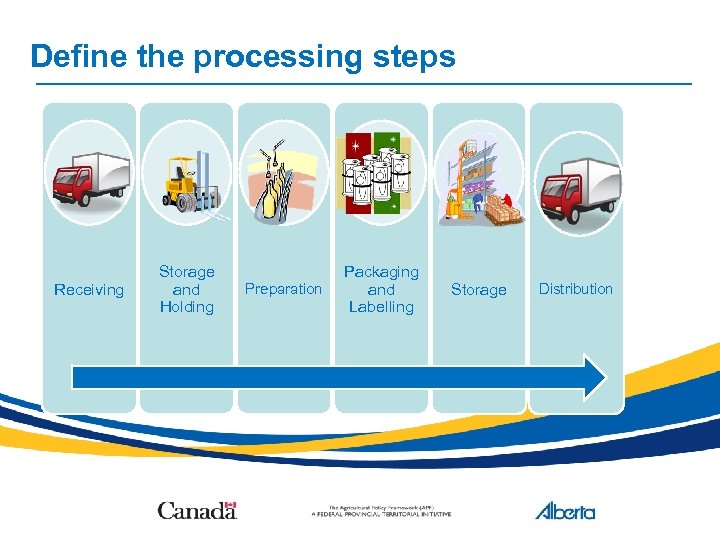
Define the processing steps Receiving Storage and Holding Preparation Packaging and Labelling Storage Distribution
Construct Plant Schematic Your Establishment’s Plant Schematic Here
Determine hazards • Look at each input- ingredients • Determine possible hazards • How are they controlled?
CCPs • Critical control points • Place where you can prevent, remove or reduce a hazard • if there is not step in the process that can eliminate or reduce the hazards- use labelling, cooking instructions to inform how control can be achieved
Our CCPS • Metal detector – Metal is a hazard in our facility – Not fully controlled by any prerequisite program – Metal detectors specifically designed identify product containing metal – That product can be removed – No other step will remove the metal
CCPs What is your role? • Monitor – Look, smell, measure • Record • Corrective actions • Verify – Monitor people doing activity – Take corrective actions when necessary – Complete records properly
Practical application
On the job. . . • Watch for hazards and remove any that you find • If you are involved in CCP monitoring: – Perform your checks as required: • according to procedure • on time
Скачать презентацию Developed by Introduction to HACCP Agenda
d45c18e9a543f4a398254ee6acfd24b3.ppt