 Скачать презентацию Deutsche Bank Sustainable Investments The European Energy Efficiency
cc0aab7d2ee734384237da425cd345b6.ppt
- Количество слайдов: 10



Deutsche Bank Sustainable Investments The European Energy Efficiency Facility* An Introduction European Union - Sustainable Energy Week Brussels, 13 April 2011 *The Facility is currently being incorporated.
Objective and mission of the European Energy Efficiency Facility (EEEF) Objective — EEEF aims to (i) provide market based financing for commercially viable public energy efficiency (EE) and renewable energy (RE) projects within the European Union (hereafter the “Fund”) and to (ii) provide grants for project development services (technical assistance) related to technical and financial preparation of projects (a). What is EEEF? — The Fund contributes with a layered risk/return structure to enhance EE and foster RE in the form of a targeted private public partnership, primarily through the provision of dedicated financing via direct finance and partnering with financial institutions. — … amendment of the European Energy Program for Recovery Regulation (b) Why EEEF? — … commitment of the EU member states to achieve the 20/20/20 goals, cutting GHG emissions by 20%, increasing RE usage by 20%, and cutting energy consumption through improved EE by 20% — … substantial potential for EE and small scale RE in the European public sector (a) About EUR 20 million of the EU funding will be made available as grants for project development services (technical assistance) related to technical and financial preparation of projects funded by EEEF. Also, awareness-raising activities for national/regional authorities managing cohesion/structural funds in the field of sustainable energy are envisaged. For the avoidance of doubt, this presentation focuses on the “Fund” that is currently being incorporated, rather than the technical assistance part of the Facility. Regulation (EU) No 1233/2010 of the European Parliament and of the Council amended the European Energy Program for Recovery Regulation (EC) No 663/2009 establishing a program to aid economic recovery by granting Community financial assistance to projects in the field of energy. Uncommitted funds will be used for the creation of the EEEF. (b) Deutsche Bank Sustainable Investments 3/16/2018 1 2010 DB Blue template
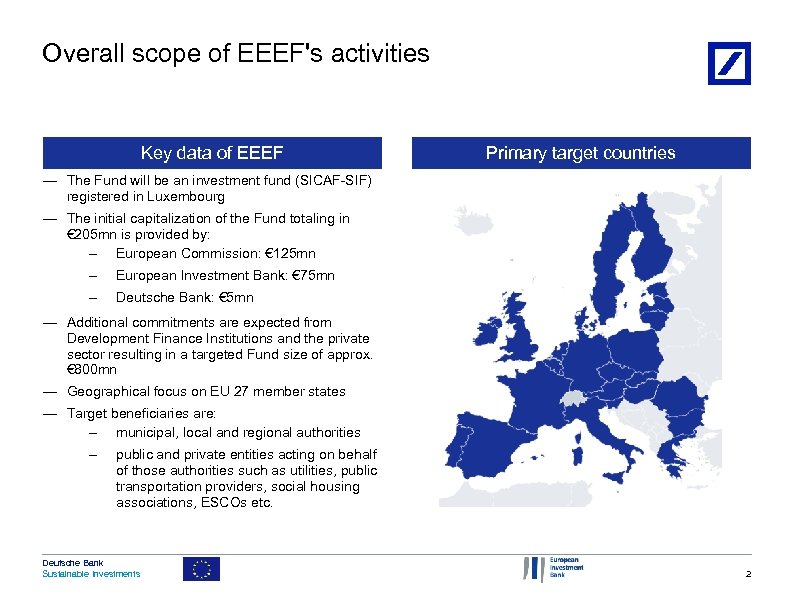
Overall scope of EEEF's activities Key data of EEEF Primary target countries — The Fund will be an investment fund (SICAF-SIF) registered in Luxembourg — The initial capitalization of the Fund totaling in € 205 mn is provided by: - European Commission: € 125 mn - European Investment Bank: € 75 mn - Deutsche Bank: € 5 mn — Additional commitments are expected from Development Finance Institutions and the private sector resulting in a targeted Fund size of approx. € 800 mn — Geographical focus on EU 27 member states — Target beneficiaries are: - municipal, local and regional authorities - public and private entities acting on behalf of those authorities such as utilities, public transportation providers, social housing associations, ESCOs etc. Deutsche Bank Sustainable Investments 3/16/2018 2 2010 DB Blue template
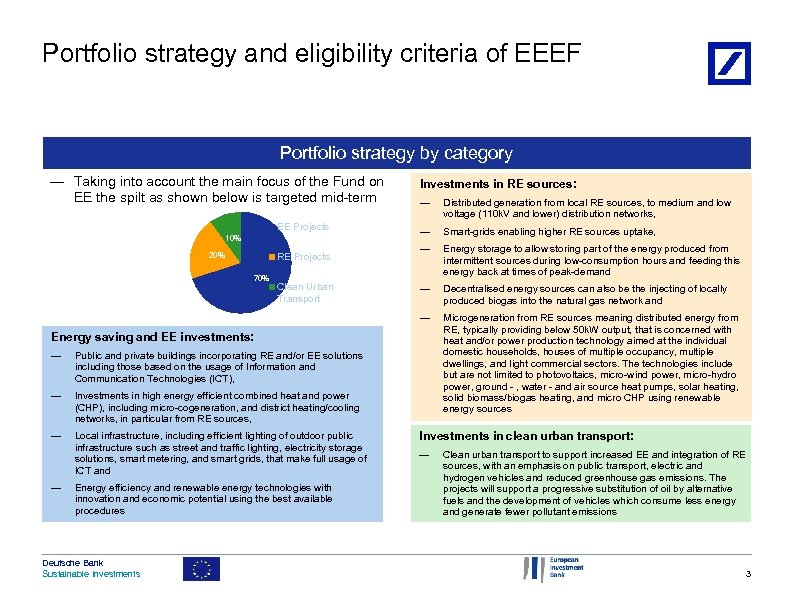
Portfolio strategy and eligibility criteria of EEEF Portfolio strategy by category — Taking into account the main focus of the Fund on EE the spilt as shown below is targeted mid-term Investments in RE sources: 20% RE Projects 70% Clean Urban Transport Distributed generation from local RE sources, to medium and low voltage (110 k. V and lower) distribution networks, — Smart-grids enabling higher RE sources uptake, — Energy storage to allow storing part of the energy produced from intermittent sources during low-consumption hours and feeding this energy back at times of peak-demand — Decentralised energy sources can also be the injecting of locally produced biogas into the natural gas network and — EE Projects 10% — Microgeneration from RE sources meaning distributed energy from RE, typically providing below 50 k. W output, that is concerned with heat and/or power production technology aimed at the individual domestic households, houses of multiple occupancy, multiple dwellings, and light commercial sectors. The technologies include but are not limited to photovoltaics, micro-wind power, micro-hydro power, ground - , water - and air source heat pumps, solar heating, solid biomass/biogas heating, and micro CHP using renewable energy sources Energy saving and EE investments: — Public and private buildings incorporating RE and/or EE solutions including those based on the usage of Information and Communication Technologies (ICT), — Investments in high energy efficient combined heat and power (CHP), including micro-cogeneration, and district heating/cooling networks, in particular from RE sources, — Local infrastructure, including efficient lighting of outdoor public infrastructure such as street and traffic lighting, electricity storage solutions, smart metering, and smart grids, that make full usage of ICT and — Energy efficiency and renewable energy technologies with innovation and economic potential using the best available procedures Deutsche Bank Sustainable Investments 3/16/2018 Investments in clean urban transport: — Clean urban transport to support increased EE and integration of RE sources, with an emphasis on public transport, electric and hydrogen vehicles and reduced greenhouse gas emissions. The projects will support a progressive substitution of oil by alternative fuels and the development of vehicles which consume less energy and generate fewer pollutant emissions 3 2010 DB Blue template
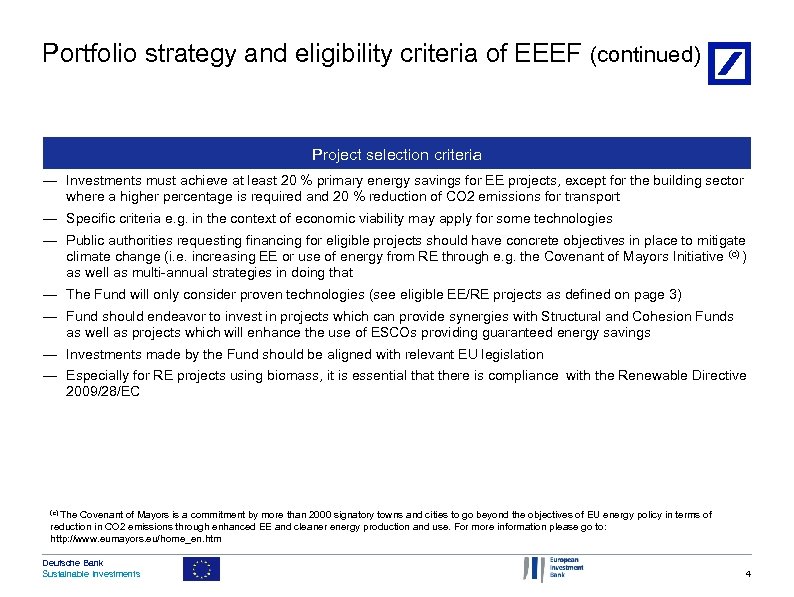
Portfolio strategy and eligibility criteria of EEEF (continued) Project selection criteria — Investments must achieve at least 20 % primary energy savings for EE projects, except for the building sector where a higher percentage is required and 20 % reduction of CO 2 emissions for transport — Specific criteria e. g. in the context of economic viability may apply for some technologies — Public authorities requesting financing for eligible projects should have concrete objectives in place to mitigate climate change (i. e. increasing EE or use of energy from RE through e. g. the Covenant of Mayors Initiative (c) ) as well as multi-annual strategies in doing that — The Fund will only consider proven technologies (see eligible EE/RE projects as defined on page 3) — Fund should endeavor to invest in projects which can provide synergies with Structural and Cohesion Funds as well as projects which will enhance the use of ESCOs providing guaranteed energy savings — Investments made by the Fund should be aligned with relevant EU legislation — Especially for RE projects using biomass, it is essential that there is compliance with the Renewable Directive 2009/28/EC (c) The Covenant of Mayors is a commitment by more than 2000 signatory towns and cities to go beyond the objectives of EU energy policy in terms of reduction in CO 2 emissions through enhanced EE and cleaner energy production and use. For more information please go to: http: //www. eumayors. eu/home_en. htm Deutsche Bank Sustainable Investments 4
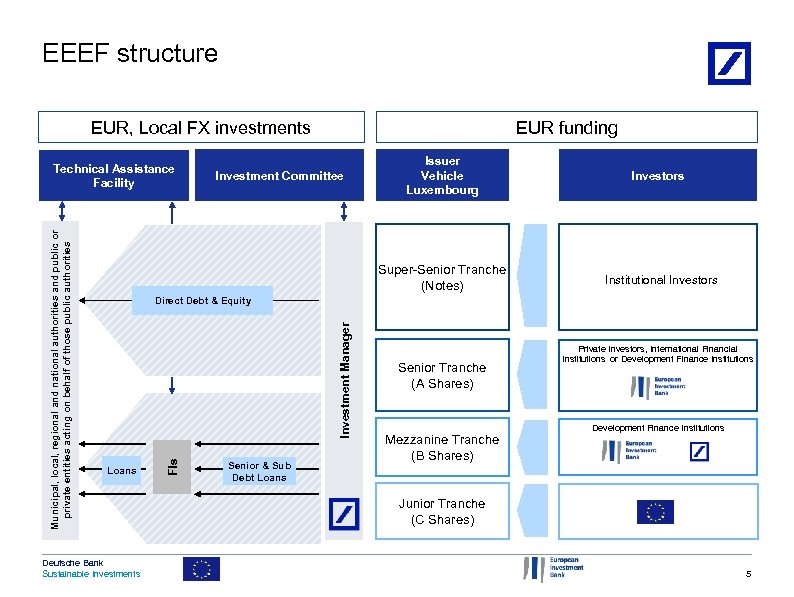
EEEF structure EUR, Local FX investments Investors Institutional Investors Investment Manager Direct Debt & Equity Loans Deutsche Bank Sustainable Investments FIs Municipal, local, regional and national authorities and public or private entities acting on behalf of those public authorities Investment Committee Issuer Vehicle Luxembourg Super-Senior Tranche (Notes) Technical Assistance Facility 3/16/2018 EUR funding Senior & Sub Debt Loans Senior Tranche (A Shares) Mezzanine Tranche (B Shares) Private Investors, International Financial Institutions or Development Finance Institutions Junior Tranche (C Shares) 5
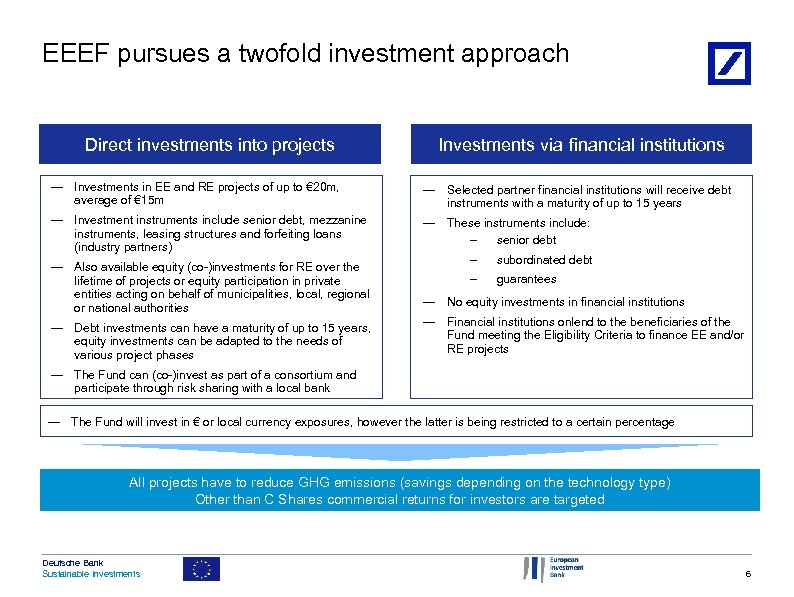
EEEF pursues a twofold investment approach Direct investments into projects Investments via financial institutions — Investments in EE and RE projects of up to € 20 m, average of € 15 m — Selected partner financial institutions will receive debt instruments with a maturity of up to 15 years — Investment instruments include senior debt, mezzanine instruments, leasing structures and forfeiting loans (industry partners) — These instruments include: senior debt — Also available equity (co-)investments for RE over the lifetime of projects or equity participation in private entities acting on behalf of municipalities, local, regional or national authorities — Debt investments can have a maturity of up to 15 years, equity investments can be adapted to the needs of various project phases - subordinated debt - guarantees — No equity investments in financial institutions — Financial institutions onlend to the beneficiaries of the Fund meeting the Eligibility Criteria to finance EE and/or RE projects — The Fund can (co-)invest as part of a consortium and participate through risk sharing with a local bank — The Fund will invest in € or local currency exposures, however the latter is being restricted to a certain percentage All projects have to reduce GHG emissions (savings depending on the technology type) Other than C Shares commercial returns for investors are targeted Deutsche Bank Sustainable Investments 3/16/2018 6
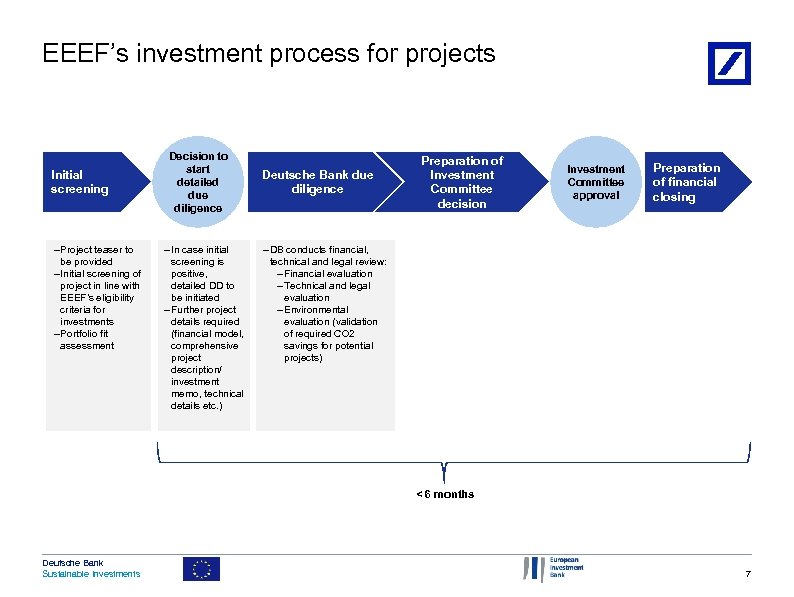
EEEF’s investment process for projects Initial screening - Project teaser to be provided - Initial screening of project in line with EEEF’s eligibility criteria for investments - Portfolio fit assessment Decision to start detailed due diligence - In case initial screening is positive, detailed DD to be initiated - Further project details required (financial model, comprehensive project description/ investment memo, technical details etc. ) Deutsche Bank due diligence Preparation of Investment Committee decision Investment Committee approval Preparation of financial closing - DB conducts financial, technical and legal review: - Financial evaluation - Technical and legal evaluation - Environmental evaluation (validation of required CO 2 savings for potential projects) < 6 months Deutsche Bank Sustainable Investments 3/16/2018 7 2010 DB Blue template
Contacts European Energy Efficiency Fund Peter Coveliers +352 4379 87 403 p. coveliers@eib. org Michael Schneider +49(69)910 -46448 michael-d. schneider@db. com Deutsche Bank Sustainable Investments 3/16/2018 8 2010 DB Blue template
Deutsche Bank Sustainable Investments © Copyright 2011. Deutsche Bank AG, D-60311 Frankfurt am Main, Germany. All rights reserved. This presentation (the ‘Document’) has been prepared by Deutsche Bank AG and/or a subsidiary of Deutsche Bank AG (collectively: ‘Deutsche Bank’) exclusively for the benefit and internal use of the ‘Client’ in order to indicate, on a preliminary basis, the feasibility of a possible transaction or transactions. The Document may only be used for these purposes. The Client is not permitted to duplicate the information provided in this Document and to communicate the received information of this Document to any third party without the prior written consent of Deutsche Bank. The Document is incomplete without reference to, and should be viewed solely in conjunction with, the oral briefing provided by Deutsche Bank. The Document is neither intended to serve as legal or tax advice nor should it replace it. The information in the Document reflects prevailing conditions and Deutsche Bank's views as of this date, all of which are subject to change. In preparing the Document, Deutsche Bank has relied upon and assumed, without independent verification, the accuracy and completeness of all information available from public sources or received by or on behalf of the Client. The analyses contained in the Document are not and do not purport to be appraisals of the assets, stock, or business of the Client. The information in the Document does not take into account the effects of a possible transaction or transactions involving an actual or potential change of control, which may have significant valuation and other effects.
Скачать презентацию Deutsche Bank Sustainable Investments The European Energy Efficiency
cc0aab7d2ee734384237da425cd345b6.ppt