


 Скачать презентацию DETERMINISTIC ETHERNET IEEE 802 1 standards for real-time
6c01d46f59ed69176e3283e8ac8bdaae.ppt
- Количество слайдов: 72
 DETERMINISTIC ETHERNET IEEE 802. 1 standards for real-time process control, industrial automation, and vehicular networks IEEE 802 tutorial November 12, 2012
 Deterministic Ethernet Contents • History, markets and use cases • Time synchronization on networks • Quality of Service • Shortest Path Bridging • Mixed-technology networking 2
 Deterministic Ethernet 3 HISTORY, MARKETS AND USE CASES Oliver Kleineberg Belden / Hirschmann Automation & Control IEEE 802 tutorial November 12, 2012
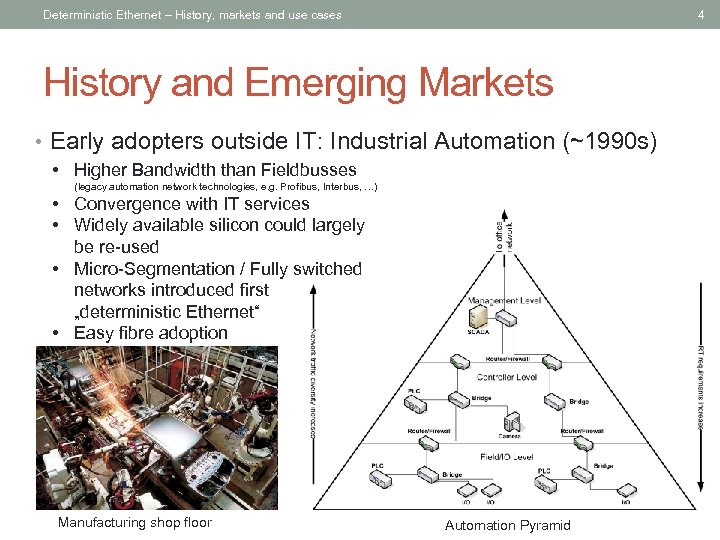 Deterministic Ethernet – History, markets and use cases 4 History and Emerging Markets • Early adopters outside IT: Industrial Automation (~1990 s) • Higher Bandwidth than Fieldbusses (legacy automation network technologies, e. g. Profibus, Interbus, …) • Convergence with IT services • Widely available silicon could largely be re-used • Micro-Segmentation / Fully switched networks introduced first „deterministic Ethernet“ • Easy fibre adoption Manufacturing shop floor Automation Pyramid
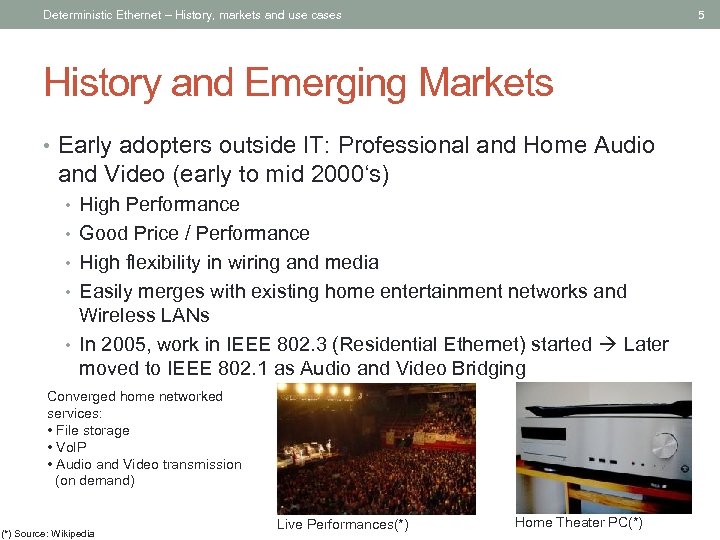 Deterministic Ethernet – History, markets and use cases 5 History and Emerging Markets • Early adopters outside IT: Professional and Home Audio and Video (early to mid 2000‘s) • High Performance • Good Price / Performance • High flexibility in wiring and media • Easily merges with existing home entertainment networks and Wireless LANs • In 2005, work in IEEE 802. 3 (Residential Ethernet) started Later moved to IEEE 802. 1 as Audio and Video Bridging Converged home networked services: • File storage • Vo. IP • Audio and Video transmission (on demand) (*) Source: Wikipedia Live Performances(*) Home Theater PC(*)
 Deterministic Ethernet – History, markets and use cases History and Emerging Markets • Existing Technologies: IEEE and Non-IEEE • IEEE 802. 1 Audio and Video Bridging • • • Of high interest in Professional and Home Audio and Video Time Synchronization based on well-proven IEEE 1588 protocol Bandwidth Reservation and Class-based Qo. S (Traffic Shaping) Deterministic Real-Time Ethernet technology that fits the original use case very well Already applicable to some of the emerging new market applications • IEEE 802. 1 Shortest Path Briding • Providing resiliency to failures in the network infrastructure • Where no IEEE standards were available, other specifications emerged, often driven by proprietary technologies: • Proprietary protocols for Professional Audio (e. g. Cobranet) • Proprietary protocols for Industrial Automation (e. g. ISO/IEC addressing Redundancy and Real-Time in ISO/IEC 62439 / 61158 / 61784 series) • Application-specific extensions of standard IEEE 802 technologies (e. g. ARINC Avionics Full-Duplex Switched Ethernet - AFDX) High demand for a converged IEEE 802 solution for deterministic Ethernet to replace proprietary technology and fit the needs of existing and emerging markets. 6
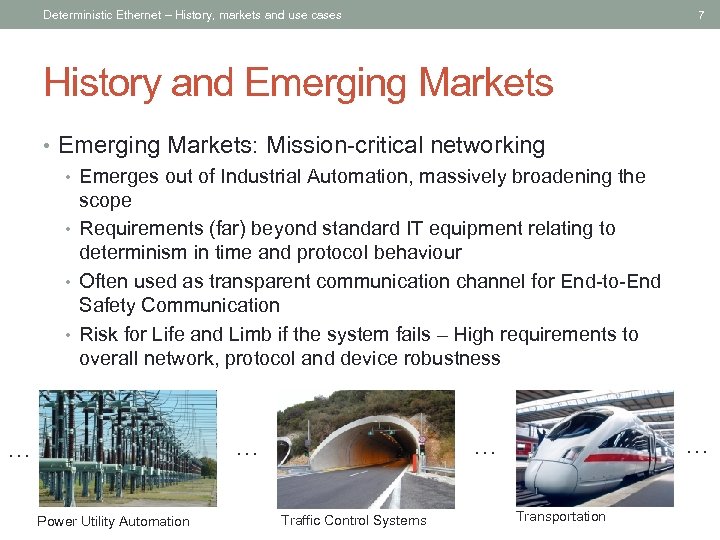 Deterministic Ethernet – History, markets and use cases 7 History and Emerging Markets • Emerging Markets: Mission-critical networking • Emerges out of Industrial Automation, massively broadening the scope • Requirements (far) beyond standard IT equipment relating to determinism in time and protocol behaviour • Often used as transparent communication channel for End-to-End Safety Communication • Risk for Life and Limb if the system fails – High requirements to overall network, protocol and device robustness Power Utility Automation … … Traffic Control Systems Transportation
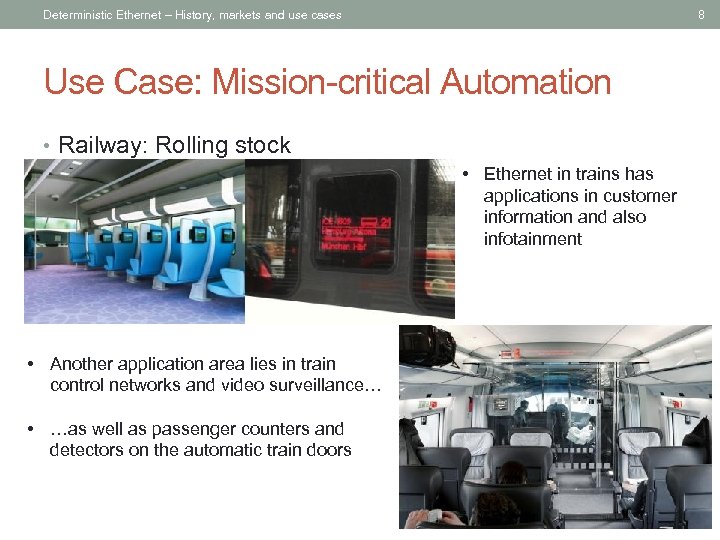 Deterministic Ethernet – History, markets and use cases 8 Use Case: Mission-critical Automation • Railway: Rolling stock • Ethernet in trains has applications in customer information and also infotainment • Another application area lies in train control networks and video surveillance… • …as well as passenger counters and detectors on the automatic train doors
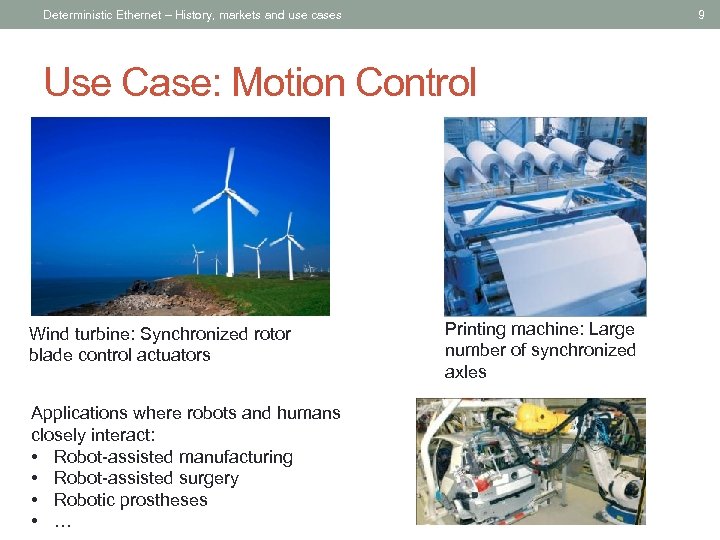 Deterministic Ethernet – History, markets and use cases 9 Use Case: Motion Control Wind turbine: Synchronized rotor blade control actuators Applications where robots and humans closely interact: • Robot-assisted manufacturing • Robot-assisted surgery • Robotic prostheses • … Printing machine: Large number of synchronized axles
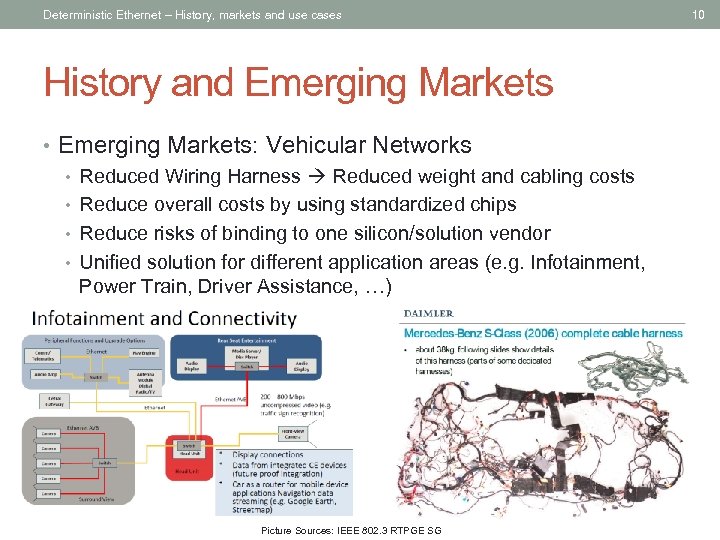 Deterministic Ethernet – History, markets and use cases History and Emerging Markets • Emerging Markets: Vehicular Networks • Reduced Wiring Harness Reduced weight and cabling costs • Reduce overall costs by using standardized chips • Reduce risks of binding to one silicon/solution vendor • Unified solution for different application areas (e. g. Infotainment, Power Train, Driver Assistance, …) Picture Sources: IEEE 802. 3 RTPGE SG 10
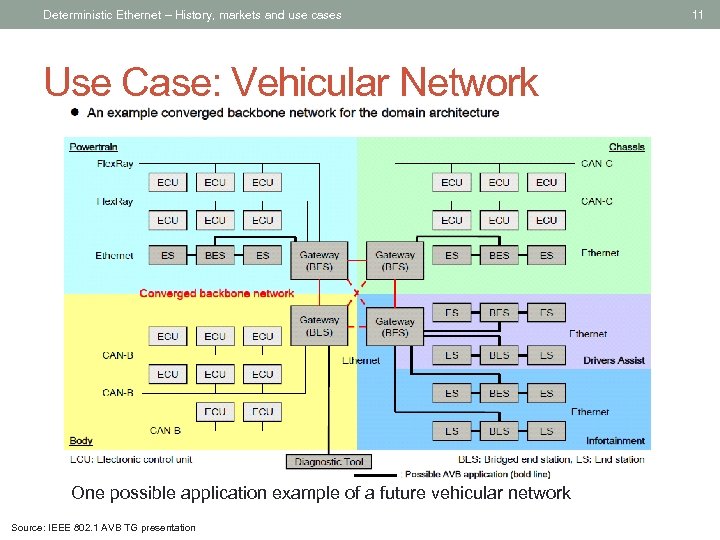 Deterministic Ethernet – History, markets and use cases Use Case: Vehicular Network One possible application example of a future vehicular network Source: IEEE 802. 1 AVB TG presentation 11
 Deterministic Ethernet – History, markets and use cases History and Emerging Markets • One Step further - Added Requirements for a converged IEEE solution for Deterministic Ethernet: • There are many requirements already covered by 802. 1 AVB and • • • other IEEE 802 solutions, but the scope has broadened Need to support larger network structures (long daisy-chains, interconnected rings…) Very High EM resistance and low weight/cost of PHY‘s (see RTPGE) Very low latency and jitter, exceeding the original AVB scope Seamless fault-tolerance Resilient Time Synchronization 802. 1 and 802. 3 are currently starting or have already started to address these market needs! 12
 Deterministic Ethernet 13 TIME SYNCHRONIZATION ON NETWORKS Michael D. Johas Teener, Broadcom Corporation IEEE 802 tutorial November 12, 2012
 Deterministic Ethernet – Time synchronization on networks Agenda • Why do we care? • Network time synch fundamentals • IEEE 802. 1 AS • What’s next 14
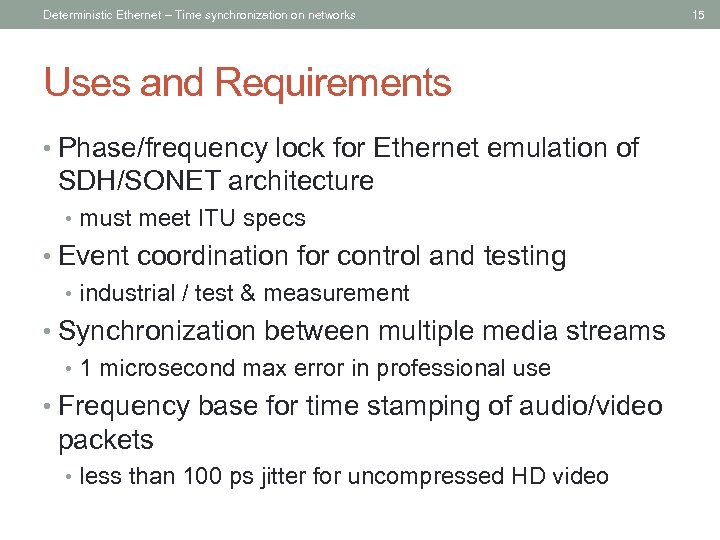 Deterministic Ethernet – Time synchronization on networks Uses and Requirements • Phase/frequency lock for Ethernet emulation of SDH/SONET architecture • must meet ITU specs • Event coordination for control and testing • industrial / test & measurement • Synchronization between multiple media streams • 1 microsecond max error in professional use • Frequency base for time stamping of audio/video packets • less than 100 ps jitter for uncompressed HD video 15
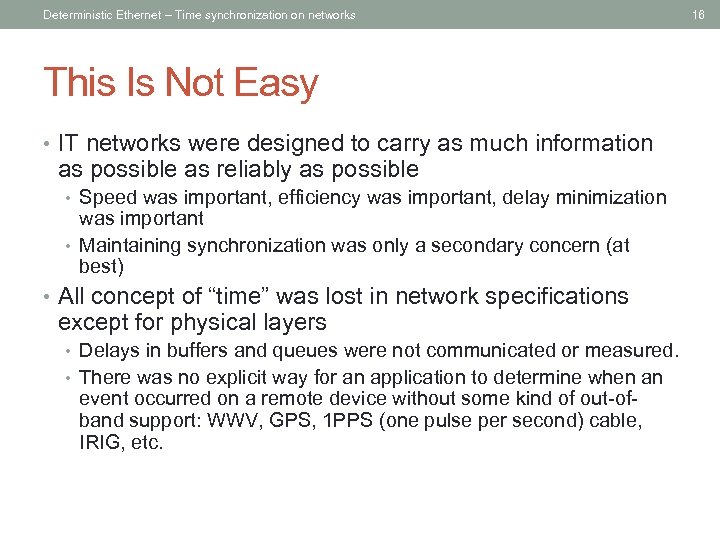 Deterministic Ethernet – Time synchronization on networks This Is Not Easy • IT networks were designed to carry as much information as possible as reliably as possible • Speed was important, efficiency was important, delay minimization was important • Maintaining synchronization was only a secondary concern (at best) • All concept of “time” was lost in network specifications except for physical layers • Delays in buffers and queues were not communicated or measured. • There was no explicit way for an application to determine when an event occurred on a remote device without some kind of out-ofband support: WWV, GPS, 1 PPS (one pulse per second) cable, IRIG, etc. 16
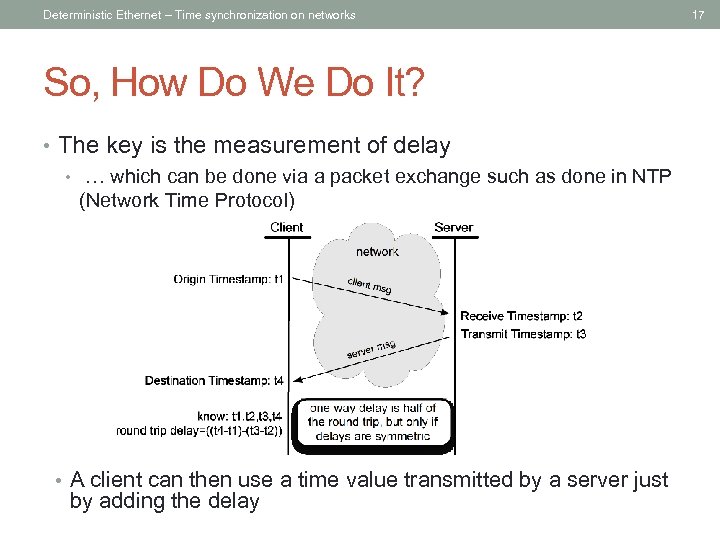 Deterministic Ethernet – Time synchronization on networks So, How Do We Do It? • The key is the measurement of delay • … which can be done via a packet exchange such as done in NTP (Network Time Protocol) • A client can then use a time value transmitted by a server just by adding the delay 17
 Deterministic Ethernet – Time synchronization on networks The Magic Is The Time Stamp • A timestamp is the value of some timer when a particular event occurs • The more precise and deterministic the event, the better • In NTP, it’s not well controlled … usually a kernel/driver software event as close to the hardware as possible, only millisecond accuracy • To get better results, we use a physical layer event … in Ethernet, that’s the start of packet, sub microsecond accuracy • By communicating the value of timestamps at well-known events, we can correlate network actions with actual time. 18
 Deterministic Ethernet – Time synchronization on networks Precision Time Protocol (PTP) • IEEE 1588 standardized the use of physical layer timestamps to compute network delays and define synchronization events • IEEE 802. 1 AS is a 1588 “profile” with fewer options, and extended physical layer options • Components • Time Distribution • Link Delay Measurement • Best Master Clock Selection 19
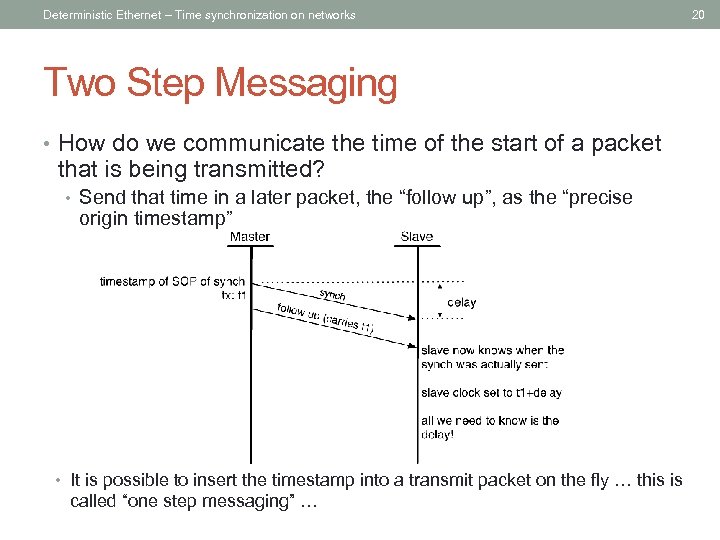 Deterministic Ethernet – Time synchronization on networks Two Step Messaging • How do we communicate the time of the start of a packet that is being transmitted? • Send that time in a later packet, the “follow up”, as the “precise origin timestamp” • It is possible to insert the timestamp into a transmit packet on the fly … this is called “one step messaging” … 20
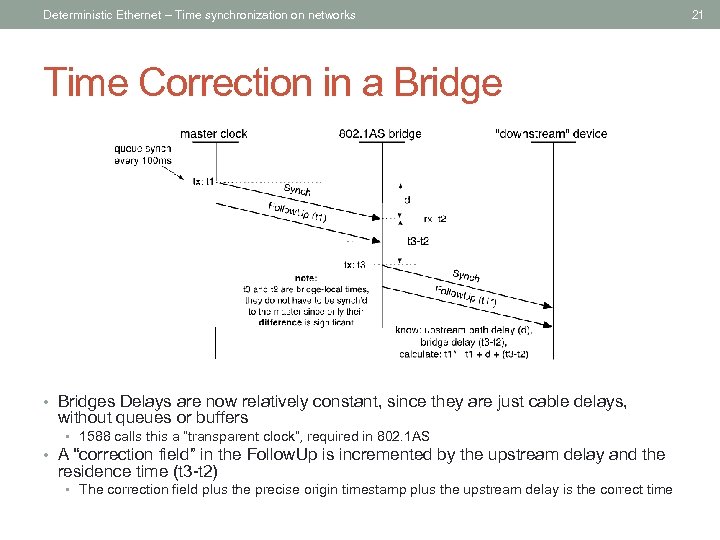 Deterministic Ethernet – Time synchronization on networks Time Correction in a Bridge • Bridges Delays are now relatively constant, since they are just cable delays, without queues or buffers • 1588 calls this a “transparent clock”, required in 802. 1 AS • A “correction field” in the Follow. Up is incremented by the upstream delay and the residence time (t 3 -t 2) • The correction field plus the precise origin timestamp plus the upstream delay is the correct time 21
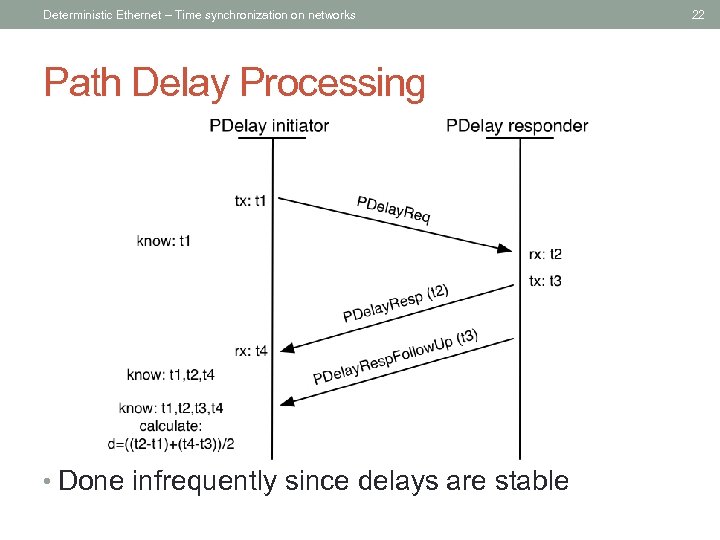 Deterministic Ethernet – Time synchronization on networks Path Delay Processing • Done infrequently since delays are stable 22
 Deterministic Ethernet – Time synchronization on networks IEEE 802. 1 AS • 802. 1 AS uses a subset and superset of IEEE 1588 v 2 • Different methods for delay measurement for different L 2 technologies • 802. 3 (full duplex) is supported using a very specific profile of IEEE 1588 • f 802. 3 (EPON), 802. 11, and generalized CSN’s (coordinated shared networks) are supported by new specifications • Includes performance specifications for bridges as “time aware systems” • Uses accumulated “neighbor rate ratio” calculations to improve accuracy and speed up convergence • Includes plug and play operation and startup • Requires use of a very specific form of BMCA (Best Master Clock Algorithm) that bridges also use 23
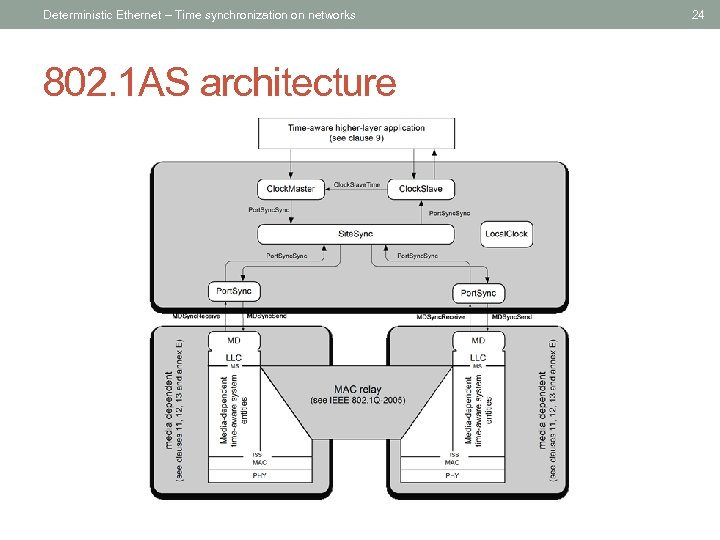 Deterministic Ethernet – Time synchronization on networks 802. 1 AS architecture 24
 Deterministic Ethernet – Time synchronization on networks Best Master Clock Selection • All bridges announce the quality of their clock to their neighbors • The best announcements are propagated • Each bridge compares received announcements to their own clock quality • Quality is comprised of (in decreasing order of importance): • Priority (configurable) • Multiple “clock quality” fields • MAC address • If “superior” announce messages are received • that bridge ceases to announce and adopts the superior bridge as the grand master • If the grand master dies and announce messages cease • all bridges announce and a new grand master is quickly chosen 25
 Deterministic Ethernet – Time synchronization on networks Next Steps (802. 1 ASbt) • Explicit support for one-step processing • Backwards compatible to two-step • Hot standby for backup GMs • Multiple paths for clock propagation • Clock path quality metric 26
 Deterministic Ethernet 27 QUALITY OF SERVICE Christian Boiger Deggendorf University of Applied Sciences IEEE 802 tutorial November 12, 2012
 Deterministic Ethernet – Quality of Service • The requirements on traffic are very different for various applications and types of data • For some applications it is enough to have strict priority transmission selection and low utilization • But for some types of traffic with high Qo. S demands it is not enough to be sent before the lower priority traffic • And some of these applications need guaranteed Qo. S (e. g. guaranteed very low latency) • The “old” IEEE 802. 1 Qo. S mechanisms did not provide guarantees 28
 Deterministic Ethernet – Quality of Service Guaranteed Qo. S • An example for a type of traffic with high Qo. S requirements are audio/video streams • Some applications need guaranteed low latency for this type of data • The network needs low latency (latency = buffers) • Audio Video Bridging addresses this problem • One part of the solution to achieve the requirements of audio/video streams is the combination of: • Stream reservation (incl. bandwidth reservation) • Traffic shaping • Both parts are necessary, in order to provide a latency guarantee for this type of traffic 29
 Deterministic Ethernet – Quality of Service Audio Video Bridging • Audio Video Bridging (AVB) introduced new a type of traffic classes for audio/video streams • SR class A • SR class B • SR class A traffic has the highest priority in the network • The major goals of the AVB Qo. S features are to: • Protect the best effort traffic from the SR class traffic • Protect the SR class traffic from best effort traffic • Protect the SR class traffic from itself • Both AVB Qo. S mechanisms (stream reservation and traffic shaping) address these goals 30
 Deterministic Ethernet – Quality of Service Stream Reservation • The Stream Reservation Protocol (SRP): • Advertises streams in the whole network • Registers the path of streams • Calculates the “worst case latency” • Specifies the forwarding rules for AVB streams • Establishes an AVB domain • Reserves the bandwidth for AVB streams • Especially the bandwidth reservation is important in order to: • Protect the best effort traffic, as only 75% of the bandwidth can be reserved for SR class traffic • Protect the SR class traffic as it is not possible to use more bandwidth for SR class traffic than 75% (this is an important factor in order to guarantee a certain latency) 31
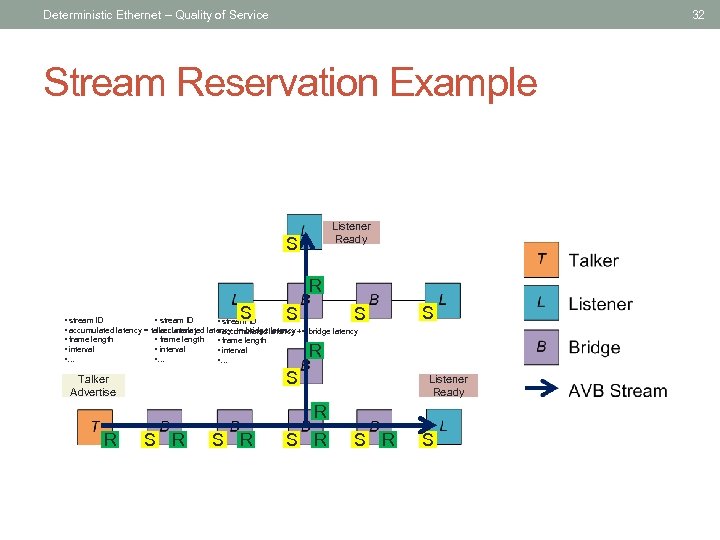 Deterministic Ethernet – Quality of Service 32 Stream Reservation Example Listener Ready S R S S S • stream ID • accumulated latency = talker latency += bridge latency • accumulated latency • frame length • interval • … • … S R S Talker Advertise Listener Ready R R S R S R S
 Deterministic Ethernet – Quality of Service Traffic Shaping • As audio/video streams require a high bandwidth utilization, it was necessary to set the maximum available bandwidth for this new traffic class quite high (75%) • Therefore the Credit Based Shaper (CBS) was introduced • The CBS spaces out the frames as much as possible in order to reduce bursting and bunching • This behavior: • Protects the best effort traffic as the maximum interference (AVB stream burst) for the highest best effort priority is limited and known • Protects the AVB streams, as it limits the back to back AVB stream bursts which can interfere in a bridge 33
 Deterministic Ethernet – Quality of Service Credit Based Shaper 34
 Deterministic Ethernet – Quality of Service Future Work – Gen 2 • The stream reservation protocol and Credit Based Shaper allow for a converged network with IT traffic and high priority SR class traffic (e. g. audio/video streams) with plug and play support • But as shown before, there a lot of non audio/video applications in the industrial and vehicle control area with high Qo. S requirements • The Qo. S requirements of some of these applications can’t be achieved with the current AVB standards • Therefore 802. 1 started new projects to address the needs of this markets • These new projects will provide lowest latency for engineered networks 35
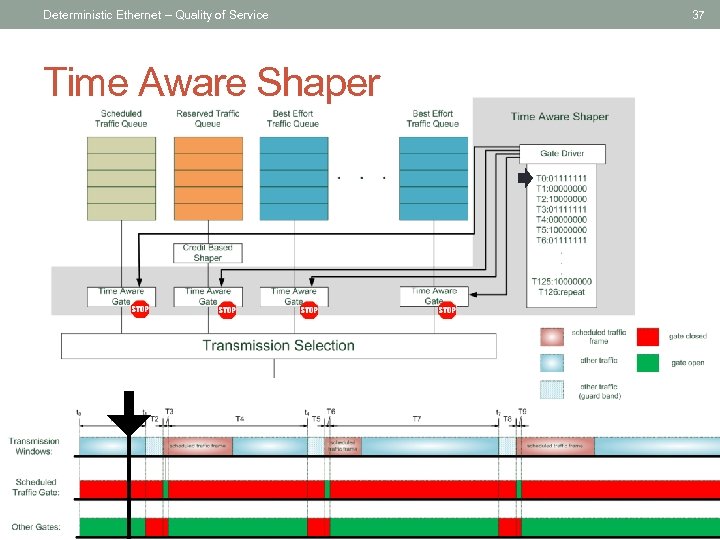
 Deterministic Ethernet – Quality of Service Scheduled Traffic • The latency requirements in the industrial and vehicle control • • • networks imply a significant reduction of latency (compared to AVB Gen 1) Therefore it is necessary to prevent from any interference with other lower priority or even same priority traffic To prevent from any interference, the high priority traffic has to be scheduled IEEE P 802. 1 Qbv will introduce the Time Aware Shaper to allow for Scheduled Traffic In order to enforce the schedule throughout a network, the interference with lower priority traffic has to be prevented, as this would not only increase the latency but also the delivery variation Hence the Time Aware Shaper blocks the non Scheduled Traffic, so that the port is idle when the Scheduled Traffic is scheduled for transmission 36
 Deterministic Ethernet – Quality of Service Time Aware Shaper 37
 Deterministic Ethernet – Quality of Service Qo. S Summary • Audio Video Bridging introduced mechanisms for the convergence of IT networks and audio/video networks • Audio Video Bridging guarantees bandwidth for reserved streams and best effort traffic • Audio Video Bridging guarantees a certain latency for reserved streams • Scheduled Traffic will provide mechanisms to guarantee minimum latency for industrial and vehicle control applications • Studying additional improvements for converged networks which support all three types of traffic in one network 38
 Deterministic Ethernet 39 IEEE 802. 1 aq – SHORTEST PATH BRIDGING János Farkas, Ericsson Paul Unbehagen, Avaya Don Fedyk, Alcatel-Lucent IEEE 802 tutorial November 12, 2012
 Deterministic Ethernet – Shortest Path Bridging Acknowledgements • Many people contributed to 802. 1 aq SPB, which is a significant add-on to 802. 1 Q • The editors • Don Fedyk and Mick Seaman • Major contributors • David Allan, Peter Ashwood-Smith, Nigel Bragg, Jérôme Chiabaut, János Farkas, Stephen Haddock, Ben Mack-Crane, Panagiotis Saltsidis and Paul Unbehagen • This section also involves their contribution 40
 Deterministic Ethernet – Shortest Path Bridging Section Contents • An insight to IEEE 802. 1 aq Shortest Path Bridging (SPB) • SPB is a control protocol Existing data plane leveraged Standardized by IEEE 802. 1 Compatible with other 802. 1 standards; both backwards and “forward” (due to backwards compatibility of future standards) • The insight involves: • A quick look on the data plane • Paradigm shift in the control plane Link state for bridges • A lot of capabilities Advantages and applications • What comes next? 41
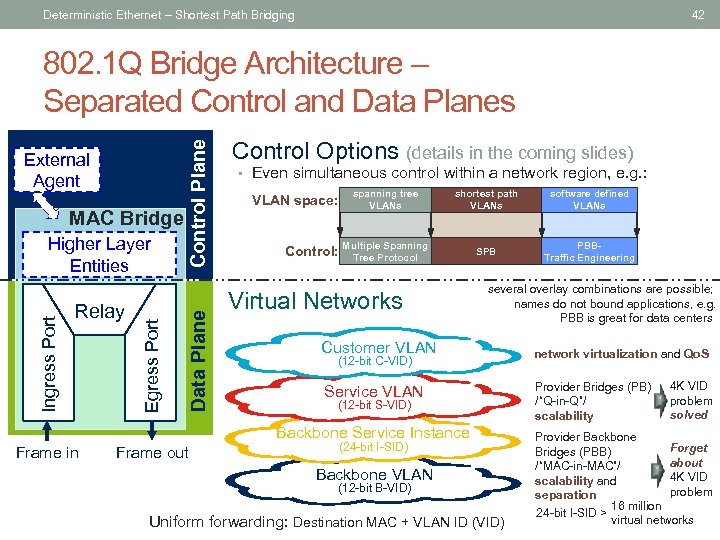 Deterministic Ethernet – Shortest Path Bridging 42 MAC Bridge Relay Egress Port Ingress Port Higher Layer Entities Data Plane External Agent Control Plane 802. 1 Q Bridge Architecture – Separated Control and Data Planes Control Options (details in the coming slides) • Even simultaneous control within a network region, e. g. : VLAN space: spanning tree VLANs shortest path VLANs software defined VLANs SPB PBBTraffic Engineering Control: Multiple Spanning Tree Protocol Virtual Networks several overlay combinations are possible; names do not bound applications, e. g. PBB is great for data centers Virtual LAN (VLAN) Customer VLAN (12 -bit VID) (12 -bit C-VID) Service VLAN (12 -bit S-VID) Backbone Service Instance Frame in Frame out (24 -bit I-SID) Backbone VLAN (12 -bit B-VID) Uniform forwarding: Destination MAC + VLAN ID (VID) network virtualization and Qo. S Provider Bridges (PB) /“Q-in-Q”/ scalability 4 K VID problem solved Provider Backbone Forget Bridges (PBB) about /“MAC-in-MAC”/ 4 K VID scalability and problem separation 16 million 24 -bit I-SID > virtual networks
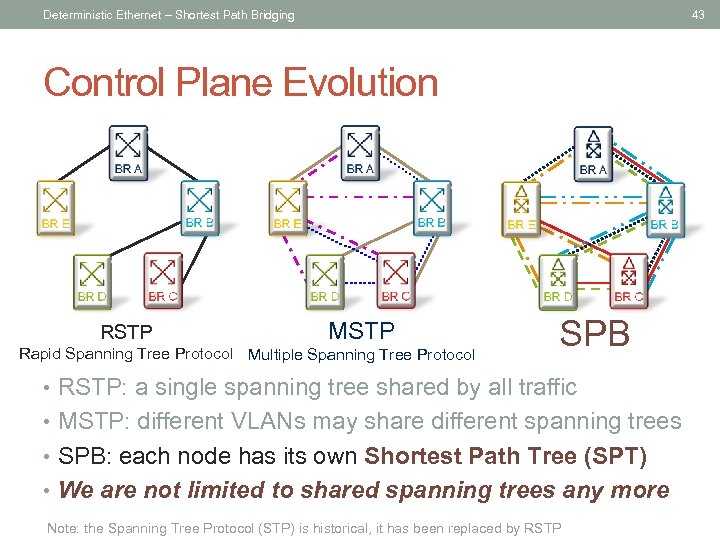 Deterministic Ethernet – Shortest Path Bridging 43 Control Plane Evolution RSTP MSTP Rapid Spanning Tree Protocol Multiple Spanning Tree Protocol SPB • RSTP: a single spanning tree shared by all traffic • MSTP: different VLANs may share different spanning trees • SPB: each node has its own Shortest Path Tree (SPT) • We are not limited to shared spanning trees any more Note: the Spanning Tree Protocol (STP) is historical, it has been replaced by RSTP
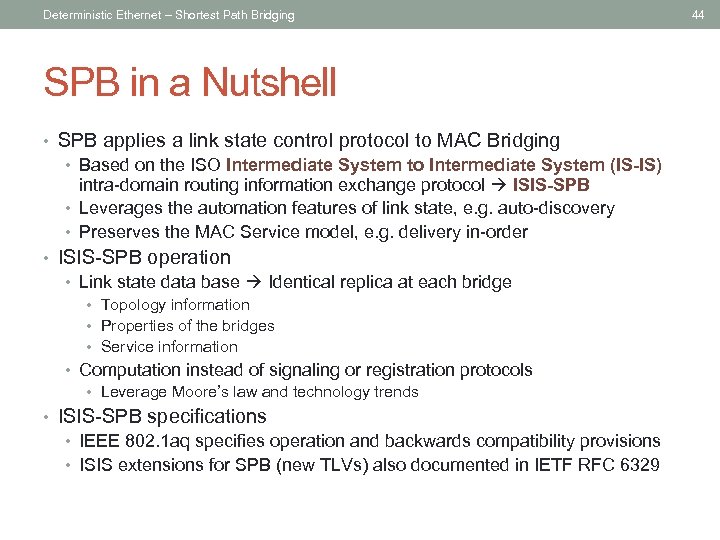 Deterministic Ethernet – Shortest Path Bridging SPB in a Nutshell • SPB applies a link state control protocol to MAC Bridging • Based on the ISO Intermediate System to Intermediate System (IS-IS) intra-domain routing information exchange protocol ISIS-SPB • Leverages the automation features of link state, e. g. auto-discovery • Preserves the MAC Service model, e. g. delivery in-order • ISIS-SPB operation • Link state data base Identical replica at each bridge • Topology information • Properties of the bridges • Service information • Computation instead of signaling or registration protocols • Leverage Moore’s law and technology trends • ISIS-SPB specifications • IEEE 802. 1 aq specifies operation and backwards compatibility provisions • ISIS extensions for SPB (new TLVs) also documented in IETF RFC 6329 44
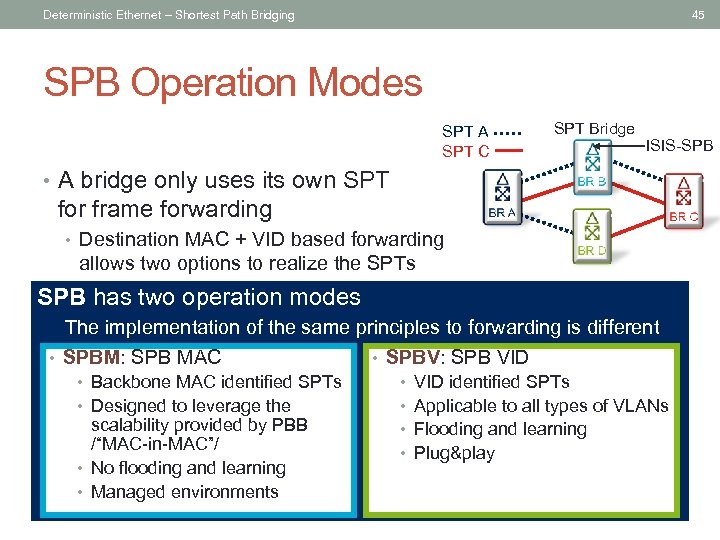 Deterministic Ethernet – Shortest Path Bridging 45 SPB Operation Modes SPT A SPT C SPT Bridge ISIS-SPB • A bridge only uses its own SPT for frame forwarding • Destination MAC + VID based forwarding allows two options to realize the SPTs SPB has two operation modes The implementation of the same principles to forwarding is different • SPBM: SPB MAC • SPBV: SPB VID • Backbone MAC identified SPTs • VID identified SPTs • Designed to leverage the • Applicable to all types of VLANs scalability provided by PBB /“MAC-in-MAC”/ • No flooding and learning • Managed environments • Flooding and learning • Plug&play
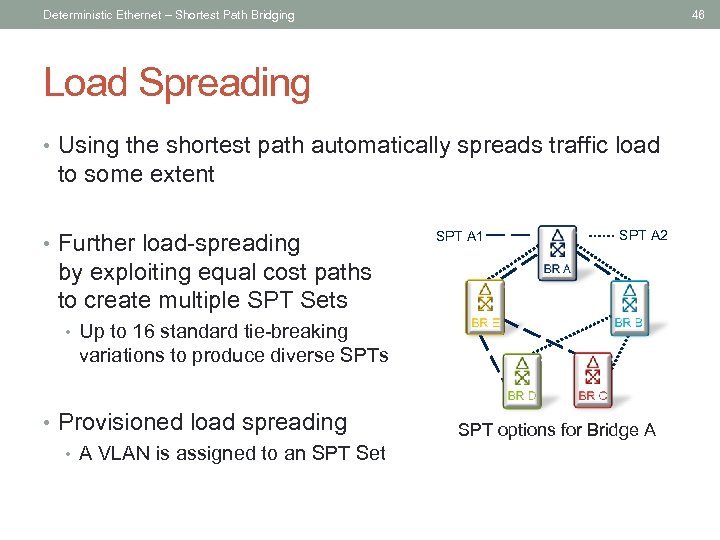 Deterministic Ethernet – Shortest Path Bridging 46 Load Spreading • Using the shortest path automatically spreads traffic load to some extent • Further load-spreading SPT A 1 SPT A 2 by exploiting equal cost paths to create multiple SPT Sets • Up to 16 standard tie-breaking variations to produce diverse SPTs • Provisioned load spreading • A VLAN is assigned to an SPT Set SPT options for. Set An SPT Bridge A
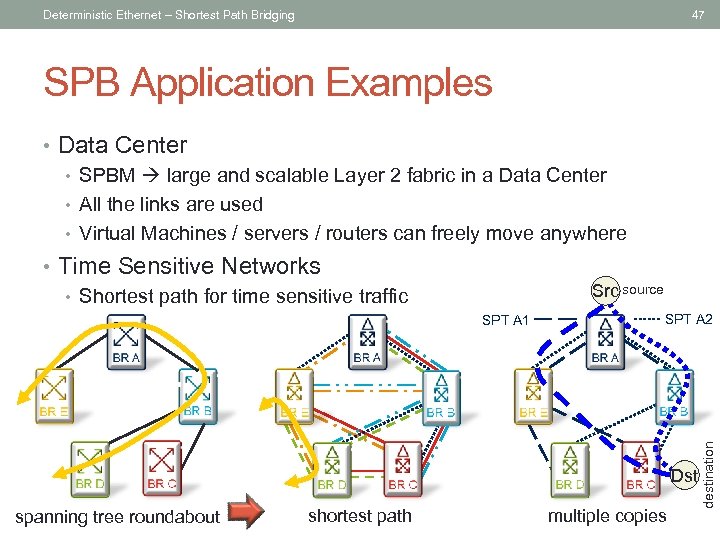 Deterministic Ethernet – Shortest Path Bridging 47 SPB Application Examples • Data Center • SPBM large and scalable Layer 2 fabric in a Data Center • All the links are used • Virtual Machines / servers / routers can freely move anywhere • Time Sensitive Networks • Shortest path for time sensitive traffic Src source SPT A 2 Dst spanning tree roundabout shortest path multiple copies destination SPT A 1
 Deterministic Ethernet – Shortest Path Bridging SPB Summary: A Great Feature Set • Single link state control for large networks • High degree of automation • Scalability (thousand nodes) • Deterministic multiple shortest path routing • Optimum multicast • Minimized address learning • Fast convergence (within the range of 100 msec) • All 802. 1 standards supported, e. g. • Connectivity Fault Management (802. 1 ag CFM) • Edge Virtual Bridging (802. 1 Qbg EVB) • Metro Ethernet Forum (MEF) services natively provided • E-LINE, E-TREE, E-LAN 48
 Deterministic Ethernet – Shortest Path Bridging Ongoing SPB Related Activities • Deployments • Multiple vendors shipping product • Three Interops so far: Alcatel-Lucent, Avaya, Huawei, Solana, Spirent • 802. 1 Qbp – Equal Cost Multiple Paths (ECMP) – Ongoing project • Per hop load balancing for unicast • Shared trees for multicast • Standardized Flow Hash OAM enabler • New tag to carry Flow Hash and TTL • 802. 1 Qca – Path Control and Reservation – Project proposal • Beyond shortest path Explicit path control • Leveraging link state for • Bandwidth and stream reservation • Redundancy (protection or restoration) for data flows • Distribution of control parameters for time synchronization and scheduling • More on IS-IS based future in the next section by Norm 49
 Deterministic Ethernet 50 MIXED-TECHNOLOGY NETWORKING Norman Finn, Cisco Systems IEEE 802 tutorial November 12, 2012
 Deterministic Ethernet – Mixed-technology networking Mixed-technology Networking There are two senses in which 802. 1 is pursuing mixedtechnology networking. • Bridging together diverse media. • Simultaneous use of different topology control protocols and Qo. S mechanisms. Both are essential in achieving the goal of providing “convergence”: a single network that can support both mission-critical industrial or vehicular control applications, and more general traffic such as audio, video, and bulk data transfer. 51
 Deterministic Ethernet – Mixed-technology networking Diverse Media • In the early days of IEEE 802, bridges used the Spanning Tree protocol to interconnect 802. 3 Ethernet, 802. 5 Token Ring, FDDI, and other technologies into one network. • Over the years, only 802. 3 survived in the market. • 802. 1 is again reaching out to integrate multiple technologies into a bridged network: • IEEE 802. 11 Wi-Fi • IEEE 1901 Broadband Over Power Line • Multimedia over Coax Alliance (Mo. CA) • More? ? • The object is to allow stations on any of these media to speak freely with stations of the same or other media via standard bridges. 52
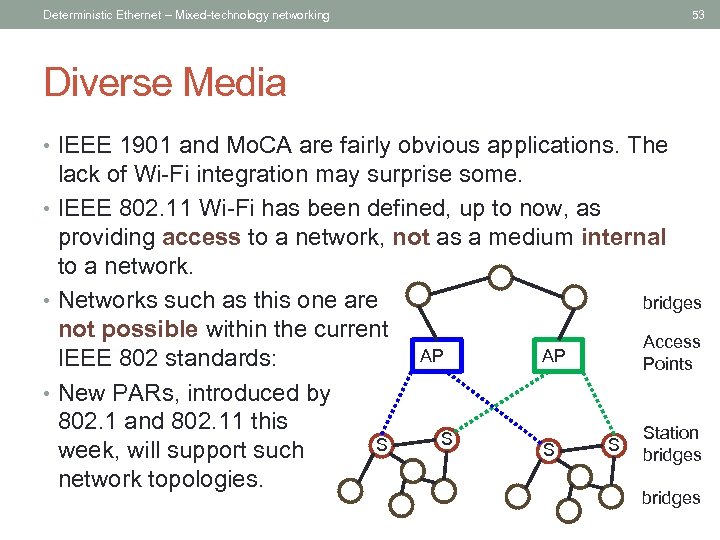 Deterministic Ethernet – Mixed-technology networking 53 Diverse Media • IEEE 1901 and Mo. CA are fairly obvious applications. The lack of Wi-Fi integration may surprise some. • IEEE 802. 11 Wi-Fi has been defined, up to now, as providing access to a network, not as a medium internal to a network. • Networks such as this one are bridges not possible within the current Access AP AP IEEE 802 standards: Points • New PARs, introduced by 802. 1 and 802. 11 this Station S S week, will support such bridges network topologies. bridges
 Deterministic Ethernet – Mixed-technology networking Multiple Topology Control Protocols In the industrial and vehicular markets, there are many different mechanisms for topology control protocols that provide robust networks in the face of possible failures: • No redundancy. Very simple, but not very resilient. • Rings. Fast (10 ms) failure recovery, but high hop count. • Spanning tree. Guaranteed connectivity, plug-and-play, but poor worst-case recovery time and high hop count. • Duplicate delivery. 0 -time failure recovery, but costs in configuration effort and bandwidth. • Shortest Path Bridging. Good recovery time, guaranteed connectivity, but expensive in CPU cycles and training. 54
 Deterministic Ethernet – Mixed-technology networking Multiple Qualities of Service As mentioned earlier in this tutorial, there are many different Quality of Service features desired by designers and users of industrial and vehicular networks: • Priority-base best-effort. Most important goes, less important waits. • Fair queuing. Most important is more favored, less important waits more, all get at least some bandwidth. bridges • Reserved flows. Make reservations for max-bandwidth flows; those flows get latency and delivery guarantees. • Scheduled transmissions. Specific frames transmitted at specific times on a repeating schedule. Proper use of Qo. S permits the convergence of network usage models. 55
 Deterministic Ethernet – Mixed-technology networking Multiplication of Solutions • At present, various public standards bodies and industry consortia provide different standards for topology control and Qo. S; they often compete for market- and mind-share. • A single user in a single network can have needs not addressable by any one topology control + Qo. S suite. • Furthermore, there is increasing pressure to integrate industrial and vehicular control networks into larger company networks, or into the Big-I Internet, at Layer 3 and above; this introduces many more topology control and Qo. S ideas. 56
 Deterministic Ethernet – Mixed-technology networking Seeing the Forest, Not Just Trees • Ultimately, an industrial control or vehicular network is made of boxes and connections passing packets. There are two decisions to be made for every packet: • On what port (if any) is this packet to be sent? (FORWARDING) • Given that there are potentially many packets queued up on the selected output port, when is this packet sent? (Qo. S) • We make this observation: Qo. S decisions are largely orthogonal to forwarding decisions. That is, the various topology control protocols, even if operating at Layer 2 and Layer 3, have to cooperate and interoperate at the port level to decide which packet to send next on this connection. 57
 Deterministic Ethernet – Mixed-technology networking Simultaneous Topology Control • The standard IEEE 802. 1 data forwarding mechanism (the “ 802. 1 data plane”) supports most standard topology control protocols, covering all of the classes mentioned, earlier (spanning tree, SPB, rings, etc. ) by many different standards bodies (ISO/IEC, ITU-T, etc. ) • The standard IEEE 802. 1 Qo. S mechanisms are the most complete of any standard, at either Layer 2 or Layer 3, for converged industrial and vehicular control networks. 58
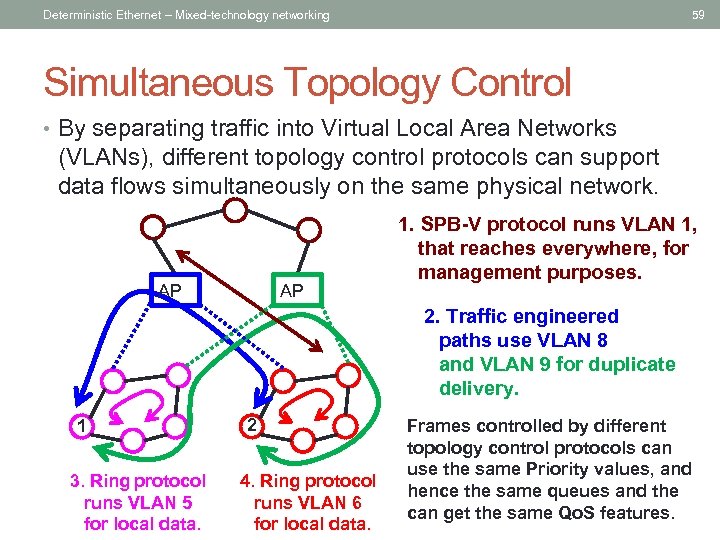 Deterministic Ethernet – Mixed-technology networking 59 Simultaneous Topology Control • By separating traffic into Virtual Local Area Networks (VLANs), different topology control protocols can support data flows simultaneously on the same physical network. AP AP 1. SPB-V protocol runs VLAN 1, that reaches everywhere, for management purposes. 2. Traffic engineered paths use VLAN 8 and VLAN 9 for duplicate delivery. 1 3. Ring protocol runs VLAN 5 for local data. 2 4. Ring protocol runs VLAN 6 for local data. Frames controlled by different topology control protocols can use the same Priority values, and hence the same queues and the can get the same Qo. S features.
 Deterministic Ethernet – Mixed-technology networking And Under It All – ISIS • Underlying these networks is a “glue” protocol: the ISO Intermediate System to Intermediate System protocol, ISIS. (Hopefully, with a simplified subset for use by simple devices, in order to enable trading capability for development and deployment costs. ) • Using ISIS to report the network topology, carry Qo. S protocols (such as bandwidth reservation), and support new features provides now-competing standards organizations with a neutral ground for feature development that will be beneficial to all. 60
 Deterministic Ethernet 61 SUMMARY IEEE 802 tutorial November 12, 2012
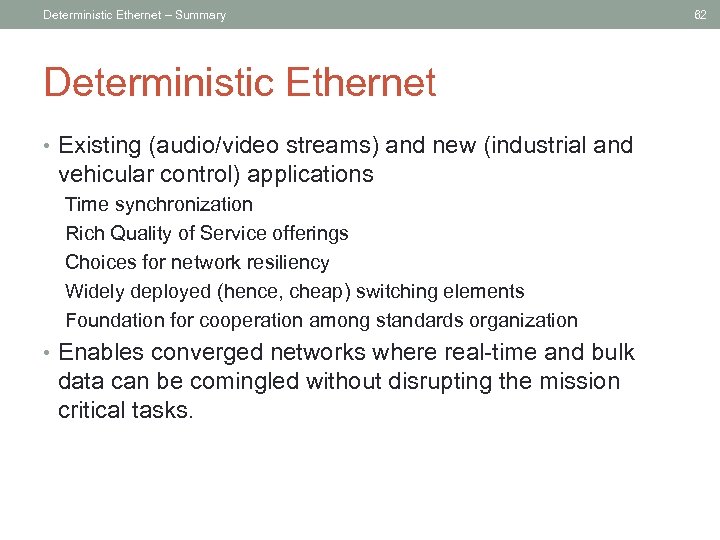 Deterministic Ethernet – Summary Deterministic Ethernet • Existing (audio/video streams) and new (industrial and vehicular control) applications Time synchronization Rich Quality of Service offerings Choices for network resiliency Widely deployed (hence, cheap) switching elements Foundation for cooperation among standards organization • Enables converged networks where real-time and bulk data can be comingled without disrupting the mission critical tasks. 62
 Deterministic Ethernet 63 REFERENCES IEEE 802 tutorial November 12, 2012
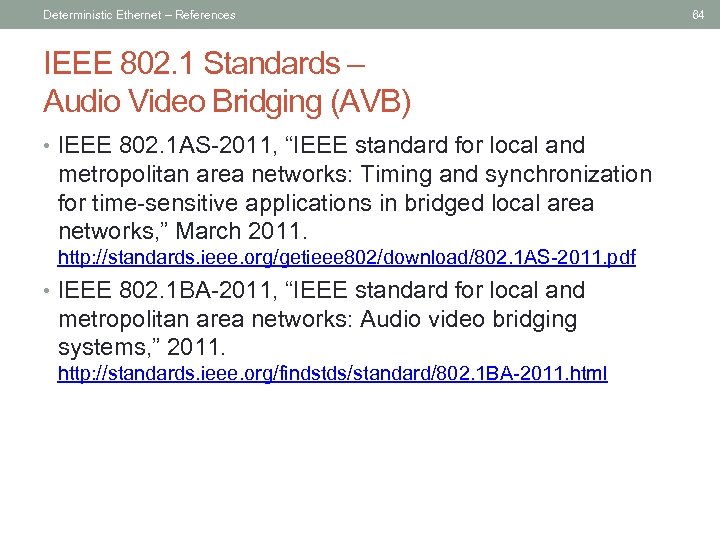 Deterministic Ethernet – References IEEE 802. 1 Standards – Audio Video Bridging (AVB) • IEEE 802. 1 AS-2011, “IEEE standard for local and metropolitan area networks: Timing and synchronization for time-sensitive applications in bridged local area networks, ” March 2011. http: //standards. ieee. org/getieee 802/download/802. 1 AS-2011. pdf • IEEE 802. 1 BA-2011, “IEEE standard for local and metropolitan area networks: Audio video bridging systems, ” 2011. http: //standards. ieee. org/findstds/standard/802. 1 BA-2011. html 64
 Deterministic Ethernet – References IEEE 802. 1 Standards – Data Center Bridging (DCB) • IEEE 802. 1 BR, “IEEE standard for local and metropolitan area networks: Media access control (MAC) bridges and virtual bridged local area networks: Bridge port extension, ” 2012. https: //standards. ieee. org/findstds/standard/802. 1 BR-2012. html • IEEE 802. 1 Qaz, “IEEE standard for local and metropolitan area networks: Media access control (MAC) bridges and virtual bridged local area networks – Amendment 18: Enhanced transmission selection for bandwidth sharing between traffic classes, ” September 2001. http: //standards. ieee. org/getieee 802/download/802. 1 Qaz-2011. pdf • IEEE 802. 1 Qbb, “IEEE standard for local and metropolitan area networks: Media access control (MAC) bridges and virtual bridged local area networks – Amendment 17: Priority-based flow control, ” September 2011. http: //standards. ieee. org/getieee 802/download/802. 1 Qbb-2011. pdf • IEEE 802. 1 Qbg, “IEEE standard for local and metropolitan area networks: Media access control (MAC) bridges and virtual bridged local area networks – Amendment 21: Edge virtual bridging, ” 2012. http: //standards. ieee. org/findstds/standard/802. 1 Qbg-2012. html 65
 Deterministic Ethernet – References IEEE 802. 1 Standards – Interworking • IEEE 802. 1 AB-2009, “IEEE standard for local and metropolitan area networks: Station and media access control • • connectivity discovery, ” September 2009. http: //standards. ieee. org/getieee 802/download/802. 1 AB-2009. pdf IEEE 802. 1 AX-2008, “IEEE standard for local and metropolitan area networks: Link aggregation, ” November 2008. http: //standards. ieee. org/getieee 802/download/802. 1 AX-2008. pdf IEEE 802. 1 D-2004, ”IEEE standard for local and metropolitan area networks: Media access control (MAC) bridges, ” June 2004. http: //standards. ieee. org/getieee 802/download/802. 1 D-2004. pdf IEEE 802. 1 H-1997, “IEEE technical report and guidelines - Part 5: Media access control (MAC) bridging of Ethernet V 2. 0 in local area networks, ” May 2002, http: //standards. ieee. org/getieee 802/download/802. 1 H-1997. pdf IEEE 802. 1 Q-2011, ”IEEE standard for local and metropolitan area networks: Media access control (MAC) bridges and virtual bridged local area networks, ” August 2011. http: //standards. ieee. org/getieee 802/download/802. 1 Q 2011. pdf IEEE 802. 1 aq, “IEEE standard for local and metropolitan area networks: Media access control (MAC) bridges and virtual bridged local area networks – Amendment 20: Shortest path bridging, ” June 2012. http: //standards. ieee. org/findstds/standard/802. 1 aq-2012. html IEEE 802. 1 Qbc, “IEEE standard for local and metropolitan area networks: Media access control (MAC) bridges and virtual bridged local area networks – Amendment 16: Provider bridging: Remote customer service interfaces, ” September 2011. http: //standards. ieee. org/getieee 802/download/802. 1 Qbc-2011. pdf IEEE 802. 1 Qbe, “IEEE standard for local and metropolitan area networks: Media access control (MAC) bridges and virtual bridged local area networks – Amendment 15: Multiple I-SID registration protocol, ” September 2011. http: //standards. ieee. org/getieee 802/download/802. 1 Qbe-2011. pdf IEEE 802. 1 Qbf, “IEEE standard for local and metropolitan area networks: Media access control (MAC) bridges and virtual bridged local area networks – Amendment 19: PBB-TE infrastructure segment protection, ” December 2011. http: //standards. ieee. org/getieee 802/download/802. 1 Qbf-2011. pdf • Note that 802. 1 Q-2011 incorporates amendments 802. 1 ad-2005, 802. 1 ak-2007, 802. 1 ag-2007, 802. 1 ah-2008, 802 -1 Q-2005/Cor-1 -2008, 802. 1 ap-2008, 802. 1 Qaw-2009, 802. 1 Qay-2009, 802. 1 aj-2009, 802. 1 Qav-2009, 802. 1 Qau -2010, and 802. 1 Qat-2010. 66
 Deterministic Ethernet – References IEEE 802. 1 Standards – Security • IEEE 802. 1 AE-2006, “IEEE standard for local and metropolitan area networks: Media access control (MAC) security, ” August 2006. http: //standards. ieee. org/getieee 802/download/802. 1 AE-2006. pdf • IEEE 802. 1 AEbn-2011, “IEEE standard for local and metropolitan area networks: Media access control (MAC) security amendment 1: Galois counter code - Advanced encryption standard - 256 (GCMAES-256) cipher suite, ” October 2011. http: //standards. ieee. org/getieee 802/download/802. 1 AEbn-2011. pdf • IEEE 802. 1 AR-2009, “IEEE standard for local and metropolitan area networks: Secure device identity, ” December 2009. http: //standards. ieee. org/getieee 802/download/802. 1 AR. -2009. pdf • IEEE 802. 1 X-2010, “IEEE standard for local and metropolitan area networks: Port-based network access control, ” February 2010. http: //standards. ieee. org/getieee 802/download/802. 1 X-2010. pdf 67
 Deterministic Ethernet – References Ongoing IEEE 802. 1 Projects • Audio Video Bridging (may be renamed to Time Sensitive Networking) • P 802. 1 ASbt, “Draft standard for local and metropolitan area networks: Timing and synchronization: Enhancements and performance improvements, ” http: //www. ieee 802. org/1/pages/802. 1 asbt. html • P 802. 1 Qbv, “Draft standard for local and metropolitan area networks: Media access control (MAC) bridges and virtual bridged local area networks – Amendment: Enhancements for scheduled traffic, ” http: //www. ieee 802. org/1/pages/802. 1 bv. html • P 802. 1 Qbu, “Draft standard for local and metropolitan area networks: Media access control (MAC) bridges and virtual bridged local area networks – Amendment: Frame preemption, ” http: //www. ieee 802. org/1/pages/802. 1 bu. html • Interworking • P 802 -REV, ““Draft standard for local and metropolitan area networks: Overview & architecture, ” Revision, http: //www. ieee 802. org/1/pages/802 -rev. html • P 802. 1 AX-REV, “IEEE standard for local and metropolitan area networks: Link aggregation, ” Revision incorporating Distributed Resilient Network Interconnect (DRNI), http: //www. ieee 802. org/1/pages/802. 1 AXrev. html • P 802. 1 Qbp, “Draft standard for local and metropolitan area networks: Media access control (MAC) bridges and virtual bridged local area networks – Amendment: Equal cost multiple paths (ECMP), ” http: //www. ieee 802. org/1/pages/802. 1 bp. html • Security • P 802. 1 AEbw, “IEEE standard for local and metropolitan area networks: Media access control (MAC) security – Amendment : Extended packet numbering, ” http: //www. ieee 802. org/1/pages/802. 1 aebw. html • Note that access to “ 802. 1 private area“ is free. Access control is just a very basic tool to filter really interested readers/contributors. Ask 802. 1 people! 68
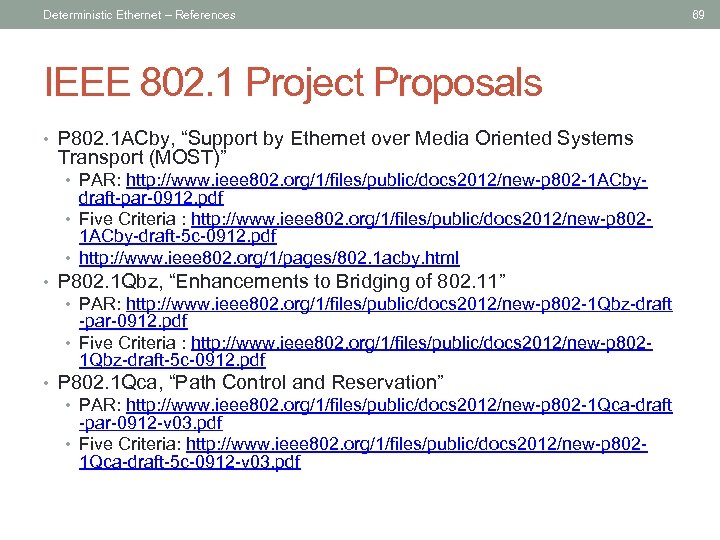 Deterministic Ethernet – References IEEE 802. 1 Project Proposals • P 802. 1 ACby, “Support by Ethernet over Media Oriented Systems Transport (MOST)” • PAR: http: //www. ieee 802. org/1/files/public/docs 2012/new-p 802 -1 ACby- draft-par-0912. pdf • Five Criteria : http: //www. ieee 802. org/1/files/public/docs 2012/new-p 8021 ACby-draft-5 c-0912. pdf • http: //www. ieee 802. org/1/pages/802. 1 acby. html • P 802. 1 Qbz, “Enhancements to Bridging of 802. 11” • PAR: http: //www. ieee 802. org/1/files/public/docs 2012/new-p 802 -1 Qbz-draft -par-0912. pdf • Five Criteria : http: //www. ieee 802. org/1/files/public/docs 2012/new-p 8021 Qbz-draft-5 c-0912. pdf • P 802. 1 Qca, “Path Control and Reservation” • PAR: http: //www. ieee 802. org/1/files/public/docs 2012/new-p 802 -1 Qca-draft -par-0912 -v 03. pdf • Five Criteria: http: //www. ieee 802. org/1/files/public/docs 2012/new-p 8021 Qca-draft-5 c-0912 -v 03. pdf 69
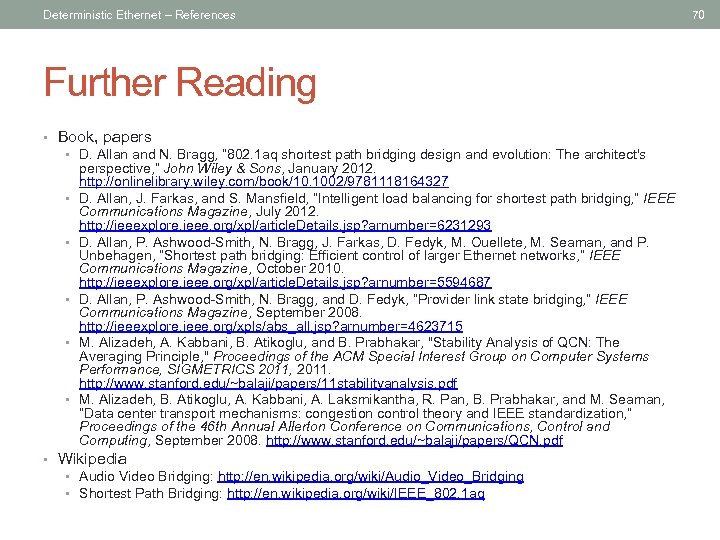 Deterministic Ethernet – References Further Reading • Book, papers • D. Allan and N. Bragg, “ 802. 1 aq shortest path bridging design and evolution: The architect's perspective, ” John Wiley & Sons, January 2012. http: //onlinelibrary. wiley. com/book/10. 1002/9781118164327 • D. Allan, J. Farkas, and S. Mansfield, “Intelligent load balancing for shortest path bridging, ” IEEE Communications Magazine, July 2012. http: //ieeexplore. ieee. org/xpl/article. Details. jsp? arnumber=6231293 • D. Allan, P. Ashwood-Smith, N. Bragg, J. Farkas, D. Fedyk, M. Ouellete, M. Seaman, and P. Unbehagen, ”Shortest path bridging: Efficient control of larger Ethernet networks, ” IEEE Communications Magazine, October 2010. http: //ieeexplore. ieee. org/xpl/article. Details. jsp? arnumber=5594687 • D. Allan, P. Ashwood-Smith, N. Bragg, and D. Fedyk, “Provider link state bridging, ” IEEE Communications Magazine, September 2008. http: //ieeexplore. ieee. org/xpls/abs_all. jsp? arnumber=4623715 • M. Alizadeh, A. Kabbani, B. Atikoglu, and B. Prabhakar, "Stability Analysis of QCN: The Averaging Principle, " Proceedings of the ACM Special Interest Group on Computer Systems Performance, SIGMETRICS 2011, 2011. http: //www. stanford. edu/~balaji/papers/11 stabilityanalysis. pdf • M. Alizadeh, B. Atikoglu, A. Kabbani, A. Laksmikantha, R. Pan, B. Prabhakar, and M. Seaman, “Data center transport mechanisms: congestion control theory and IEEE standardization, ” Proceedings of the 46 th Annual Allerton Conference on Communications, Control and Computing, September 2008. http: //www. stanford. edu/~balaji/papers/QCN. pdf • Wikipedia • Audio Video Bridging: http: //en. wikipedia. org/wiki/Audio_Video_Bridging • Shortest Path Bridging: http: //en. wikipedia. org/wiki/IEEE_802. 1 aq 70
 Deterministic Ethernet 71 ABBREVIATIONS IEEE 802 tutorial November 12, 2012
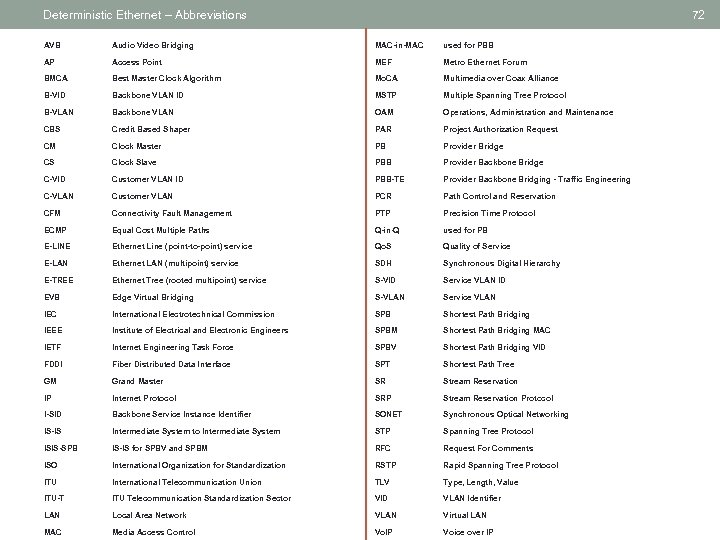 Deterministic Ethernet – Abbreviations 72 AVB Audio Video Bridging MAC-in-MAC used for PBB AP Access Point MEF Metro Ethernet Forum BMCA Best Master Clock Algorithm Mo. CA Multimedia over Coax Alliance B-VID Backbone VLAN ID MSTP Multiple Spanning Tree Protocol B-VLAN Backbone VLAN OAM Operations, Administration and Maintenance CBS Credit Based Shaper PAR Project Authorization Request CM Clock Master PB Provider Bridge CS Clock Slave PBB Provider Backbone Bridge C-VID Customer VLAN ID PBB-TE Provider Backbone Bridging - Traffic Engineering C-VLAN Customer VLAN PCR Path Control and Reservation CFM Connectivity Fault Management PTP Precision Time Protocol ECMP Equal Cost Multiple Paths Q-in-Q used for PB E-LINE Ethernet Line (point-to-point) service Qo. S Quality of Service E-LAN Ethernet LAN (multipoint) service SDH Synchronous Digital Hierarchy E-TREE Ethernet Tree (rooted multipoint) service S-VID Service VLAN ID EVB Edge Virtual Bridging S-VLAN Service VLAN IEC International Electrotechnical Commission SPB Shortest Path Bridging IEEE Institute of Electrical and Electronic Engineers SPBM Shortest Path Bridging MAC IETF Internet Engineering Task Force SPBV Shortest Path Bridging VID FDDI Fiber Distributed Data Interface SPT Shortest Path Tree GM Grand Master SR Stream Reservation IP Internet Protocol SRP Stream Reservation Protocol I-SID Backbone Service Instance Identifier SONET Synchronous Optical Networking IS-IS Intermediate System to Intermediate System STP Spanning Tree Protocol ISIS-SPB IS-IS for SPBV and SPBM RFC Request For Comments ISO International Organization for Standardization RSTP Rapid Spanning Tree Protocol ITU International Telecommunication Union TLV Type, Length, Value ITU-T ITU Telecommunication Standardization Sector VID VLAN Identifier LAN Local Area Network VLAN Virtual LAN MAC Media Access Control Vo. IP Voice over IP