


 Скачать презентацию Determination of Trade Policy in the real world
aced0e2be9356cb8d02d3bc34021cabb.ppt
- Количество слайдов: 13
 Determination of Trade Policy in the real world §Political §Economical – Optimum Tariff Rate §Strategic Game Playing between Countries • Negotiations under the WTO umbrella
 Income Distribution and Trade Policy § § Electoral Competition • Political scientists argue that policies are determined by competition among political parties that try to attract as many votes as possible. Trade Policy and Collective Action • Trade policies that impose total large losses that are spread among many individual firms or consumers may not face opposition. – Industries that are well organized (or have a small number of firms) get protection. • Interest groups “buy” policies by offering contributions § contingent on the policies followed by the government. Strategic Multi and Bi lateral trade Agreements - Strategic Behavior in the Global World.
 Income Distribution and Trade Policy § Who Gets Protected? • Following sectors seem to get protected in advanced countries: – Agriculture – Farmers are well organized and the structure of the U. S. government enhances their political power. – Clothing – Both textiles and apparel have enjoyed substantial protection. This sector employs less skilled workers and it is unionized as well. – Steel – On March 5, 2002, the US President announced the imposition of temporary tariffs, ranging from 8 percent to 30 percent on approximately $5 billion of steel imports, to last 3 years
 International Negotiations and Trade Policy § How was the removal of tariffs politically possible? • The postwar liberalization of trade was achieved through international negotiation. – Governments agreed to engage in mutual tariff reduction. § The Advantages of Negotiation • It is easier to lower tariffs as part of a mutual agreement than to do so as a unilateral policy because: – It helps mobilize exporters to support freer trade. – It can help governments avoid getting caught in destructive trade wars.
 International Negotiations and Trade Policy Eight GATT trade rounds have occurred since 1947: An eighth round of negotiations, the so-called Uruguay Round, was competed in 1994. § § § The Uruguay Round • Its most important results are: – Trade liberalization – Administrative reforms Trade Liberalization • The average tariff imposed by advanced countries decreased by almost 40%. – More important is the move to liberalize trade in two important sectors: agricultural and clothing. From the GATT to the WTO • Much of the publicity surrounding the Uruguay Round focused on its creation of the WTO.
 § Negotiations: Multilateral § Negotiations: Bilateral
 International Negotiations and Trade Policy § Preferential Trading Agreements • Nations establish preferential trading agreements • under which they lower tariffs with respect to each other but not the rest of the world. The GATT-WTO, through the principle of nondiscrimination called the “most favored nation” (MFN) principle, prohibits such agreements. – The formation of preferential trading agreements is allowed if they lead to free trade between the agreeing countries.
 International Negotiations and Trade Policy • Free trade can be established among several WTO members as follows: – A free trade area allows free-trade among members, but each member can have its own trade policy towards non-member countries. – Example: The North American Free Trade Agreement (NAFTA) creates a free trade area. – A customs union allows free trade among members and requires a common external trade policy towards non-member countries. – South Africa, Botswana, Lesotho and Swaziland established the Southern African Customs Union (SACU) in 1969 as a continuance of their custom union arrangements, which are in force since 1910. – A common market is a customs union with free factor movements (especially labor) among members. – Example: The European Union (EU) is a full customs union.
 International Negotiations and Trade Policy § Are preferential trading agreements good? • It depends on whether it leads to trade creation or trade diversion. – Trade creation – Occurs when the formation of a preferential trading agreement leads to replacement of high-cost domestic production by low-cost imports from other members. – Trade diversion – Occurs when the formation of a preferential trading agreement leads to the replacement of low-cost imports from non members with higher-cost imports from member nations.
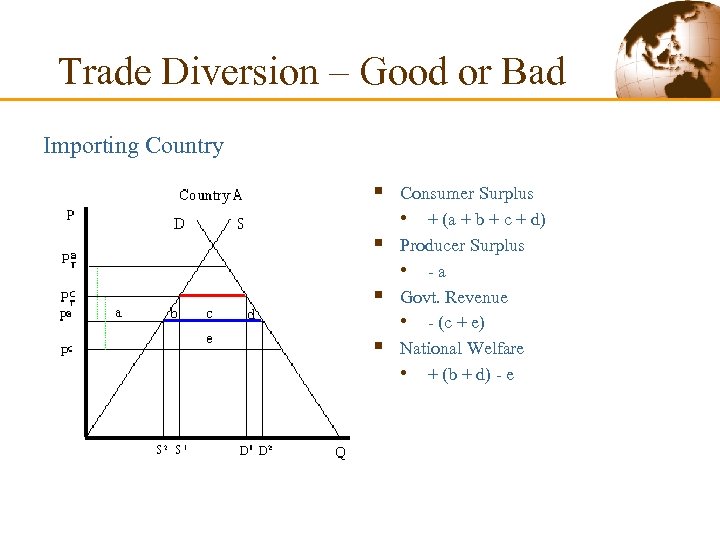 Trade Diversion – Good or Bad Importing Country § § Consumer Surplus • + (a + b + c + d) Producer Surplus • -a Govt. Revenue • - (c + e) National Welfare • + (b + d) - e
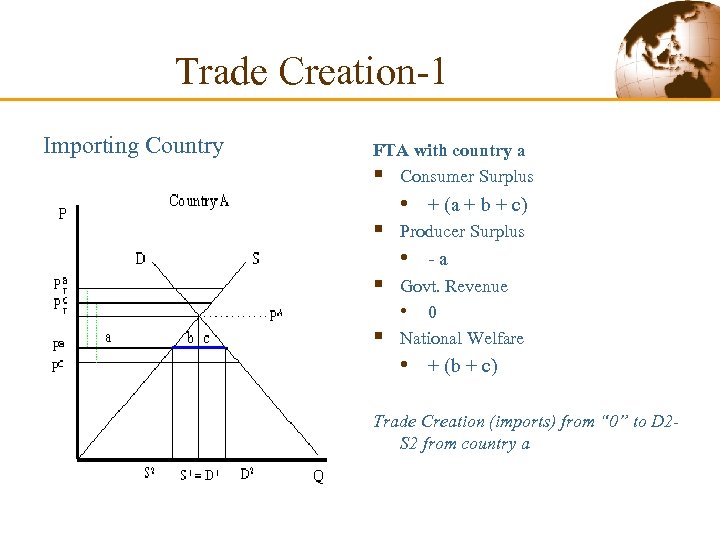 Trade Creation-1 Importing Country FTA with country a § Consumer Surplus § § § • + (a + b + c) Producer Surplus • -a Govt. Revenue • 0 National Welfare • + (b + c) Trade Creation (imports) from “ 0” to D 2 S 2 from country a
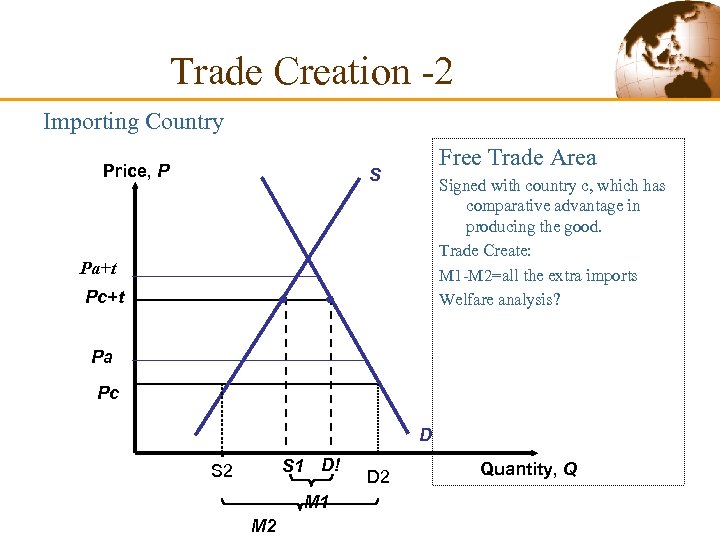 Trade Creation -2 Importing Country Price, P Free Trade Area S Signed with country c, which has comparative advantage in producing the good. Trade Create: M 1 -M 2=all the extra imports Welfare analysis? Pa+t Pc+t Pa Pc D S 1 D! S 2 M 1 M 2 D 2 Quantity, Q
 AD- Trade Restriction and Trade Diversion § Importing Country § Level of Import Restriction: • § [(D 1 - S 1) - (D 2 - S 2)] Level of Import Diversion from country A to country C: • [(D 2 -S 2) - (D 3 - S 3)]