


 Скачать презентацию Detection of mex A and mex X efflux
4810a20aacb9b7ea2330e74ffffc29f3.ppt
- Количество слайдов: 1
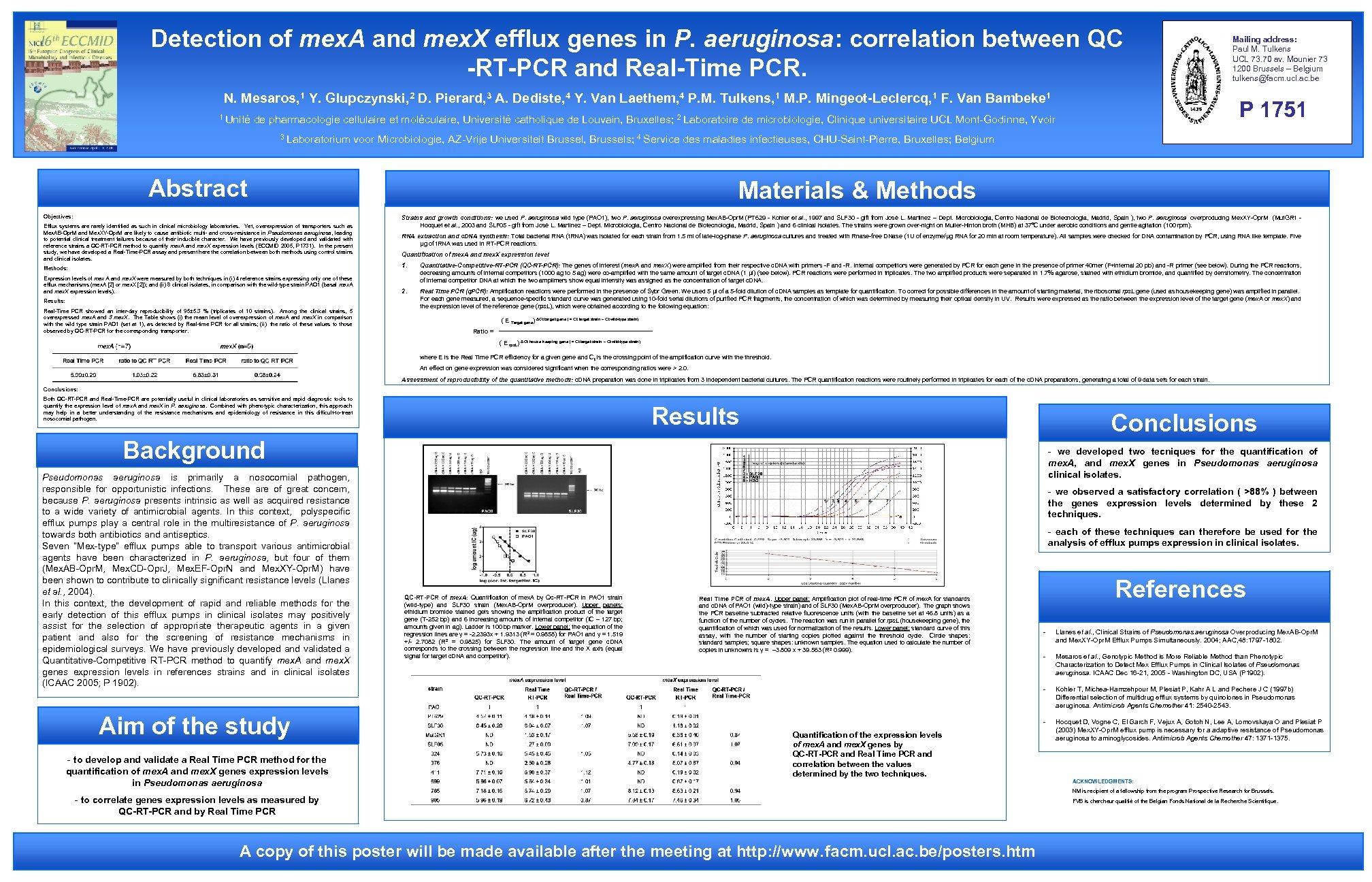 Detection of mex. A and mex. X efflux genes in P. aeruginosa: correlation between QC -RT-PCR and Real-Time PCR. N. Mesaros, 1 Y. Glupczynski, 2 D. Pierard, 3 A. Dediste, 4 Y. Van Laethem, 4 P. M. Tulkens, 1 M. P. Mingeot-Leclercq, 1 F. Van Bambeke 1 1 Unité P 1751 de pharmacologie cellulaire et moléculaire, Université catholique de Louvain, Bruxelles; 2 Laboratoire de microbiologie, Clinique universitaire UCL Mont-Godinne, Yvoir 3 Laboratorium voor Microbiologie, AZ-Vrije Universiteit Brussel, Brussels; 4 Service des maladies infectieuses, CHU-Saint-Pierre, Bruxelles; Belgium Abstract Objectives: Efflux systems are rarely identified as such in clinical microbiology laboratories. Yet, overexpression of transporters such as Mex. AB-Opr. M and Mex. XY-Opr. M are likely to cause antibiotic multi- and cross-resistance in Pseudomonas aeruginosa, leading to potential clinical treatment failures because of their inducible character. We have previously developed and validated with reference strains a QC-RT-PCR method to quantify mex. A and mex. X expression levels (ECCMID 2005, P 1731). In the present study, we have developed a Real-Time-PCR assay and present here the correlation between both methods using control strains and clinical isolates. Mailing address: Paul M. Tulkens UCL 73. 70 av. Mounier 73 1200 Brussels – Belgium tulkens@facm. ucl. ac. be Materials & Methods Strains and growth conditions: we used P. aeruginosa wild type (PAO 1), two P. aeruginosa overexpressing Mex. AB-Opr. M (PT 629 - Kohler et al. , 1997 and SLF 30 - gift from José L. Martinez – Dept. Microbiologia, Centro Nacional de Biotecnologia, Madrid, Spain ), two P. aeruginosa overproducing Mex. XY-Opr. M (Mut. GR 1 Hocquet et al. , 2003 and SLF 05 - gift from José L. Martinez – Dept. Microbiologia, Centro Nacional de Biotecnologia, Madrid, Spain ) and 6 clinical isolates. The strains were grown over-night on Muller-Hinton broth (MHB) at 37°C under aerobic conditions and gentle agitation (100 rpm). RNA extraction and c. DNA synthesis: Total bacterial RNA (t. RNA) was isolated for each strain from 1. 5 ml of late-log-phase P. aeruginosa cultures and treated with Rnase-free DNase (1 U of enzyme/µg RNA for 20 min at room temperature). All samples were checked for DNA contamination by PCR, using RNA like template. Five µg of t. RNA was used in RT-PCR reactions. Quantification of mex. A and mex. X expression level Methods: 1. Expression levels of mex A and mex. X were measured by both techniques in (i) 4 reference strains expressing only one of these efflux mechanisms (mex. A [2] or mex. X [2]); and (ii) 8 clinical isolates, in comparison with the wild-type strain PAO 1 (basal mex. A and mex. X expression levels). Quantitative-Competitive-RT-PCR (QC-RT-PCR): The genes of interest (mex. A and mex. X) were amplified from their respective c. DNA with primers -F and -R. Internal competitors were generated by PCR for each gene in the presence of primer 40 mer (F+internal 20 pb) and -R primer (see below). During the PCR reactions, decreasing amounts of internal competitors (1000 ag to 5 ag) were co-amplified with the same amount of target c. DNA (1 µl) (see below). PCR reactions were performed in triplicates. The two amplified products were separated in 1. 7% agarose, stained with ethidium bromide, and quantified by densitometry. The concentration of internal competitor DNA at which the two amplimers show equal intensity was assigned as the concentration of target c. DNA. 2. Real Time PCR (q. PCR): Amplification reactions were performed in the presence of Sybr Green. We used 5 µl of a 5 -fold dilution of c. DNA samples as template for quantification. To correct for possible differences in the amount of starting material, the ribosomal rps. L gene (used as housekeeping gene) was amplified in parallel. For each gene measured, a sequence-specific standard curve was generated using 10 -fold serial dilutions of purified PCR fragments, the concentration of which was determined by measuring their optical density in UV. Results were expressed as the ratio between the expression level of the target gene (mex. A or mex. X) and the expression level of the reference gene (rps. L), which were obtained according to the following equation: Results: Real-Time PCR showed an inter-day reproducibility of 95± 5. 3 % (triplicates of 10 strains). Among the clinical strains, 5 overexpressed mex. A and 3 mex. X. The Table shows (i) the mean level of overexpression of mex. A and mex. X in comparison with the wild type strain PAO 1 (set at 1), as detected by Real-time PCR for all strains; (ii) the ratio of these values to those observed by QC-RT-PCR for the corresponding transporter. ( E Target gene) ΔCt target gene ( = Ct target strain – Ct wild-type strain) Ratio = ( E rps. L) ΔCt house keeping gene ( = Ct target strain – Ct wild-type strain) where E is the Real Time PCR efficiency for a given gene and Ct is the crossing point of the amplification curve with the threshold. An effect on gene expression was considered significant when the corresponding ratios were > 2. 0. Assessment of reproducibility of the quantitative methods: c. DNA preparation was done in triplicates from 3 independent bacterial cultures. The PCR quantification reactions were routinely performed in triplicates for each of the c. DNA preparations, generating a total of 9 data sets for each strain. Conclusions: Both QC-RT-PCR and Real-Time-PCR are potentially useful in clinical laboratories as sensitive and rapid diagnostic tools to quantify the expression level of mex. A and mex. X in P. aeruginosa. Combined with phenotypic characterization, this approach may help in a better understanding of the resistance mechanisms and epidemiology of resistance in this difficult-to-treat nosocomial pathogen. Results Conclusions Background Pseudomonas aeruginosa is primarily a nosocomial pathogen, responsible for opportunistic infections. These are of great concern, because P. aeruginosa presents intrinsic as well as acquired resistance to a wide variety of antimicrobial agents. In this context, polyspecific efflux pumps play a central role in the multiresistance of P. aeruginosa towards both antibiotics and antiseptics. Seven “Mex-type” efflux pumps able to transport various antimicrobial agents have been characterized in P. aeruginosa, but four of them (Mex. AB-Opr. M, Mex. CD-Opr. J, Mex. EF-Opr. N and Mex. XY-Opr. M) have been shown to contribute to clinically significant resistance levels (Llanes et al. , 2004). In this context, the development of rapid and reliable methods for the early detection of this efflux pumps in clinical isolates may positively assist for the selection of appropriate therapeutic agents in a given patient and also for the screening of resistance mechanisms in epidemiological surveys. We have previously developed and validated a Quantitative-Competitive RT-PCR method to quantify mex. A and mex. X genes expression levels in references strains and in clinical isolates (ICAAC 2005; P 1902). Objectives Aim of the study - to develop and validate a Real Time PCR method for the quantification of mex. A and mex. X genes expression levels in Pseudomonas aeruginosa - we developed two tecniques for the quantification of mex. A, and mex. X genes in Pseudomonas aeruginosa clinical isolates. - we observed a satisfactory correlation ( >88% ) between the genes expression levels determined by these 2 techniques. - each of these techniques can therefore be used for the analysis of efflux pumps expression in clinical isolates. QC-RT-PCR of mex. A: Quantification of mex. A by Qc-RT-PCR in PAO 1 strain (wild-type) and SLF 30 strain (Mex. AB-Opr. M overproducer). Upper panels: ethidium bromide stained gels showing the amplification product of the target gene (T-252 bp) and 6 increasing amounts of internal competitor (IC – 127 bp; amounts given in ag). Ladder is 100 bp marker. Lower panel: the equation of the regression lines are y = -2. 2393 x + 1. 9313 (R 2 = 0. 9858) for PAO 1 and y = 1. 519 +/- 2. 7082 (R 2 = 0. 9825) for SLF 30. The amount of target gene c. DNA corresponds to the crossing between the regression line and the X axis (equal signal for target c. DNA and competitor). Real Time PCR of mex. A. Upper panel: Amplification plot of real-time PCR of mex. A for standards and c. DNA of PAO 1 (wild)-type strain) and of SLF 30 (Mex. AB-Opr. M overproducer). The graph shows the PCR baseline subtracted relative fluorescence units (with the baseline set at 46. 8 units) as a function of the number of cycles. The reaction was run in parallel for rps. L (housekeeping gene), the quantification of which was used for normalization of the results. Lower panel: standard curve of this assay, with the number of starting copies plotted against the threshold cycle. Circle shapes: standard samples; square shapes: unknown samples. The equation used to calculate the number of copies in unknowns is y = – 3. 809 x + 39. 563 (R 2 0. 999). References A copy of this poster will be made available after the meeting at http: //www. facm. ucl. ac. be/posters. htm - Mesaros et al. , Genotypic Method is More Reliable Method than Phenotypic Characterization to Detect Mex Efflux Pumps in Clinical Isolates of Pseudomonas aeruginosa. ICAAC Dec 16 -21, 2005 - Washington DC, USA (P 1902). Kohler T, Michea-Hamzehpour M, Plesiat P, Kahr A L and Pechere J C (1997 b) Differential selection of multidrug efflux systems by quinolones in Pseudomonas aeruginosa. Antimicrob Agents Chemother 41: 2540 -2543. - - to correlate genes expression levels as measured by QC-RT-PCR and by Real Time PCR Llanes et al. , Clinical Strains of Pseudomonas aeruginosa Overproducing Mex. AB-Opr. M and Mex. XY-Opr. M Efflux Pumps Simultaneously. 2004; AAC, 48: 1797 -1802. - Quantification of the expression levels of mex. A and mex. X genes by QC-RT-PCR and Real Time PCR and correlation between the values determined by the two techniques. - Hocquet D, Vogne C, El Garch F, Vejux A, Gotoh N, Lee A, Lomovskaya O and Plesiat P (2003) Mex. XY-Opr. M efflux pump is necessary for a adaptive resistance of Pseudomonas aeruginosa to aminoglycosides. Antimicrob Agents Chemother 47: 1371 -1375. ACKNOWLEDGMENTS: NM is recipient of a fellowship from the program Prospective Research for Brussels. FVB is chercheur qualifié of the Belgian Fonds National de la Recherche Scientifique.