


 Скачать презентацию Detecting Prosecuting Fraud 2 June 2010 Army
97e436faf1abc389d0fb668ec1bd4953.ppt
- Количество слайдов: 62
 Detecting & Prosecuting Fraud 2 June 2010 Army Day In Tune with Army Financial Management
 What is Fraud? v Fraud is defined by Generally Accepted Government Auditing Standards as a type of illegal act involving the obtaining of something of value through willful misrepresentation. In Tune with Army Financial Management 1
 Common Types of Fraud • • • Theft of cash, supplies, inventory, equipment, and information Skimming Fictitious disbursement Duplicate billing Billing for goods not delivered or services not performed Inflated employee expense claims—travel vouchers Payroll fraud Fraudulent financial statements or performance reports Bribery and kickbacks Bid rigging • • • Corruption Conflict of interest Unauthorized use of government property Falsifying information Overtime fraud Contractor misrepresenting or overstating costs Contractor misrepresenting self as small/disadvantaged business Product substitution Noncompliance with contract specifications In Tune with Army Financial Management 2
 Fraud Characteristics Most frauds begin small and continue to grow over time. v Fraudsters primarily exploit inadequate internal controls for their own gain. v Fraudsters usually try to conceal fraud by making false entries into systems. v In Tune with Army Financial Management 3
 Fraud Characteristics v Typical fraudster: Ø Ø Ø Ø Middle age Member of management Employed by the organization for a number of years In position of trust Educated Head of household Member of community organizations In Tune with Army Financial Management 4
 Fraud Indicators Management override of key controls. v Inadequate or weak internal controls. v No written policies and procedures. v Overly complex organizational structure. v Key employee never taking leave or vacation. v High turnover rate, reassignment, firing of key personnel. v In Tune with Army Financial Management 5
 Fraud Indicators Missing electronic or hard copy documents that materialize later in the review. v Lost or destroyed electronic or hard copy records. v Photocopied documents instead of originals. Copies are poor quality or illegible. v “Unofficial” electronic files or records instead of “archived” or “official” files or records. v Revisions to electronic or hard copy documents with no explanation or support. v Use of means of alteration to data files. v In Tune with Army Financial Management 6
 Fraud Indicators Computer-generated dates for modifications to electronic files that do not fit the appropriate time line for when they were created. v Missing signatures of approval or discrepancies in signature/handwriting. v Computer report totals that are not supported by source documentation. v Lengthy unexplained delays in producing requested documentation. v In Tune with Army Financial Management 7
 How is Fraud Detected? Audits v Government Employees v Hotline Allegations/Tips v Accident v Crime Prevention Surveys v In Tune with Army Financial Management 8
 Fraud Detection Statistics v Certified Fraud Examiners Survey 2008 showed fraud detection as: Ø 66% by tips or accidents Ø 28% by audits In Tune with Army Financial Management 9
 Auditor’s Responsibilities In planning an audit, auditors should assess risks of fraud occurring that is significant within the context of the audit objectives (workplace/individual pressures, opportunity, rationalization). v Auditors should design procedures to provide reasonable assurance of detecting fraud if risk factors indicate that fraud has or is likely to occur. v In Tune with Army Financial Management 10
 Auditor’s Responsibilities Auditors should extend audit steps to determine whether fraud has likely occurred if information comes to the auditors’ attention indicating that fraud that is significant within the context of objectives may have occurred. v When risk factors are identified, auditors should document the risk factors identified, the auditors’ response to those risk factors individually or collectively, and the auditors’ conclusions. v In Tune with Army Financial Management 11
 What is Fraud Risk? The possibility of asset misappropriation, misuse of entrusted power, and the intentional misreporting/concealment of information for private gain. v Risk is measured in terms of: Ø Impact. Ø Likelihood. v In Tune with Army Financial Management 12
 Fraud Risk Assessment v v v Determine relevant fraud risks within context of audit objectives. Identify potential fraud schemes and prioritize them based on risk. Map existing controls to potential fraud schemes and test controls. Test for fraud. Document and report on the fraud risk assessment. In Tune with Army Financial Management 13
 Investigative Referral Process v Contact investigators about potential fraud whenever audit results show: Ø Ø v Presence of one or more “red flag” fraud indicators combined with risk assessment showing heightened fraud risk and major control weaknesses. Actual examples or evidence of potentially fraudulent activity (e. g. , falsified documents or misrepresentation, vendor overbilling, and/or testimonial statements). Contact your Office of Counsel to discuss fraud risk and indicators. In Tune with Army Financial Management 14
 Investigative Referral Process v Auditor’s role in supporting investigations & prosecutions: Ø Provide analytical support to investigators. Ø Assist the activity in correcting internal control weaknesses that allowed fraud to occur. Ø Provide working papers to U. S. Attorney. Ø Testify as requested. In Tune with Army Financial Management 15
 Case Studies Kuwait Contracting v Vendor Payments In Southwest Asia v Active Duty Military Payroll Adjustments v Role Players At Joint Multinational Training Center v Job Order Contracting In Europe v In Tune with Army Financial Management 16
 CASE STUDY #1 KUWAIT CONTRACTING In Tune with Army Financial Management
 Identified Fraud Indicators Contract awarded to highest bidder and KO’s rationale not reasonable. v Unreasonably high prices. v Limited competition. v In Tune with Army Financial Management 18
 Referral to CID Command could not provide reasonable explanation concerning fraud indicators. v CID interested because: Ø Fraud indicators significant and involved multimillion dollar contract. Ø Investigators were investigating contractor based on allegation from Government employee. v In Tune with Army Financial Management 19
 Investigative Support Performed analyses on contractors’ current and past contracts to estimate overpayment. Ø Higher unit prices. Ø Unreasonable quantities. v Performed audit at the contracting office to assess the adequacy of internal controls and to determine whether significant fraud indicators existed for other contracts. v In Tune with Army Financial Management 20
 Fixing Internal Controls v Audit and investigation led to significant changes to improve contracting operations. Ø Kuwait office reorganized and staff increased. Ø Task Force established to look at contracting operations throughout SWA. Ø Established the Gansler Commission. In Tune with Army Financial Management 21
 CASE STUDY #2 VENDOR PAYMENTS IN SOUTHWEST ASIA In Tune with Army Financial Management
 Identified Fraud Indicators Hard copy voucher packages didn’t provide sufficient support to validate vendor payments. Voucher error rates: Ø 50% (563 of 1, 116) in statistical sample. Ø 27% (105 of 394) judgmental (on-site) sample. v Automated data didn’t always match hardcopy voucher packages or actual operations. v Limited Depository Accounts (LDAs) not reconciled. v Lack of separation of duties. v Insufficient internal control program – checklist mentality. v In Tune with Army Financial Management 23
 Referral to CID v Breakdowns with purchasing, accountability and payments processes. Ø Billing without support – 2, 199 purchases ($5. 5 M) didn’t have proper support for requisitions. Ø Poor recordkeeping – about $640. 7 M in unaccounted for property. Ø Invalid payments – $47 M on 4 invoices sampled were invalid payments due to lack of supporting documentation. In Tune with Army Financial Management 24
 Referral to CID Developed partnership with CID early in audit process – continual communication. v CID interested in audit results due to increased number of fraud cases related to contracting and personnel handling cash on the battlefield. Examples of recent known cases: Ø An officer pilfered CERP funds ($690, 000). Ø An officer falsified currency fluctuation rate ($400, 000). v In Tune with Army Financial Management 25
 Investigative Support Provided names of individuals with access to cash – used to conduct Fin. CEN checks. v Conducted attestation on questionable purchases in Iraq based on vendor payment information. v Identified potential duplicate payments as part of data mining effort – 3, 000 potential duplicate payments. v Continuing to refer questionable purchases and improperly supported payments based on audit results. v In Tune with Army Financial Management 26
 Fixing Internal Controls Cash off the Battlefield. v Vendor Pay Summit (April 2010) - members of fiscal triad collaboratively worked through contracting and payment issues. v Finance Management Workshop (May 2010) addressed training and automation challenges. v Finance Management Command - revising internal control program (incorporating risk assessment). v In Tune with Army Financial Management 27
 CASE STUDY #3 Active Duty Military Payroll Adjustments In Tune with Army Financial Management
 CID Request Notified by California National Guard CID in Nov 2005. v AR 15 -6 investigation completed. v Numerous suspicious DFAS transactions. v Occurred at U. S. Property & Fiscal Office, California. v Audit support requested on 15 Dec 2005. v In Tune with Army Financial Management 29
 Investigative Support v Agreed Upon Procedures: Ø Verify accuracy of each Soldier’s pay, allowances, and adjustments while on Active Duty. Ø Compare each Soldier’s pay, allowances, and adjustments by month from Jan 2004 through Dec 2005. Ø Identify any unusual payroll transactions. In Tune with Army Financial Management 30
 Auditor Conclusions $724, 048 paid to 5 individuals over 24 months. v Transactions included Gross Pay, Basic Allowance For Housing, Miscellaneous Other Credits (W 7). v 55 transactions— 53 from California, 2 from Kuwait. v $323, 228 in overpayments. v In Tune with Army Financial Management 31
 Investigative Outcomes Verified money received by 5 suspects. v Clear instances of kickbacks totaling about $150 K. v One instance of one soldier’s pay going into another soldier’s bank account. v One soldier clearly identified as the leader. v In Tune with Army Financial Management 32
 Followon Referral Based on CID support, expanded review of highrisk manual payroll adjustments for Reserve Component soldiers receiving Federal active duty pay. v Identified a National Guard soldier who received high-dollar payments ($220 K over 18 months). v Referred to investigators—Nov 2006. v DCIS request for audit support—Dec 2006. v In Tune with Army Financial Management 33
 Investigative Support v Agreed Upon Procedures: Ø Explain pay & allowance system used by DFAS for processing Reserve Component pay. Ø Macro analysis of pay & allowances associated with suspect account/any other pay accounts. Ø Onsite analysis of questionable manual transactions to determine who processed them. Ø Determine origination of funds for suspect transactions. In Tune with Army Financial Management 34
 Auditor Conclusions 85 unsupported payment transactions resulting in $728, 181 loss. v Transactions were result of pay account adjustments made by 2 DFAS employees: Ø 81 transactions paid to one individual—loss of $698, 181. Ø 4 transactions paid to another individual—loss of $30, 000. v In Tune with Army Financial Management 35
 Fixing Internal Controls v Followon Audit of Miscellaneous Credits For Reserve Component Pay disclosed 4 causative factors that allowed fraud to occur without detection: Ø No tax impact—once processed unlikely to be reviewed/audited. Ø Use varied greatly among pay offices. Ø Used routinely for transactions that had legitimate transaction codes. Ø DJMPS-RC lacked controls to track & identify source of entry for pay transactions. In Tune with Army Financial Management 36
 Fixing Internal Controls Inconsistently applied or ineffective controls were result of pay offices not having established guidance for processing W 7 transactions. v These controls either weren’t in place or weren’t consistently followed: v • Daily reconciliation of processed transactions. • Supervisory reviews of high-dollar transactions. • Document maintenance to support transactions. • Uniform guidance on use of miscellaneous credit transactions. In Tune with Army Financial Management 37
 Fixing Internal Controls v Recommendations: Ø Develop uniform guidance for managing miscellaneous credit transactions: • Reconciliation of daily transaction logs. • Appropriate Use Of W 7 Transactions. • 100% review & support for miscellaneous credit transactions over a predetermined amount. Ø Test & implement system changes to correct site of entry weakness. In Tune with Army Financial Management 38
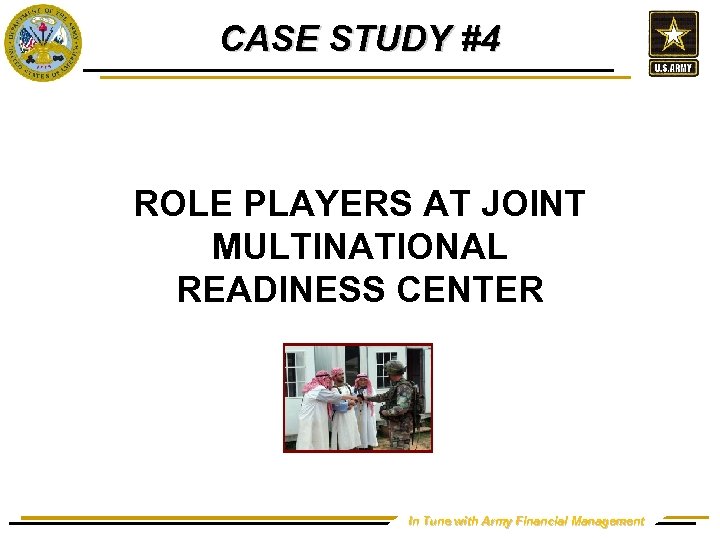 CASE STUDY #4 ROLE PLAYERS AT JOINT MULTINATIONAL READINESS CENTER In Tune with Army Financial Management
 Identified Fraud Indicators v Poor internal controls for tracking attendance of contract role-players. COR didn’t document contractor deficiencies. v Contractor’s invoice wasn’t mathematically accurate. v v Neither COR’s nor contractor’s daily attendance records supported contractor’s invoice. In Tune with Army Financial Management 40
 Referral to CID v Follow-up interviews with COR raised more “red flags”: Ø Admitted he was aware the invoice wasn’t accurate. Ø Told us he and contractor’s lead employee were close friends. Ø Exhibited an unusually high-level of nervousness. Ø Made unusual statements concerning guilt. v CID interested because: Ø Numerous fraud indicators. Ø Critical theater contract. Ø Vale of contract. In Tune with Army Financial Management 41
 Investigative Support Reconstructed invoice using available documentation. v Concluded the contractor billed: Ø For role-players it didn’t provide. Ø Using incorrect rates. Ø For contractors who were sick (unavailable). v Army overpaid the contractor about $807, 000 (for a task order valued at about $4. 6 million). v In Tune with Army Financial Management 42
 Fixing Internal Controls v Audit and investigation led to significant changes in personnel and improvements to controls: Ø COR removed and retired (also debarred). Ø Contractor’s lead employee was terminated and debarred. Ø Funds recovered (entire amount). Ø Command revised its processes and improved contract oversight (confirmed by follow-up audit) In Tune with Army Financial Management 43
 CASE STUDY #5 JOB ORDER CONTRACTING IN EUROPE In Tune with Army Financial Management
 CID Request v Local national employee allegedly inflated IGEs to collude with contractors. v CID requested audit support for its investigation. v Audit evaluated whether processes and controls for preparing IGEs and contracting for work resulted in best value. In Tune with Army Financial Management 45
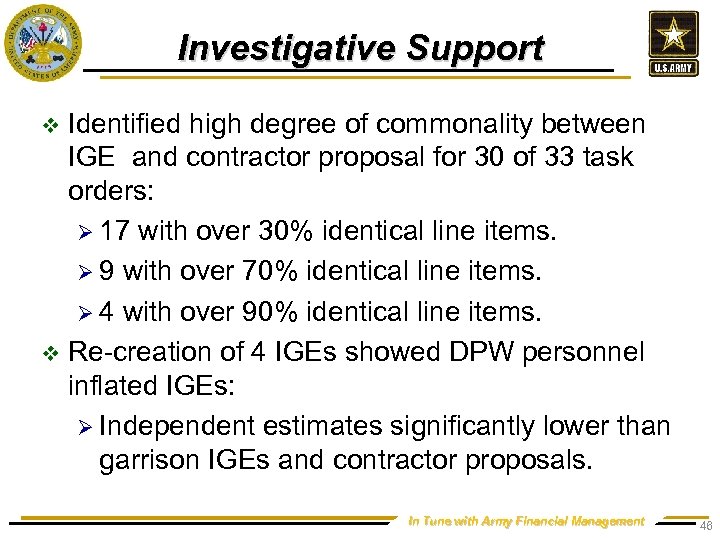 Investigative Support Identified high degree of commonality between IGE and contractor proposal for 30 of 33 task orders: Ø 17 with over 30% identical line items. Ø 9 with over 70% identical line items. Ø 4 with over 90% identical line items. v Re-creation of 4 IGEs showed DPW personnel inflated IGEs: Ø Independent estimates significantly lower than garrison IGEs and contractor proposals. v In Tune with Army Financial Management 46
 Investigative Support Identified 4 government employees who shared or falsified IGEs: Ø 1 got kickbacks (terminated and undergoing prosecution). Ø 3 to expedite contracting process. v Expanded scope to two other garrisons and found similar results. v In Tune with Army Financial Management 47
 Control Weaknesses v Process weaknesses: Ø Work wasn’t described adequately. Ø Revised desk estimates weren’t supported with justifications. Ø SOWs didn’t clearly describe work required. Ø IGEs weren’t properly prepared or reviewed. Ø Contractor’s proposals weren’t properly controlled and safeguarded. Ø Negotiations not documented sufficiently. Ø Inadequate separation of key duties. In Tune with Army Financial Management 48
 Control Weaknesses v Guidance weaknesses: Ø Regulatory guidance wasn’t followed. Ø Regulatory guidance wasn’t incorporated into garrison SOPs. v Oversight weaknesses: Ø Feasibility studies weren’t performed. Ø Results of bi-annual inspection reviews weren’t reported to appropriate levels. In Tune with Army Financial Management 49
 Fixing Internal Controls v Responsibility for Job Order Contracts assigned to one organization—the Corps of Engineers (COE): Ø SOP prepared. Ø Training provided to all DPWs in Europe. Ø Biannual reviews performed by COE with independent engineer evaluations. Ø 8 personnel terminated with criminal charges currently pending in the German Courts. Ø Recoupment actions initiated. In Tune with Army Financial Management 50
 Case Studies Summary v Fraudulent activities occurred because: Ø Managers/employees weren’t trained adequately. Ø Insufficient staffing/duties weren’t separated effectively. Ø Appropriate guidance wasn’t established. Ø Controls weren’t enforced and complied with. Ø Documentation requirements were dismissed. In Tune with Army Financial Management 51
 Case Studies Summary Fraudulent activities occurred because (cont’d): Ø Required reporting wasn’t done or was incorrect. Ø Oversight activities were ineffective. Ø Processes were used as work-around solutions without control modifications. Ø Transactions weren’t reconciled as required. v Evidence of collusion existed in some cases. v In Tune with Army Financial Management 52
 Managers’ Role Continually assess and evaluate their internal control structure to assure it’s well designed and operating effectively. v Ensure control structure provides reasonable assurance that organizational objectives are being achieved. v Update controls to meet changing conditions. v Souce: GAO Internal Control Management and Evaluation Tool In Tune with Army Financial Management 53
 The Five GAO Standards Control Environment v Risk Assessment v Control Activities v Information and Communications v Monitoring v Souce: GAO Standards for Internal Control in the Federal Government In Tune with Army Financial Management 54
 Control Environment v Management and employees should establish and maintain an environment throughout the organization that sets a positive and supportive attitude toward internal control and conscientious management. Souce: GAO Standards for Internal Control in the Federal Government In Tune with Army Financial Management 55
 Risk Assessment v Internal control should provide for an assessment of the risks the agency faces from both external and internal sources. Souce: GAO Standards for Internal Control in the Federal Government In Tune with Army Financial Management 56
 Control Activities Internal control activities help ensure that management's directives are carried out. v Control activities should be effective and efficient in accomplishing the agency's control objectives. v Souce: GAO Standards for Internal Control in the Federal Government In Tune with Army Financial Management 57
 Control Activities—Examples Top level reviews of actual performance. v Reviews by management at the functional or activity level. v Management of human capital. v Controls over information processing. v Physical control over vulnerable assets. v Souce: GAO Standards for Internal Control in the Federal Government In Tune with Army Financial Management 58
 Control Activities—Examples Establishment and review of performance measures and indicators. v Segregation of duties. v Proper execution of transactions and events. v Accurate and timely recording of transactions and events. v Access restrictions to and accountability for resources and records. v Appropriate documentation of transactions and internal control. v Souce: GAO Standards for Internal Control in the Federal Government In Tune with Army Financial Management 59
 Information & Communications v Information should be recorded and communicated to management and others within the entity who need it and in a form and within a time frame that enables them to carry out their internal control and other responsibilities. Souce: GAO Standards for Internal Control in the Federal Government In Tune with Army Financial Management 60
 Monitoring v Internal control monitoring should assess the quality of performance over time and ensure that the findings of audits and other reviews are promptly resolved. Souce: GAO Standards for Internal Control in the Federal Government In Tune with Army Financial Management 61