


 Скачать презентацию Detecting Kernel-level Rootkits using Data Structure Invariants Vinod
0faaa01d3a511eb2fc8ea4405cc8a8d0.ppt
- Количество слайдов: 35
 Detecting Kernel-level Rootkits using Data Structure Invariants Vinod Ganapathy Rutgers University
 What are rootkits? Rootkits = Stealthy malware • Tools used by attackers to conceal their presence on a compromised system • Typically installed after attacker has obtained root privileges • Stealth is achieved by hiding accompanying user level malicious programs December 4, 2009 Vinod Ganapathy - Rutgers University 2
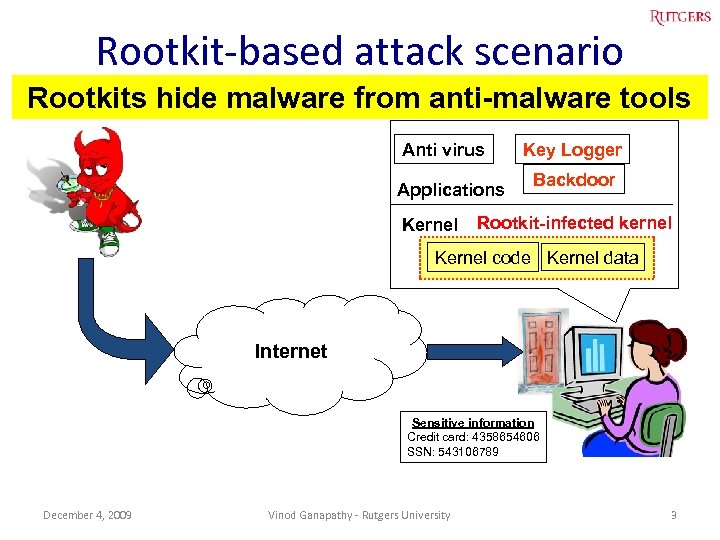 Rootkit-based attack scenario Rootkits hide malware from anti-malware tools Anti virus Applications Kernel Key Logger Backdoor Rootkit-infected kernel Kernel code Kernel data Internet Sensitive information Credit card: 4358654606 SSN: 543106789 December 4, 2009 Vinod Ganapathy - Rutgers University 3
 Significance of the problem • Alarming increase in number of rootkits – 600% increase in three-year period from 20042006 [Mac. Afee Avert Labs Report] – 200 new rootkits in the first quarter of 2008 alone [antirootkit. com] • Rootkits are the vehicle of choice for botnetbased attacks – Stealth allows bot-masters to retain long-term control December 4, 2009 Vinod Ganapathy - Rutgers University 4
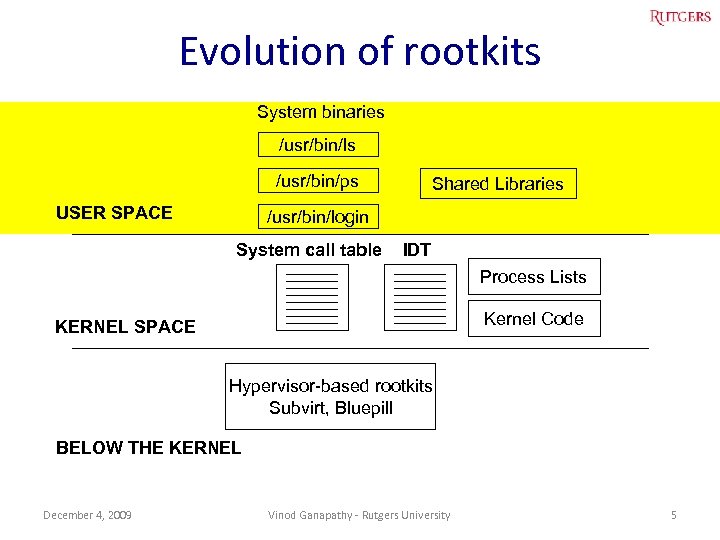 Evolution of rootkits System binaries /usr/bin/ls /usr/bin/ps USER SPACE Shared Libraries /usr/bin/login System call table IDT Process Lists Kernel Code KERNEL SPACE Hypervisor-based rootkits Subvirt, Bluepill BELOW THE KERNEL December 4, 2009 Vinod Ganapathy - Rutgers University 5
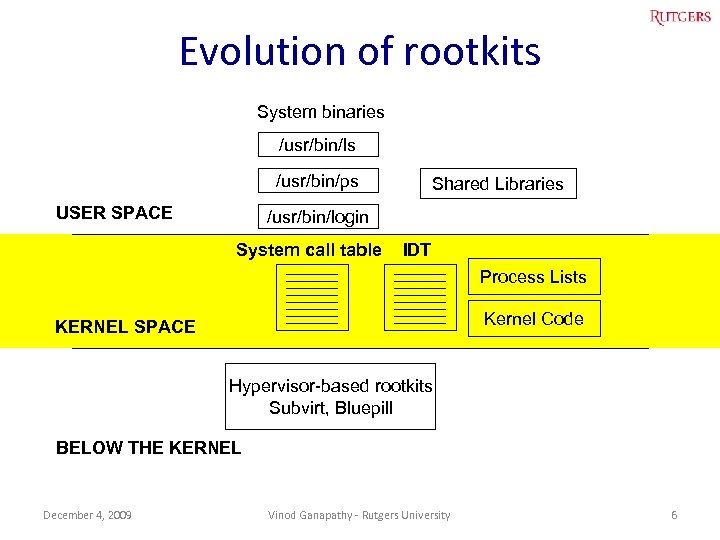 Evolution of rootkits System binaries /usr/bin/ls /usr/bin/ps USER SPACE Shared Libraries /usr/bin/login System call table IDT Process Lists Kernel Code KERNEL SPACE Hypervisor-based rootkits Subvirt, Bluepill BELOW THE KERNEL December 4, 2009 Vinod Ganapathy - Rutgers University 6
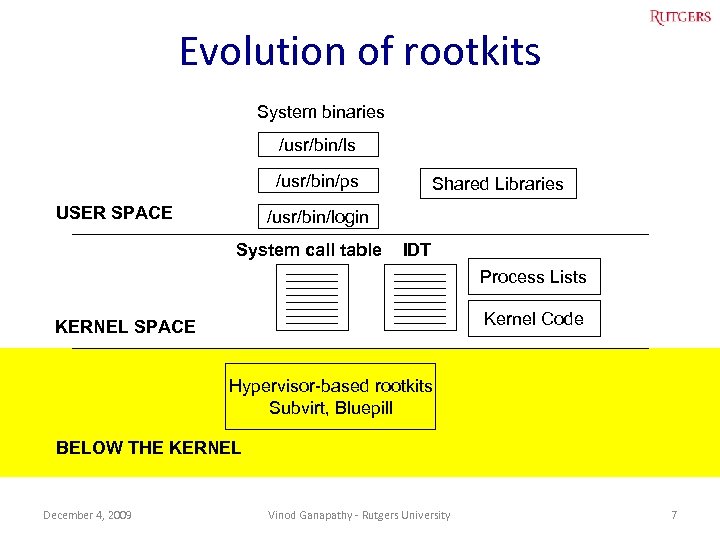 Evolution of rootkits System binaries /usr/bin/ls /usr/bin/ps USER SPACE Shared Libraries /usr/bin/login System call table IDT Process Lists Kernel Code KERNEL SPACE Hypervisor-based rootkits Subvirt, Bluepill BELOW THE KERNEL December 4, 2009 Vinod Ganapathy - Rutgers University 7
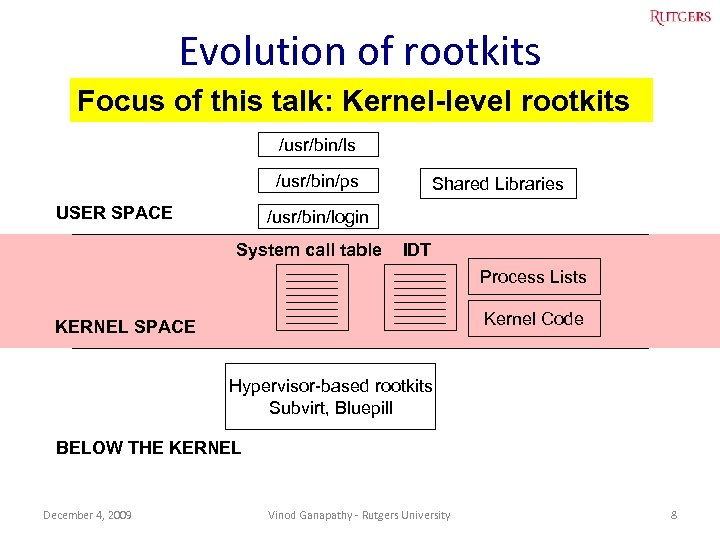 Evolution of rootkits Focus of this talk: Kernel-level rootkits System binaries /usr/bin/ls /usr/bin/ps USER SPACE Shared Libraries /usr/bin/login System call table IDT Process Lists Kernel Code KERNEL SPACE Hypervisor-based rootkits Subvirt, Bluepill BELOW THE KERNEL December 4, 2009 Vinod Ganapathy - Rutgers University 8
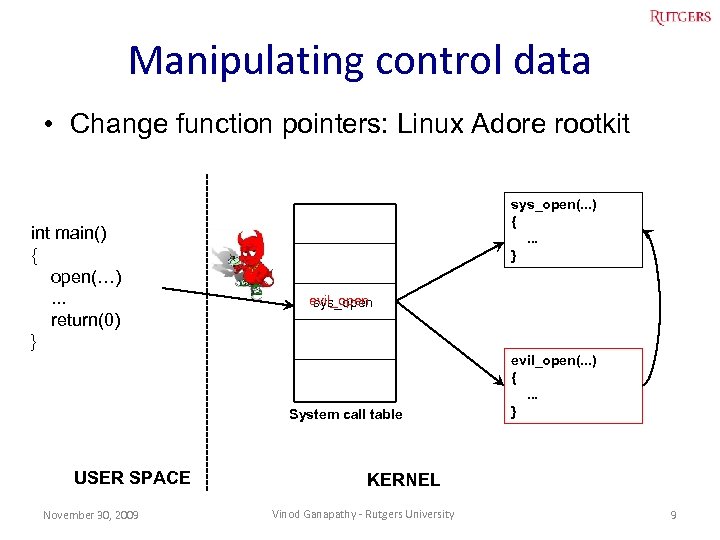 Manipulating control data • Change function pointers: Linux Adore rootkit int main() { open(…). . . return(0) } sys_open(. . . ) {. . . } evil_open sys_open System call table USER SPACE November 30, 2009 evil_open(. . . ) {. . . } KERNEL Vinod Ganapathy - Rutgers University 9
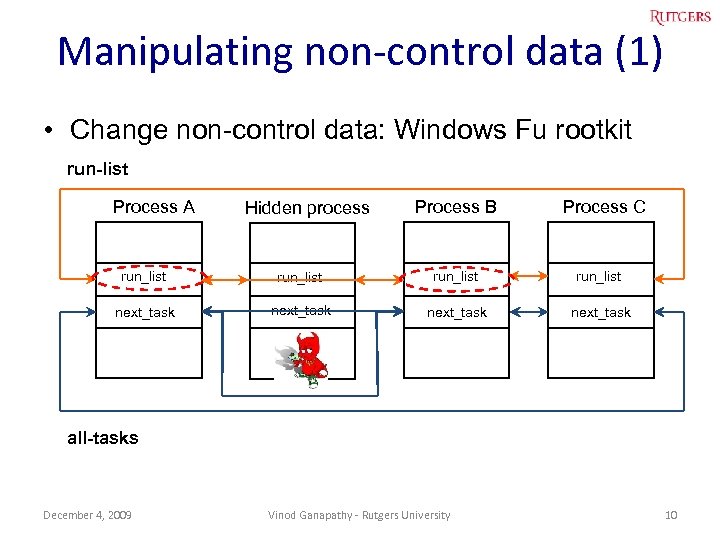 Manipulating non-control data (1) • Change non-control data: Windows Fu rootkit run-list Process A Hidden process Process B Process C run_list next_task all-tasks December 4, 2009 Vinod Ganapathy - Rutgers University 10
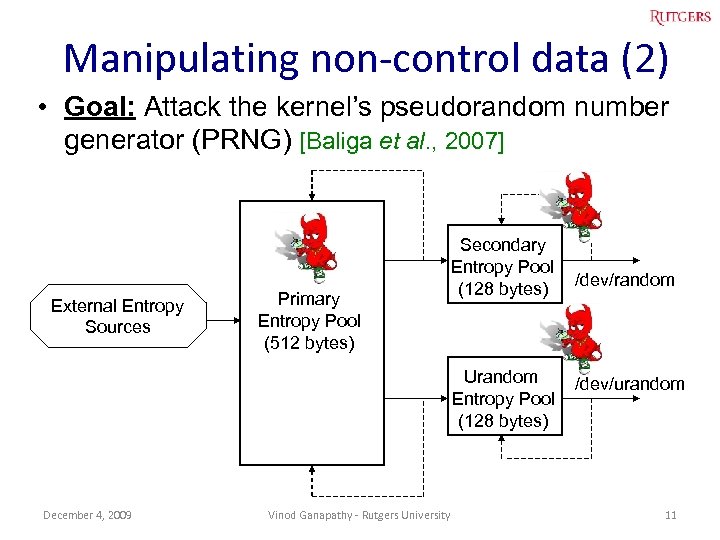 Manipulating non-control data (2) • Goal: Attack the kernel’s pseudorandom number generator (PRNG) [Baliga et al. , 2007] External Entropy Sources Primary Entropy Pool (512 bytes) Secondary Entropy Pool (128 bytes) Urandom Entropy Pool (128 bytes) December 4, 2009 Vinod Ganapathy - Rutgers University /dev/random /dev/urandom 11
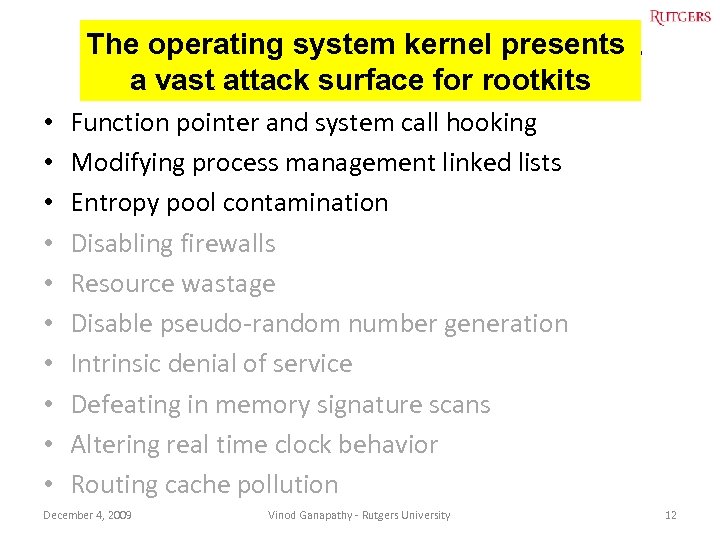 The operating system kernel presents Many more attacks are possible a vast attack surface for rootkits • • • Function pointer and system call hooking Modifying process management linked lists Entropy pool contamination Disabling firewalls Resource wastage Disable pseudo-random number generation Intrinsic denial of service Defeating in memory signature scans Altering real time clock behavior Routing cache pollution December 4, 2009 Vinod Ganapathy - Rutgers University 12
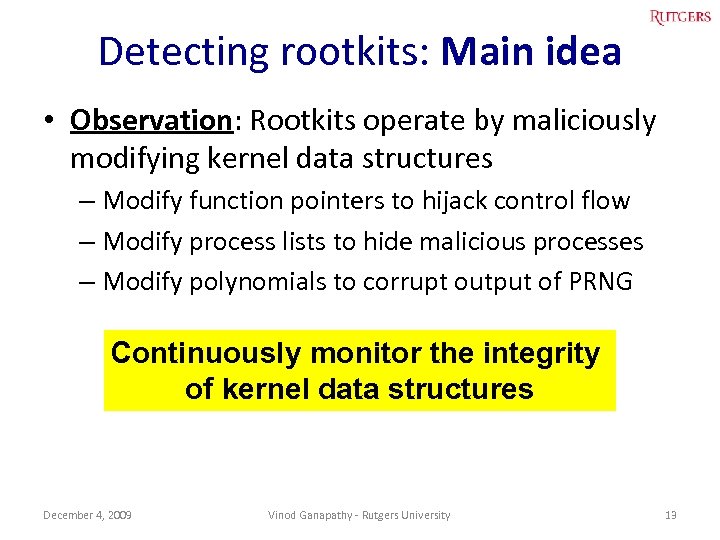 Detecting rootkits: Main idea • Observation: Rootkits operate by maliciously modifying kernel data structures – Modify function pointers to hijack control flow – Modify process lists to hide malicious processes – Modify polynomials to corrupt output of PRNG Continuously monitor the integrity of kernel data structures December 4, 2009 Vinod Ganapathy - Rutgers University 13
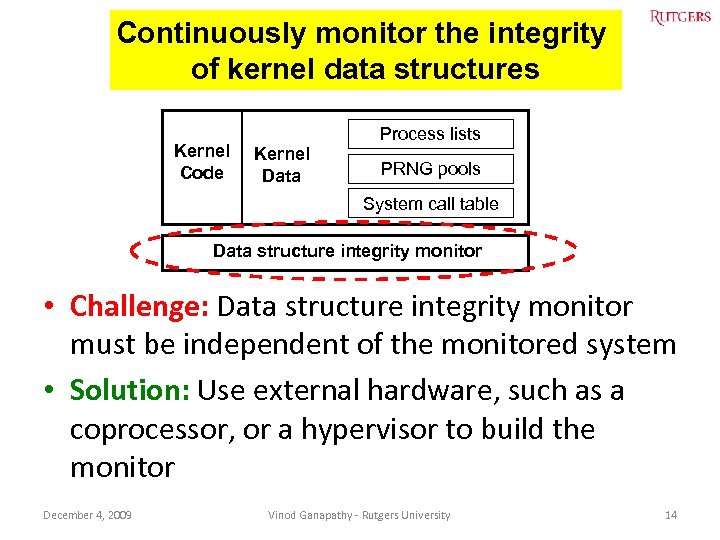 Continuously monitor the integrity of kernel data structures Kernel Code Process lists Kernel Data PRNG pools System call table Data structure integrity monitor • Challenge: Data structure integrity monitor must be independent of the monitored system • Solution: Use external hardware, such as a coprocessor, or a hypervisor to build the monitor December 4, 2009 Vinod Ganapathy - Rutgers University 14
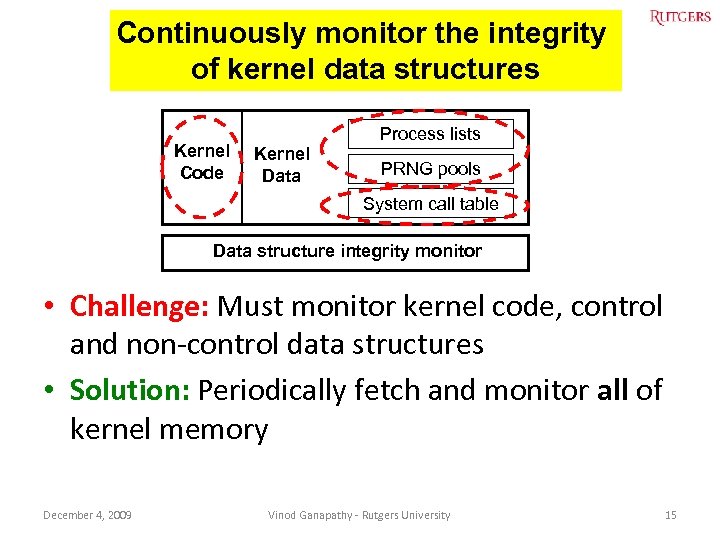 Continuously monitor the integrity of kernel data structures Kernel Code Process lists Kernel Data PRNG pools System call table Data structure integrity monitor • Challenge: Must monitor kernel code, control and non-control data structures • Solution: Periodically fetch and monitor all of kernel memory December 4, 2009 Vinod Ganapathy - Rutgers University 15
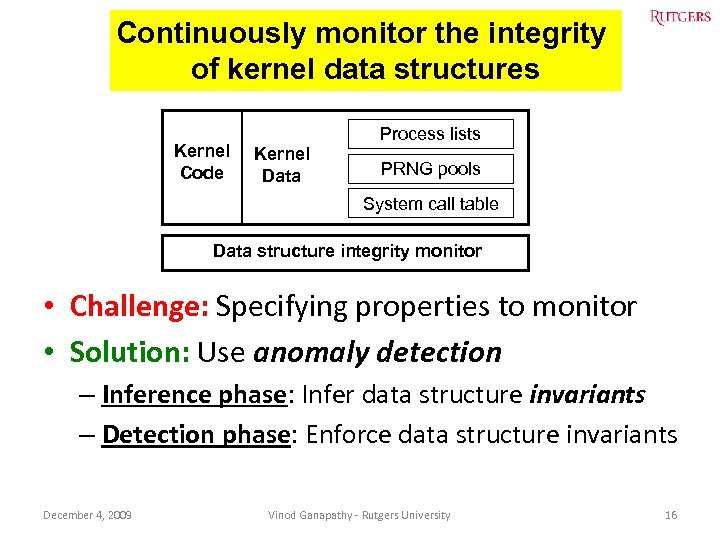 Continuously monitor the integrity of kernel data structures Kernel Code Process lists Kernel Data PRNG pools System call table Data structure integrity monitor • Challenge: Specifying properties to monitor • Solution: Use anomaly detection – Inference phase: Infer data structure invariants – Detection phase: Enforce data structure invariants December 4, 2009 Vinod Ganapathy - Rutgers University 16
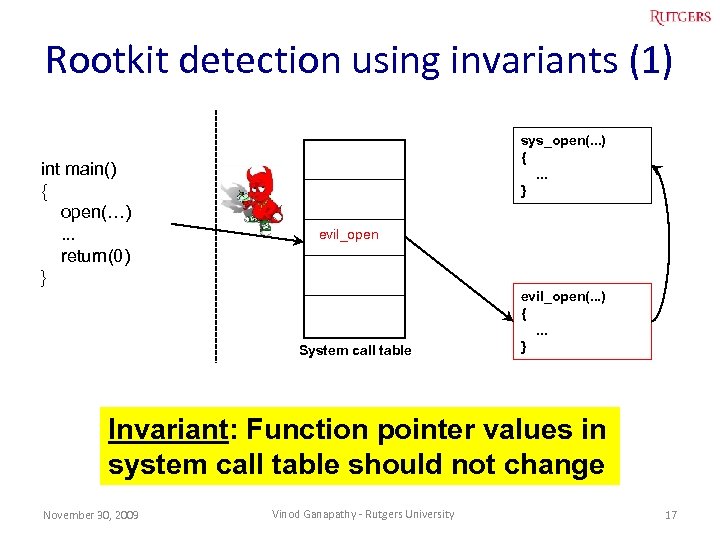 Rootkit detection using invariants (1) int main() { open(…). . . return(0) } sys_open(. . . ) {. . . } evil_open System call table evil_open(. . . ) {. . . } Invariant: Function pointer values in system call table should not change November 30, 2009 Vinod Ganapathy - Rutgers University 17
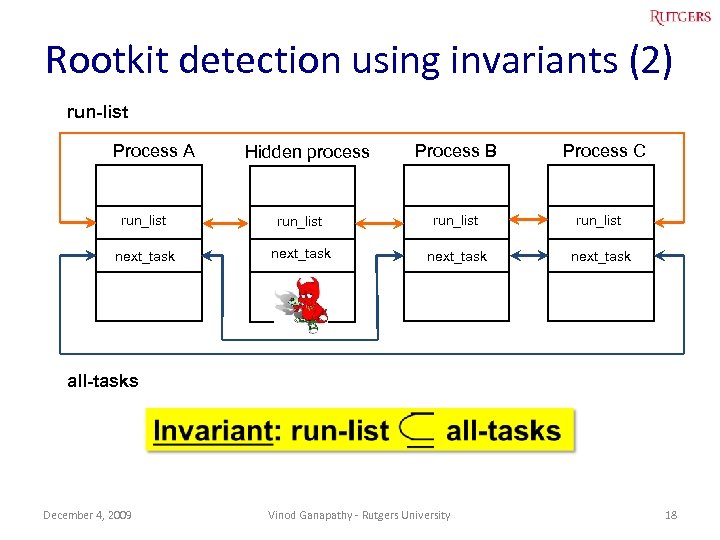 Rootkit detection using invariants (2) run-list Process A Hidden process Process B Process C run_list next_task all-tasks December 4, 2009 Vinod Ganapathy - Rutgers University 18
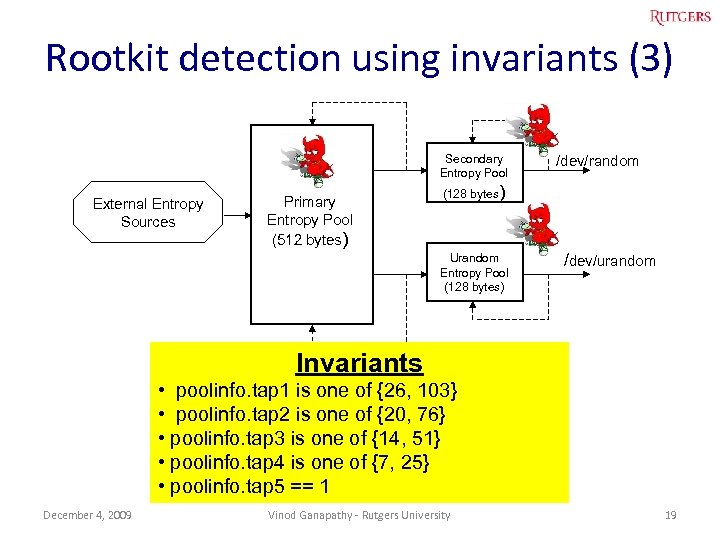 Rootkit detection using invariants (3) Secondary Entropy Pool External Entropy Sources Primary Entropy Pool (512 bytes) /dev/random (128 bytes) Urandom Entropy Pool (128 bytes) /dev/urandom Invariants • poolinfo. tap 1 is one of {26, 103} • poolinfo. tap 2 is one of {20, 76} • poolinfo. tap 3 is one of {14, 51} • poolinfo. tap 4 is one of {7, 25} • poolinfo. tap 5 == 1 December 4, 2009 Vinod Ganapathy - Rutgers University 19
 A new rootkit detection tool • Gibraltar * Identifies rootkits that modify control and noncontrol data * Automatically infers specifications of data structure integrity * Is physically isolated from the target machine December 4, 2009 Vinod Ganapathy - Rutgers University 20 Image courtesy of Wikipedia
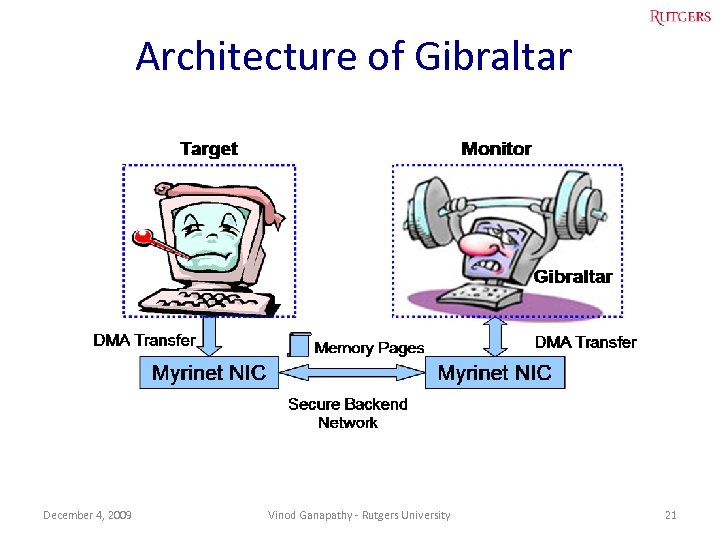 Architecture of Gibraltar December 4, 2009 Vinod Ganapathy - Rutgers University 21
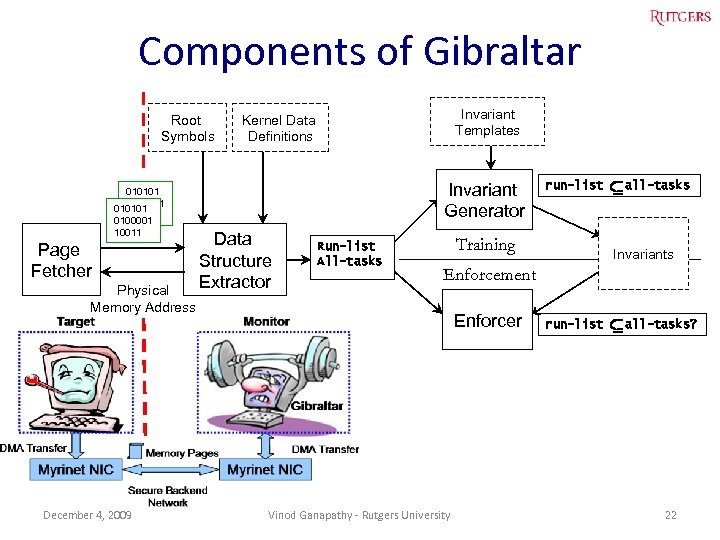 Components of Gibraltar Root Symbols Invariant Templates Kernel Data Definitions Invariant Generator 010101 0100001 010101 10011 0100001 10011 Page Fetcher Physical Memory Address December 4, 2009 Data Structure Extractor Run-list All-tasks run-list Training all-tasks Invariants Enforcement Enforcer Vinod Ganapathy - Rutgers University run-list all-tasks? 22
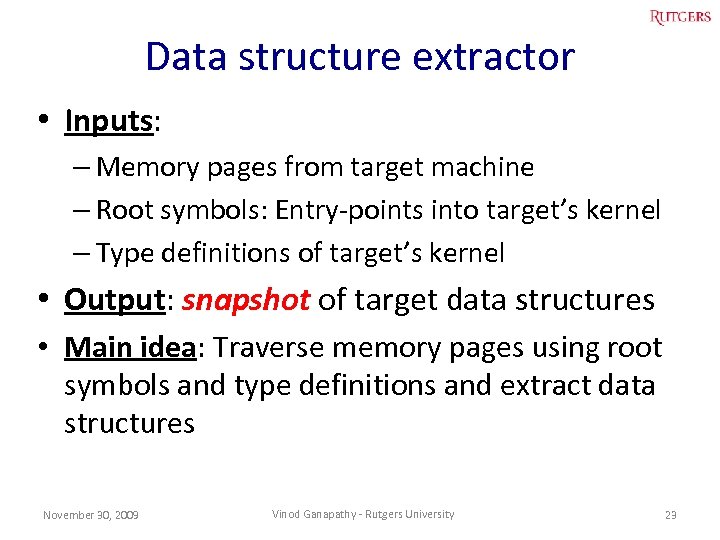 Data structure extractor • Inputs: – Memory pages from target machine – Root symbols: Entry-points into target’s kernel – Type definitions of target’s kernel • Output: snapshot of target data structures • Main idea: Traverse memory pages using root symbols and type definitions and extract data structures November 30, 2009 Vinod Ganapathy - Rutgers University 23
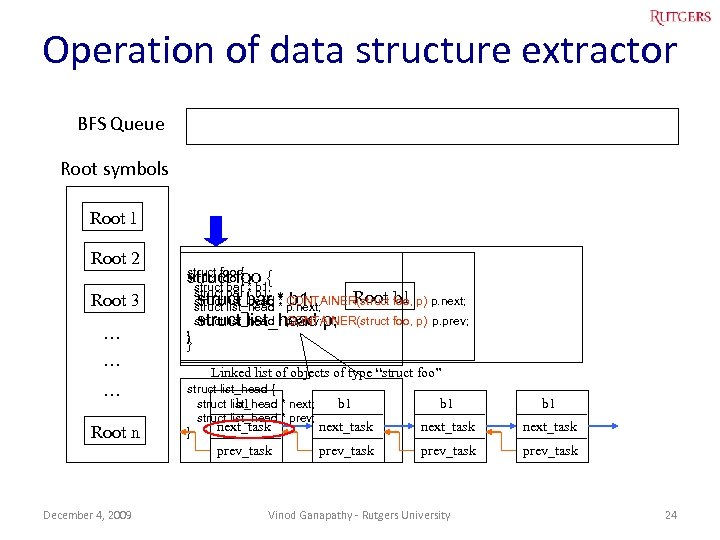 Operation of data structure extractor BFS Queue Root symbols Root 1 Root 2 Root 3 … … … Root n struct foo { struct bar * b 1; Root b 1 struct bar * b 1; struct list_head * p. next; struct list_head * CONTAINER(struct foo, p) p. next; } CONTAINER(struct foo, p) p. prev; struct list_head * p. prev; p; struct list_head } Linked list of objects of type “struct foo” struct list_head { struct list_head * next; b 1 struct list_head * prev; next_task } b 1 next_task prev_task December 4, 2009 Vinod Ganapathy - Rutgers University 24
 Invariant generator • Executes during a controlled, training phase • Inputs: Memory snapshots from a benign (uninfected) kernel • Output: Likely data structure invariants Invariants serve as specifications of data structure integrity November 30, 2009 Vinod Ganapathy - Rutgers University 25
![Invariant generator • Used an off-the-shelf tool: Daikon [Ernst et al. , 2000] •](https://present5.com/presentation/0faaa01d3a511eb2fc8ea4405cc8a8d0/image-26.jpg "Invariant generator • Used an off-the-shelf tool: Daikon [Ernst et al. , 2000] •") Invariant generator • Used an off-the-shelf tool: Daikon [Ernst et al. , 2000] • Daikon observes execution of user-space programs and hypothesizes likely invariants • We adapted Daikon’s front-end to reason about snapshots – Obtain snapshots at different times during training – Hypothesize likely invariants across snapshots November 30, 2009 Vinod Ganapathy - Rutgers University 26 Image courtesy of the Daikon project
Invariant generator • Used an off-the-shelf tool: Daikon [Ernst et al. , 2000] • Daikon observes execution of user-space programs and hypothesizes likely invariants • We adapted Daikon’s front-end to reason about snapshots – Obtain snapshots at different times during training – Hypothesize likely invariants across snapshots November 30, 2009 Vinod Ganapathy - Rutgers University 26 Image courtesy of the Daikon project
 Experimental evaluation Three main goals: ①How effective is Gibraltar at detecting rootkits? i. e. , what is the false negative rate? ②What is the quality of automatically-generated invariants? i. e. , what is the false positive rate? ③What is the runtime performance overhead of Gibraltar? November 30, 2009 Vinod Ganapathy - Rutgers University 27
 Experimental setup • Implemented on a Intel Xeon 2. 80 GHz, 1 GB machine, running Linux-2. 4. 20 • Fetched memory pages using Myrinet PCI card • Obtained invariants by training the system using several benign workloads November 30, 2009 Vinod Ganapathy - Rutgers University 28
 ①False negative rate • Conducted experiments with 23 Linux rootkits 14 rootkits from Packet. Storm u 9 advanced rootkits, discussed in the literature u • All rootkits modify kernel control and noncontrol data • Installed rootkits one at a time and tested effectiveness of Gibraltar at detecting the infection November 30, 2009 Vinod Ganapathy - Rutgers University 29
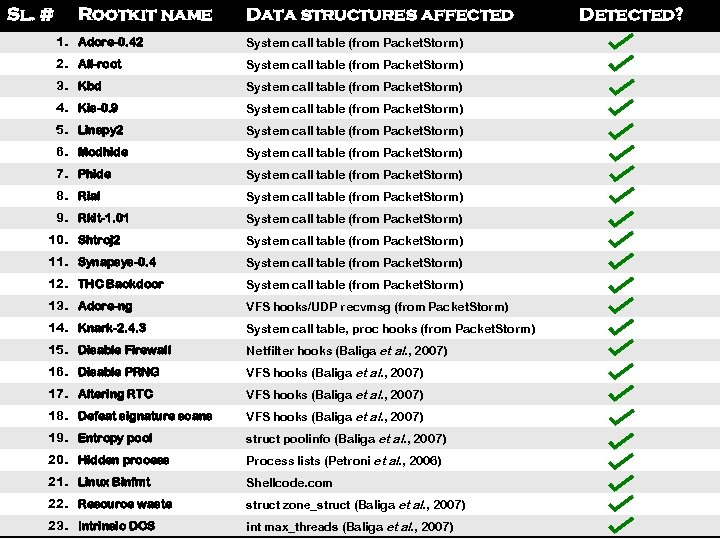 Sl. # Rootkit name Data structures affected 1. Adore-0. 42 System call table (from Packet. Storm) 2. All-root System call table (from Packet. Storm) 3. Kbd System call table (from Packet. Storm) 4. Kis-0. 9 System call table (from Packet. Storm) 5. Linspy 2 System call table (from Packet. Storm) 6. Modhide System call table (from Packet. Storm) 7. Phide System call table (from Packet. Storm) 8. Rial System call table (from Packet. Storm) 9. Rkit-1. 01 Detected? System call table (from Packet. Storm) 10. Shtroj 2 System call table (from Packet. Storm) 11. Synapsys-0. 4 System call table (from Packet. Storm) 12. THC Backdoor System call table (from Packet. Storm) 13. Adore-ng VFS hooks/UDP recvmsg (from Packet. Storm) 14. Knark-2. 4. 3 System call table, proc hooks (from Packet. Storm) 15. Disable Firewall Netfilter hooks (Baliga et al. , 2007) 16. Disable PRNG VFS hooks (Baliga et al. , 2007) 17. Altering RTC VFS hooks (Baliga et al. , 2007) 18. Defeat signature scans VFS hooks (Baliga et al. , 2007) 19. Entropy pool struct poolinfo (Baliga et al. , 2007) 20. Hidden process Process lists (Petroni et al. , 2006) 21. Linux Binfmt Shellcode. com 22. Resource waste struct zone_struct (Baliga et al. , 2007) November 30, 2009 DOS 23. Intrinsic int max_threads (Baliga et al. , 2007) 30
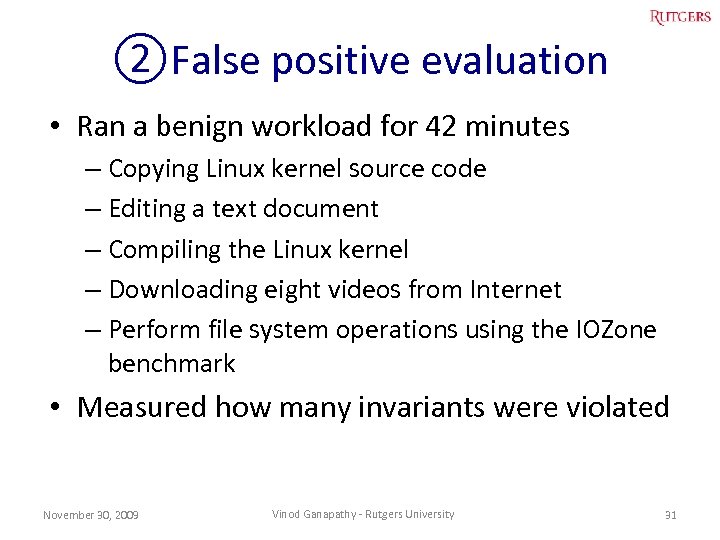 ②False positive evaluation • Ran a benign workload for 42 minutes – Copying Linux kernel source code – Editing a text document – Compiling the Linux kernel – Downloading eight videos from Internet – Perform file system operations using the IOZone benchmark • Measured how many invariants were violated November 30, 2009 Vinod Ganapathy - Rutgers University 31
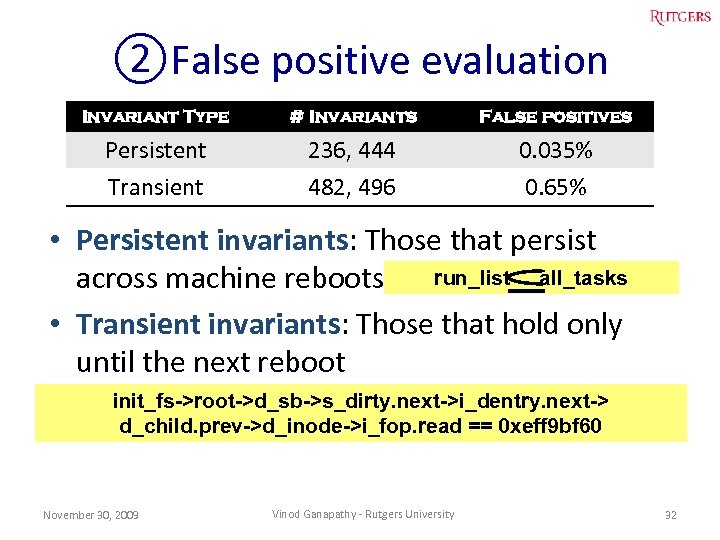 ②False positive evaluation Invariant Type # Invariants False positives Persistent Transient 236, 444 482, 496 0. 035% 0. 65% • Persistent invariants: Those that persist run_list all_tasks across machine reboots • Transient invariants: Those that hold only until the next reboot init_fs->root->d_sb->s_dirty. next->i_dentry. next-> d_child. prev->d_inode->i_fop. read == 0 xeff 9 bf 60 November 30, 2009 Vinod Ganapathy - Rutgers University 32
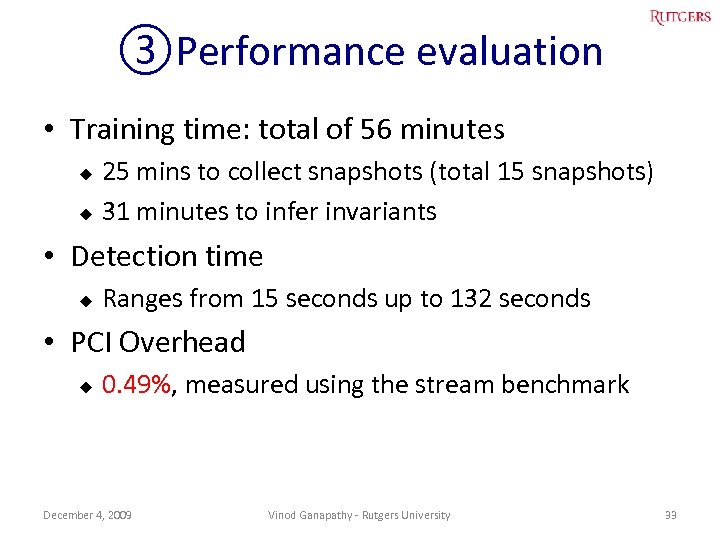 ③Performance evaluation • Training time: total of 56 minutes 25 mins to collect snapshots (total 15 snapshots) u 31 minutes to infer invariants u • Detection time u Ranges from 15 seconds up to 132 seconds • PCI Overhead u 0. 49%, measured using the stream benchmark December 4, 2009 Vinod Ganapathy - Rutgers University 33
 Future work • Reducing the number of false positives – Automated filtering techniques – Longer training time, better training workload • Usefulness of invariants generated – Other invariant templates – Feasibility versus complexity • Portability of invariants across different systems December 4, 2009 Vinod Ganapathy - Rutgers University 34
 Thank you Detecting Kernel-level Rootkits using Data Structure Invariants “Automatic Inference and Enforcement of Kernel Data Structure Invariants” Arati Baliga, Vinod Ganapathy and Liviu Iftode Published in Proc. 24 th ACSAC, December 2008.