


 Скачать презентацию Designing Graduate Curriculum for Stream Restoration Vaughan Voller
d876e9f74ef911009da8cf0c8bdcf7fe.ppt
- Количество слайдов: 14
 Designing Graduate Curriculum for Stream Restoration Vaughan Voller 1, Chris Paola 2, Karen Gran 3, Deborah Hudleston 4 and Karen Campbell 4 1 Department of Civil Engineering, NCED and SAFL, University of Minnesota 2 Department of Geology and Geophysics, NCED and SAFL, University of Minnesota 3 Department of Geology, NCED University of Minnesota, Duluth 4 NCED and SAFL, University of Minnesota Objective— To outline ingredients in our 1 year post-baccalaureate certificate program Highlight elements in our curriculum that have been successful /worthwhile
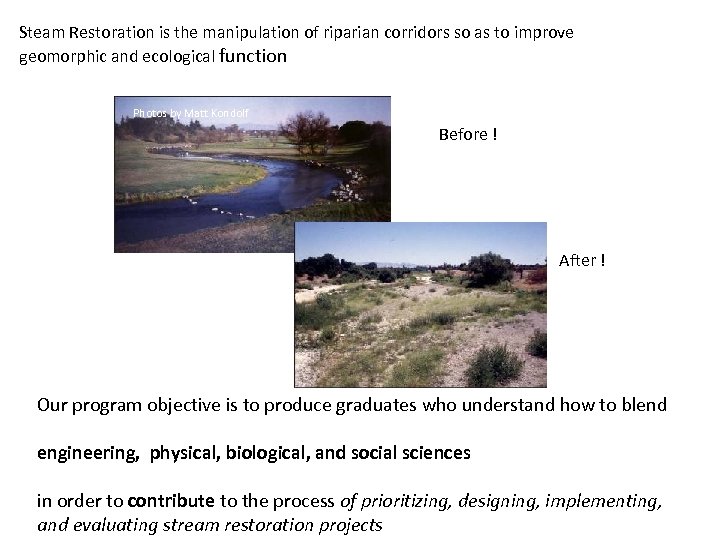 Steam Restoration is the manipulation of riparian corridors so as to improve geomorphic and ecological function Photos by Matt Kondolf Before ! After ! Our program objective is to produce graduates who understand how to blend engineering, physical, biological, and social sciences in order to contribute to the process of prioritizing, designing, implementing, and evaluating stream restoration projects
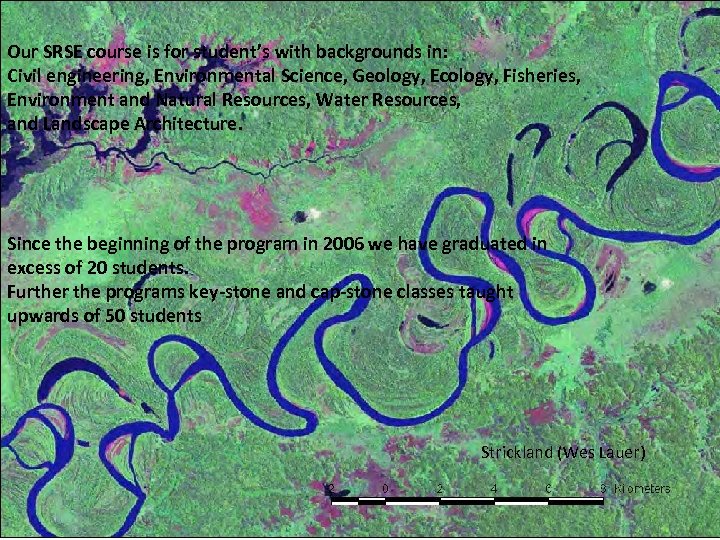 Our SRSE course is for student’s with backgrounds in: Civil engineering, Environmental Science, Geology, Ecology, Fisheries, Environment and Natural Resources, Water Resources, and Landscape Architecture. Since the beginning of the program in 2006 we have graduated in excess of 20 students. Further the programs key-stone and cap-stone classes taught upwards of 50 students Strickland (Wes Lauer)
 Program Philosophy Emphasis on SR design based on analysis and prediction, not analogy. Fir st The importance of placing SR projects in the watershed context. do Use of approaches that integrate ecology & geomorphology with engineering. no Ha rm Emphasis on working with natural processes towards self-sustaining design. The importance of using and integrating historical records. The critical natures of problem identification, construction, and post restoration monitoring. Recognition of the societal context –stakeholders interests, funding sources, regulations, cultural issues, etc.
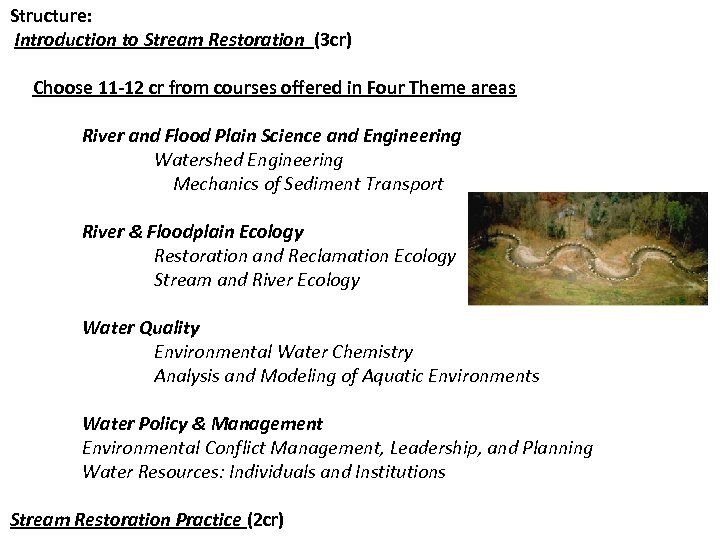 Structure: Introduction to Stream Restoration (3 cr) Choose 11 -12 cr from courses offered in Four Theme areas River and Flood Plain Science and Engineering Watershed Engineering Mechanics of Sediment Transport River & Floodplain Ecology Restoration and Reclamation Ecology Stream and River Ecology Water Quality Environmental Water Chemistry Analysis and Modeling of Aquatic Environments Water Policy & Management Environmental Conflict Management, Leadership, and Planning Water Resources: Individuals and Institutions Stream Restoration Practice (2 cr)
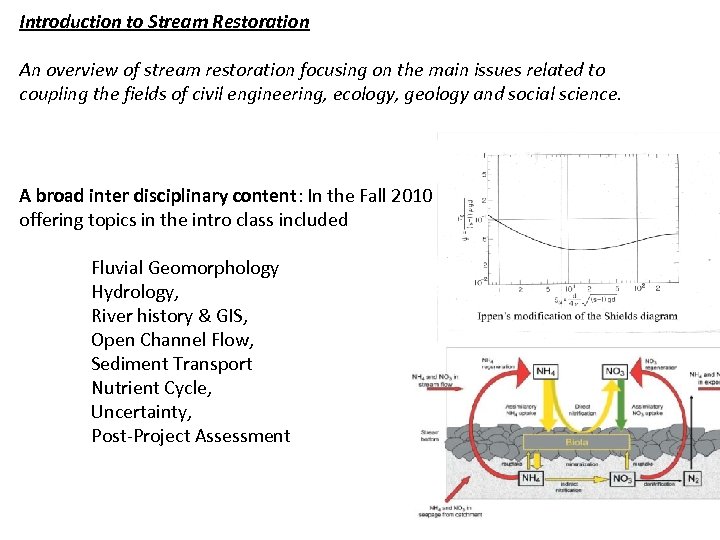 Introduction to Stream Restoration An overview of stream restoration focusing on the main issues related to coupling the fields of civil engineering, ecology, geology and social science. A broad inter disciplinary content: In the Fall 2010 offering topics in the intro class included Fluvial Geomorphology Hydrology, River history & GIS, Open Channel Flow, Sediment Transport Nutrient Cycle, Uncertainty, Post-Project Assessment
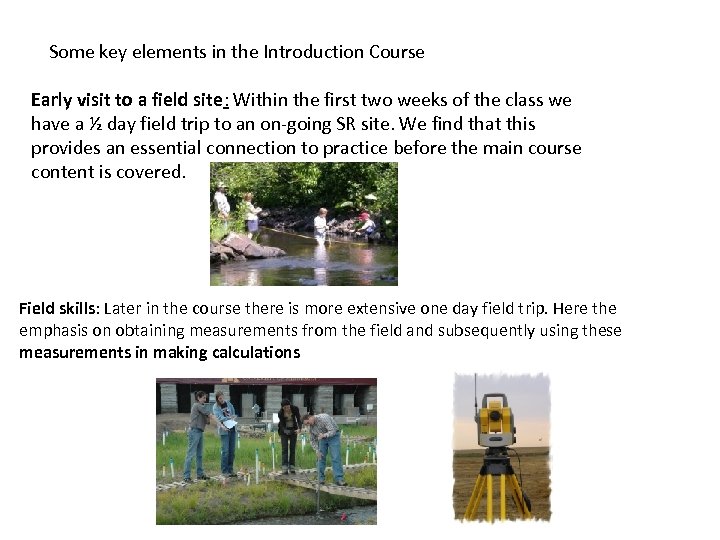 Some key elements in the Introduction Course Early visit to a field site: Within the first two weeks of the class we have a ½ day field trip to an on-going SR site. We find that this provides an essential connection to practice before the main course content is covered. Field skills: Later in the course there is more extensive one day field trip. Here the emphasis on obtaining measurements from the field and subsequently using these measurements in making calculations
 Some key elements in the Introduction Course (cont) Connection to practice: We have been fortunate to develop a very good working relationship with stream restoration professionals, in particular Marty Melchoir and Nick Nelson of Interfluve inc. —a leading North American river restoration design firm Key Notes: We are very conscious of the need to provided our students a legacy from the intro course that will serve thru and beyond the reminder of the certificate program. One important legacy we refer to as “Key Notes. ” Here the idea is to get the students to create a stream restoration guide or ready equations, “rules of thumb, and categorization information—on no more than four laminated sides of 8 x 11—that can provide an at hand guide in the field. Again to provide an illustration below is a “snippit” from the field guide prepared by Jon Schwenk in our 2010 class s Stream Re
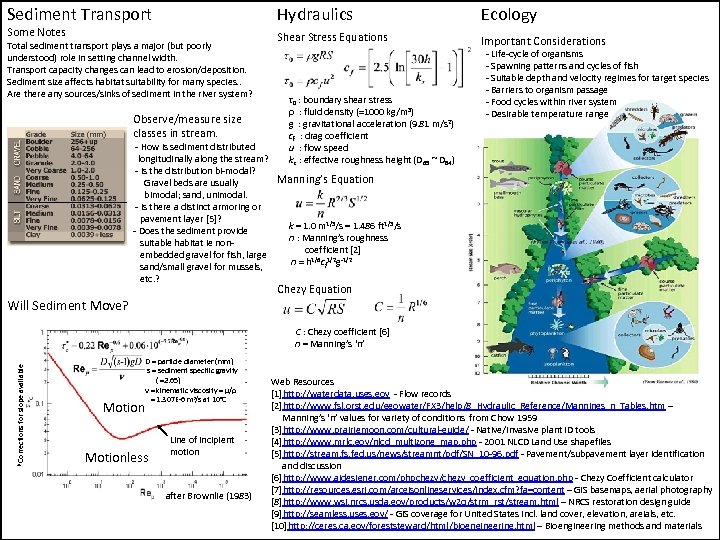 Sediment Transport Hydraulics Some Notes Total sediment transport plays a major (but poorly understood) role in setting channel width. Transport capacity changes can lead to erosion/deposition. Sediment size affects habitat suitability for many species. . Are there any sources/sinks of sediment in the river system? Ecology Shear Stress Equations Important Considerations τ0 : boundary shear stress ρ : fluid density (≈1000 kg/m 3) Observe/measure size g : gravitational acceleration (9. 81 m/s 2) classes in stream. cf : drag coefficient - How is sediment distributed u : flow speed longitudinally along the stream? ks : effective roughness height (D 65 ~ D 84) - Is the distribution bi-modal? Manning’s Equation Gravel beds are usually bimodal; sand, unimodal. - Is there a distinct armoring or pavement layer [5]? k = 1. 0 m 1/3/s = 1. 486 ft 1/3/s - Does the sediment provide n : Manning’s roughness suitable habitat ie non- coefficient [2] embedded gravel for fish, large n ≈ h 1/6 cf 1/2 g-1/2 sand/small gravel for mussels, etc. ? - Life-cycle of organisms - Spawning patterns and cycles of fish - Suitable depth and velocity regimes for target species - Barriers to organism passage - Food cycles within river system - Desirable temperature range Chezy Equation Will Sediment Move? *Corrections for slope available C : Chezy coefficient [6] n = Manning’s ‘n’ Motion D = particle diameter (mm) s = sediment specific gravity ( ≈2. 65) ν = kinematic viscosity = μ/ρ = 1. 307 E-6 m 2/s at 10°C Motionless Line of incipient motion after Brownlie (1983) Web Resources [1]http: //waterdata. usgs. gov - Flow records [2]http: //www. fsl. orst. edu/geowater/FX 3/help/8_Hydraulic_Reference/Mannings_n_Tables. htm – Manning’s ‘n’ values for variety of conditions from Chow 1959 [3]http: //www. prairiemoon. com/cultural-guide/ - Native/Invasive plant ID tools [4]http: //www. mrlc. gov/nlcd_multizone_map. php - 2001 NLCD Land Use shapefiles [5]http: //stream. fs. fed. us/news/streamnt/pdf/SN_10 -96. pdf - Pavement/subpavement layer identification and discussion [6]http: //www. ajdesigner. com/phpchezy/chezy_coefficient_equation. php - Chezy Coefficient calculator [7]http: //resources. esri. com/arcgisonlineservices/index. cfm? fa=content – GIS basemaps, aerial photography [8]http: //www. wsi. nrcs. usda. gov/products/w 2 q/strm_rst/stream. html – NRCS restoration design guide [9]http: //seamless. usgs. gov/ - GIS coverage for United States incl. land cover, elevation, areials, etc. [10]http: //ceres. ca. gov/foreststeward/html/bioengineering. html – Bioengineering methods and materials
 Skills test: We do not have a formal final in the course but rather have the students do a take home skills test. The objective here is to ensure that the student have picked up the critical basic calculation skills and an understanding of how engineering and science can be blended in an SR project. 1. The data in the attached Excel file give relative bed elevation and grain size data for a series of positions across a stream. 1. 1. Find theoretical rating curve for the section based on steady uniform flow AND 1. 2. Find the critical discharge for initiation of sediment movement in the section 2. Explain how residence time affects denitrification and how specific stream restoration design measures can affect residence time. 3. Although habitat requirements differ for different species, there are some physical habitat characteristics that are good for stream ecosystems in general. Discuss three such habitat characteristics and how they can be improved through restoration design.
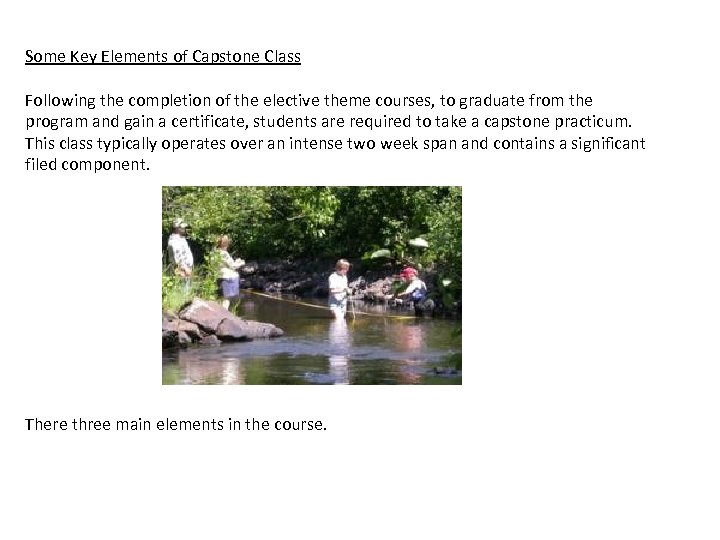 Some Key Elements of Capstone Class Following the completion of the elective theme courses, to graduate from the program and gain a certificate, students are required to take a capstone practicum. This class typically operates over an intense two week span and contains a significant filed component. There three main elements in the course.
 Overview of theme course work: To begin the course, each students are required to make a 30 minute presentation on what they have seen as important SR contributions from the elective course work they have undertaken. Critique and regarding of skills test: Beginning in our next offering of the capstone class we are going to require students to critique and re-grade the skills tests they prepared in the key-stone class. The objective here is for students to apply the new knowledge gained from their theme electives to update and modify their original understanding based on material presented in the intro class. A
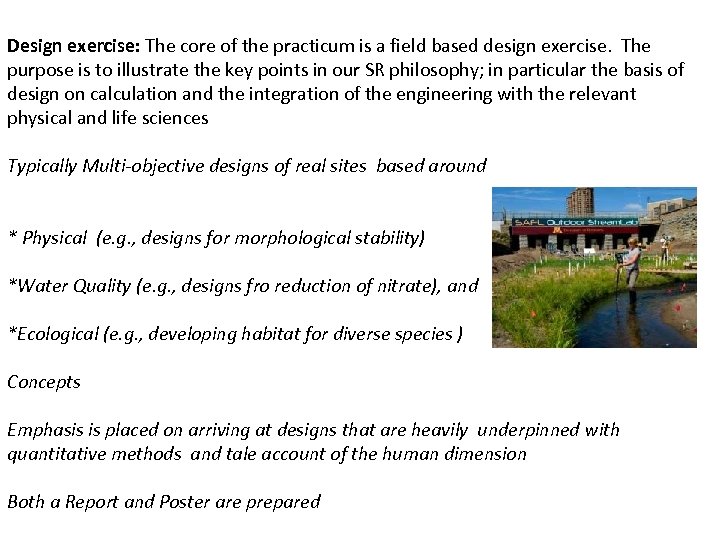 Design exercise: The core of the practicum is a field based design exercise. The purpose is to illustrate the key points in our SR philosophy; in particular the basis of design on calculation and the integration of the engineering with the relevant physical and life sciences Typically Multi-objective designs of real sites based around * Physical (e. g. , designs for morphological stability) *Water Quality (e. g. , designs fro reduction of nitrate), and *Ecological (e. g. , developing habitat for diverse species ) Concepts Emphasis is placed on arriving at designs that are heavily underpinned with quantitative methods and tale account of the human dimension Both a Report and Poster are prepared
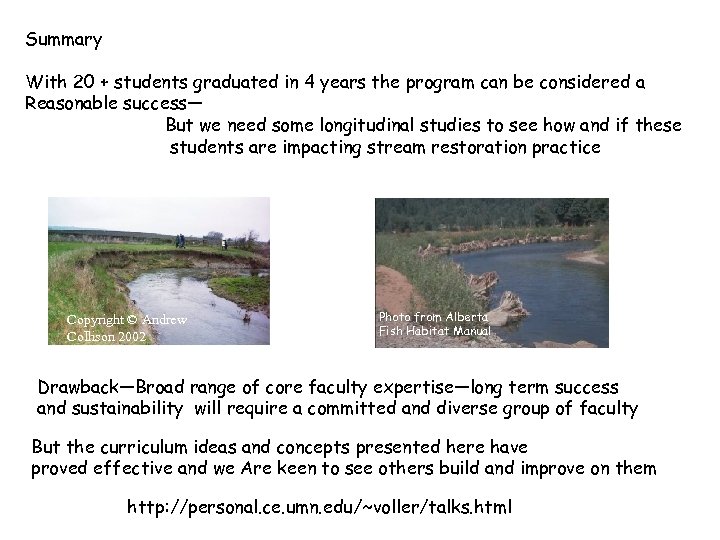 Summary With 20 + students graduated in 4 years the program can be considered a Reasonable success— But we need some longitudinal studies to see how and if these students are impacting stream restoration practice Copyright © Andrew Collison 2002 Photo from Alberta Fish Habitat Manual Drawback—Broad range of core faculty expertise—long term success and sustainability will require a committed and diverse group of faculty But the curriculum ideas and concepts presented here have proved effective and we Are keen to see others build and improve on them http: //personal. ce. umn. edu/~voller/talks. html