 Скачать презентацию Designing for Success Choosing Cube Sat Components Wisely
86d9a85aa42d4a4aa9f742743fc5694b.ppt
- Количество слайдов: 20



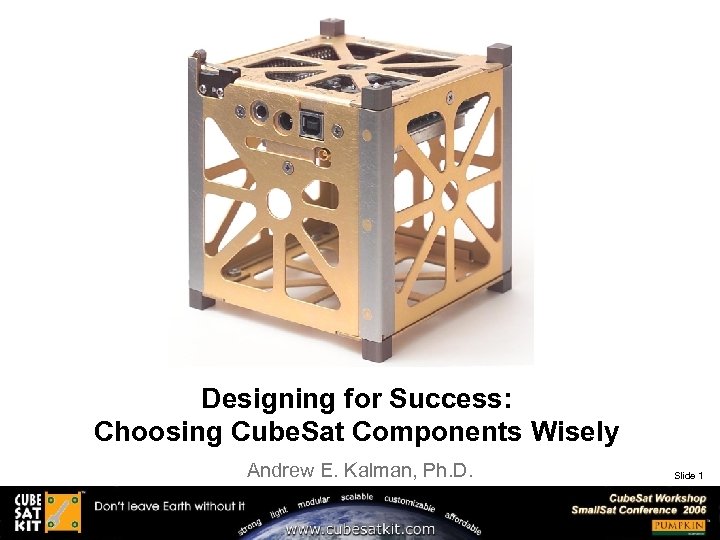
Designing for Success: Choosing Cube. Sat Components Wisely Andrew E. Kalman, Ph. D. Slide 1
Introduction • Andrew E. Kalman § President and CTO, Pumpkin, Inc. § Author of § Creator of the § 20+ years of embedded systems design and programming experience. § Contact: aek@pumpkininc. com Slide 2
Outline • Overview: Presentation Goals • Part I: Building vs. Buying • Part II: Extreme Timelines • Part III: Examples • Part IV: Suggested Guidelines Slide 3
Overview • This presentation is targeted at educators, students and project managers who are working to rapidly develop hardware & software for Cube. Sat missions. • With over 30 Pumpkin Cube. Sat Kits in customer hands, we have seen customers faced with a variety of design decisions as their Cube. Sat projects progress towards completion. • We examine three critical areas that will affect every Cube. Sat project – PCB fabrication, connectors and software – and supply examples of choices to be made for the sake of efficiency. • Finally, we provide some guidelines to aid in successfully designing for Cube. Sat missions within the relatively short timeframes available. Slide 4
Part I: Building vs. Buying • Advantages of building something from scratch: § Pride in building something yourself. § Educational experience. § Custom size / power / functionality requirements. § Exactly what you wanted. • Advantages of buying off-the-shelf (COTS) components: § Much faster design & integration process. § Often cheaper, especially when time is factored in. § Effort is the same for 100 units. § Let someone else worry about the details. § Often built for interoperability via standards. § You’re not alone. Slide 5
Building vs. Buying (cont’d) • Disadvantages of building something from scratch: § Expertise may be lacking. § Ramp-up time may not be available. § Substantial NRE in labor, tools & materials. § Design iterations take time. Early revisions are likely to have errors, esp. as complexity increases. § Resulting product may be a dead end. • Disadvantages of buying off-the-shelf components: § Advertised cost & availability may not reflect reality. § Generally not designed for space use (e. g. temp. ratings). § Dependent on supplier for support. § Often not an “ideal fit” to your architecture or plans. § Higher apparent cost. Slide 6
Building vs. Buying (cont’d) • A Cube. Sat will likely be a combination of COTS (i. e. bought) components and custom (i. e. built) components. The trick is to choose wisely. . . • For proof-of-concept work – where mass, volume and power constraints are not an issue – “going all COTS” saves lots of time. Slide 7
Building vs. Buying (cont’d) • Building and buying are both affected by parts availability: § Ro. HS and WEEE have recently caused many parts sourcing difficulties, esp. in the USA. Most parts are now Pb-free, etc. § Parts obsolescence is unavoidable in the electronics industry. Microcontrollers and commodity discretes have relatively long lifespans. Other, more specialized components are often subject to availability and/or allocation, or are simply phased out. Designers must deal with these issues on a regular basis. Parts can become unavailable overnight. § Increasing miniaturization forces PCB redesigns to keep up with newer package offerings. § Because of their small numbers and their low parts costs, Cube. Sats have little or no clout with parts manufacturers and are at the mercy of bigger market forces. • One advantage of Cube. Sats is their relatively low internal parts cost. Therefore lifetime buys of critical components should be seriously considered, thereby alleviating worries about availability. Slide 8
Part II: Extreme Timelines • 12 to 18 months appears to be the current desired timeframe for Cube. Sat development within educational settings. Projects with larger scopes can take much longer. • Since students pass in and out of Cube. Sat projects relatively quickly, it is imperative to organize their efforts to yield a sense of ownership and accomplishment for each student. At the end of a term, each student or team of students should deliver a complete, functional and welldocumented Cube. Sat module (hardware and software) that can be integrated into the whole with a minimum of further changes. • When succeeding students & teams do not build upon previous efforts, timelines are invariably stretched out. • Even student-led projects appear to develop NIH Slide 9 syndrome …
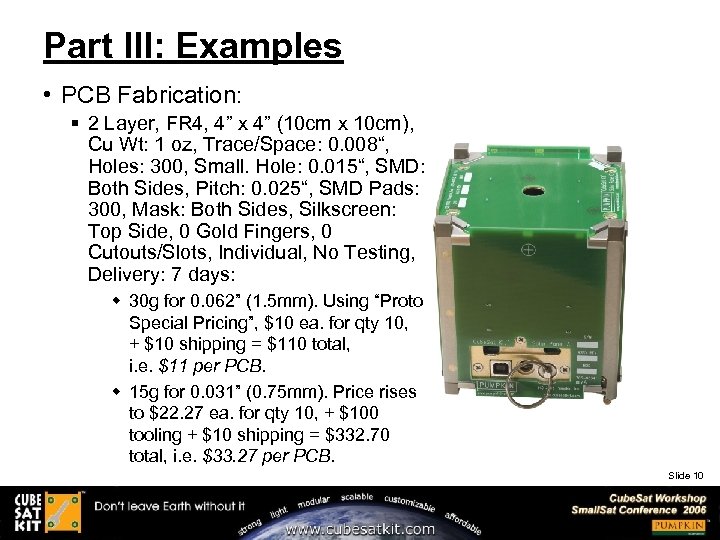
Part III: Examples • PCB Fabrication: § 2 Layer, FR 4, 4” x 4” (10 cm x 10 cm), Cu Wt: 1 oz, Trace/Space: 0. 008“, Holes: 300, Small. Hole: 0. 015“, SMD: Both Sides, Pitch: 0. 025“, SMD Pads: 300, Mask: Both Sides, Silkscreen: Top Side, 0 Gold Fingers, 0 Cutouts/Slots, Individual, No Testing, Delivery: 7 days: w 30 g for 0. 062” (1. 5 mm). Using “Proto Special Pricing”, $10 ea. for qty 10, + $10 shipping = $110 total, i. e. $11 per PCB. w 15 g for 0. 031” (0. 75 mm). Price rises to $22. 27 ea. for qty 10, + $100 tooling + $10 shipping = $332. 70 total, i. e. $33. 27 per PCB. Slide 10
Part III: Examples (cont’d) • PCB Fabrication (cont’d): § Idea is to take advantage of “best buys” for prototyping and proofof-concept, and then optimize design for Cube. Sat specifications in following iteration(s). Parametric changes (e. g. PCB thickness) can have far-reaching implications. 1 st revision often has errors! § Going from 0. 062” (1. 5 mm) to 0. 031” (0. 75 mm) Solar Panel PCBs saves nearly 100 g (10% of Cube. Sat’s mass) for six sides! Therefore “slight deviations from the norm” (here, the norm is 0. 062” PCB thickness) are often highly desirable. § The demands of the Cube. Sat specification (esp. low mass) push the prices of fabrication (e. g. PCB fab) out of the mainstream and into the higher-cost custom region. § With increased standardization amongst Cube. Sats, these costs can be reduced as manufacturing volumes increase. Greater demand for Cube. Sat-specific components can substantially reduce their per-unit cost by reducing the impact of NRE for custom fabrication. Slide 11
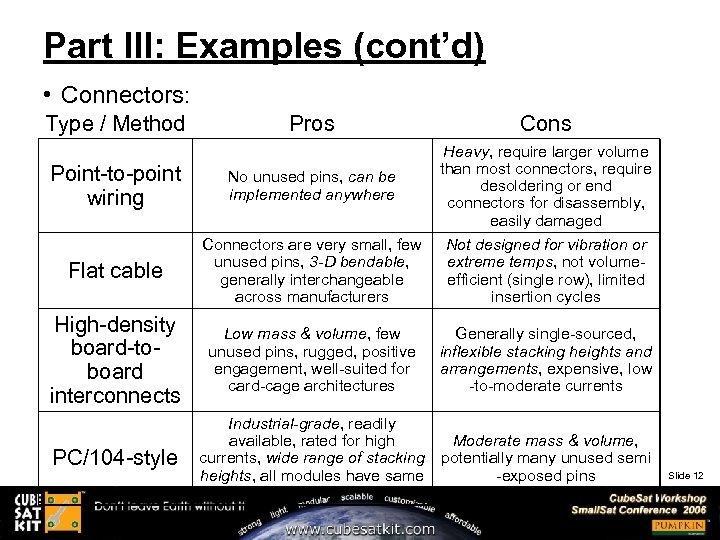
Part III: Examples (cont’d) • Connectors: Type / Method Pros Cons Point-to-point wiring No unused pins, can be implemented anywhere Heavy, require larger volume than most connectors, require desoldering or end connectors for disassembly, easily damaged Flat cable Connectors are very small, few unused pins, 3 -D bendable, generally interchangeable across manufacturers Not designed for vibration or extreme temps, not volumeefficient (single row), limited insertion cycles High-density board-toboard interconnects Low mass & volume, few unused pins, rugged, positive engagement, well-suited for card-cage architectures Generally single-sourced, inflexible stacking heights and arrangements, expensive, low -to-moderate currents PC/104 -style Industrial-grade, readily available, rated for high Moderate mass & volume, currents, wide range of stacking potentially many unused semi heights, all modules have same -exposed pins pinout Slide 12
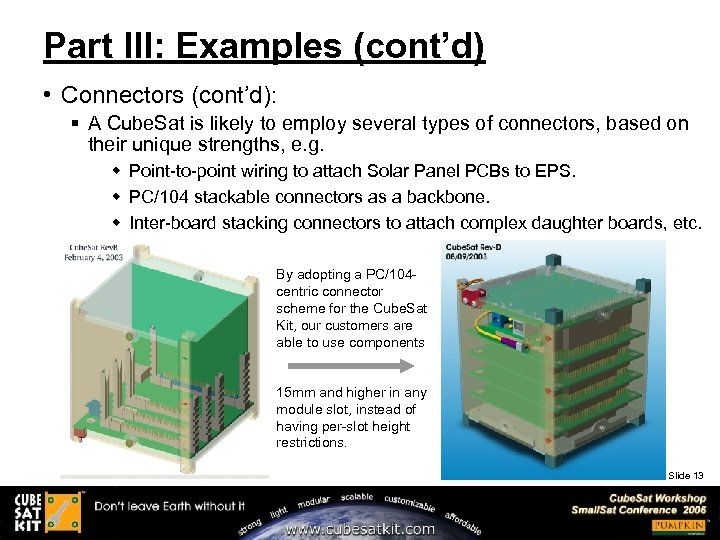
Part III: Examples (cont’d) • Connectors (cont’d): § A Cube. Sat is likely to employ several types of connectors, based on their unique strengths, e. g. w Point-to-point wiring to attach Solar Panel PCBs to EPS. w PC/104 stackable connectors as a backbone. w Inter-board stacking connectors to attach complex daughter boards, etc. By adopting a PC/104 centric connector scheme for the Cube. Sat Kit, our customers are able to use components 15 mm and higher in any module slot, instead of having per-slot height restrictions. Slide 13
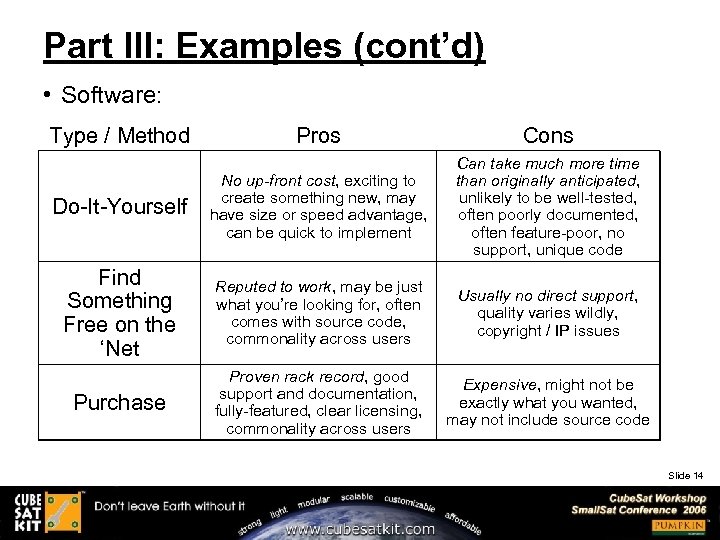
Part III: Examples (cont’d) • Software: Type / Method Pros Cons Do-It-Yourself No up-front cost, exciting to create something new, may have size or speed advantage, can be quick to implement Can take much more time than originally anticipated, unlikely to be well-tested, often poorly documented, often feature-poor, no support, unique code Find Something Free on the ‘Net Reputed to work, may be just what you’re looking for, often comes with source code, commonality across users Usually no direct support, quality varies wildly, copyright / IP issues Purchase Proven rack record, good support and documentation, fully-featured, clear licensing, commonality across users Expensive, might not be exactly what you wanted, may not include source code Slide 14
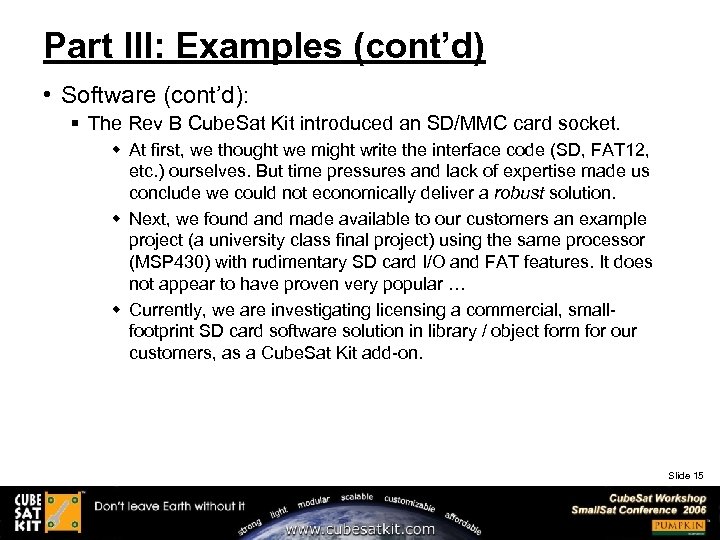
Part III: Examples (cont’d) • Software (cont’d): § The Rev B Cube. Sat Kit introduced an SD/MMC card socket. w At first, we thought we might write the interface code (SD, FAT 12, etc. ) ourselves. But time pressures and lack of expertise made us conclude we could not economically deliver a robust solution. w Next, we found and made available to our customers an example project (a university class final project) using the same processor (MSP 430) with rudimentary SD card I/O and FAT features. It does not appear to have proven very popular … w Currently, we are investigating licensing a commercial, smallfootprint SD card software solution in library / object form for our customers, as a Cube. Sat Kit add-on. Slide 15
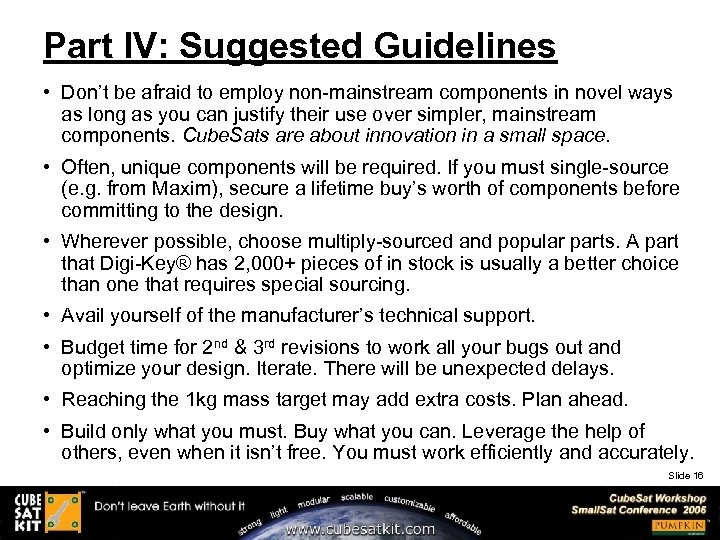
Part IV: Suggested Guidelines • Don’t be afraid to employ non-mainstream components in novel ways as long as you can justify their use over simpler, mainstream components. Cube. Sats are about innovation in a small space. • Often, unique components will be required. If you must single-source (e. g. from Maxim), secure a lifetime buy’s worth of components before committing to the design. • Wherever possible, choose multiply-sourced and popular parts. A part that Digi-Key® has 2, 000+ pieces of in stock is usually a better choice than one that requires special sourcing. • Avail yourself of the manufacturer’s technical support. • Budget time for 2 nd & 3 rd revisions to work all your bugs out and optimize your design. Iterate. There will be unexpected delays. • Reaching the 1 kg mass target may add extra costs. Plan ahead. • Build only what you must. Buy what you can. Leverage the help of others, even when it isn’t free. You must work efficiently and accurately. Slide 16
Notice This presentation is available online in Microsoft Power. Point and Adobe Acrobat formats at: ® ® www. pumpkininc. com/content/doc/press/Pumpkin_Small. Sat-2006. ppt and: www. pumpkininc. com/content/doc/press/Pumpkin_ Small. Sat-2006. pdf Slide 17
Q&A Session Thank you for attending the workshop! Slide 18
Notes & References 1. Cube. Sat Design Specification, www. cubesat. org. 2. Cube. Sat Kit User Manual, Pumpkin, Inc. 2005, www. pumpkininc. com. 3. PCB price quotes via http: //www. pcb 4 u. com (Accutrace, Inc. ). 4. For connectors of many different types (including PC/104 and inter-board), please see http: //www. samtec. com. 5. Digi-Key is at http: //www. digi-key. com. Slide 19
Appendix • Speaker information § Dr. Kalman is Pumpkin's president and chief technology architect. He entered the embedded programming world in the mid-1980's. After co-founding Euphonix, Inc – the pioneering Silicon Valley high-tech pro-audio company – he founded Pumpkin to explore the feasibility of applying high-level programming paradigms to severely memory-constrained embedded architectures. He holds two United States patents and is a consulting professor at Stanford University. • Acknowledgements § Stanford Professors Bob Twiggs' and Jamie Cutler’s continued support for the Cube. Sat Kit, and their inputs on enhancements and suggestions for future Cube. Sat Kit products, are greatly appreciated. § Pumpkin’s Salvo and Cube. Sat Kit customers, whose real-world experience with our products helps us improve and innovate. • Salvo, Cube. Sat Kit and Cube. Sat information § More information on Pumpkin’s Salvo RTOS and Pumpkin’s Cube. Sat Kit can be found at http: //www. pumpkininc. com/ and http: //www. cubesatkit. com/, respectively. § More information on the open Cube. Sat standard and the Cube. Sat community can be found at http: //www. cubesat. info/. • Copyright notice © 2006 Pumpkin, Inc. All rights reserved. Pumpkin and the Pumpkin logo, Salvo and the Salvo logo, The RTOS that runs in tiny places, Cube. Sat Kit Bus and the Cube. Sat Kit logo are all trademarks of Pumpkin, Inc. All other trademarks and logos are the property of their respective owners. No endorsements of or by third parties listed are implied. All specifications subject to change without notice. First presented at the Cube. Sat workshop of the 20 th Annual Conference on Small Satellites in Logan, Utah on August 12, 2006. Slide 20
Скачать презентацию Designing for Success Choosing Cube Sat Components Wisely
86d9a85aa42d4a4aa9f742743fc5694b.ppt