


 Скачать презентацию Designing Energy-Efficient Fetch Engines Michele Co Department of
4d872530793d04e005abe228432a1331.ppt
- Количество слайдов: 37
 Designing Energy-Efficient Fetch Engines Michele Co Department of Computer Science University of Virginia Advisor: Co-Advisor: Committee: Kevin Skadron Dee A. B. Weikle Jack Davidson (Chair) James Cohoon, John Lach, Christopher Milner
 Overview • • • Introduction Fetch Engine Design Space Related Work Results Summary 2
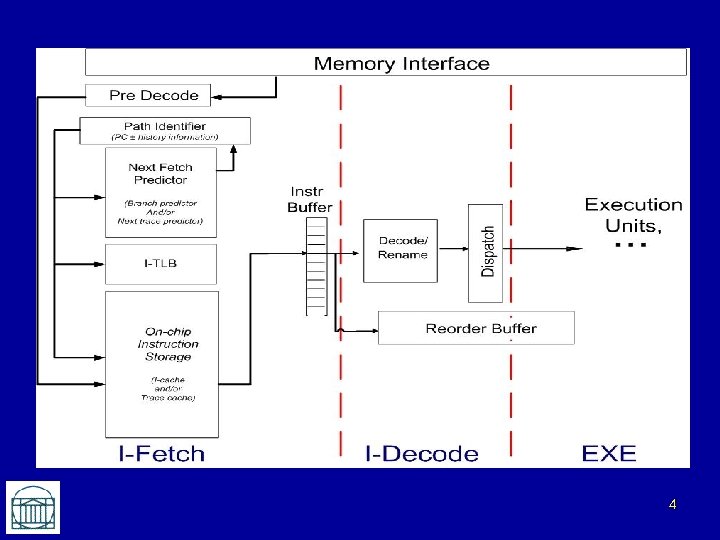
 Introduction • Energy efficiency – Balance power and performance (runtime) • Fetch Engine – I-storage – I-TLB – Predictor 3
 4
4
 Fetch Engines are Important • Provides instructions to execution units – Impacts overall processor energy • Bottleneck to performance – Deep processor pipelines → high branch misprediction penalty – Mispredictions waste work and energy 5
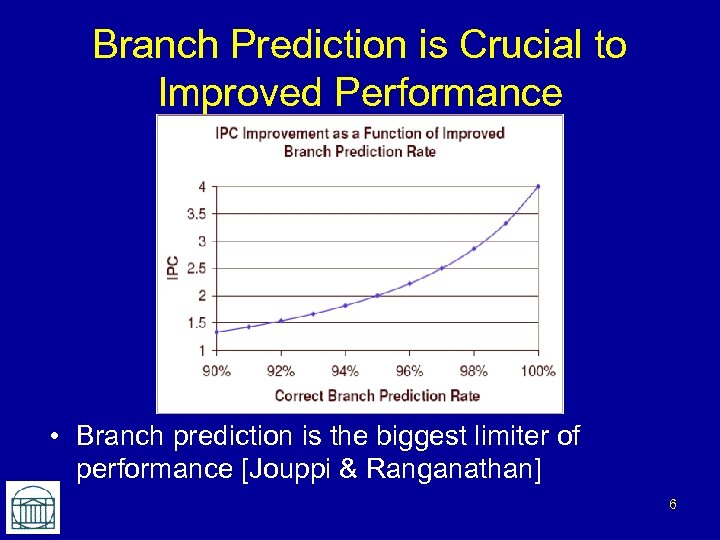 Branch Prediction is Crucial to Improved Performance • Branch prediction is the biggest limiter of performance [Jouppi & Ranganathan] 6
 Why Study Fetch Engine Energy Efficiency? • High fetch bandwidth mechanisms – Rotenberg, et al. ; Black, et al. ; many others • Better branch predictor → better chip energy -efficiency – Parikh, et al. • Recent branch predictors: ↑ accuracy, ↑ performance, ↑ area – Jimenez; Seznec; Tarjan 7
 What is the most energy efficient fetch organization? • Performance design ≠ Energy-efficiency design • What improves energy efficiency? – Caches? – Branch predictors? – Other? Thesis: • Branch prediction is key factor affecting energyefficiency • Analytical methods are needed to help focus design space studies 8
 Overview • • • Introduction Fetch Engine Design Space Related Work Results Summary 9
 Fetch Engine Design Space • Design space parameters – – – Instruction storage order Cache associativity and area Instruction fetch bundle Next fetch predictor Instruction issue width • Technology factors – Leakage power – Access latency • System-level factors – Context switching 10
 Research Goals • Evaluate fetch engine design space for energy efficiency • Develop techniques to aid in design space evaluations 11
 Contributions • Fetch engine design space evaluation for energy-efficiency – Insight: Branch prediction and access latency • Ahead-pipelined next trace prediction • Evaluated the effect of context switching 12
 Contributions • Breakeven branch predictor energy formulation • Extension of breakeven formulation for inorder processors • Evaluated potential for phase adaptation for branch predictors 13
 Overview • • • Introduction Fetch Engine Design Space Related Work Results Summary 14
 Related Work • Design space studies – Friendly, et al. ; Rotenberg, et al. (trace caches) • Power and energy consumption – Hu, et al. ; (trace caches) – Bahar; Kim; Zhang (instruction caches) – Parikh, et al. (branch predictors) 15
 Overview • • • Introduction Fetch Engine Design Space Related Work Results Summary 16
 Methodology • Simulator and Power Models – Simple. Scalar • Instruction cache and trace cache models • Branch predictors, next trace predictors • Context-switching – Wattch • Benchmarks – SPECcpu 1995, SPECcpu 2000 • Metrics – Performance: Instructions per Clock (IPC), branch misprediction rate – Energy-efficiency: Energy, Energy-Delay-Squared Product (ED 2) 17
 Fetch Engine Design Space Study • Varied fetch organization – Sequential trace cache – Block-based trace cache – Instruction cache • Classic fetch • Streaming fetch – Branch predictor / trace predictor • Varied component sizes – 2 KB - 512 KB ACM TACO, in review 18
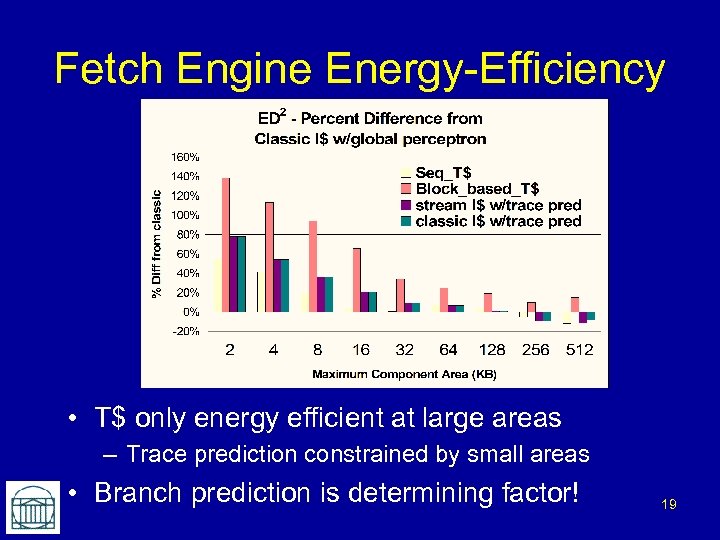 Fetch Engine Energy-Efficiency • T$ only energy efficient at large areas – Trace prediction constrained by small areas • Branch prediction is determining factor! 19
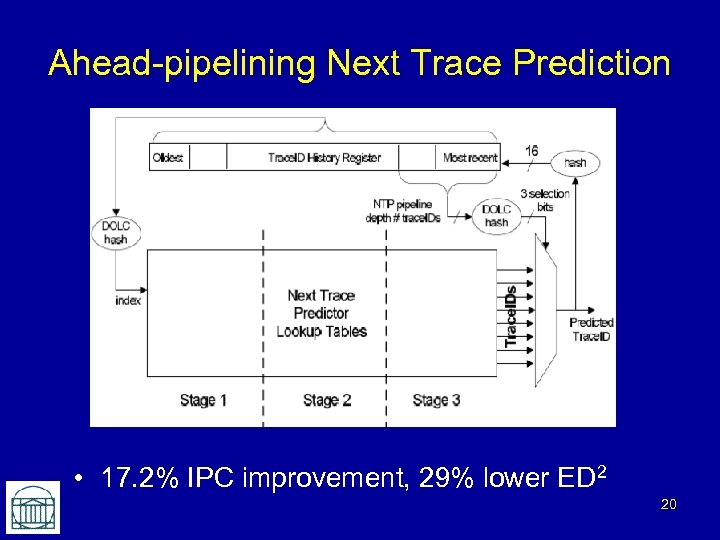 Ahead-pipelining Next Trace Prediction • 17. 2% IPC improvement, 29% lower ED 2 20
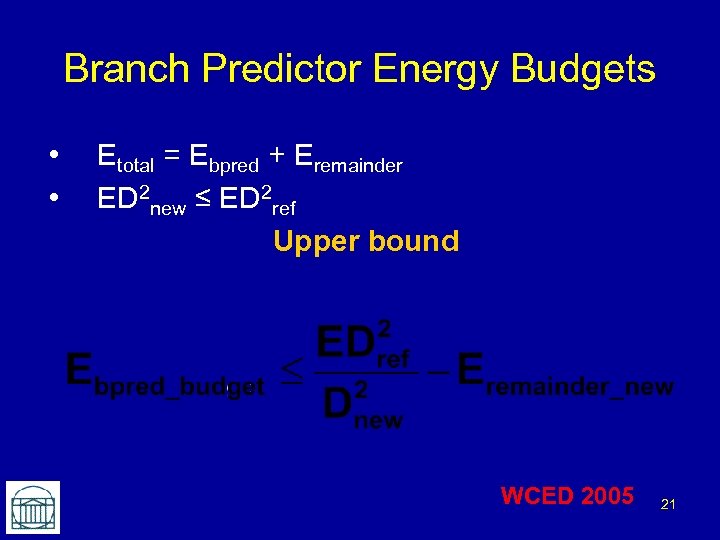 Branch Predictor Energy Budgets • • Etotal = Ebpred + Eremainder ED 2 new ≤ ED 2 ref Upper bound WCED 2005 21
 Branch Predictor Energy Budgets (Intuitively) • How much energy may the branch predictor afford to consume to break even? 22
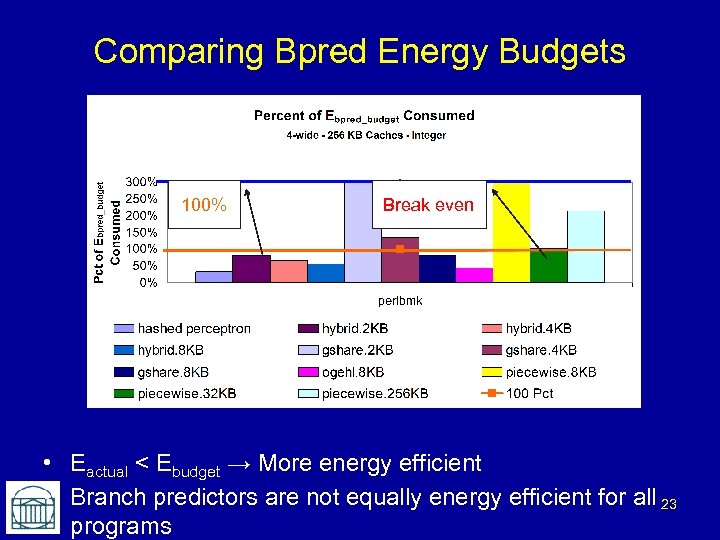 Comparing Bpred Energy Budgets 100% Break even • Eactual < Ebudget → More energy efficient • Branch predictors are not equally energy efficient for all 23 programs
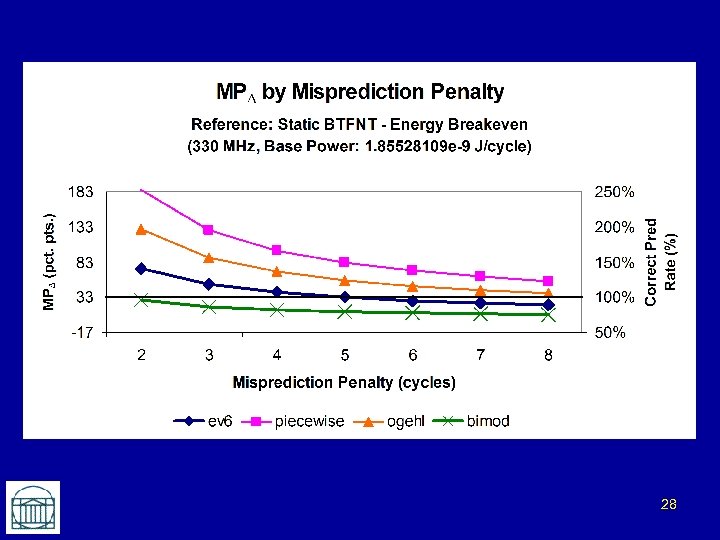
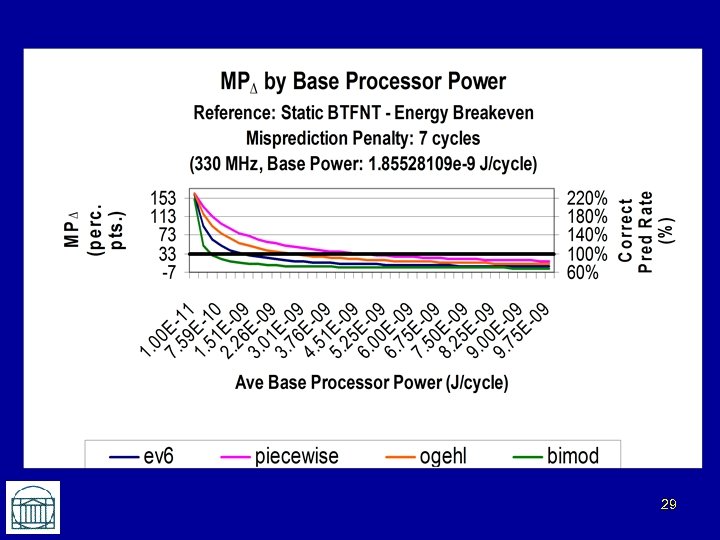
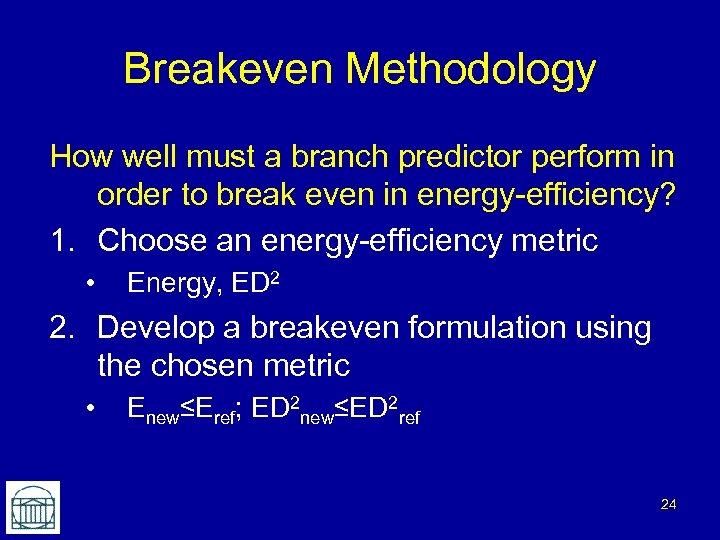 Breakeven Methodology How well must a branch predictor perform in order to break even in energy-efficiency? 1. Choose an energy-efficiency metric • Energy, ED 2 2. Develop a breakeven formulation using the chosen metric • Enew≤Eref; ED 2 new≤ED 2 ref 24
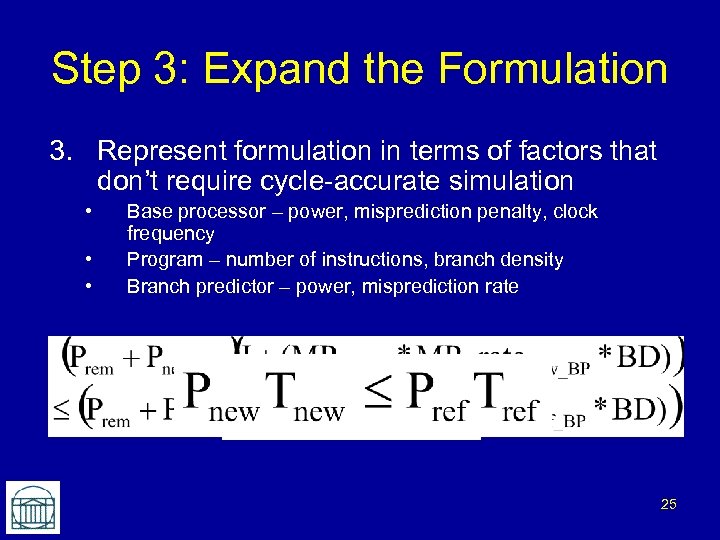 Step 3: Expand the Formulation 3. Represent formulation in terms of factors that don’t require cycle-accurate simulation • • • Base processor – power, misprediction penalty, clock frequency Program – number of instructions, branch density Branch predictor – power, misprediction rate 25
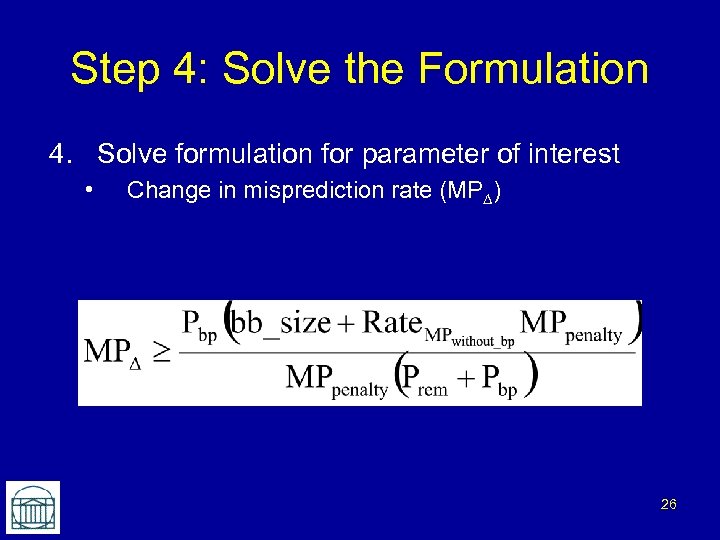 Step 4: Solve the Formulation 4. Solve formulation for parameter of interest • Change in misprediction rate (MP∆) 26
 Step 5: Narrow the Design Space 5. Cull design space, eliminate noninteresting design points from cycleaccurate simulation evaluation 27
 28
28
 29
29
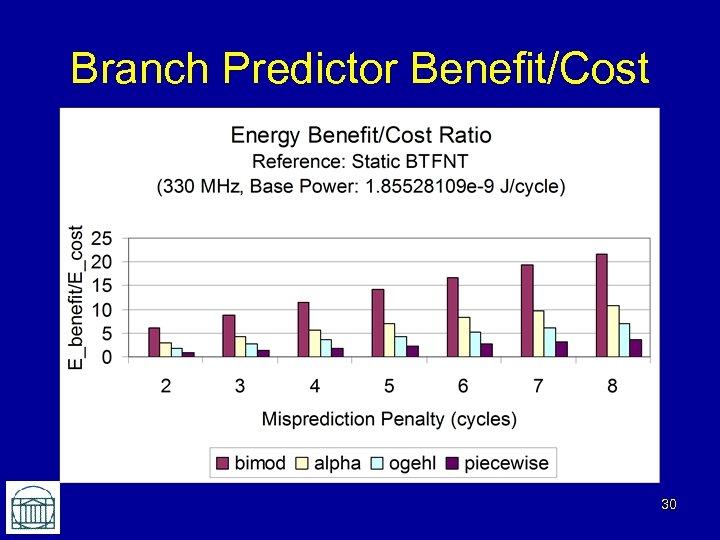 Branch Predictor Benefit/Cost 30
 Adapting the Fetch Engine for Energy Efficiency • Proposed Idea – Adapt branch predictor based on program phase behavior • Finding – Little potential for phase-based branch predictor adaptation • Given state-of-the-art branch predictors and the SPEC 2000 benchmark suite 31
 Overview • • • Introduction Fetch Engine Design Space Related Work Results Summary 32
![Contributions • Fetch engine design space evaluation considering energy-efficiency [ACM TACO, in review] •](https://present5.com/presentation/4d872530793d04e005abe228432a1331/image-33.jpg "Contributions • Fetch engine design space evaluation considering energy-efficiency [ACM TACO, in review] •") Contributions • Fetch engine design space evaluation considering energy-efficiency [ACM TACO, in review] • Ahead-pipelined next trace predictor [ACM TACO, in review] • Effects of context-switching on branch predictors [ISPASS 2001] • Branch prediction breakeven formulation [WCED 2005] • Branch predictor benefit/cost formulation • Potential for phase-based branch predictor adaptation 33
Contributions • Fetch engine design space evaluation considering energy-efficiency [ACM TACO, in review] • Ahead-pipelined next trace predictor [ACM TACO, in review] • Effects of context-switching on branch predictors [ISPASS 2001] • Branch prediction breakeven formulation [WCED 2005] • Branch predictor benefit/cost formulation • Potential for phase-based branch predictor adaptation 33
 Future Work • Fetch engine design space – More sophisticated trace selection heuristics • Branch predictor breakeven formulation – Extend to consider more components • Benefit-cost methodology – Extend to more complex processor designs – Incorporate into a semi-automated tool 34
 Observations • Trace caches and instruction caches have similar performance and energy-efficiency • Branch prediction is critical to energy-efficiency • Access latency is a critical limiter to branch prediction accuracy • Techniques that attack this problem can help branch prediction accuracy (ahead-pipelined NTP) • Realistic time slices have little effect on branch predictor accuracy 35
 Observations (cont’d) • Increasing leakage ratio does not affect relative energy-efficiency of fetch designs • Design space studies are complex and time consuming. Analytical methods are needed to narrow the evaluation space. – Branch predictor breakeven energy budget – Benefit/cost formulation and metric 36
 Designing Energy-Efficient Fetch Engines Michele Co Department of Computer Science University of Virginia Advisor: Committee: Kevin Skadron Jack Davidson (Chair) James Cohoon, John Lach, Christopher Milner, Dee A. B. Weikle