 Скачать презентацию Designing Distributed Applications using Mobile Agents Sridhar Iyer
67df2c3212560bd12e3ae08f03522311.ppt
- Количество слайдов: 158



Designing Distributed Applications using Mobile Agents Sridhar Iyer Vikram Jamwal KR School of IT, IIT Bombay, INDIA International Conference on High Performance Computing December 17, 2001 Hyderabad, INDIA
Outline n n n n Motivation Mobile Agent technology Application domains MA frameworks overview MA based Structuring MA Framework Issues MA Application Case Studies Conclusion
Distributed Computing Outlook n n Peer-Peer computing Context-aware computing Mobile computing Distributed communities n n networks of mobile and fixed people, devices and applications Virtual communities for e-business, e-government and e-education Real-time 3 D environments Intelligent environments
Required … n n Dynamic adaptations in heterogeneous environments Self-organizing systems Metadata, ontologies and the Semantic Web More than simple client-server interactions n From one-one or many-one interactions to • One-many • Many-many n n Support for collaborations We shall pick one representative application viz. Distance Evaluation
Distance Evaluation n Emergence of distance education n n Alternatives to paper-based exams n n n Computer based and Internet based Scheduled and uniform exams Scenario n n Need for distance evaluation mechanisms IIT-JEE type of examination Stages n n n Paper Setting Distribution and Testing Evaluation and Result publication
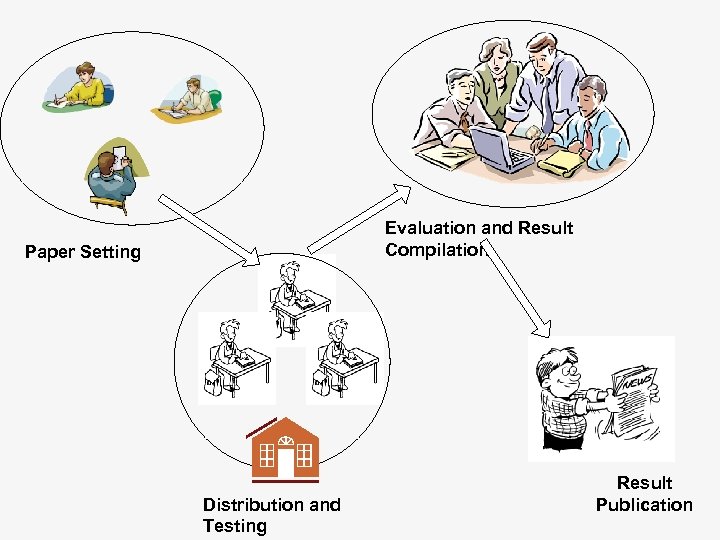
Evaluation and Result Compilation Paper Setting Distribution and Testing Result Publication
Design Goals Map to real life scenario n Automate as much as possible n Minimize the infrastructure at different ends n Include all the stages n
Types of e-testing mechanisms n n Where does the database reside? Locally n n Computer Based Testing (CBT) Examples • GRE and GMAT n Remote n n Internet based testing Example • www. netexam. com n These are any time exams
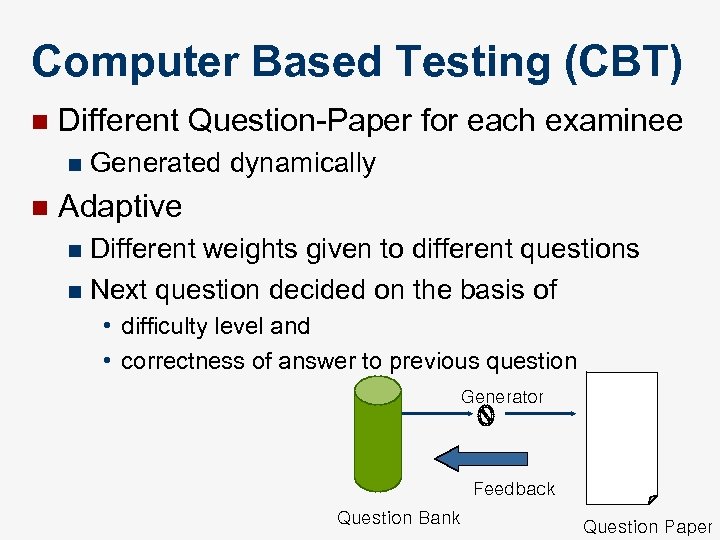
Computer Based Testing (CBT) n Different Question-Paper for each examinee n n Generated dynamically Adaptive Different weights given to different questions n Next question decided on the basis of n • difficulty level and • correctness of answer to previous question Generator Feedback Question Bank Question Paper
Internet Based Testing Existing Schemes n Front End n n Back End n n n CGI scripts Java servlets Security n n n Mostly “HTML - form based” answers sent using ‘GET’ and ‘POST’ methods Java applets, Java Script, flash Authentication done using ‘login - password’ May use “https” for secure exchange Some issues n Web Servers are basically stateless
Important Points n Existing models are basically n n n Extending Internet based evaluation techniques n n n Pull based Client-Server Push model Different kinds of content Dynamic organization of content Off-line examination V/S on-line examination Subjective answers (not just objective) Key technical issues n n How to deliver the exam content? How to evaluate the answers?
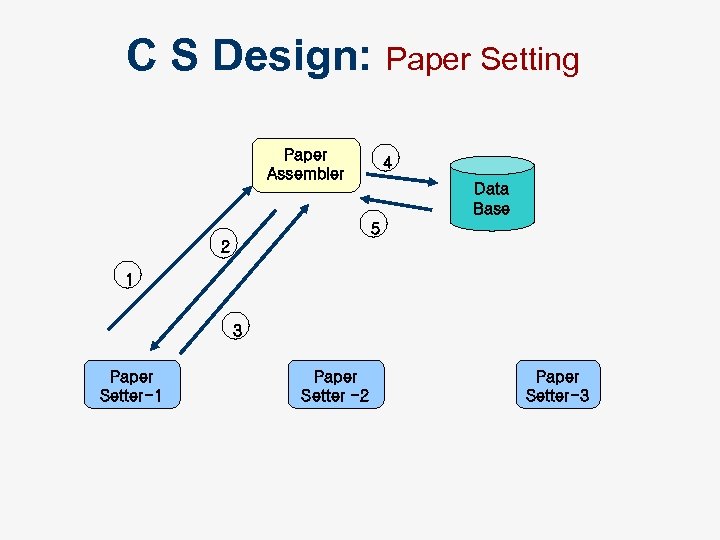
Client-Server Solution : Paper Setting Stage n n Paper Setters (PS) are distributed over a large area. PS may want to work offline (why? ) PS need to be sent notification by the Paper Assembler (PA) from time to time At appropriate time the Question Paper(QA) needs to be gathered, even if partially done
C S Design: Paper Setting Paper Assembler 4 Data Base 5 2 1 3 Paper Setter-1 Paper Setter -2 Paper Setter-3
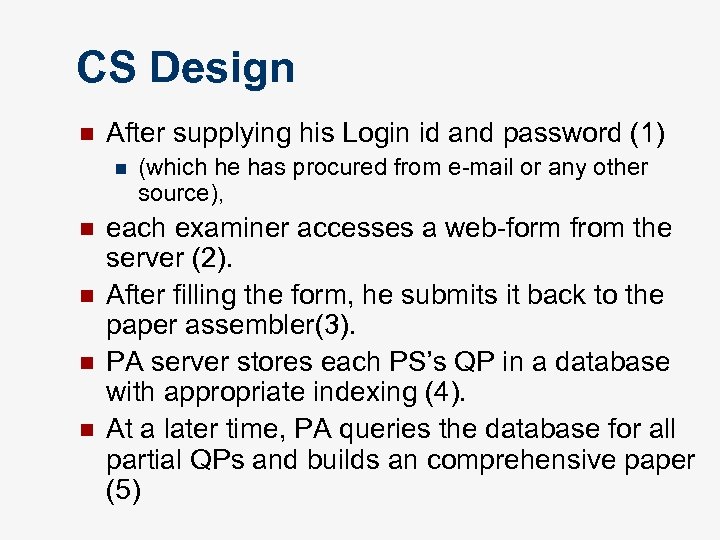
CS Design n After supplying his Login id and password (1) n n n (which he has procured from e-mail or any other source), each examiner accesses a web-form from the server (2). After filling the form, he submits it back to the paper assembler(3). PA server stores each PS’s QP in a database with appropriate indexing (4). At a later time, PA queries the database for all partial QPs and builds an comprehensive paper (5)
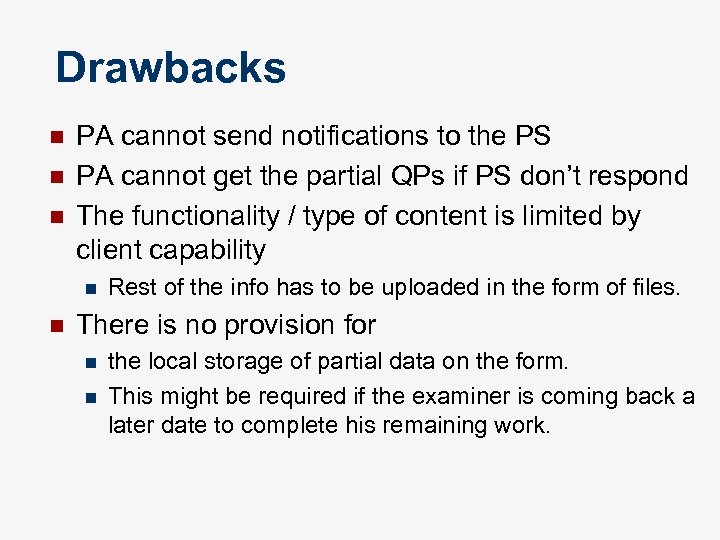
Drawbacks n n n PA cannot send notifications to the PS PA cannot get the partial QPs if PS don’t respond The functionality / type of content is limited by client capability n n Rest of the info has to be uploaded in the form of files. There is no provision for n n the local storage of partial data on the form. This might be required if the examiner is coming back a later date to complete his remaining work.
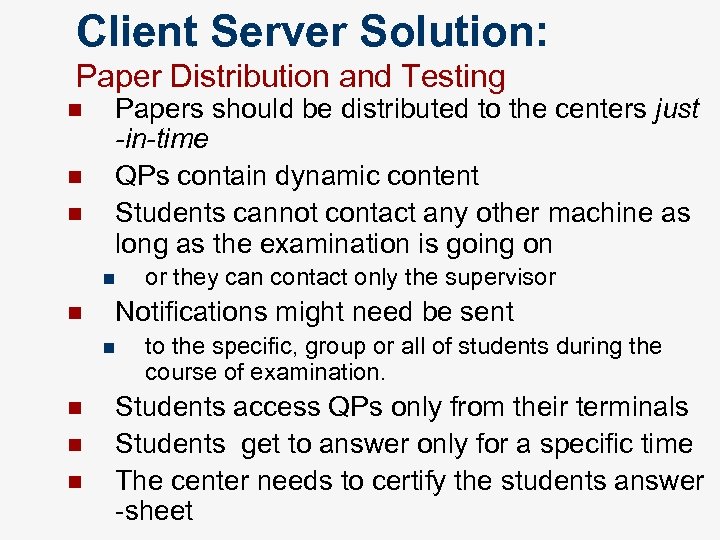
Client Server Solution: Paper Distribution and Testing n n n Papers should be distributed to the centers just -in-time QPs contain dynamic content Students cannot contact any other machine as long as the examination is going on n n Notifications might need be sent n n or they can contact only the supervisor to the specific, group or all of students during the course of examination. Students access QPs only from their terminals Students get to answer only for a specific time The center needs to certify the students answer -sheet
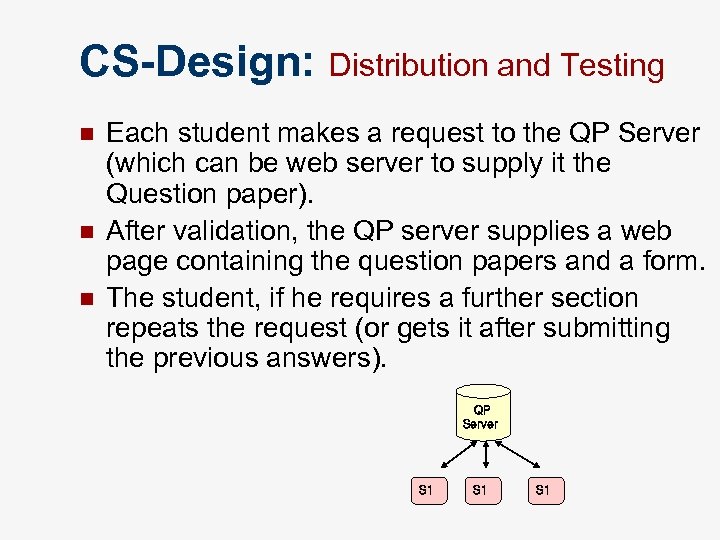
CS-Design: Distribution and Testing n n n Each student makes a request to the QP Server (which can be web server to supply it the Question paper). After validation, the QP server supplies a web page containing the question papers and a form. The student, if he requires a further section repeats the request (or gets it after submitting the previous answers). QP Server S 1 S 1
Drawbacks: n n The web-server (QP server) gets overloaded by various clients requesting at the same time Web server needs to maintain a state information for each student n n n A simple web-form offers various limitations like the kind of multimedia content it can support The information (e. g. question papers or corrections) cannot be pushed to the clients. If the paper collection site is different n n the number of sections he has been offered, the time elapsed for each student. user need to push the answers to a different webserver. The responsibility that an answer paper is submitted properly is now with the student.
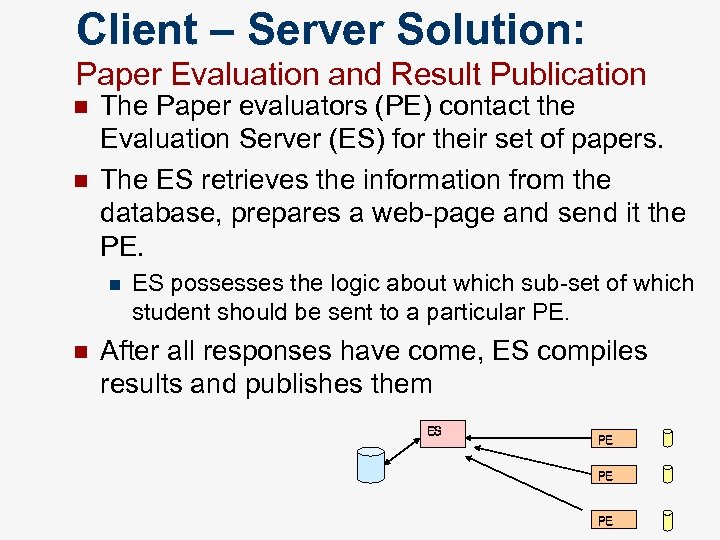
Client – Server Solution: Paper Evaluation and Result Publication n n The Paper evaluators (PE) contact the Evaluation Server (ES) for their set of papers. The ES retrieves the information from the database, prepares a web-page and send it the PE. n n ES possesses the logic about which sub-set of which student should be sent to a particular PE. After all responses have come, ES compiles results and publishes them ES PE PE PE
Drawbacks: n ES cannot push the information to the PEs n n ES has to maintain information about n n each students, subsection, and the part forwarded to a PE and its status. Where a paper needs to pass multiple PEs n n n depends upon them to fetch the information a ES has to coordinate passively. As ES does not get the evaluated copy till PE decides to send it. mode of push n n Mechanisms like e-mail Do not tightly tie the system
Observations Client – Server Solutions do not always scale n Do provide the solution in many cases but tend to create n Cumbersome solutions when complexity increases n Unintuitive designs n n Need for alternate structuring mechanisms
Can Mobile Agents Help ? What are they ? n How to exploit their advantage ? n Constituents n Agent n Mobility n n We shall first discuss the agent in general and then focus on mobile agents
Agents: An Introduction One of the most hyped Software technologies of recent times n We shall now try to: n Define Software Agents n Classify Software Agents n Discuss their relevance n Look at their enabling technologies n
What Software Agents are and aren't n Exact definition difficult n n The English word "agent" n n n term is over-used in various contexts. shares the same Latin root as the word “act” "someone (or something) that has the ability, power or authority to act”, When applied to software n n "a program that does something on behalf of the user” too general • can actually describe any running program! n Alternative approach n look at the common list of ideal characteristics that most Software Agent Systems seem to share
Experts say: Agent should display n Autonomy n n n system does its work in a largely pro-active manner, without explicit control from the user at every step In practice, most agents will check with the user, at least for major decisions and actions Intelligence n n system does something smart exhibits behaviour that humans would consider intelligent typically solving some non-trivial problem, and exhibiting some kind of learning, that is, the ability to adapt and improve over time
Experts say: Agent should display n Cooperation n the system collaborates, minimally with the user, and usually with other agents, to perform the task. Based on this criterion, we can categorize agents into the four classes [see figure]
![Part-View of Agent Topology [Nwana 96] Collaborative Learning Agents Collaborative Agents Cooperate Autonomous Smart](https://present5.com/presentation/67df2c3212560bd12e3ae08f03522311/image-27.jpg "Part-View of Agent Topology [Nwana 96] Collaborative Learning Agents Collaborative Agents Cooperate Autonomous Smart")
Part-View of Agent Topology [Nwana 96] Collaborative Learning Agents Collaborative Agents Cooperate Autonomous Smart Agents Learn Interface Agents
Agent – Non Agent: according to above classification n Should exhibit at least two of the above features to a reasonable degree those in the non-overlapping area of the circles are not considered to be Software Agents Non-Agent examples n expert system • exhibit intelligence • not cooperation or autonomy n a web indexing robot • might be autonomous, • may not very intelligent n a distributed system • might display some collaboration among the components • may be neither autonomous nor intelligent
Classification of Agents: n Single-Agent vs Multi-Agent (Collaborative) n n n A multi-agent system involves a collection of agents collaborating to perform a task. This model is more complex, but more modular, and is well-suited for concurrent or distributed tasks. Static vs Mobile n n n Static agents work on a single system, mobile agents (also known as "bots") move from system to system. Depending on the degree of autonomy and the nature of the task, mobile agents may keep sending intermediate status to the base.
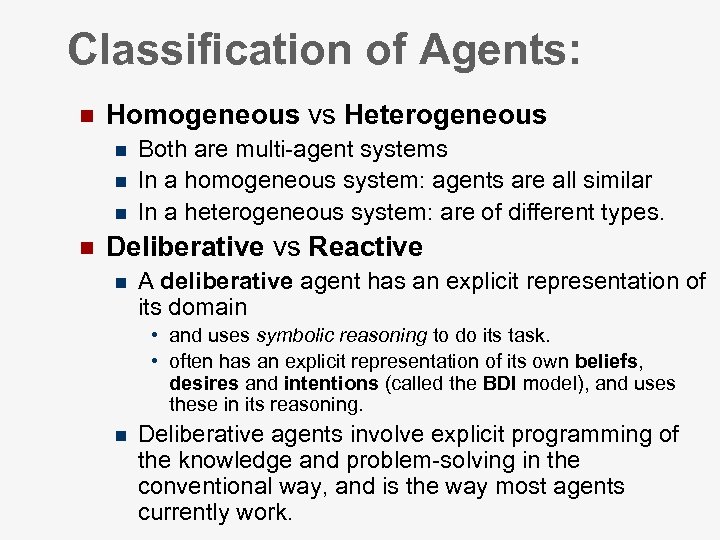
Classification of Agents: n Homogeneous vs Heterogeneous n n Both are multi-agent systems In a homogeneous system: agents are all similar In a heterogeneous system: are of different types. Deliberative vs Reactive n A deliberative agent has an explicit representation of its domain • and uses symbolic reasoning to do its task. • often has an explicit representation of its own beliefs, desires and intentions (called the BDI model), and uses these in its reasoning. n Deliberative agents involve explicit programming of the knowledge and problem-solving in the conventional way, and is the way most agents currently work.
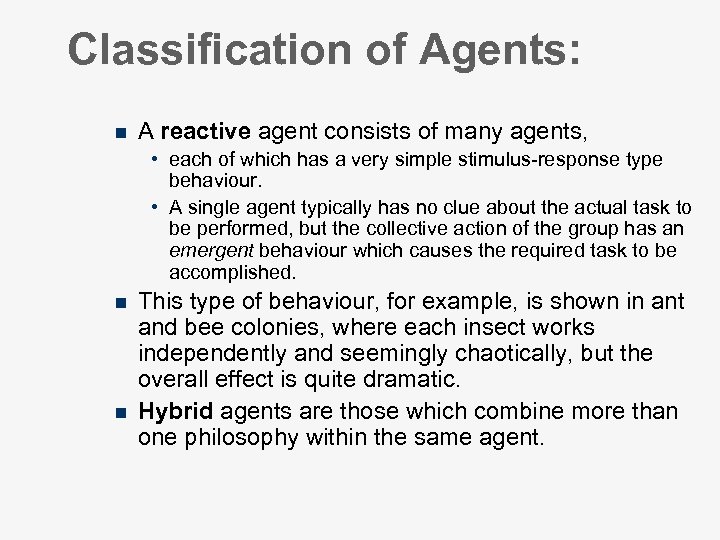
Classification of Agents: n A reactive agent consists of many agents, • each of which has a very simple stimulus-response type behaviour. • A single agent typically has no clue about the actual task to be performed, but the collective action of the group has an emergent behaviour which causes the required task to be accomplished. n n This type of behaviour, for example, is shown in ant and bee colonies, where each insect works independently and seemingly chaotically, but the overall effect is quite dramatic. Hybrid agents are those which combine more than one philosophy within the same agent.
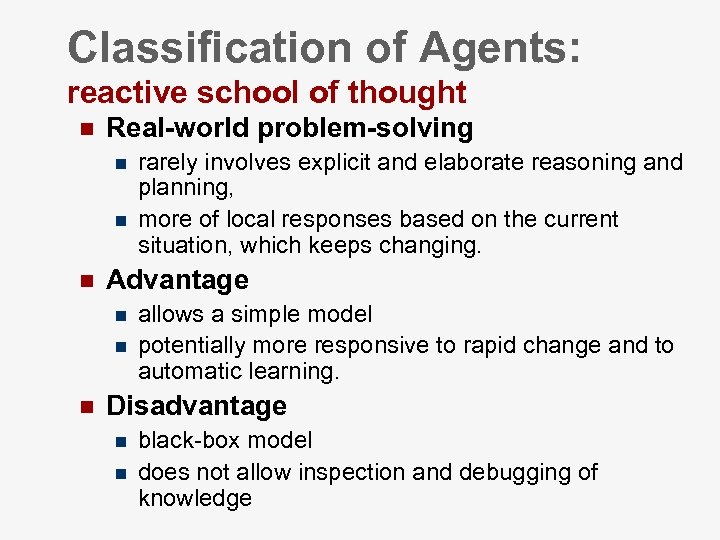
Classification of Agents: reactive school of thought n Real-world problem-solving n n n Advantage n n n rarely involves explicit and elaborate reasoning and planning, more of local responses based on the current situation, which keeps changing. allows a simple model potentially more responsive to rapid change and to automatic learning. Disadvantage n n black-box model does not allow inspection and debugging of knowledge
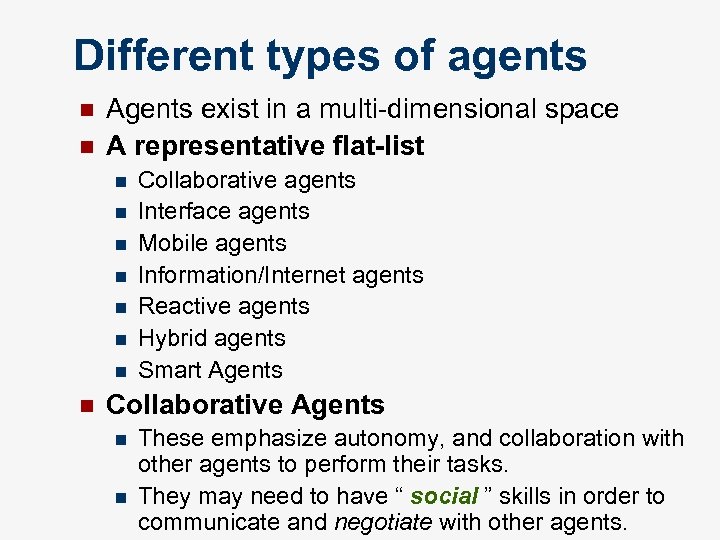
Different types of agents n n Agents exist in a multi-dimensional space A representative flat-list n n n n Collaborative agents Interface agents Mobile agents Information/Internet agents Reactive agents Hybrid agents Smart Agents Collaborative Agents n n These emphasize autonomy, and collaboration with other agents to perform their tasks. They may need to have “ social ” skills in order to communicate and negotiate with other agents.
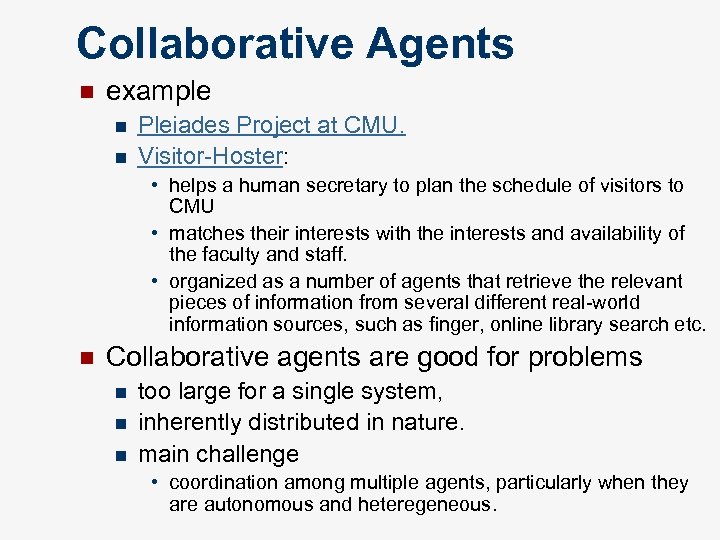
Collaborative Agents n example n n Pleiades Project at CMU. Visitor-Hoster: • helps a human secretary to plan the schedule of visitors to CMU • matches their interests with the interests and availability of the faculty and staff. • organized as a number of agents that retrieve the relevant pieces of information from several different real-world information sources, such as finger, online library search etc. n Collaborative agents are good for problems n n n too large for a single system, inherently distributed in nature. main challenge • coordination among multiple agents, particularly when they are autonomous and heteregeneous.
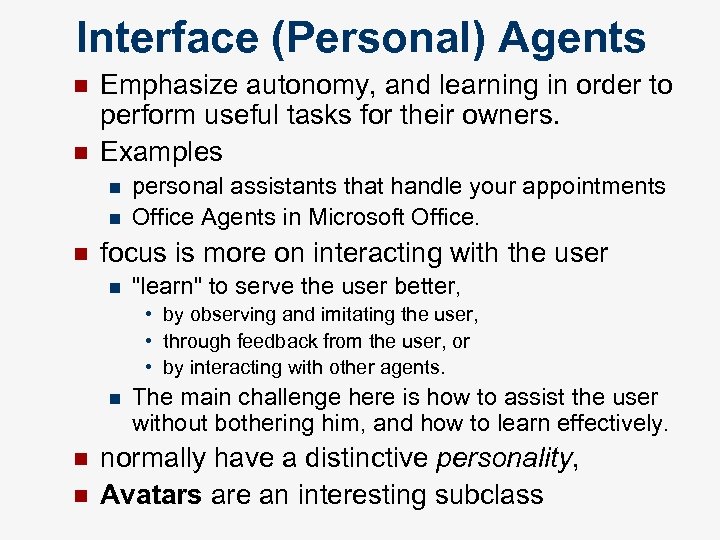
Interface (Personal) Agents n n Emphasize autonomy, and learning in order to perform useful tasks for their owners. Examples n n n personal assistants that handle your appointments Office Agents in Microsoft Office. focus is more on interacting with the user n "learn" to serve the user better, • by observing and imitating the user, • through feedback from the user, or • by interacting with other agents. n n n The main challenge here is how to assist the user without bothering him, and how to learn effectively. normally have a distinctive personality, Avatars are an interesting subclass
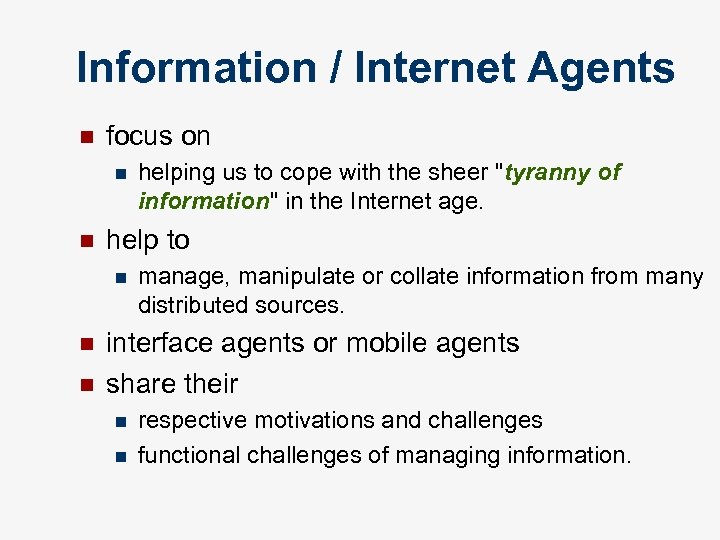
Information / Internet Agents n focus on n n help to n n n helping us to cope with the sheer "tyranny of information" in the Internet age. manage, manipulate or collate information from many distributed sources. interface agents or mobile agents share their n n respective motivations and challenges functional challenges of managing information.
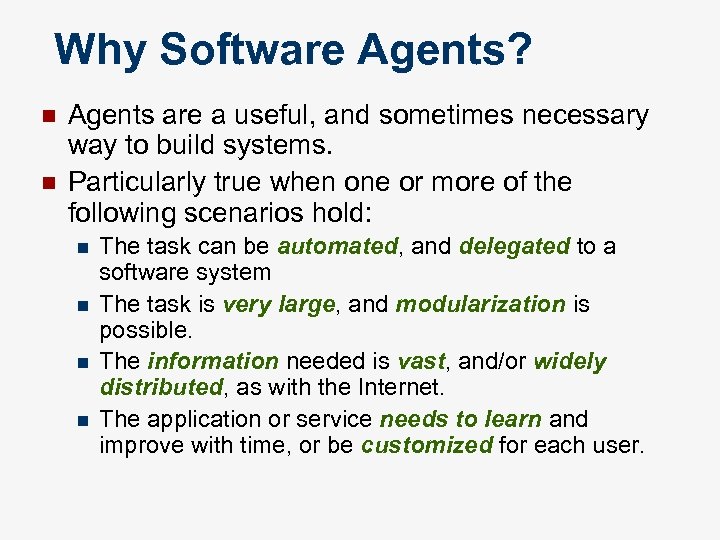
Why Software Agents? n n Agents are a useful, and sometimes necessary way to build systems. Particularly true when one or more of the following scenarios hold: n n The task can be automated, and delegated to a software system The task is very large, and modularization is possible. The information needed is vast, and/or widely distributed, as with the Internet. The application or service needs to learn and improve with time, or be customized for each user.
Example domain: E-commerce n n n Many e-commerce tasks have one or more of these features Agents: a key technology for e-commerce. buyers n n sellers n n n locate relevant goods and services, and to identify the best deals for them identify prospective customers and their needs, help them to select products and services, customize products and services for them, handle the sale and subsequent customer relation management in B 2 C, C 2 C as well as B 2 B scenarios.
Enabling Technologies n Agents is a highly multi-disciplinary technology combining inputs from n n n n Software Technology Artificial Intelligence Networking Human Computer Interaction and even Sociology Management and Economics in addition to the actual domain of the task • e. g. Business and Commerce in case of e-commerce
Trends: OMG Agent Technology Green Paper n The growth similar to many earlier technologies n n Not a single, new, technology n n n can add a new set of capabilities to existing applications. may strengthen HCI Initially n n integrated application of multiple technologies. Not necessarily a new isolated application n n such as DBMS, OO and GUI agent functions will emerge within applications, Later (with experience) n become part of the operating system or application environment.
Trends: OMG Agent Technology Green Paper n Ultimately (might happen) n n applications that do not exploit agent support in the operating system will be severely disadvantaged. Current state: n n n n still an active research area. isolated pioneer products are emerging. full set of technologies are not available. technologies not integrated with one another. no consensus on operating system level support despite hype, not in widespread use, nor has it been widely accepted as an inevitable trend. early adopters who can demonstrate the value
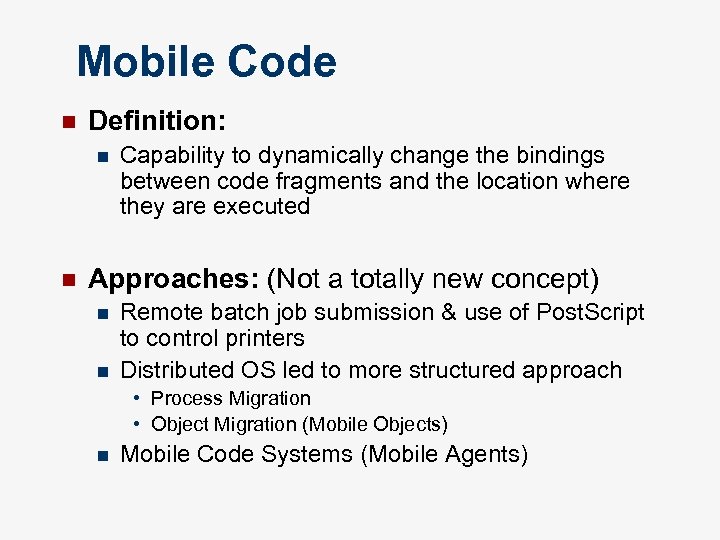
Mobile Code n Definition: n n Capability to dynamically change the bindings between code fragments and the location where they are executed Approaches: (Not a totally new concept) n n Remote batch job submission & use of Post. Script to control printers Distributed OS led to more structured approach • Process Migration • Object Migration (Mobile Objects) n Mobile Code Systems (Mobile Agents)
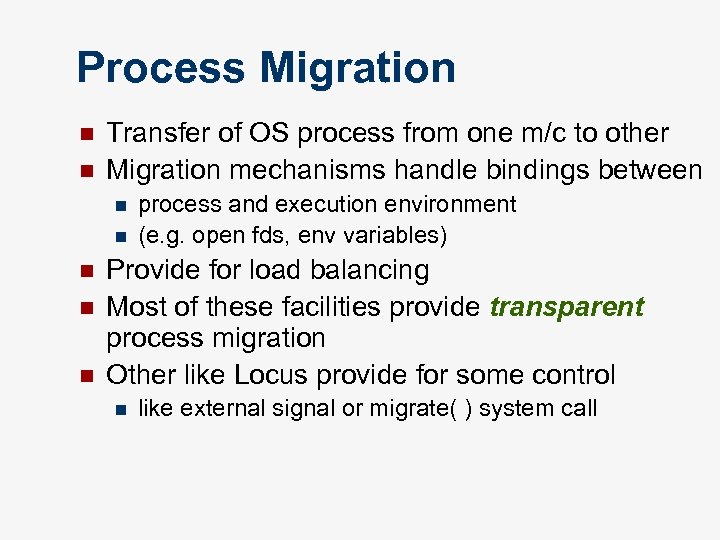
Process Migration n n Transfer of OS process from one m/c to other Migration mechanisms handle bindings between n n process and execution environment (e. g. open fds, env variables) Provide for load balancing Most of these facilities provide transparent process migration Other like Locus provide for some control n like external signal or migrate( ) system call
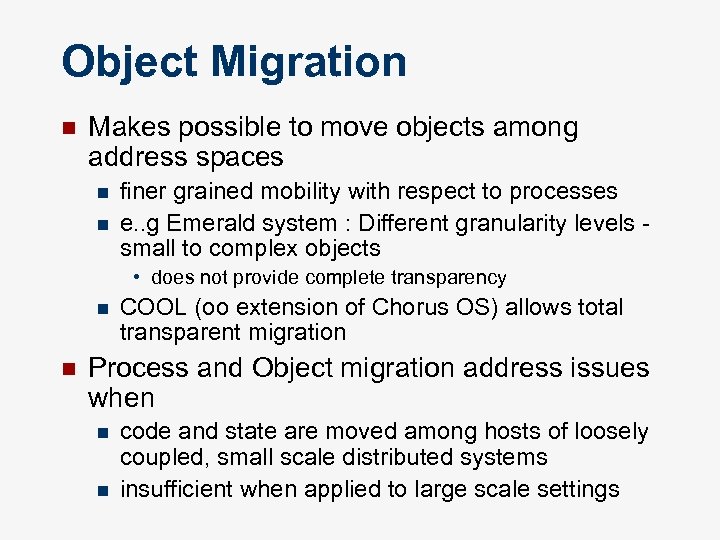
Object Migration n Makes possible to move objects among address spaces n n finer grained mobility with respect to processes e. . g Emerald system : Different granularity levels - small to complex objects • does not provide complete transparency n n COOL (oo extension of Chorus OS) allows total transparent migration Process and Object migration address issues when n n code and state are moved among hosts of loosely coupled, small scale distributed systems insufficient when applied to large scale settings
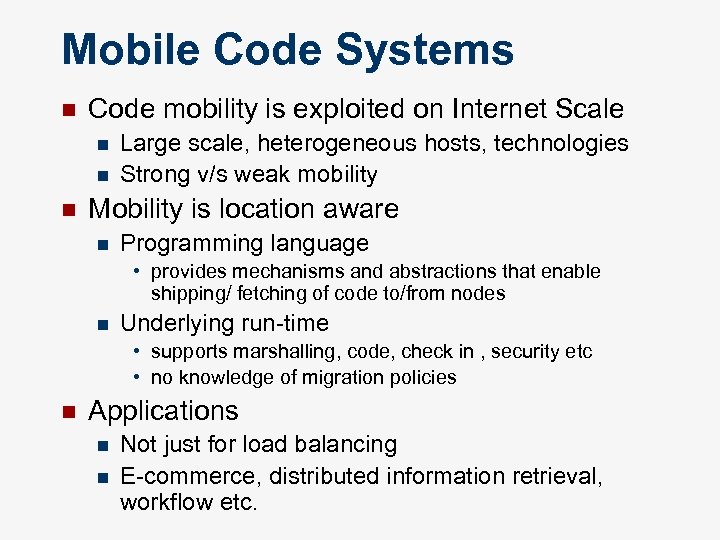
Mobile Code Systems n Code mobility is exploited on Internet Scale n n n Large scale, heterogeneous hosts, technologies Strong v/s weak mobility Mobility is location aware n Programming language • provides mechanisms and abstractions that enable shipping/ fetching of code to/from nodes n Underlying run-time • supports marshalling, code, check in , security etc • no knowledge of migration policies n Applications n n Not just for load balancing E-commerce, distributed information retrieval, workflow etc.
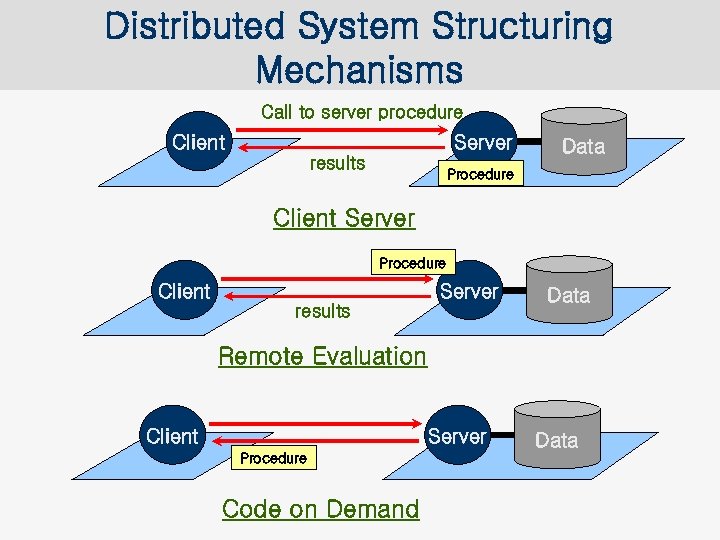
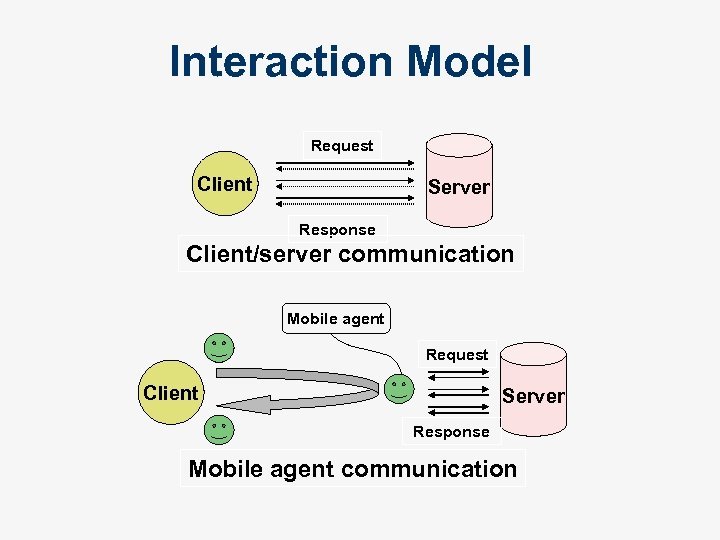
Distributed System Structuring Mechanisms Call to server procedure Client Server results Data Procedure Client Server results Data Remote Evaluation Client Server Procedure Code on Demand Data
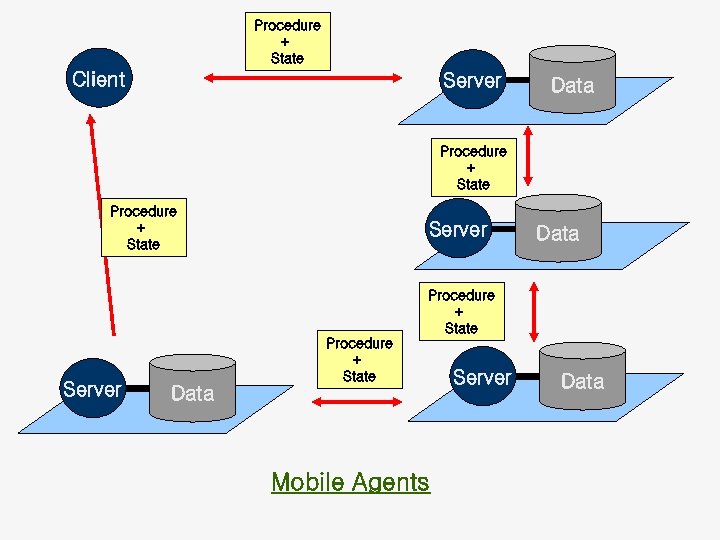
Procedure + State Client Server Data Procedure + State Mobile Agents Server Data
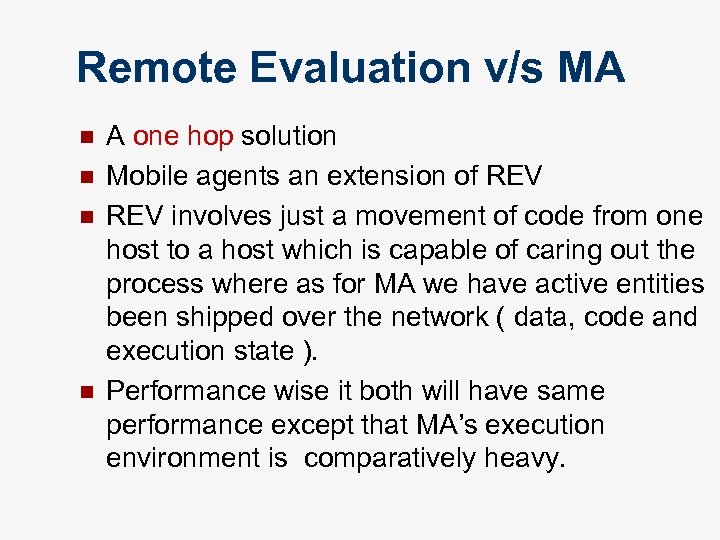
Remote Evaluation v/s MA n n A one hop solution Mobile agents an extension of REV involves just a movement of code from one host to a host which is capable of caring out the process where as for MA we have active entities been shipped over the network ( data, code and execution state ). Performance wise it both will have same performance except that MA’s execution environment is comparatively heavy.
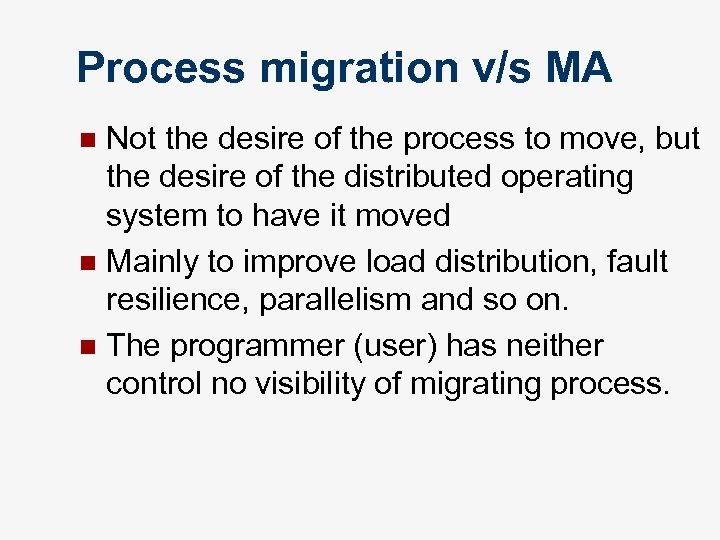
Process migration v/s MA Not the desire of the process to move, but the desire of the distributed operating system to have it moved n Mainly to improve load distribution, fault resilience, parallelism and so on. n The programmer (user) has neither control no visibility of migrating process. n
Mobile Agents: Example
Interaction Model Request Client Server Response Client/server communication Mobile agent Request Client Server Response Mobile agent communication
A generic Mobile Agent Server • Event notification • Agent collaboration support Event Manager • Execution environment • User identification Mobile Agent • Protection (agent, server) • Communication (agent dispatching) • Authentication • Agent life cycle (creation, destruction) Agent Manager • Agent state Security Manager • Agent checkpoint (fault tolerance) Persistent Manager
Java based Agent server Context Network Class. Loader Serialized Object Daemon Code server Agent Message Java-based Agent server
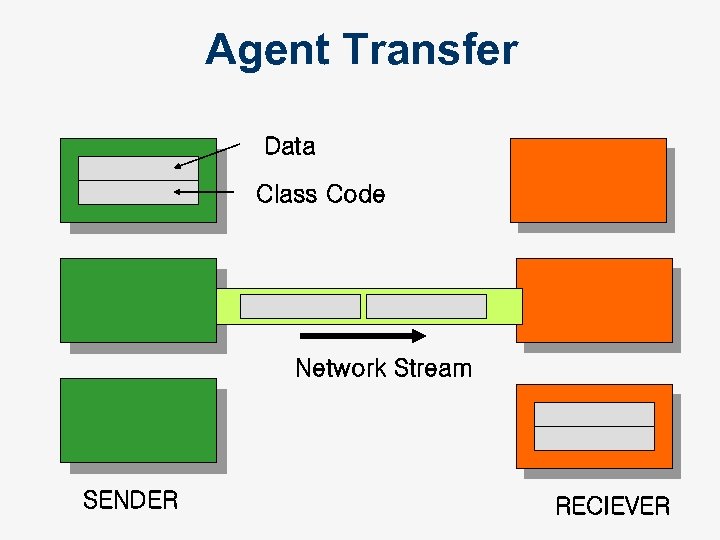
Agent Transfer Data Class Code Network Stream SENDER RECIEVER
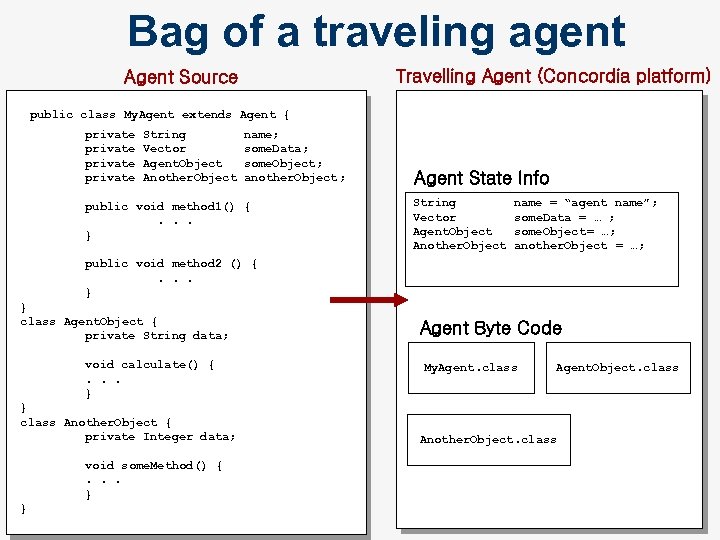
Bag of a traveling agent Travelling Agent (Concordia platform) Agent Source public class My. Agent extends Agent { private String Vector Agent. Object Another. Object name; some. Data; some. Object; another. Object ; public void method 1() {. . . } Agent State Info String Vector Agent. Object Another. Object name = “agent name”; some. Data = … ; some. Object= …; another. Object = …; public void method 2 () {. . . } } class Agent. Object { private String data; void calculate() {. . . } } class Another. Object { private Integer data; void some. Method() {. . . } } Agent Byte Code My. Agent. class Agent. Object. class Another. Object. class
MA based Structuring
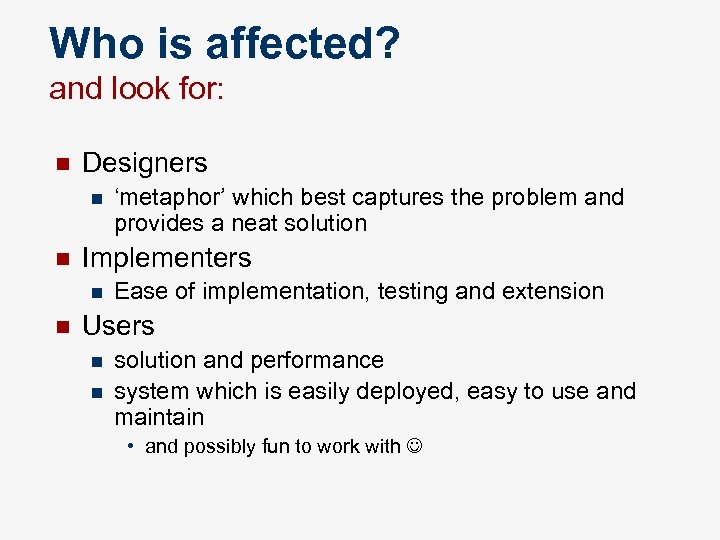
Who is affected? and look for: n Designers n n Implementers n n ‘metaphor’ which best captures the problem and provides a neat solution Ease of implementation, testing and extension Users n n solution and performance system which is easily deployed, easy to use and maintain • and possibly fun to work with
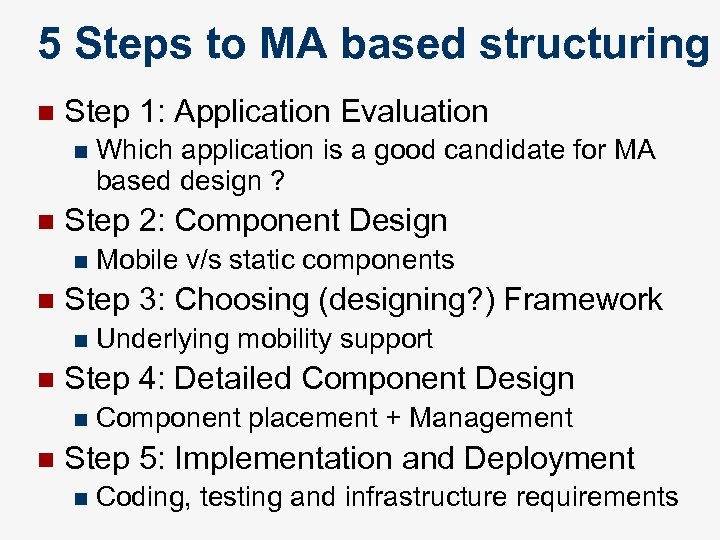
5 Steps to MA based structuring n Step 1: Application Evaluation n n Step 2: Component Design n n Underlying mobility support Step 4: Detailed Component Design n n Mobile v/s static components Step 3: Choosing (designing? ) Framework n n Which application is a good candidate for MA based design ? Component placement + Management Step 5: Implementation and Deployment n Coding, testing and infrastructure requirements
Realizing Step 1: Application Evaluation n Case 1: n n Case 2: n n You have an application and you want to test its candidacy for MA based design You want to invent an application that best exploits MA paradigm In both cases: Required understanding of advantages that MA’s bring n Issues that they raise n
![metaphor [G. Picco] Two friends Asha and Latha interact to make a cake](https://present5.com/presentation/67df2c3212560bd12e3ae08f03522311/image-60.jpg "metaphor [G. Picco] Two friends Asha and Latha interact to make a cake")
metaphor [G. Picco] Two friends Asha and Latha interact to make a cake (results of service) n recipe is needed (know-how about service) n also ingredients (movable resources) n oven to bake (hard to move resource) a person to mix ingredients following recipe (a computational component responsible for execution of code) n n prepare cake (execute the service) n where cake is prepared (site of execution)
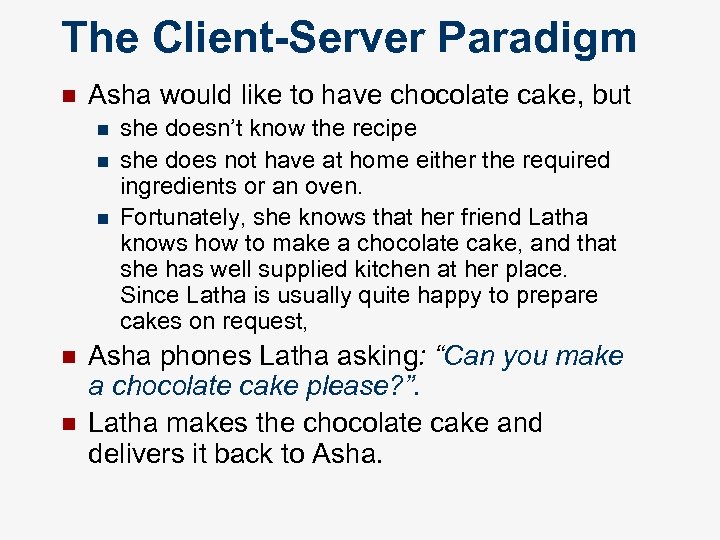
The Client-Server Paradigm n Asha would like to have chocolate cake, but n n n she doesn’t know the recipe she does not have at home either the required ingredients or an oven. Fortunately, she knows that her friend Latha knows how to make a chocolate cake, and that she has well supplied kitchen at her place. Since Latha is usually quite happy to prepare cakes on request, Asha phones Latha asking: “Can you make a chocolate cake please? ”. Latha makes the chocolate cake and delivers it back to Asha.
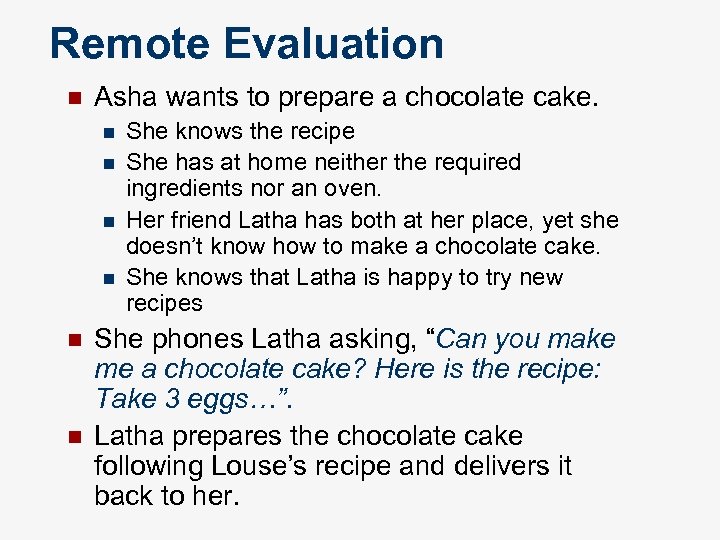
Remote Evaluation n Asha wants to prepare a chocolate cake. n n n She knows the recipe She has at home neither the required ingredients nor an oven. Her friend Latha has both at her place, yet she doesn’t know how to make a chocolate cake. She knows that Latha is happy to try new recipes She phones Latha asking, “Can you make me a chocolate cake? Here is the recipe: Take 3 eggs…”. Latha prepares the chocolate cake following Louse’s recipe and delivers it back to her.
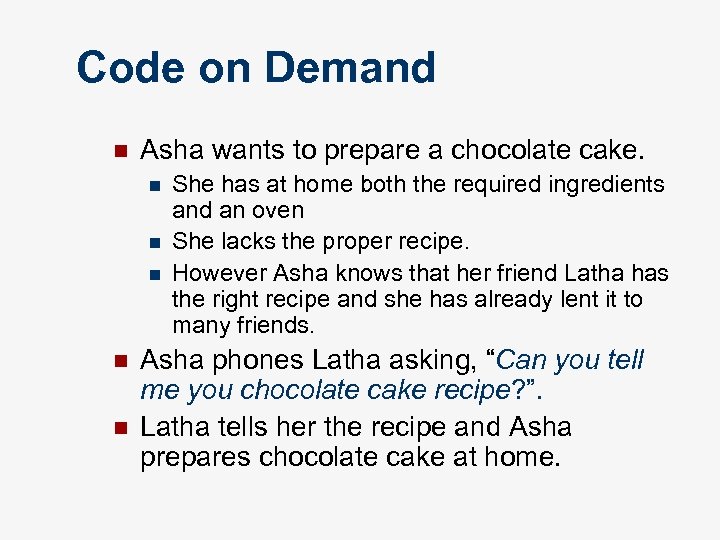
Code on Demand n Asha wants to prepare a chocolate cake. n n n She has at home both the required ingredients and an oven She lacks the proper recipe. However Asha knows that her friend Latha has the right recipe and she has already lent it to many friends. Asha phones Latha asking, “Can you tell me you chocolate cake recipe? ”. Latha tells her the recipe and Asha prepares chocolate cake at home.
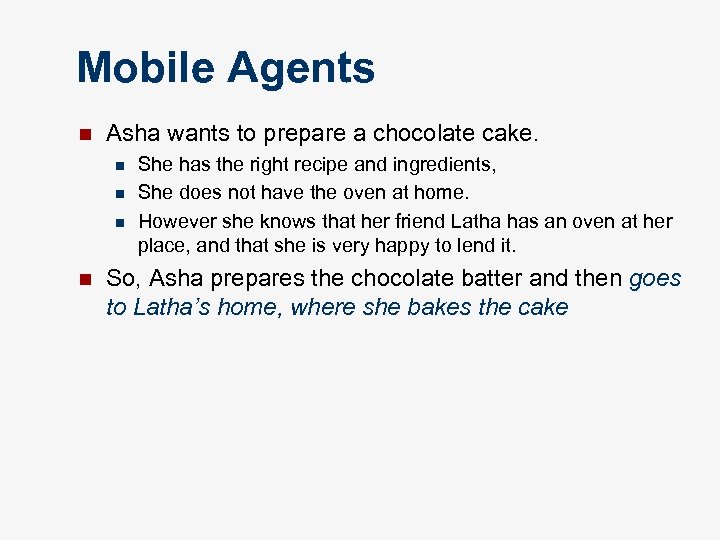
Mobile Agents n Asha wants to prepare a chocolate cake. n n She has the right recipe and ingredients, She does not have the oven at home. However she knows that her friend Latha has an oven at her place, and that she is very happy to lend it. So, Asha prepares the chocolate batter and then goes to Latha’s home, where she bakes the cake
![Good Reasons [Dennis Lange]: Reduce the network load n Help in overcoming Network latency](https://present5.com/presentation/67df2c3212560bd12e3ae08f03522311/image-65.jpg "Good Reasons [Dennis Lange]: Reduce the network load n Help in overcoming Network latency")
Good Reasons [Dennis Lange]: Reduce the network load n Help in overcoming Network latency n Encapsulate protocols n Execute asynchronously and autonomously n Adapt dynamically n Naturally heterogeneous n They are robust and fault-tolerant n
Realizing Step 2 Component Design n n OO principles still apply Two aspects that affect design n Autonomous entities • What advantage do they bring? n Mobile Components • Does it make sense to move the component ? • What is good mobile component? n n Question 1: To move or not to move? Question 2: Passive or Active Mobility?
Classical MA definition: “A mobile agent is a program that represents a user (or user task) and can autonomously migrate between the various nodes of a network to perform computations on her behalf” n Much powerful paradigm n Need not be restricted to above definition n Can/should be extended to include n • MAs which work in background • MA that provide structuring glue
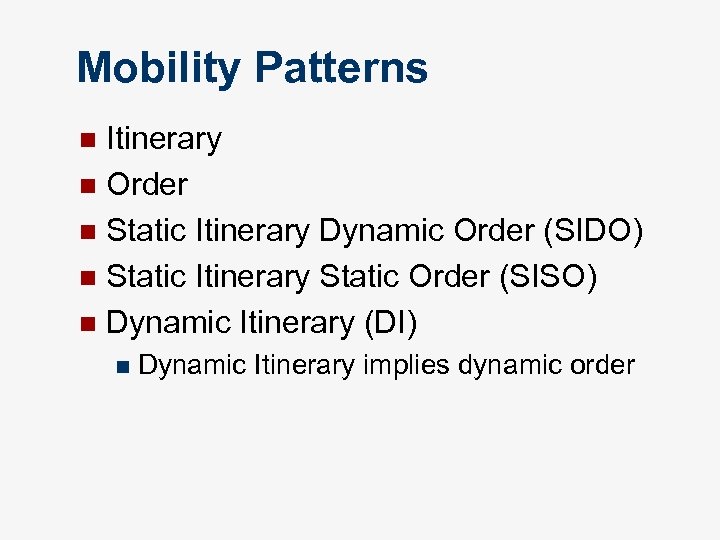
Mobility Patterns Itinerary n Order n Static Itinerary Dynamic Order (SIDO) n Static Itinerary Static Order (SISO) n Dynamic Itinerary (DI) n n Dynamic Itinerary implies dynamic order
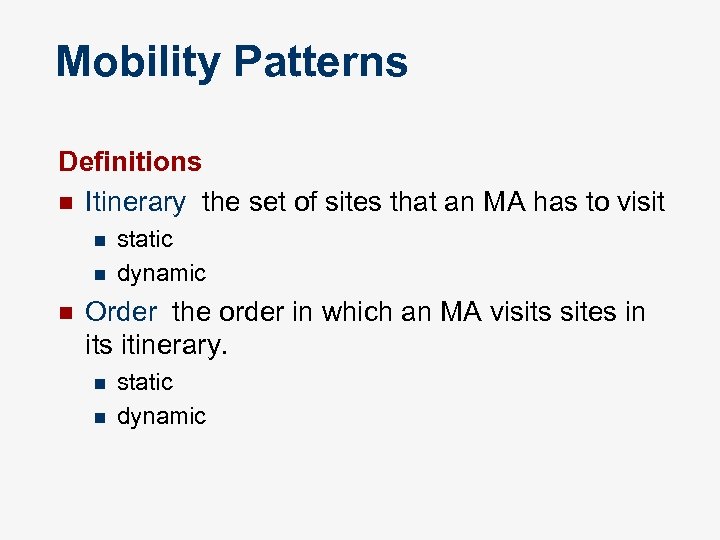
Mobility Patterns Definitions n Itinerary the set of sites that an MA has to visit n n n static dynamic Order the order in which an MA visits sites in its itinerary. n n static dynamic
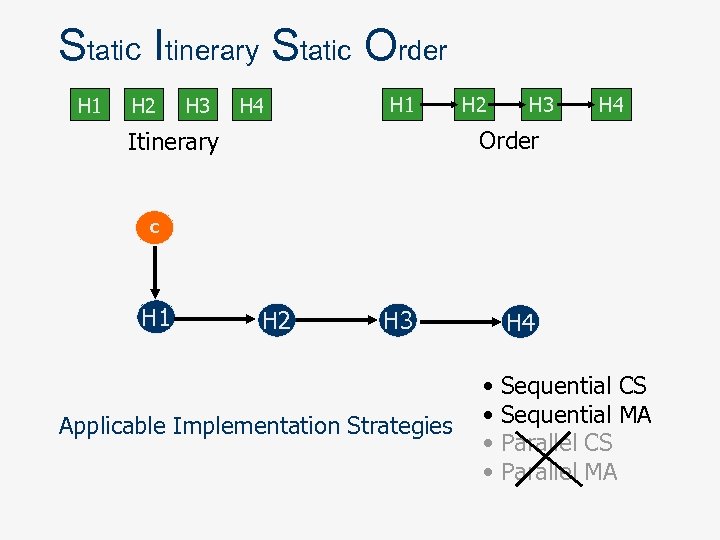
Static Itinerary Static Order H 1 H 2 H 3 H 4 Order Itinerary C H 1 H 2 H 3 Applicable Implementation Strategies H 4 • • Sequential CS Sequential MA Parallel CS Parallel MA
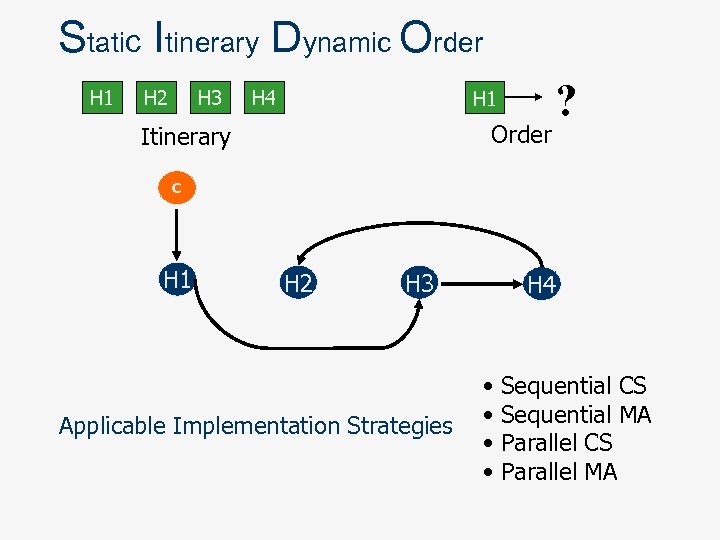
Static Itinerary Dynamic Order H 1 H 2 H 3 H 4 H 1 Order Itinerary ? C H 1 H 2 H 3 Applicable Implementation Strategies H 4 • • Sequential CS Sequential MA Parallel CS Parallel MA
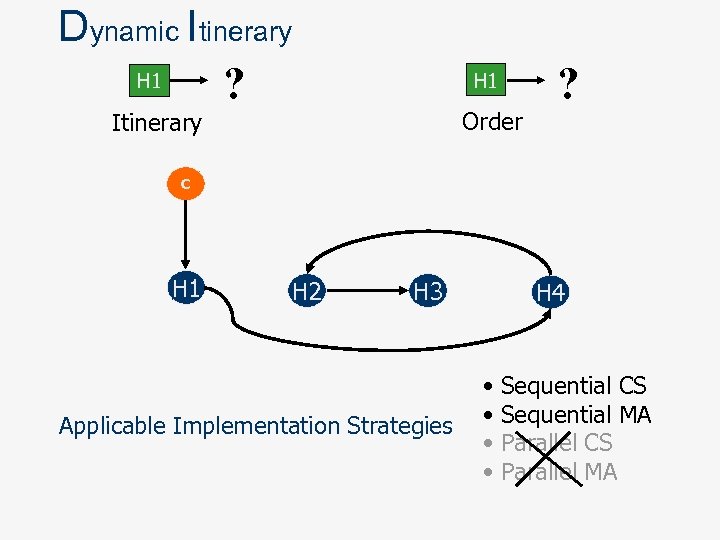
Dynamic Itinerary H 1 ? H 1 Order Itinerary ? C H 1 H 2 H 3 Applicable Implementation Strategies H 4 • • Sequential CS Sequential MA Parallel CS Parallel MA
MA Applications n n n n n Electronic Commerce Personal Assistance Secure Brokering Distributed Information Retrieval Telecommunication networks services Workflow Applications and groupware Monitoring and notification Information Dissemination Parallel Processing
Realizing Step 3 Choosing a MA framework n n Understanding what a MAF provides Two aspects that affect design n Autonomous entities • What advantage do they bring? n Mobile Components • Does it make sense to move the component ? • What is good mobile component? n n Question 1: To move or not to move? Question 2: Passive or Active Mobility?
Mobile Agent Frameworks n Need n n n Components n n n language, execution environment, messaging, resources, migrate, persist, collaborate, control, trace, protect, create, destroy etc. Framework is the mechanism to support these facilities Life Cycle Navigation Communication Security Systems n n 60+ frameworks Notable: Aglets, Concordia, Voyager, Grasshopper, D’Agents, Mole
![Typical Mobile Agent Framework [F. Hohl] Server Laptop Desktop Data Base System Resources User](https://present5.com/presentation/67df2c3212560bd12e3ae08f03522311/image-76.jpg "Typical Mobile Agent Framework [F. Hohl] Server Laptop Desktop Data Base System Resources User")
Typical Mobile Agent Framework [F. Hohl] Server Laptop Desktop Data Base System Resources User Application Legacy Software Execution Environment Mobile Agent Service Agent Application Agent Migration Local Communication Global Communication
Mobile Agent Frameworks Design Issues
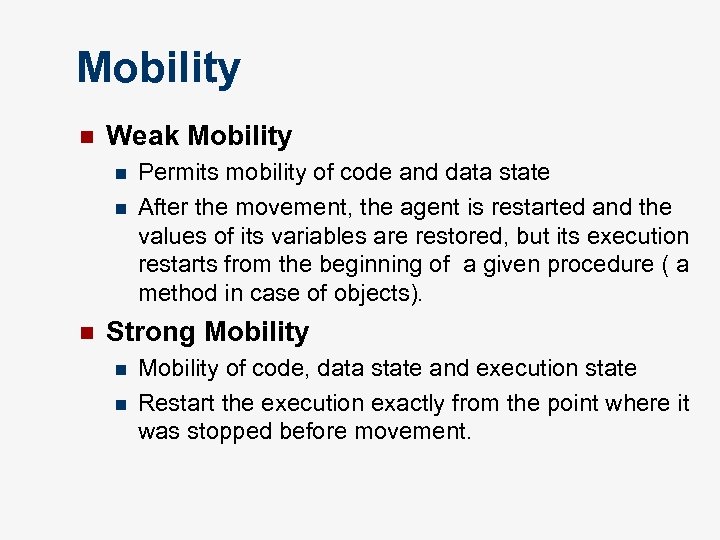
Mobility n Weak Mobility n n n Permits mobility of code and data state After the movement, the agent is restarted and the values of its variables are restored, but its execution restarts from the beginning of a given procedure ( a method in case of objects). Strong Mobility n n Mobility of code, data state and execution state Restart the execution exactly from the point where it was stopped before movement.
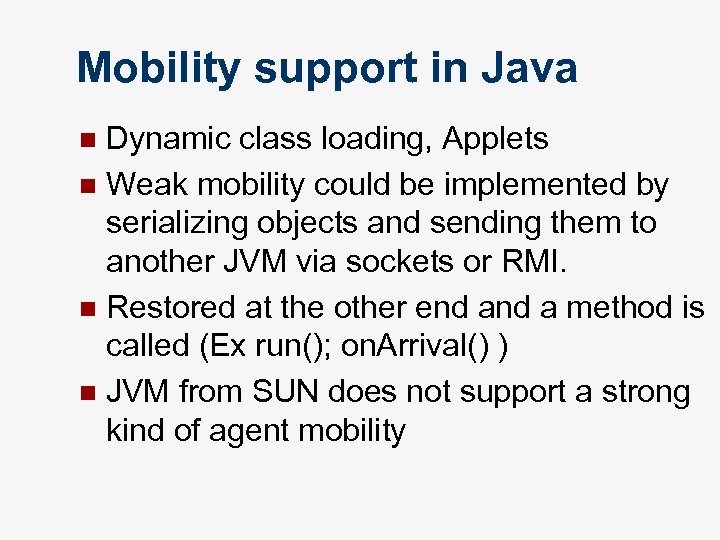
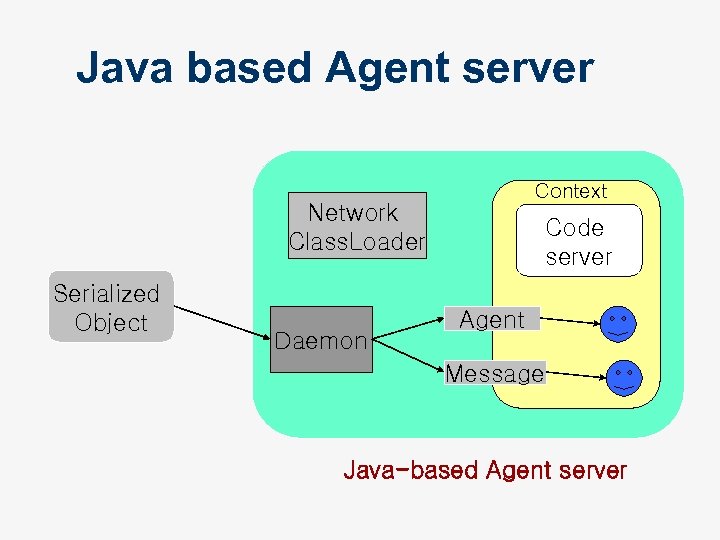
Mobility support in Java Dynamic class loading, Applets n Weak mobility could be implemented by serializing objects and sending them to another JVM via sockets or RMI. n Restored at the other end a method is called (Ex run(); on. Arrival() ) n JVM from SUN does not support a strong kind of agent mobility n
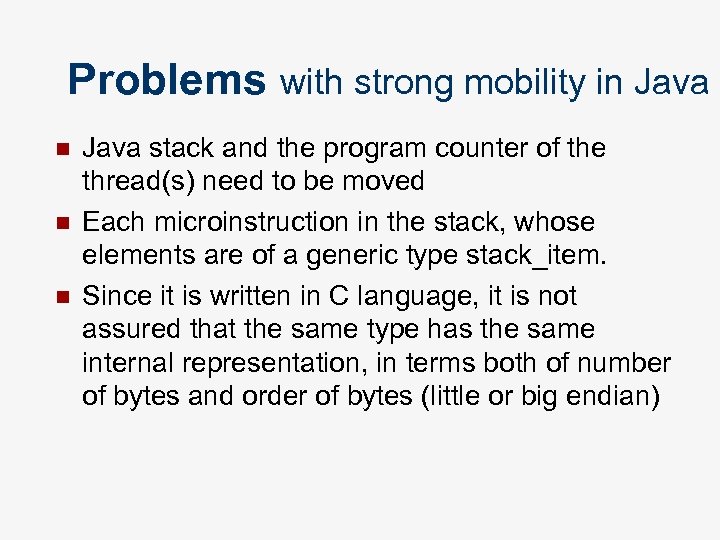
Problems with strong mobility in Java n n n Java stack and the program counter of the thread(s) need to be moved Each microinstruction in the stack, whose elements are of a generic type stack_item. Since it is written in C language, it is not assured that the same type has the same internal representation, in terms both of number of bytes and order of bytes (little or big endian)
![Code fragment for weak mobility void main(String args[]) { . . . // some](https://present5.com/presentation/67df2c3212560bd12e3ae08f03522311/image-81.jpg "Code fragment for weak mobility void main(String args[]) { . . . // some")
Code fragment for weak mobility void main(String args[]) { . . . // some instructions go(“New. Node”, “New. Method”); // not reached } //end of main void New. Method() { // the execution restarts HERE . . . } //end of New. Method
![Code fragment for strong mobility void main(String args[]) { . . . // some](https://present5.com/presentation/67df2c3212560bd12e3ae08f03522311/image-82.jpg "Code fragment for strong mobility void main(String args[]) { . . . // some")
Code fragment for strong mobility void main(String args[]) { . . . // some instructions go(``New. Node''); // the execution restarts HERE . . . } //end of main
![Repetitive job using weak mobility public static void main(String args[]) { . . .](https://present5.com/presentation/67df2c3212560bd12e3ae08f03522311/image-83.jpg "Repetitive job using weak mobility public static void main(String args[]) { . . .")
Repetitive job using weak mobility public static void main(String args[]) { . . . // go to the first node go(Itinerary. next. Element(), ``Execute. On. Arrival''); } public void Execute. On. Arrival() { // execution restarts HERE after a travel if (Go. Home) . . . //execute here when the agent is back home else { . . . //do some repetitive jobs on the current node if (Itinerary. has. More. Elements()) go(Itinerary. next. Element(), ``Execute. On. Arrival''); else { Go. Home = true; go(Home. Node, ``Execute. On. Arrival''); } } }
![Repetitive job using strong mobility public static void main(String args[]) { . . .](https://present5.com/presentation/67df2c3212560bd12e3ae08f03522311/image-84.jpg "Repetitive job using strong mobility public static void main(String args[]) { . . .")
Repetitive job using strong mobility public static void main(String args[]) { . . . while (Itinerary. has. More. Elements()) { go(Itinerary. next. Element()) // execution restarts HERE after a travel . . . // do something on the current node } go(Home. Node); . . . // execute here when the agent is back home }
Code Shipping n Carried by the agent n n Any type agent can run anywhere Pre-installed on destination host Less run time transfer overhead n New types cannot be added at run-time n When and how would you pre-install ? n n Available on code-base server Easy to maintain n Location of code-base server ? n
Naming and Addressing n Location dependent e. g. <hostname> + <local id/ port no> n when agent migrates its name changes n application task of tracking the agent becomes cumbersome n n Location independent system has to keep track of the agent n local proxies with current location information n naming service which resolves name to current location n
Agent Tracking: locating an agent n Brute force n n n Logging n n Search in multiple location Sequential or parallel search Agent located by following trial information Tracking Redirection Registration n n Communicating parties need to agree on a common Directory Server Agent updates information in a Directory Server Other agents use this information to locate Useful when unknown parties have to communicate
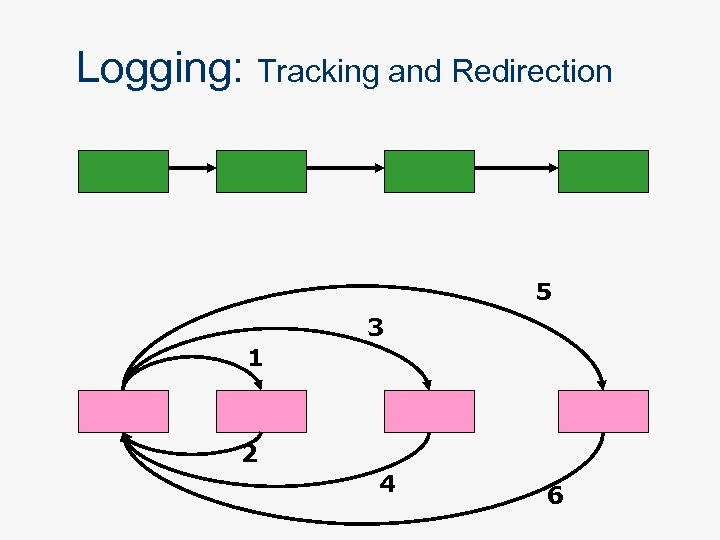
Logging: Tracking and Redirection 5 3 1 2 4 6
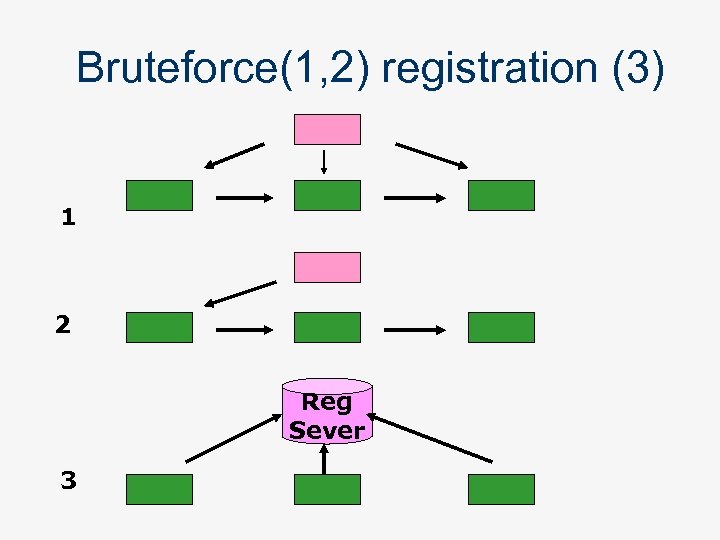
Bruteforce(1, 2) registration (3) 1 2 Reg Sever 3
Message delivery messaging an agent n Locate and transfer Two separate phases are used n More efficient if messages are big n May not always be accurate n n Forwarding Single phase n More efficient if messages are small n
Communication Mechanisms n Method invocation n Call method on another object Parameters and return values Achieved by • Direct reference to the method (same address space) • LPC (object on local host) • RPC (object on remote host) n Message passing n n Message encapsulates the protocol Parsed and interpreted
Communication Mechanisms n Black board n n n Interactions via shared-data spaces local to each EE Need for common message format/identifier understood by each agent Temporal uncoupling • When you cannot create/predict a agent schedule n Tuple spaces n n Extension of black-board model Information stored in tuple-space Retrieved by associative pattern-matching Useful as MAs have to adaptively deal with • Heterogeneity, dynamicity, uncertainty n Mechanism for agent coordination • Simplifies programming and reduces complexity of application
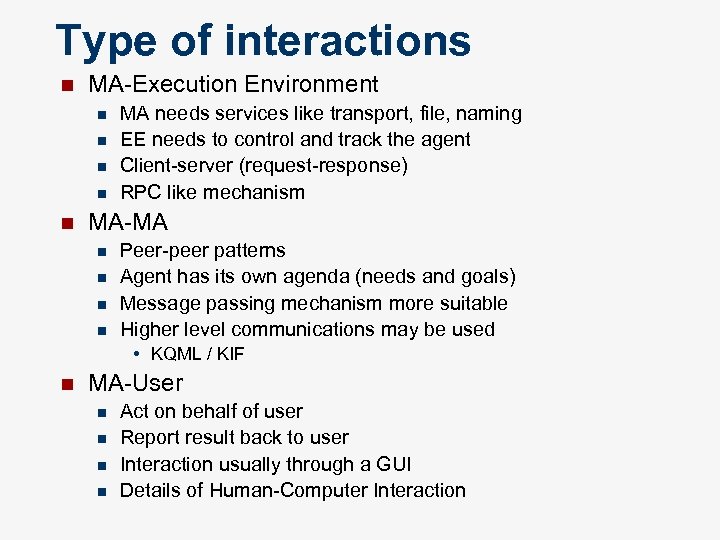
Type of interactions n MA-Execution Environment n n n MA needs services like transport, file, naming EE needs to control and track the agent Client-server (request-response) RPC like mechanism MA-MA n n Peer-peer patterns Agent has its own agenda (needs and goals) Message passing mechanism more suitable Higher level communications may be used • KQML / KIF n MA-User n n Act on behalf of user Report result back to user Interaction usually through a GUI Details of Human-Computer Interaction
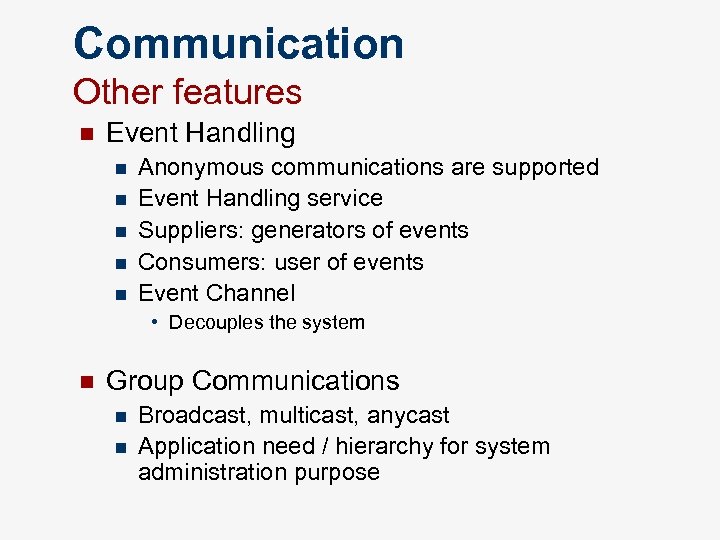
Communication Other features n Event Handling n n n Anonymous communications are supported Event Handling service Suppliers: generators of events Consumers: user of events Event Channel • Decouples the system n Group Communications n n Broadcast, multicast, anycast Application need / hierarchy for system administration purpose
Issues n Message ordering When agents move rapidly n Out of order messages n Need for higher level-protocol over simple message delivery n Sequence Number overhead n
Issues n Double Identity n n Agents migrating to different host might get different names / identities Makes certain operations difficult • E. g. if secure channel is set up between two agents • If change in place, how do you ensure that new agent is not an imposter of the previous one n Agent Tracking n n After being located, the agent can move Lost Agents n n Agent might disappear without deregistering Provide monitors on agent-handles
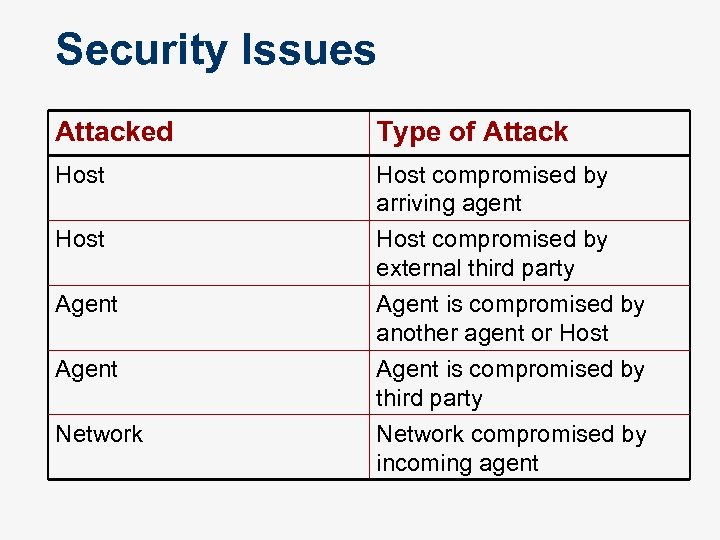
Security Issues Attacked Type of Attack Host compromised by arriving agent Host compromised by external third party Agent is compromised by another agent or Host Agent Network Agent is compromised by third party Network compromised by incoming agent
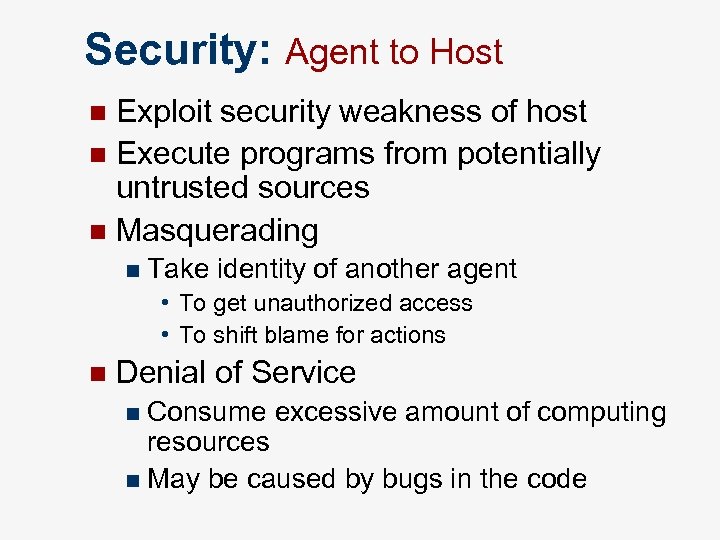
Security: Agent to Host Exploit security weakness of host n Execute programs from potentially untrusted sources n Masquerading n n Take identity of another agent • To get unauthorized access • To shift blame for actions n Denial of Service Consume excessive amount of computing resources n May be caused by bugs in the code n
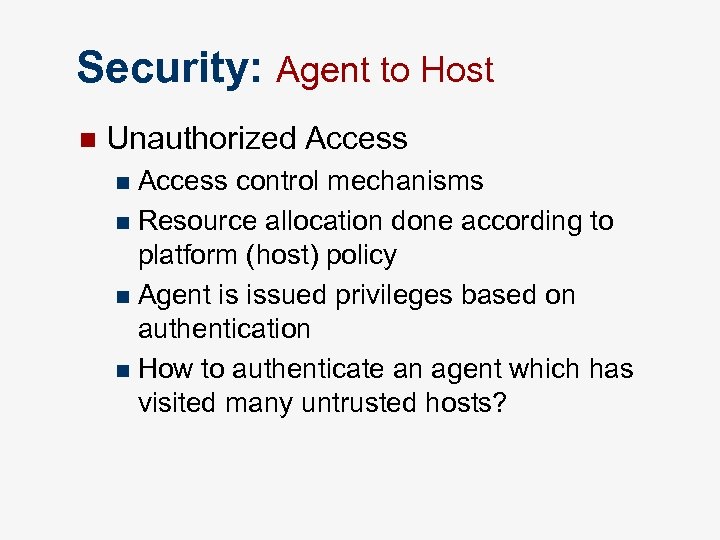
Security: Agent to Host n Unauthorized Access control mechanisms n Resource allocation done according to platform (host) policy n Agent is issued privileges based on authentication n How to authenticate an agent which has visited many untrusted hosts? n
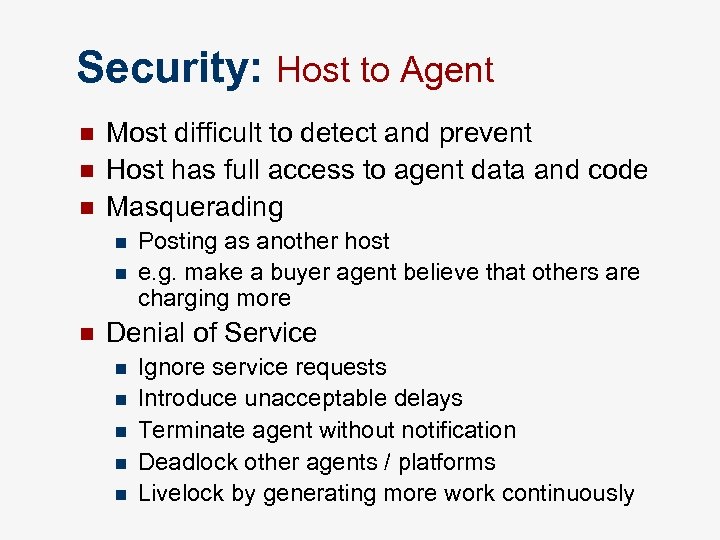
Security: Host to Agent n n n Most difficult to detect and prevent Host has full access to agent data and code Masquerading n n n Posting as another host e. g. make a buyer agent believe that others are charging more Denial of Service n n n Ignore service requests Introduce unacceptable delays Terminate agent without notification Deadlock other agents / platforms Livelock by generating more work continuously
Security: Host to Agent n Eavesdropping n n Classical threat in electronic communication More serious in MA systems as agent platform can • Monitor communications • Read every instruction executed by agent • Read all unencrypted data • May contain proprietary algorithms, trade secrets • Infer from service requests • E. g. agent communicating with a travel agent n Alteration n n Modification of data, state, code Cannot be prevented • only detection possible in some cases n Typically using digital signature • Only for code and static data
Security: Agent to Agent n n Exploit security weakness of other agents Masquerading n n Harms both the attacked agent and the agent whose identity is stolen Denial of Service n E. g. sending repeated messages to another agent • Cause undue burden on message-handling techniques • If agent is being charged for resource-utilization • Monetary loss n n Repudiation Unauthorized Access n Get hold of modify sensitive information
Security: Other n Masquerading n collective Network Denial of Service n Copy and Replay n
Counter measures n Convention techniques can be employed Public key cryptography n Digital signatures n Session keys n n But need adaptation n n cannot be directly employed Some difficulties
Protecting the agent from Host: some efforts n Computing with encrypted functions n n n n For computational privacy Remote signature without revealing the key Environmental key generation Partial result encapsulation Mutual itinerary recording Itinerary recording with Replication and voting Obfuscated code Cryptographic containers for Data Protection
Protecting the Agent Platform Software-Based Fault Isolation n Safe code interpretation n Signed code n
Mobile Agent Framework real world examples n Voyager n Aglets n Concordia
Aglets Weak mobility n Event driven programming model (dispatch, on. Dispatch. . n Proxies for location transperency n IBM
Voyager An ORB supporting mobility n Built on top of Corba n Weak mobility n Federated directory service and multicast support n Object. Space
Concordia Weak mobility n Event driven programming mode n Uses Java RMI for mobility n Mitsubishi Electric IT
Communication mechanisms n Agelts: n Java RMI, ATP(Agent Transfer Protocol), CORBA n Voyager n Java RMI, Corba n Concordia: n TCP socket n Java RMI
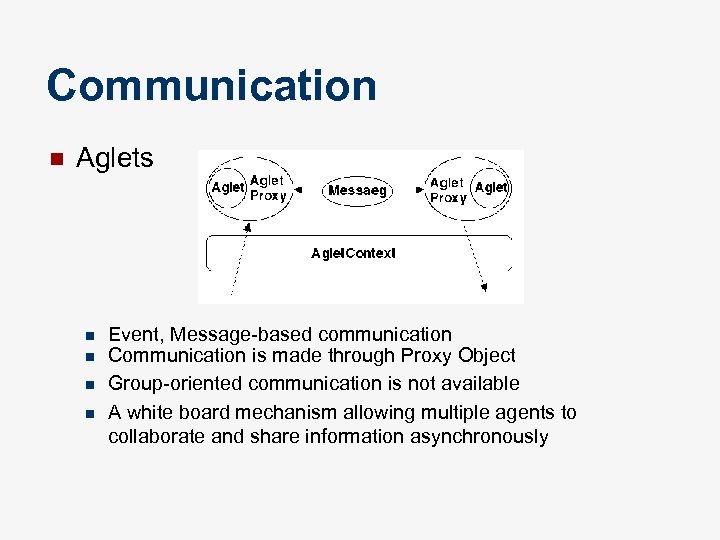
Communication n Aglets n n Event, Message-based communication Communication is made through Proxy Object Group-oriented communication is not available A white board mechanism allowing multiple agents to collaborate and share information asynchronously
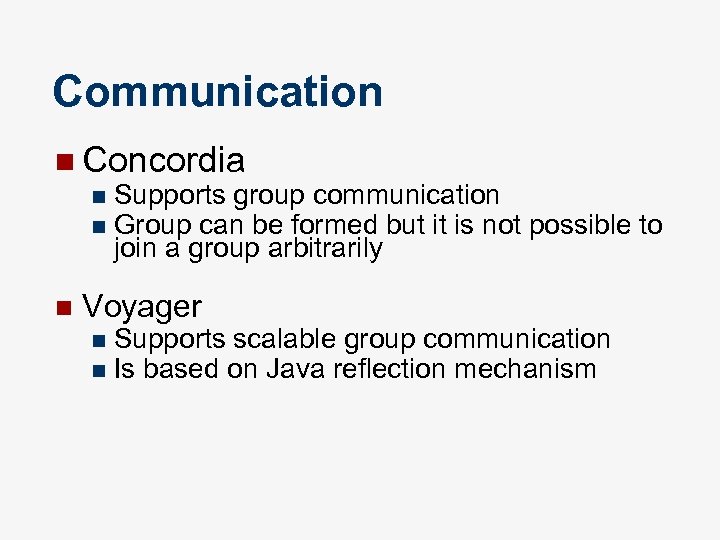
Communication n Concordia n Supports group communication n Group can be formed but it is not possible to join a group arbitrarily n Voyager Supports scalable group communication n Is based on Java reflection mechanism n
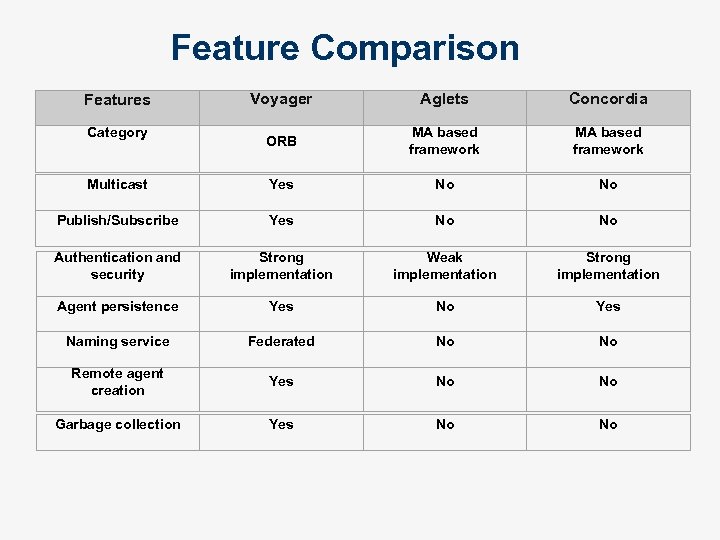
Feature Comparison Features Voyager Aglets Concordia Category ORB MA based framework Multicast Yes No No Publish/Subscribe Yes No No Authentication and security Strong implementation Weak implementation Strong implementation Agent persistence Yes No Yes Naming service Federated No No Remote agent creation Yes No No Garbage collection Yes No No
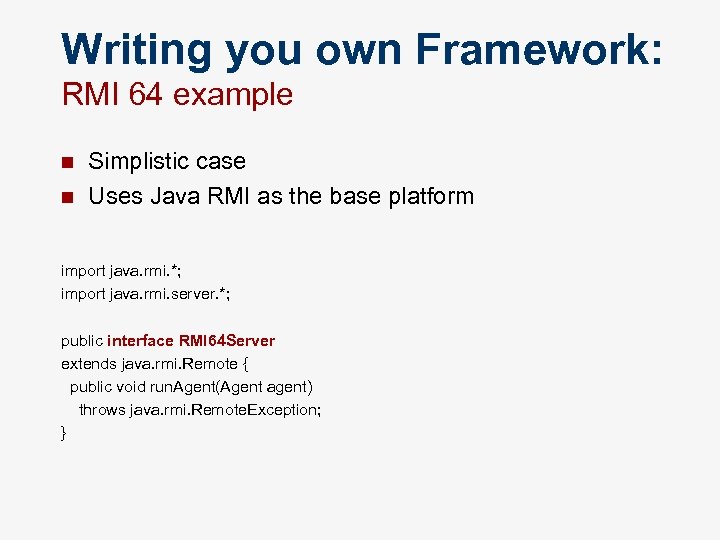
Writing you own Framework: RMI 64 example n n Simplistic case Uses Java RMI as the base platform import java. rmi. *; import java. rmi. server. *; public interface RMI 64 Server extends java. rmi. Remote { public void run. Agent(Agent agent) throws java. rmi. Remote. Exception; }
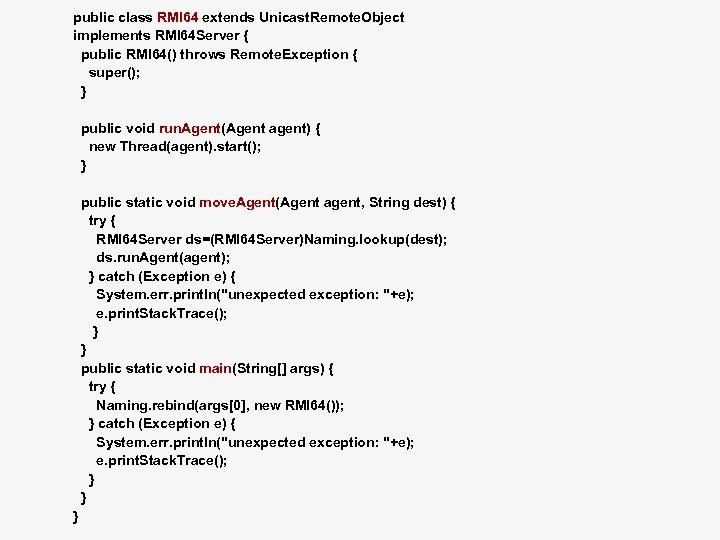
public class RMI 64 extends Unicast. Remote. Object implements RMI 64 Server { public RMI 64() throws Remote. Exception { super(); } public void run. Agent(Agent agent) { new Thread(agent). start(); } public static void move. Agent(Agent agent, String dest) { try { RMI 64 Server ds=(RMI 64 Server)Naming. lookup(dest); ds. run. Agent(agent); } catch (Exception e) { System. err. println("unexpected exception: "+e); e. print. Stack. Trace(); } } public static void main(String[] args) { try { Naming. rebind(args[0], new RMI 64()); } catch (Exception e) { System. err. println("unexpected exception: "+e); e. print. Stack. Trace(); } } }
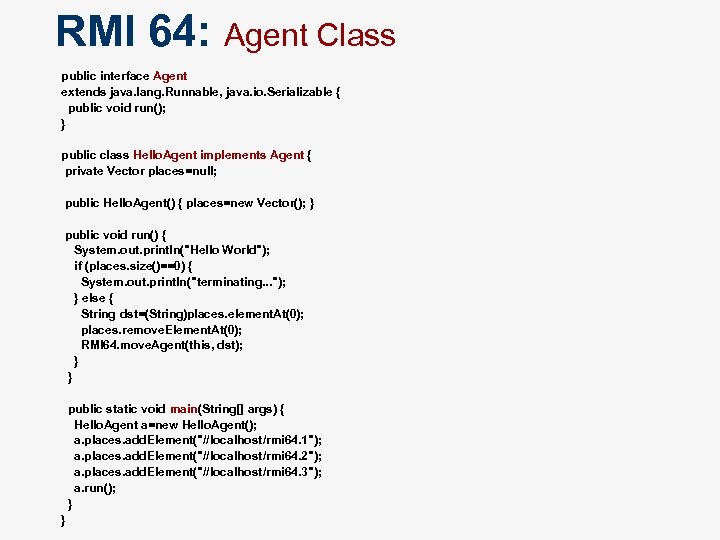
RMI 64: Agent Class public interface Agent extends java. lang. Runnable, java. io. Serializable { public void run(); } public class Hello. Agent implements Agent { private Vector places=null; public Hello. Agent() { places=new Vector(); } public void run() { System. out. println("Hello World"); if (places. size()==0) { System. out. println("terminating. . . "); } else { String dst=(String)places. element. At(0); places. remove. Element. At(0); RMI 64. move. Agent(this, dst); } } public static void main(String[] args) { Hello. Agent a=new Hello. Agent(); a. places. add. Element("//localhost/rmi 64. 1"); a. places. add. Element("//localhost/rmi 64. 2"); a. places. add. Element("//localhost/rmi 64. 3"); a. run(); } }
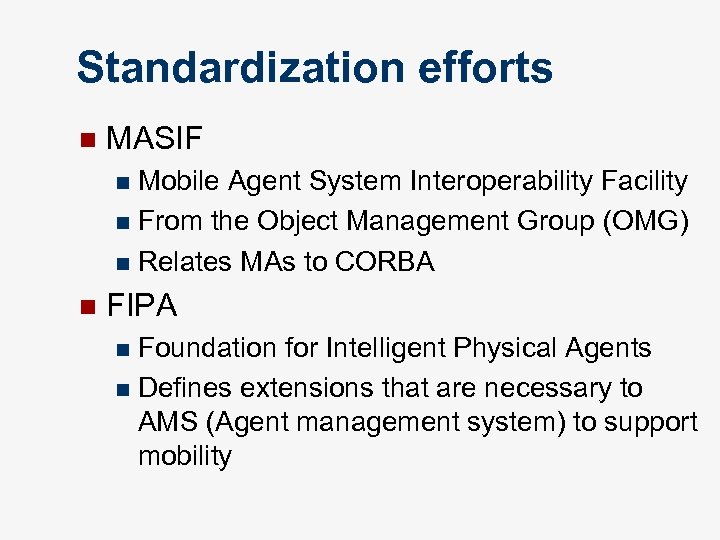
Standardization efforts n MASIF Mobile Agent System Interoperability Facility n From the Object Management Group (OMG) n Relates MAs to CORBA n n FIPA Foundation for Intelligent Physical Agents n Defines extensions that are necessary to AMS (Agent management system) to support mobility n
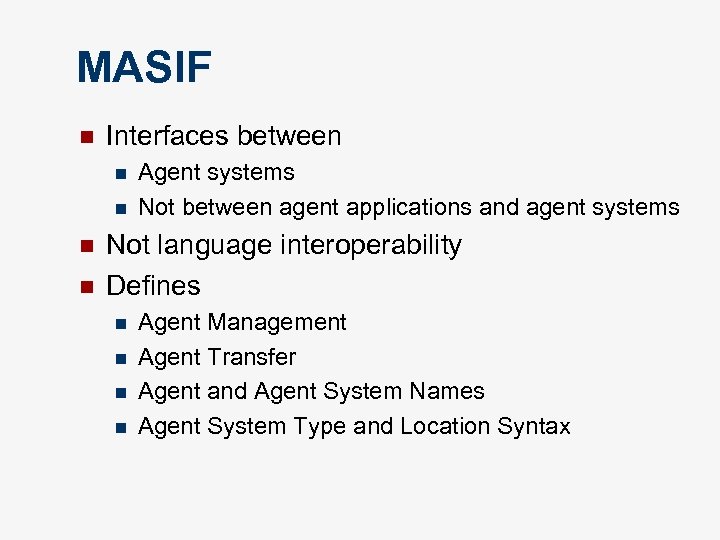
MASIF n Interfaces between n n Agent systems Not between agent applications and agent systems Not language interoperability Defines n n Agent Management Agent Transfer Agent and Agent System Names Agent System Type and Location Syntax
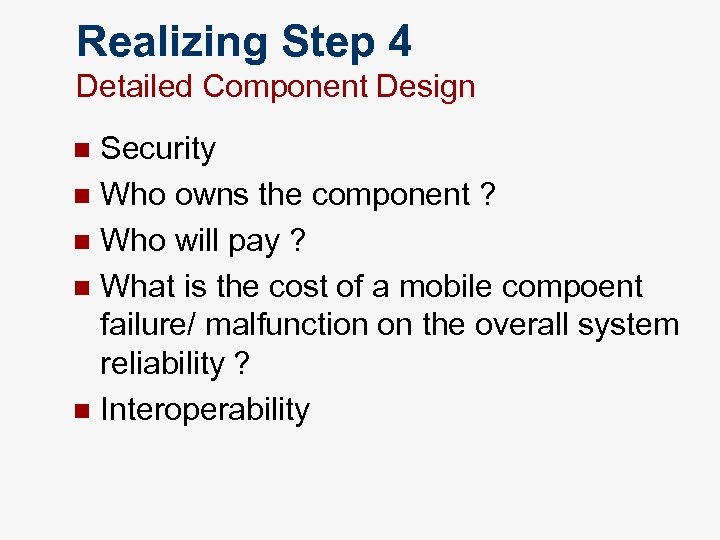
Realizing Step 4 Detailed Component Design Security n Who owns the component ? n Who will pay ? n What is the cost of a mobile compoent failure/ malfunction on the overall system reliability ? n Interoperability n
Realizing Step 5 Implementation and Deployment n Coding, Debugging and Testing • as easy / difficult as any other distributed system development Many surprises during the run-time n Managing run-time entities n Infrastructure requirements n • Resource control • Agent Environment Uptimes
Application Case Studies E-commerce Distance Evaluation
Characteristics E-commerce applications n Aim n n n Determine the availability of products; to place and confirm orders and to negotiate delivery. Large amount of data exchange over the network in fetching information(catalog) Client specific request of products To reduce delays that hamper tight interaction Disconnected (low B/W) shopping
Mobile agents in E-commerce n Shopping Agent n n n Salesman Agent n n Customer-driven market place Elimination of large amount of information exchange over the network Supplier-driven market place For products with short shelf-life, advertising a product, . . Network delays in servicing orders is reduced Auction Agent n Supports disconnected operations and quicker response
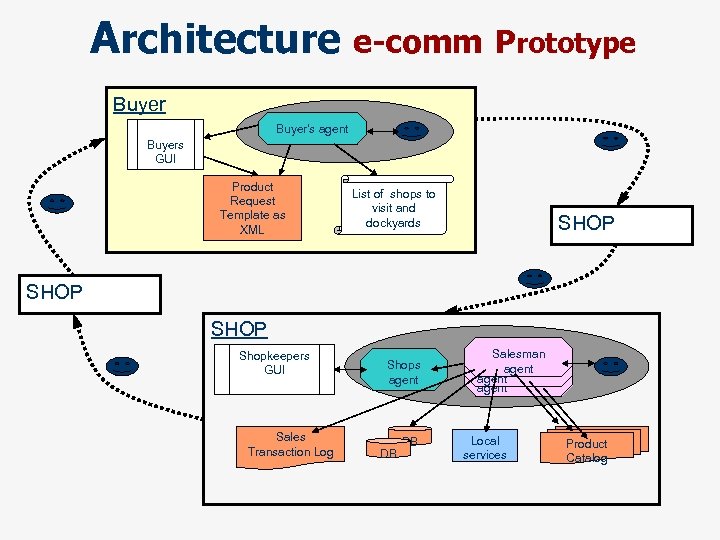
Architecture e-comm Prototype Buyer Buyer's agent Buyers GUI Product Request Template as XML List of shops to visit and dockyards SHOP Shopkeepers GUI Sales Transaction Log Shops agent DB DB Salesman agent Local services Product Catalog
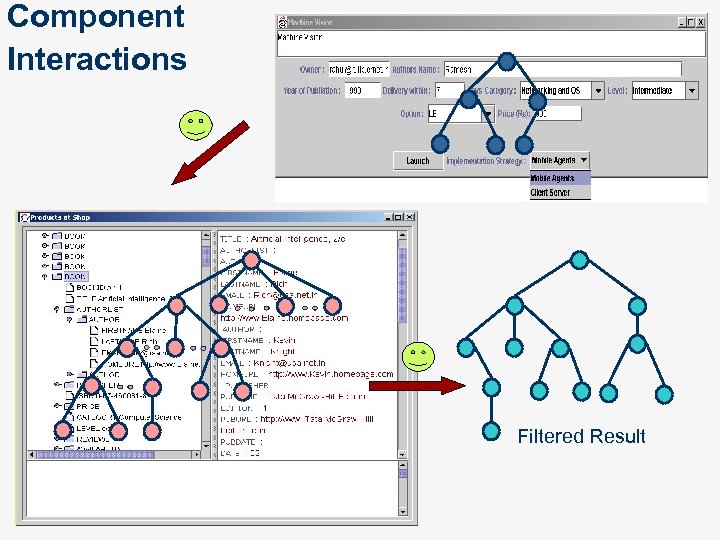
Component Interactions Filtered Result
Why MAs? Helps user with tedious repetitive job and time consuming activities. n Faster and real time interaction at shops n Reduce network load n Support disconnected operation. n Introduce n concurrency of operations n client specific functionalities at the shops n
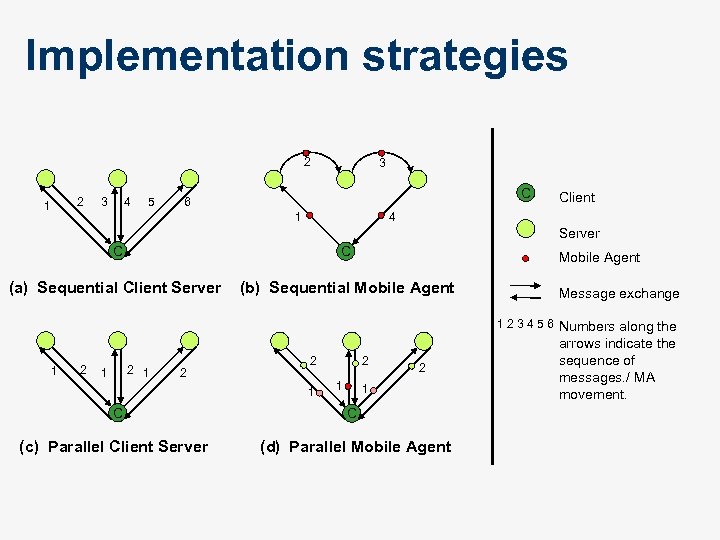
Implementation strategies 2 1 2 4 3 5 3 C 6 Client 4 1 Server C C Mobile Agent (a) Sequential Client Server (b) Sequential Mobile Agent Message exchange 1 2 3 4 5 6 Numbers along the 1 2 2 1 1 2 1 C C (c) Parallel Client Server (d) Parallel Mobile Agent arrows indicate the sequence of messages. / MA movement.
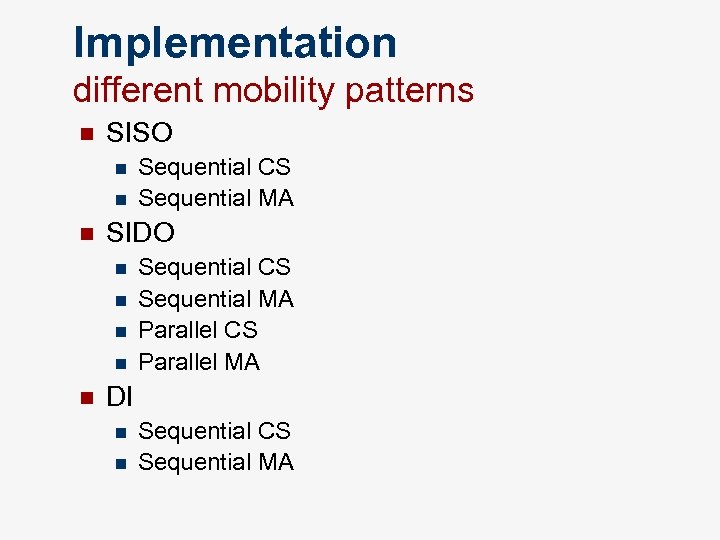
Implementation different mobility patterns n SISO n n n SIDO n n n Sequential CS Sequential MA Parallel CS Parallel MA DI n n Sequential CS Sequential MA
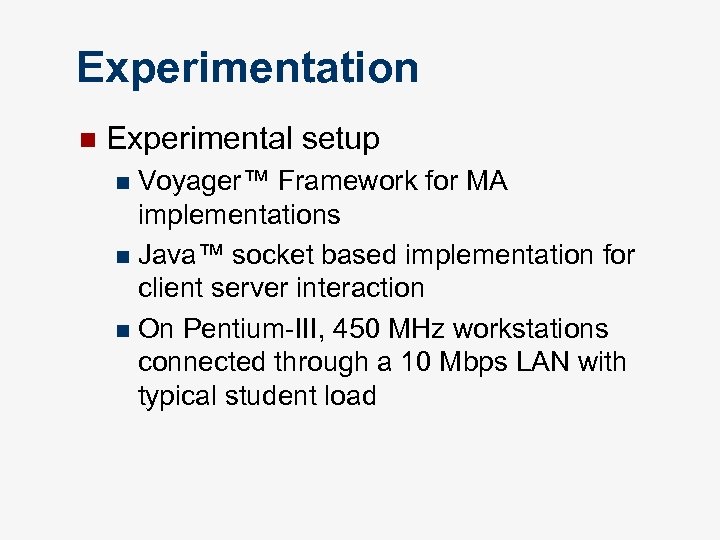
Experimentation n Experimental setup Voyager™ Framework for MA implementations n Java™ socket based implementation for client server interaction n On Pentium-III, 450 MHz workstations connected through a 10 Mbps LAN with typical student load n
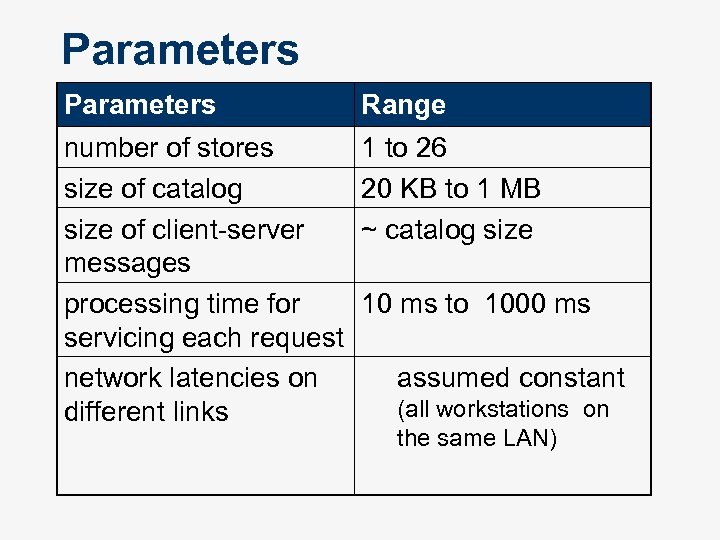
Parameters Range number of stores size of catalog size of client-server messages processing time for servicing each request network latencies on different links 1 to 26 20 KB to 1 MB ~ catalog size 10 ms to 1000 ms assumed constant (all workstations on the same LAN)
Performance metric User Turnaround Time n Time elapsed between n n a user initiating a request and receiving the results. Equals time taken for • agent creation + • visit / collect catalogs + • processing time to extract information.
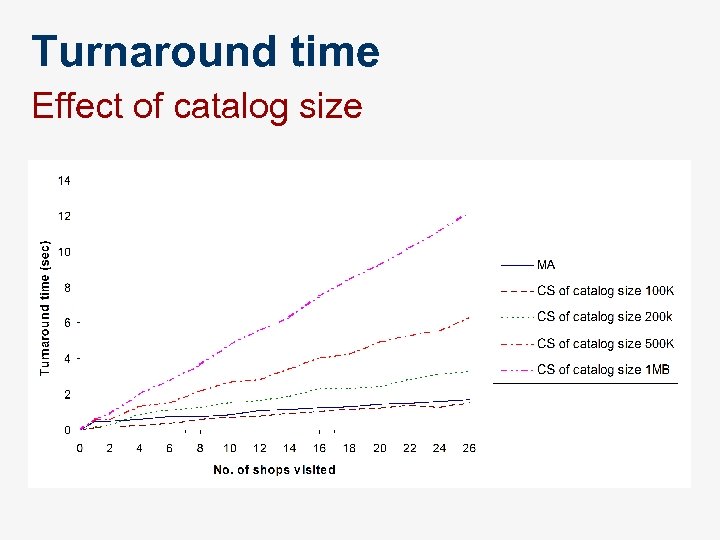
Turnaround time Effect of catalog size
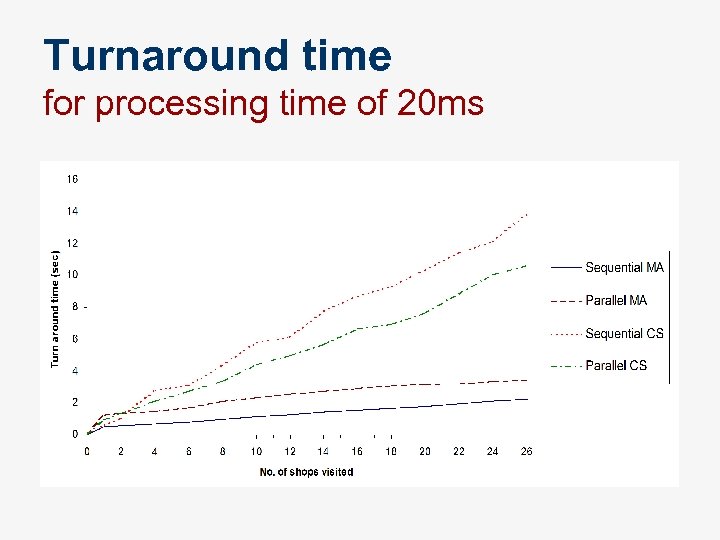
Turnaround time for processing time of 20 ms
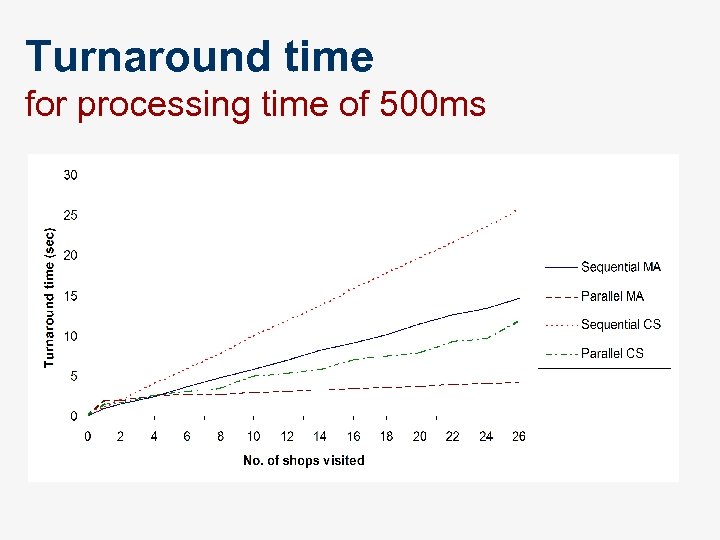
Turnaround time for processing time of 500 ms
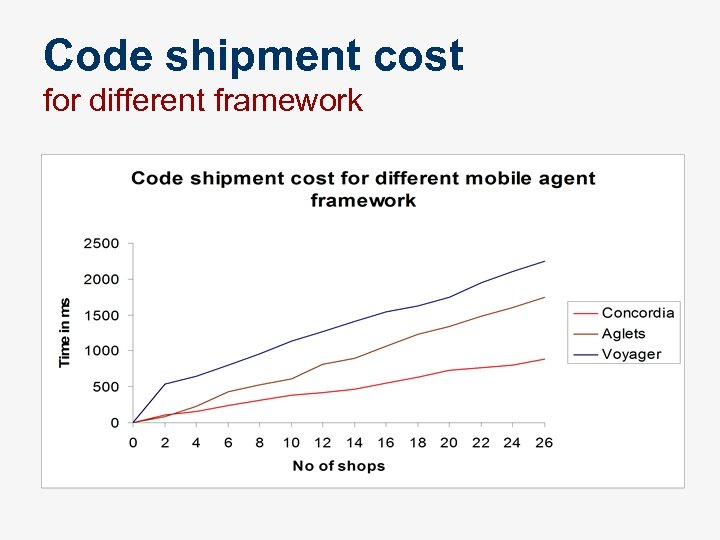
Code shipment cost for different framework
Observations n n Mobility patterns determine the implementation strategies Sequential CS most suitable where n n a small amount of information has to be retrieved from few remote information sources. Parallel implementations effective when n processing information contributes significantly to the turnaround time.
Observations n Mobile agents out perform traditional approaches when n n When the cost of shipping MAs < message exchange size. MAs scale effectively across the parameters of E-commerce application
MADE Mobile Agents for Distance Evaluation Design + Implementation
How Mobile Agents Help Map directly to real life situations n Need a generic execution environment n Can work in both modes n push n pull n Can work off-line n Provide local interactions n Provide multi-hop solutions n
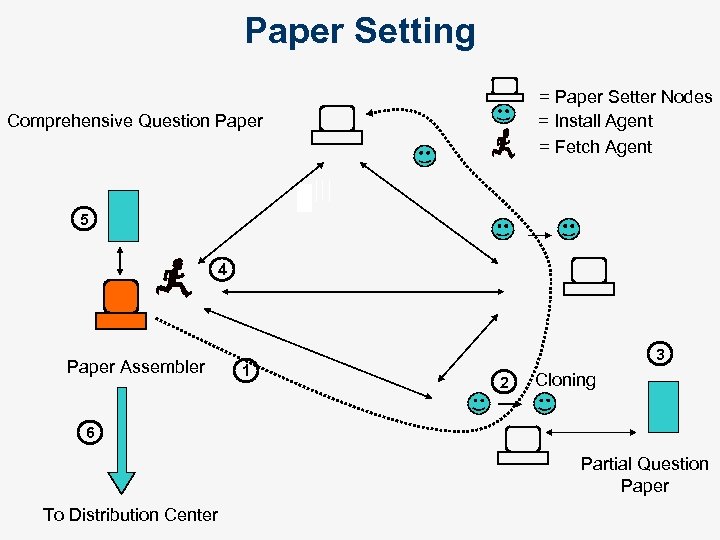
Paper Setting = Paper Setter Nodes = Install Agent = Fetch Agent Comprehensive Question Paper 5 4 Paper Assembler 1 3 2 Cloning 6 Partial Question Paper To Distribution Center
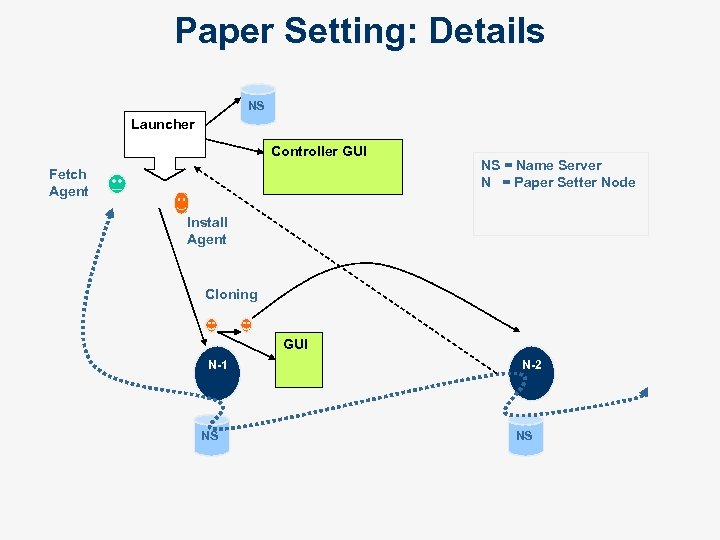
Paper Setting: Details NS Launcher Controller GUI Fetch Agent NS = Name Server N = Paper Setter Node Install Agent Cloning GUI N-1 NS N-2 NS
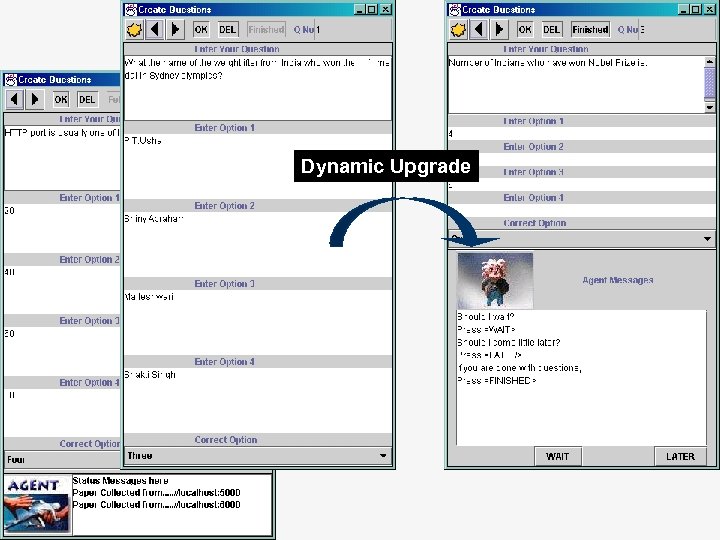
Dynamic Upgrade
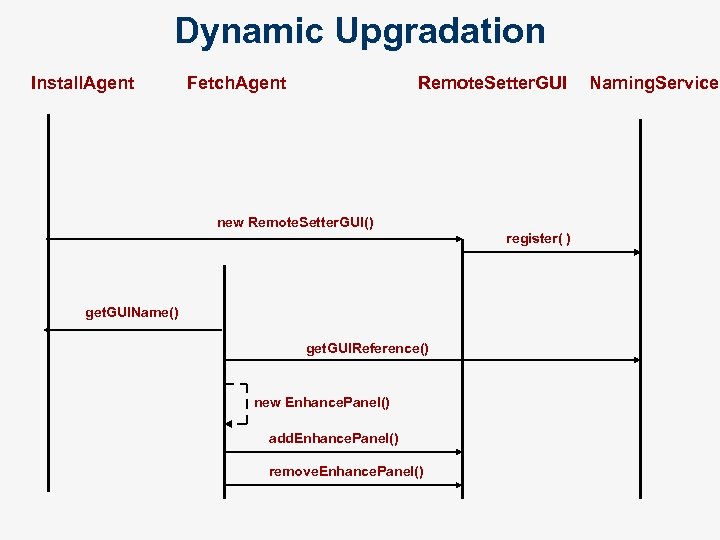
Dynamic Upgradation Install. Agent Fetch. Agent Remote. Setter. GUI new Remote. Setter. GUI() register( ) get. GUIName() get. GUIReference() new Enhance. Panel() add. Enhance. Panel() remove. Enhance. Panel() Naming. Service
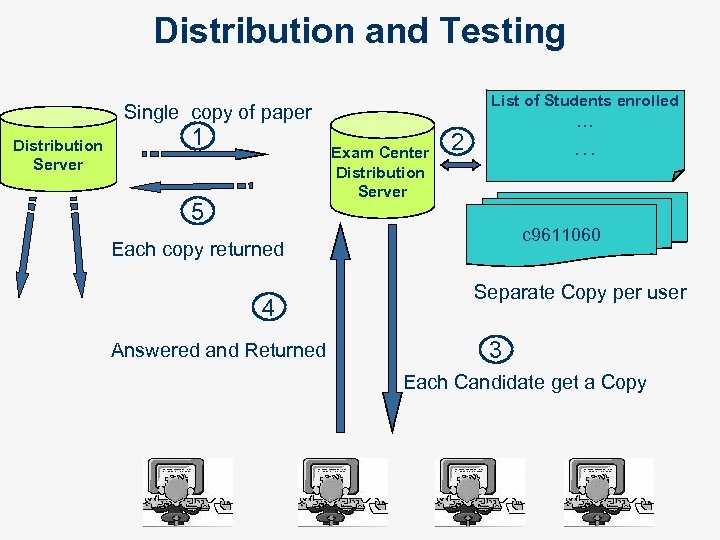
Distribution and Testing List of Students enrolled Single copy of paper Distribution Server 1 Exam Center Distribution Server 5 … 2 … c 9611060 Each copy returned 4 Answered and Returned Separate Copy per user 3 Each Candidate get a Copy
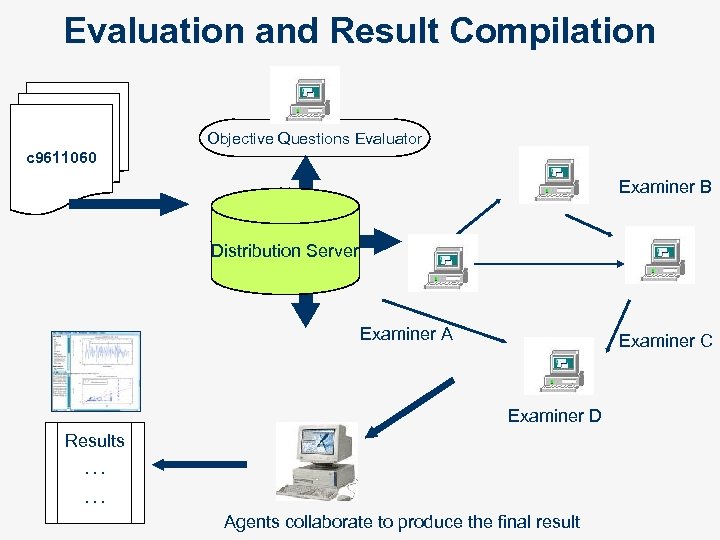
Evaluation and Result Compilation Objective Questions Evaluator c 9611060 Examiner B Distributor Distribution Server Examiner A Examiner C Examiner D Results … … Agents collaborate to produce the final result
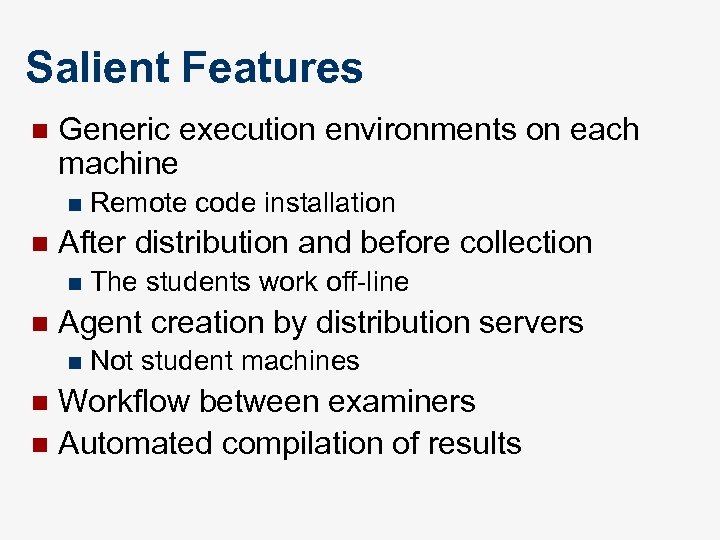
Salient Features n Generic execution environments on each machine n n After distribution and before collection n n Remote code installation The students work off-line Agent creation by distribution servers n Not student machines Workflow between examiners n Automated compilation of results n
Voyager: Implementation Platform n n Generalized distributed object computing platform Compatibility with latest java version Easy creation of remote objects Moving objects n n relative and absolute Other n n n Federated directory service Different kinds of messaging (sync, one-way, future) Object and agent persistence support Distributed event handling Security manager Compatible with CORBA and DCOM
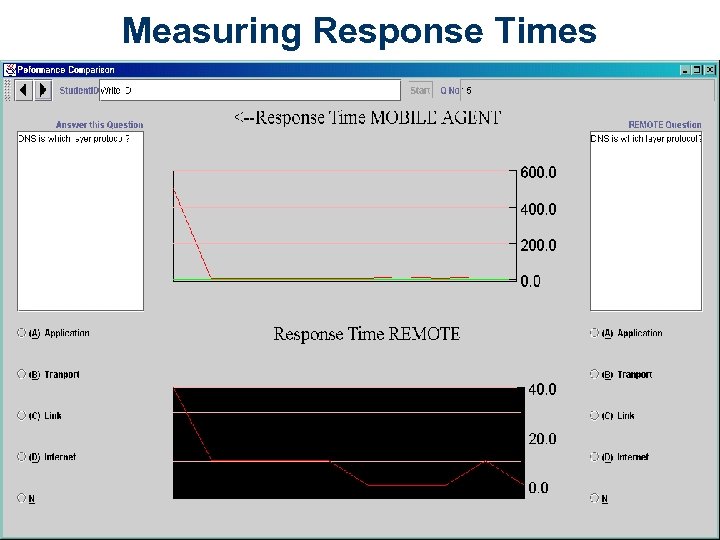
Measuring Response Times
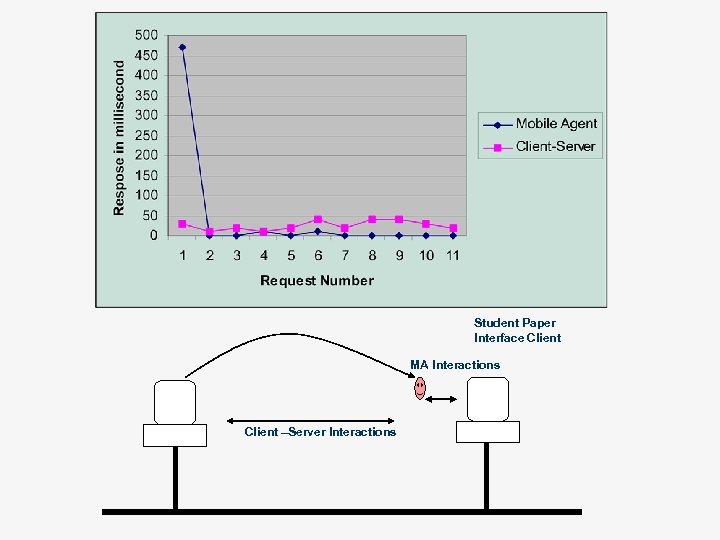
Student Paper Interface Client MA Interactions Client –Server Interactions
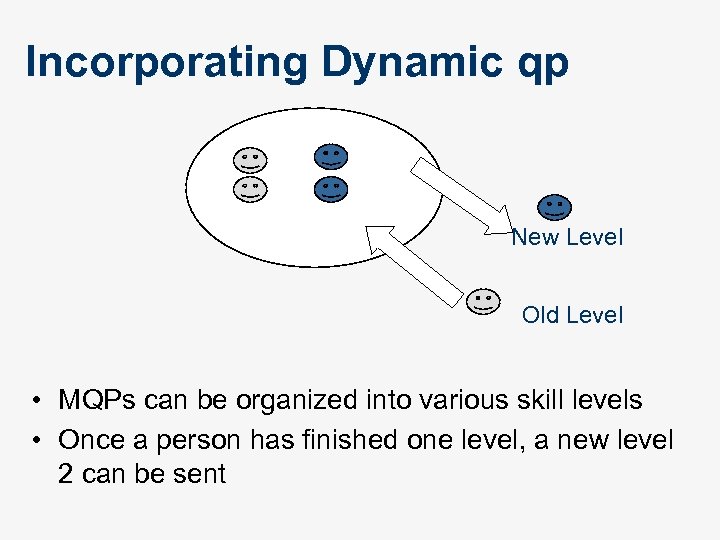
Incorporating Dynamic qp New Level Old Level • MQPs can be organized into various skill levels • Once a person has finished one level, a new level 2 can be sent
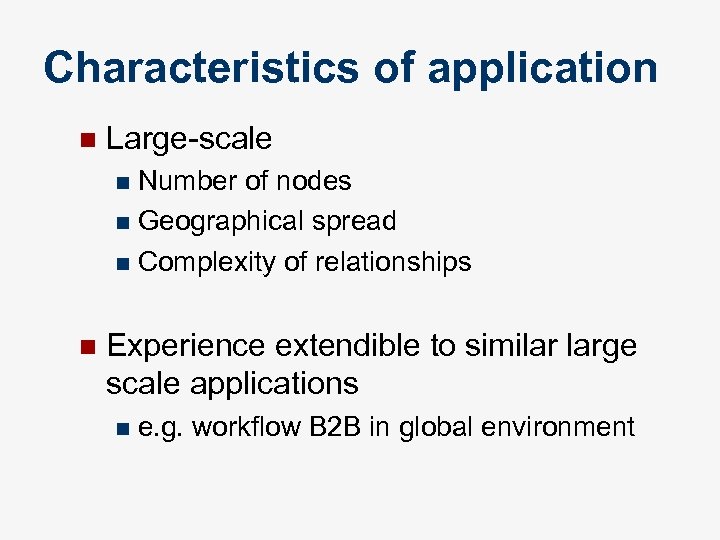
Characteristics of application n Large-scale Number of nodes n Geographical spread n Complexity of relationships n n Experience extendible to similar large scale applications n e. g. workflow B 2 B in global environment
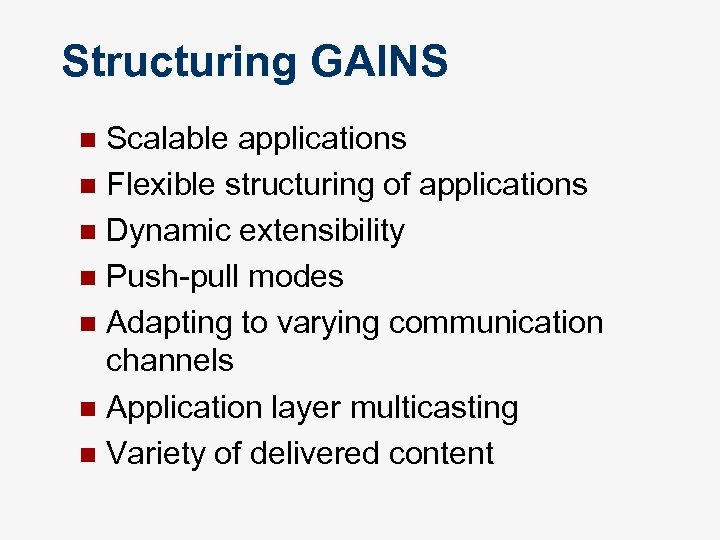
Structuring GAINS Scalable applications n Flexible structuring of applications n Dynamic extensibility n Push-pull modes n Adapting to varying communication channels n Application layer multicasting n Variety of delivered content n
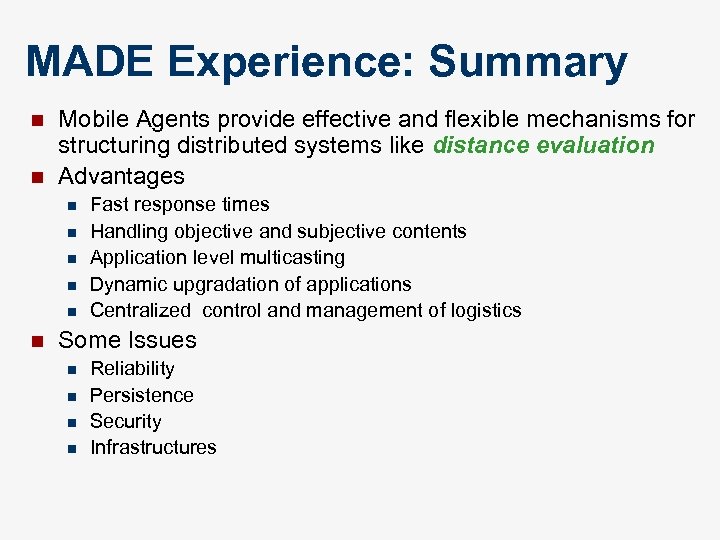
MADE Experience: Summary n n Mobile Agents provide effective and flexible mechanisms for structuring distributed systems like distance evaluation Advantages n n n Fast response times Handling objective and subjective contents Application level multicasting Dynamic upgradation of applications Centralized control and management of logistics Some Issues n n Reliability Persistence Security Infrastructures
![Current trends lead to mobile agents [Kotz] Information overload Increased need for personalization “Customization”](https://present5.com/presentation/67df2c3212560bd12e3ae08f03522311/image-156.jpg "Current trends lead to mobile agents [Kotz] Information overload Increased need for personalization “Customization”")
Current trends lead to mobile agents [Kotz] Information overload Increased need for personalization “Customization” Diversified population Bandwidth gap Mobile users and devices Server-side Too many unique, dispersed clients to handle Proxy-based Mobile code to server or proxy Multiple sites to visit Mobile Agents Avoid large transfers Mobile code to client Avoid “star” itinerary Disconnected Operation High latency
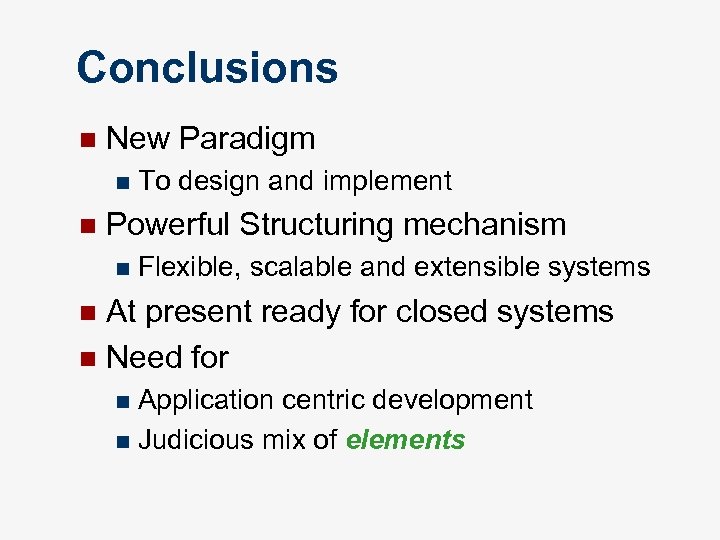
Conclusions n New Paradigm n n To design and implement Powerful Structuring mechanism n Flexible, scalable and extensible systems At present ready for closed systems n Need for n Application centric development n Judicious mix of elements n
Thank You updated version of the tutorial www. it. iitb. ac. in/~sri/talks/hipc 01 tut. ppt
Скачать презентацию Designing Distributed Applications using Mobile Agents Sridhar Iyer
67df2c3212560bd12e3ae08f03522311.ppt