 Скачать презентацию Designing and Building a Results-Based Monitoring and Evaluation
fe050137c2b3912c2a125ae57d2b5930.ppt
- Количество слайдов: 180



Designing and Building a Results-Based Monitoring and Evaluation System: A Tool for Public Sector Management A Workshop for Government Officials and Their Development Partners © 2000 The International Bank for Reconstruction and Development / THE WORLD BANK 1818 H Street N. W. Washington, DC 20433 1 All rights reserved Manufactured in the United States of America First printing October 2000

Introduction to the Workshop 2
Designing and Building a Results-Based Monitoring and Evaluation System 3 A Tool for Public Sector Management Table of Contents 1 Introduction to Workshop 2 Introduction to Monitoring and Evaluation 3 Step 1 – Conducting a “Readiness Assessment” 4 Step 2 – Agreeing on Outcomes to Monitor and Evaluate 5 Step 3 – Selecting Key Indicators to Monitor Outcomes
Designing and Building Results-Based Monitoring and Evaluation System (Cont. ) 4 Table of Contents 6 Step 4 – Data on Indicators— Where Are We Today? 7 Step 5 – for Improvement— Setting Results Targets 8 Step 6 – for Results 9 Step 7 – of Evaluations 10 Step 8 – Your Findings 11 Step 9 – Findings Baseline Planning Monitoring The Role Reporting Using Your
Goals for This Workshop • • 5 To prepare you to plan, design, and implement a results-based monitoring and evaluation system within your organization To demonstrate how an M&E system is a valuable tool to support good public management
Workshop Overview • • These steps begin with conducting a “Readiness Assessment” and on through designing and managing your monitoring and evaluation system • 6 This workshop focuses on ten steps that describe how results-based monitoring and evaluation systems are designed and built We will be discussing these steps, the tasks needed to complete them, and the tools available to help along the way
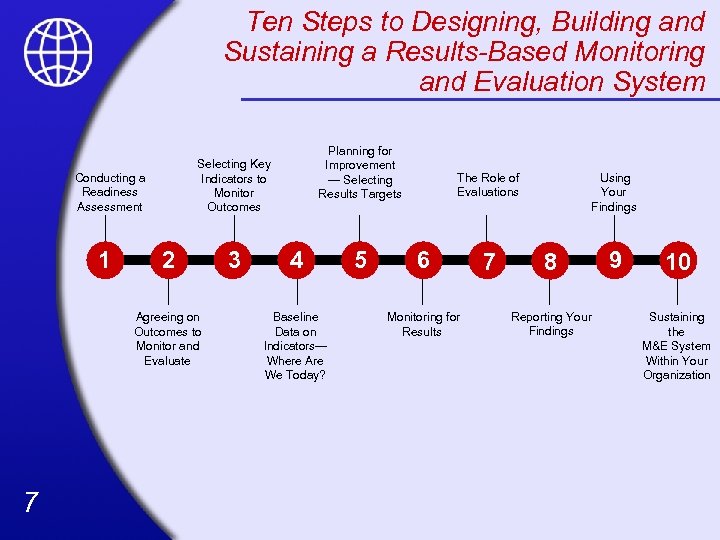
Ten Steps to Designing, Building and Sustaining a Results-Based Monitoring and Evaluation System Selecting Key Indicators to Monitor Outcomes Conducting a Readiness Assessment 1 2 Agreeing on Outcomes to Monitor and Evaluate 7 Planning for Improvement — Selecting Results Targets 3 4 Baseline Data on Indicators— Where Are We Today? 5 The Role of Evaluations 6 Monitoring for Results 7 Using Your Findings 8 Reporting Your Findings 9 10 Sustaining the M&E System Within Your Organization
Introduction to Results-Based Monitoring and Evaluation 8
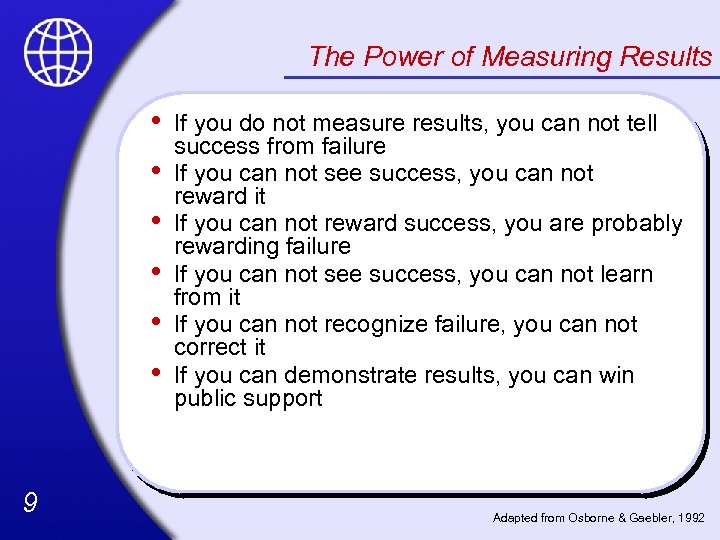
The Power of Measuring Results • • • 9 If you do not measure results, you can not tell success from failure If you can not see success, you can not reward it If you can not reward success, you are probably rewarding failure If you can not see success, you can not learn from it If you can not recognize failure, you can not correct it If you can demonstrate results, you can win public support Adapted from Osborne & Gaebler, 1992
Introduction to Results-Based Monitoring and Evaluation What Are We Talking About? • • Results-based monitoring and evaluation is a management tool! • 10 Results-based monitoring and evaluation measures how well governments are performing Results-based monitoring and evaluation emphasizes assessing how outcomes are being achieved over time

Who Are Stakeholders That Care About Government Performance? • • 11 Government officials/Parliament Donors Program managers and staff Civil society (Citizens, NGOs, Media, Private Sector etc. )
Remember • Monitoring and evaluation are two separate, but interrelated strategies to collect data and report the findings on how well (or not) the public sector is performing • During this workshop, we will be discussing: – – 12 Monitoring as a tool The ten steps to build a results-based monitoring and evaluation system to measure government performance Evaluation as a tool How the two interrelate to support good public management
Reasons to Do Results-Based M&E • • Provides a view over time on the status of a project, program, or policy • Promotes credibility and public confidence by reporting on the results of programs • • 13 Provides crucial information about public sector performance Helps formulate and justify budget requests Identifies potentially promising programs or practices
Reasons to Do Results-Based M&E (cont. ) • • Provides timely, frequent information to staff • 14 Focuses attention on achieving outcomes important to the organization and its stakeholders Supports a development agenda that is shifting towards greater accountability for aid lending Helps establish key goals and objectives Permits managers to identify and take action to correct weaknesses
Important… • It takes leadership commitment to achieve a better-performing organization • Plus redeployment of resources to build monitoring and evaluation systems • Plus individuals committed to improve public sector performance So…it comes down to a combination of institutional capacity and political will. 15
Definition Results-Based Monitoring (what we will call “monitoring”) is a continuous process of collecting and analyzing information to compare how well a project, program or policy is performing against expected results 16
Major Activities Where Results Monitoring Is Needed • • • Managing projects, programs and policies • • 17 Setting goals and objectives Reporting to donors Reporting to Parliament and other stakeholders Allocating resources
A New Emphasis on Both Implementation and Results-Based Monitoring • Traditional monitoring focuses on implementation monitoring – – This approach focuses on monitoring how well a project, program or policy is being implemented – 18 This involves tracking inputs ($$, resources, strategies), activities (what actually took place) and outputs (the products or services produced) Often used to assess compliance with workplans and budget
A New Emphasis on Both Implementation and Results-Based Monitoring • • 19 Results-based monitoring involves the regular collection of information on how effectively government (or any organization) is performing Results-based monitoring demonstrates whether a project, program, or policy is achieving its stated goals
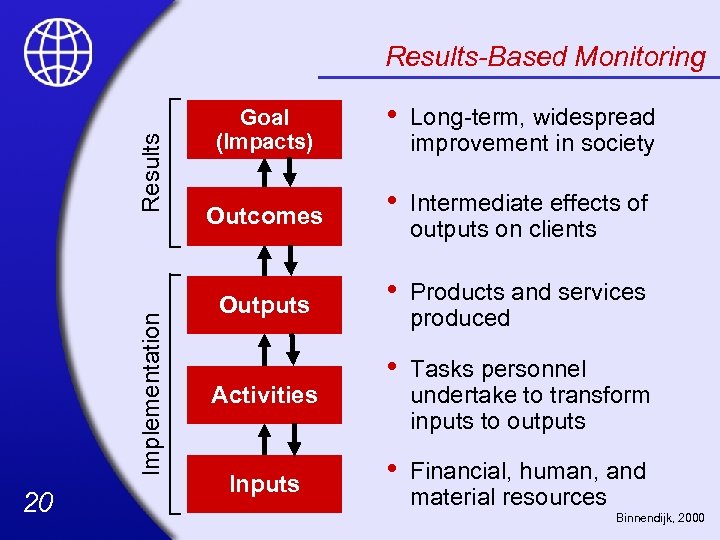
Implementation Results-Based Monitoring 20 • Long-term, widespread improvement in society Outcomes • Intermediate effects of outputs on clients Outputs • Products and services produced • Tasks personnel undertake to transform inputs to outputs • Financial, human, and material resources Goal (Impacts) Activities Inputs Binnendijk, 2000
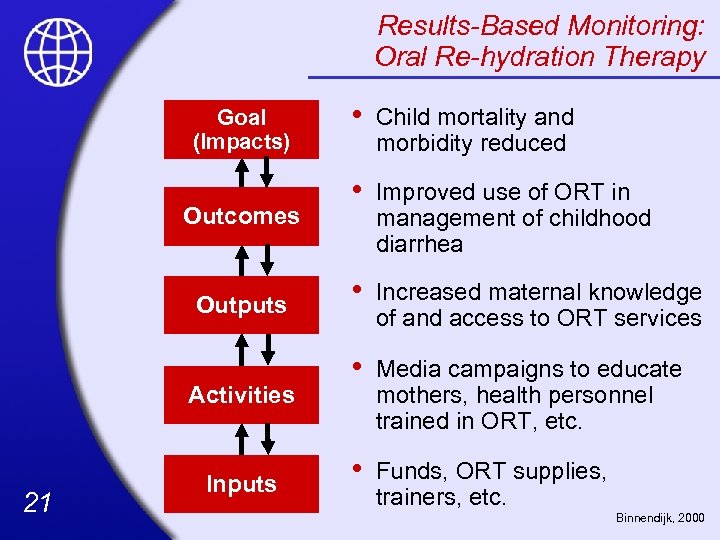
Results-Based Monitoring: Oral Re-hydration Therapy Goal (Impacts) Outcomes Outputs Activities 21 Inputs • Child mortality and morbidity reduced • Improved use of ORT in management of childhood diarrhea • Increased maternal knowledge of and access to ORT services • Media campaigns to educate mothers, health personnel trained in ORT, etc. • Funds, ORT supplies, trainers, etc. Binnendijk, 2000
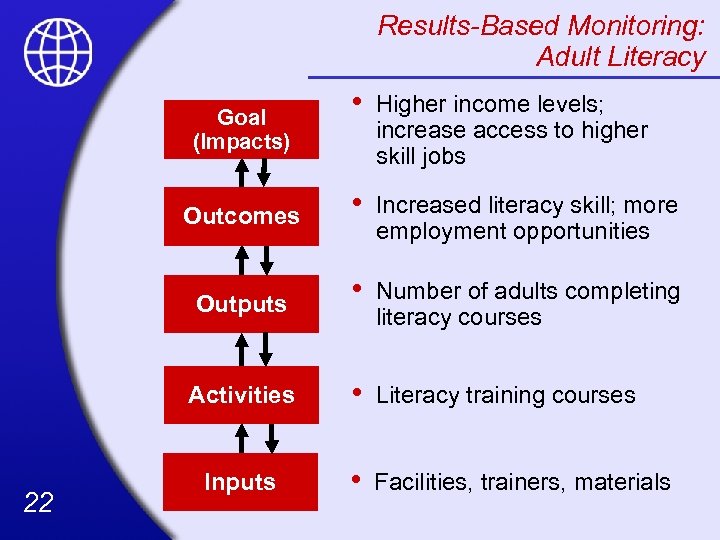
Results-Based Monitoring: Adult Literacy • Higher income levels; increase access to higher skill jobs Outcomes • Increased literacy skill; more employment opportunities Outputs • Number of adults completing literacy courses Activities • Literacy training courses Inputs • Facilities, trainers, materials Goal (Impacts) 22
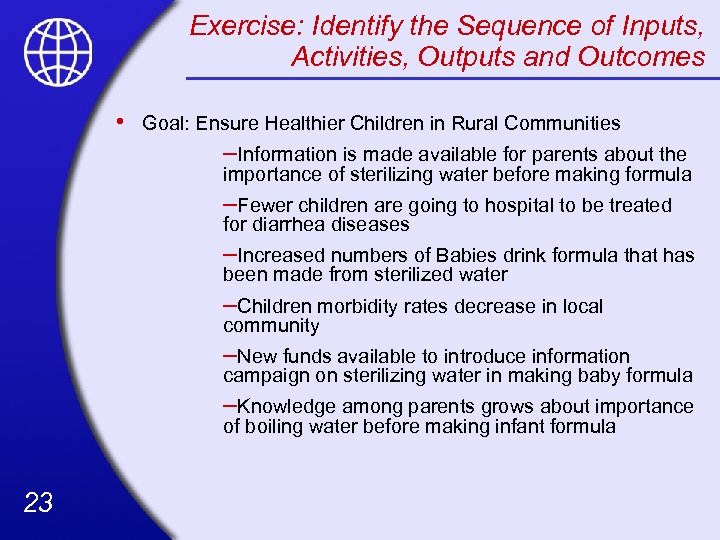
Exercise: Identify the Sequence of Inputs, Activities, Outputs and Outcomes • Goal: Ensure Healthier Children in Rural Communities –Information is made available for parents about the importance of sterilizing water before making formula –Fewer children are going to hospital to be treated for diarrhea diseases –Increased numbers of Babies drink formula that has been made from sterilized water –Children morbidity rates decrease in local community –New funds available to introduce information campaign on sterilizing water in making baby formula –Knowledge among parents grows about importance of boiling water before making infant formula 23
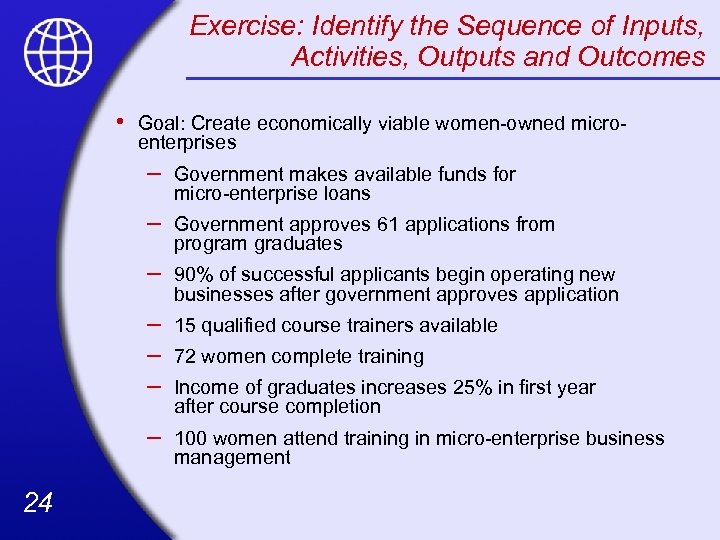
Exercise: Identify the Sequence of Inputs, Activities, Outputs and Outcomes • Goal: Create economically viable women-owned microenterprises – – Government approves 61 applications from program graduates – 90% of successful applicants begin operating new businesses after government approves application – – – 15 qualified course trainers available – 24 Government makes available funds for micro-enterprise loans 100 women attend training in micro-enterprise business management 72 women complete training Income of graduates increases 25% in first year after course completion
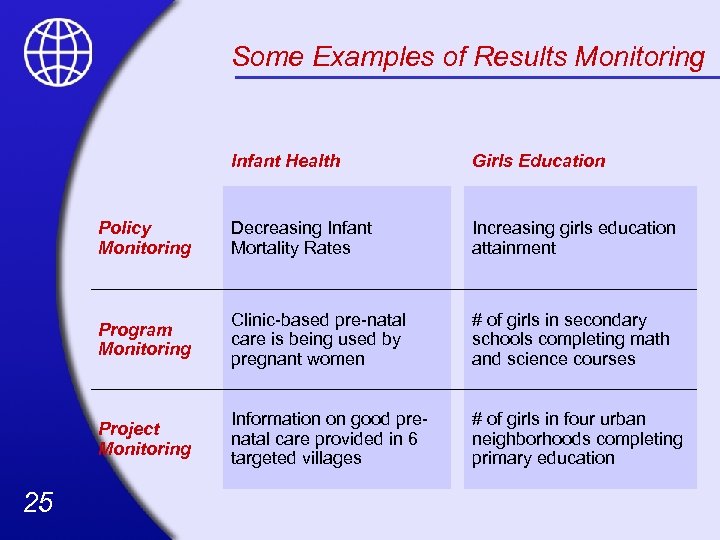
Some Examples of Results Monitoring Infant Health Policy Monitoring Decreasing Infant Mortality Rates Increasing girls education attainment Program Monitoring Clinic-based pre-natal care is being used by pregnant women # of girls in secondary schools completing math and science courses Project Monitoring 25 Girls Education Information on good prenatal care provided in 6 targeted villages # of girls in four urban neighborhoods completing primary education
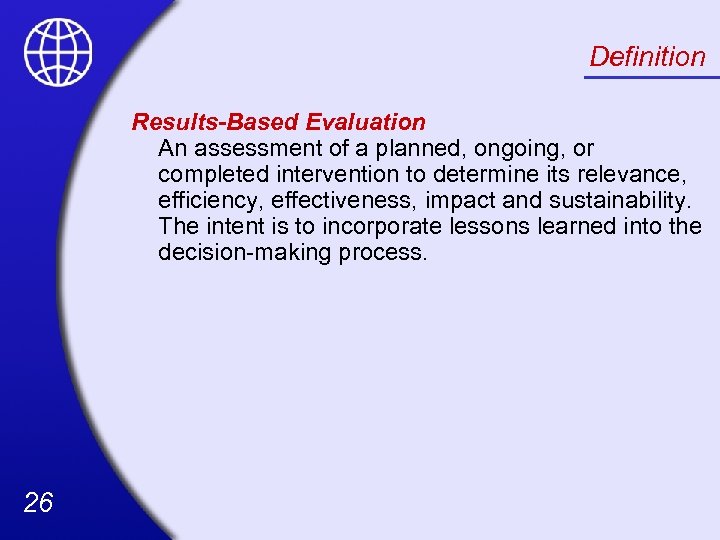
Definition Results-Based Evaluation An assessment of a planned, ongoing, or completed intervention to determine its relevance, efficiency, effectiveness, impact and sustainability. The intent is to incorporate lessons learned into the decision-making process. 26
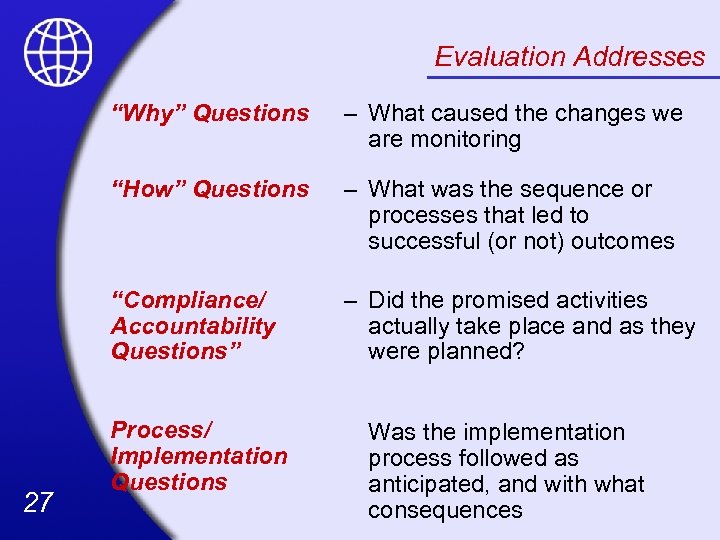
Evaluation Addresses “Why” Questions “How” Questions – What was the sequence or processes that led to successful (or not) outcomes “Compliance/ Accountability Questions” 27 – What caused the changes we are monitoring – Did the promised activities actually take place and as they were planned? Process/ Implementation Questions Was the implementation process followed as anticipated, and with what consequences
Designing Good Evaluations • • • 28 Getting the questions right is critical Answering the questions is critical Supporting public sector decision-making with credible and useful information is critical
Designing Good Evaluations “Better to have an approximate answer to the right question, than an exact answer to the wrong question. ” Paraphrased from statistician John W. Tukey 29
Designing Good Evaluations “Better to be approximately correct than precisely wrong. ” Paraphrased from Bertrand Russell 30
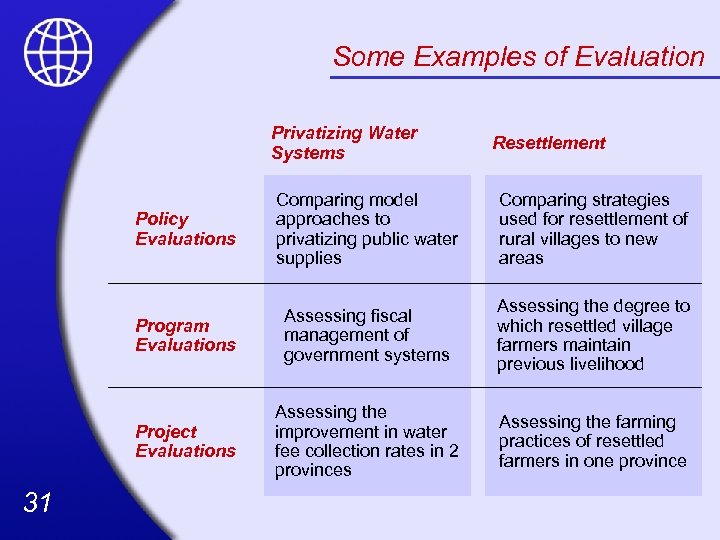
Some Examples of Evaluation Privatizing Water Systems Resettlement Policy Evaluations Comparing strategies used for resettlement of rural villages to new areas Program Evaluations Assessing fiscal management of government systems Assessing the degree to which resettled village farmers maintain previous livelihood Project Evaluations 31 Comparing model approaches to privatizing public water supplies Assessing the improvement in water fee collection rates in 2 provinces Assessing the farming practices of resettled farmers in one province
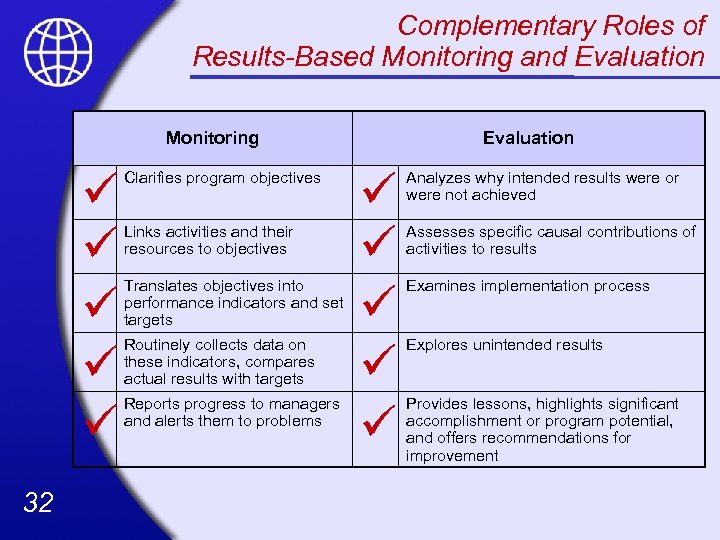
Complementary Roles of Results-Based Monitoring and Evaluation Monitoring ü ü ü 32 Clarifies program objectives Links activities and their resources to objectives Translates objectives into performance indicators and set targets Routinely collects data on these indicators, compares actual results with targets Reports progress to managers and alerts them to problems Evaluation ü ü ü Analyzes why intended results were or were not achieved Assesses specific causal contributions of activities to results Examines implementation process Explores unintended results Provides lessons, highlights significant accomplishment or program potential, and offers recommendations for improvement
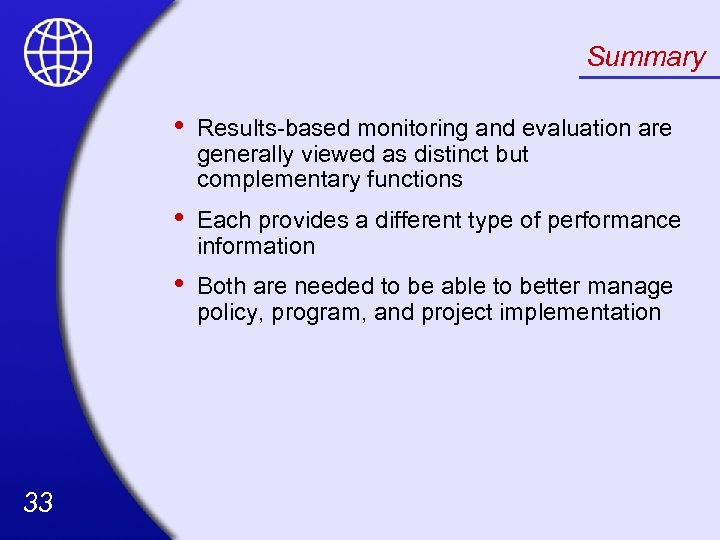
Summary • • Each provides a different type of performance information • 33 Results-based monitoring and evaluation are generally viewed as distinct but complementary functions Both are needed to be able to better manage policy, program, and project implementation
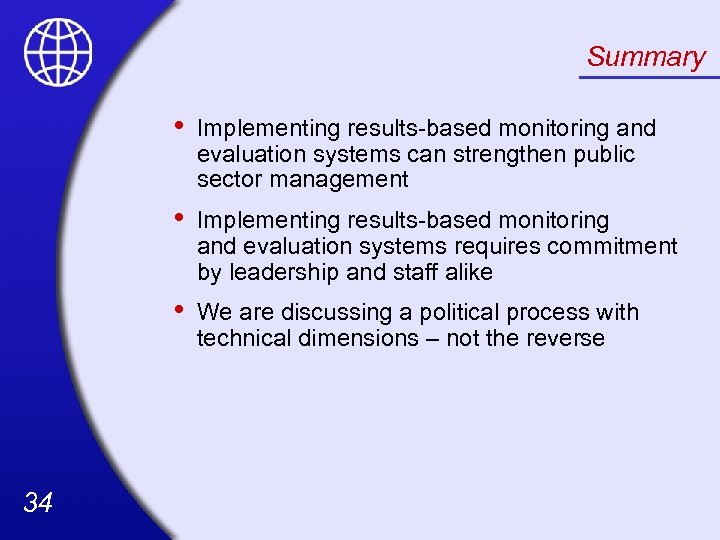
Summary • • Implementing results-based monitoring and evaluation systems requires commitment by leadership and staff alike • 34 Implementing results-based monitoring and evaluation systems can strengthen public sector management We are discussing a political process with technical dimensions – not the reverse
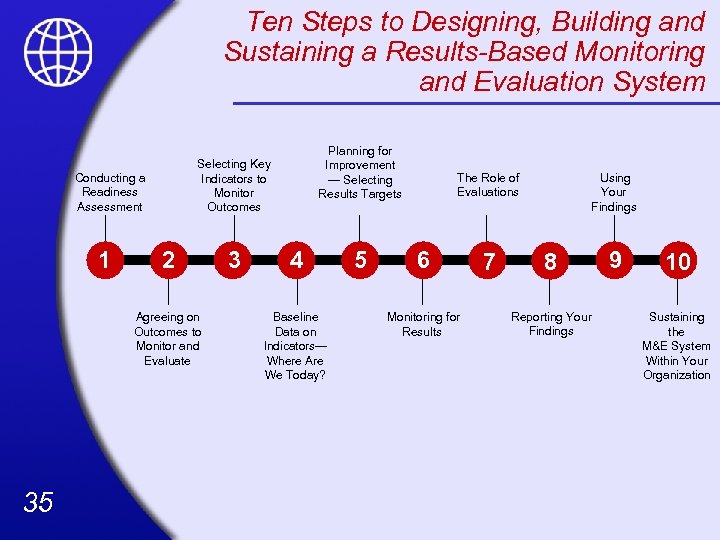
Ten Steps to Designing, Building and Sustaining a Results-Based Monitoring and Evaluation System Selecting Key Indicators to Monitor Outcomes Conducting a Readiness Assessment 1 2 Agreeing on Outcomes to Monitor and Evaluate 35 Planning for Improvement — Selecting Results Targets 3 4 Baseline Data on Indicators— Where Are We Today? 5 The Role of Evaluations 6 Monitoring for Results 7 Using Your Findings 8 Reporting Your Findings 9 10 Sustaining the M&E System Within Your Organization
Step 1 Conducting a “Readiness Assessment” 36
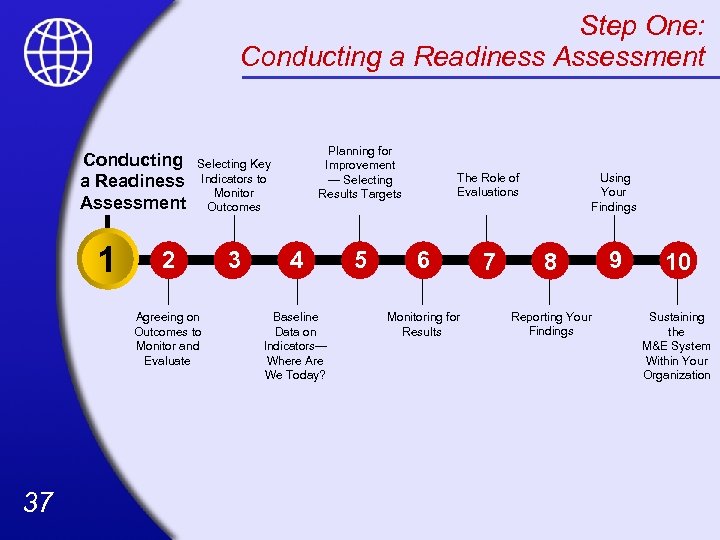
Step One: Conducting a Readiness Assessment 1 1 Selecting Key Indicators to Monitor Outcomes 2 Agreeing on Outcomes to Monitor and Evaluate 37 Planning for Improvement — Selecting Results Targets 3 4 Baseline Data on Indicators— Where Are We Today? 5 The Role of Evaluations 6 Monitoring for Results 7 Using Your Findings 8 Reporting Your Findings 9 10 Sustaining the M&E System Within Your Organization
What is a Readiness Assessment? An analytical framework to assess a country’s ability to monitor and evaluate its development goals : 38
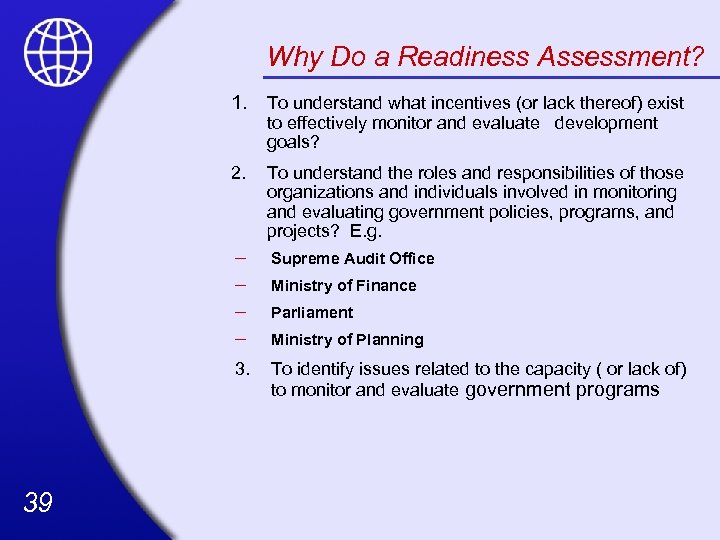
Why Do a Readiness Assessment? 1. To understand what incentives (or lack thereof) exist to effectively monitor and evaluate development goals? 2. – – Supreme Audit Office 3. 39 To understand the roles and responsibilities of those organizations and individuals involved in monitoring and evaluating government policies, programs, and projects? E. g. To identify issues related to the capacity ( or lack of) to monitor and evaluate government programs Ministry of Finance Parliament Ministry of Planning
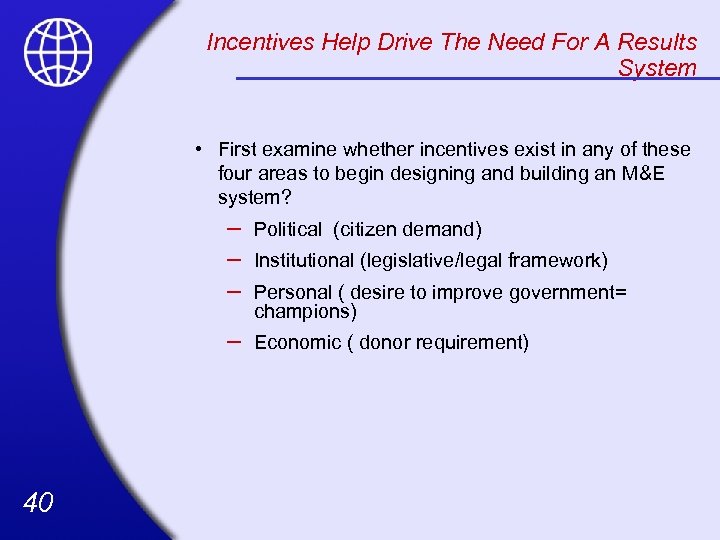
Incentives Help Drive The Need For A Results System • First examine whether incentives exist in any of these four areas to begin designing and building an M&E system? – – 40 Political (citizen demand) Economic ( donor requirement) Institutional (legislative/legal framework) Personal ( desire to improve government= champions)
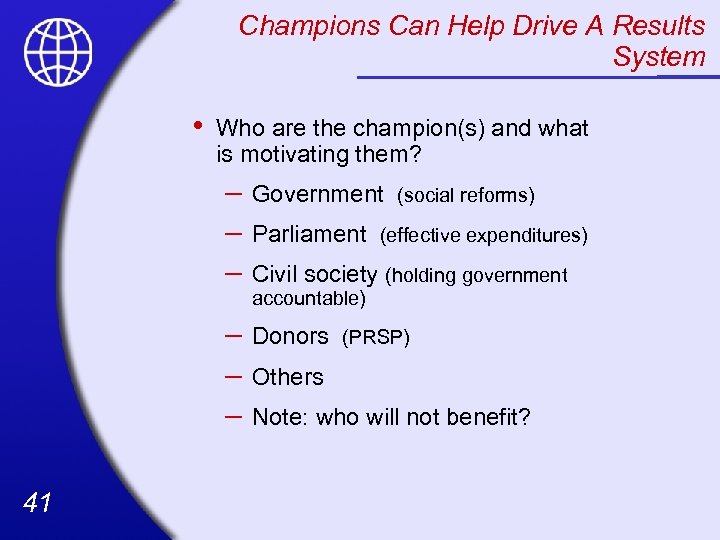
Champions Can Help Drive A Results System • Who are the champion(s) and what is motivating them? – – – 41 Government (social reforms) Donors (PRSP) Parliament (effective expenditures) Civil society (holding government accountable) Others Note: who will not benefit?
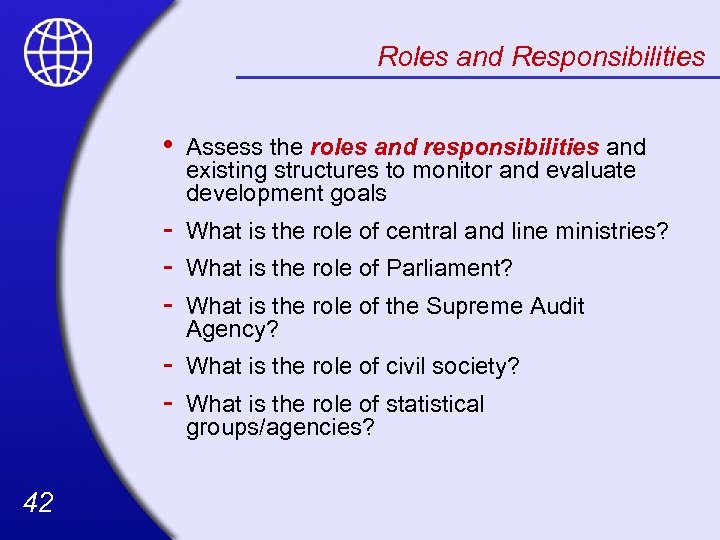
Roles and Responsibilities • - What is the role of central and line ministries? 42 Assess the roles and responsibilities and existing structures to monitor and evaluate development goals What is the role of civil society? What is the role of Parliament? What is the role of the Supreme Audit Agency? What is the role of statistical groups/agencies?
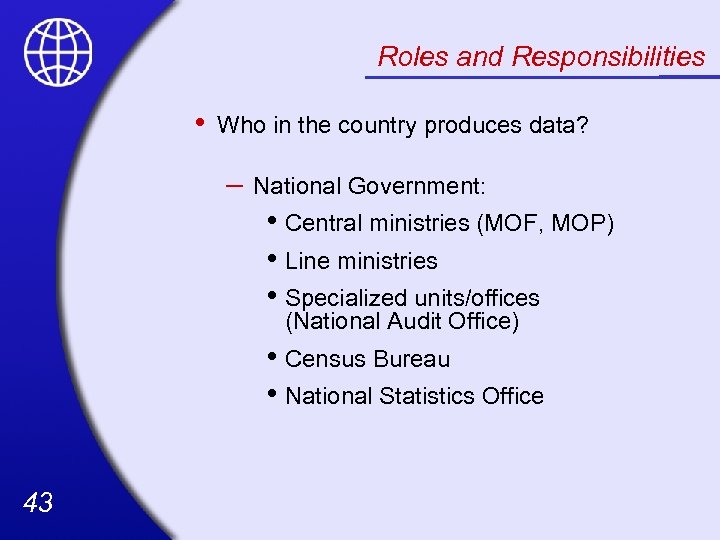
Roles and Responsibilities • Who in the country produces data? – National Government: • Central ministries (MOF, MOP) • Line ministries • Specialized units/offices (National Audit Office) • Census Bureau • National Statistics Office 43
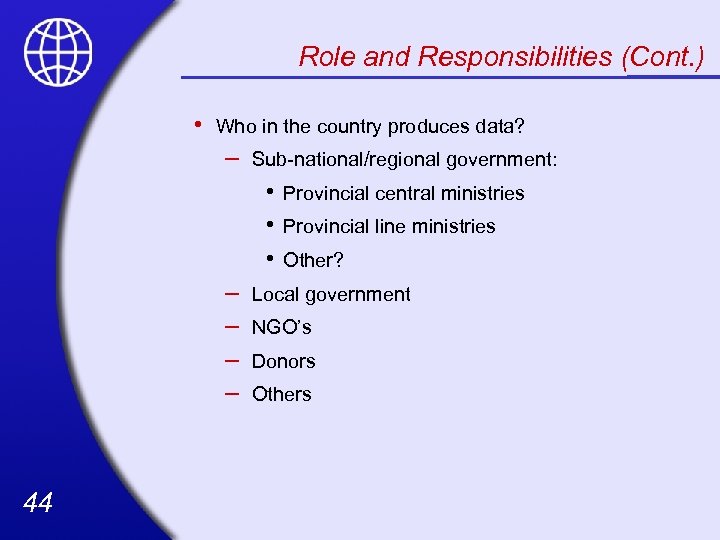
Role and Responsibilities (Cont. ) • Who in the country produces data? – Sub-national/regional government: • • • – – 44 Provincial central ministries Provincial line ministries Other? Local government NGO’s Donors Others
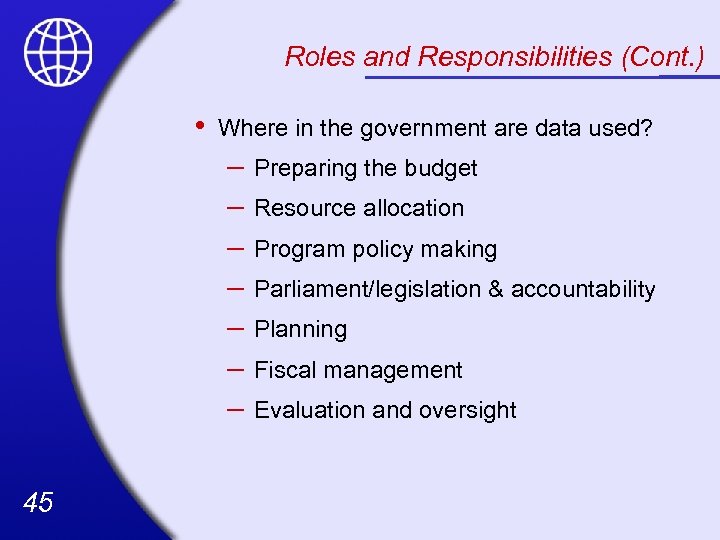
Roles and Responsibilities (Cont. ) • Where in the government are data used? – – – – 45 Preparing the budget Resource allocation Program policy making Parliament/legislation & accountability Planning Fiscal management Evaluation and oversight
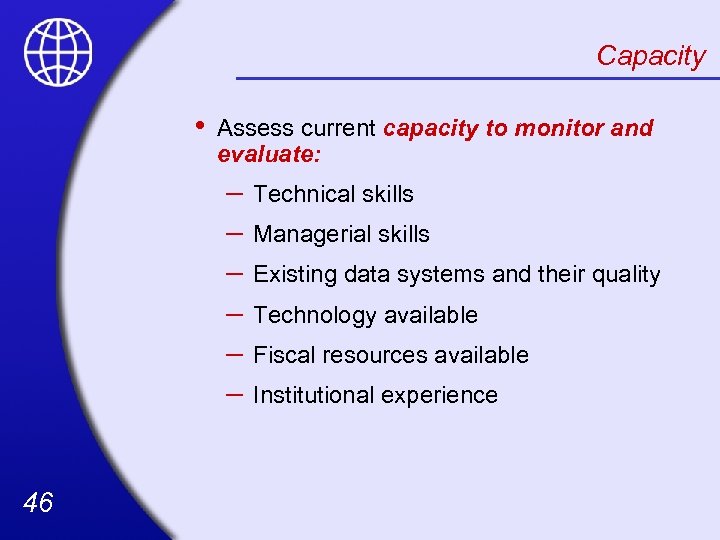
Capacity • Assess current capacity to monitor and evaluate: – – – 46 Technical skills Managerial skills Existing data systems and their quality Technology available Fiscal resources available Institutional experience
Barriers • Do any of these immediate barriers now exist to getting started in building an M&E system? – – – 47 Lack of fiscal resources Lack of political will Lack of champion Lack of expertise & knowledge Lack of strategy Lack of prior experience
Key Elements of Success • Assess the Country’s Capacity Against the Following: – Does a clear mandate exist for M&E? • PRSP? , Law? Civil Society? Other? – – Are resource and policy decisions linked to the budget? – How reliable is information that may be used for policy and management decision making? – How involved is civil society as a partner with government, or voice with government? – 48 Is there the presence of strong leadership at the most senior level of the government? Are there pockets of innovation that can serve as beginning practices or pilot programs?
Step 2 Choosing Outcomes to Monitor & Evaluate 49
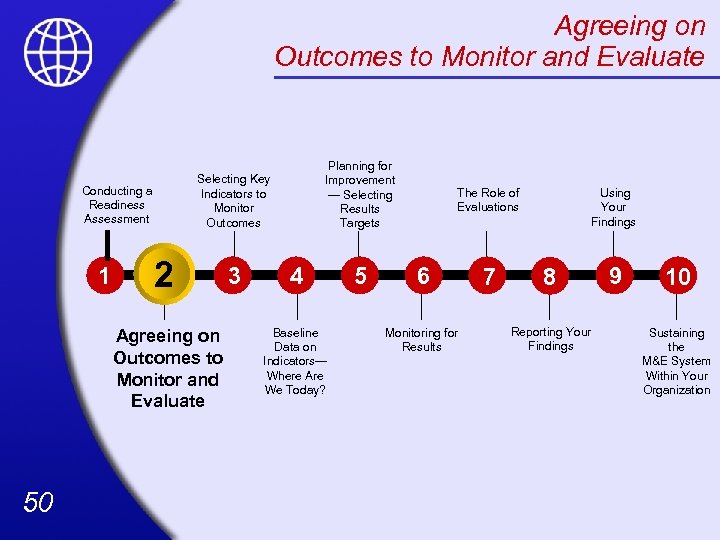
Agreeing on Outcomes to Monitor and Evaluate Conducting a Readiness Assessment 1 2 2 Agreeing on Outcomes to Monitor and Evaluate 50 Planning for Improvement — Selecting Results Targets Selecting Key Indicators to Monitor Outcomes 3 4 Baseline Data on Indicators— Where Are We Today? 5 The Role of Evaluations 6 Monitoring for Results 7 Using Your Findings 8 Reporting Your Findings 9 10 Sustaining the M&E System Within Your Organization
Why an Emphasis on Outcomes? • Makes explicit the intended objectives of government action (“Know where you are going before you get moving”) • • 51 Outcomes are what produce benefits They tell you when you have been successful or not
Why Is It Important to Choose a Set of Key Goals or Outcomes? “If you don’t know where you’re going, any road will get you there. ” Paraphrased from Lewis Carroll’s Alice in Wonderland 52
Issues to Consider in Choosing Outcomes to Monitor and Evaluate • • • Do citizen polling data indicate specific concerns? • • • 53 Are there stated national/sectoral goals? Is authorizing legislation present? Have political promises been made that specify improved performance of the government? Other? (Millennium Development Goals) Is aid lending linked with specific goals?
Note: When Choosing Outcomes, Remember – “Do Not Go It Alone!” • 54 Develop a participative approach that includes the views and ideas of key stakeholder groups
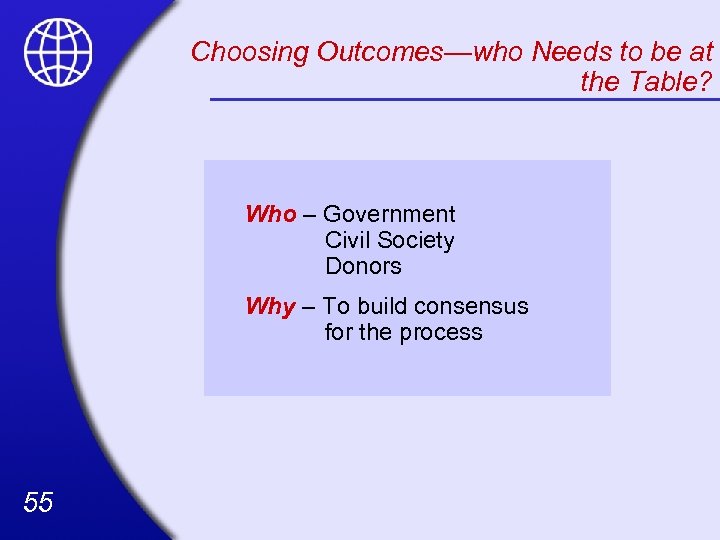
Choosing Outcomes—who Needs to be at the Table? Who – Government Civil Society Donors Why – To build consensus for the process 55
Why Building Consensus Is Important “The new realities of governance, globalization, aid lending, and citizen expectations require an approach that is consultative, cooperative and committed to consensus building. ” 56
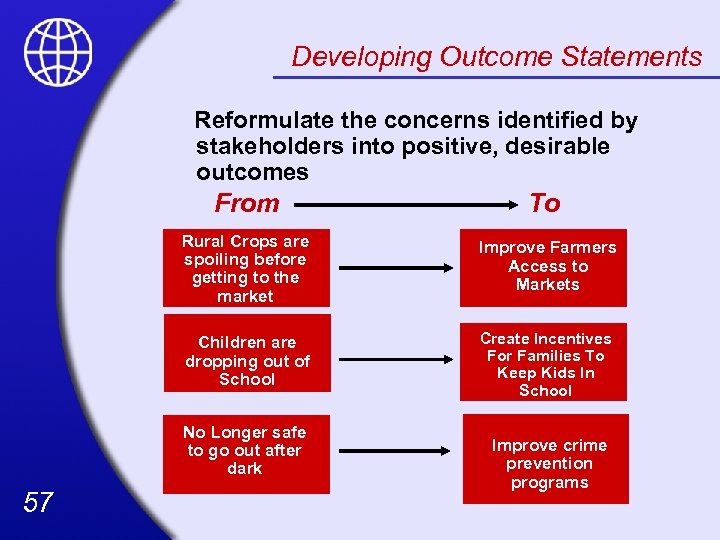
Developing Outcome Statements Reformulate the concerns identified by stakeholders into positive, desirable outcomes From To Rural Crops are spoiling before getting to the market Improve Farmers Access to Markets Children are dropping out of School Create Incentives For Families To Keep Kids In School No Longer safe to go out after dark 57 Improve crime prevention programs
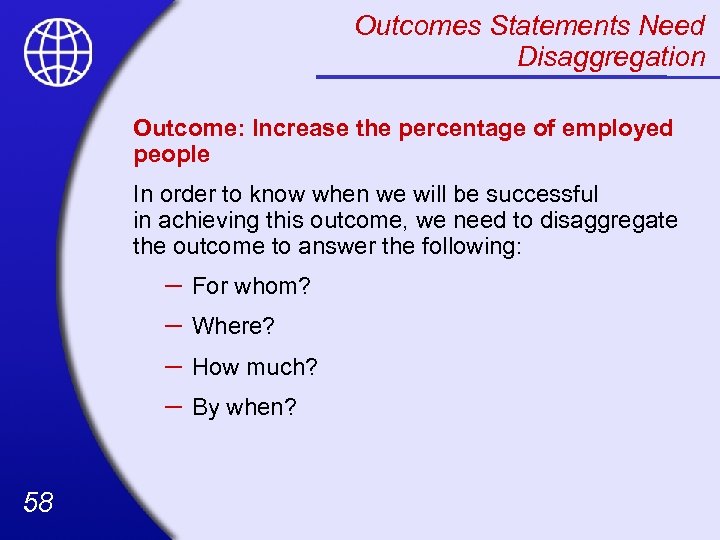
Outcomes Statements Need Disaggregation Outcome: Increase the percentage of employed people In order to know when we will be successful in achieving this outcome, we need to disaggregate the outcome to answer the following: – – 58 For whom? Where? How much? By when?
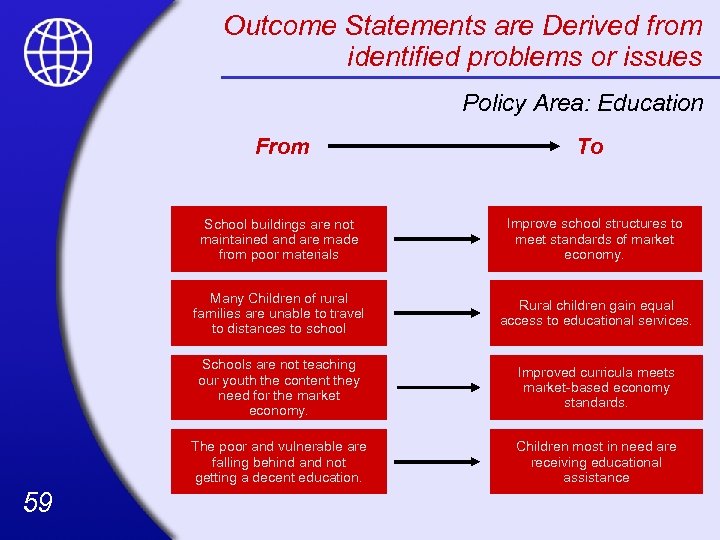
Outcome Statements are Derived from identified problems or issues Policy Area: Education From To School buildings are not maintained and are made from poor materials Many Children of rural families are unable to travel to distances to school Rural children gain equal access to educational services. Schools are not teaching our youth the content they need for the market economy. Improved curricula meets market-based economy standards. The poor and vulnerable are falling behind and not getting a decent education. 59 Improve school structures to meet standards of market economy. Children most in need are receiving educational assistance
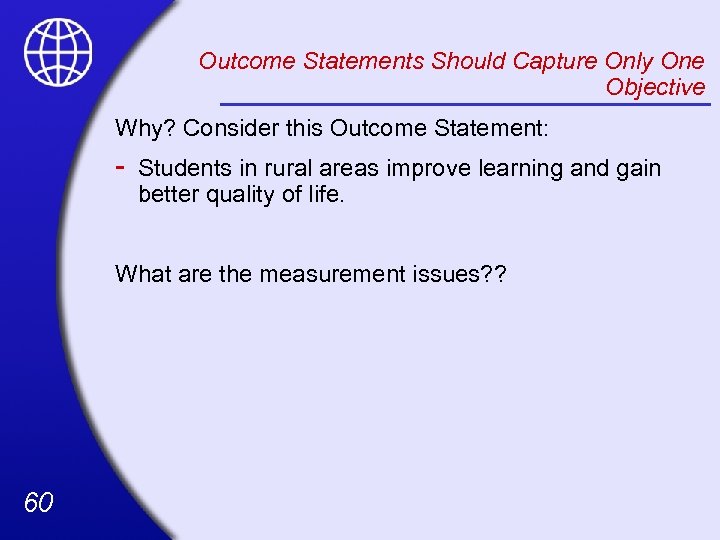
Outcome Statements Should Capture Only One Objective Why? Consider this Outcome Statement: - Students in rural areas improve learning and gain better quality of life. What are the measurement issues? ? 60
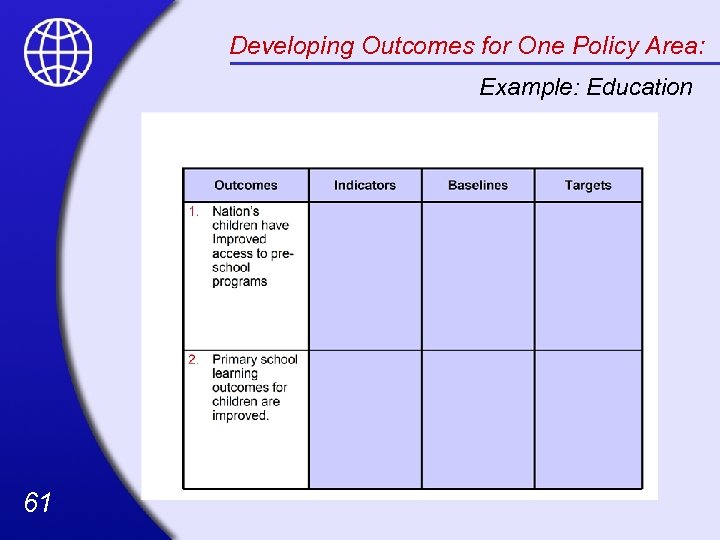
Developing Outcomes for One Policy Area: Example: Education 61
In Summary: Why an Emphasis on Outcomes? • Makes explicit the intended objectives of government action (“Know where you are going before you get moving”) • • Clear setting of outcomes is key to results-based M&E system • 62 Outcomes are the results governments hope to achieve Note: Budget to outputs, manage to outcomes!
Outcomes Summary Continued Outcomes are usually not directly measured—only reported on Outcomes must be translated to a set of key indicators 63
Step 3 Selecting Key Indicators to Monitor Outcomes 64
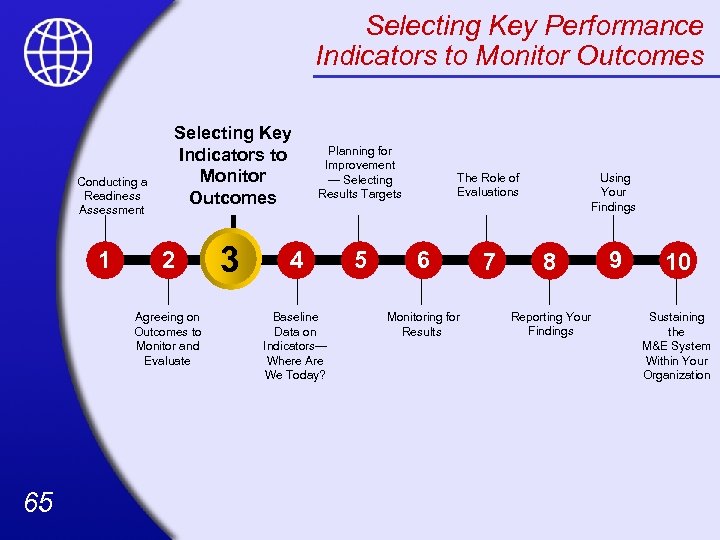
Selecting Key Performance Indicators to Monitor Outcomes Conducting a Readiness Assessment 1 Selecting Key Indicators to Monitor Outcomes 2 Agreeing on Outcomes to Monitor and Evaluate 65 3 3 Planning for Improvement — Selecting Results Targets 4 Baseline Data on Indicators— Where Are We Today? 5 The Role of Evaluations 6 Monitoring for Results 7 Using Your Findings 8 Reporting Your Findings 9 10 Sustaining the M&E System Within Your Organization
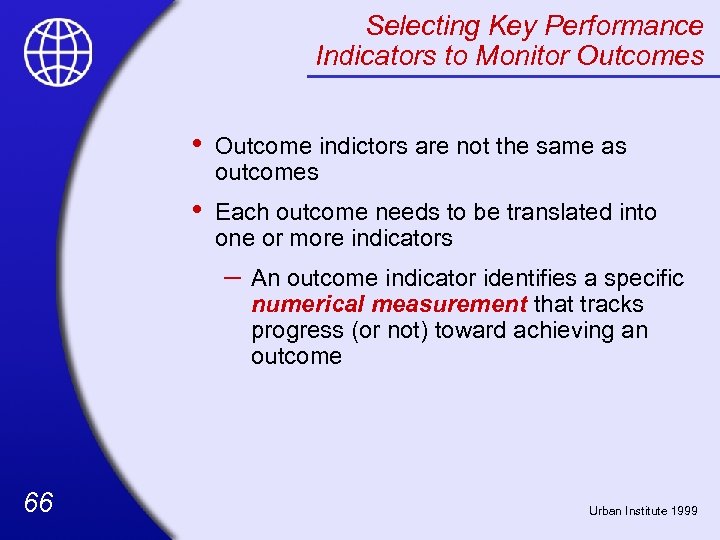
Selecting Key Performance Indicators to Monitor Outcomes • Outcome indictors are not the same as outcomes • Each outcome needs to be translated into one or more indicators – 66 An outcome indicator identifies a specific numerical measurement that tracks progress (or not) toward achieving an outcome Urban Institute 1999
An Outcome Indicator Answers the question: “How will we know success when we see it? ” 67
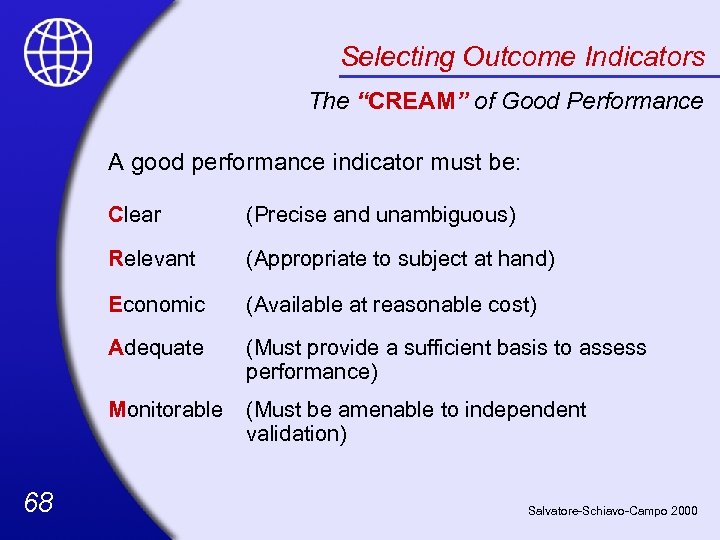
Selecting Outcome Indicators The “CREAM” of Good Performance A good performance indicator must be: Clear Relevant (Appropriate to subject at hand) Economic (Available at reasonable cost) Adequate (Must provide a sufficient basis to assess performance) Monitorable 68 (Precise and unambiguous) (Must be amenable to independent validation) Salvatore-Schiavo-Campo 2000
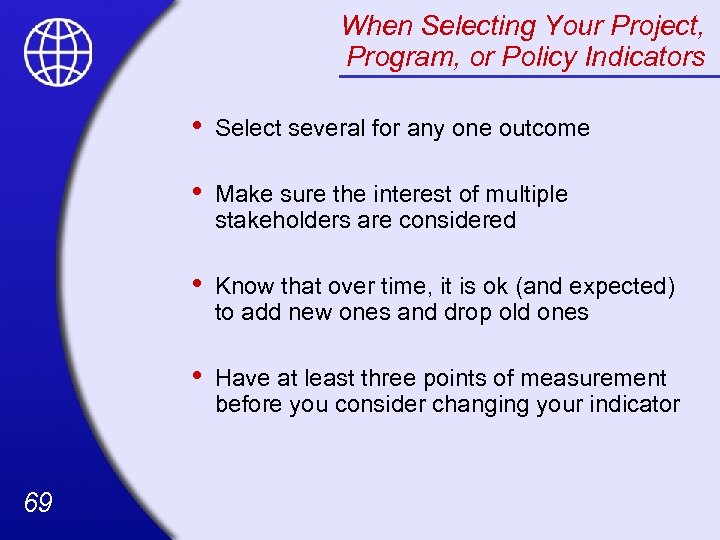
When Selecting Your Project, Program, or Policy Indicators • • Make sure the interest of multiple stakeholders are considered • Know that over time, it is ok (and expected) to add new ones and drop old ones • 69 Select several for any one outcome Have at least three points of measurement before you consider changing your indicator
How Many Indicators Are Enough? The minimum number that answers the question: “Has the outcome been achieved? ” 70
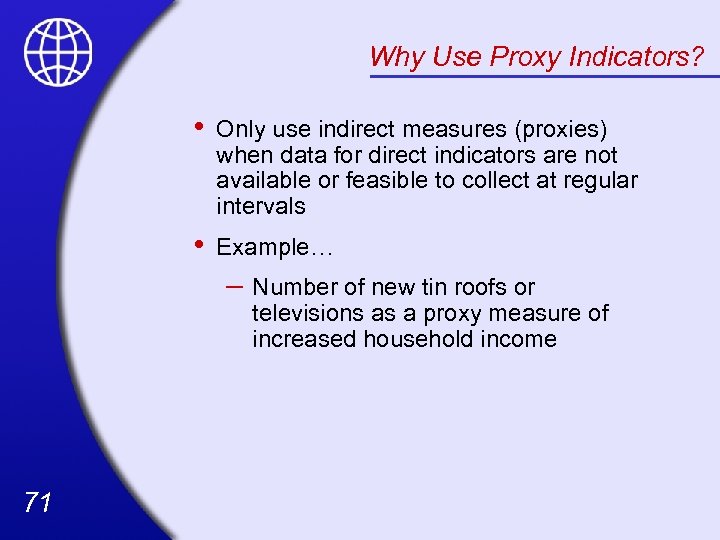
Why Use Proxy Indicators? • Only use indirect measures (proxies) when data for direct indicators are not available or feasible to collect at regular intervals • Example… – 71 Number of new tin roofs or televisions as a proxy measure of increased household income
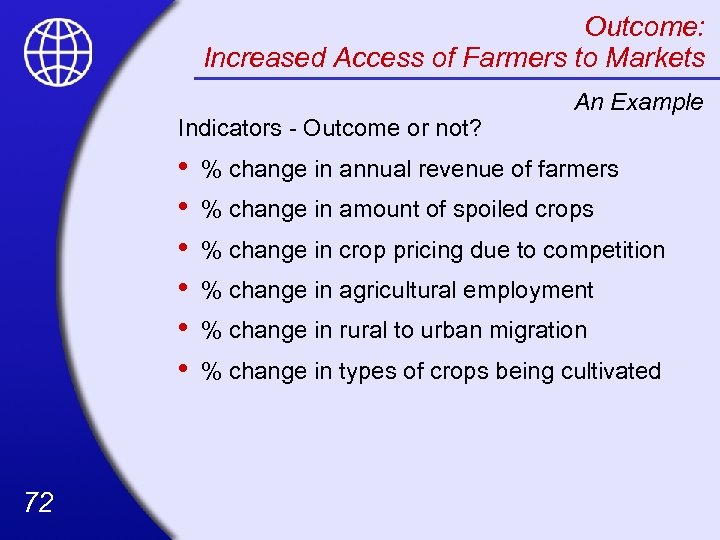
Outcome: Increased Access of Farmers to Markets Indicators - Outcome or not? • • • 72 An Example % change in annual revenue of farmers % change in amount of spoiled crops % change in crop pricing due to competition % change in agricultural employment % change in rural to urban migration % change in types of crops being cultivated
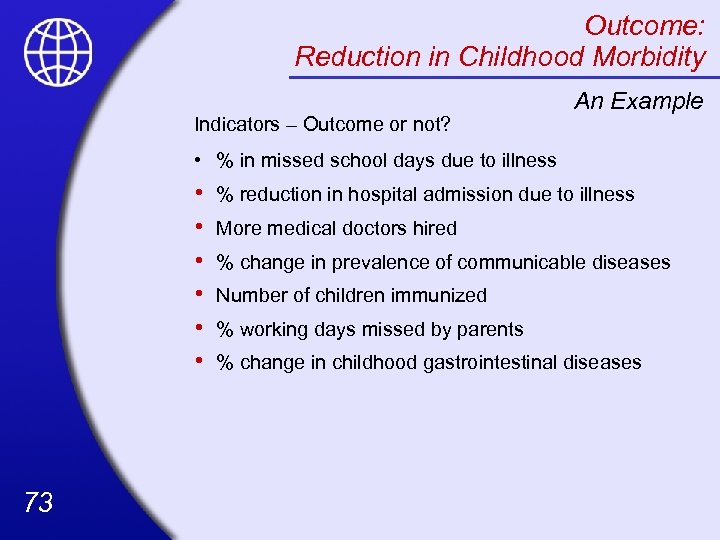
Outcome: Reduction in Childhood Morbidity Indicators – Outcome or not? An Example • % in missed school days due to illness • • • 73 % reduction in hospital admission due to illness More medical doctors hired % change in prevalence of communicable diseases Number of children immunized % working days missed by parents % change in childhood gastrointestinal diseases
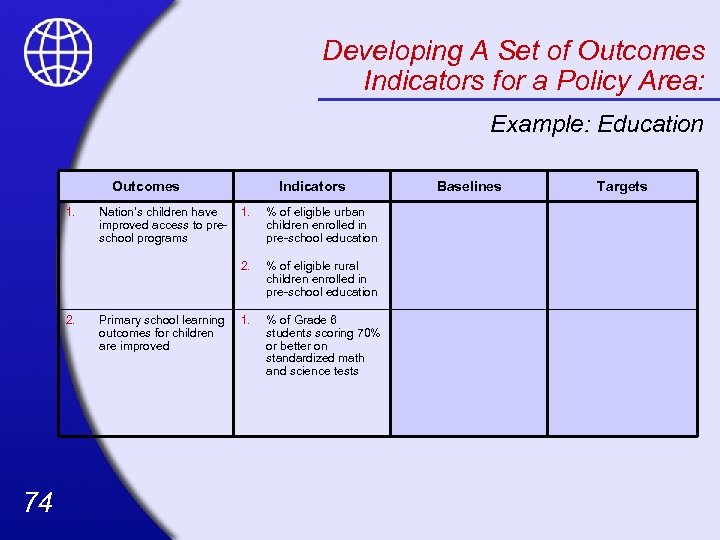
Developing A Set of Outcomes Indicators for a Policy Area: Example: Education Outcomes 1. 74 Primary school learning outcomes for children are improved 1. % of eligible urban children enrolled in pre-school education 2. Nation’s children have improved access to preschool programs Indicators % of eligible rural children enrolled in pre-school education 1. % of Grade 6 students scoring 70% or better on standardized math and science tests Baselines Targets
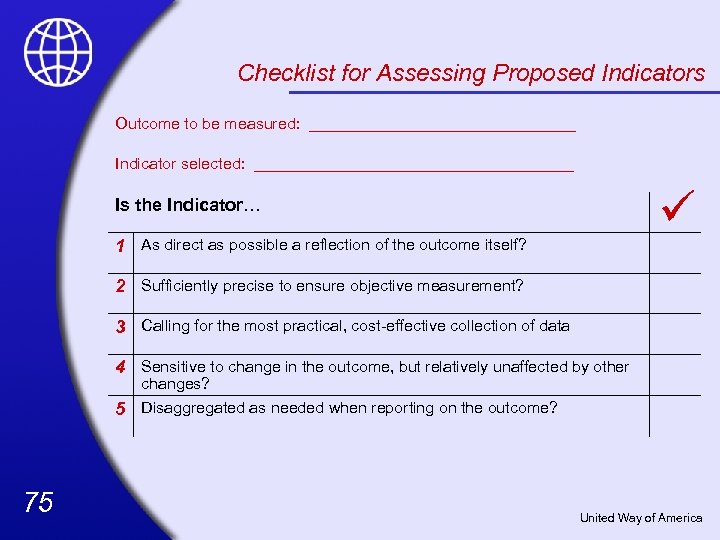
Checklist for Assessing Proposed Indicators Outcome to be measured: _______________ Indicator selected: __________________ ü Is the Indicator… 1 As direct as possible a reflection of the outcome itself? 2 Sufficiently precise to ensure objective measurement? 3 Calling for the most practical, cost-effective collection of data 4 Sensitive to change in the outcome, but relatively unaffected by other changes? 5 Disaggregated as needed when reporting on the outcome? 75 United Way of America
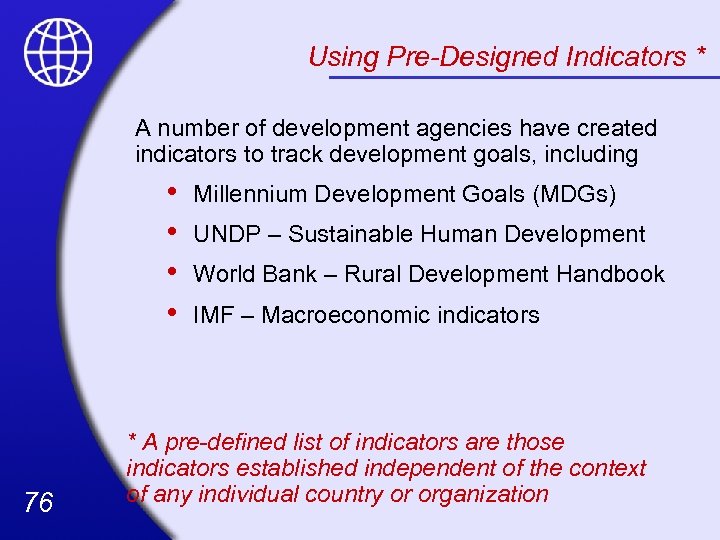
Using Pre-Designed Indicators * A number of development agencies have created indicators to track development goals, including • • 76 Millennium Development Goals (MDGs) UNDP – Sustainable Human Development World Bank – Rural Development Handbook IMF – Macroeconomic indicators * A pre-defined list of indicators are those indicators established independent of the context of any individual country or organization
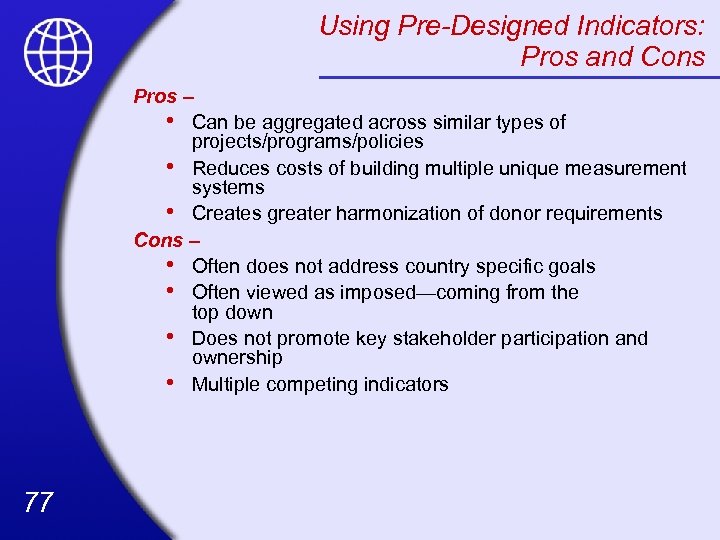
Using Pre-Designed Indicators: Pros and Cons Pros – • Can be aggregated across similar types of projects/programs/policies • Reduces costs of building multiple unique measurement systems • Creates greater harmonization of donor requirements Cons – • Often does not address country specific goals • Often viewed as imposed—coming from the top down • Does not promote key stakeholder participation and ownership • Multiple competing indicators 77
In Summary: Developing Indicators • • Developing good indicators often takes more than one try! • Arriving at the final indicators you will use will take time! • 78 You will need to develop your own indicators to meet your own needs. Pilot, Pilot!
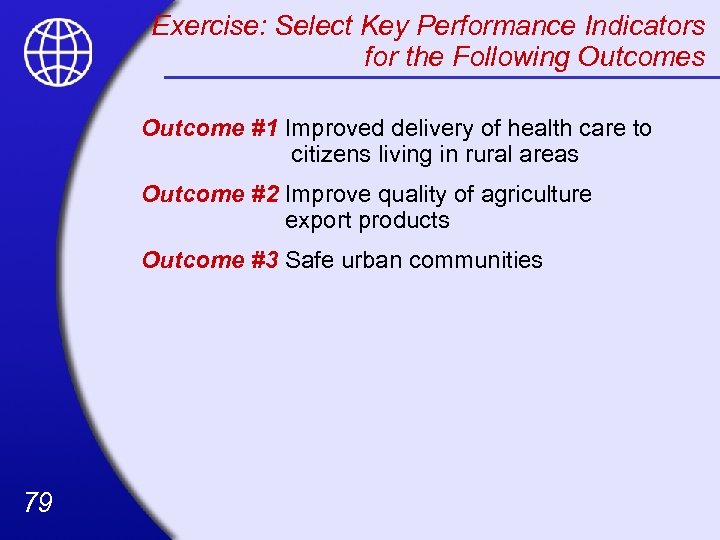
Exercise: Select Key Performance Indicators for the Following Outcomes Outcome #1 Improved delivery of health care to citizens living in rural areas Outcome #2 Improve quality of agriculture export products Outcome #3 Safe urban communities 79
Step 4 Baseline Data on Indicators – Where Are We Today 80
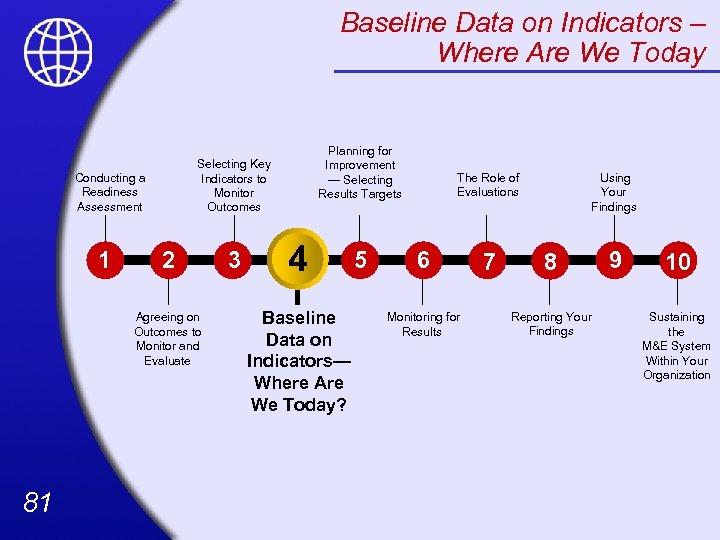
Baseline Data on Indicators – Where Are We Today Selecting Key Indicators to Monitor Outcomes Conducting a Readiness Assessment 1 2 Agreeing on Outcomes to Monitor and Evaluate 81 Planning for Improvement — Selecting Results Targets 3 4 Baseline Data on Indicators— Where Are We Today? 5 The Role of Evaluations 6 Monitoring for Results 7 Using Your Findings 8 Reporting Your Findings 9 10 Sustaining the M&E System Within Your Organization

“If you do not know where you are, you will have difficulty determining where you need to go. ” Harry Hatry Urban Institute, 1999 82
Establishing Baseline Data on Indicators A performance baseline is… • Information (quantitative or qualitative) that provides data at the beginning of, or just prior to, the monitoring period. The baseline is used to: – – 83 Learn about recent levels and patterns of performance on the indicator; and to Gauge subsequent policy, program, or project performance
The challenge now is to think about how to obtain baseline information for results indicators selected for each outcome 84
Identify Data Sources for Your Indicators • • 85 Sources are who or what provide data – not the method of collecting data What types of data sources can you think of for performance indicators in Highway Transportation Safety?
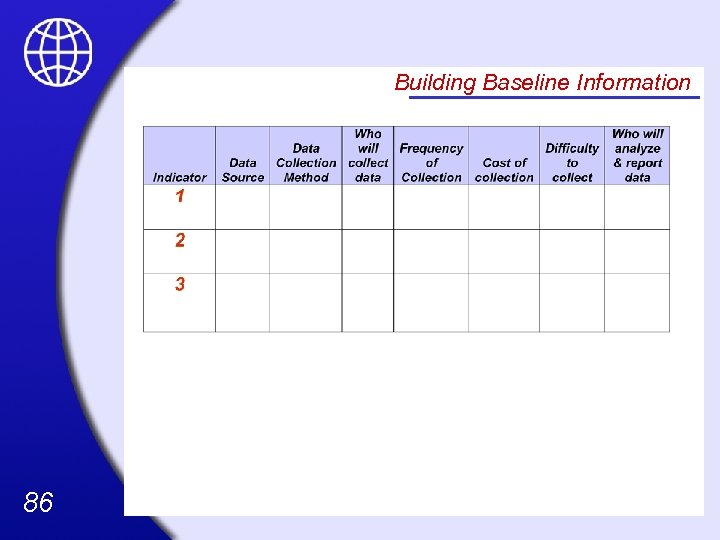
Building Baseline Information 84 84 84 86
Data Sources May Be Primary or Secondary • PRIMARY data are collected directly by your organization, for example, through surveys, direct observation, and interviews. • SECONDARY data have been collected by someone else, initially for a purpose other than yours. Examples include survey data collected by another agency, a Demographic Health Survey, or data from a financial market. – 87 Secondary data often can save you money in acquiring data you need, but be careful!
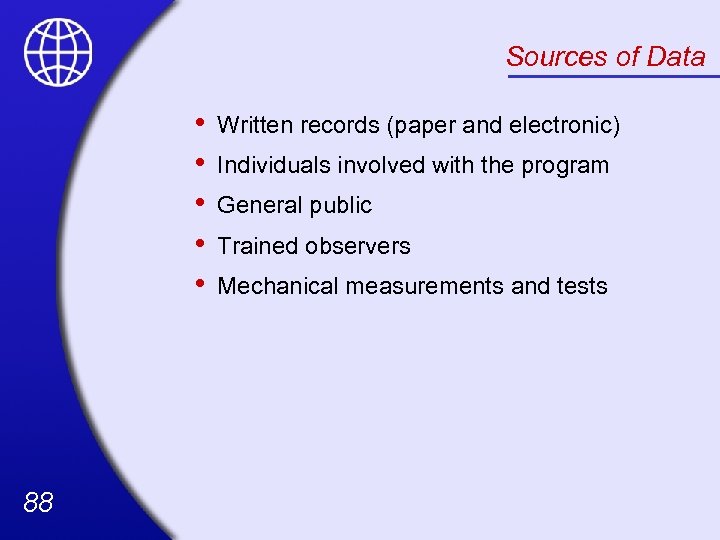
Sources of Data • • • 88 Written records (paper and electronic) Individuals involved with the program General public Trained observers Mechanical measurements and tests
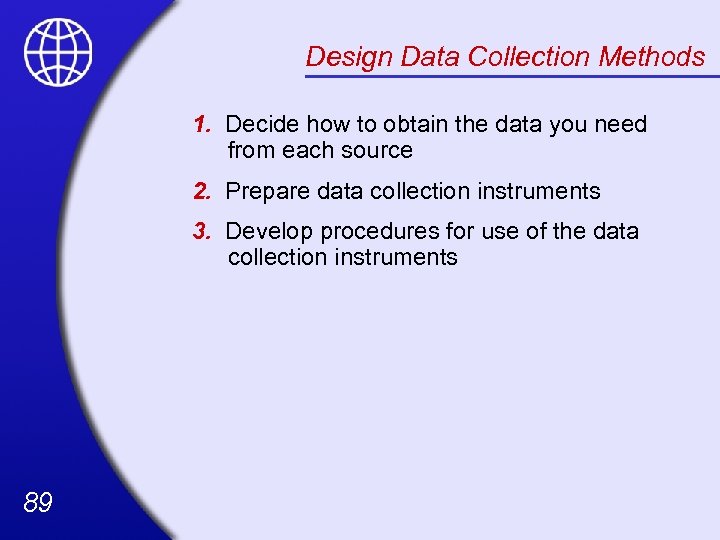
Design Data Collection Methods 1. Decide how to obtain the data you need from each source 2. Prepare data collection instruments 3. Develop procedures for use of the data collection instruments 89
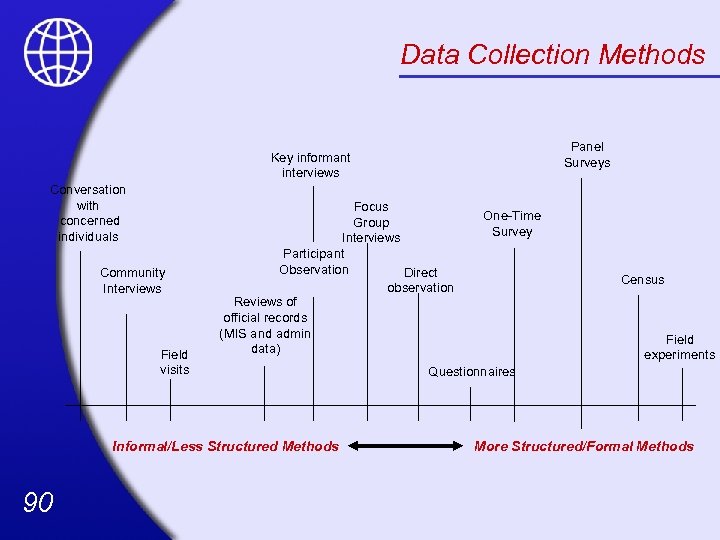
Data Collection Methods Panel Surveys Key informant interviews Conversation with concerned individuals Community Interviews Field visits Focus Group Interviews Participant Observation Direct observation Reviews of official records (MIS and admin data) Informal/Less Structured Methods 90 One-Time Survey Census Field experiments Questionnaires More Structured/Formal Methods
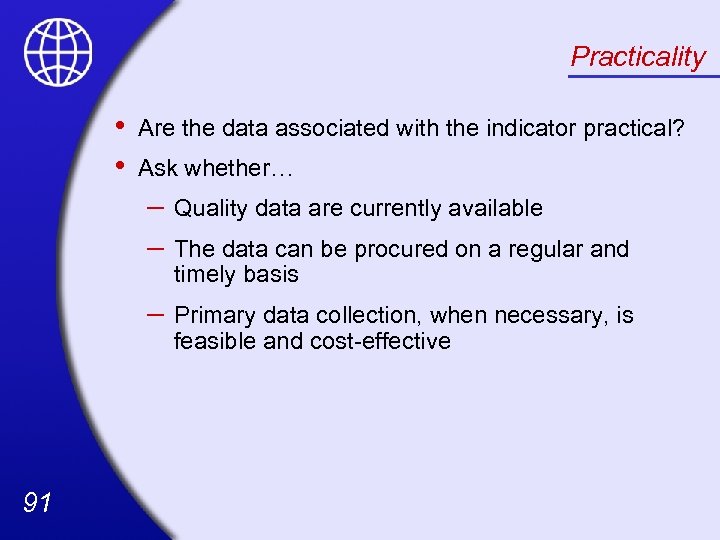
Practicality • • Are the data associated with the indicator practical? Ask whether… – – – 91 Quality data are currently available Primary data collection, when necessary, is feasible and cost-effective The data can be procured on a regular and timely basis
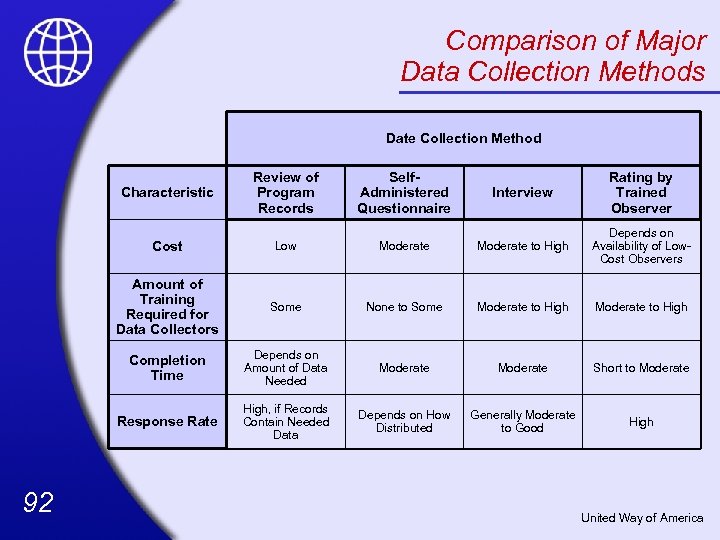
Comparison of Major Data Collection Methods Date Collection Method Characteristic Self. Administered Questionnaire Interview Rating by Trained Observer Cost Low Moderate to High Depends on Availability of Low. Cost Observers Amount of Training Required for Data Collectors Some None to Some Moderate to High Completion Time Depends on Amount of Data Needed Moderate Short to Moderate Response Rate 92 Review of Program Records High, if Records Contain Needed Data Depends on How Distributed Generally Moderate to Good High United Way of America
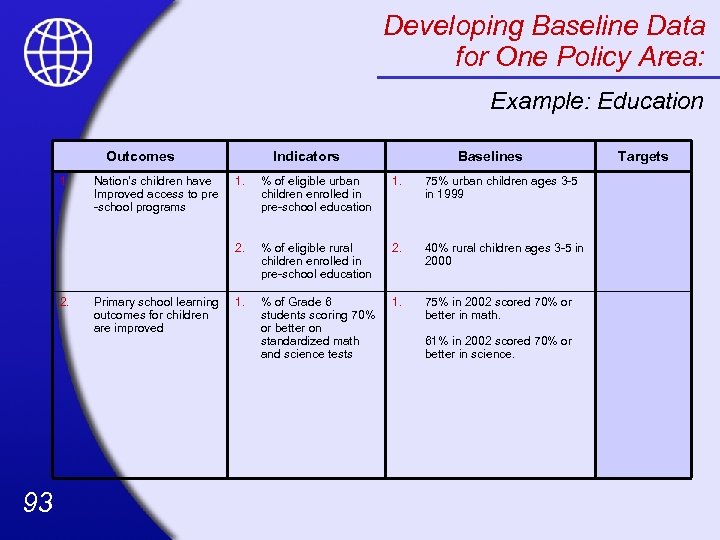
Developing Baseline Data for One Policy Area: Example: Education Outcomes 1. Baselines 93 Primary school learning outcomes for children are improved 1. % of eligible urban children enrolled in pre-school education 1. 75% urban children ages 3 -5 in 1999 2. Nation’s children have Improved access to pre -school programs Indicators % of eligible rural children enrolled in pre-school education 2. 40% rural children ages 3 -5 in 2000 1. % of Grade 6 students scoring 70% or better on standardized math and science tests 1. 75% in 2002 scored 70% or better in math. 61% in 2002 scored 70% or better in science. Targets
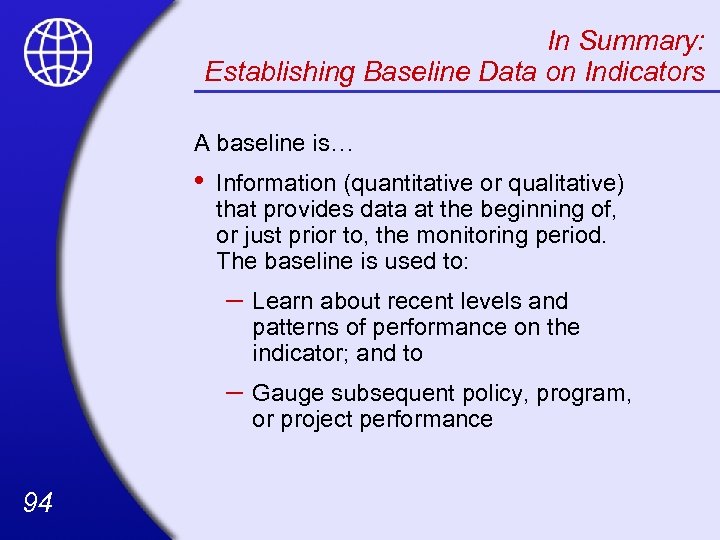
In Summary: Establishing Baseline Data on Indicators A baseline is… • Information (quantitative or qualitative) that provides data at the beginning of, or just prior to, the monitoring period. The baseline is used to: – – 94 Learn about recent levels and patterns of performance on the indicator; and to Gauge subsequent policy, program, or project performance
Step 5 Planning for Improvement – Selecting Results Targets 95
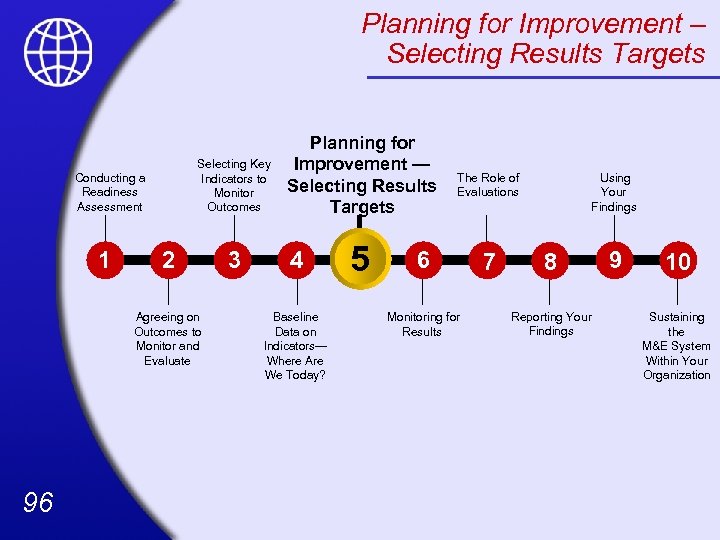
Planning for Improvement – Selecting Results Targets Selecting Key Indicators to Monitor Outcomes Conducting a Readiness Assessment 1 2 Agreeing on Outcomes to Monitor and Evaluate 96 3 Planning for Improvement — Selecting Results Targets 4 Baseline Data on Indicators— Where Are We Today? 5 The Role of Evaluations 6 Monitoring for Results 7 Using Your Findings 8 Reporting Your Findings 9 10 Sustaining the M&E System Within Your Organization
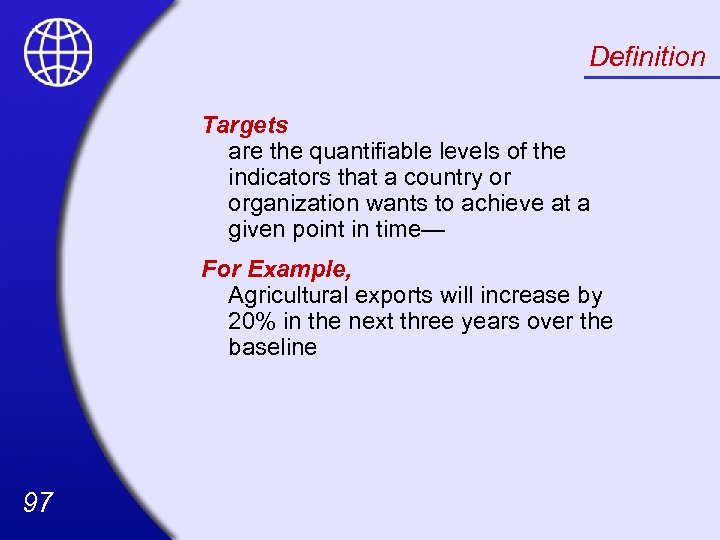
Definition Targets are the quantifiable levels of the indicators that a country or organization wants to achieve at a given point in time— For Example, Agricultural exports will increase by 20% in the next three years over the baseline 97
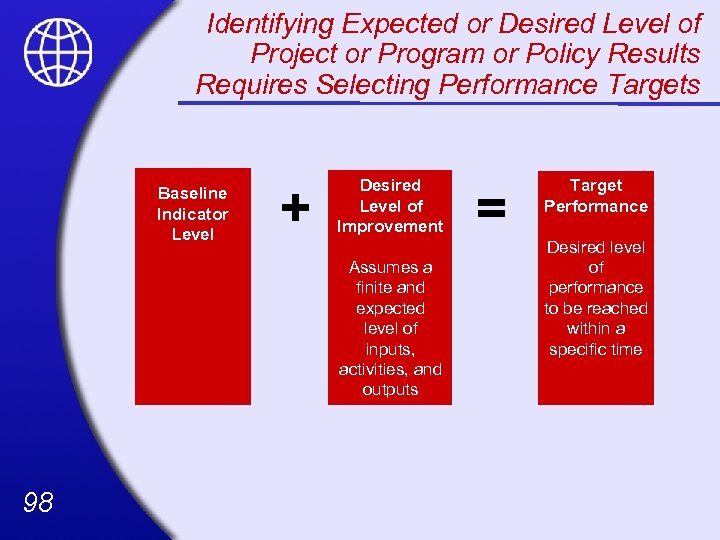
Identifying Expected or Desired Level of Project or Program or Policy Results Requires Selecting Performance Targets Baseline Indicator Level + Desired Level of Improvement Assumes a finite and expected level of inputs, activities, and outputs 98 = Target Performance Desired level of performance to be reached within a specific time
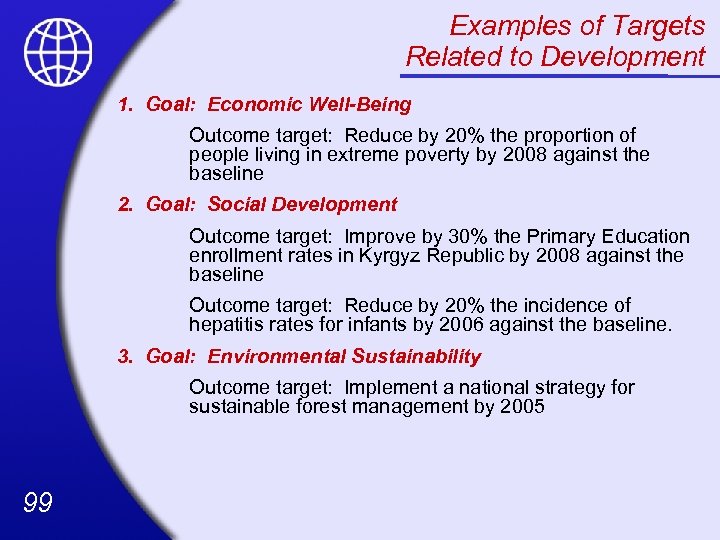
Examples of Targets Related to Development 1. Goal: Economic Well-Being Outcome target: Reduce by 20% the proportion of people living in extreme poverty by 2008 against the baseline 2. Goal: Social Development Outcome target: Improve by 30% the Primary Education enrollment rates in Kyrgyz Republic by 2008 against the baseline Outcome target: Reduce by 20% the incidence of hepatitis rates for infants by 2006 against the baseline. 3. Goal: Environmental Sustainability Outcome target: Implement a national strategy for sustainable forest management by 2005 99
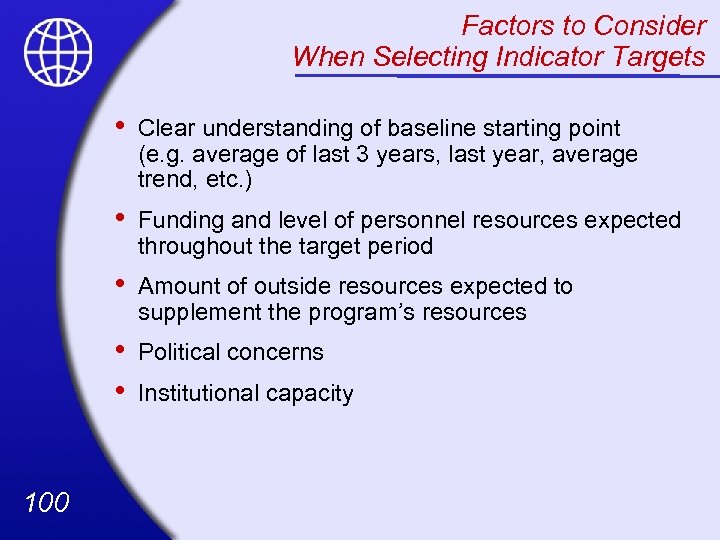
Factors to Consider When Selecting Indicator Targets • • Funding and level of personnel resources expected throughout the target period • Amount of outside resources expected to supplement the program’s resources • • 100 Clear understanding of baseline starting point (e. g. average of last 3 years, last year, average trend, etc. ) Political concerns Institutional capacity
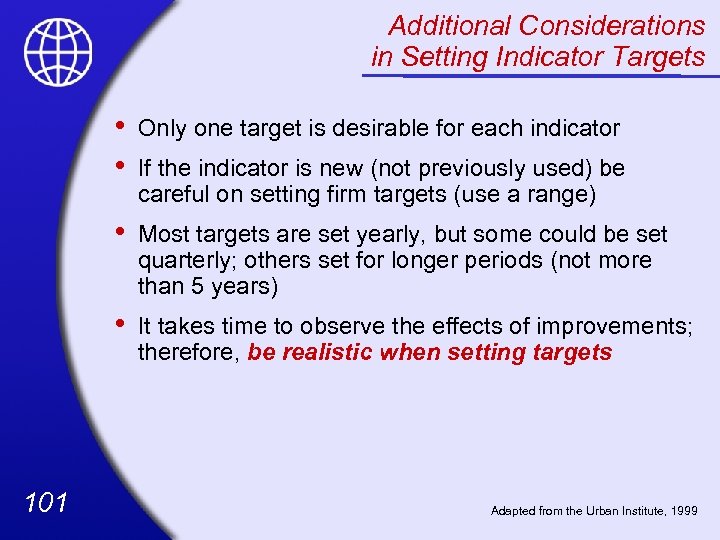
Additional Considerations in Setting Indicator Targets • • • Most targets are set yearly, but some could be set quarterly; others set for longer periods (not more than 5 years) • 101 Only one target is desirable for each indicator It takes time to observe the effects of improvements; therefore, be realistic when setting targets If the indicator is new (not previously used) be careful on setting firm targets (use a range) Adapted from the Urban Institute, 1999
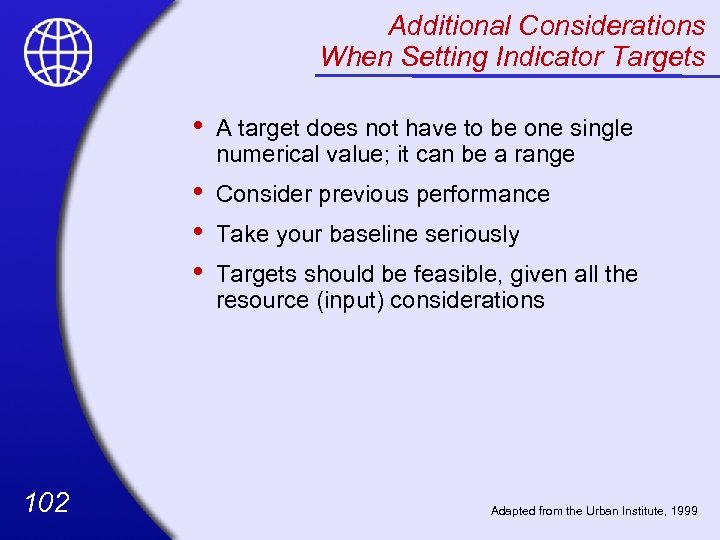
Additional Considerations When Setting Indicator Targets • • 102 A target does not have to be one single numerical value; it can be a range Consider previous performance Take your baseline seriously Targets should be feasible, given all the resource (input) considerations Adapted from the Urban Institute, 1999

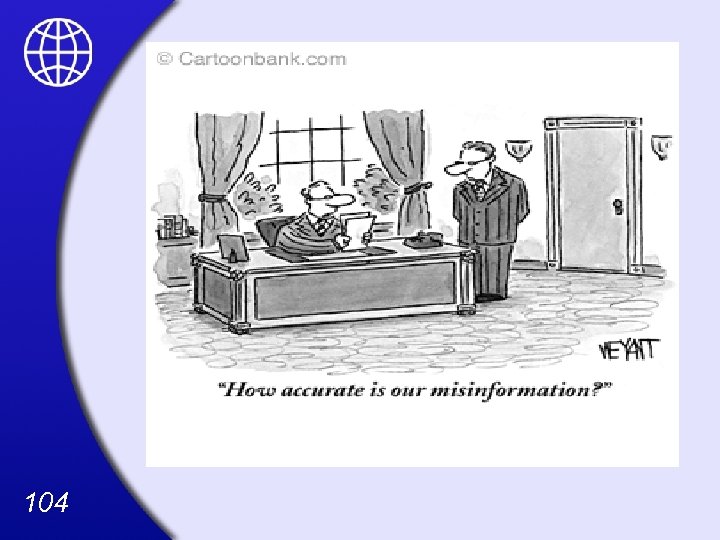
“Games Sometimes Played When Setting Targets” • • Move the target (as needed) to fit performance • 103 Set targets so modest (easy) that they will surely be met Pick targets that are not politically sensitive
104
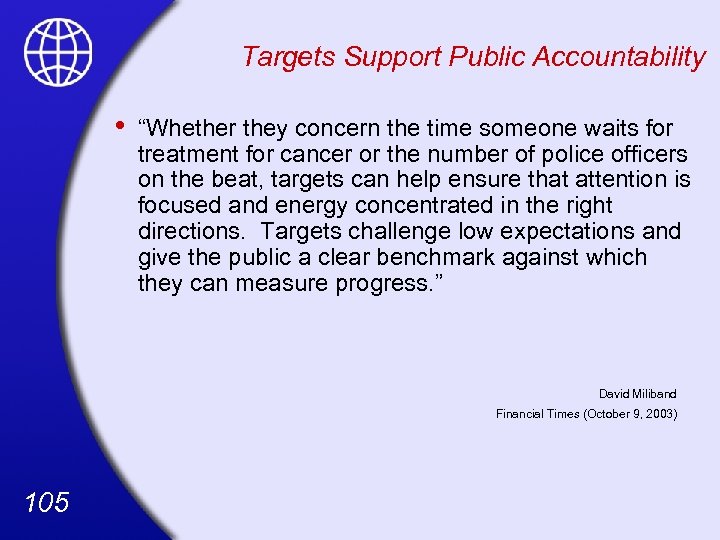
Targets Support Public Accountability • “Whether they concern the time someone waits for treatment for cancer or the number of police officers on the beat, targets can help ensure that attention is focused and energy concentrated in the right directions. Targets challenge low expectations and give the public a clear benchmark against which they can measure progress. ” David Miliband Financial Times (October 9, 2003) 105
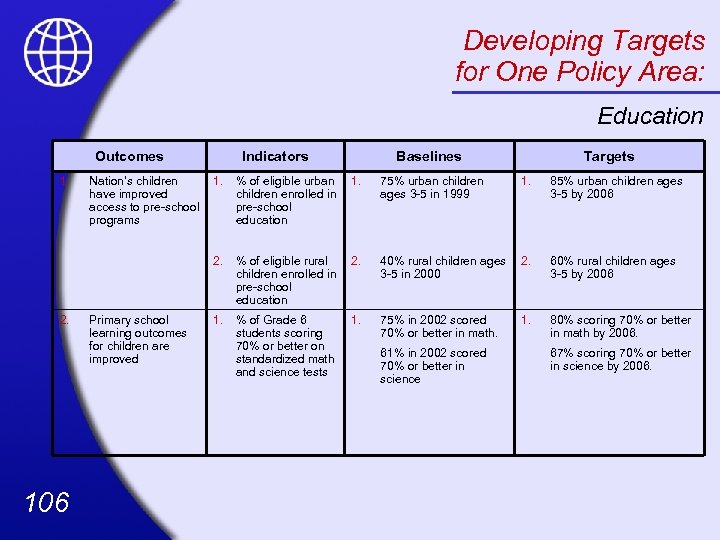
Developing Targets for One Policy Area: Education Outcomes 1. Baselines Targets 106 Primary school learning outcomes for children are improved 1. % of eligible urban children enrolled in pre-school education 1. 75% urban children ages 3 -5 in 1999 1. 85% urban children ages 3 -5 by 2006 2. Nation’s children have improved access to pre-school programs Indicators % of eligible rural children enrolled in pre-school education 2. 40% rural children ages 3 -5 in 2000 2. 60% rural children ages 3 -5 by 2006 1. % of Grade 6 students scoring 70% or better on standardized math and science tests 1. 75% in 2002 scored 70% or better in math. 1. 80% scoring 70% or better in math by 2006. 61% in 2002 scored 70% or better in science 67% scoring 70% or better in science by 2006.
Now We Have A Results Framework Note: This completed matrix becomes your results framework! – 107 It defines your outcomes and gives you a plan for how you will know if you have been successful (or not) in achieving these outcomes
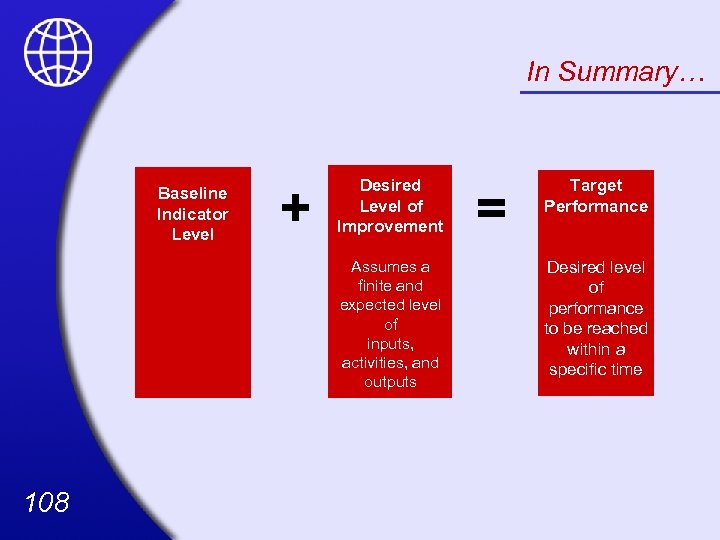
In Summary… Baseline Indicator Level + Desired Level of Improvement Assumes a finite and expected level of inputs, activities, and outputs 108 = Target Performance Desired level of performance to be reached within a specific time
Step 6 Monitoring For Results 109
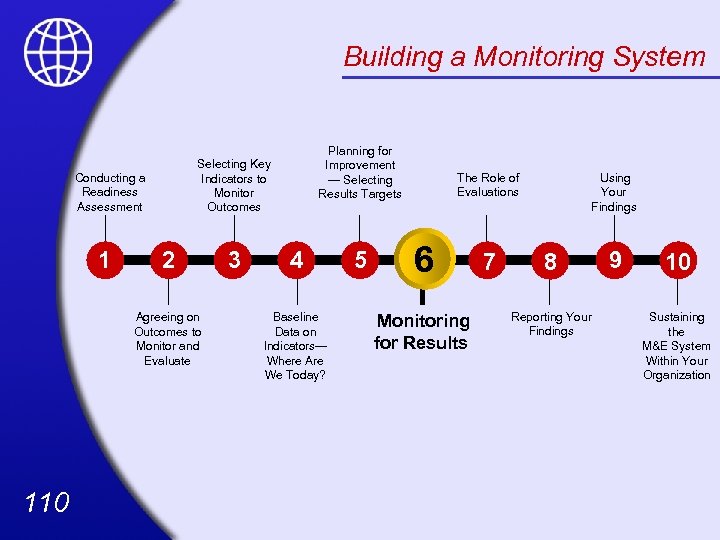
Building a Monitoring System Selecting Key Indicators to Monitor Outcomes Conducting a Readiness Assessment 1 2 Agreeing on Outcomes to Monitor and Evaluate 110 Planning for Improvement — Selecting Results Targets 3 4 Baseline Data on Indicators— Where Are We Today? 5 The Role of Evaluations 6 Monitoring for Results 7 Using Your Findings 8 Reporting Your Findings 9 10 Sustaining the M&E System Within Your Organization
Monitoring for Results • • 111 A results-based monitoring system tracks both implementation (inputs, activities, outputs) and results (outcomes and goals) Implementation monitoring is supported through the use of management tools – budget, staffing plans, and activity planning
Monitoring for Results (cont. ) • • Means and strategies are found in annual and multiyear workplans • Do not forget: Results framework is not the same as a work plan • 112 Implementation monitoring tracks the means and strategies used by the organization Do not forget: Budget to outputs, manage to outcomes
Developing A Results Plan • • In the traditional approach to developing a plan, the first thing a manager usually did was to identify activities and assign responsibilities • 113 Once a set of outcomes are identified, it is time to develop a plan to assess how the organization will begin to achieve these outcomes But the shortcoming in this approach is that completing all the activities does not mean the same as reaching the outcome goal
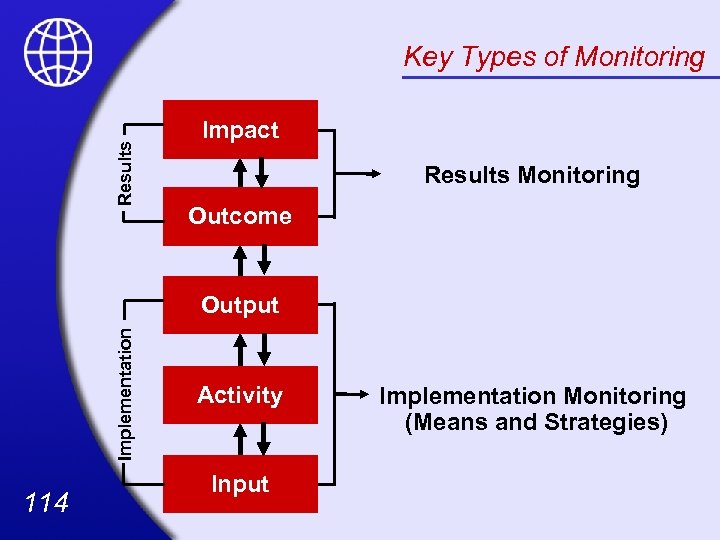
Results Key Types of Monitoring Impact Results Monitoring Outcome Implementation Output 114 Activity Input Implementation Monitoring (Means and Strategies)
Translating Outcomes to Action • • But the sum of these activities may or may not mean you have achieved your outcomes • 115 Note: Activities are crucial! They are the actions you take to manage and implement your programs, use your resources, and deliver the services of government Question is: How will you know when you have been successful?
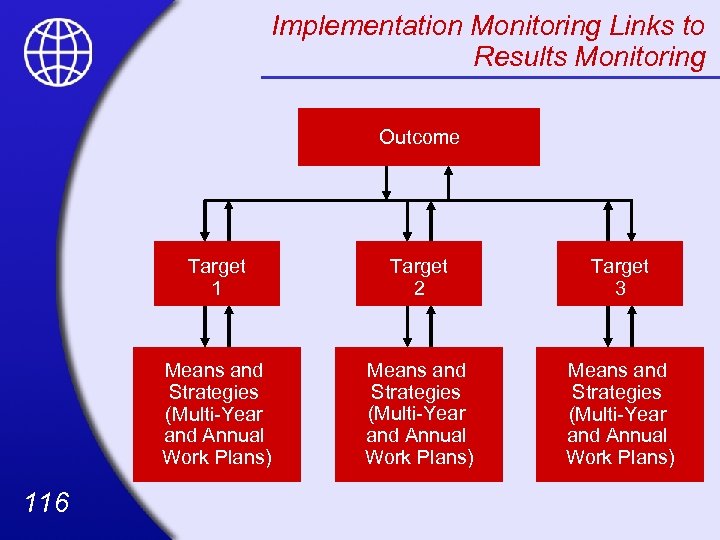
Implementation Monitoring Links to Results Monitoring Outcome Target 1 Target 3 Means and Strategies (Multi-Year and Annual Work Plans) 116 Target 2 Means and Strategies (Multi-Year and Annual Work Plans)
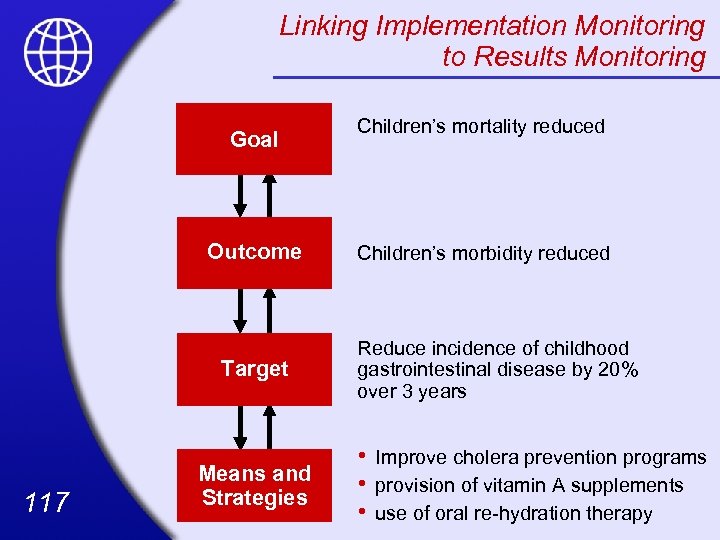
Linking Implementation Monitoring to Results Monitoring Goal Outcome Target 117 Means and Strategies Children’s mortality reduced Children’s morbidity reduced Reduce incidence of childhood gastrointestinal disease by 20% over 3 years • • • Improve cholera prevention programs provision of vitamin A supplements use of oral re-hydration therapy
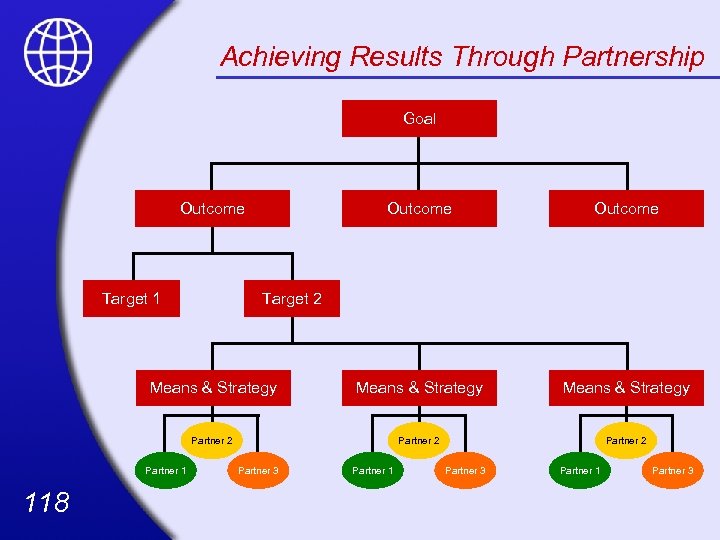
Achieving Results Through Partnership Goal Outcome Means & Strategy Partner 2 Target 1 Partner 1 118 Partner 3 Partner 1 Partner 3
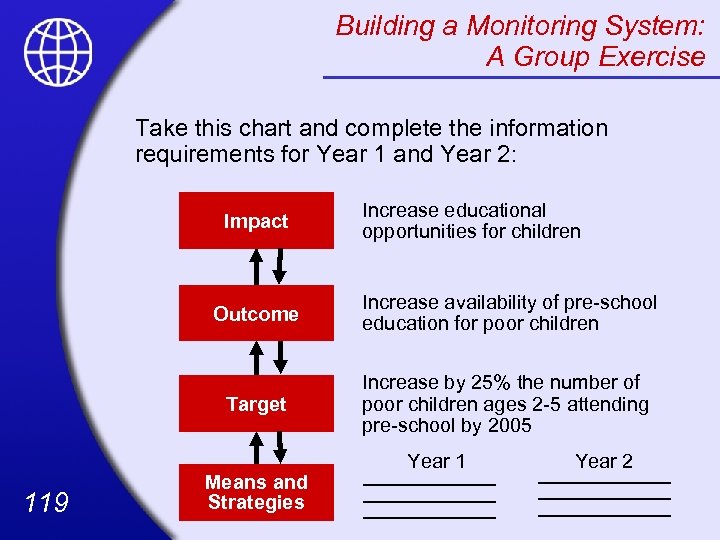
Building a Monitoring System: A Group Exercise Take this chart and complete the information requirements for Year 1 and Year 2: Impact Increase educational opportunities for children Outcome Target 119 Increase availability of pre-school education for poor children Increase by 25% the number of poor children ages 2 -5 attending pre-school by 2005 Means and Strategies Year 1 Year 2
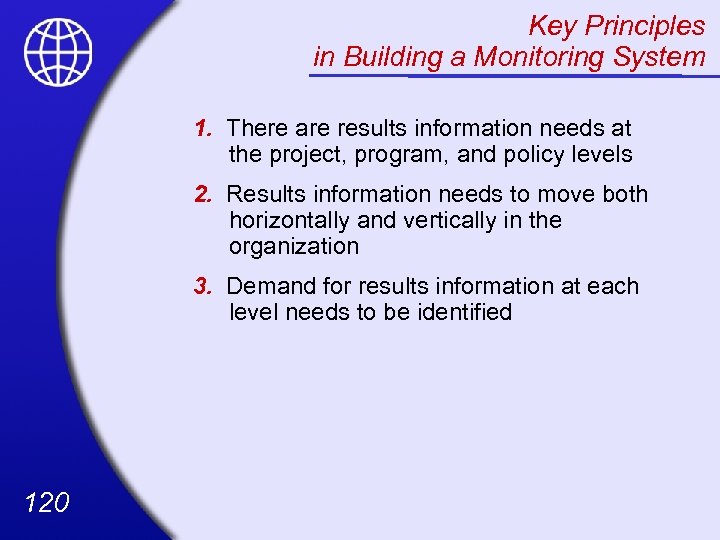
Key Principles in Building a Monitoring System 1. There are results information needs at the project, program, and policy levels 2. Results information needs to move both horizontally and vertically in the organization 3. Demand for results information at each level needs to be identified 120
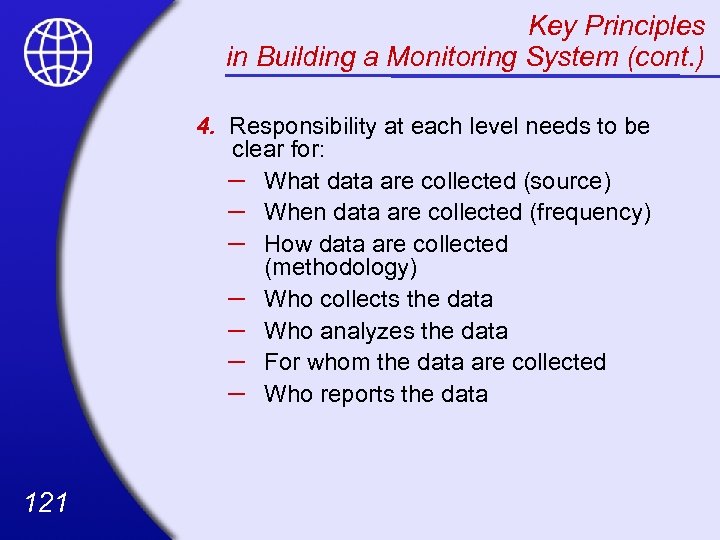
Key Principles in Building a Monitoring System (cont. ) 4. Responsibility at each level needs to be clear for: – What data are collected (source) – When data are collected (frequency) – How data are collected (methodology) – Who collects the data – Who analyzes the data – For whom the data are collected – Who reports the data 121
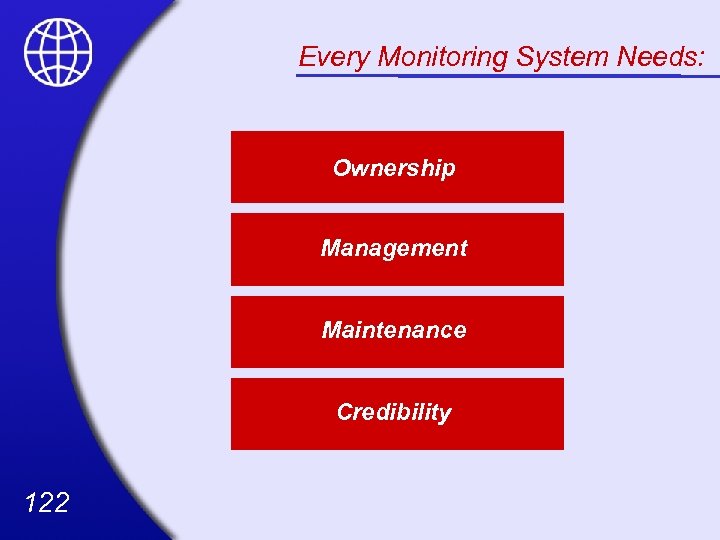
Every Monitoring System Needs: Ownership Management Maintenance Credibility 122
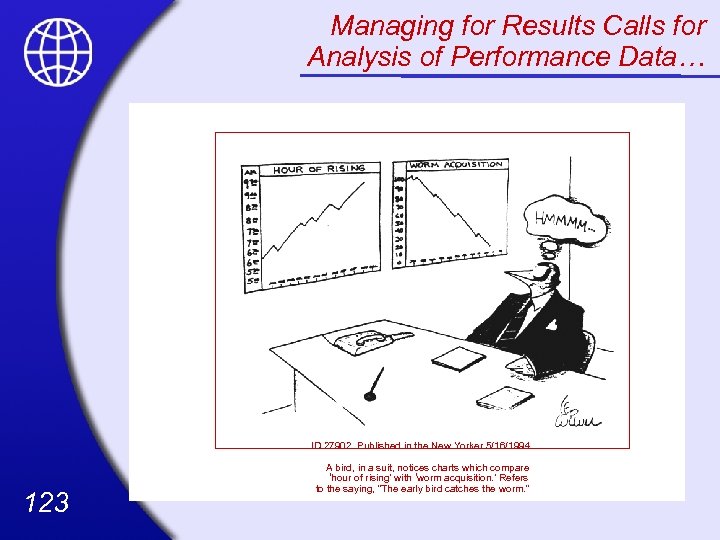
Managing for Results Calls for Analysis of Performance Data… ID 27902 Published in the New Yorker 5/16/1994 120 123 A bird, in a suit, notices charts which compare ‘hour of rising’ with ‘worm acquisition. ’ Refers to the saying, “The early bird catches the worm. ”
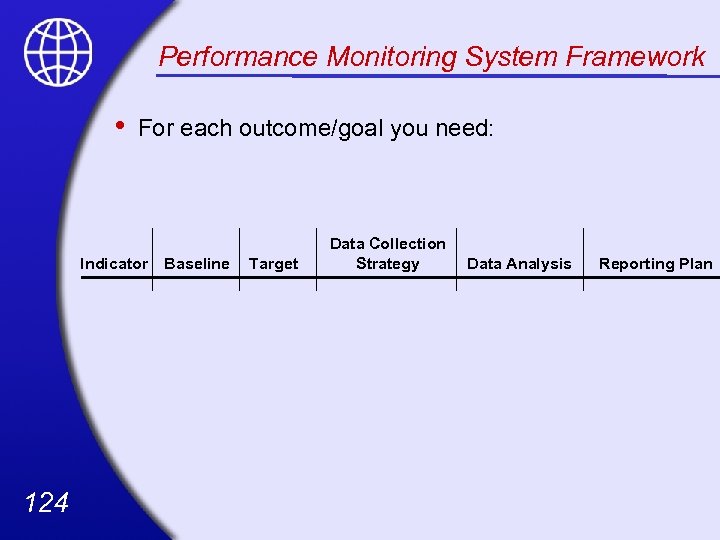
Performance Monitoring System Framework • For each outcome/goal you need: Indicator 124 Baseline Target Data Collection Strategy Data Analysis Reporting Plan
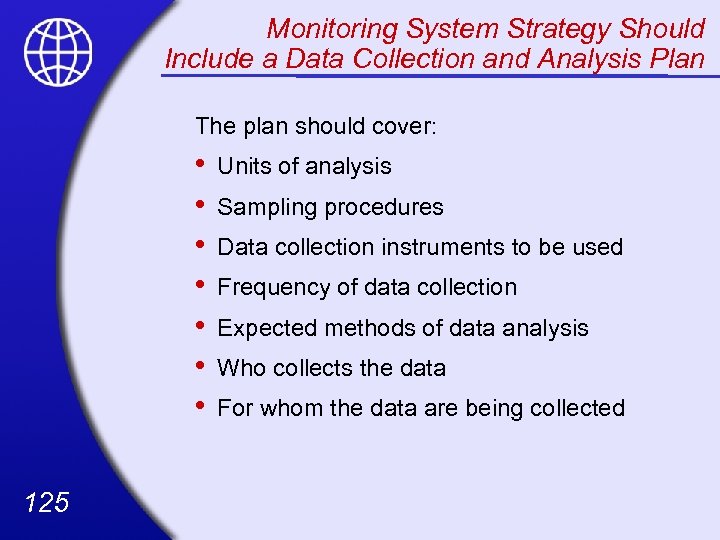
Monitoring System Strategy Should Include a Data Collection and Analysis Plan The plan should cover: • • 125 Units of analysis Sampling procedures Data collection instruments to be used Frequency of data collection Expected methods of data analysis Who collects the data For whom the data are being collected
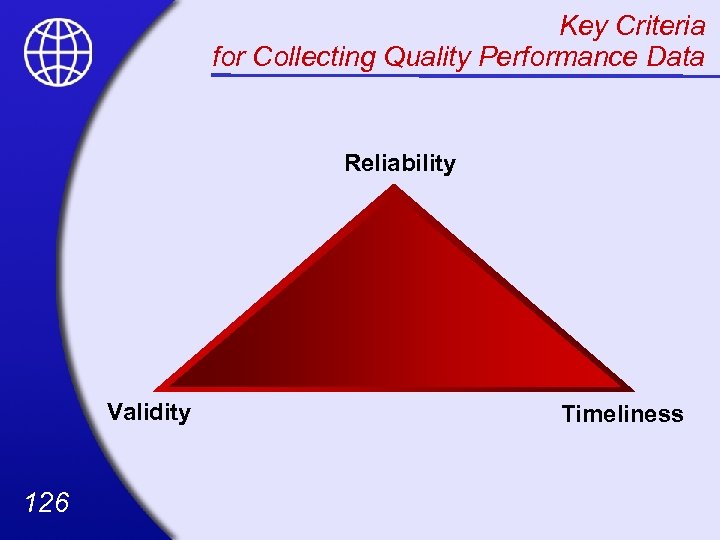
Key Criteria for Collecting Quality Performance Data Reliability Validity 126 Timeliness
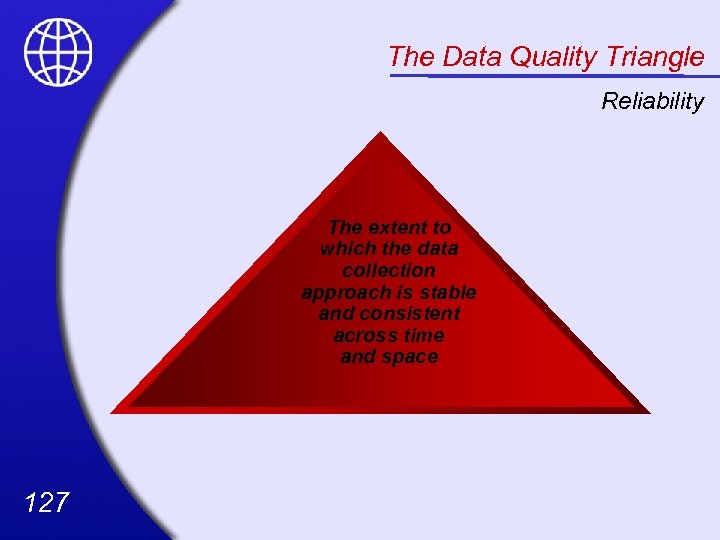
The Data Quality Triangle Reliability The extent to which the data collection approach is stable and consistent across time and space 127
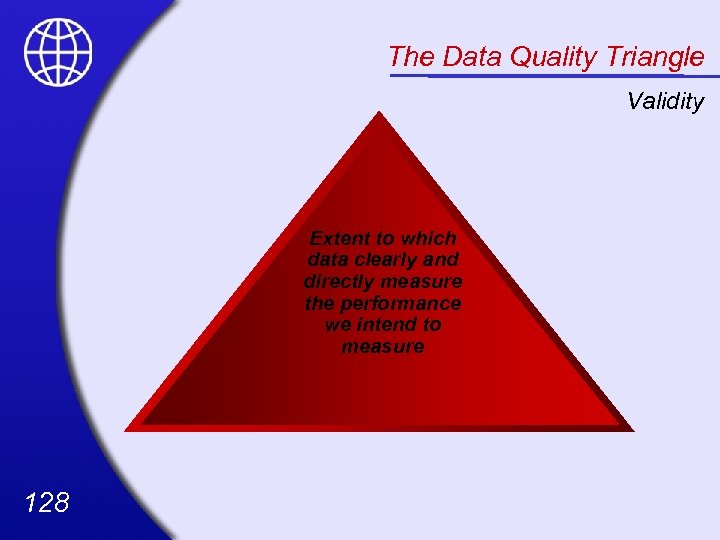
The Data Quality Triangle Validity Extent to which data clearly and directly measure the performance we intend to measure 128
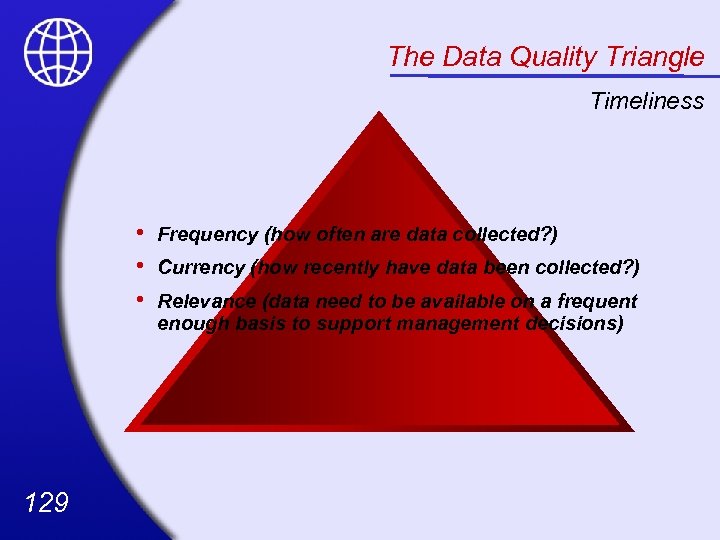
The Data Quality Triangle Timeliness • • • 129 Frequency (how often are data collected? ) Currency (how recently have data been collected? ) Relevance (data need to be available on a frequent enough basis to support management decisions)
Quality Assurance Challenges • What will be collected, and by what methods, are tempered by what is practical and realistic in the country and program context – – 130 How much existing data relevant to our project, program, or policy are already available? How much of the available data are good enough to meet your organization’s needs?
Pretest Your Data Collection Instruments and Procedures • • Pretesting is learning how to improve your instruments or procedures, before your data collection is fully under way • 131 You will never really know how good your data collection approach is until you test it Avoiding pretesting probably will result in mistakes. The mistake could cost your organization a lot of wasted time and money, and maybe its valued reputation with the public.
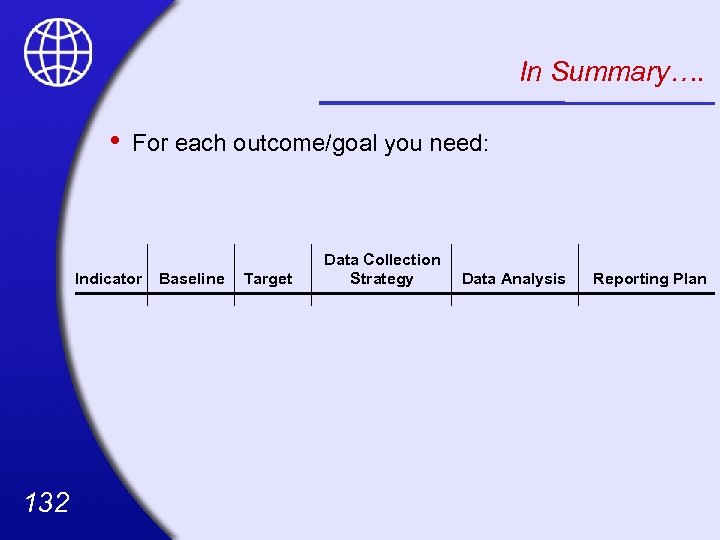
In Summary…. • For each outcome/goal you need: Indicator 132 Baseline Target Data Collection Strategy Data Analysis Reporting Plan

Step 7 The Role of Evaluations 133
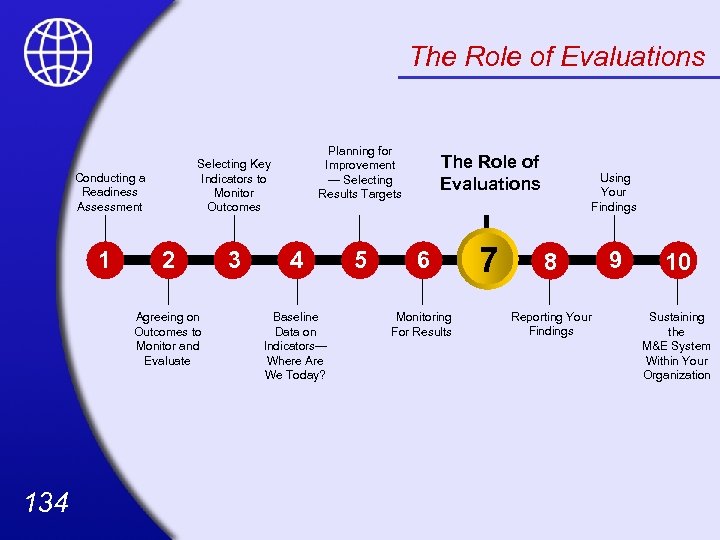
The Role of Evaluations Selecting Key Indicators to Monitor Outcomes Conducting a Readiness Assessment 1 2 Agreeing on Outcomes to Monitor and Evaluate 134 Planning for Improvement — Selecting Results Targets 3 4 Baseline Data on Indicators— Where Are We Today? 5 The Role of Evaluations 6 Monitoring For Results 7 Using Your Findings 8 Reporting Your Findings 9 10 Sustaining the M&E System Within Your Organization
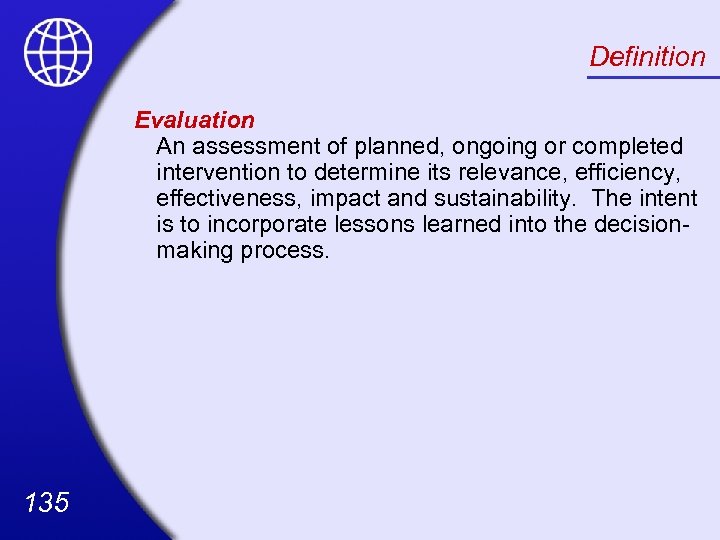
Definition Evaluation An assessment of planned, ongoing or completed intervention to determine its relevance, efficiency, effectiveness, impact and sustainability. The intent is to incorporate lessons learned into the decisionmaking process. 135
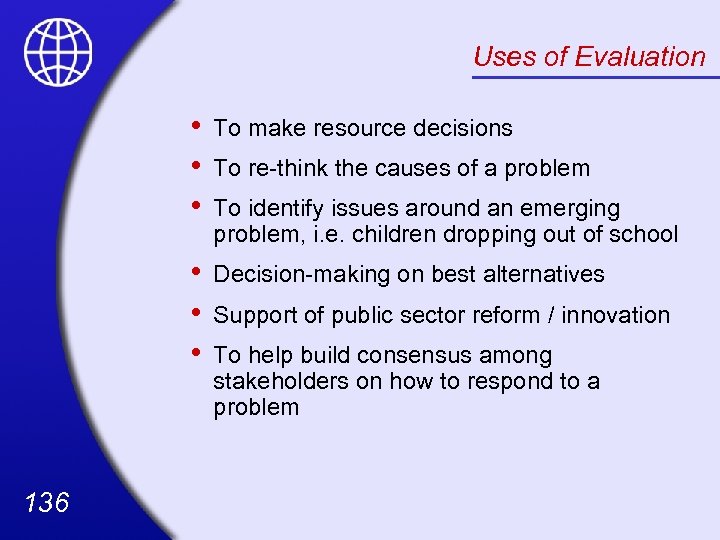
Uses of Evaluation • • • 136 To make resource decisions Decision-making on best alternatives To re-think the causes of a problem To identify issues around an emerging problem, i. e. children dropping out of school Support of public sector reform / innovation To help build consensus among stakeholders on how to respond to a problem
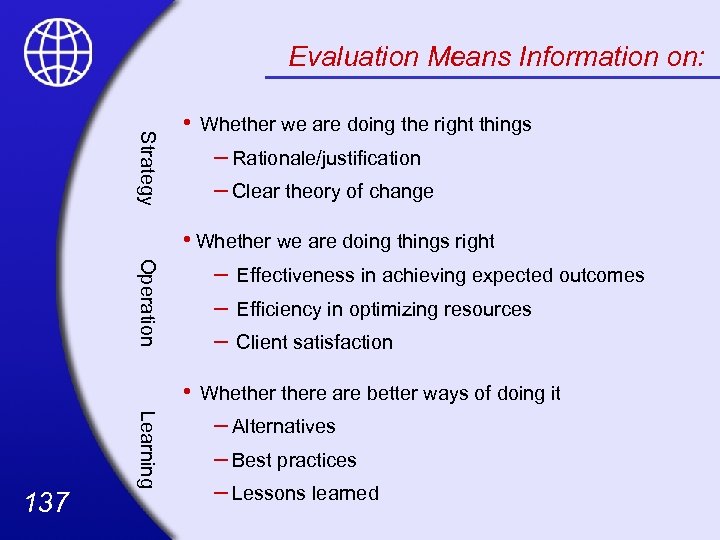
Evaluation Means Information on: Strategy • – Rationale/justification – Clear theory of change Operation • Whether we are doing things right – Effectiveness in achieving expected outcomes – Efficiency in optimizing resources – Client satisfaction • Learning 137 Whether we are doing the right things Whethere are better ways of doing it – Alternatives – Best practices – Lessons learned
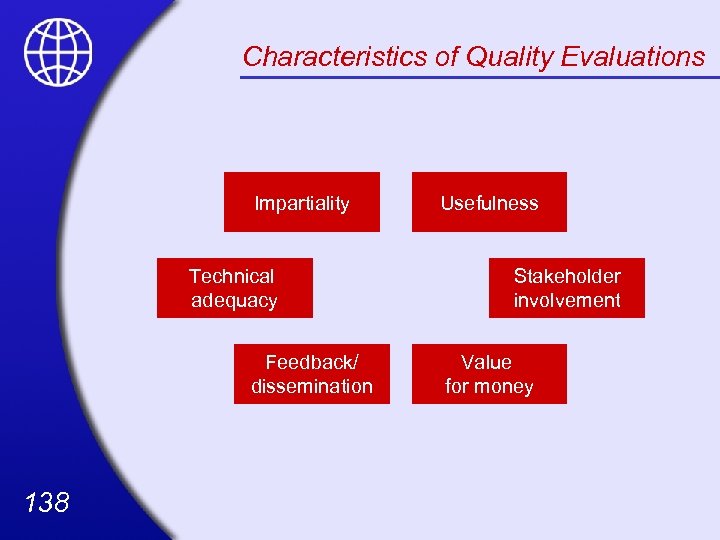
Characteristics of Quality Evaluations Impartiality Technical adequacy Feedback/ dissemination 138 Usefulness Stakeholder involvement Value for money
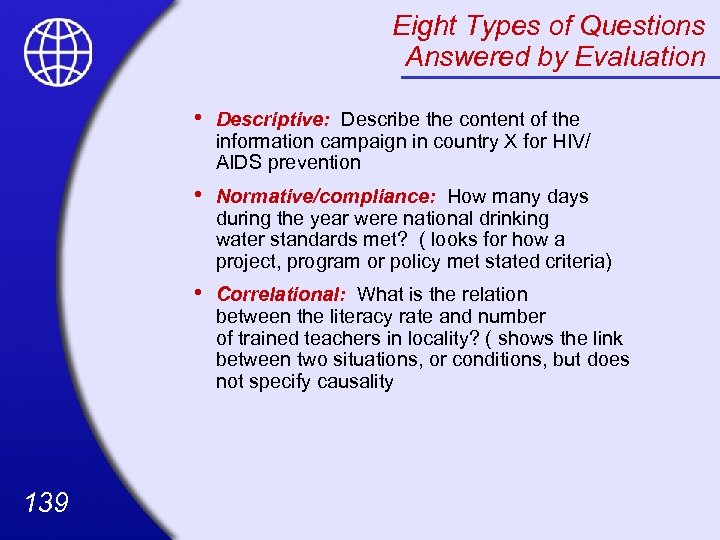
Eight Types of Questions Answered by Evaluation • • Normative/compliance: How many days during the year were national drinking water standards met? ( looks for how a project, program or policy met stated criteria) • 139 Descriptive: Describe the content of the information campaign in country X for HIV/ AIDS prevention Correlational: What is the relation between the literacy rate and number of trained teachers in locality? ( shows the link between two situations, or conditions, but does not specify causality
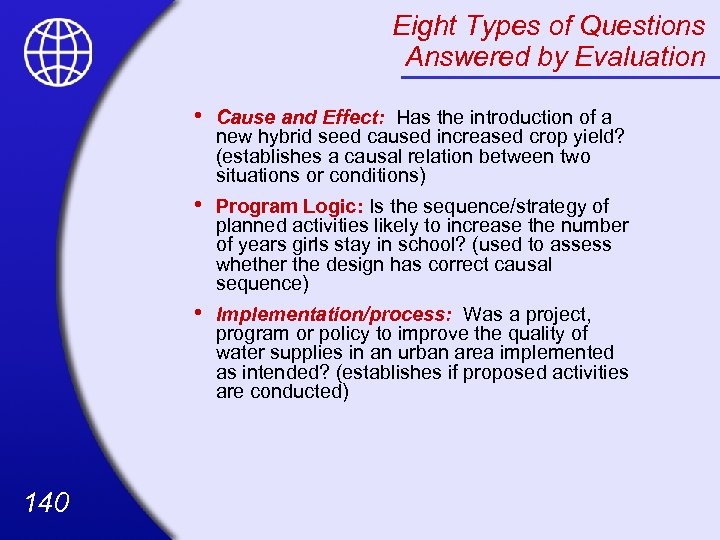
Eight Types of Questions Answered by Evaluation • • Program Logic: Is the sequence/strategy of planned activities likely to increase the number of years girls stay in school? (used to assess whether the design has correct causal sequence) • 140 Cause and Effect: Has the introduction of a new hybrid seed caused increased crop yield? (establishes a causal relation between two situations or conditions) Implementation/process: Was a project, program or policy to improve the quality of water supplies in an urban area implemented as intended? (establishes if proposed activities are conducted)
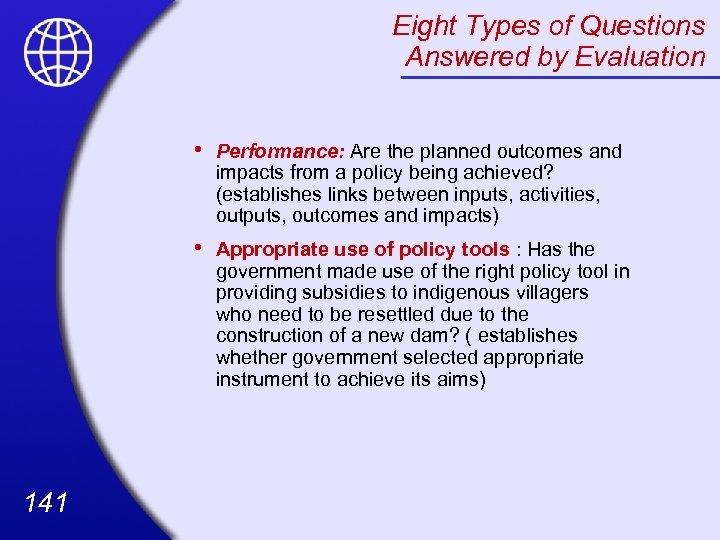
Eight Types of Questions Answered by Evaluation • • 141 Performance: Are the planned outcomes and impacts from a policy being achieved? (establishes links between inputs, activities, outputs, outcomes and impacts) Appropriate use of policy tools : Has the government made use of the right policy tool in providing subsidies to indigenous villagers who need to be resettled due to the construction of a new dam? ( establishes whether government selected appropriate instrument to achieve its aims)
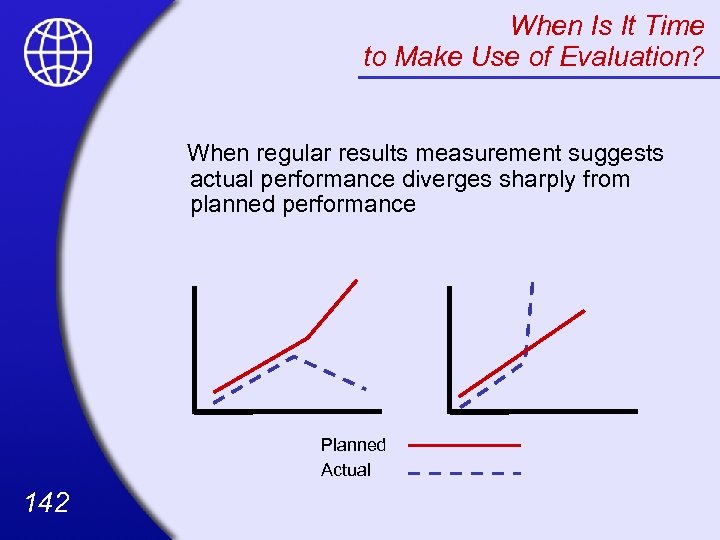
When Is It Time to Make Use of Evaluation? When regular results measurement suggests actual performance diverges sharply from planned performance Planned Actual 142
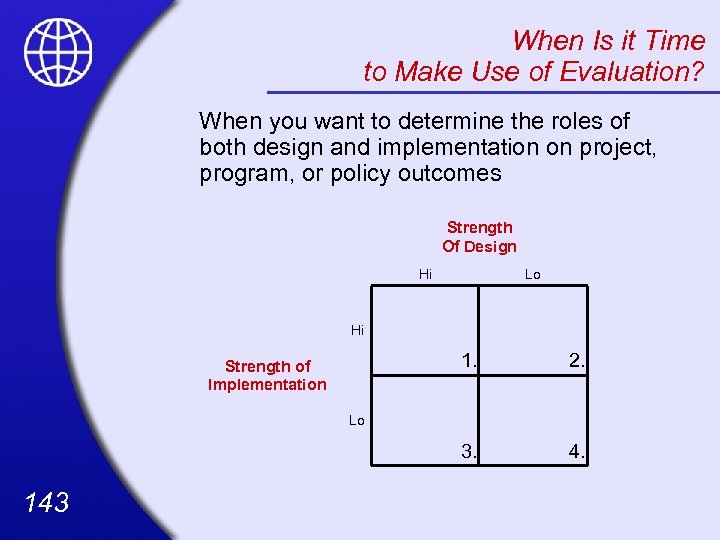
When Is it Time to Make Use of Evaluation? When you want to determine the roles of both design and implementation on project, program, or policy outcomes Strength Of Design Hi Lo Hi 1. 2. 3. Strength of Implementation 4. Lo 143
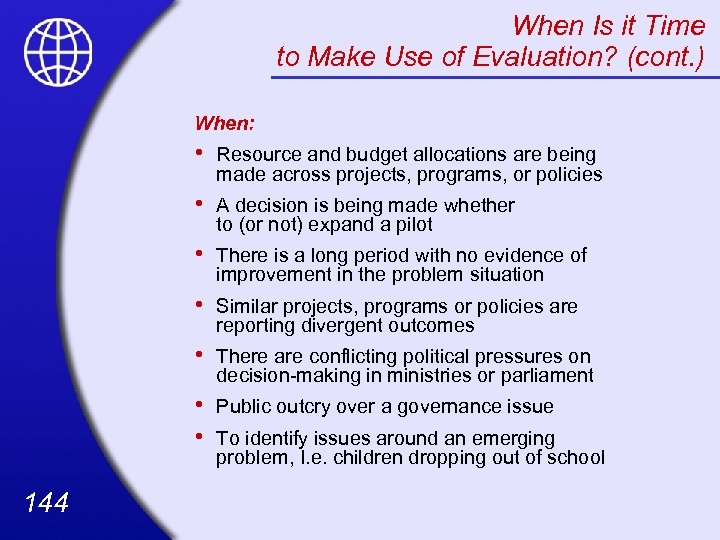
When Is it Time to Make Use of Evaluation? (cont. ) When: • • A decision is being made whether to (or not) expand a pilot • There is a long period with no evidence of improvement in the problem situation • Similar projects, programs or policies are reporting divergent outcomes • There are conflicting political pressures on decision-making in ministries or parliament • • 144 Resource and budget allocations are being made across projects, programs, or policies Public outcry over a governance issue To identify issues around an emerging problem, I. e. children dropping out of school
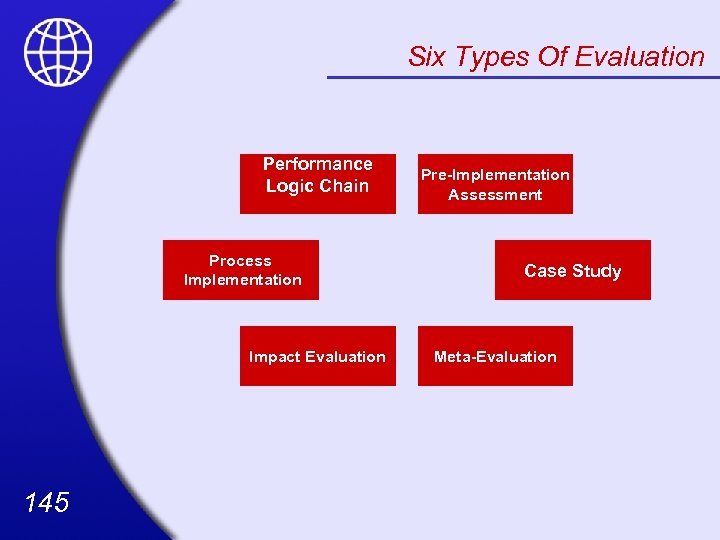
Six Types Of Evaluation Performance Logic Chain Process Implementation Impact Evaluation 145 Pre-Implementation Assessment Case Study Meta-Evaluation
1) Performance Logic– Chain Assessment • • Asks about the rationale for the sequence of activities of the project, program, or policy • 146 Asks questions about the basic causal logic of the project, program, or policy (cause and effect assumptions) Asks about the plausibility of achieving intended effects based on research and prior experience
2) Pre-Implementation Assessment Preliminary evaluation of a project, program, or policy’s implementation strategy to assure that three standards are met: • • • 147 Objectives are well defined Implementation plans are plausible Intended uses of resources are well defined and appropriate to achievement of objectives
3) Process Implementation Evaluation • • Provides detailed information on program functioning to those interested in replication or scaling up a pilot • 148 Provides detailed information on whether the program is operating as it ought ( are we doing things right? ) Provides continuous feedback loops to assist managers
4) Case Study A case study is a method for learning about a complex situation and is based on a comprehensive understanding of that situation. 149
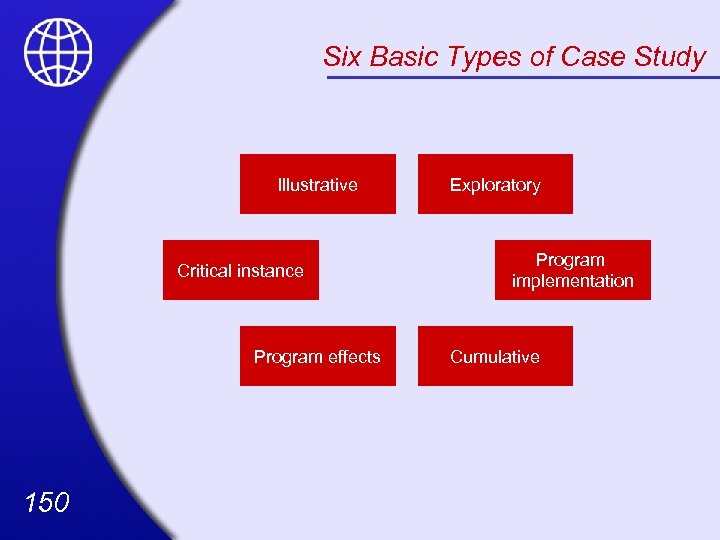
Six Basic Types of Case Study Illustrative Critical instance Program effects 150 Exploratory Program implementation Cumulative
5) Impact Evaluation • Provides information on how and why intended (and un-intended) project, program, or policy outcomes and impacts were achieved (or not) 151
6) Meta-Evaluation • • Addresses where there are credible supportable evaluation findings on a topic • 152 Pulls together known studies on a topic to gain greater confidence in findings and generalizability Compares different studies with disparate findings about a topic against a common set of criteria
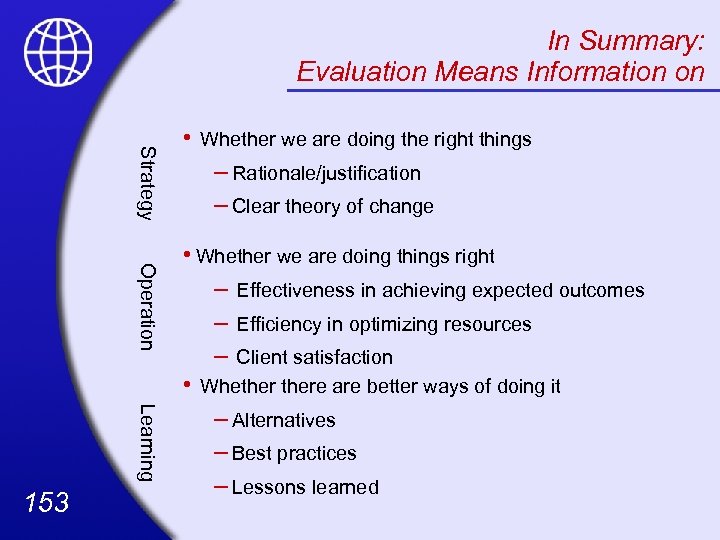
In Summary: Evaluation Means Information on Strategy Operation Learning 153 • Whether we are doing the right things – Rationale/justification – Clear theory of change • Whether we are doing things right – Effectiveness in achieving expected outcomes – Efficiency in optimizing resources – Client satisfaction • Whethere are better ways of doing it – Alternatives – Best practices – Lessons learned
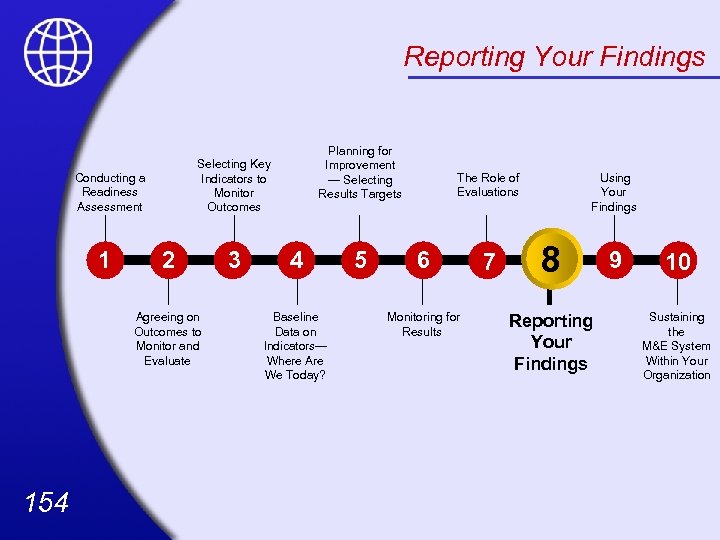
Reporting Your Findings Selecting Key Indicators to Monitor Outcomes Conducting a Readiness Assessment 1 2 Agreeing on Outcomes to Monitor and Evaluate 154 Planning for Improvement — Selecting Results Targets 3 4 Baseline Data on Indicators— Where Are We Today? 5 The Role of Evaluations 6 Monitoring for Results 7 Using Your Findings 8 Reporting Your Findings 9 10 Sustaining the M&E System Within Your Organization
“If You Do Not Measure Results, You Can Not Tell Success From Failure” Analyzing and Reporting Data: • • • Provides clues to problems • Provides important information over time on trends and directions • 155 Gives information on the status of projects, programs, and policies Helps confirm or challenge theory of change Creates opportunities to consider improvements in the (projects, programs, or policy) implementation strategies
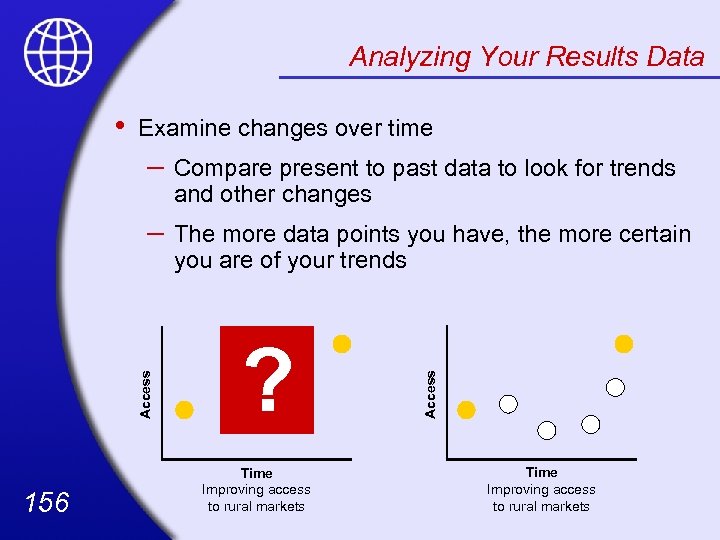
Analyzing Your Results Data • Examine changes over time – The more data points you have, the more certain you are of your trends 156 ? Time Improving access to rural markets Access Compare present to past data to look for trends and other changes Access – Time Improving access to rural markets
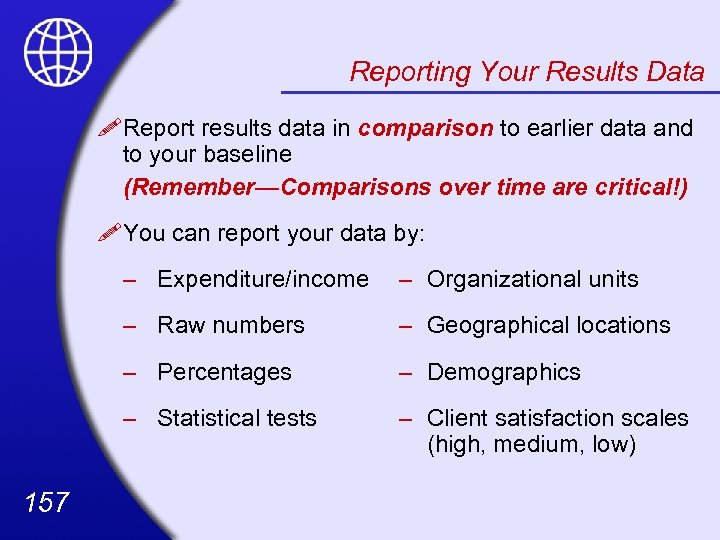
Reporting Your Results Data Report results data in comparison to earlier data and to your baseline (Remember—Comparisons over time are critical!) You can report your data by: – Expenditure/income – Raw numbers – Geographical locations – Percentages – Demographics – Statistical tests 157 – Organizational units – Client satisfaction scales (high, medium, low)
Present Your Data in Clear and Understandable Form • • • Use visual presentations (charts, graphs, maps) to highlight key points • 158 Present most important data only Avoid “data dumps” Use an appendix or a separate report to convey detailed data
When Reporting Your Finding Use Explanatory Notes Suggestions: • • Combine qualitative information along with quantitative • Report internal explanatory notes When comparisons show unexpected trends or values, provide explanations, if known – • Report external explanatory notes, – • 159 e. g. loss of program personnel or other resources e. g unexpected natural disaster, or political changes Summarize important findings The Urban Institute, 1999
What Happens If the Results News Is Bad? • • Reports on performance should include explanations about poor outcomes and identify steps taken or planned to correct problems • 160 A good results measurement system is intended to surface problems (early warning system) Protect the messenger Adapted from The Urban Institute, 1999
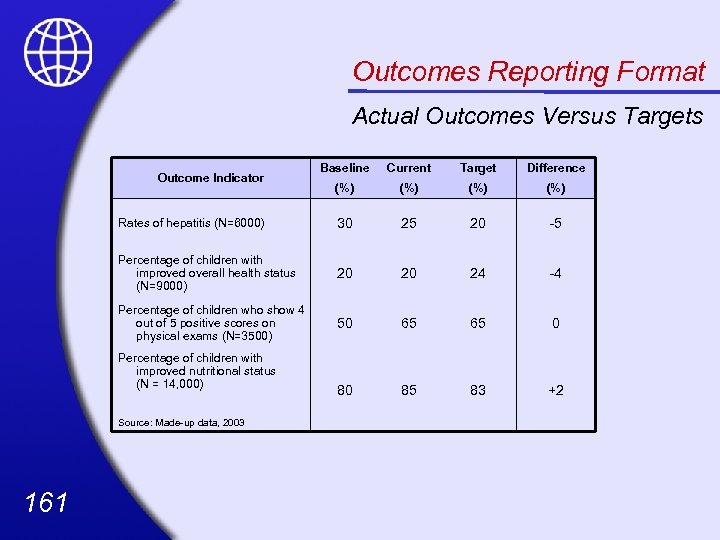
Outcomes Reporting Format Actual Outcomes Versus Targets Baseline Current Target Difference (%) (%) Rates of hepatitis (N=6000) 30 25 20 -5 Percentage of children with improved overall health status (N=9000) 20 20 24 -4 Percentage of children who show 4 out of 5 positive scores on physical exams (N=3500) 50 65 65 0 80 85 83 +2 Outcome Indicator Percentage of children with improved nutritional status (N = 14, 000) Source: Made-up data, 2003 161
In Summary: Analyzing and Reporting Data: • • • Provides clues to problems • 162 Gives information on the status of projects, programs, and policies Provides important information over time on trends and directions Creates opportunities to consider improvements in the (projects, programs, or policy) implementation strategies

Step 9 Using Your Findings 163
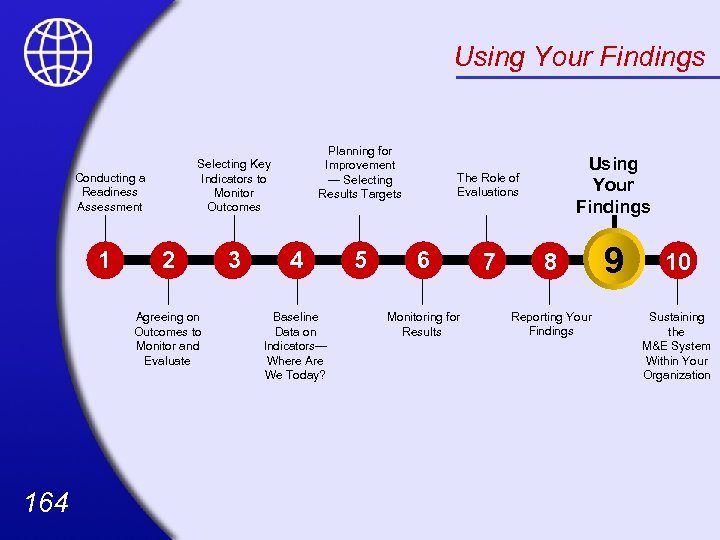
Using Your Findings Selecting Key Indicators to Monitor Outcomes Conducting a Readiness Assessment 1 2 Agreeing on Outcomes to Monitor and Evaluate 164 Planning for Improvement — Selecting Results Targets 3 4 Baseline Data on Indicators— Where Are We Today? 5 Using Your Findings The Role of Evaluations 6 Monitoring for Results 7 8 Reporting Your Findings 9 10 Sustaining the M&E System Within Your Organization
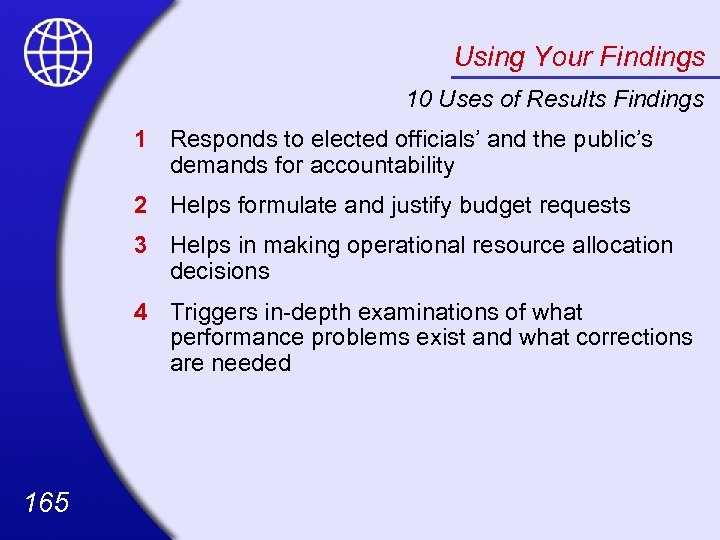
Using Your Findings 10 Uses of Results Findings 1 Responds to elected officials’ and the public’s demands for accountability 2 Helps formulate and justify budget requests 3 Helps in making operational resource allocation decisions 4 Triggers in-depth examinations of what performance problems exist and what corrections are needed 165
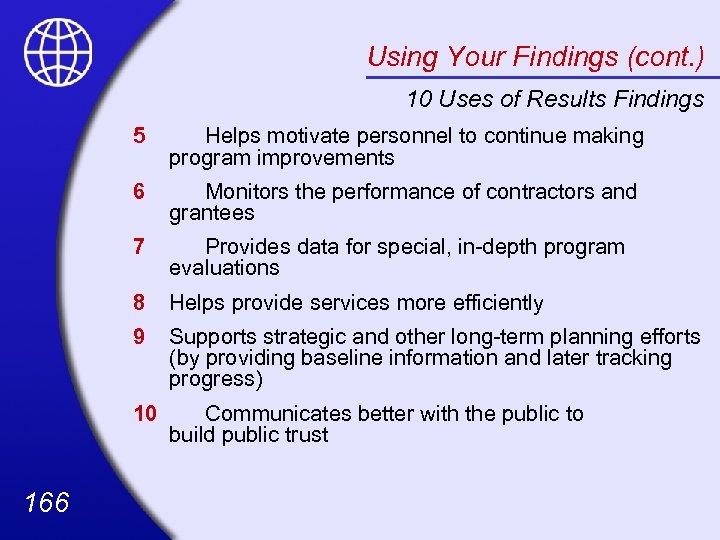
Using Your Findings (cont. ) 10 Uses of Results Findings 5 6 Monitors the performance of contractors and grantees 7 Provides data for special, in-depth program evaluations 8 Helps provide services more efficiently 9 Supports strategic and other long-term planning efforts (by providing baseline information and later tracking progress) 10 166 Helps motivate personnel to continue making program improvements Communicates better with the public to build public trust
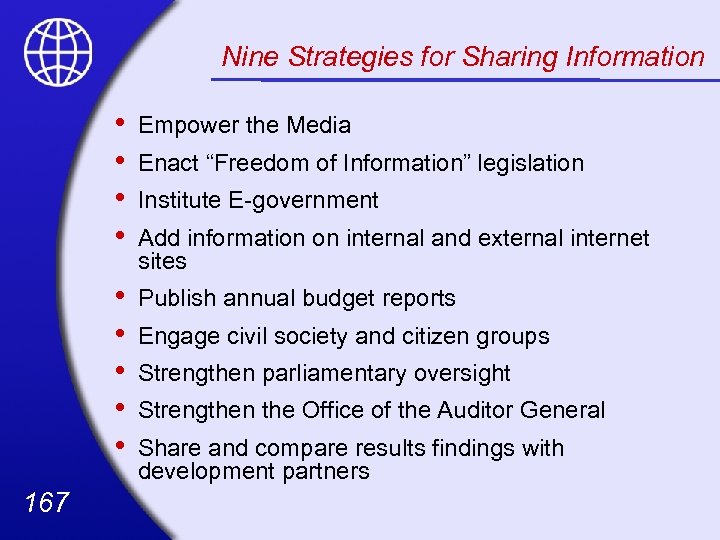
Nine Strategies for Sharing Information • • • 167 Empower the Media Publish annual budget reports Enact “Freedom of Information” legislation Institute E-government Add information on internal and external internet sites Engage civil society and citizen groups Strengthen parliamentary oversight Strengthen the Office of the Auditor General Share and compare results findings with development partners
Credible Information Strengthens Public Accountability “In the National Health Service it is not always clear that the board asks the right questions, ” because “inadequate information reduces the clarity behind decision-making that is necessary to achieve effective accountability”. Nicole Timmins Financial Times (October 14, 2003) 168
Step 10 Sustaining the M&E System Within Your Organization 169
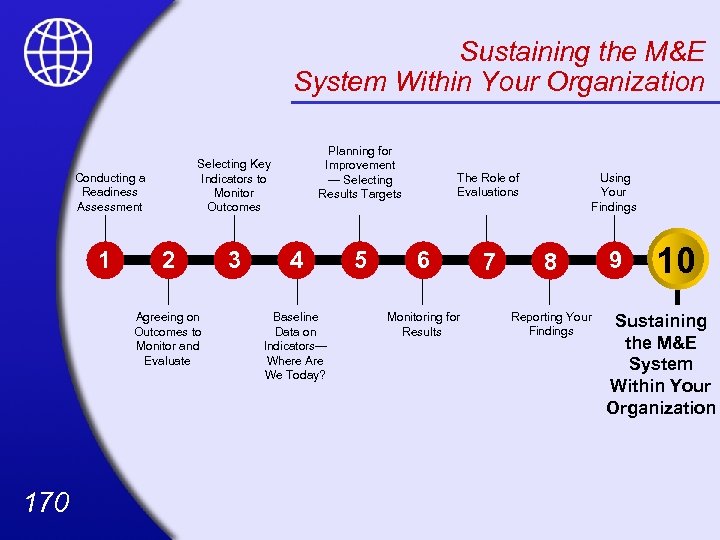
Sustaining the M&E System Within Your Organization Selecting Key Indicators to Monitor Outcomes Conducting a Readiness Assessment 1 2 Agreeing on Outcomes to Monitor and Evaluate 170 Planning for Improvement — Selecting Results Targets 3 4 Baseline Data on Indicators— Where Are We Today? 5 The Role of Evaluations 6 Monitoring for Results 7 Using Your Findings 8 Reporting Your Findings 9 10 Sustaining the M&E System Within Your Organization
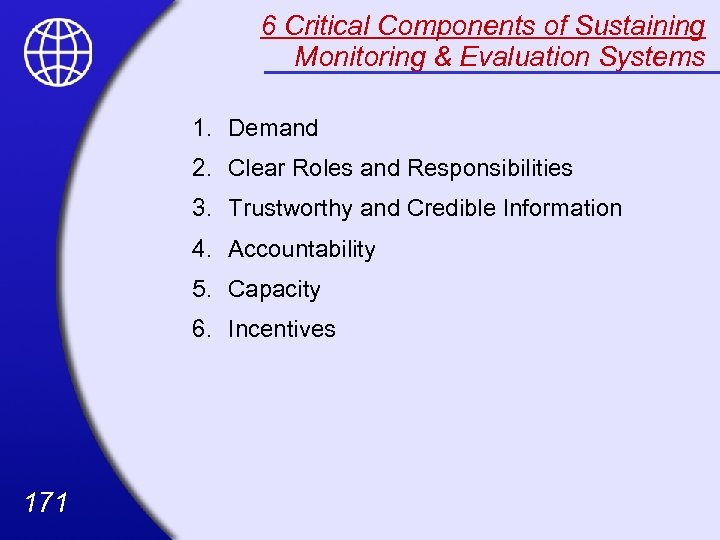
6 Critical Components of Sustaining Monitoring & Evaluation Systems 1. Demand 2. Clear Roles and Responsibilities 3. Trustworthy and Credible Information 4. Accountability 5. Capacity 6. Incentives 171
Critical Component One: Demand • • The results from M&E system are sought and available for the government, civil society, and for donors • Officials want evidence on their own performance • 172 Structured requirements for reporting on results e. g. European Union Accession or national legislation Organizations seek better accountability
Critical Component Two: Clear Roles and Responsibilities • • • 173 Establish formal organizational lines of authority (that are clear) for collecting, analyzing, and reporting of performance information Build a system that links the central planning and finance ministries to line/sector ministries (internal coordination) Issue clear guidance on who is responsible for which components of the M&E system and procedures
Critical Component Two: Clear Roles and Responsibilities (cont. ) • • 174 Build a system that goes beyond national government to other levels of government for data collection and analysis Build a system that has demand for results information at every level where information is collected analyzed, i. e. there is no level in the system that is only a “pass through” of the information
Critical Component Three: Trustworthy and Credible Information • • The producers of results information need protection from political reprisals • The information produced by the M&E system should be transparent and subject to independent verification • 175 The system has to be able to produce results information that brings both good and bad news The data collection and analysis procedures should be subject to review by national audit office and/or Parliament

The Blame Game “Stop whimpering and spin the wheel of blame, Lipton!” Cartoon by Scott Arthur Masear, Harvard Business Review, November 2003. 176
Critical Component Four: Accountability • • The media, private sector, and the Parliament all have roles to ensure that the information is timely, accurate, and accessible • • 177 Civil society organizations play a role by encouraging transparency of the information Failure is not rewarded Problems are acknowledged and addressed
Critical Component Five: Capacity • • Managerial skills in strategic goal setting and organizational development • Existing data collection and retrieval systems • Ongoing availability of financial resources • 178 Sound technical skills in data collection and analysis Institutional experience
Critical Component Six: Incentives • • 179 Incentives need to be introduced to encourage use of performance information: Success is acknowledged and rewarded Problems are addressed Messengers are not punished Organizational learning is valued Budget savings are shared Others?
Last Reminders! • • • Keep your champions on your side and help them! • Look for every opportunity to link results information to budget and resource allocation decisions. • Begin with pilot efforts to demonstrate effective resultsbased monitoring: Begin with an enclave strategy (e. g. islands of innovation) as opposed to a whole-ofgovernment approach. • Monitor both implementation progress and results achievements. • 180 The demand for capacity building never ends! The only way an organization can coast is downhill… Complement performance monitoring with evaluations to ensure better understanding of public sector results. Establish the understanding with the Ministry of Finance and the Parliament that an M&E system needs sustained resources.
Скачать презентацию Designing and Building a Results-Based Monitoring and Evaluation
fe050137c2b3912c2a125ae57d2b5930.ppt