 Скачать презентацию Designing a Sustainable Training and Compliance Program The
7255b9c866439bbe0aadf5f6635a8a7d.ppt
- Количество слайдов: 44




Designing a Sustainable Training and Compliance Program The Roadmap
Agenda: Leaders in Life Sciences Learning • 9: 00 – 9: 30 • 9: 30 – 11: 00 • • • 11: 15 – 11: 30 – 12: 00 – 12: 30 – 13: 30 – 15: 30 – 16: 00 Breakfast and networking Building and Implementing a quality and compliance learning programme - Elements of a sustainable & scalable programme - Role-based training formula - Optimisation through integrations - Meeting goals: metrics, dashboards, reporting - Best practices Break Company presentation/case study Regulatory update Lunch User Group Open discussion, concluding remarks and adjournment
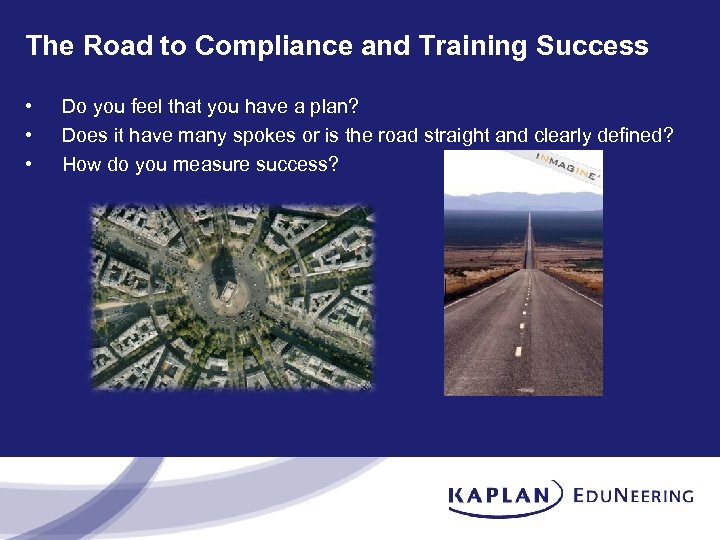
The Road to Compliance and Training Success • • • Do you feel that you have a plan? Does it have many spokes or is the road straight and clearly defined? How do you measure success?
The road starts with … striving for compliance. But, the road does not end there… Knowledge Solutions that Assure Compliance and Improve Business Performance How can you and your company develop the long-term plan to Improve Business Performance?
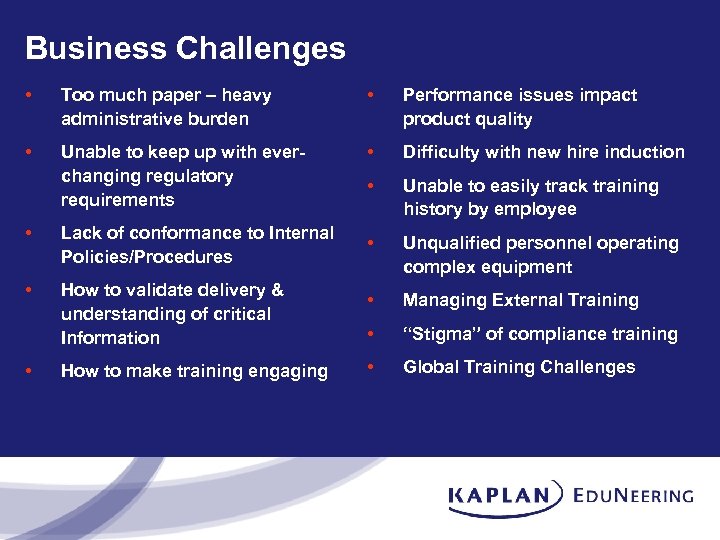
Business Challenges • Too much paper – heavy administrative burden • Performance issues impact product quality • Unable to keep up with everchanging regulatory requirements • Difficulty with new hire induction • Unable to easily track training history by employee • Unqualified personnel operating complex equipment • Managing External Training • “Stigma” of compliance training • Global Training Challenges • Lack of conformance to Internal Policies/Procedures • How to validate delivery & understanding of critical Information • How to make training engaging
Key considerations for success • What is driving the programme? Corporate initiative or regulatory action? • Have the executive sponsors support the initiative? • Do you understand your users and corporate culture? • Have you assessed your organisational structure and role-based training requirements • How quickly to adopt new programme elements? - Speed of change, appetite for change • How to measure, report and manage progress and risk • What is your strategy for keeping the programme valid and applicable
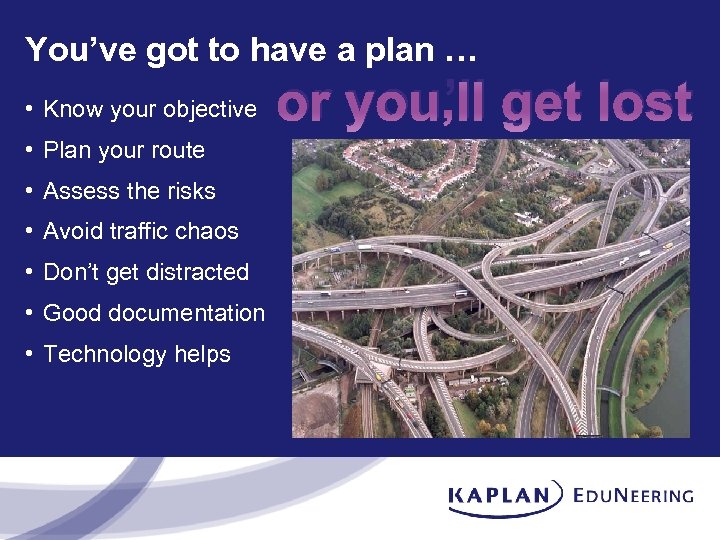
You’ve got to have a plan … • Know your objective • Plan your route • Assess the risks • Avoid traffic chaos • Don’t get distracted • Good documentation • Technology helps or you’ll get lost
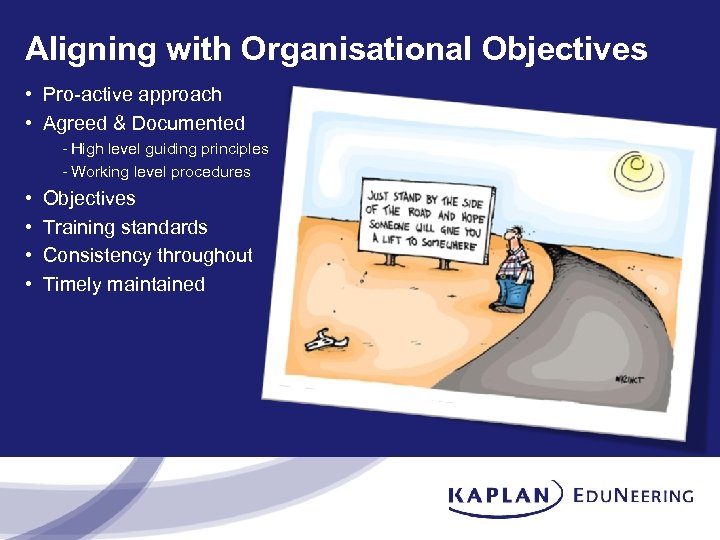
Aligning with Organisational Objectives • Pro-active approach • Agreed & Documented - High level guiding principles - Working level procedures • • Objectives Training standards Consistency throughout Timely maintained
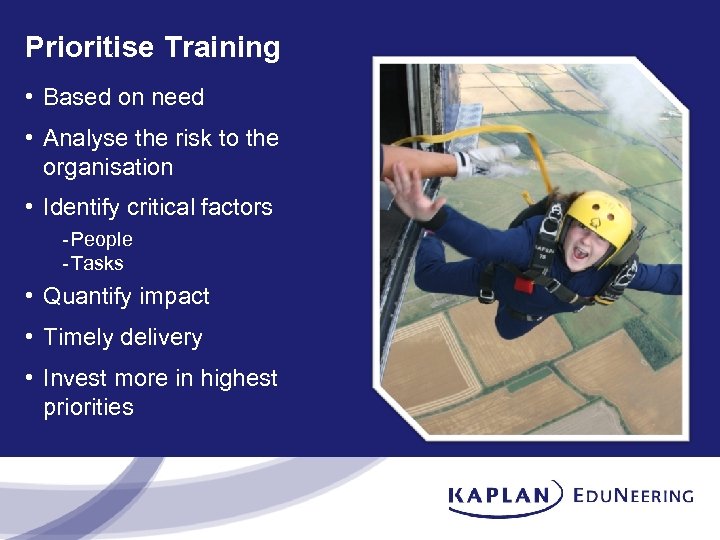
Prioritise Training • Based on need • Analyse the risk to the organisation • Identify critical factors - People - Tasks • Quantify impact • Timely delivery • Invest more in highest priorities
Lessons from Toyota • Failure to identify root cause • Failure to recognise trends in "adverse events" • Failure to employ policies and procedures to enable rapid ow of critical information across the organisation • Failure to adapt to working, learning + cultural conditions of global enterprise • Failure to provide regulators with full and accurate safety records and complaint history • Failure to manage quality of supplier products • Failure to recognise the impact of rapid growth on corporate culture
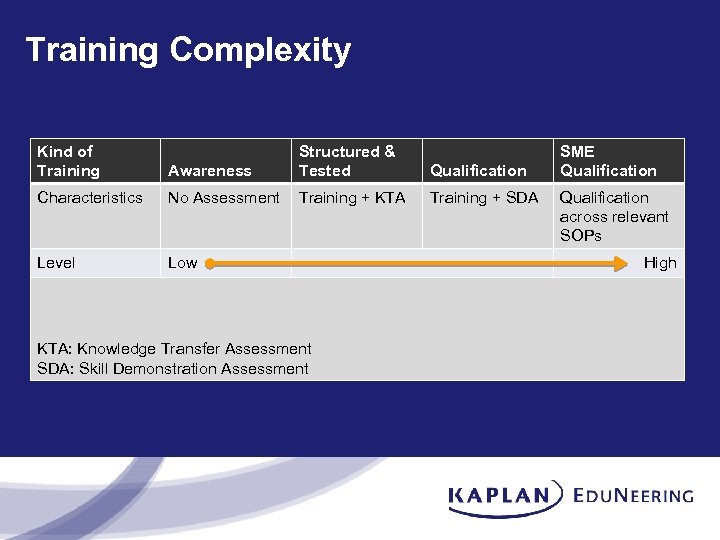
Training Complexity Kind of Training Awareness Structured & Tested Qualification Characteristics No Assessment Training + KTA Training + SDA Level Low KTA: Knowledge Transfer Assessment SDA: Skill Demonstration Assessment SME Qualification across relevant SOPs High
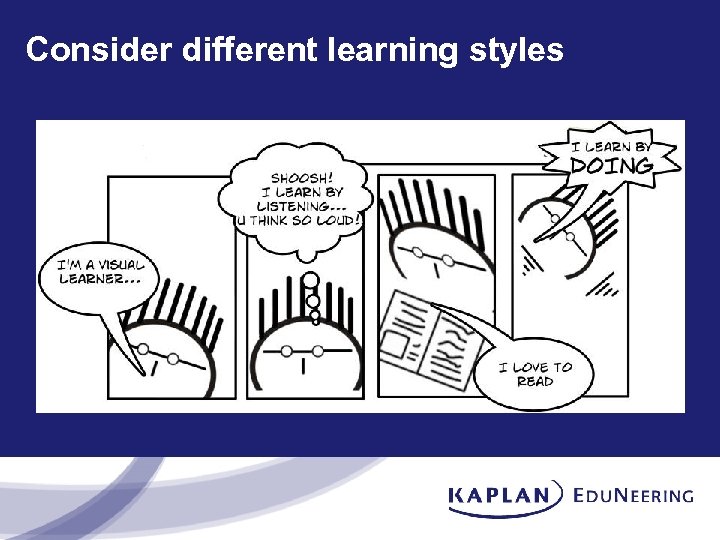
Consider different learning styles
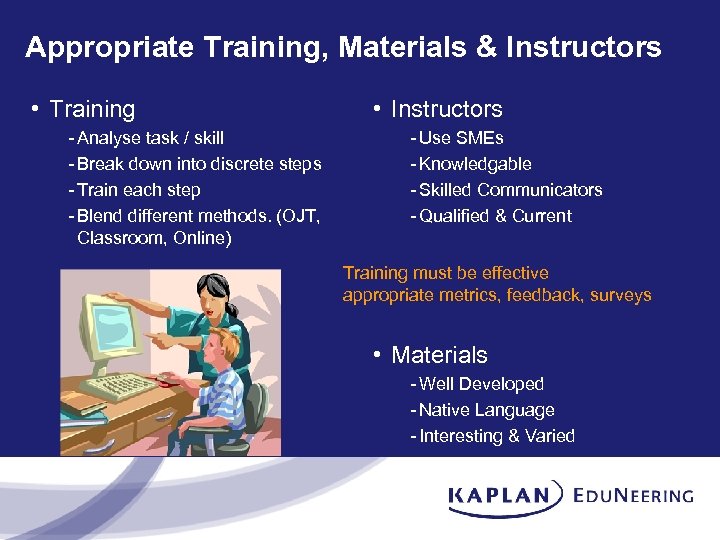
Appropriate Training, Materials & Instructors • Training - Analyse task / skill - Break down into discrete steps - Train each step - Blend different methods. (OJT, Classroom, Online) • Instructors - Use SMEs - Knowledgable - Skilled Communicators - Qualified & Current Training must be effective appropriate metrics, feedback, surveys • Materials - Well Developed - Native Language - Interesting & Varied
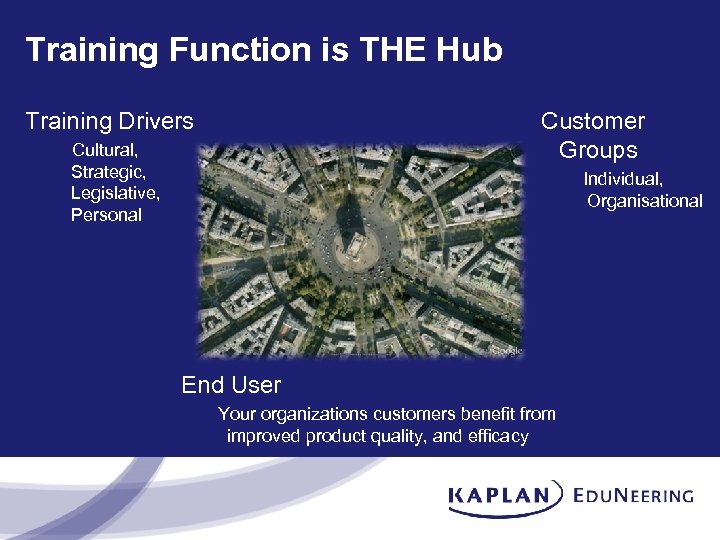
Training Function is THE Hub Customer Groups Training Drivers Cultural, Strategic, Legislative, Personal Individual, Organisational End User Your organizations customers benefit from improved product quality, and efficacy
Monitor, Adjust & Change • • • Effectiveness should be monitored Regulatory advice – track operator errors Modify materials as needed Feedback from trainees Trained personnel should demonstrate improved performance • Change training in good time
Documentation • All aspects of training to be documented • Version & Change Control • Meet needs of Org & External Audit Efficient & Cost Effective • Minimize waste • Measure ROI • Demonstrate Value to Organisation
Working Together • Management Stakeholders - Set clear expectations - Support appropriate training methods (OJT, Classroom, On-line) • Trainers - Resources, time, investment - Development of training materials • Trainees (learners) - Required to perform task post training - Require efficient use of their time - Require effective training - Provide dedication and commitment These groups must work towards a common goal
Senior Management Support • Critical Success Factor • Management Provide - Resources - Time - Personnel - Funding • Training is an investment in the future

Developing Your Learning Culture
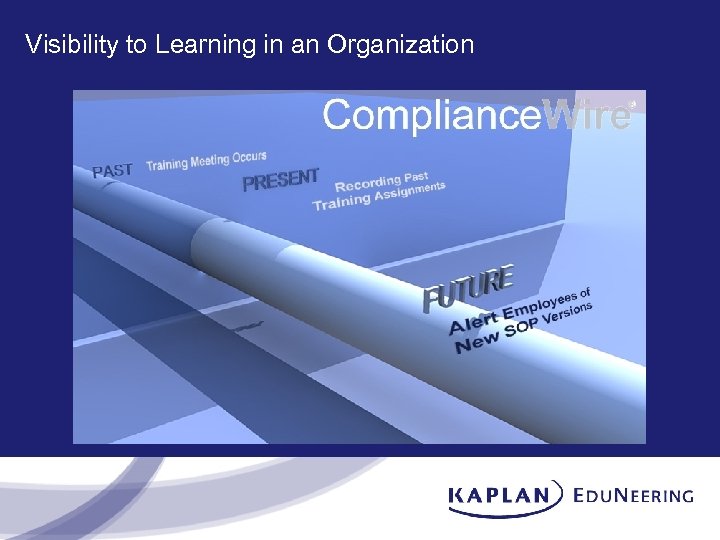
Visibility to Learning in an Organization
Deliver Training Users Time
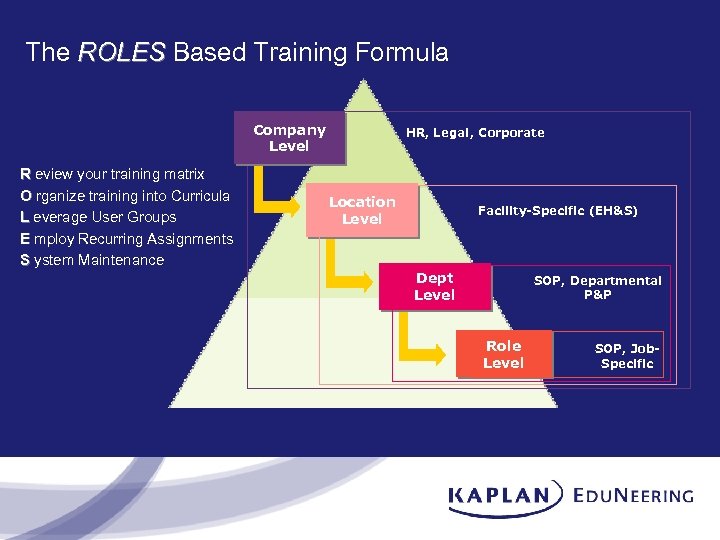
The ROLES Based Training Formula Company Level R eview your training matrix R O rganize training into Curricula O L everage User Groups L E mploy Recurring Assignments E S ystem Maintenance S HR, Legal, Corporate Location Level Facility-Specific (EH&S) Dept Level SOP, Departmental P&P Role Level SOP, Job. Specific
ROLES: Review Your Training Matrix • • • Review what you have now (be honest) Determine what is missing Perform a risk based analysis Start slow and build with consistency Build your internal processes
ROLES: Organize Training into Curricula • • • Manageable Size Curriculum Types Due Dates / Retraining Periods Sequencing Define your process for maintaining curricula
ROLES: Leverage User Groups ES • User Groups are “Containers” for users • Use Custom Field values as automated membership criteria • Use Suggested Membership for cross-training and developmental assignments • Use Group Types for cataloging of User Groups and for creating hierarchical arrangements of your Groups
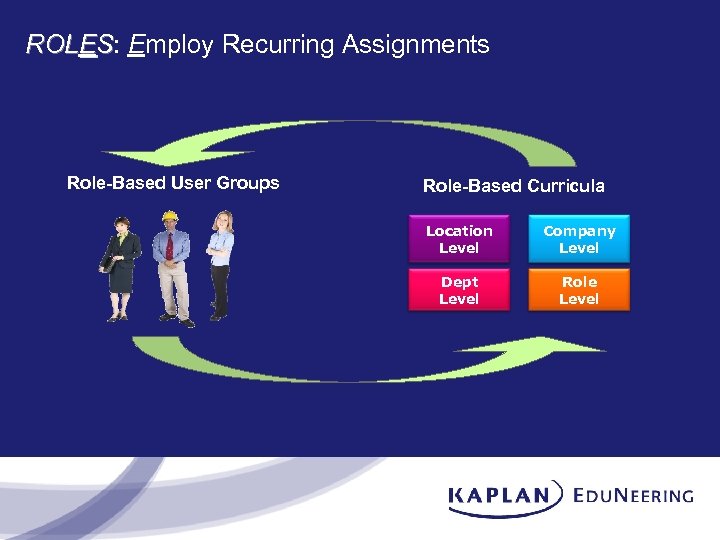
ROLES: Employ Recurring Assignments Role-Based User Groups Role-Based Curricula Location Level Company Level Dept Level Role Level Recurring Assignment
ROLES : System Maintenance • • • Standardize nomenclature and other meta data Create an assign Security Roles as appropriate Decentralize system administration where and how it is appropriate Monitor the system through standardized reporting Maintain control of data entry and system usage through documented procedures and monitoring - Users, Training Items, Curricula, User Groups • This is an exercise in continuous improvement • There may be on-going consolidation and refinement opportunities
ROLES: Training Metrics ROLES
Refining Your Training Program – Continuous Improvement • Audit and Maintain your System - Process, Process!!! - Garbage In = Garbage Out! • Periodic Needs Analysis - Maintain the Accuracy of your Training Matrix • Keep your Training Materials Fresh • Expand your Program to Other High Risk Areas - Clinical Trials - Supply Chain - Other Plants, Locations, Divisions, Business Units, etc.

Optimizing Your Training System
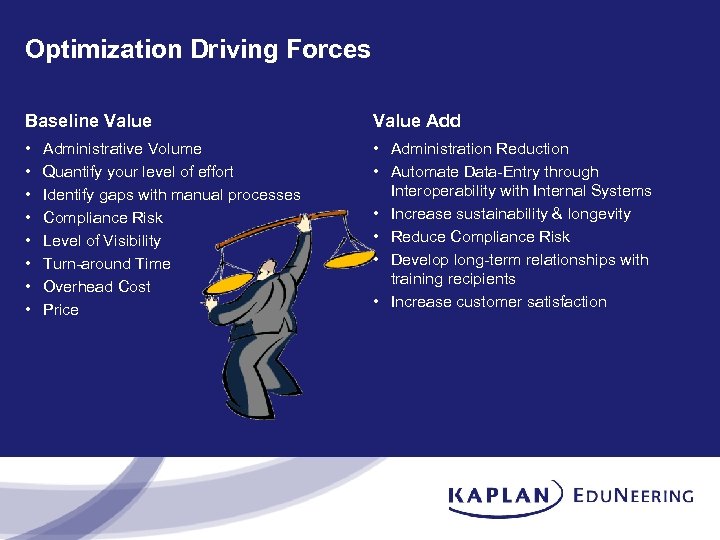
Optimization Driving Forces Baseline Value Add • • • Administration Reduction • Automate Data-Entry through Interoperability with Internal Systems • Increase sustainability & longevity • Reduce Compliance Risk • Develop long-term relationships with training recipients • Increase customer satisfaction Administrative Volume Quantify your level of effort Identify gaps with manual processes Compliance Risk Level of Visibility Turn-around Time Overhead Cost Price
Tools for Optimization Best Practice • HRIS - Synchronizing user profile information • EDMS - Synchronizing training content • MES - Compliance Status Verification
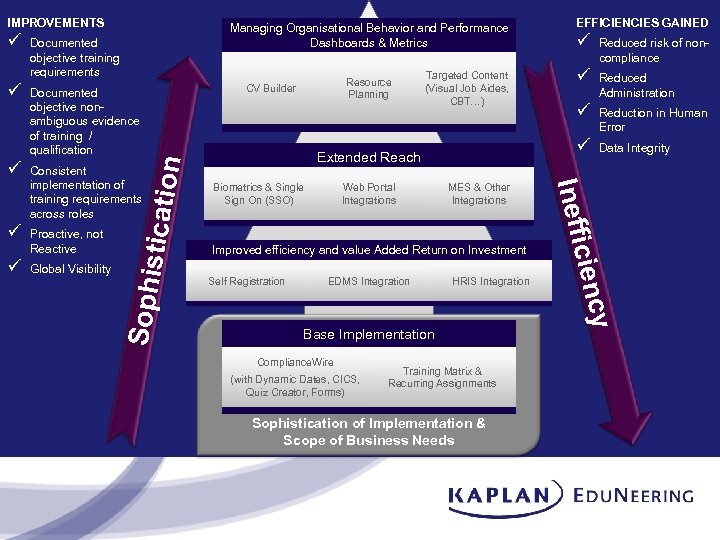
IMPROVEMENTS Proactive, not Reactive Global Visibility Extended Reach Biometrics & Single Sign On (SSO) Web Portal Integrations MES & Other Integrations Improved efficiency and value Added Return on Investment Self Registration EDMS Integration HRIS Integration Compliance. Wire (with Dynamic Dates, CICS, Quiz Creator, Forms) Training Matrix & Recurring Assignments Sophistication of Implementation & Scope of Business Needs ü Reduced Administration ü Reduction in Human Error Data Integrity cy Base Implementation Reduced risk of noncompliance ü Targeted Content (Visual Job Aides, CBT…) ü icien ü Consistent implementation of training requirements across roles EFFICIENCIES GAINED Ineff ü Documented objective nonambiguous evidence of training / qualification n ü Resource Planning CV Builder ticatio ü Documented objective training requirements Sophis ü Managing Organisational Behavior and Performance Dashboards & Metrics
Professional Development Program My Development Planning Your Development Journey My Development Progress Section Name Here Description of this section here

Metrics & Reporting: Communicating to Executive Management
Executive Management: Communications • Metrics / Reporting must be: - Clear – Presented in a manner that is self explanatory - Concise – Summary level information with detail as a backup - Reliable – Information must be generated in a consistent fashion - Timely – so that trend changes are quickly identified - Actionable – Management must be able to make business decisions based upon this information!
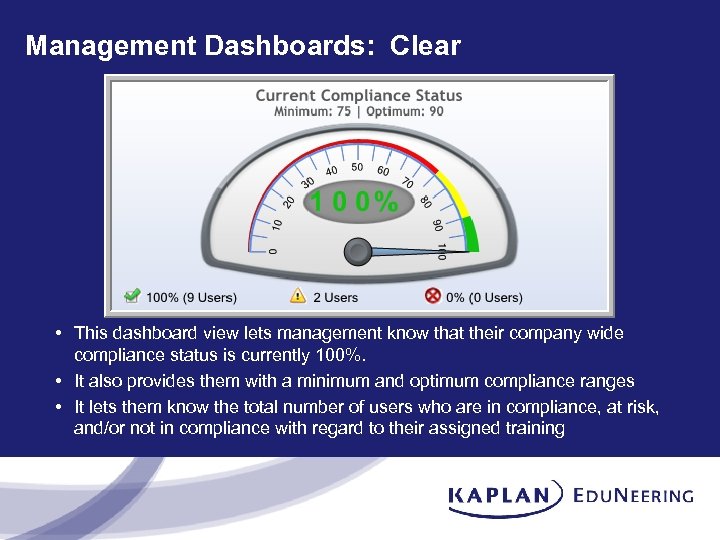
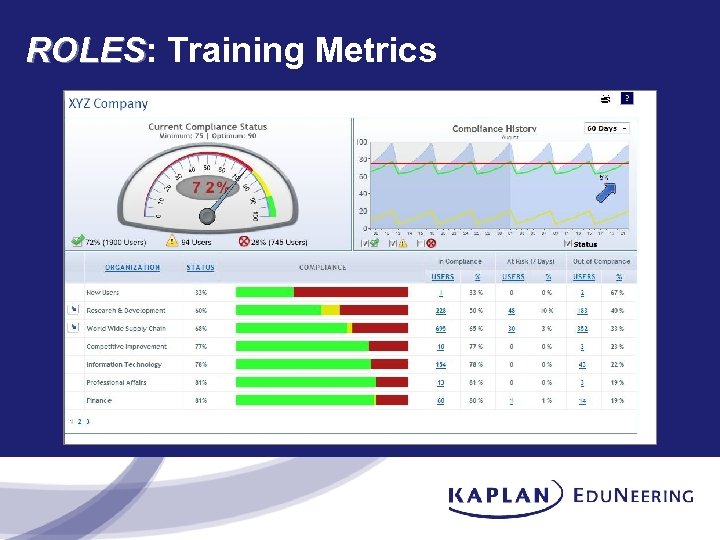
Management Dashboards: Clear • This dashboard view lets management know that their company wide compliance status is currently 100%. • It also provides them with a minimum and optimum compliance ranges • It lets them know the total number of users who are in compliance, at risk, and/or not in compliance with regard to their assigned training
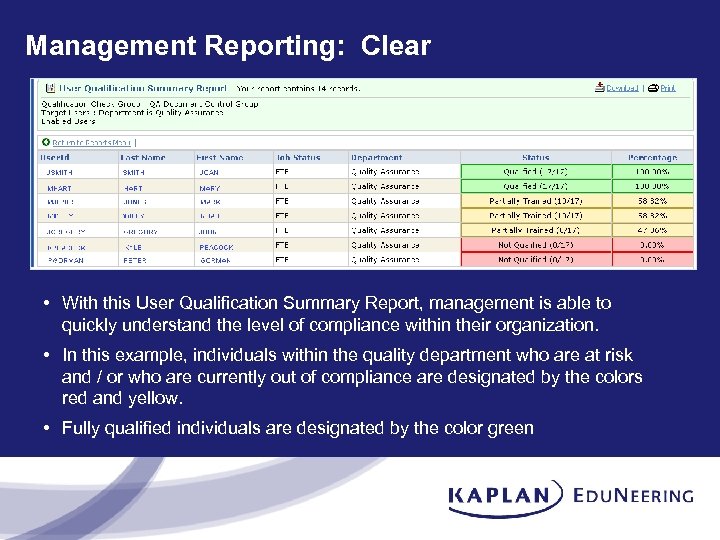
Management Reporting: Clear • With this User Qualification Summary Report, management is able to quickly understand the level of compliance within their organization. • In this example, individuals within the quality department who are at risk and / or who are currently out of compliance are designated by the colors red and yellow. • Fully qualified individuals are designated by the color green
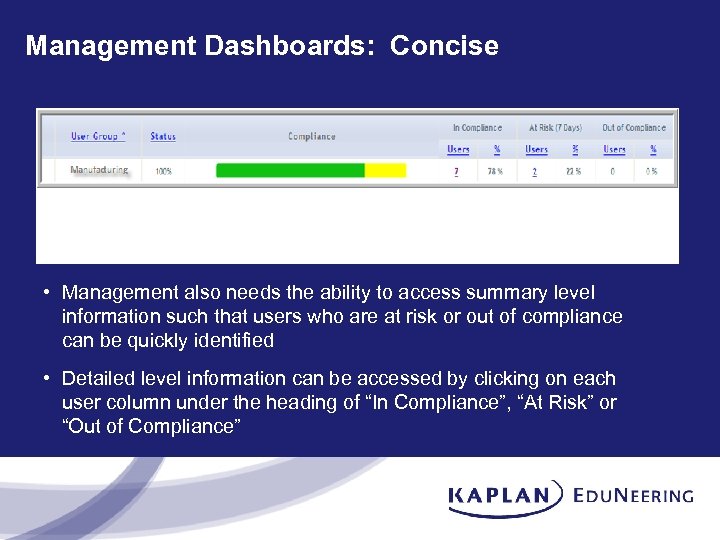
Management Dashboards: Concise • Management also needs the ability to access summary level information such that users who are at risk or out of compliance can be quickly identified • Detailed level information can be accessed by clicking on each user column under the heading of “In Compliance”, “At Risk” or “Out of Compliance”
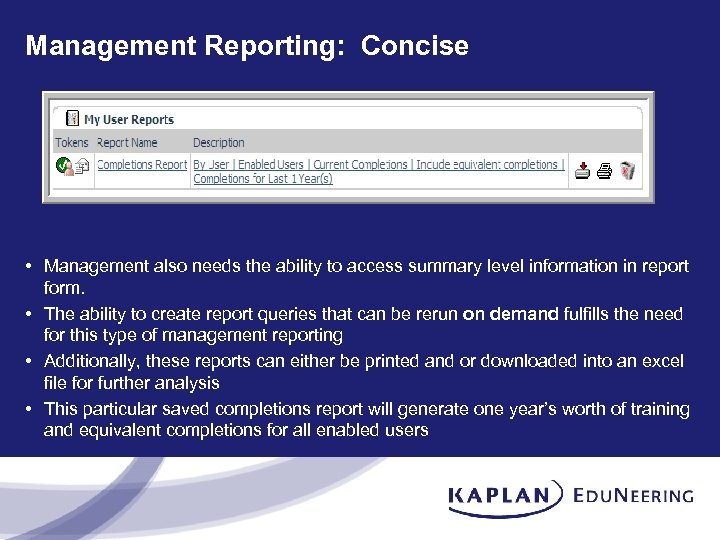
Management Reporting: Concise • Management also needs the ability to access summary level information in report form. • The ability to create report queries that can be rerun on demand fulfills the need for this type of management reporting • Additionally, these reports can either be printed and or downloaded into an excel file for further analysis • This particular saved completions report will generate one year’s worth of training and equivalent completions for all enabled users
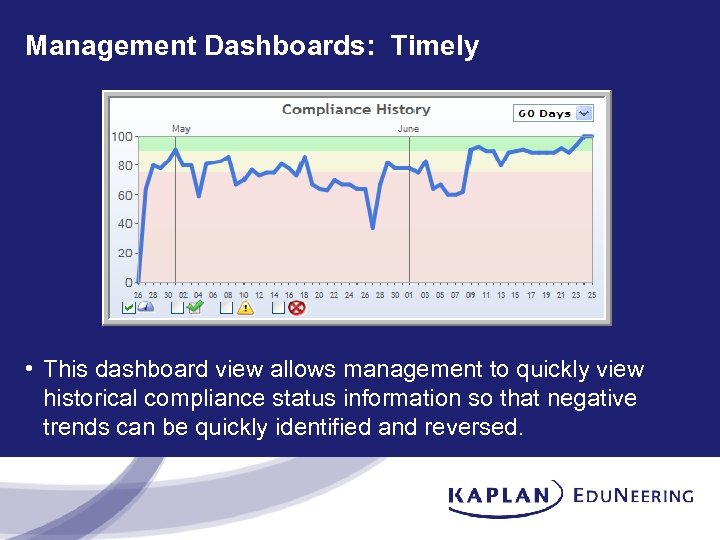
Management Dashboards: Timely • This dashboard view allows management to quickly view historical compliance status information so that negative trends can be quickly identified and reversed.
Management Dashboards: Reliable The KE Learning Management System (LMS) is validated and must therefore produce information that is: - Dependable: Worthy of reliance of trust - Authentic: Conforming to a fact or set of facts - Consistent: Capable of being reproduced - Reproducible: Capable of creating a copy or producing an equivalent
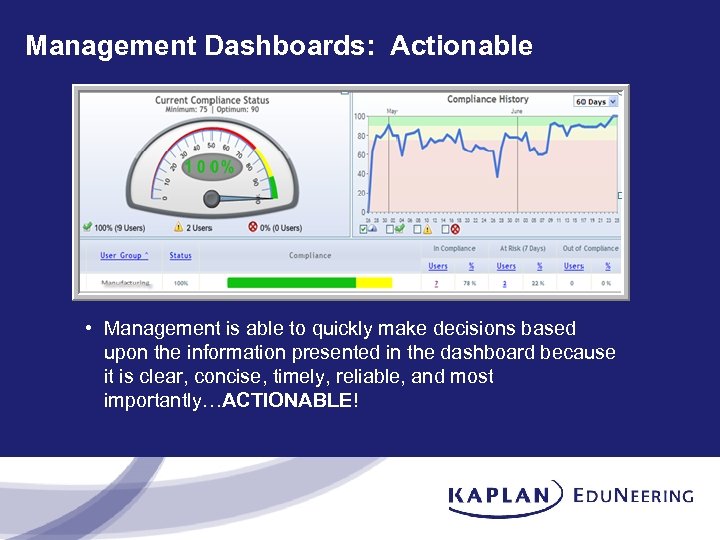
Management Dashboards: Actionable • Management is able to quickly make decisions based upon the information presented in the dashboard because it is clear, concise, timely, reliable, and most importantly…ACTIONABLE!
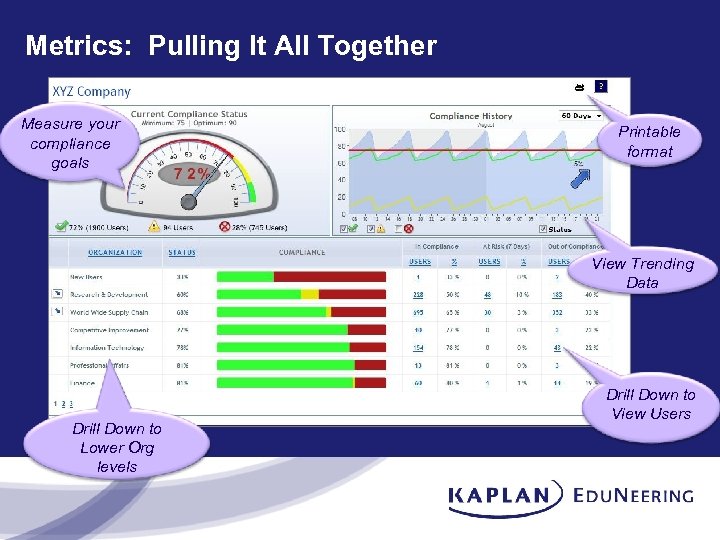
Metrics: Pulling It All Together Measure your compliance goals Printable format View Trending Data Drill Down to Lower Org levels Drill Down to View Users
Скачать презентацию Designing a Sustainable Training and Compliance Program The
7255b9c866439bbe0aadf5f6635a8a7d.ppt