 Скачать презентацию Design Patterns David Talby This Lecture n
b8174aae1ca6120d863e2f5c137bd12c.ppt
- Количество слайдов: 51



Design Patterns David Talby
This Lecture n The rest of the pack u Working F Proxy, u Working over a network State, Chain of Responsibility with external libraries F Adapter, u Coding Façade partial algorithms F Template Method u Special-case F Interpreter, u Summary patterns Momento
16. Proxy n n Provide a placeholder for another object, to control access to it For example, we’d like to defer loading the images of a document until we must display it
The Requirements n n n Only load images when required Client code must not know whether lazy load is used or not Images may be loaded from a file, a database or a network u Such code should be encapsulated u Should be easy to add variations, such as security and compression
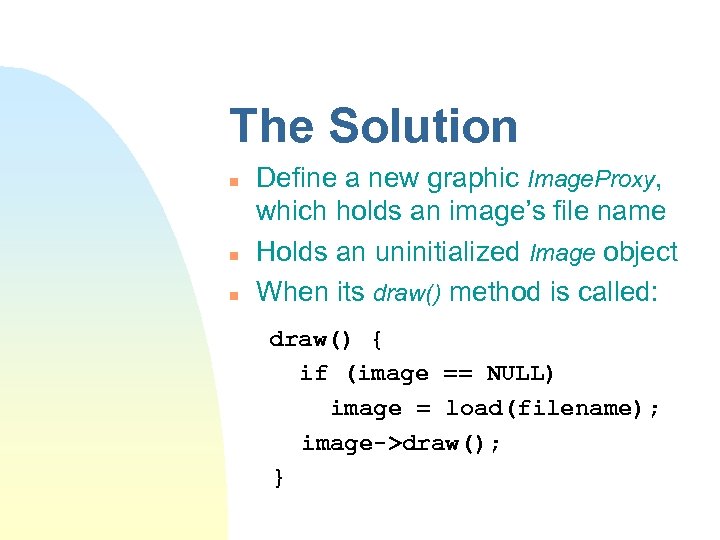
The Solution n Define a new graphic Image. Proxy, which holds an image’s file name Holds an uninitialized Image object When its draw() method is called: draw() { if (image == NULL) image = load(filename); image->draw(); }
The Solution II n Many ways to implement load: u Read from a file or database u Use a complex network protocol u Use encryption, compression, … u Compute the returned object n n Any such complex logic is well encapsulated in the proxy The proxy can hold part of Image’s data for efficiency
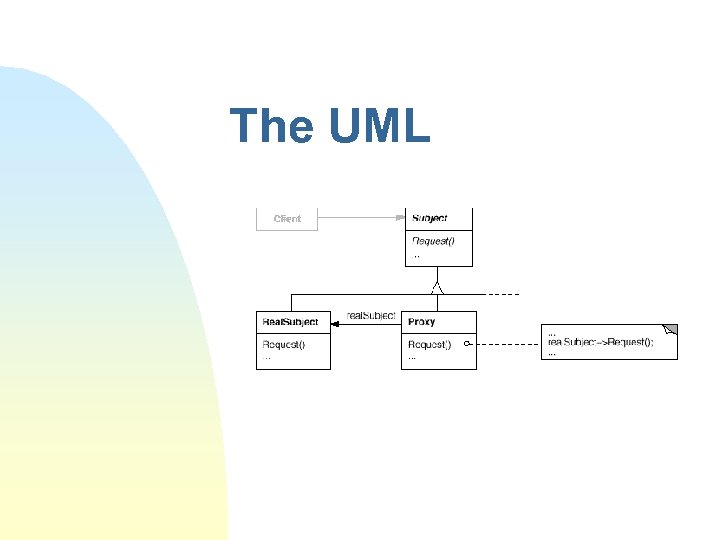
The UML
The Fine Print n The Proxy vocabulary u Virtual Proxy – creates expensive objects on demand u Remote Proxy – a local representative of an object in another address space u Protection Proxy – controls access to the original object u Smart Pointers – overload regular pointers with additional actions
The Fine Print II n Uses of smart pointers u Reference counting u Synchronization (lock management) u Profiling and statistics u Copy-on-write u Cache coherence u Pooling n Smart pointers are easy in C++ thanks to overloading = and –>
The Fine Print III n n n Proxy is very much like Decorator = functional addition Proxy = technical addition
Known Uses n n n Every programming language Every middleware package Every database package
17. State n n n Allow an object to alter its behavior when its internal state changes For example, most methods of a TCPConnection object behave in different ways when the connection is closed, established or listening How do we encapsulate the logic and data of every state?
The Requirements n n n A class has a state diagram, and many methods behave in wildly different ways in different states When in a state, only allocate memory for data of that state The logic of a specific state should be encapsulated
Pattern of Patterns n Encapsulate the varying aspect u State n of an object Interfaces u Let’s have a TCPState interface that has all the state-sensitive methods n Inheritance describes variants u TCPEstablished, TCPListen and TCPClosed implement the interface n Composition allows a dynamic choice between variants
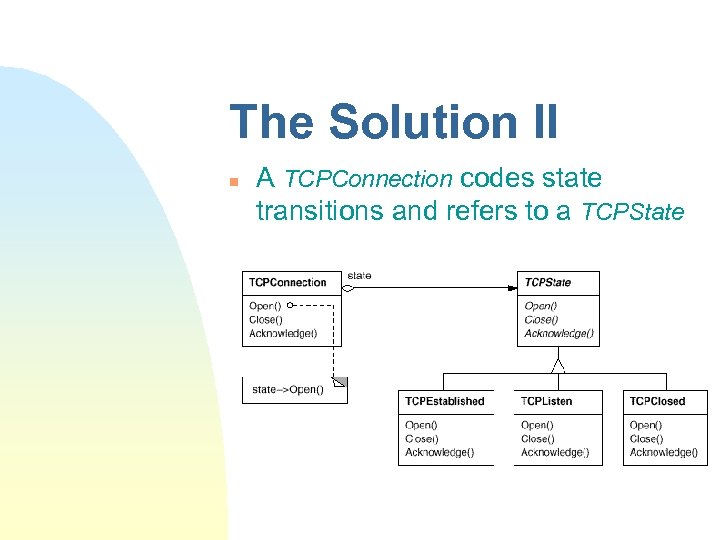
The Solution II n A TCPConnection codes state transitions and refers to a TCPState
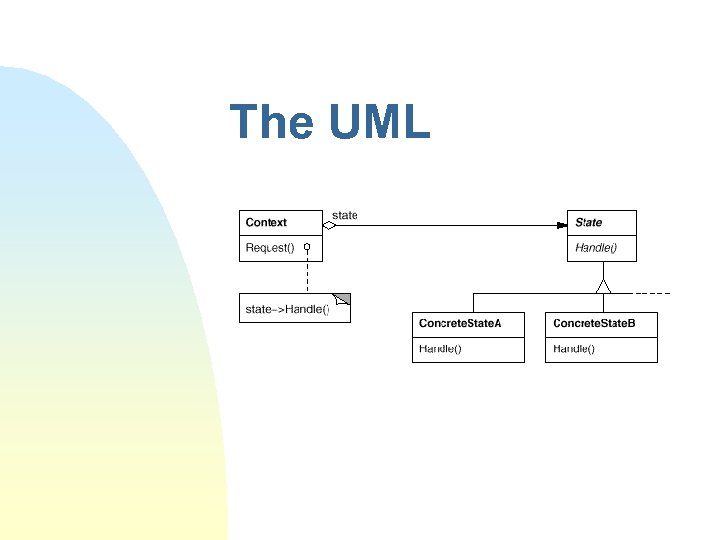
The UML
The Fine Print n n In complex cases it is better to let states define transitions, by adding a Set. State method to Context States may be created on-demand or on Context’s creation This pattern is really a workaround for the lack of dynamic inheritance State is very much like Strategy u State = Many (small) actions u Strategy = One (complex) action
Known Uses n n Streams and connections Different tools on a drawing program u Select, Erase, Crop, Rotate, Add, …
18. Chain of Responsibility n n Decouple the sender and receiver of a message, and give more than one receiver a chance to handle it For example, a context-sensitive help system returns help on the object currently in focus Or its parent if it has no help Recursively
The Requirements n n n Allow calling for context-sensitive help from any graphical object If the object can’t handle the request (it doesn’t include help), it knows where to forward it The set of possible handlers is defined and changed dynamically
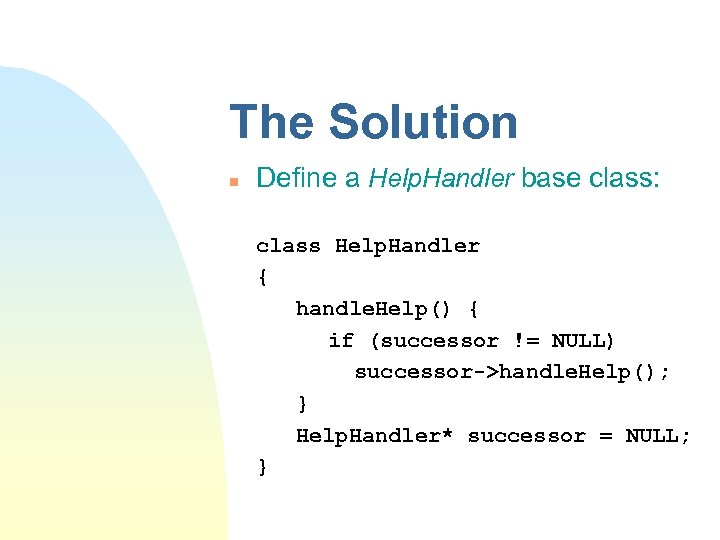
The Solution n Define a Help. Handler base class: class Help. Handler { handle. Help() { if (successor != NULL) successor->handle. Help(); } Help. Handler* successor = NULL; }
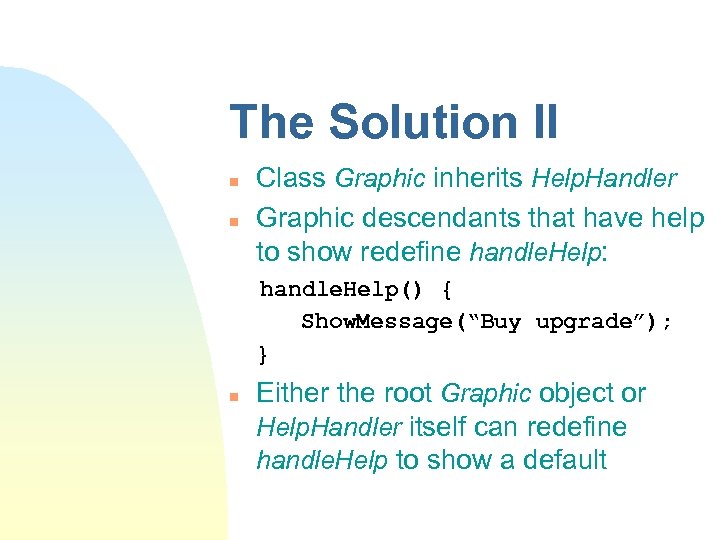
The Solution II n n Class Graphic inherits Help. Handler Graphic descendants that have help to show redefine handle. Help: handle. Help() { Show. Message(“Buy upgrade”); } n Either the root Graphic object or Help. Handler itself can redefine handle. Help to show a default
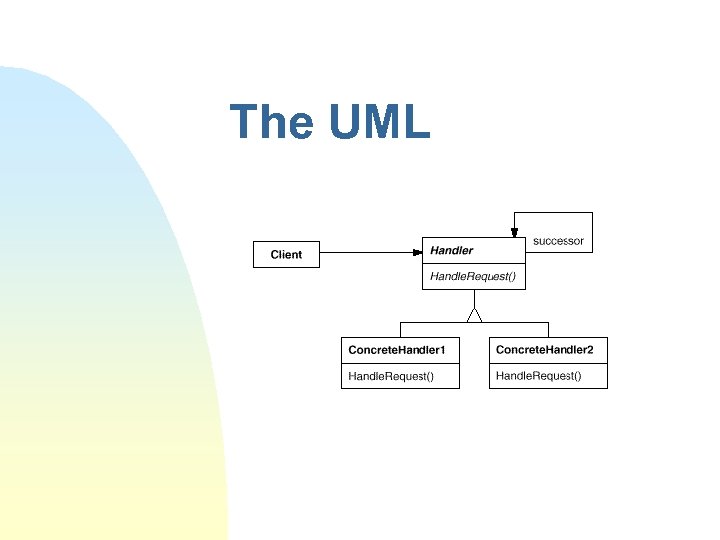
The UML
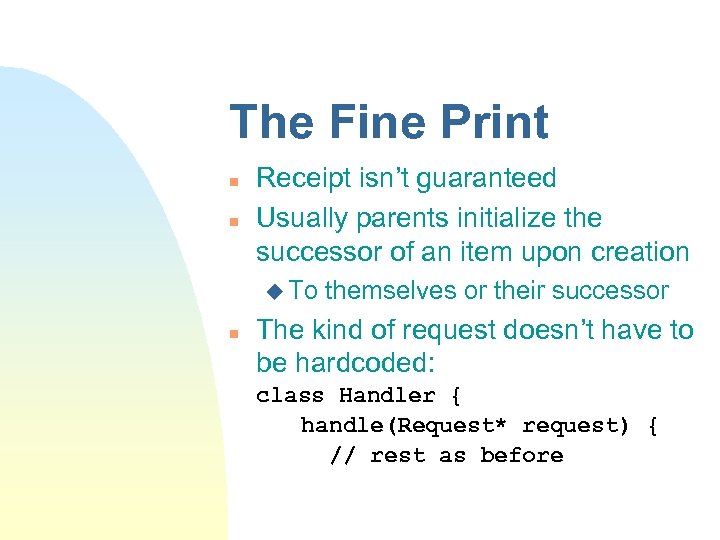
The Fine Print n n Receipt isn’t guaranteed Usually parents initialize the successor of an item upon creation u To n themselves or their successor The kind of request doesn’t have to be hardcoded: class Handler { handle(Request* request) { // rest as before
Known Uses n n Context-sensitive help Messages in a multi-protocol network service Handling user events in a user interface framework Updating contained objects/queries in a displayed document
19. Adapter n n Convert the interface of a class into another that clients expect For example, We’d like to use advanced Text and Spell. Check component that we bought But Text doesn’t inherit Graphic or supply iterators, and Spell. Check doesn’t inherit Visitor We don’t have their source code
The Requirements n n Convert the interface of a class into a more convenient one Without the class’s source code u No n compilation dependencies The class may be a module in a non-object oriented language
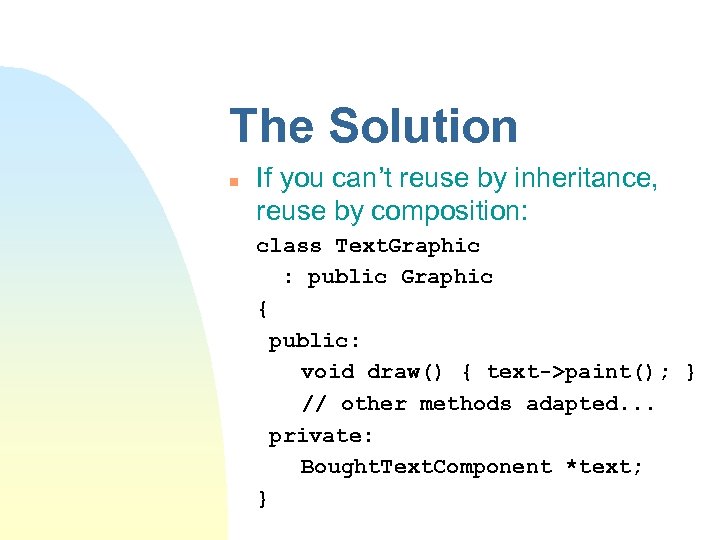
The Solution n If you can’t reuse by inheritance, reuse by composition: class Text. Graphic : public Graphic { public: void draw() { text->paint(); } // other methods adapted. . . private: Bought. Text. Component *text; }
The Requirements II n n Stacks and queues are kinds of lists, but they provide less functionality Linked. Queue is a linked list implementation of interface Queue We’d like to reuse Linked. List for it Inheritance can’t be used if children offer less than their parents
The Solution II n Object Adapter u Class Linked. Queue will hold a reference to a Linked. List and delegate requests to it n Class Adapter u Class Linked. Queue will inherit from both Queue and Linked. List u Method signatures in both classes must match n In C++ class adapters are safer thanks to private inheritance
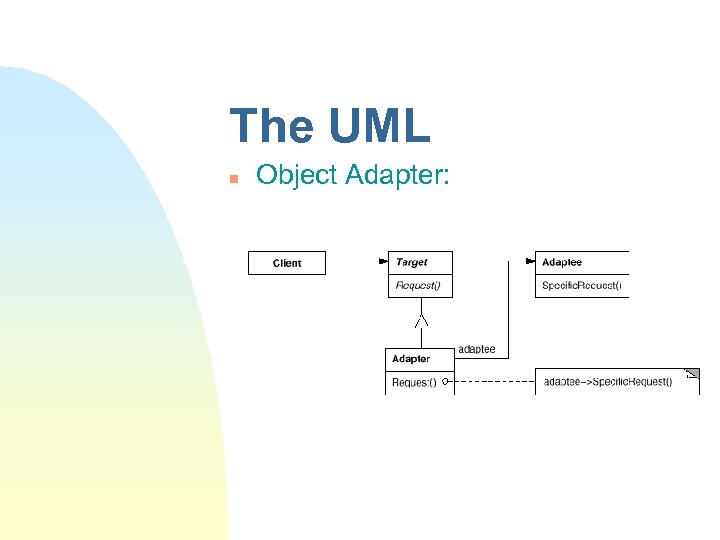
The UML n Object Adapter:

The UML II n Class Adapter:
Known Uses n n n Using external libraries Reusing non O-O code Limiting access to classes
20. Facade n n Provide a unified interface to a set of interfaces of subsystems For example, a compiler is divided into many parts u Scanner, parser, syntax tree data structure, optimizers, generation, … n Most clients just compile files, and don’t need to access inner parts
The Requirements n n Provide a simple, easy to use and remember interface for compilation Keep the flexibility to tweak inner parts when needed
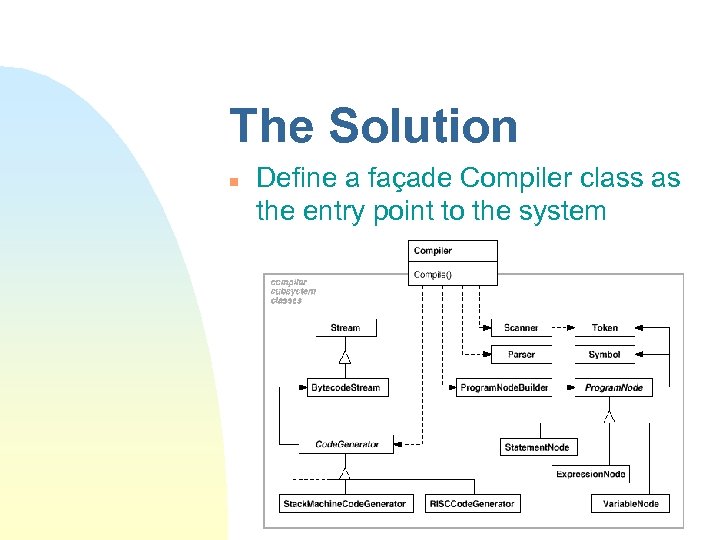
The Solution n Define a façade Compiler class as the entry point to the system
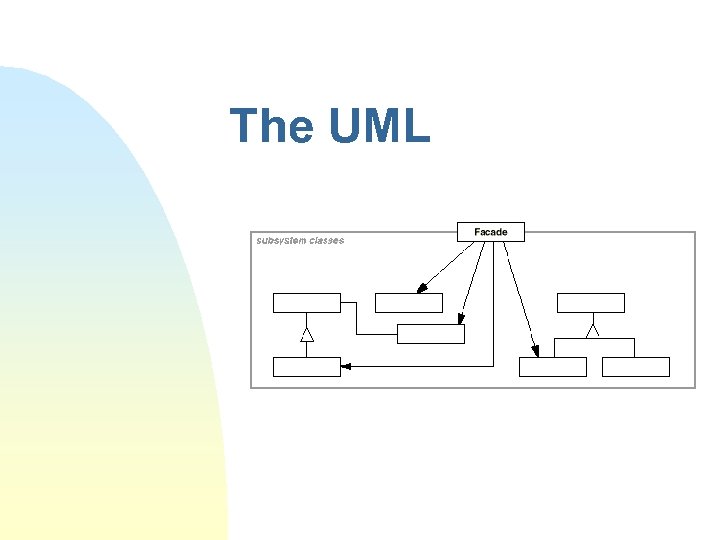
The UML
The Fine Print n Advantages of a façade: u Most users will use a very simple interface for the complex system u Clients are decoupled from the system u Makes it easier to replace the entire system with another n Packages (Java) and namespaces (C++) are ways to define “systems” of classes and decide which classes are visible to the system’s clients
Known Uses n n n A Compiler or XML Parser Browsing objects at runtime The Choices O-O operating system u The File and Memory systems
21. Template Method n n n Define the skeleton of an algorithm and let subclasses complete it For example, a generic binary tree class or sort algorithm cannot be fully implemented until a comparison operator is defined How do we implement everything except the missing part?
The Requirements n n Code once all parts of an algorithm that can be reused Let clients fill in the gaps
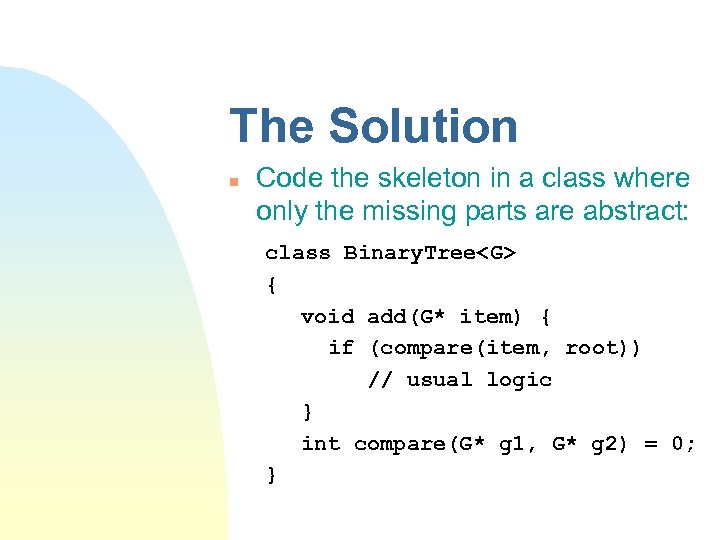
The Solution n Code the skeleton in a class where only the missing parts are abstract: class Binary. Tree<G> { void add(G* item) { if (compare(item, root)) // usual logic } int compare(G* g 1, G* g 2) = 0; }
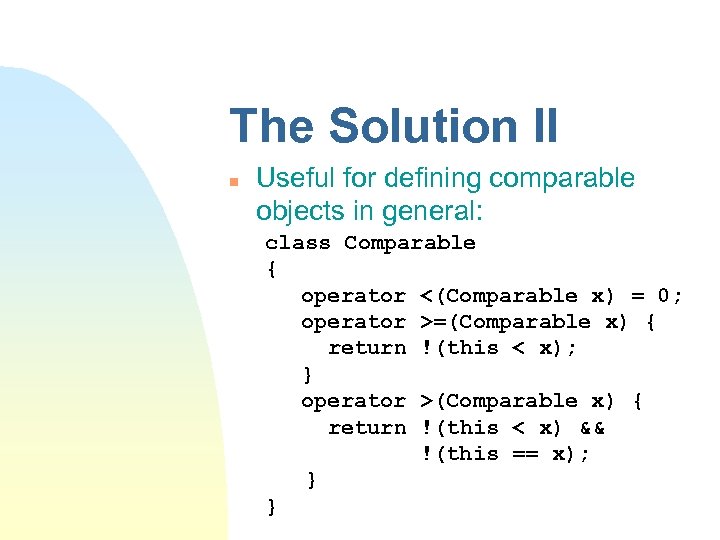
The Solution II n Useful for defining comparable objects in general: class Comparable { operator <(Comparable x) = 0; operator >=(Comparable x) { return !(this < x); } operator >(Comparable x) { return !(this < x) && !(this == x); } }
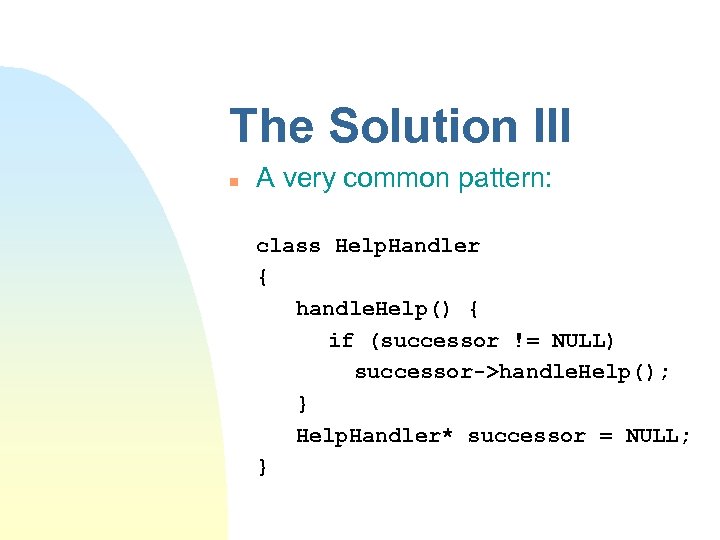
The Solution III n A very common pattern: class Help. Handler { handle. Help() { if (successor != NULL) successor->handle. Help(); } Help. Handler* successor = NULL; }
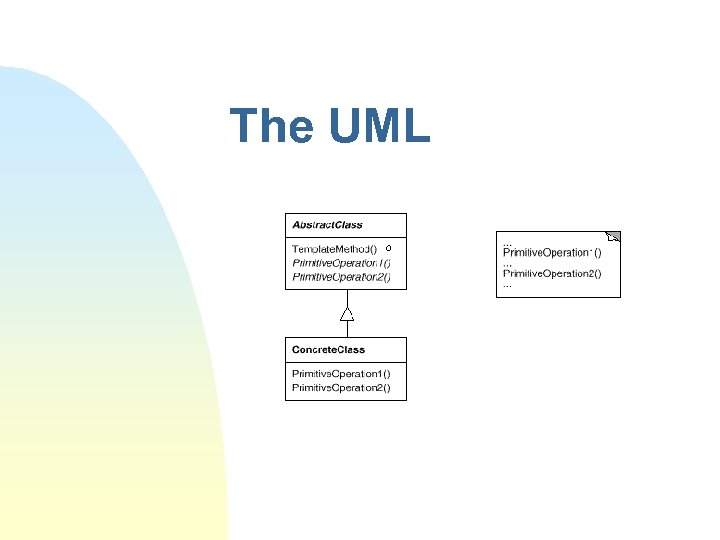
The UML
The Fine Print n n The template method is public, but the ones it calls should be protected The called methods can be declared with an empty implementation if this is a common default This template can be replaced by passing the missing function as a template parameter Java sometimes requires more coding due to single inheritance
Known Uses n n So fundamental that it can be found almost anywhere Factory Method is a kind of template method specialized for creation
22. Interpreter n n n Given a language, define a data structure for representing sentences along with an interpreter for it For example, a program must interpret code or form layout, or support search with regular expression and logical criteria Not covered here
23. Momento n n n Without violating encapsulation, store an object’s internal state so that it can be restored later For example, a program must store a simulation’s data structures before a random or approximation action, and undo must be supported Not covered here
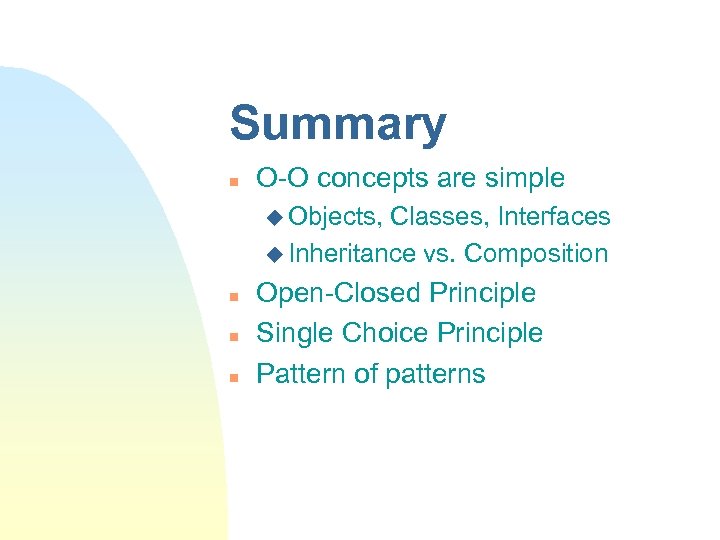
Summary n O-O concepts are simple u Objects, Classes, Interfaces u Inheritance vs. Composition n Open-Closed Principle Single Choice Principle Pattern of patterns
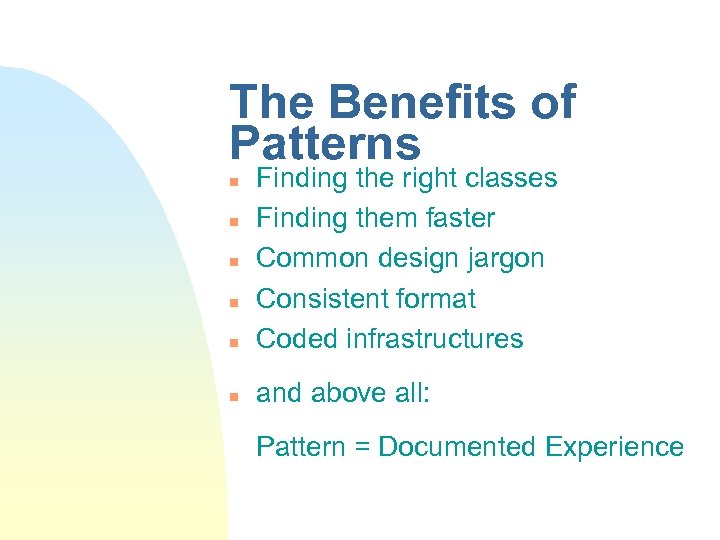
The Benefits of Patterns n Finding the right classes Finding them faster Common design jargon Consistent format Coded infrastructures n and above all: n n Pattern = Documented Experience
Скачать презентацию Design Patterns David Talby This Lecture n
b8174aae1ca6120d863e2f5c137bd12c.ppt