


 Скачать презентацию Design of Mine Ventilation Networks Application of CFD
83d204da78e1209b9be41cddd86827a1.ppt
- Количество слайдов: 39
 Design of Mine Ventilation Networks: Application of CFD A demonstration prepared by Transoft International (P) Ltd, Bangalore.
 Contents • Introduction Objectives of Mine Ventilation Design Mine Structure and Types of Ventilators Pollutant and Heat Sources in Mines • CFD in Mine Ventilation Design • CFD Simulation of Mines using Fluidyn-A Demonstration Study Objectives of the Present Study Problem Definition CFD Solver Parameters Results Suggestions for better Ventilation Design Conclusions
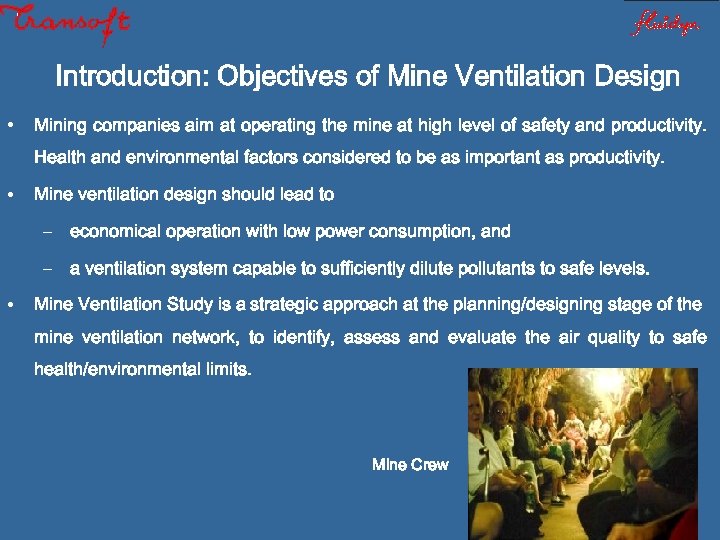 Introduction: Objectives of Mine Ventilation Design • Mining companies aim at operating the mine at high level of safety and productivity. Health and environmental factors considered to be as important as productivity. • Mine ventilation design should lead to – economical operation with low power consumption, and – a ventilation system capable to sufficiently dilute pollutants to safe levels. • Mine Ventilation Study is a strategic approach at the planning/designing stage of the mine ventilation network, to identify, assess and evaluate the air quality to safe health/environmental limits. Mine Crew
 Introduction: Mine Structure Any tool that would be used for mine ventilation design should consider the following features of tunnel and ventilation network: • Tunnel network – Inter-connected network of tunnels of random shape and orientation. – Dynamic nature - shape, size and location of tunnels changes with time/operation. – Flow turbulence due to surface roughness. • Ventilators – Pathways for air circulation between tunnels. – Generation and dissipation of radon, radon progeny and dust concentration in tunnels and their transport by airflow through ventilators between tunnels. – Control of working temperature and humidity.
 Introduction: Types of Ventilators Ventilation design process and tools should also be capable to analyse different kinds of systems such as: • Mechanical Ventilation – Fans and ducting. – Low pressure, high volume air distribution fans. – Exhaust fan at exhaust end of underground mine. • Natural Ventilation – By temperature/density difference of air/gas mixture. – By air Pressure and elevation. • Auxiliary Ventilation - Mechanical ventilation with local fans.
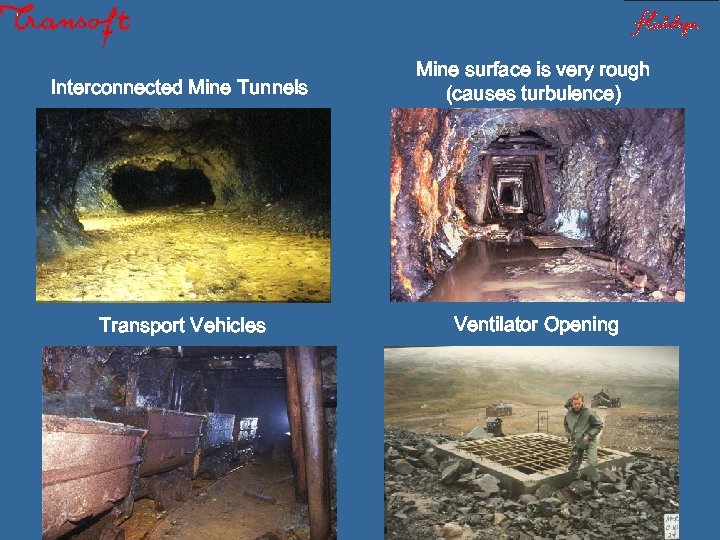 Interconnected Mine Tunnels Mine surface is very rough (causes turbulence) Transport Vehicles Ventilator Opening
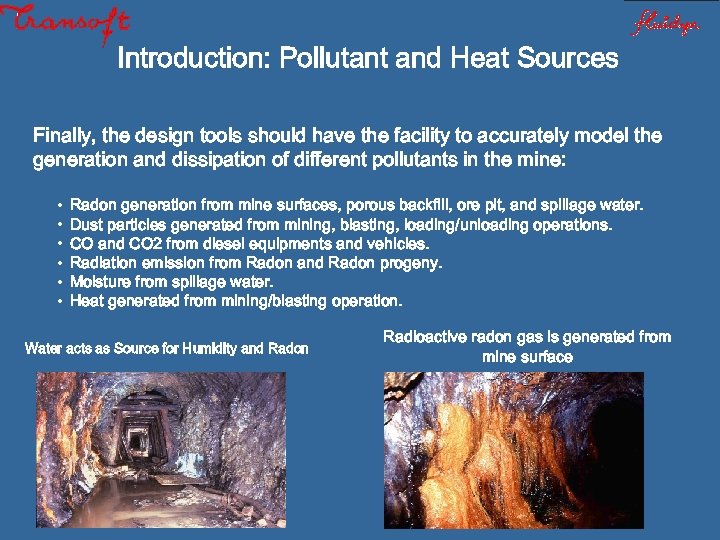 Introduction: Pollutant and Heat Sources Finally, the design tools should have the facility to accurately model the generation and dissipation of different pollutants in the mine: • • • Radon generation from mine surfaces, porous backfill, ore pit, and spillage water. Dust particles generated from mining, blasting, loading/unloading operations. CO and CO 2 from diesel equipments and vehicles. Radiation emission from Radon and Radon progeny. Moisture from spillage water. Heat generated from mining/blasting operation. Water acts as Source for Humidity and Radon Radioactive radon gas is generated from mine surface
 CFD for the Design of Efficient Mine Ventilation Network
 CFD in Mine Ventilation System Design: Results from CFD Simulations CFD tools, such as Fluidyn-VENTMINE, provide following capabilities to help the design of ventilation systems for mines: • Simulation of air flow patterns (aeroulic studies) for a given mine-ventilation configuration. • Simulation of pollutant and radioactive gas/dust/particle generation and dispersion. • Prediction of the radiation dose from radioactive materials. • Prediction of the oxygen distribution in the mine. • Identify the pockets/locations where pollutant/radiation level is above permissible limits. • Redesign the Ventilation system for better air quality. • For the new design/construction of mine network, CFD simulation provides, – Total quantity of air flow by exhaust fans to meet air quality requirements inside the mine. – Optimal locations of the fans. – Optimal locations, dimensions and orientation of the ventilators and passages. – Safety design considering fire/explosion inside the mine.
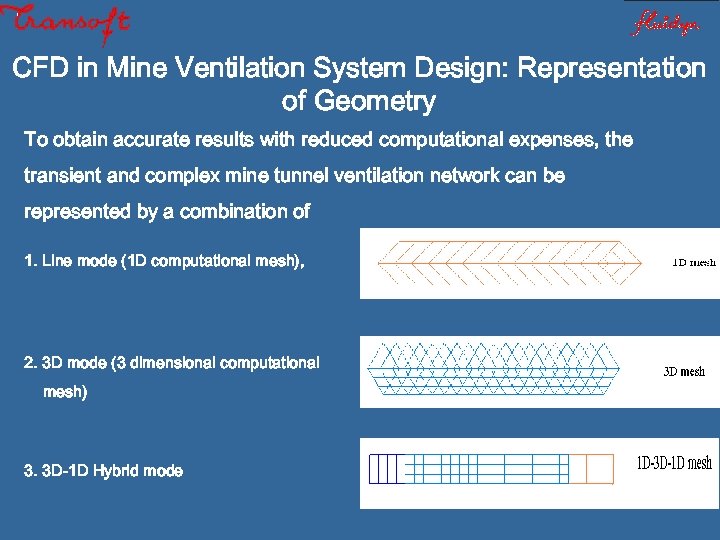 CFD in Mine Ventilation System Design: Representation of Geometry To obtain accurate results with reduced computational expenses, the transient and complex mine tunnel ventilation network can be represented by a combination of 1. Line mode (1 D computational mesh), 2. 3 D mode (3 dimensional computational mesh) 3. 3 D-1 D Hybrid mode
 Representation of Geometry (Continued) Characteristics of the three modes in Fluidyn-VENTMINE are: • 1 D MODE – Flow is one-dimensional; however, effects of the wall roughness can be considered. – Suitable in regions away from intersections and flow re-circulation zones. – Computationally least expensive, but 2 D and 3 D effects such as boundary layers and flow turnings will not be properly resolved. • 3 D-1 D HYBRID MODE – 3 D-1 D coupled flow. – Proper interpolation at 3 D-1 D mesh interface. – Computationally economical than full 3 D. • 3 D MODE – Full 3 D flow. – Most accurate, however, computationally more expensive.
 CFD in Mine Ventilation System Design: Flow Characteristics Fluidyn-VENTMINE can model the following physical/chemical processes occurring in a mine network: • Turbulent air flow. • Radon gas emission from walls and/or water and dispersion in air stream. • Radon progeny generation and dispersion. • Particle generation and dispersion in air. • Heat emission from different equipments and its dissipation. • Change in humidity.
 CFD Simulation of Mines using Fluidyn-VENTMINE: A Demonstration Study Prepared by Transoft International (P) Ltd, Bangalore.
 Objectives of the Present Study • To simulate the air flow field in a representative mine tunnel ventilation network. • To simulate radon emission and dispersion from the tunnel walls in the above mentioned flow field. • To simulate the generation, dispersion, and consumption of radon progeny in the same turbulent air flow field. • To demonstrate the feasibility of using 1 D-3 D hybrid computational mesh. One simulation is done with a fully 3 D mesh. Then this simulation is repeated using a 1 D-3 D hybrid mesh in one of the tunnels.
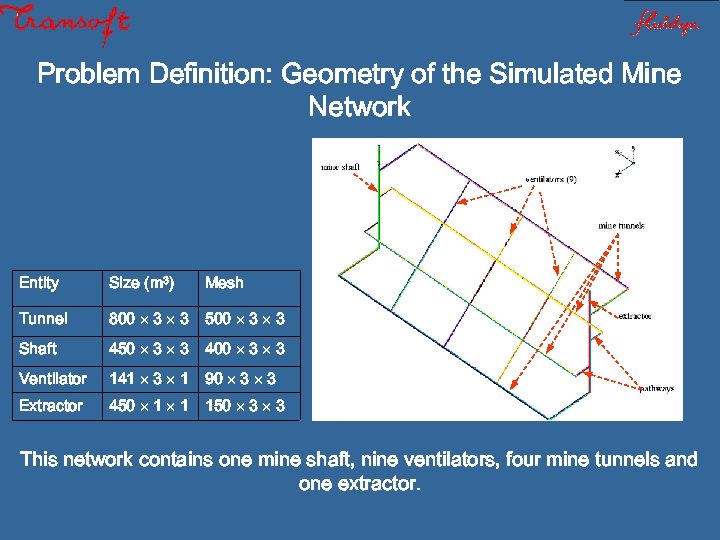 Problem Definition: Geometry of the Simulated Mine Network Entity Size (m 3) Mesh Tunnel 800 3 3 500 3 3 Shaft 450 3 3 400 3 3 Ventilator 141 3 1 90 3 3 Extractor 450 1 1 150 3 3 This network contains one mine shaft, nine ventilators, four mine tunnels and one extractor.
 Problem Definition: Flow Configuration • Flow is considered to be incompressible and viscous. • Turbulence is modeled by standard k- ε model. • Roughness factor of 1. 8 E-03 m used for tunnels. • Radon and its progeny are considered as passive scalars. • Ra 222 emission is modeled by surface sources on the tunnel walls. • Generation rates of the daughter products Po 218, Pb 214, Bi 214, and Pb 210 calculated using chemical reaction equations based on half-life time. (Continued…)
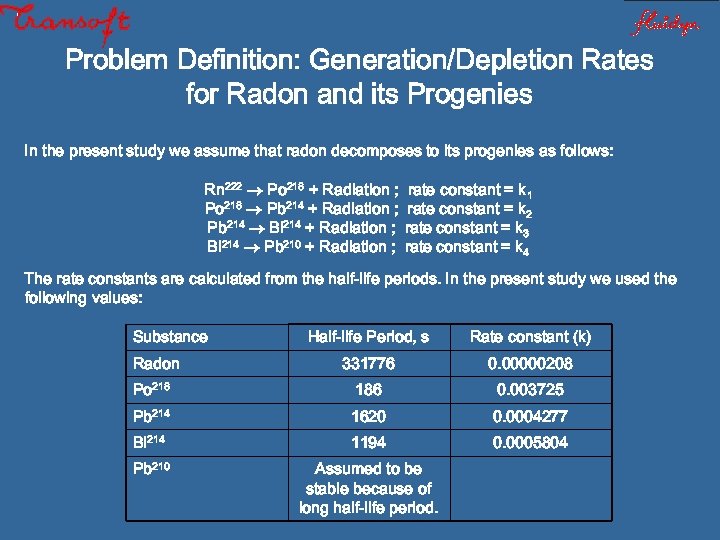 Problem Definition: Generation/Depletion Rates for Radon and its Progenies In the present study we assume that radon decomposes to its progenies as follows: Rn 222 Po 218 + Radiation ; Po 218 Pb 214 + Radiation ; Pb 214 Bi 214 + Radiation ; Bi 214 Pb 210 + Radiation ; rate constant = k 1 rate constant = k 2 rate constant = k 3 rate constant = k 4 The rate constants are calculated from the half-life periods. In the present study we used the following values: Substance Half-life Period, s Rate constant (k) 331776 0. 00000208 Po 218 186 0. 003725 Pb 214 1620 0. 0004277 Bi 214 1194 0. 0005804 Pb 210 Assumed to be stable because of long half-life period. Radon
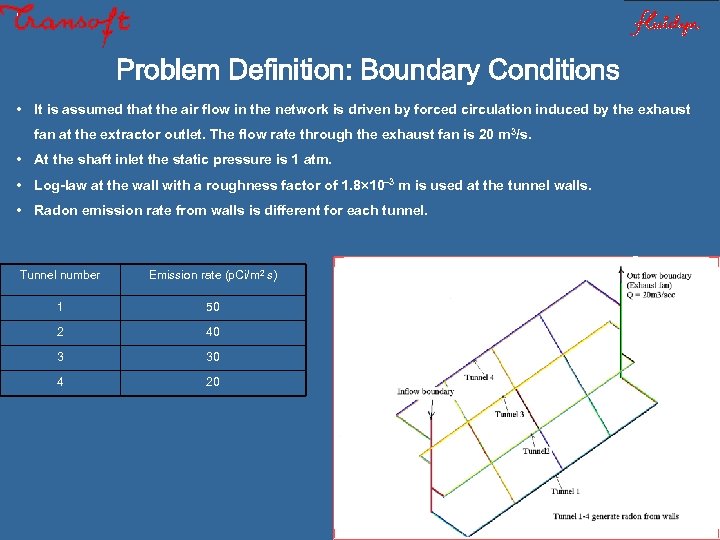 Problem Definition: Boundary Conditions • It is assumed that the air flow in the network is driven by forced circulation induced by the exhaust fan at the extractor outlet. The flow rate through the exhaust fan is 20 m 3/s. • At the shaft inlet the static pressure is 1 atm. • Log-law at the wall with a roughness factor of 1. 8 10 3 m is used at the tunnel walls. • Radon emission rate from walls is different for each tunnel. Tunnel number Emission rate (p. Ci/m 2 s) 1 50 2 40 3 30 4 20
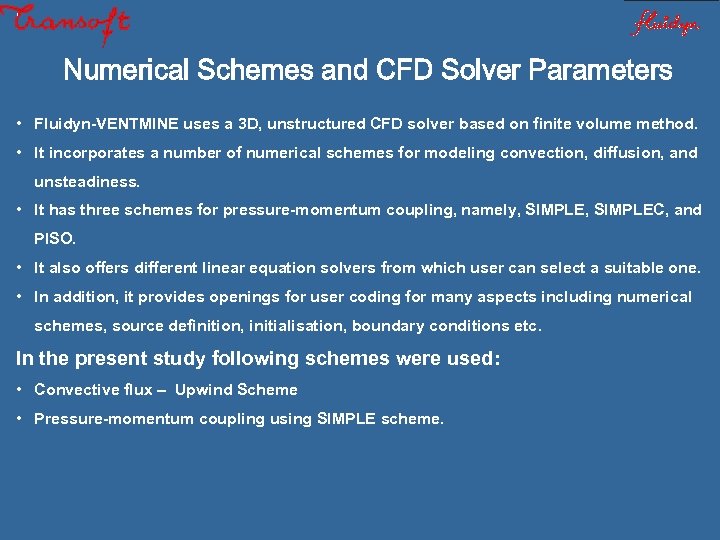 Numerical Schemes and CFD Solver Parameters • Fluidyn-VENTMINE uses a 3 D, unstructured CFD solver based on finite volume method. • It incorporates a number of numerical schemes for modeling convection, diffusion, and unsteadiness. • It has three schemes for pressure-momentum coupling, namely, SIMPLEC, and PISO. • It also offers different linear equation solvers from which user can select a suitable one. • In addition, it provides openings for user coding for many aspects including numerical schemes, source definition, initialisation, boundary conditions etc. In the present study following schemes were used: • Convective flux – Upwind Scheme • Pressure-momentum coupling using SIMPLE scheme.
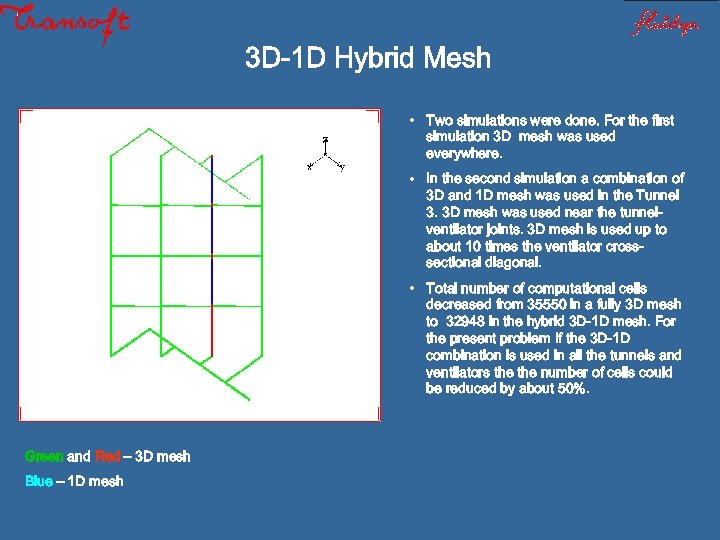 3 D-1 D Hybrid Mesh • Two simulations were done. For the first simulation 3 D mesh was used everywhere. • In the second simulation a combination of 3 D and 1 D mesh was used in the Tunnel 3. 3 D mesh was used near the tunnelventilator joints. 3 D mesh is used up to about 10 times the ventilator crosssectional diagonal. • Total number of computational cells decreased from 35550 in a fully 3 D mesh to 32948 in the hybrid 3 D-1 D mesh. For the present problem If the 3 D-1 D combination is used in all the tunnels and ventilators the number of cells could be reduced by about 50%. Green and Red – 3 D mesh Blue – 1 D mesh
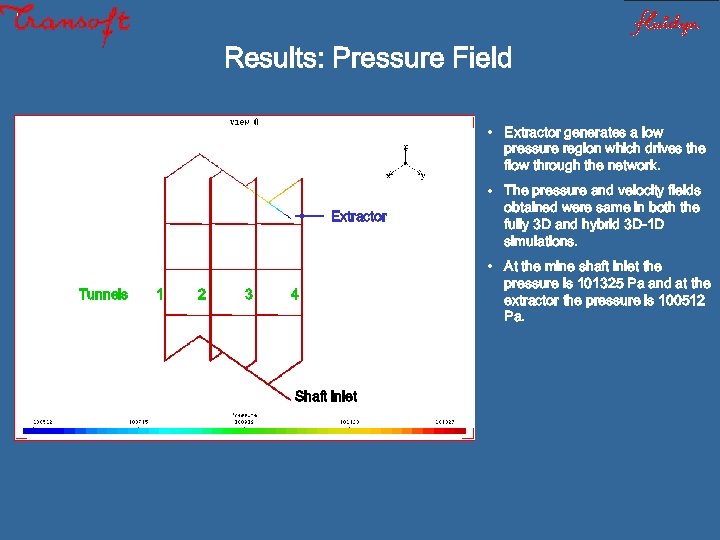 Results: Pressure Field • Extractor generates a low pressure region which drives the flow through the network. Extractor Tunnels 1 2 3 4 Shaft inlet • The pressure and velocity fields obtained were same in both the fully 3 D and hybrid 3 D-1 D simulations. • At the mine shaft inlet the pressure is 101325 Pa and at the extractor the pressure is 100512 Pa.
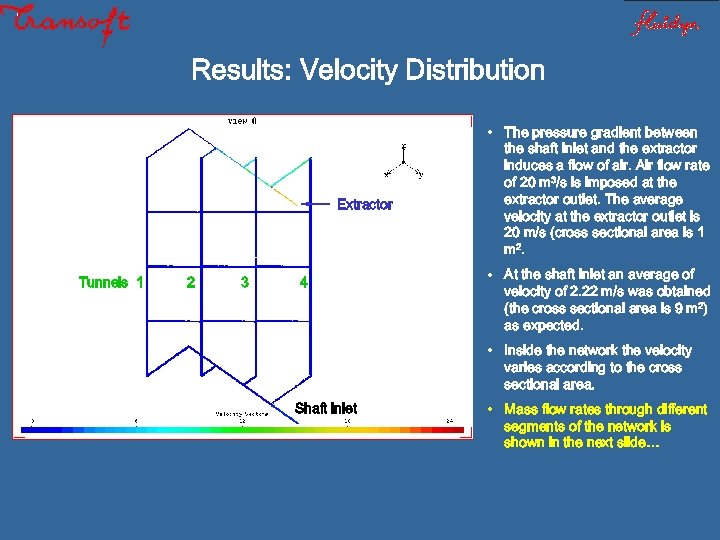 Results: Velocity Distribution Extractor Tunnels 1 2 3 4 • The pressure gradient between the shaft inlet and the extractor induces a flow of air. Air flow rate of 20 m 3/s is imposed at the extractor outlet. The average velocity at the extractor outlet is 20 m/s (cross sectional area is 1 m 2. • At the shaft inlet an average of velocity of 2. 22 m/s was obtained (the cross sectional area is 9 m 2) as expected. • Inside the network the velocity varies according to the cross sectional area. Shaft inlet • Mass flow rates through different segments of the network is shown in the next slide…
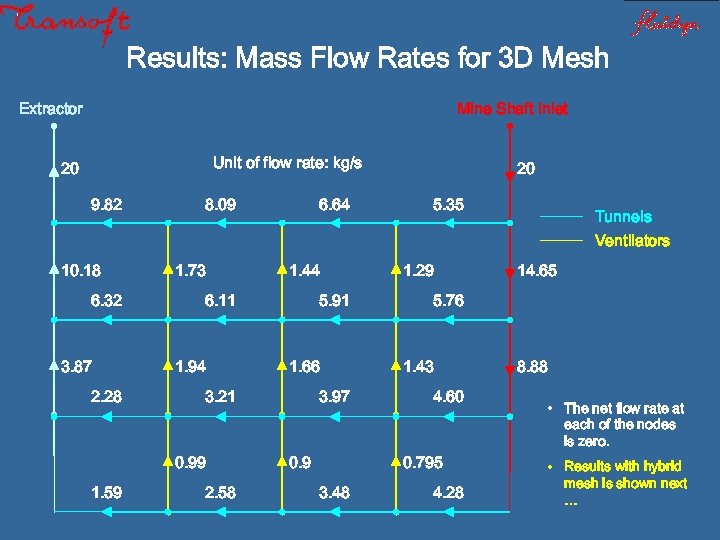 Results: Mass Flow Rates for 3 D Mesh Extractor Mine Shaft Inlet Unit of flow rate: kg/s 20 9. 82 10. 18 6. 32 3. 87 2. 28 8. 09 1. 73 1. 44 6. 11 1. 94 5. 91 1. 66 3. 21 0. 99 1. 59 6. 64 2. 58 3. 97 0. 9 20 5. 35 1. 29 14. 65 5. 76 1. 43 4. 60 0. 795 3. 48 Tunnels Ventilators 4. 28 8. 88 • The net flow rate at each of the nodes is zero. • Results with hybrid mesh is shown next …
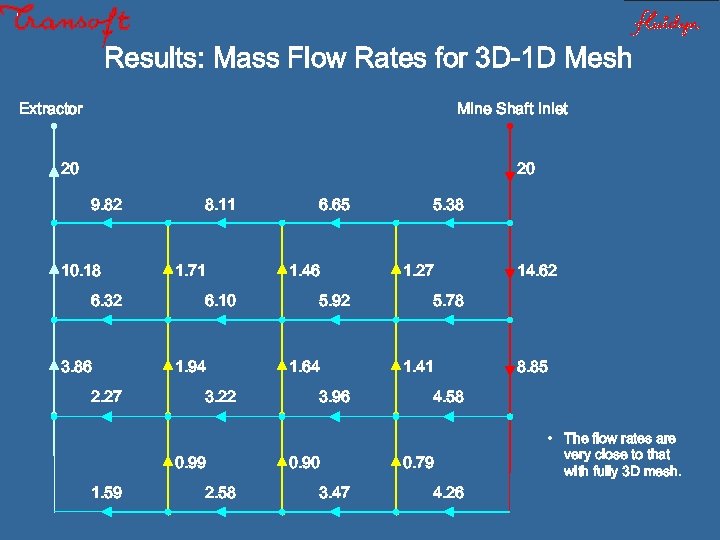 Results: Mass Flow Rates for 3 D-1 D Mesh Extractor Mine Shaft Inlet 20 20 9. 82 10. 18 6. 32 3. 86 2. 27 8. 11 1. 71 6. 10 1. 94 3. 22 0. 99 1. 59 2. 58 6. 65 1. 46 5. 92 1. 64 3. 96 0. 90 3. 47 5. 38 1. 27 14. 62 5. 78 1. 41 8. 85 4. 58 0. 79 4. 26 • The flow rates are very close to that with fully 3 D mesh.
 Results: Observations • Air flow is non-uniformly distributed to mine tunnels. • Tunnel away from extractor exhaust fan, in this case Tunnel 1, gets less air flow. • 3 D-1 D hybrid mesh could be used if regions of 1 D and 3 D mesh are judiciously selected. Generally, 1 D mesh should be used sufficiently away from the regions of flow turning, such as tunnelventilator joints. • Results obtained with the fully 3 D mesh and hybrid 3 D-1 D mesh are nearly same.
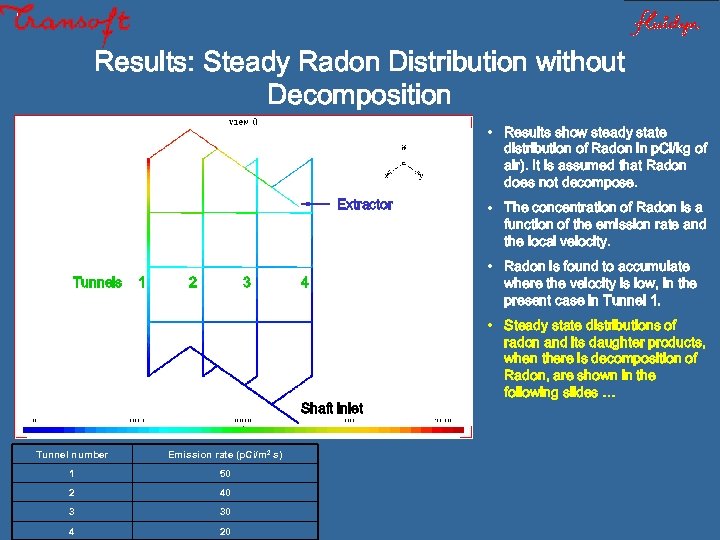 Results: Steady Radon Distribution without Decomposition • Results show steady state distribution of Radon in p. Ci/kg of air). It is assumed that Radon does not decompose. Extractor Tunnels 1 2 3 4 Shaft inlet Tunnel number Emission rate (p. Ci/m 2 s) 1 50 2 40 3 30 4 20 • The concentration of Radon is a function of the emission rate and the local velocity. • Radon is found to accumulate where the velocity is low, in the present case in Tunnel 1. • Steady state distributions of radon and its daughter products, when there is decomposition of Radon, are shown in the following slides …
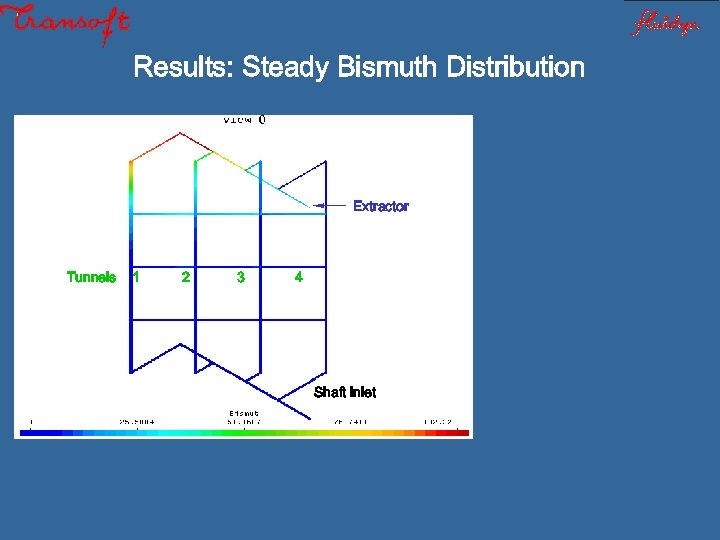
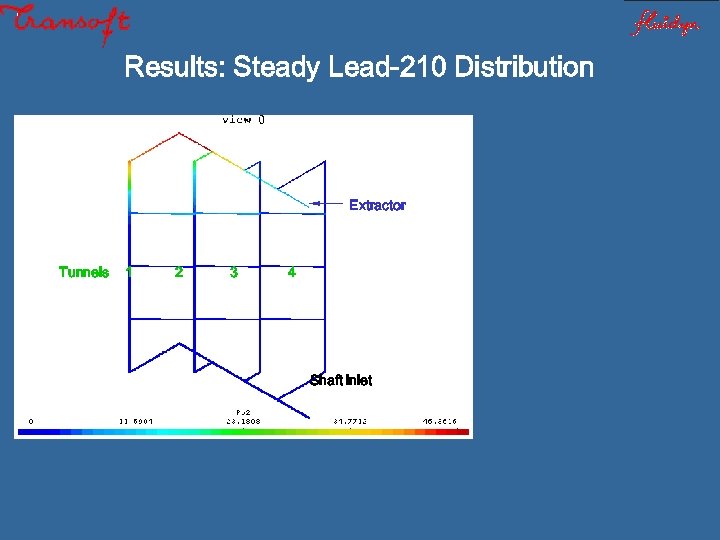
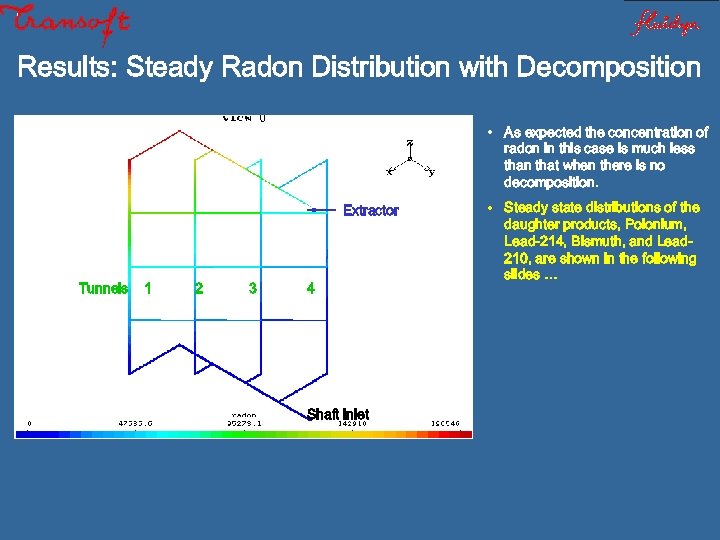 Results: Steady Radon Distribution with Decomposition • As expected the concentration of radon in this case is much less than that when there is no decomposition. Extractor Tunnels 1 2 2 3 3 4 4 Shaft inlet • Steady state distributions of the daughter products, Polonium, Lead-214, Bismuth, and Lead 210, are shown in the following slides …
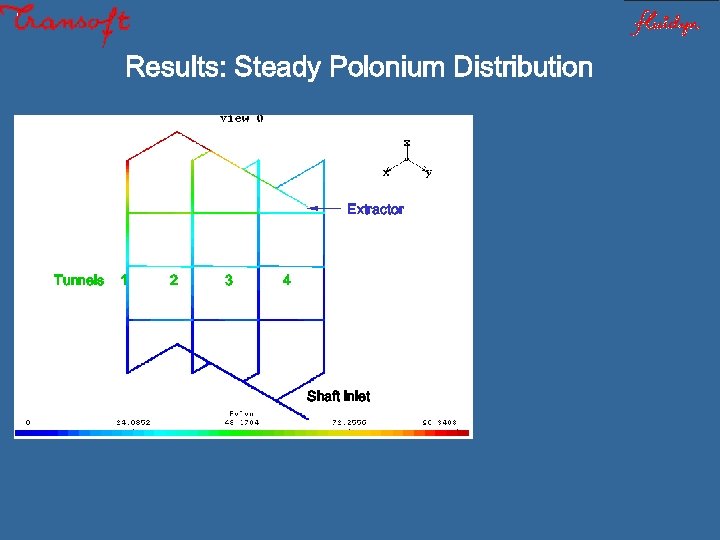 Results: Steady Polonium Distribution Extractor Tunnels 1 2 3 4 Shaft inlet
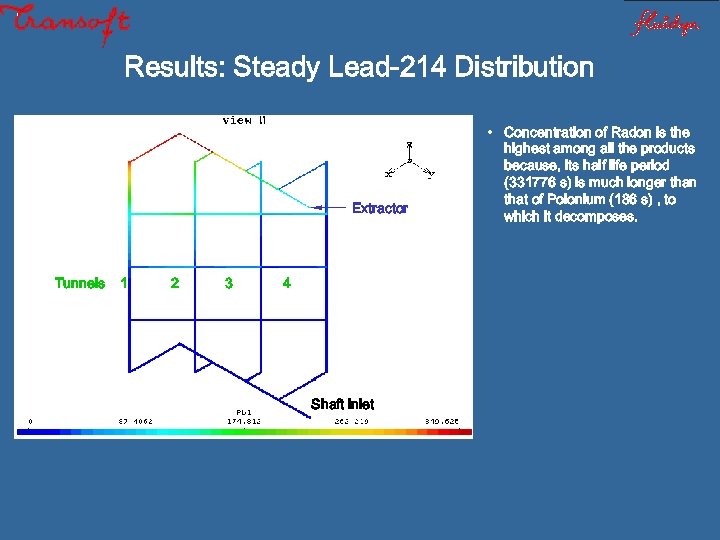 Results: Steady Lead-214 Distribution Extractor Tunnels 1 2 3 4 Shaft inlet • Concentration of Radon is the highest among all the products because, its half life period (331776 s) is much longer than that of Polonium (186 s) , to which it decomposes.
 Results: Steady Bismuth Distribution Extractor Tunnels 1 2 3 4 Shaft inlet
 Results: Steady Lead-210 Distribution Extractor Tunnels 1 2 3 4 Shaft inlet
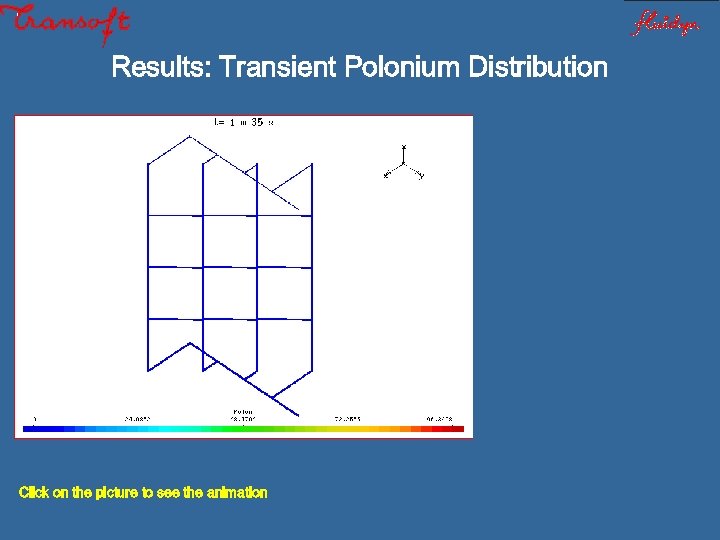
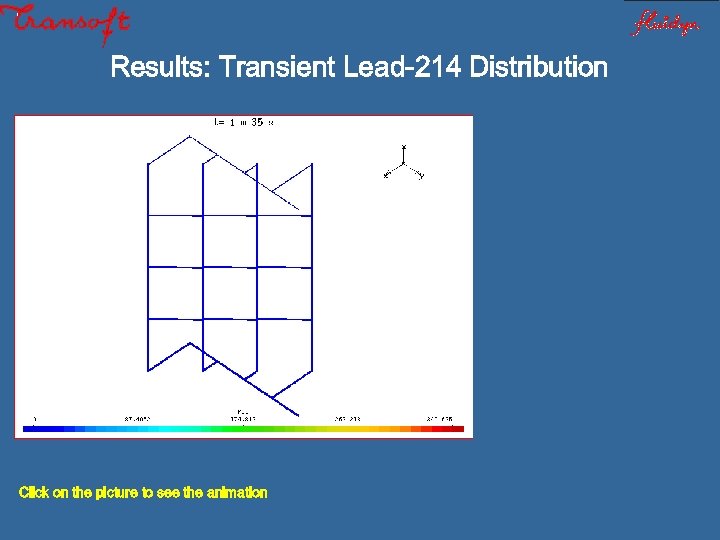
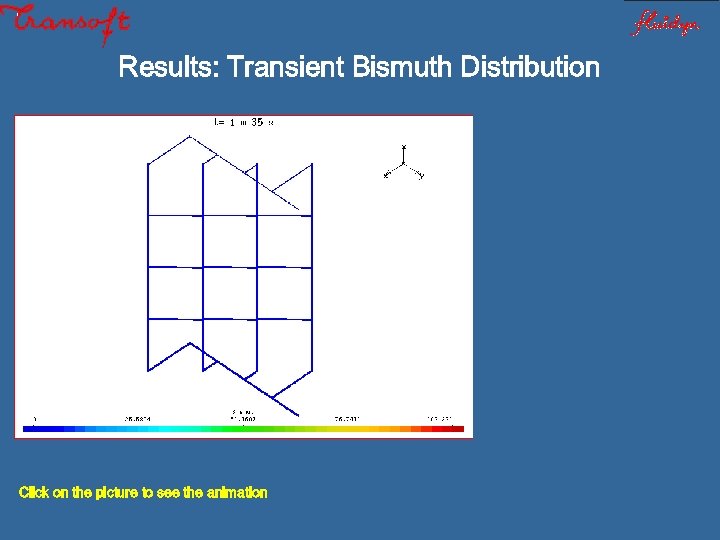
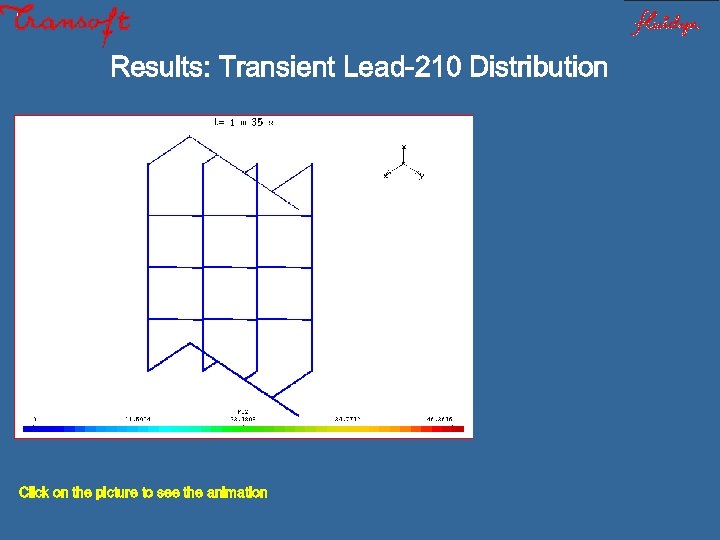
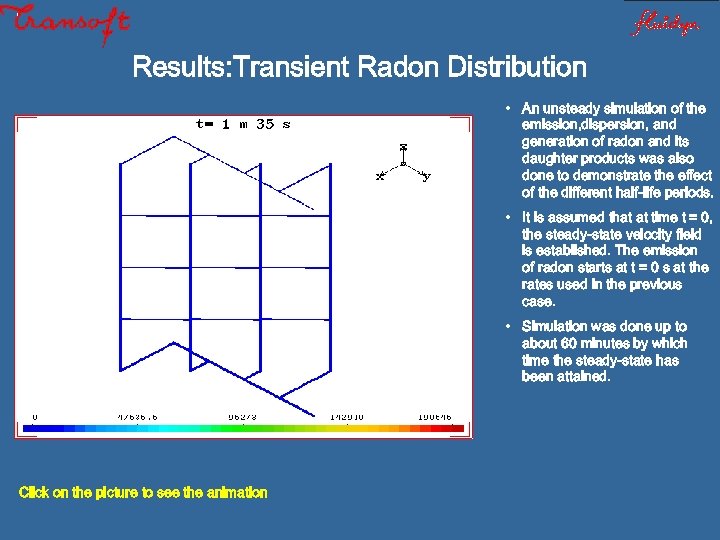 Results: Transient Radon Distribution • An unsteady simulation of the emission, dispersion, and generation of radon and its daughter products was also done to demonstrate the effect of the different half-life periods. • It is assumed that at time t = 0, the steady-state velocity field is established. The emission of radon starts at t = 0 s at the rates used in the previous case. • Simulation was done up to about 60 minutes by which time the steady-state has been attained. Click on the picture to see the animation
 Results: Transient Polonium Distribution Click on the picture to see the animation
 Results: Transient Lead-214 Distribution Click on the picture to see the animation
 Results: Transient Bismuth Distribution Click on the picture to see the animation
 Results: Transient Lead-210 Distribution Click on the picture to see the animation
 Conclusions • Simulation of air flow for a typical mine ventilation network has been performed. Emission, generation, dispersion, and accumulation of radioactive substances such as radon and its progenies in this flow field are studied and results presented. • Use of a fully 3 D mesh and capability to use a hybrid 3 D-1 D mesh has been demonstrated.
 A demonstration prepared by Transoft International (P) Ltd 7, boulevard de la Libération 93200 SAINT-DENIS FRANCE : 33 01 42 43 16 66 : 33 01 42 43 50 33 e-mail : marketing@fluidyn. com 1191 Crestmont Drive LAFAYETTE CA 94549 - 3004 USA : 1 925 284 1200 : 1 925 284 1240 e-mail : market_USA@fluidyn. com Regus Centre, Knyvett House The Causeway, STAINES MIDDLESEX, TW 18 3 BA UNITED KINGDOM : 44 0 1 784 898 000 : 44 0 1 784 898 111 e-mail : marketing@fluidyn. com 146, Ring Road, Sector 5, H. S. R LAYOUT BANGALORE 5600 34 INDIA : 91 80 25526507 : 91 80 25501964 e-mail : marketasia@fluidyn. com
 We welcome your feedback and queries. Please send them to … marketasia@fluidyn. com Transoft International (P) Ltd #146, Ring Road, Sector 5, H. S. R Layout Bangalore 5600 34 INDIA : 91 80 25526507 : 91 80 25501964