


 Скачать презентацию Design and Implementation of the Kanchan TM Arsenic
f725eb9b3c2e13f1c45514c98bb85a32.ppt
- Количество слайдов: 63
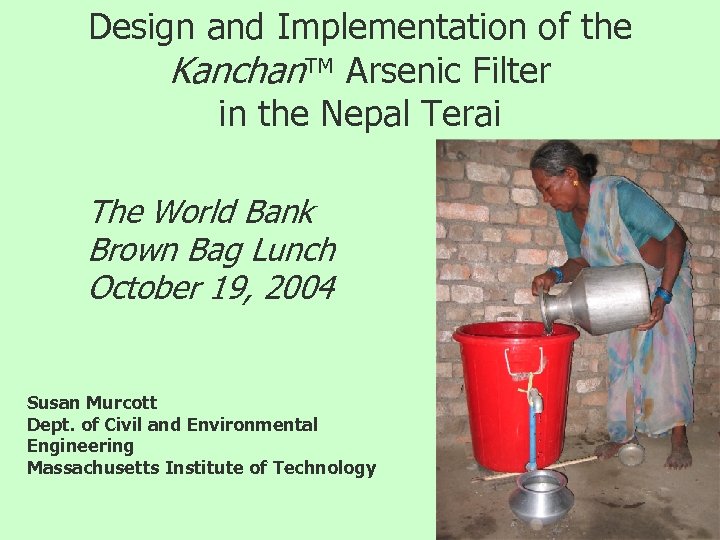 Design and Implementation of the Kanchan. TM Arsenic Filter in the Nepal Terai The World Bank Brown Bag Lunch October 19, 2004 Susan Murcott Dept. of Civil and Environmental Engineering Massachusetts Institute of Technology
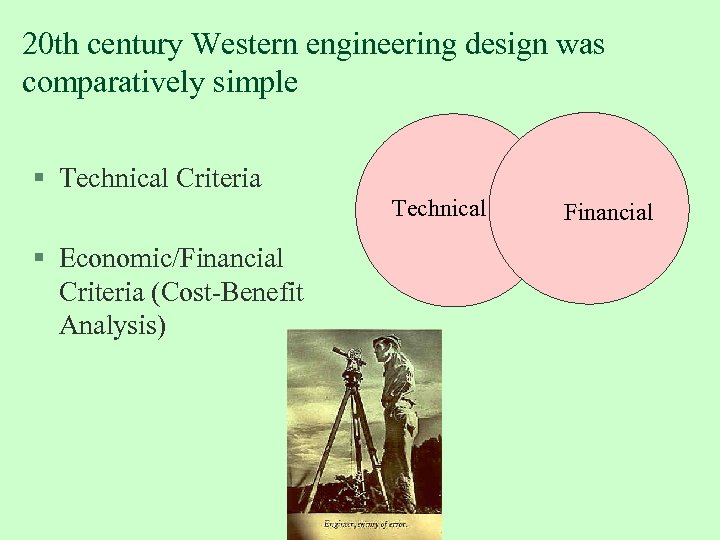 20 th century Western engineering design was comparatively simple § Technical Criteria Technical § Economic/Financial Criteria (Cost-Benefit Analysis) Financial
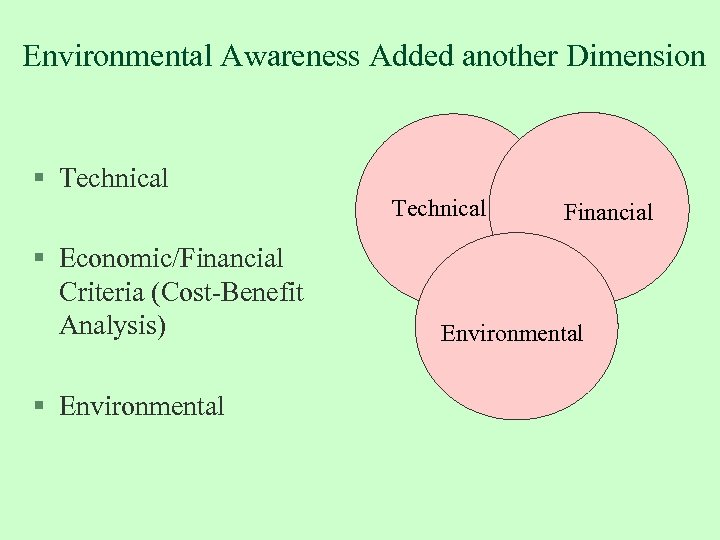 Environmental Awareness Added another Dimension § Technical § Economic/Financial Criteria (Cost-Benefit Analysis) § Environmental Financial Environmental
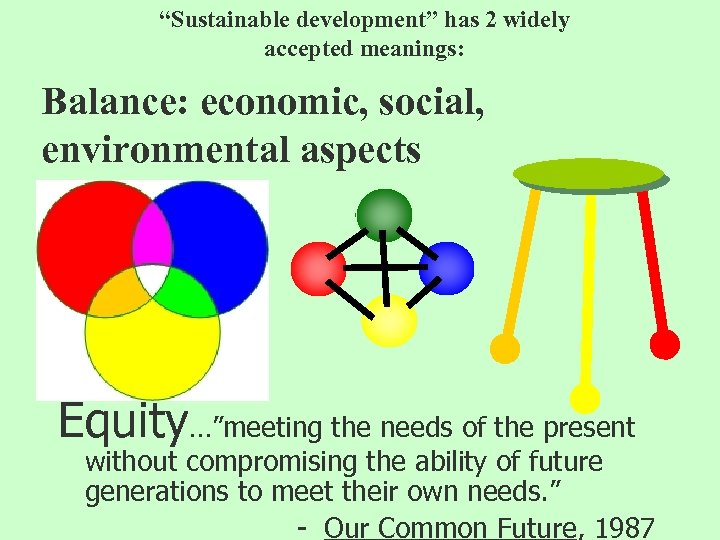 “Sustainable development” has 2 widely accepted meanings: Balance: economic, social, environmental aspects Equity…”meeting the needs of the present without compromising the ability of future generations to meet their own needs. ” - Our Common Future, 1987
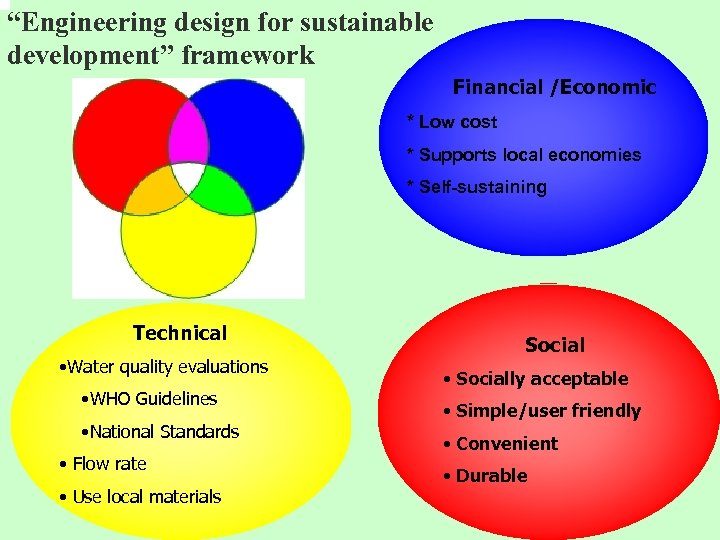 “Engineering design for sustainable development” framework Financial /Economic * Low cost * Supports local economies * Self-sustaining Technical • Water quality evaluations • WHO Guidelines • National Standards • Flow rate • Use local materials Social • Socially acceptable • Simple/user friendly • Convenient • Durable
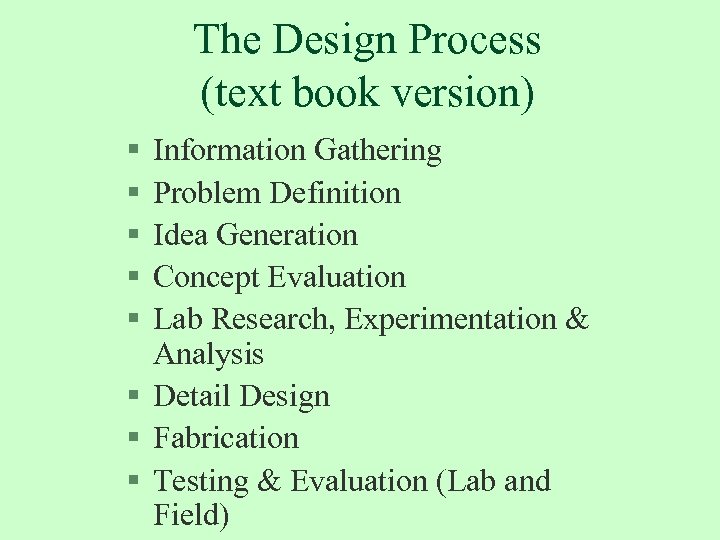 The Design Process (text book version) § § § Information Gathering Problem Definition Idea Generation Concept Evaluation Lab Research, Experimentation & Analysis § Detail Design § Fabrication § Testing & Evaluation (Lab and Field)
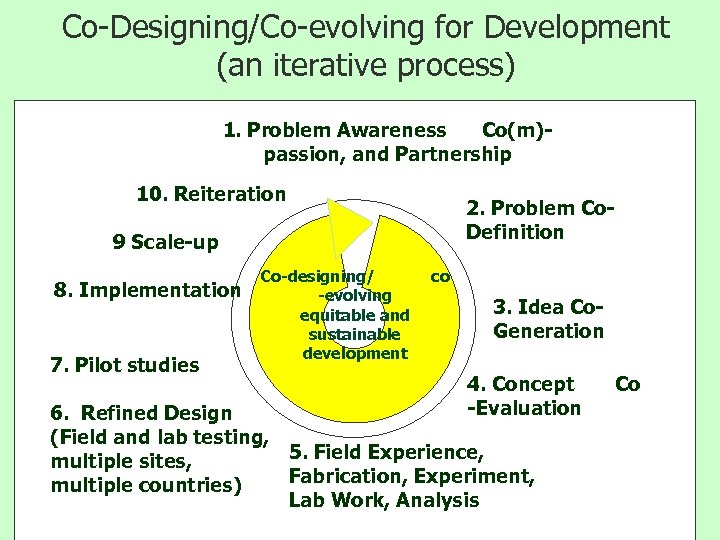 Co-Designing/Co-evolving for Development (an iterative process) 1. Problem Awareness Co(m)passion, and Partnership 10. Reiteration 2. Problem Co. Definition 9 Scale-up 8. Implementation 7. Pilot studies Co-designing/ -evolving equitable and sustainable development co 3. Idea Co. Generation 4. Concept -Evaluation 6. Refined Design (Field and lab testing, 5. Field Experience, multiple sites, Fabrication, Experiment, multiple countries) Lab Work, Analysis Co
 1. Problem Awareness, Co(m)-passion, Partnership
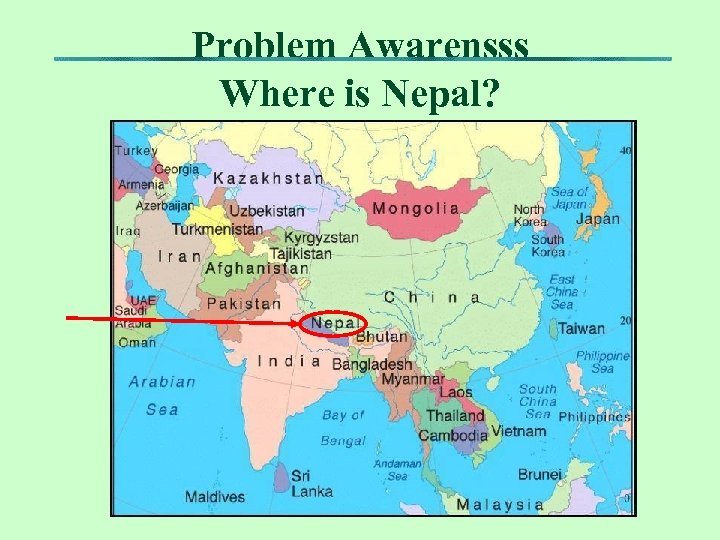 Problem Awarensss Where is Nepal?
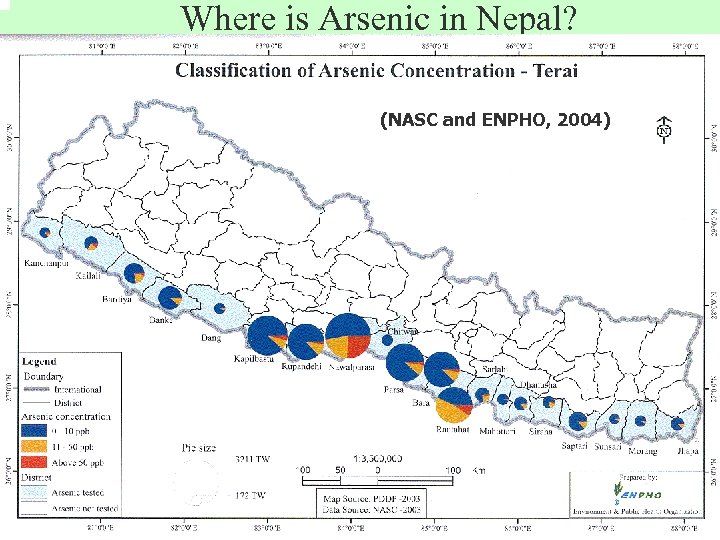 Where is Arsenic in Nepal? (NASC and ENPHO, 2004)
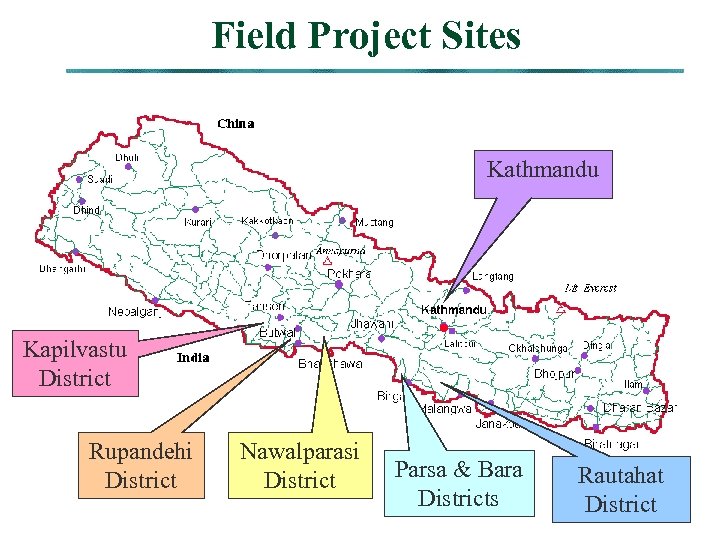 Field Project Sites Kathmandu Kapilvastu District Rupandehi District Nawalparasi District Parsa & Bara Districts Rautahat District
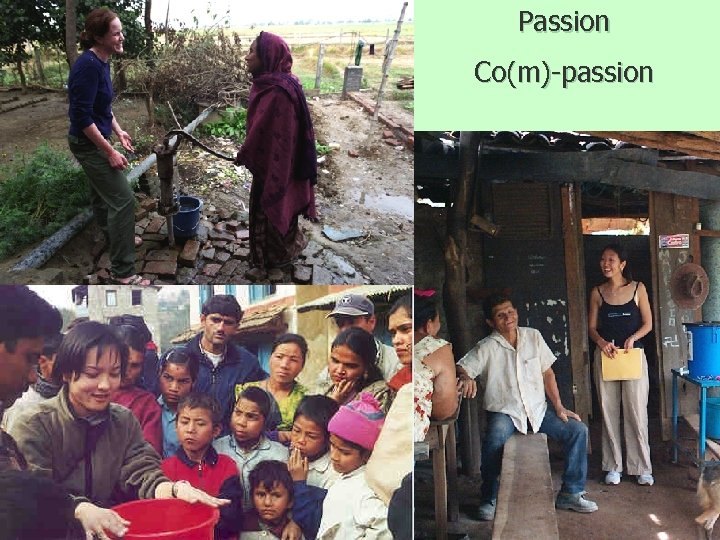 Passion Co(m)-passion
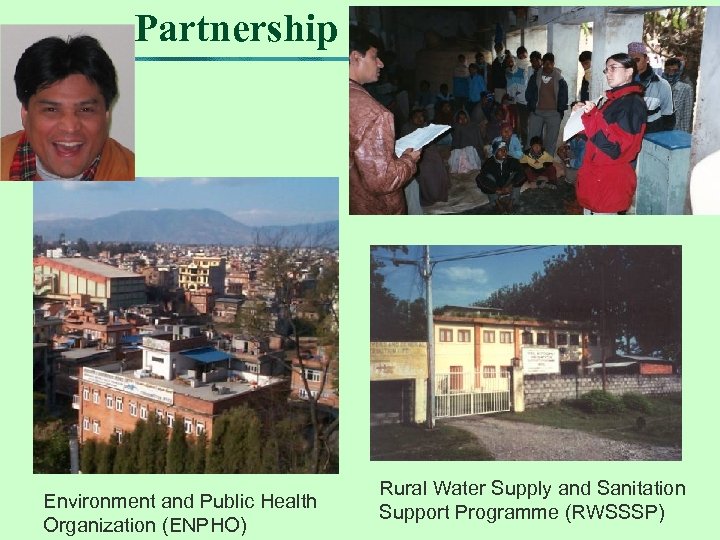 Partnership Environment and Public Health Organization (ENPHO) Rural Water Supply and Sanitation Support Programme (RWSSSP)
 2. Problem Co-Definition
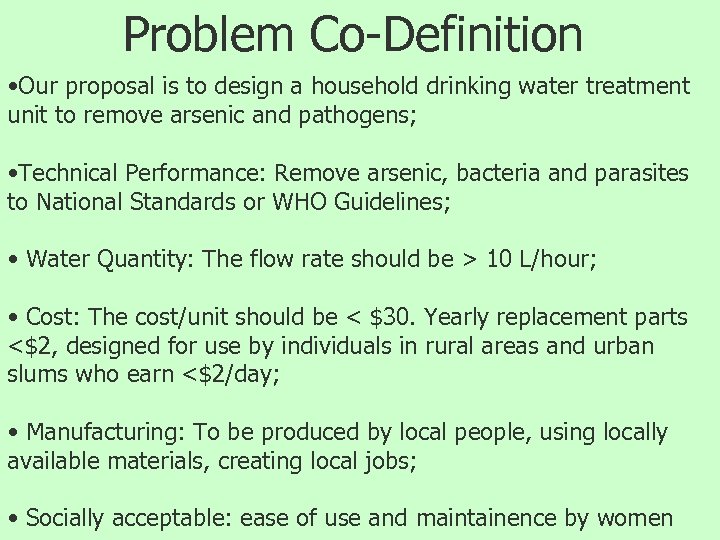 Problem Co-Definition • Our proposal is to design a household drinking water treatment unit to remove arsenic and pathogens; • Technical Performance: Remove arsenic, bacteria and parasites to National Standards or WHO Guidelines; • Water Quantity: The flow rate should be > 10 L/hour; • Cost: The cost/unit should be < $30. Yearly replacement parts <$2, designed for use by individuals in rural areas and urban slums who earn <$2/day; • Manufacturing: To be produced by local people, using locally available materials, creating local jobs; • Socially acceptable: ease of use and maintainence by women
 Problem Co-Definition Arsenic Technology Database Gather information for 50+ technologies: • Arsenic removal mechanisms (physical, chemical, etc) • Technical performance • Construction, operation and maintenance • Cost • Flow rate • Strengths, weakness, limitations http: //web. mit. edu/murcott/www/arsenic
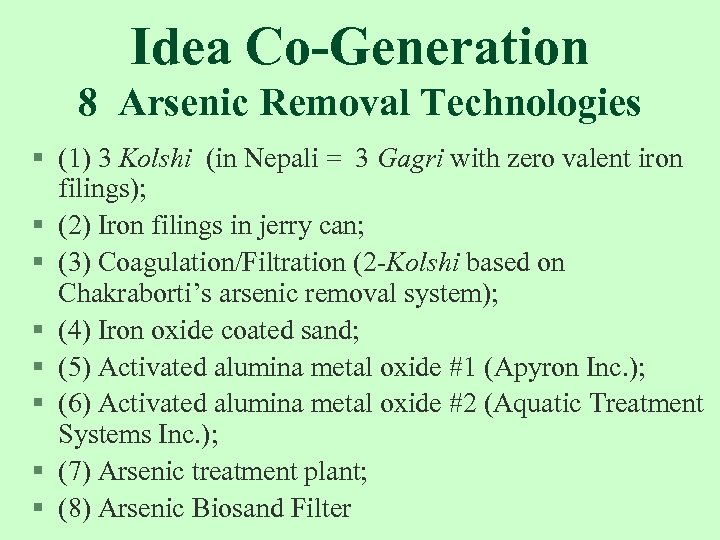 Idea Co-Generation 8 Arsenic Removal Technologies § (1) 3 Kolshi (in Nepali = 3 Gagri with zero valent iron filings); § (2) Iron filings in jerry can; § (3) Coagulation/Filtration (2 -Kolshi based on Chakraborti’s arsenic removal system); § (4) Iron oxide coated sand; § (5) Activated alumina metal oxide #1 (Apyron Inc. ); § (6) Activated alumina metal oxide #2 (Aquatic Treatment Systems Inc. ); § (7) Arsenic treatment plant; § (8) Arsenic Biosand Filter
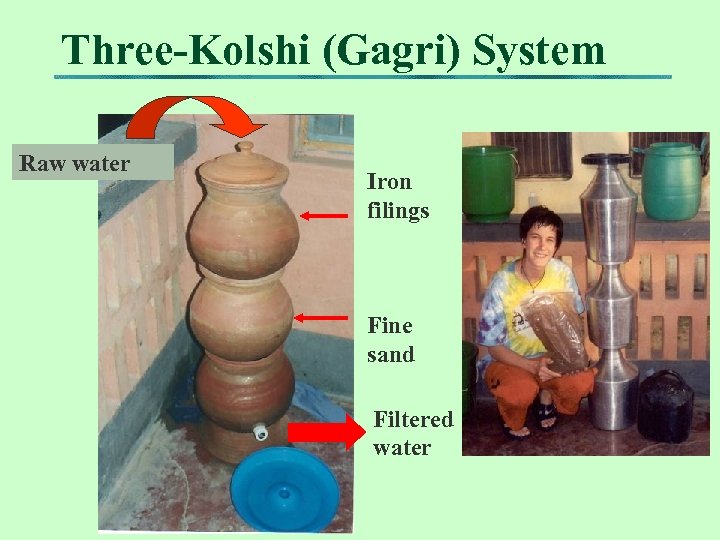 Three-Kolshi (Gagri) System Raw water Iron filings Fine sand Filtered water
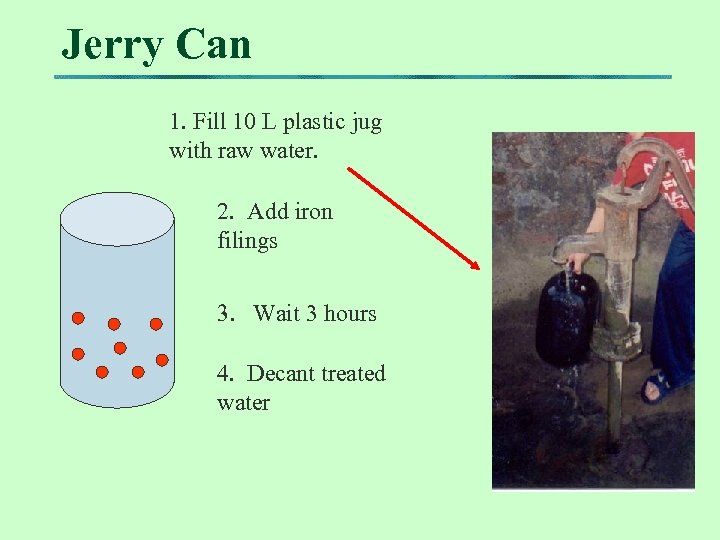 Jerry Can 1. Fill 10 L plastic jug with raw water. 2. Add iron filings 3. Wait 3 hours 4. Decant treated water
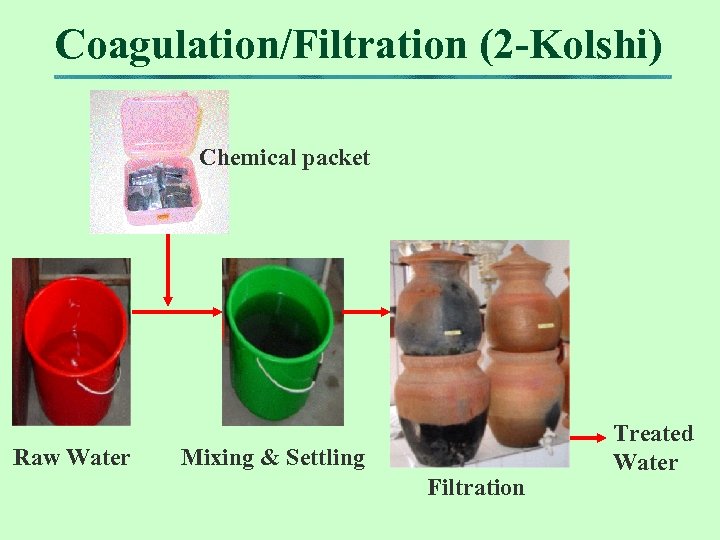 Coagulation/Filtration (2 -Kolshi) Chemical packet Raw Water Mixing & Settling Filtration Treated Water
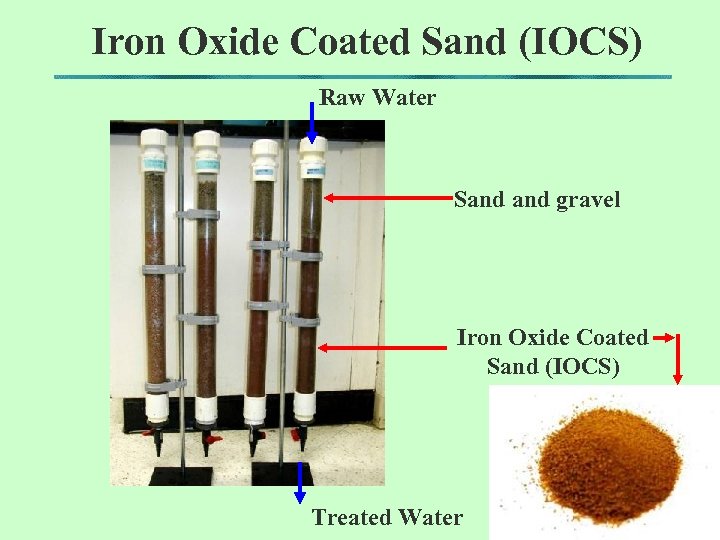 Iron Oxide Coated Sand (IOCS) Raw Water Sand gravel Iron Oxide Coated Sand (IOCS) Treated Water
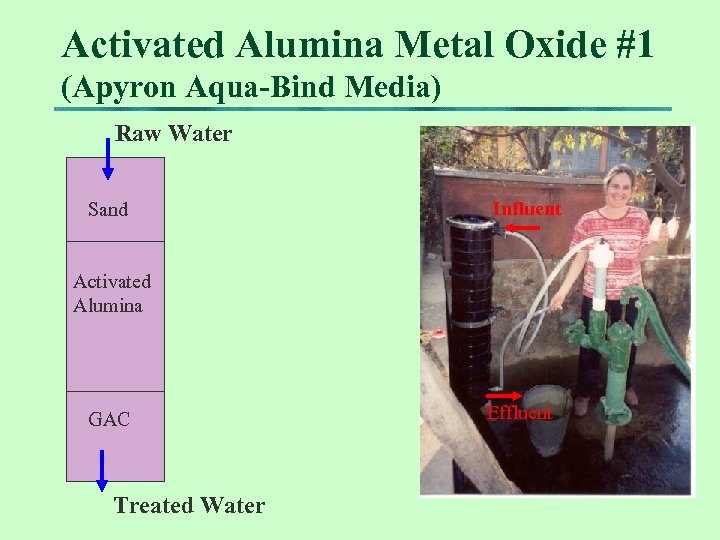 Activated Alumina Metal Oxide #1 (Apyron Aqua-Bind Media) Raw Water Sand Influent Activated Alumina GAC Treated Water Effluent
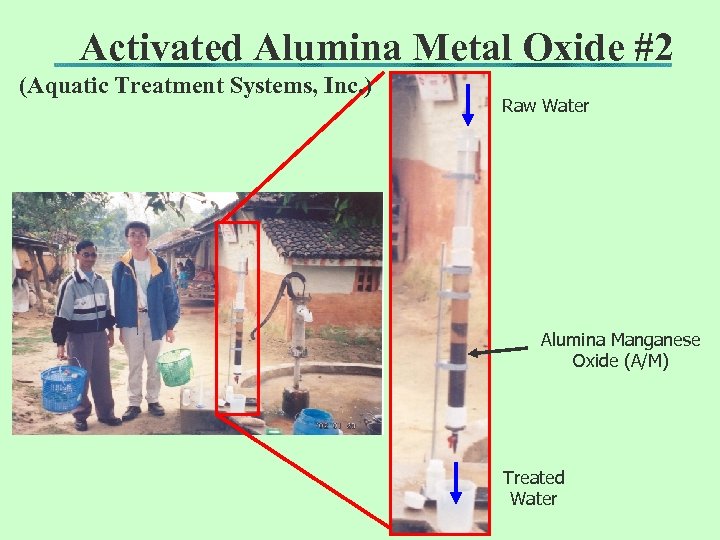 Activated Alumina Metal Oxide #2 (Aquatic Treatment Systems, Inc. ) Raw Water Alumina Manganese Oxide (A/M) Treated Water
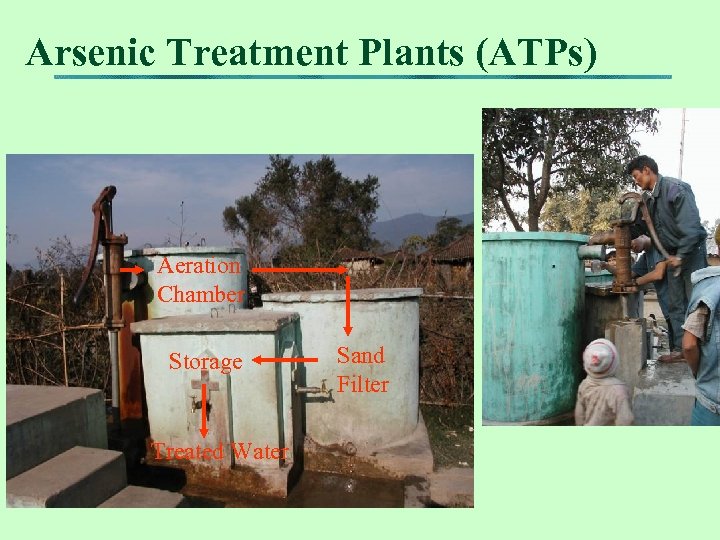 Arsenic Treatment Plants (ATPs) Aeration Chamber Storage Treated Water Sand Filter
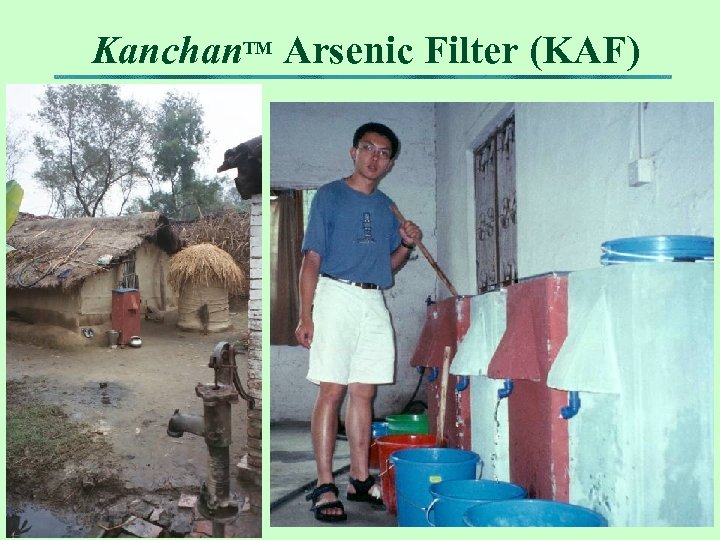 Kanchan. TM Arsenic Filter (KAF)
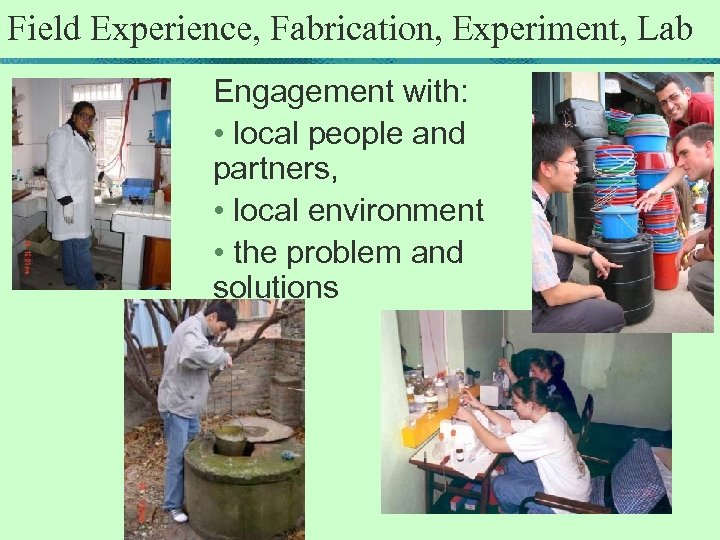 Field Experience, Fabrication, Experiment, Lab Engagement with: • local people and partners, • local environment • the problem and solutions
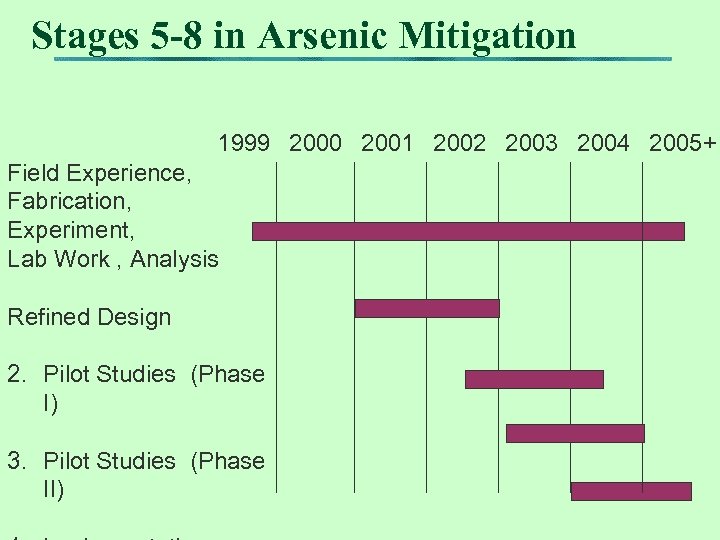 Stages 5 -8 in Arsenic Mitigation 1999 2000 2001 2002 2003 2004 2005+ Field Experience, Fabrication, Experiment, Lab Work , Analysis Refined Design 2. Pilot Studies (Phase I) 3. Pilot Studies (Phase II)
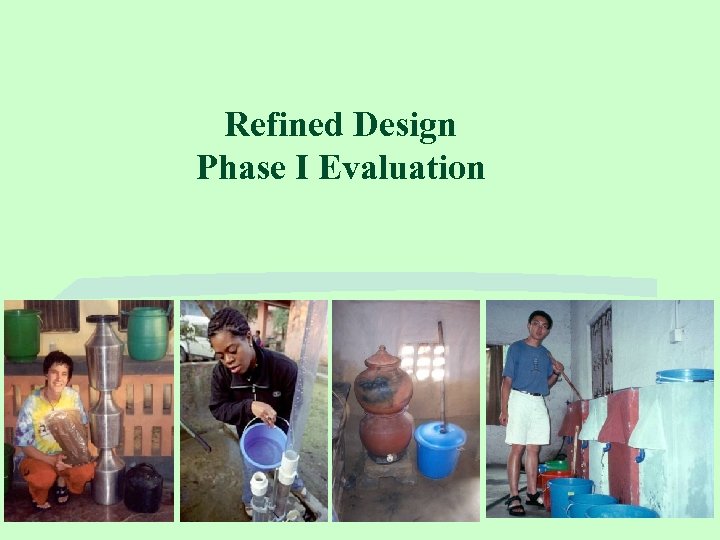 Refined Design Phase I Evaluation
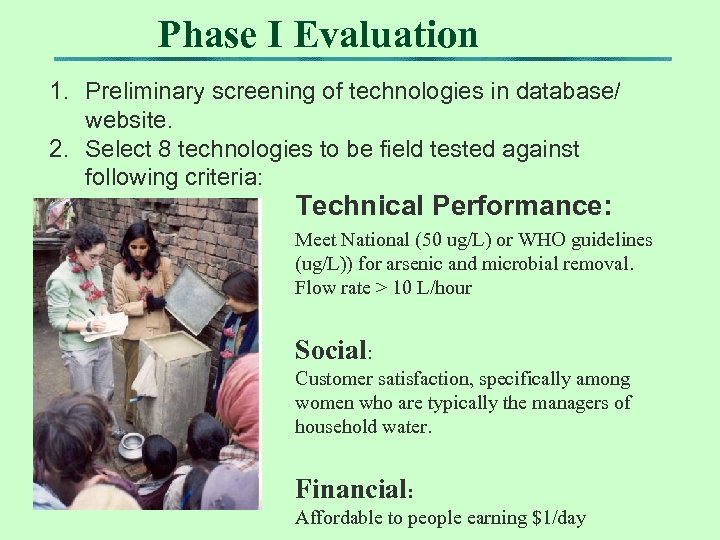 Phase I Evaluation 1. Preliminary screening of technologies in database/ website. 2. Select 8 technologies to be field tested against following criteria: Technical Performance: Meet National (50 ug/L) or WHO guidelines (ug/L)) for arsenic and microbial removal. Flow rate > 10 L/hour Social: Customer satisfaction, specifically among women who are typically the managers of household water. Financial: Affordable to people earning $1/day
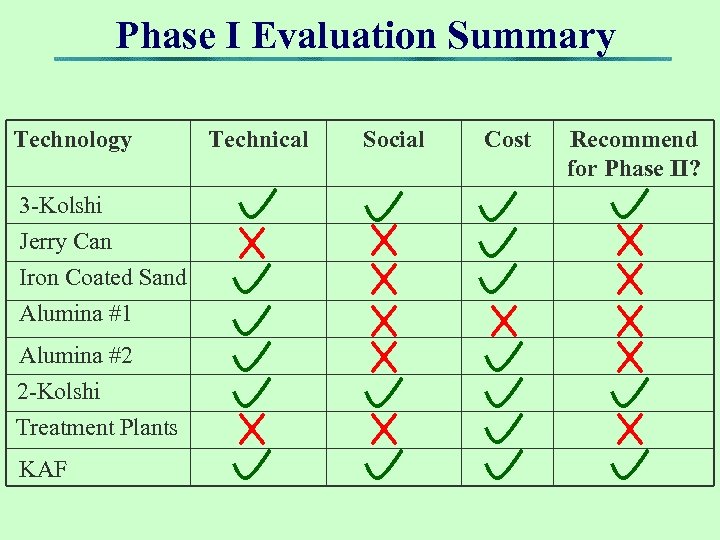 Phase I Evaluation Summary Technology 3 -Kolshi Jerry Can Iron Coated Sand Alumina #1 Alumina #2 2 -Kolshi Treatment Plants KAF Technical Social Cost Recommend for Phase II?
 Pilot Studies Phase II Evaluation
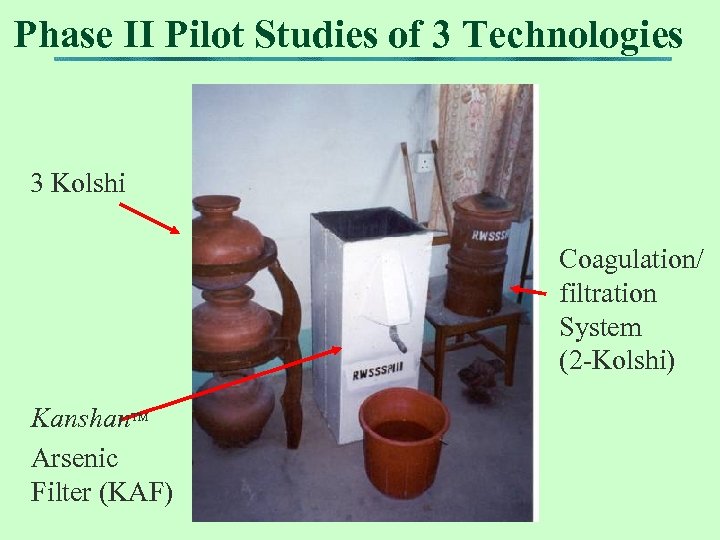 Phase II Pilot Studies of 3 Technologies 3 Kolshi Coagulation/ filtration System (2 -Kolshi) Kanshan. TM Arsenic Filter (KAF)
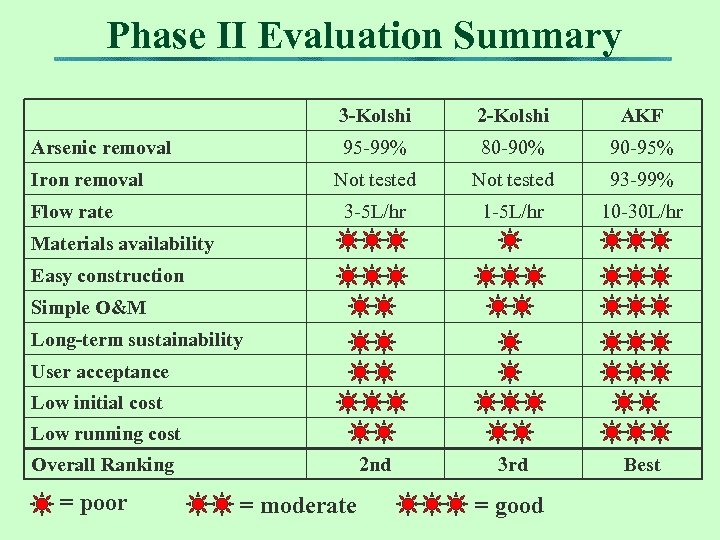 Phase II Evaluation Summary 3 -Kolshi 90 -95% Not tested 93 -99% 3 -5 L/hr 10 -30 L/hr 2 nd Flow rate 80 -90% Not tested Iron removal AKF 95 -99% Arsenic removal 2 -Kolshi 3 rd Best Materials availability Easy construction Simple O&M Long-term sustainability User acceptance Low initial cost Low running cost Overall Ranking = poor = moderate = good
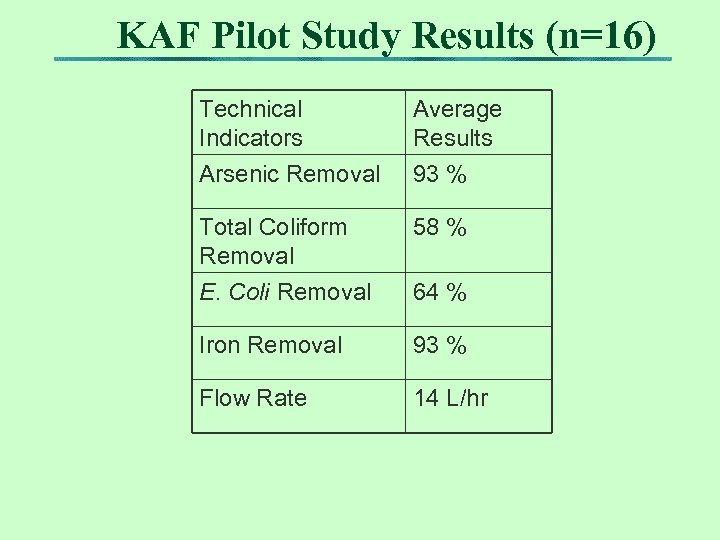 KAF Pilot Study Results (n=16) Technical Indicators Arsenic Removal Average Results 93 % Total Coliform Removal 58 % E. Coli Removal 64 % Iron Removal 93 % Flow Rate 14 L/hr
 Stages 5 -8 Kanshan. TM Arsenic Filter (AKF)
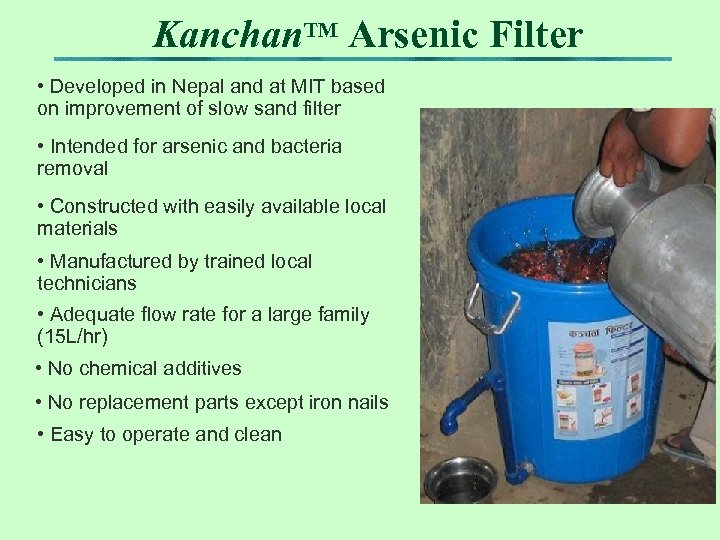 Kanchan. TM Arsenic Filter • Developed in Nepal and at MIT based on improvement of slow sand filter • Intended for arsenic and bacteria removal • Constructed with easily available local materials • Manufactured by trained local technicians • Adequate flow rate for a large family (15 L/hr) • No chemical additives • No replacement parts except iron nails • Easy to operate and clean
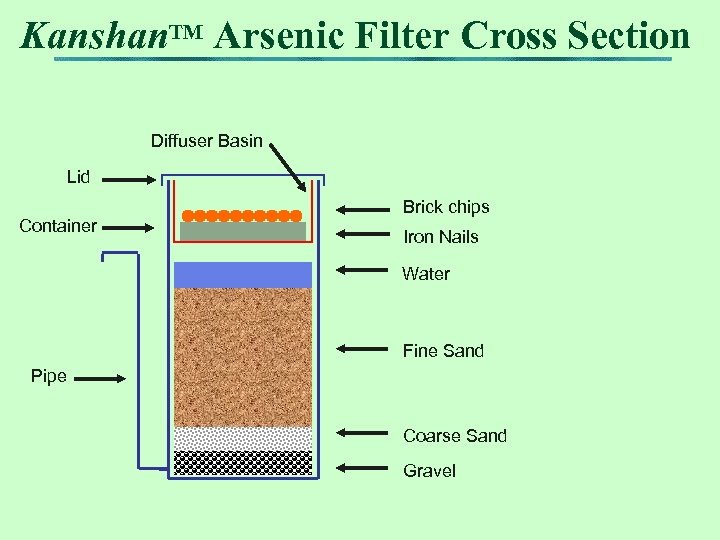 Kanshan. TM Arsenic Filter Cross Section Diffuser Basin Lid Container Brick chips Iron Nails Water Fine Sand Pipe Coarse Sand Gravel
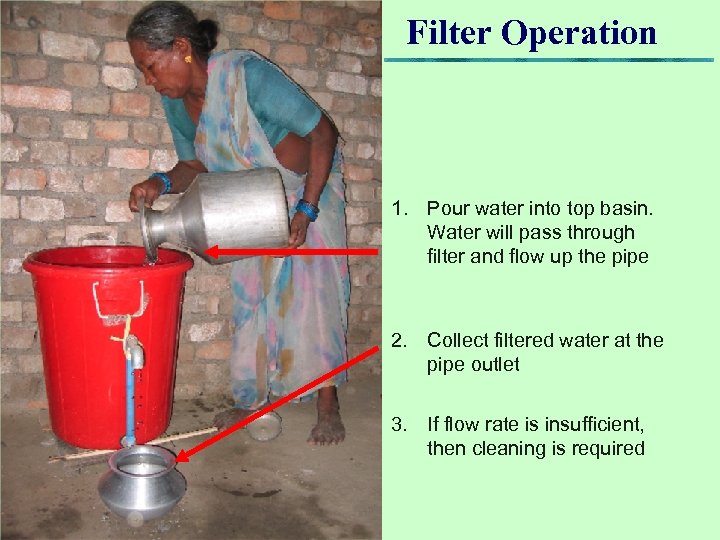 Filter Operation 1. Pour water into top basin. Water will pass through filter and flow up the pipe 2. Collect filtered water at the pipe outlet 3. If flow rate is insufficient, then cleaning is required
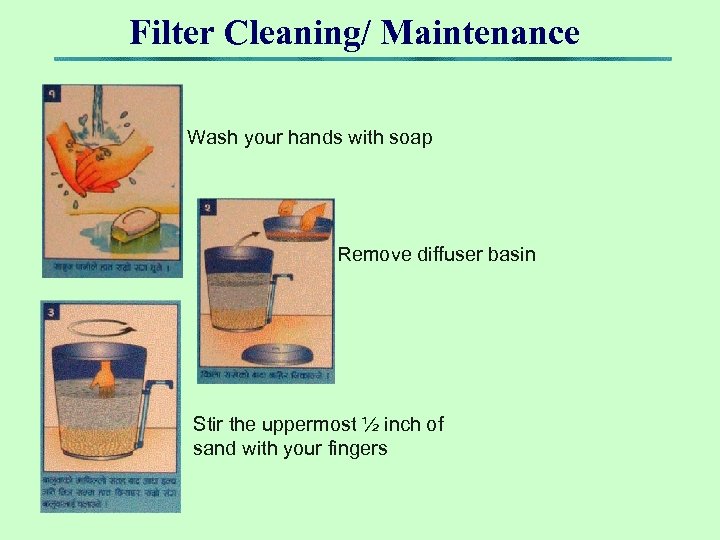 Filter Cleaning/ Maintenance Wash your hands with soap Remove diffuser basin Stir the uppermost ½ inch of sand with your fingers
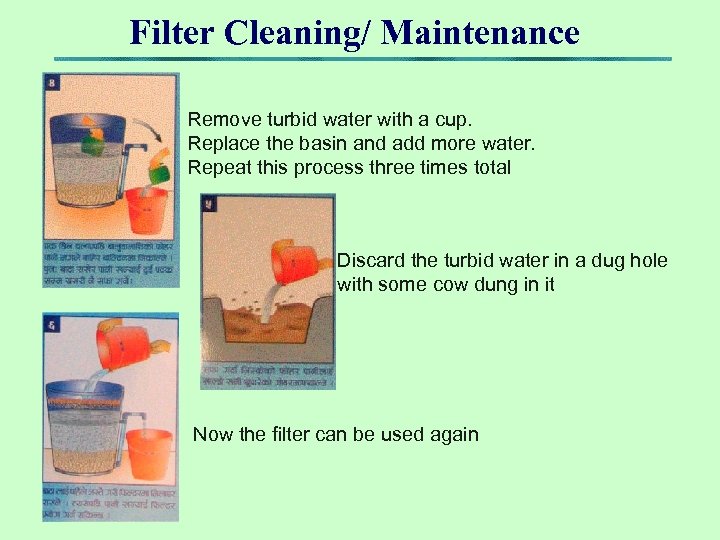 Filter Cleaning/ Maintenance Remove turbid water with a cup. Replace the basin and add more water. Repeat this process three times total Discard the turbid water in a dug hole with some cow dung in it Now the filter can be used again
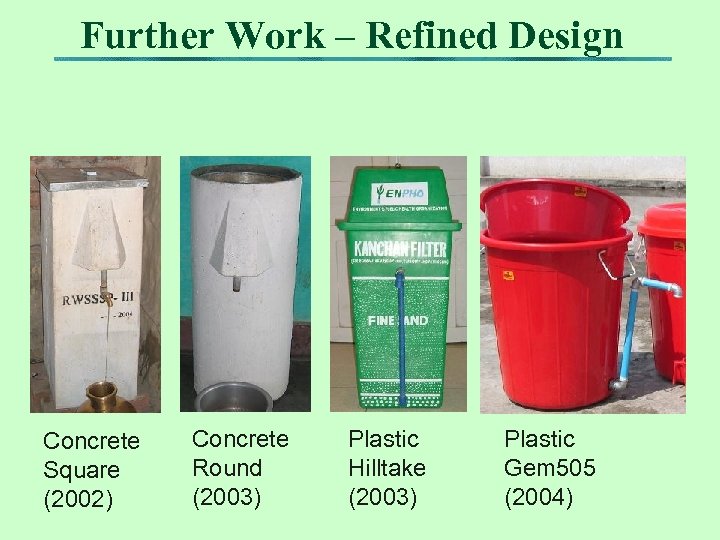 Further Work – Refined Design Concrete Square (2002) Concrete Round (2003) Plastic Hilltake (2003) Plastic Gem 505 (2004)
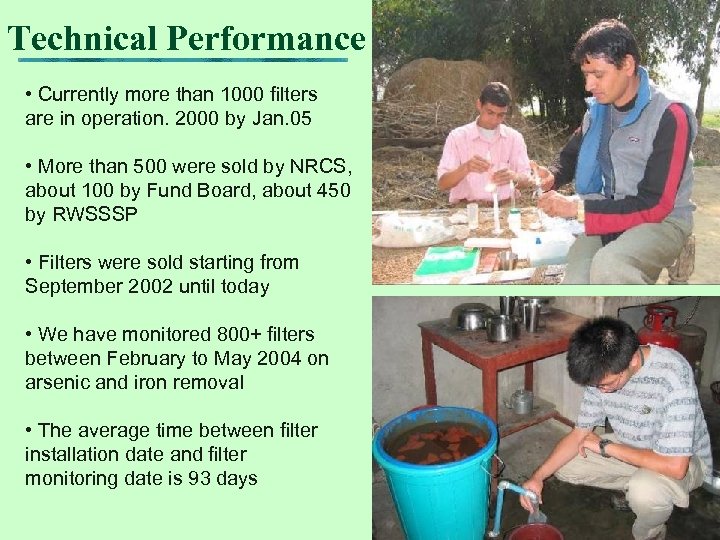 Technical Performance • Currently more than 1000 filters are in operation. 2000 by Jan. 05 • More than 500 were sold by NRCS, about 100 by Fund Board, about 450 by RWSSSP • Filters were sold starting from September 2002 until today • We have monitored 800+ filters between February to May 2004 on arsenic and iron removal • The average time between filter installation date and filter monitoring date is 93 days
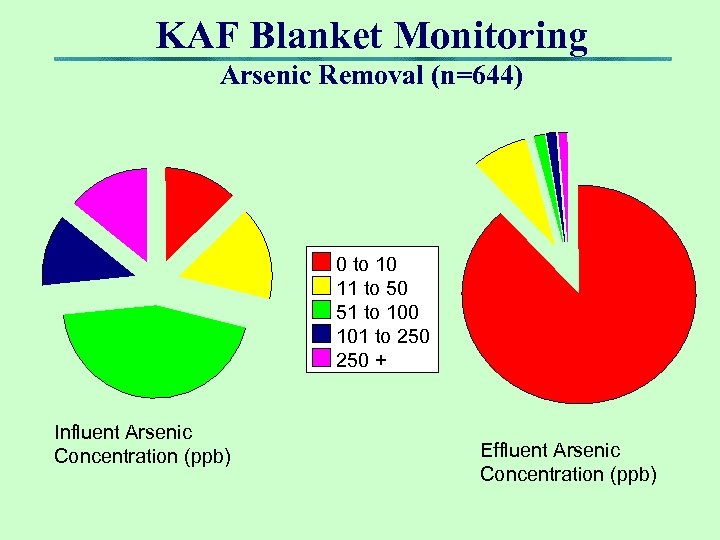 KAF Blanket Monitoring Arsenic Removal (n=644) 0 to 10 11 to 50 51 to 100 101 to 250 + Influent Arsenic Concentration (ppb) Effluent Arsenic Concentration (ppb)
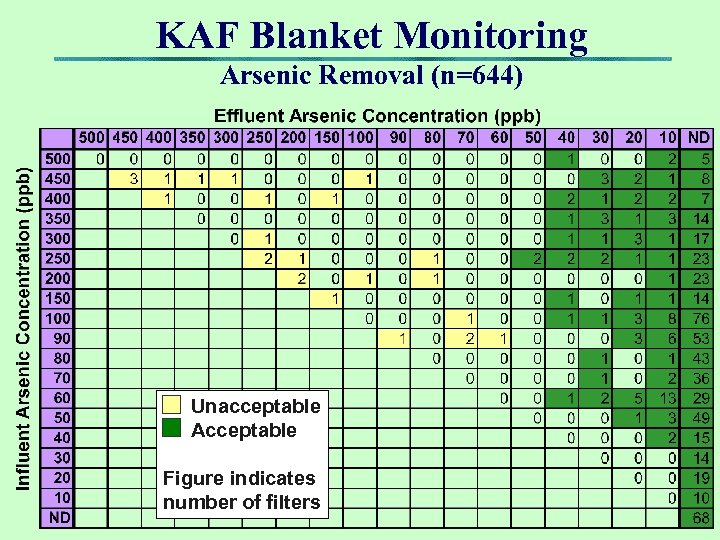 KAF Blanket Monitoring Arsenic Removal (n=644) Unacceptable Acceptable Figure indicates number of filters
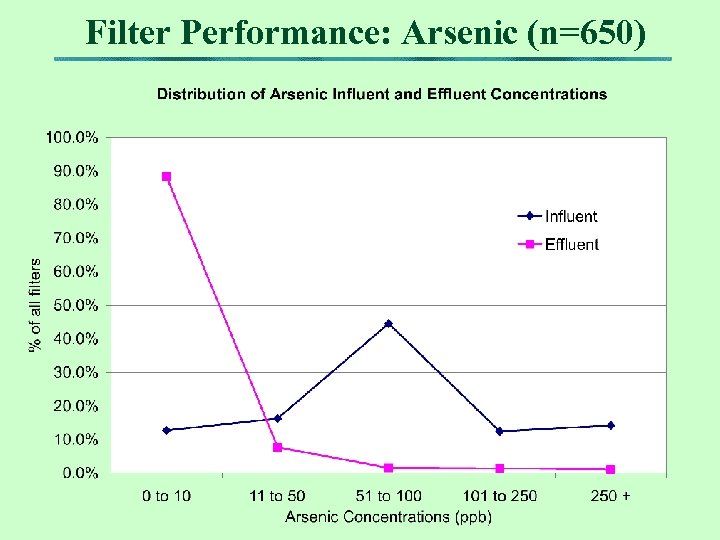 Filter Performance: Arsenic (n=650)
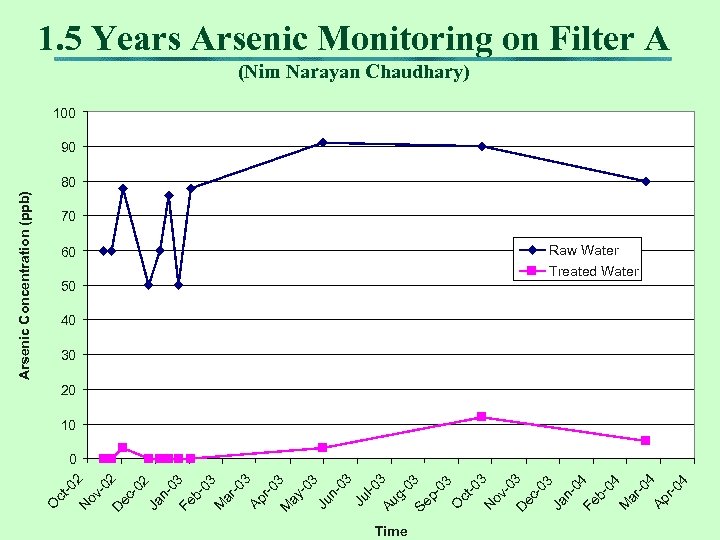 2 ov -0 2 D ec -0 2 Ja n 0 Fe 3 b 03 M ar -0 3 Ap r-0 M 3 ay -0 3 Ju n 03 Ju l-0 Au 3 g 0 Se 3 p 03 O ct -0 3 N ov -0 3 D ec -0 3 Ja n 0 Fe 4 b 04 M ar -0 4 Ap r-0 4 N ct -0 O Arsenic Concentration (ppb) 1. 5 Years Arsenic Monitoring on Filter A (Nim Narayan Chaudhary) 100 90 80 70 60 Raw Water 50 Treated Water 40 30 20 10 0 Time
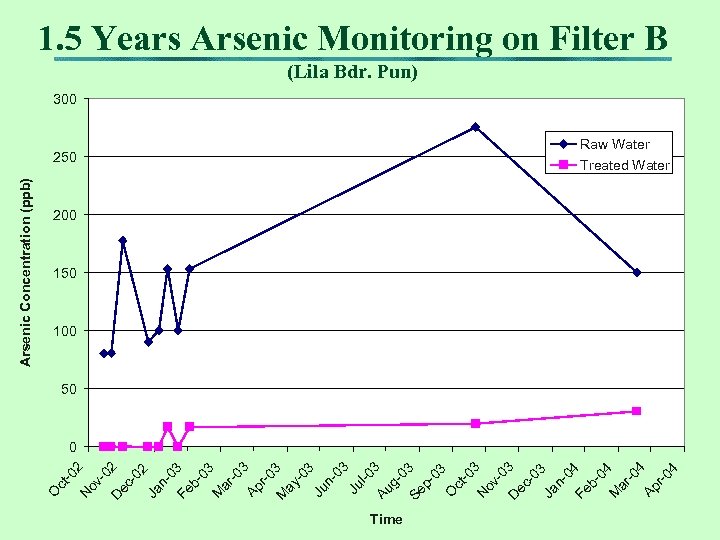 2 ov -0 2 D ec -0 2 Ja n 0 Fe 3 b 03 M ar -0 3 Ap r-0 M 3 ay -0 3 Ju n 03 Ju l-0 Au 3 g 0 Se 3 p 03 O ct -0 3 N ov -0 3 D ec -0 3 Ja n 0 Fe 4 b 04 M ar -0 4 Ap r-0 4 N ct -0 O Arsenic Concentration (ppb) 1. 5 Years Arsenic Monitoring on Filter B (Lila Bdr. Pun) 300 250 Raw Water Treated Water 200 150 100 50 0 Time
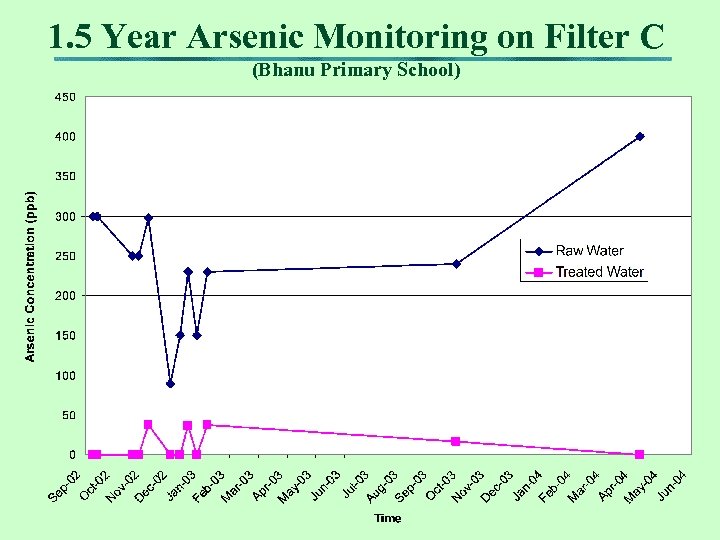 1. 5 Year Arsenic Monitoring on Filter C (Bhanu Primary School)
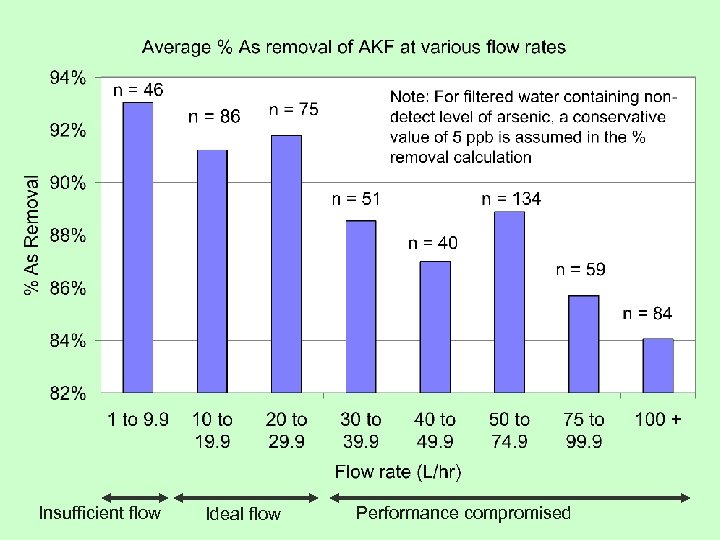 Insufficient flow Ideal flow Performance compromised
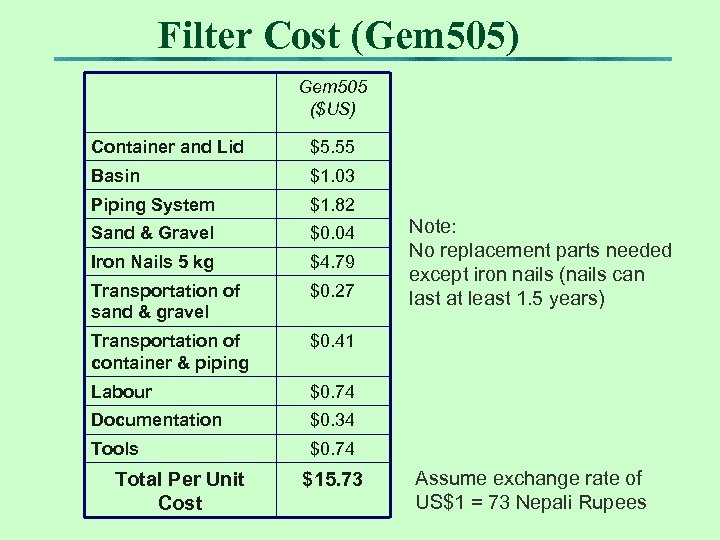 Filter Cost (Gem 505) Gem 505 ($US) Container and Lid $5. 55 Basin $1. 03 Piping System $1. 82 Sand & Gravel $0. 04 Iron Nails 5 kg $4. 79 Transportation of sand & gravel $0. 27 Transportation of container & piping $0. 41 Labour $0. 74 Documentation $0. 34 Tools $0. 74 Total Per Unit Cost $15. 73 Note: No replacement parts needed except iron nails (nails can last at least 1. 5 years) Assume exchange rate of US$1 = 73 Nepali Rupees
 Implementation and Scale-up
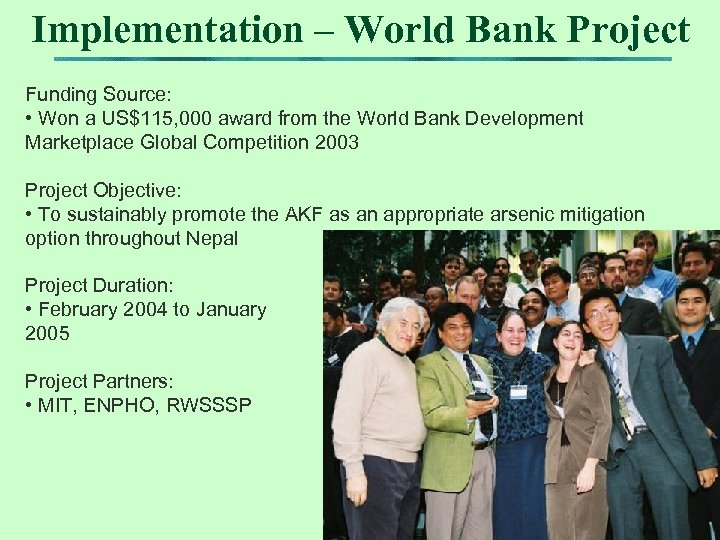 Implementation – World Bank Project Funding Source: • Won a US$115, 000 award from the World Bank Development Marketplace Global Competition 2003 Project Objective: • To sustainably promote the AKF as an appropriate arsenic mitigation option throughout Nepal Project Duration: • February 2004 to January 2005 Project Partners: • MIT, ENPHO, RWSSSP
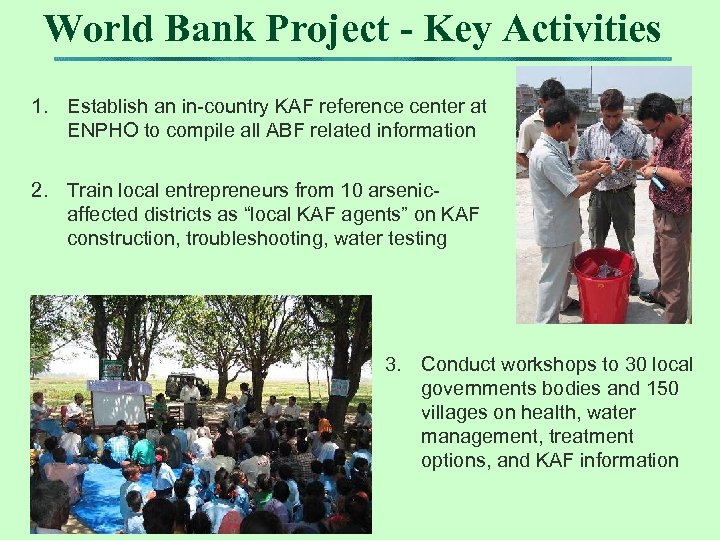 World Bank Project - Key Activities 1. Establish an in-country KAF reference center at ENPHO to compile all ABF related information 2. Train local entrepreneurs from 10 arsenicaffected districts as “local KAF agents” on KAF construction, troubleshooting, water testing 3. Conduct workshops to 30 local governments bodies and 150 villages on health, water management, treatment options, and KAF information
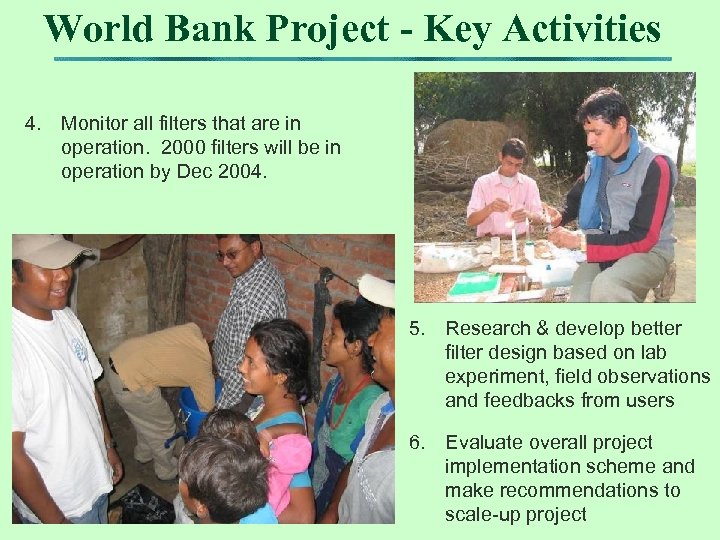 World Bank Project - Key Activities 4. Monitor all filters that are in operation. 2000 filters will be in operation by Dec 2004. 5. Research & develop better filter design based on lab experiment, field observations and feedbacks from users 6. Evaluate overall project implementation scheme and make recommendations to scale-up project
 Is this Project: Appropriate? Green? Sustainable? Co(m)-passionate?
 Design Principles for Appropriate Technology (E. F. Schumacher: Small is Beautiful, 1973) § § 1. Simple design & production 2. Inexpensive 3. Use local materials for local use 4. Rural focus Yes!
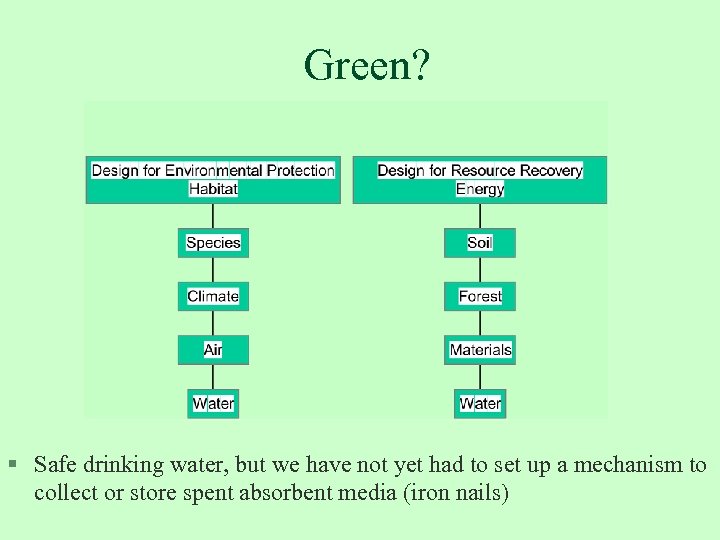 Green? § Safe drinking water, but we have not yet had to set up a mechanism to collect or store spent absorbent media (iron nails)
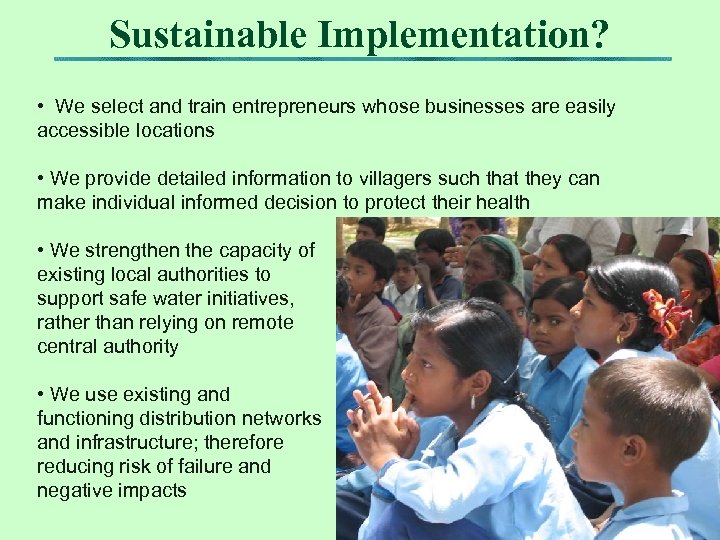 Sustainable Implementation? • We select and train entrepreneurs whose businesses are easily accessible locations • We provide detailed information to villagers such that they can make individual informed decision to protect their health • We strengthen the capacity of existing local authorities to support safe water initiatives, rather than relying on remote central authority • We use existing and functioning distribution networks and infrastructure; therefore reducing risk of failure and negative impacts
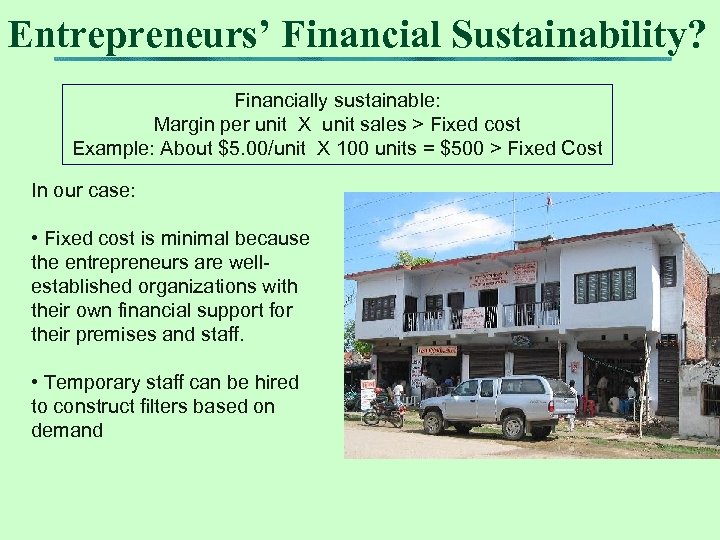 Entrepreneurs’ Financial Sustainability? Financially sustainable: Margin per unit X unit sales > Fixed cost Example: About $5. 00/unit X 100 units = $500 > Fixed Cost In our case: • Fixed cost is minimal because the entrepreneurs are wellestablished organizations with their own financial support for their premises and staff. • Temporary staff can be hired to construct filters based on demand
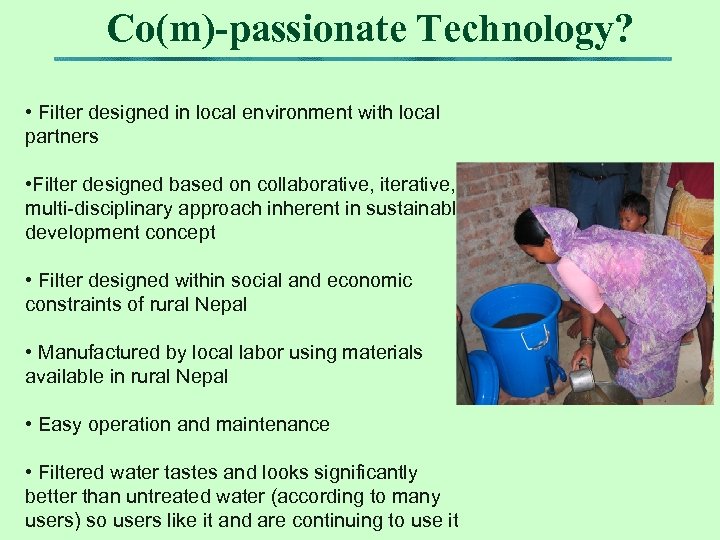 Co(m)-passionate Technology? • Filter designed in local environment with local partners • Filter designed based on collaborative, iterative, multi-disciplinary approach inherent in sustainable development concept • Filter designed within social and economic constraints of rural Nepal • Manufactured by local labor using materials available in rural Nepal • Easy operation and maintenance • Filtered water tastes and looks significantly better than untreated water (according to many users) so users like it and are continuing to use it
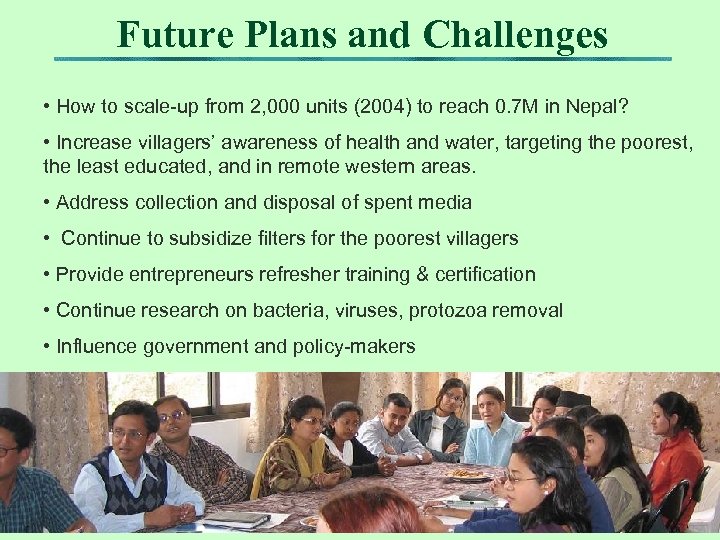 Future Plans and Challenges • How to scale-up from 2, 000 units (2004) to reach 0. 7 M in Nepal? • Increase villagers’ awareness of health and water, targeting the poorest, the least educated, and in remote western areas. • Address collection and disposal of spent media • Continue to subsidize filters for the poorest villagers • Provide entrepreneurs refresher training & certification • Continue research on bacteria, viruses, protozoa removal • Influence government and policy-makers
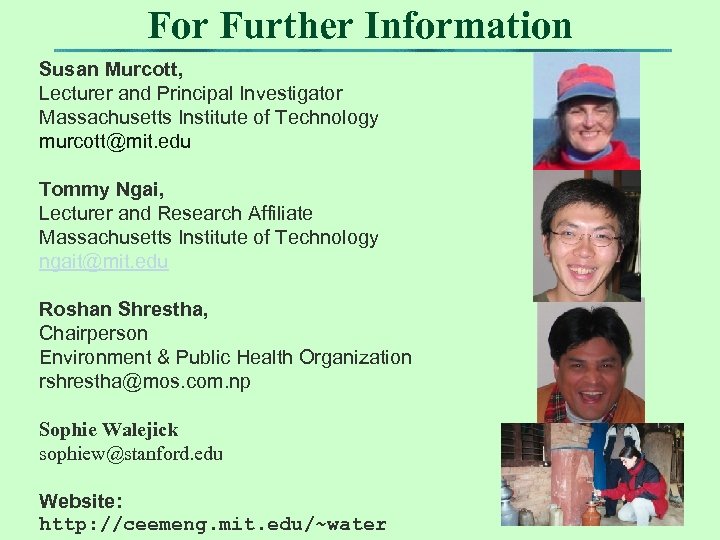 For Further Information Susan Murcott, Lecturer and Principal Investigator Massachusetts Institute of Technology murcott@mit. edu Tommy Ngai, Lecturer and Research Affiliate Massachusetts Institute of Technology ngait@mit. edu Roshan Shrestha, Chairperson Environment & Public Health Organization rshrestha@mos. com. np Sophie Walejick sophiew@stanford. edu Website: http: //ceemeng. mit. edu/~water
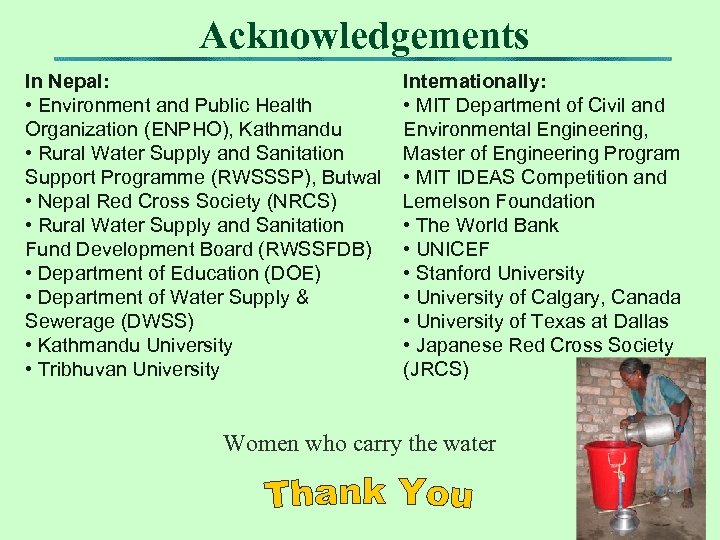 Acknowledgements In Nepal: • Environment and Public Health Organization (ENPHO), Kathmandu • Rural Water Supply and Sanitation Support Programme (RWSSSP), Butwal • Nepal Red Cross Society (NRCS) • Rural Water Supply and Sanitation Fund Development Board (RWSSFDB) • Department of Education (DOE) • Department of Water Supply & Sewerage (DWSS) • Kathmandu University • Tribhuvan University Internationally: • MIT Department of Civil and Environmental Engineering, Master of Engineering Program • MIT IDEAS Competition and Lemelson Foundation • The World Bank • UNICEF • Stanford University • University of Calgary, Canada • University of Texas at Dallas • Japanese Red Cross Society (JRCS) Women who carry the water