 Скачать презентацию Design and Implementation of Smartphone-based Systems and Networking
2ec76e77fc447fc84be3825e9ef6eec4.ppt
- Количество слайдов: 82



Design and Implementation of Smartphone-based Systems and Networking Dong Xuan Department of Computer Science and Engineering The Ohio State University, USA Dong Xuan (CSE/OSU) / 2009
Outline n Smartphones Basics n Mobile Social Networks n E-Commerce n E-Health n Safety Monitoring n Future Research Directions Dong Xuan (CSE/OSU) / 2010 2
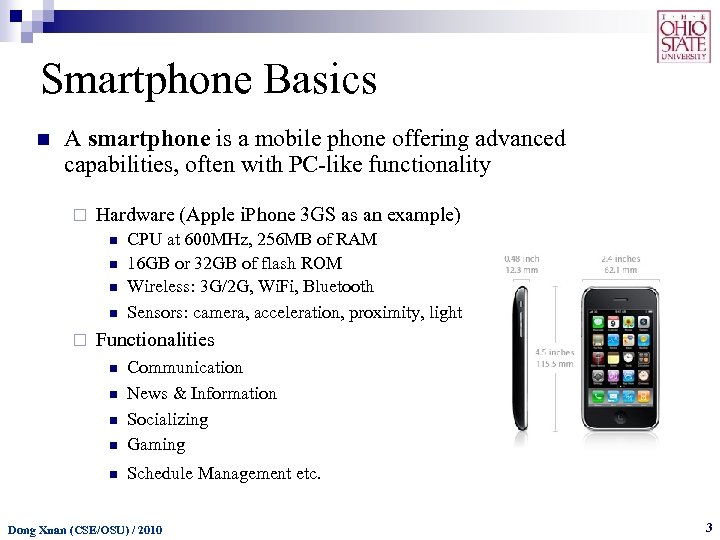
Smartphone Basics n A smartphone is a mobile phone offering advanced capabilities, often with PC-like functionality ¨ Hardware (Apple i. Phone 3 GS as an example) n n ¨ CPU at 600 MHz, 256 MB of RAM 16 GB or 32 GB of flash ROM Wireless: 3 G/2 G, Wi. Fi, Bluetooth Sensors: camera, acceleration, proximity, light Functionalities n Communication News & Information Socializing Gaming n Schedule Management etc. n n n Dong Xuan (CSE/OSU) / 2010 3
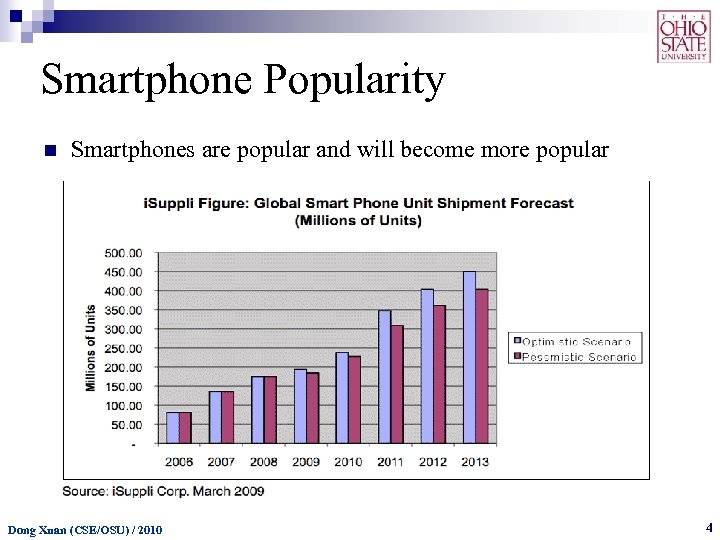
Smartphone Popularity n Smartphones are popular and will become more popular Dong Xuan (CSE/OSU) / 2010 4
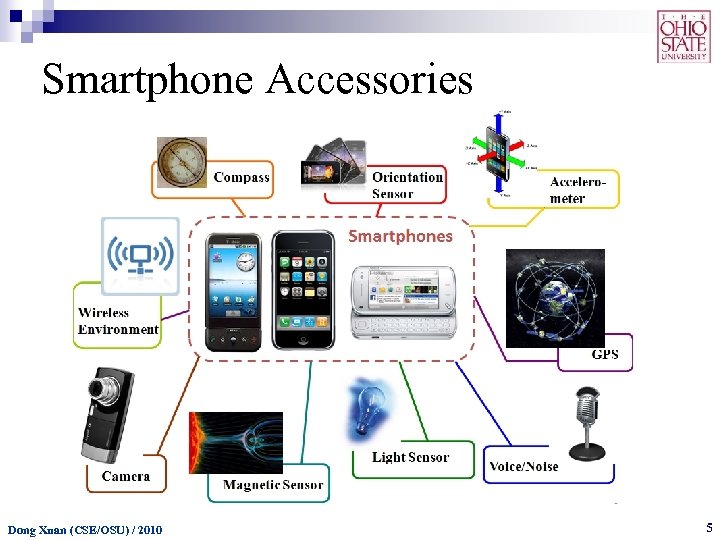
Smartphone Accessories Dong Xuan (CSE/OSU) / 2010 5
Smartphone Features n Communication/Sensing/Computation n Inseparable from our human life Dong Xuan (CSE/OSU) / 2010 6
![Our Smartphone Systems n E-Small. Talker [IEEE ICDCS 10]: senses information published by Bluetooth](https://present5.com/presentation/2ec76e77fc447fc84be3825e9ef6eec4/image-7.jpg "Our Smartphone Systems n E-Small. Talker [IEEE ICDCS 10]: senses information published by Bluetooth")
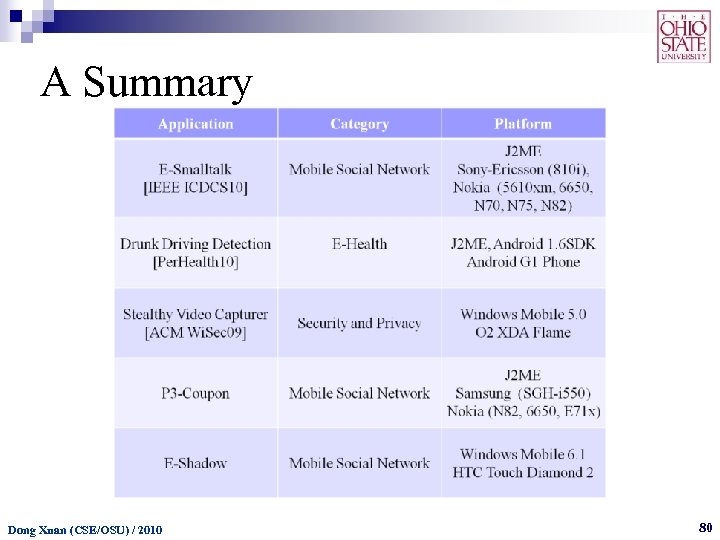
Our Smartphone Systems n E-Small. Talker [IEEE ICDCS 10]: senses information published by Bluetooth to help potential friends find each other (written in Java) n E-Shadow [IEEE ICDCS 11]: enables rich local social interactions with local profiles and mobile phone based local social networking tools n P 3 -Coupon [IEEE Percom 11]: automatically distributes electronic coupons based on an probabilistic forwarding algorithm Dong Xuan (CSE/OSU) / 2010 7
![Our Smartphone Systems n Drunk Driving Detection [Per. Health 10]: uses smartphone (Google G](https://present5.com/presentation/2ec76e77fc447fc84be3825e9ef6eec4/image-8.jpg "Our Smartphone Systems n Drunk Driving Detection [Per. Health 10]: uses smartphone (Google G")
Our Smartphone Systems n Drunk Driving Detection [Per. Health 10]: uses smartphone (Google G 1) accelerometer and orientation sensor to detect n Stealthy Video Capturer [ACM Wi. Sec 09]: secretly senses its environment and records video via smartphone camera and sends it to a third party (Windows Mobile application) Download & Run Dong Xuan (CSE/OSU) / 2010 Video sent by Email Captured Video 8
Exemplary System I: E-Small. Taker n Small Talk n A Naïve Approach n Challenges n System Design n Implementation and Experiments n Remarks Dong Xuan (CSE/OSU) / 2010 9
Small Talk n n People come into contact opportunistically Face-to-face interaction Crucial to people's social networking ¨ Immediate non-verbal communication ¨ Helps people get to know each other ¨ Provides the best opportunity to expand social network ¨ n Small talk is an important social lubricant Difficult to identify significant topics ¨ Superficial ¨ Dong Xuan (CSE/OSU) / 2010 10
A Naive Approach of Smartphonebased Small Talk n n Store all user’s information, including each user’s full contact list User report either his own geo-location or a collection of phone IDs in his physical proximity to the server using internet connection or SMS Server performs profile matching, finds out small talk topics (mutual contact, common interests, etc. ) Results are pushed to or retrieved by users Dong Xuan (CSE/OSU) / 2010 11
However…… n n Require costly data services (phone’s internet connection, SMS) Require report and store sensitive personal information in 3 rd party Trusted server may not exist Server is a bottleneck, single point of failure, target of attack Dong Xuan (CSE/OSU) / 2010 12
E-Small. Talker – A Fully Distributed Approach n n n No Internet connection required No trusted 3 rd party No centralized server Information stored locally on mobile phones Original personal data never leaves a user’s phone Communication only happens in physical proximity Dong Xuan (CSE/OSU) / 2010 13
Two Challenges n How to exchange information without establishing a Bluetooth connection ¨ Available data communication channels on mobile phones n n ¨ n Cellular network (internet, SMS, MMS), Bluetooth, Wi. Fi, Ir. DA Bluetooth is a natural choice Bluetooth connection needs user’s interaction due to security reasons How to find out common topics while preserving users privacy ¨ ¨ No pre-shared secret for strangers Bluetooth Service Discovery Protocol can only transfer limited service information Dong Xuan (CSE/OSU) / 2010 14
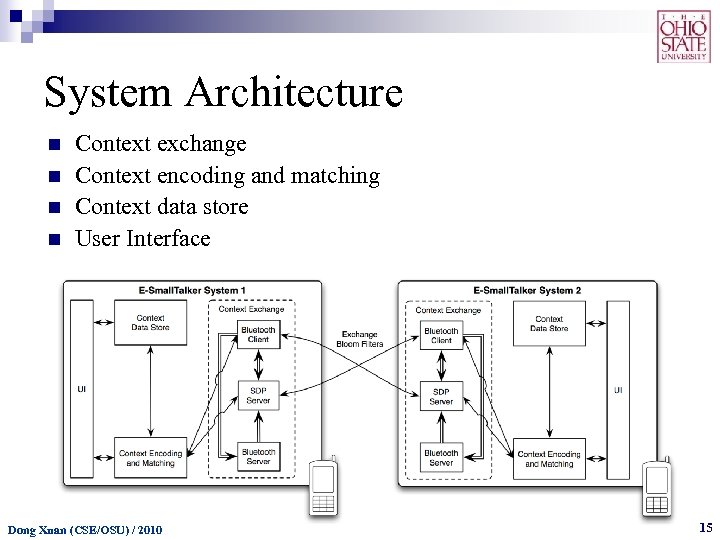
System Architecture n n Context exchange Context encoding and matching Context data store User Interface Dong Xuan (CSE/OSU) / 2010 15
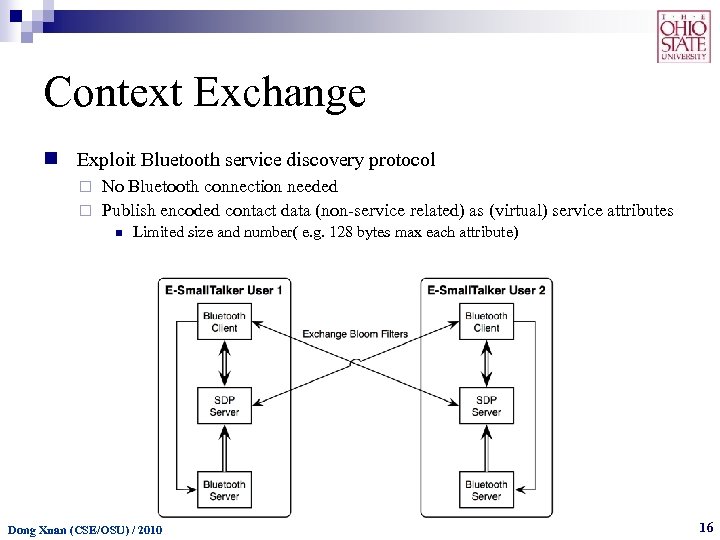
Context Exchange n Exploit Bluetooth service discovery protocol No Bluetooth connection needed ¨ Publish encoded contact data (non-service related) as (virtual) service attributes ¨ n Limited size and number( e. g. 128 bytes max each attribute) Dong Xuan (CSE/OSU) / 2010 16
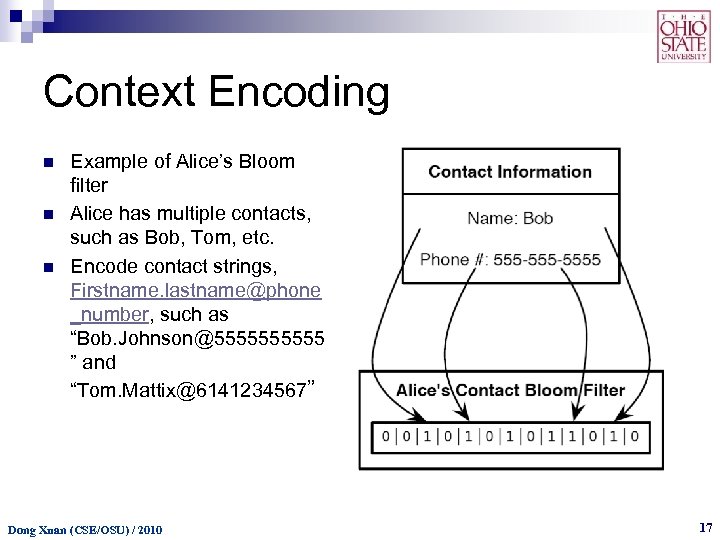
Context Encoding n n n Example of Alice’s Bloom filter Alice has multiple contacts, such as Bob, Tom, etc. Encode contact strings, Firstname. lastname@phone _number, such as “Bob. Johnson@55555 ” and “Tom. Mattix@6141234567” Dong Xuan (CSE/OSU) / 2010 17
Implementation n J 2 ME ¨ about n 40 java classes, 127 Kb jar file On real phones ¨ Sony N 82) Ericsson (W 810 i), Nokia (5610 xm, 6650, N 75, Dong Xuan (CSE/OSU) / 2010 18
Experiments n Settings ¨ n 6 phones, n=150, k=7, m=1024 bits, default distance=4 m, average of 10 runs Performance Metrics ¨ Discovery time: the period from the time of starting a search to the time of ¨ Power consumption finding someone with common interest, if there is any ¨ Discovery rate: percentage of successful discoveries among all attempts n Factors ¨ ¨ ¨ Bluetooth search interval Number of users Distance Dong Xuan (CSE/OSU) / 2010 19
Experiment Results n n n Minimum, average and maximum discovery time are 13. 39, 20. 04 and 59. 11 seconds respectively Always success if repeat searching, 90% overall if only search once Nokia N 82 last 29 hours when discovery interval is 60 seconds Dong Xuan (CSE/OSU) / 2010 20
Related Work n Social network applications on mobile phones ¨ Social Serendipity n ¨ People. Tones, Hummingbird, Just-for-Us, Mobi. Luck, P 3 Systems, Micro-Blog, and Loopt n ¨ Centralized, GPS location matching, Internet, existing friends Nokia Sensor and People. Net n n Centralized, Bluetooth MAC and profile matching, SMS, strangers Distributed, profile, Bluetooth / Wifi connection, existing friends Private matching and set intersection protocols Homomorphic encryption based ¨ Too much computation and message overhead for mobile phone ¨ n Limitations Require costly data services (phone’s internet connection, SMS) ¨ Require report and store sensitive personal information ¨ Bottleneck, single point of failure, target of attack ¨ Dong Xuan (CSE/OSU) / 2010 21
Remarks n Propose, design, implement and evaluate the E-Small. Talker system which helps strangers initialize a conversation Leveraged Bluetooth SDP to exchange these topics without establishing a connection ¨ Customized service attributes to publish non-service related information. ¨ Proposed a new iterative commonality discovery protocol based on Bloom filters that encodes topics to fit in SDP attributes to achieve a low false positive rate ¨ Dong Xuan (CSE/OSU) / 2010 22
Exemplary System II: E-Shadow n Concept n Application Scenario n Goals and Challenges n System Design n Implementation and Experiments n Remarks Dong Xuan (CSE/OSU) / 2010 23
Concept n n Motivation ¨ Importance of Face-to-Face Interaction ¨ Prevalence of mobile phones Distributed mobile phone-based local social networking system ¨ Local profiles ¨ Mobile phone based local social interaction tools Dong Xuan (CSE/OSU) / 2010
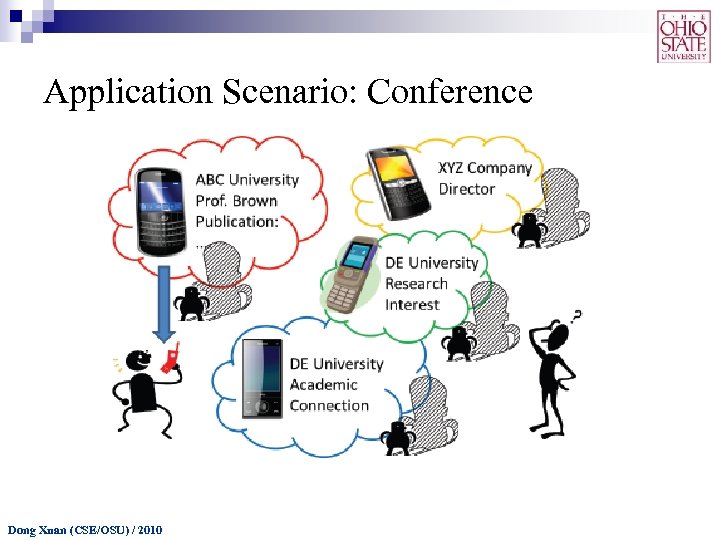
Application Scenario: Conference Dong Xuan (CSE/OSU) / 2010
Goals and Challenges n Design Goals ¨ Far-reaching and Unobtrusive ¨ Privacy and Security ¨ Auxiliary Support for Further Interactions ¨ Broad Adoption n Challenges ¨ Lack of Communication Support ¨ Power and Computation Limitation ¨ Non-pervasive Localization Service Dong Xuan (CSE/OSU) / 2010
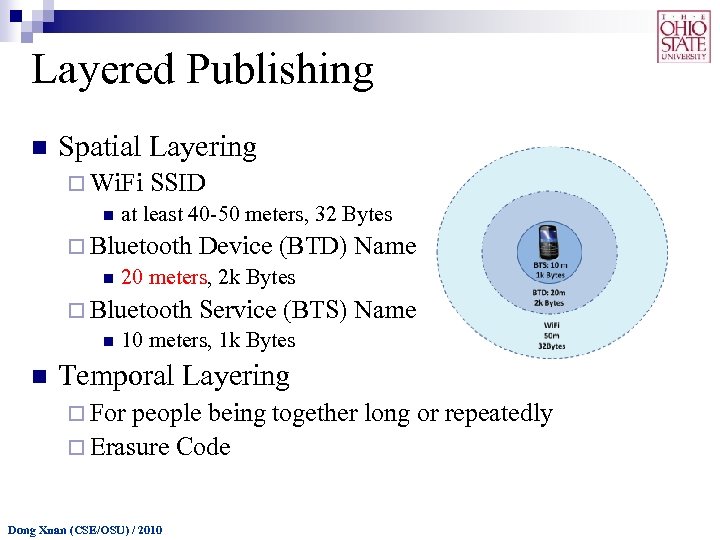
Layered Publishing n Spatial Layering ¨ Wi. Fi SSID n at least 40 -50 meters, 32 Bytes ¨ Bluetooth Device (BTD) n 20 meters, 2 k Bytes ¨ Bluetooth Service (BTS) n 10 meters, 1 k Bytes n Name Temporal Layering ¨ For people being together long or repeatedly ¨ Erasure Code Dong Xuan (CSE/OSU) / 2010
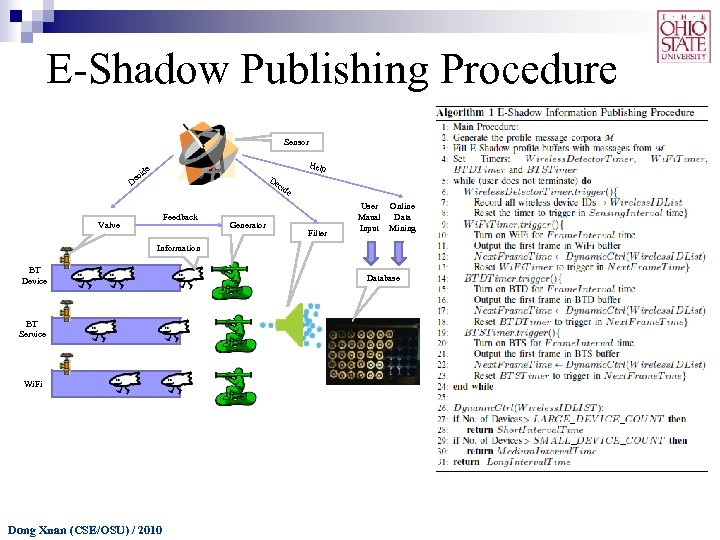
E-Shadow Publishing Procedure Sensor Help ide c De De cid Feedback Valve Generator e Filter User Online Maual Data Input Mining Information BT Device BT Service Wi. Fi Dong Xuan (CSE/OSU) / 2010 Database
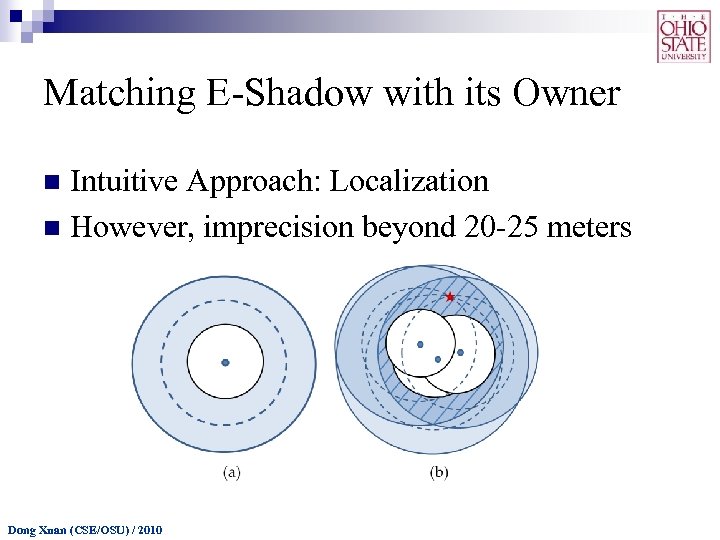
Matching E-Shadow with its Owner Intuitive Approach: Localization n However, imprecision beyond 20 -25 meters n Dong Xuan (CSE/OSU) / 2010
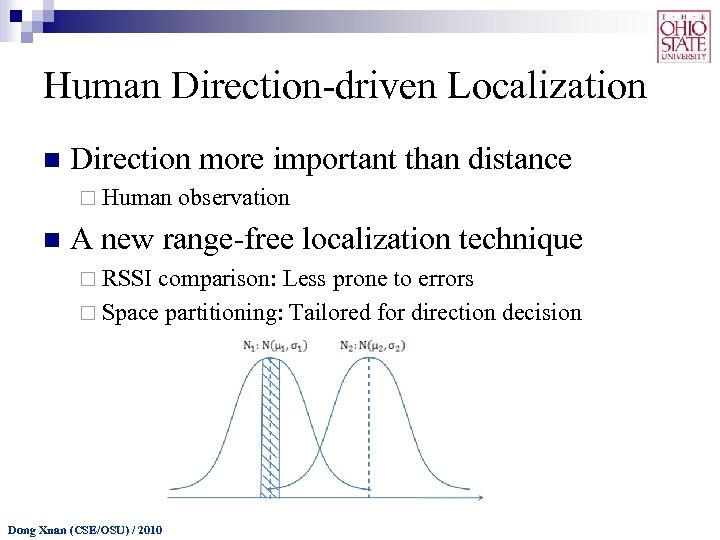
Human Direction-driven Localization n Direction more important than distance ¨ Human n observation A new range-free localization technique ¨ RSSI comparison: Less prone to errors ¨ Space partitioning: Tailored for direction decision Dong Xuan (CSE/OSU) / 2010
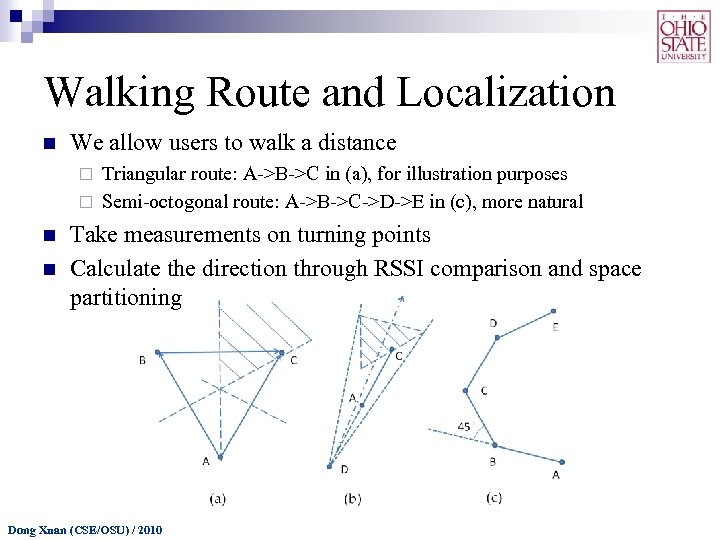
Walking Route and Localization n We allow users to walk a distance Triangular route: A->B->C in (a), for illustration purposes ¨ Semi-octogonal route: A->B->C->D->E in (c), more natural ¨ n n Take measurements on turning points Calculate the direction through RSSI comparison and space partitioning Dong Xuan (CSE/OSU) / 2010
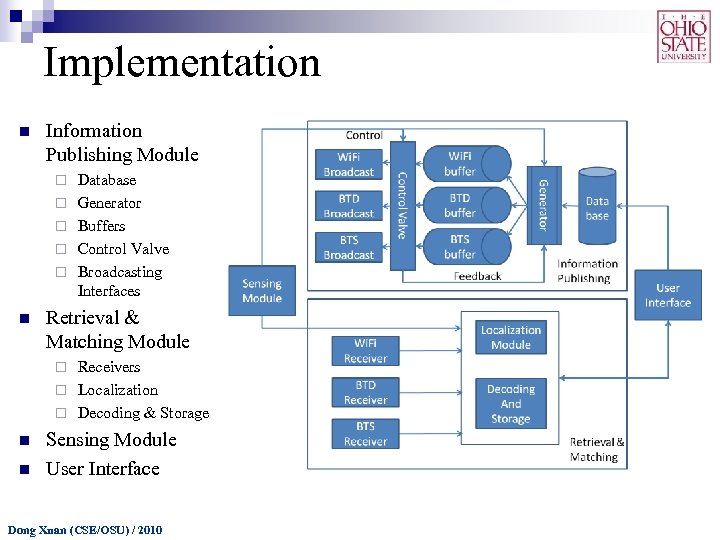
Implementation n Information Publishing Module ¨ ¨ ¨ n Database Generator Buffers Control Valve Broadcasting Interfaces Retrieval & Matching Module Receivers ¨ Localization ¨ Decoding & Storage ¨ n n Sensing Module User Interface Dong Xuan (CSE/OSU) / 2010
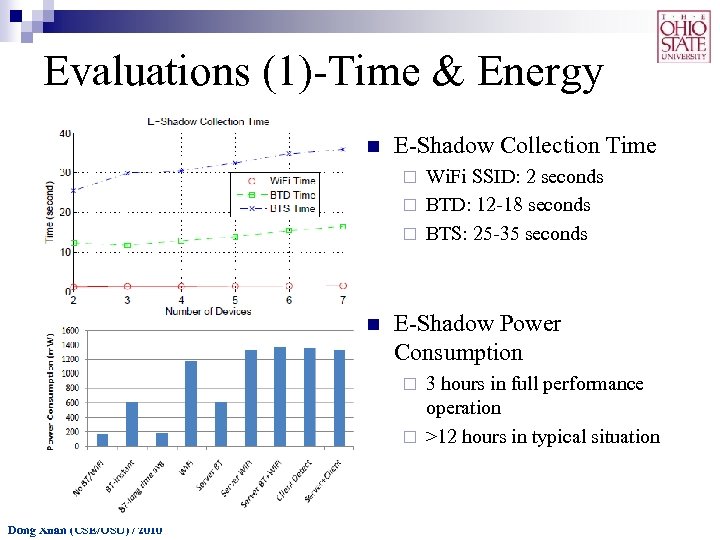
Evaluations (1)-Time & Energy n E-Shadow Collection Time Wi. Fi SSID: 2 seconds ¨ BTD: 12 -18 seconds ¨ BTS: 25 -35 seconds ¨ n E-Shadow Power Consumption 3 hours in full performance operation ¨ >12 hours in typical situation ¨ Dong Xuan (CSE/OSU) / 2010
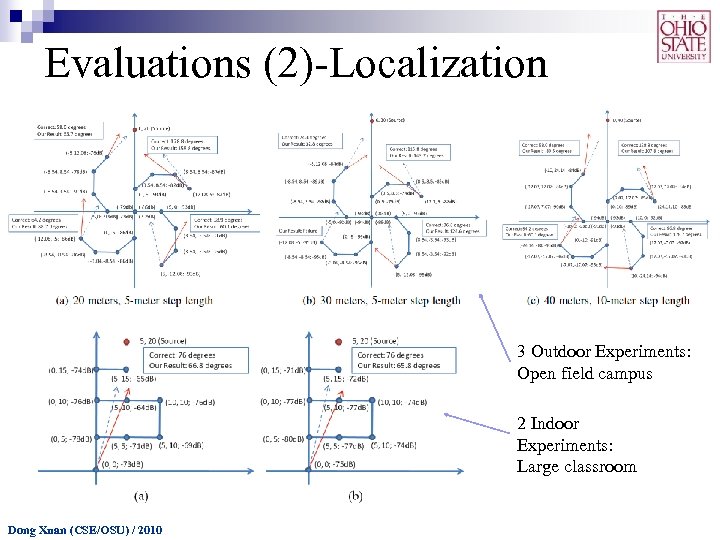
Evaluations (2)-Localization 3 Outdoor Experiments: Open field campus 2 Indoor Experiments: Large classroom Dong Xuan (CSE/OSU) / 2010
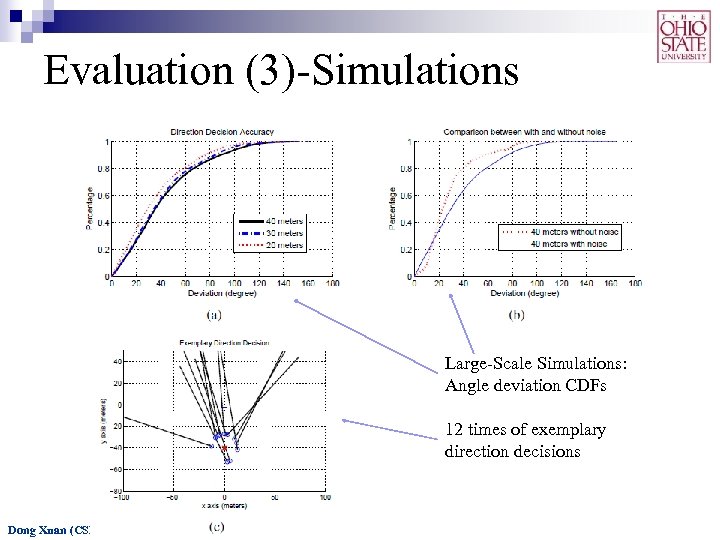
Evaluation (3)-Simulations Large-Scale Simulations: Angle deviation CDFs 12 times of exemplary direction decisions Dong Xuan (CSE/OSU) / 2010
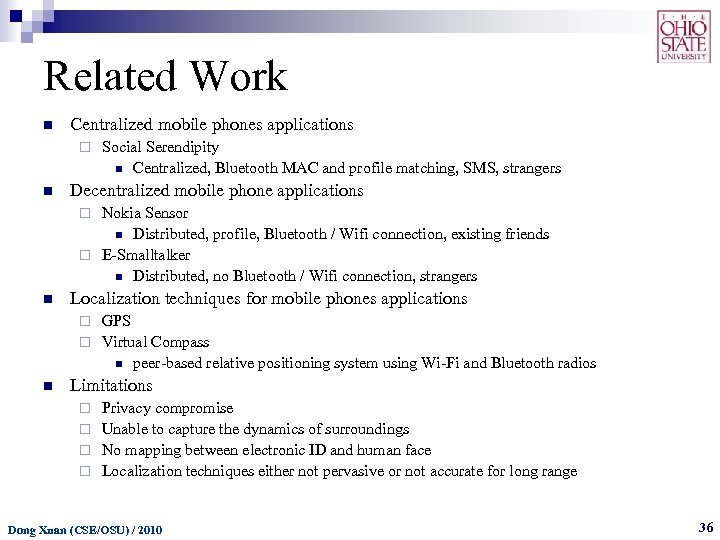
Related Work n Centralized mobile phones applications ¨ n Social Serendipity n Centralized, Bluetooth MAC and profile matching, SMS, strangers Decentralized mobile phone applications Nokia Sensor n Distributed, profile, Bluetooth / Wifi connection, existing friends ¨ E-Smalltalker n Distributed, no Bluetooth / Wifi connection, strangers ¨ n Localization techniques for mobile phones applications GPS ¨ Virtual Compass n peer-based relative positioning system using Wi-Fi and Bluetooth radios ¨ n Limitations Privacy compromise ¨ Unable to capture the dynamics of surroundings ¨ No mapping between electronic ID and human face ¨ Localization techniques either not pervasive or not accurate for long range ¨ Dong Xuan (CSE/OSU) / 2010 36
Remarks n Propose, design, implement and evaluate the E-Shadow system which lubricates local social interactions E-Shadow concept ¨ Layered publishing to capture the dynamics of surroundings ¨ Human-assisted matching that works for mapping E-Shadow with its owner in a fairly large distance ¨ Implementing and evaluating E-Shadow on real world mobile phones ¨ Dong Xuan (CSE/OSU) / 2010 37
Exemplary System III: P 3 -Coupon n Coupon Distribution n A Naïve Approach n Challenges n System Design n Implementation and Experiments n Remarks Dong Xuan (CSE/OSU) / 2010 38
Electronic Coupon Distribution n Electronic coupons Similar to paper coupons ¨ Can be stored on mobile phones ¨ n Two distribution methods ¨ Downloading from Internet websites n n n ¨ Need to define target group Limited coverage Hard to maintain dynamic preferences lists on central databases Peer to Peer Distribution n No special destination/target group More coverage More flexible user-maintained preferences list Dong Xuan (CSE/OSU) / 2010 39
A Naive Approach of Peer-to-Peer Coupon Distribution n n A store periodically broadcast the coupon Users within broadcast range receive the coupon ¨ n Users forward the coupon to others in physical proximity ¨ n n User can decide whether to use, forward or discard the coupon Forwarder’s IDs are recorded in a dynamically expanding list The coupon is used by some user The store reward all users who have forwarded the coupon Dong Xuan (CSE/OSU) / 2010 40
However…… n Require manually establishing wireless connections Cumbersome ¨ Not prompt ¨ Not possible for coupon forwarding among strangers ¨ n Require recording the entire forwarding path Potential privacy leakage ¨ Discourage user’s forwarding incentives ¨ Dong Xuan (CSE/OSU) / 2010 41
Challenge n How to design a prompt coupon distribution mechanism that ¨ Incentivize coupon forwarder appropriately for keeping the coupons circulating ¨ Preserve the privacy of coupon forwarders Dong Xuan (CSE/OSU) / 2010 42
P 3 -Coupon – A Probabilistic Coupon Forwarding Approach n Probabilistic sampling on forwarding path Keep only one forwarder for each coupon: NO privacy leakage ¨ Probabilistically flip ownership at each hop ¨ n Accurate approximation of coupon rewards plenty of chances of interpersonal encounters ¨ Accurate bonus distribution with 50 coupons and 5000 people ¨ n Adaptive to different promotion strategies Flip-once model ¨ Always-flip model ¨ n No manual connection establishment ¨ Connectionless information exchange via Bluetooth SDP Dong Xuan (CSE/OSU) / 2010 43
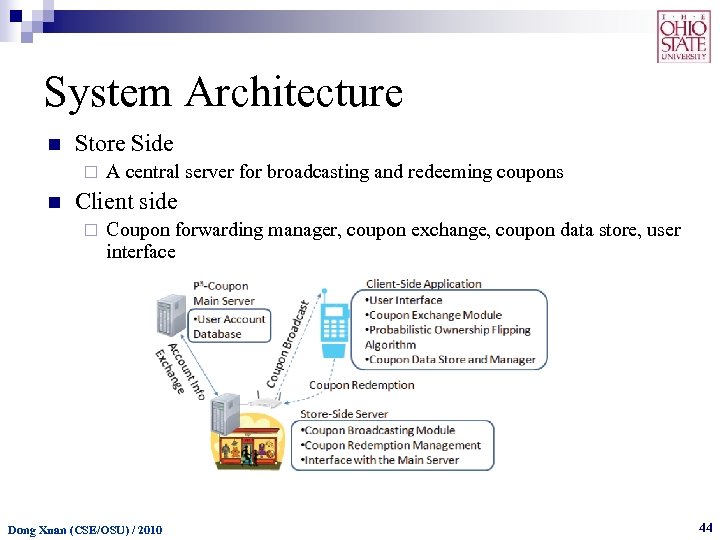
System Architecture n Store Side ¨ n A central server for broadcasting and redeeming coupons Client side ¨ Coupon forwarding manager, coupon exchange, coupon data store, user interface Dong Xuan (CSE/OSU) / 2010 44
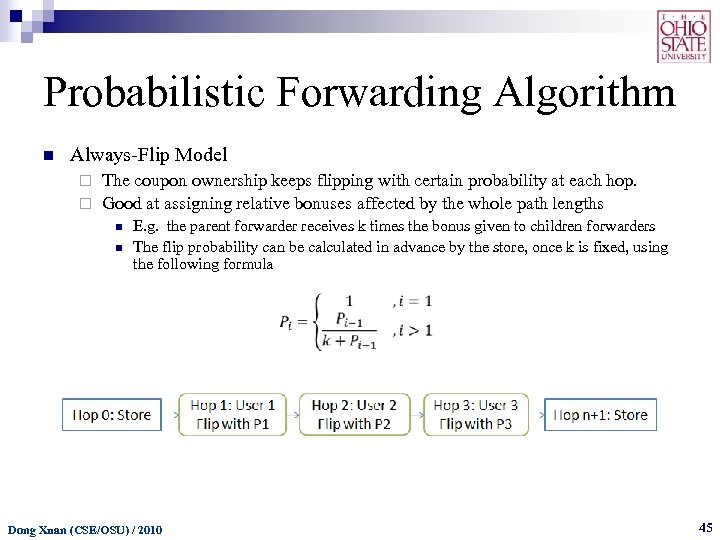
Probabilistic Forwarding Algorithm n Always-Flip Model The coupon ownership keeps flipping with certain probability at each hop. ¨ Good at assigning relative bonuses affected by the whole path lengths ¨ n n E. g. the parent forwarder receives k times the bonus given to children forwarders The flip probability can be calculated in advance by the store, once k is fixed, using the following formula Dong Xuan (CSE/OSU) / 2010 45
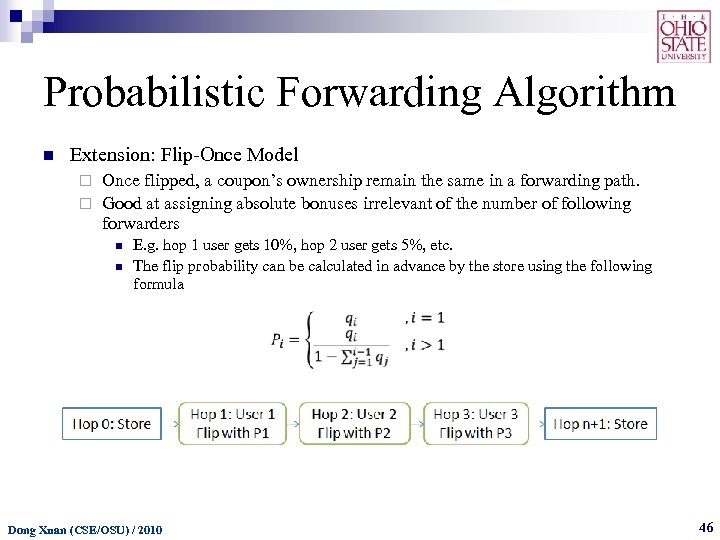
Probabilistic Forwarding Algorithm n Extension: Flip-Once Model Once flipped, a coupon’s ownership remain the same in a forwarding path. ¨ Good at assigning absolute bonuses irrelevant of the number of following forwarders ¨ n n E. g. hop 1 user gets 10%, hop 2 user gets 5%, etc. The flip probability can be calculated in advance by the store using the following formula Dong Xuan (CSE/OSU) / 2010 46
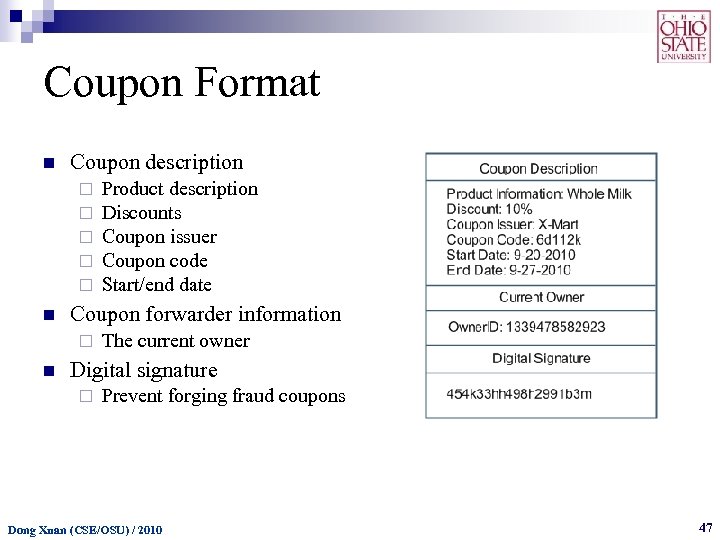
Coupon Format n Coupon description ¨ ¨ ¨ n Coupon forwarder information ¨ n Product description Discounts Coupon issuer Coupon code Start/end date The current owner Digital signature ¨ Prevent forging fraud coupons Dong Xuan (CSE/OSU) / 2010 47
Implementation n J 2 ME ¨ about n 17 java classes, 1390 Kb jar file On real phones ¨ Samsung Dong Xuan (CSE/OSU) / 2010 (SGH-i 550), Nokia (N 82, 6650, N 71 x) 48
Experiments n Experimental evaluations ¨ ¨ n Simulation evaluation ¨ ¨ n Coupon forwarding time Power consumption Number of Coupon holders vs. Time Distribution saturation time vs. Number of Seeds Coupon ownership distribution for probabilistic sampling Deviation between theoretical and actual bonus (Always-Flip, Flip. Once) Factors ¨ ¨ ¨ Number of coupons Number of users Number of initial coupon holders Dong Xuan (CSE/OSU) / 2010 49
Experiment Results n n Average coupon forwarding time is 33. 52 seconds Nokia N 82 last 25 hours with P 3 -Coupon running in background One coupon could be delivered to 5000 people within 32 hours Very small deviation between theoretical and actual bonus distribution with 50 coupons circulating among 5000 people Dong Xuan (CSE/OSU) / 2010 50
Remarks n Propose, design, implement and evaluate the P 3 -Coupon system which helps prompt and privacy preserving coupon distribution Probabilistic one-ownership coupon forwarding algorithm ¨ Implement the system on various types of mobile phones ¨ Extensive experiments and evaluations show that our approach accurately approximate theoretical coupon distribution in which the whole forwarding path needs to be recorded ¨ Practical for real-world deployment ¨ Dong Xuan (CSE/OSU) / 2010 51
52 Exemplary System IV – Drunk Driving Detection n. Motivation n. Our Contributions n. Detection Criteria n. Our System n. Related Work n. Implementation and Evaluation n. Remarks Dong Xuan (CSE/OSU) / 2010 52
53 Motivation n. Crashes caused by alcohol-impaired driving pose a serious danger to the general public safety and health ¨ 13, 041 and 11, 773 driving fatalities happened in 2007 and 2008* ¨ 32% of the total fatalities in these two years* n. Drunk driving also imposes a heavy financial burden on the whole society ¨Annual cost of alcohol-related crashes totals more than $51 billion** * Data from U. S. NHTSA (National Highway Traffic Safety Administration) ** Data from U. S. CDC (Central of Disease Control) Dong Xuan (CSE/OSU) / 2010 53
54 Motivation n Detection of drunk driving so far still relies on visual observation by patrol officers ¨Drunk drivers usually make certain types of dangerous maneuvers ¨NHTSA researchers identify cues of typical drunk driving behavior n Visual observation is insufficient to prevent drunk driving ¨The number of patrol officers is far from enough ¨The guidelines are only descriptive and qualitative ¨Usually, it is too late when drunk drivers are stopped by officers n It is essential to develop systems actively monitoring drunk driving and to prevent accidents Dong Xuan (CSE/OSU) / 2010 54
55 Our Contributions n. Propose utilizing mobile phones as a platform for active drunk driving detection system n. Design a real-time algorithm for drunk driving detection system using mobile phones ¨Simple n sensors required only i. e. , accelerometers and orientation sensors n. Design and implement a mobile phone-based active drunk driving detection system ¨Reliable, Non-intrusive, Lightweight and power efficient, and No extra hardware and service cost Dong Xuan (CSE/OSU) / 2010 55
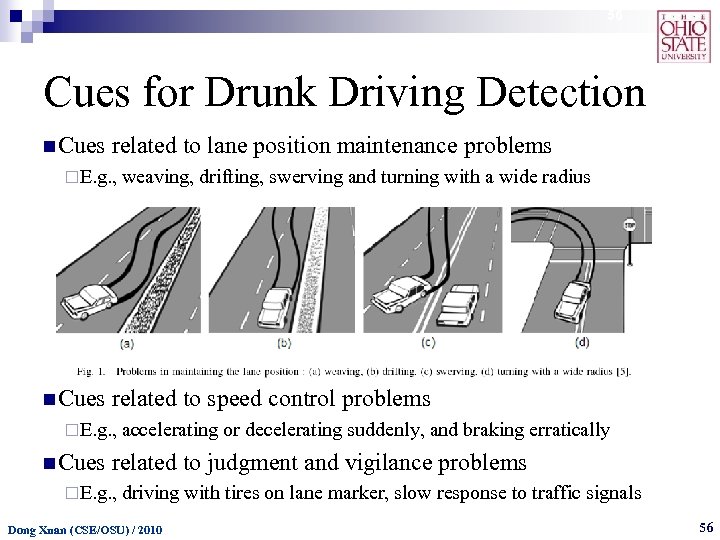
56 Cues for Drunk Driving Detection n Cues related to lane position maintenance problems ¨E. g. , n Cues related to speed control problems ¨E. g. , n Cues weaving, drifting, swerving and turning with a wide radius accelerating or decelerating suddenly, and braking erratically related to judgment and vigilance problems ¨E. g. , driving with tires on lane marker, slow response to traffic signals Dong Xuan (CSE/OSU) / 2010 56
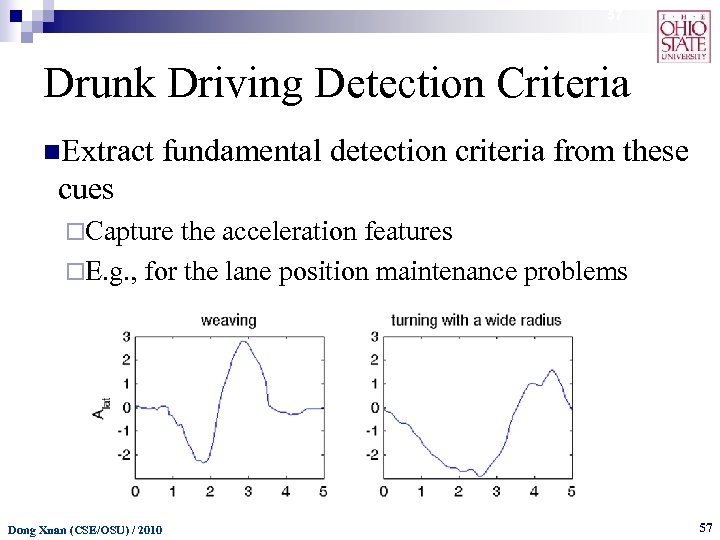
57 Drunk Driving Detection Criteria n. Extract fundamental detection criteria from these cues ¨Capture the acceleration features ¨E. g. , for the lane position maintenance problems Dong Xuan (CSE/OSU) / 2010 57
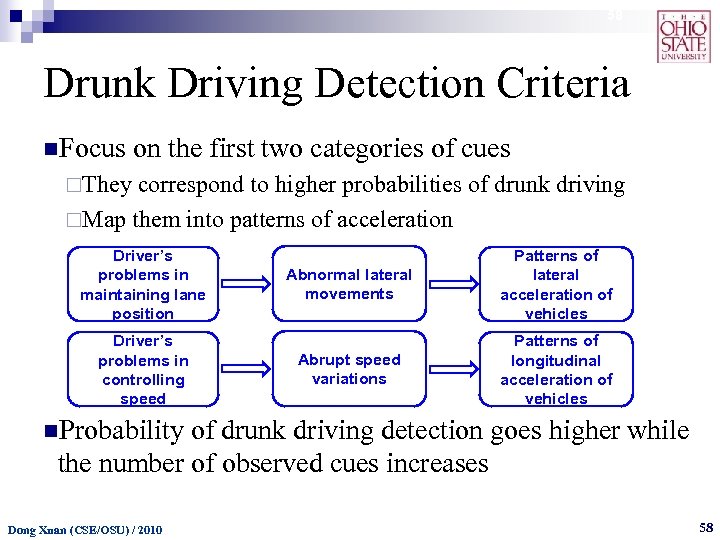
58 Drunk Driving Detection Criteria n. Focus on the first two categories of cues ¨They correspond to higher probabilities of drunk driving ¨Map them into patterns of acceleration Driver’s problems in maintaining lane position Driver’s problems in controlling speed Abnormal lateral movements Patterns of lateral acceleration of vehicles Abrupt speed variations Patterns of longitudinal acceleration of vehicles n. Probability of drunk driving detection goes higher while the number of observed cues increases Dong Xuan (CSE/OSU) / 2010 58
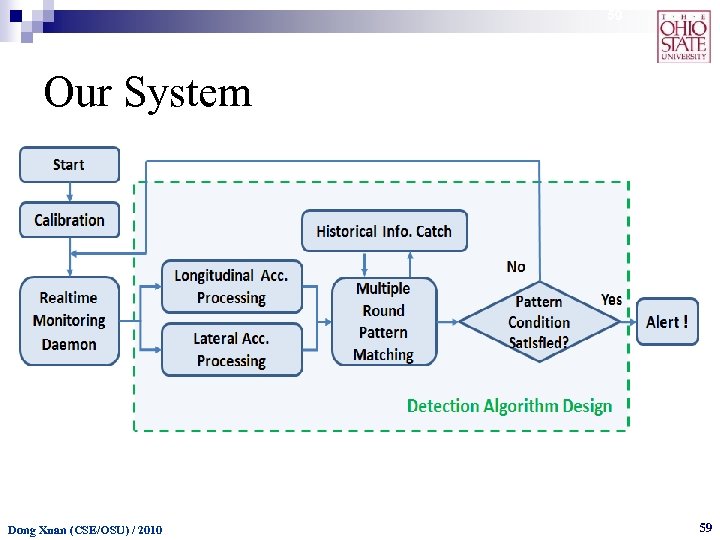
59 Our System Dong Xuan (CSE/OSU) / 2010 59
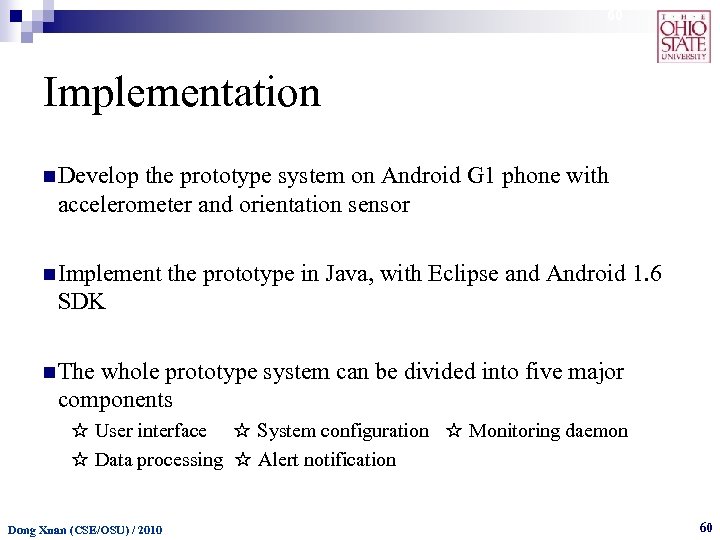
60 Implementation n Develop the prototype system on Android G 1 phone with accelerometer and orientation sensor n Implement the prototype in Java, with Eclipse and Android 1. 6 SDK n The whole prototype system can be divided into five major components ☆ User interface ☆ System configuration ☆ Monitoring daemon ☆ Data processing ☆ Alert notification Dong Xuan (CSE/OSU) / 2010 60
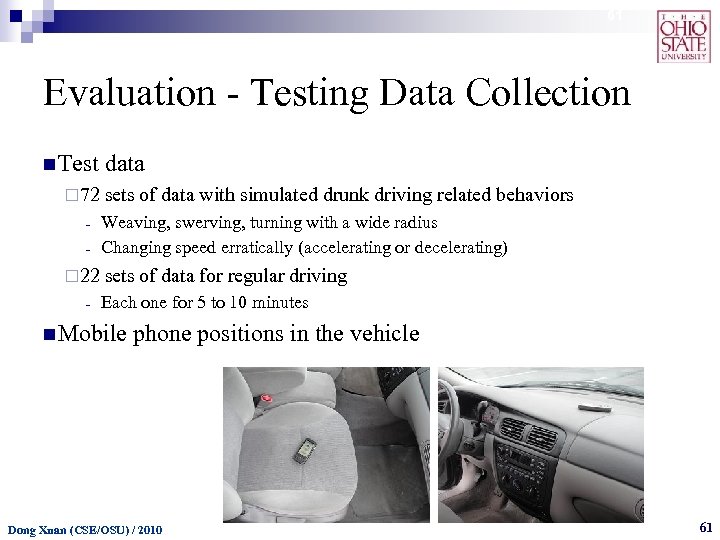
61 Evaluation - Testing Data Collection n Test ¨ 72 - ¨ 22 - data sets of data with simulated drunk driving related behaviors Weaving, swerving, turning with a wide radius Changing speed erratically (accelerating or decelerating) sets of data for regular driving Each one for 5 to 10 minutes n Mobile phone positions in the vehicle Dong Xuan (CSE/OSU) / 2010 61
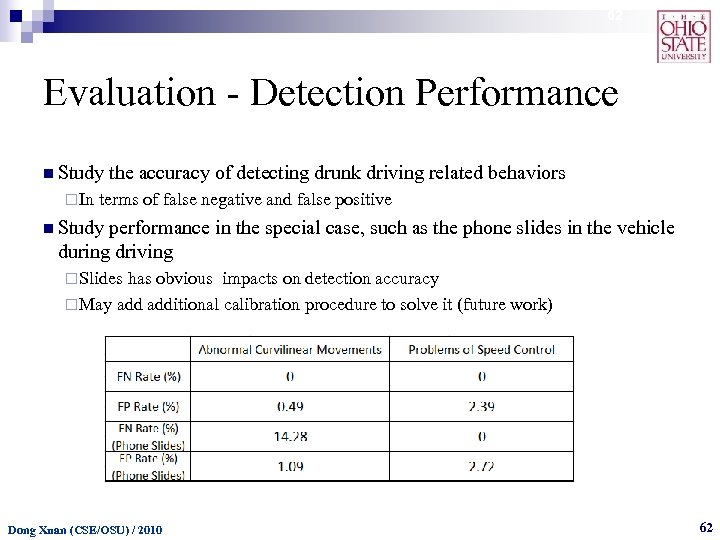
62 Evaluation - Detection Performance n Study ¨ In the accuracy of detecting drunk driving related behaviors terms of false negative and false positive n Study performance in the special case, such as the phone slides in the vehicle during driving ¨ Slides has obvious impacts on detection accuracy ¨ May additional calibration procedure to solve it (future work) Dong Xuan (CSE/OSU) / 2010 62
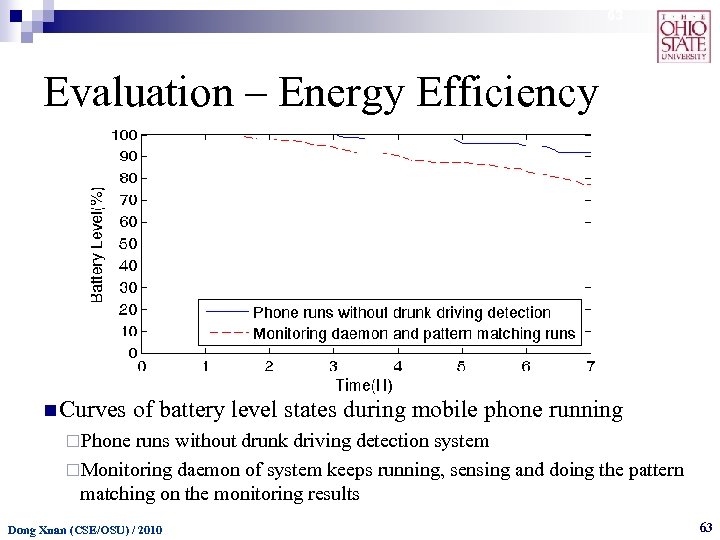
63 Evaluation – Energy Efficiency n Curves of battery level states during mobile phone running ¨Phone runs without drunk driving detection system ¨Monitoring daemon of system keeps running, sensing and doing the pattern matching on the monitoring results Dong Xuan (CSE/OSU) / 2010 63
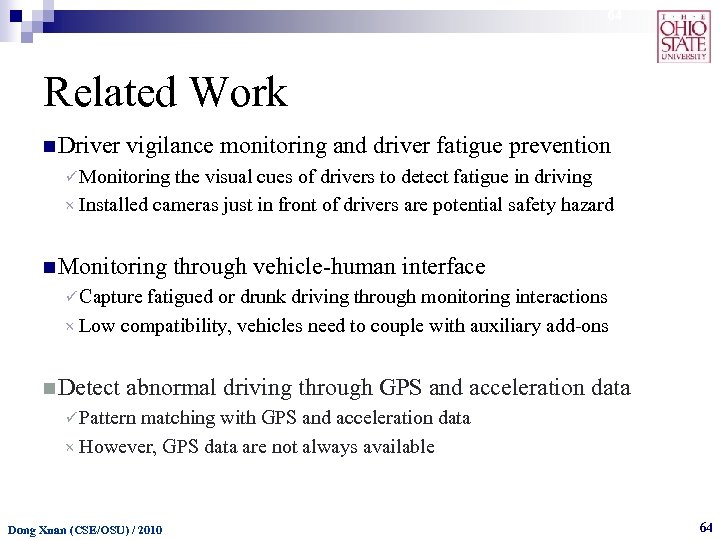
64 Related Work n Driver vigilance monitoring and driver fatigue prevention ü Monitoring the visual cues of drivers to detect fatigue in driving × Installed cameras just in front of drivers are potential safety hazard n Monitoring through vehicle-human interface ü Capture fatigued or drunk driving through monitoring interactions × Low compatibility, vehicles need to couple with auxiliary add-ons n Detect abnormal driving through GPS and acceleration data ü Pattern matching with GPS and acceleration data × However, GPS data are not always available Dong Xuan (CSE/OSU) / 2010 64
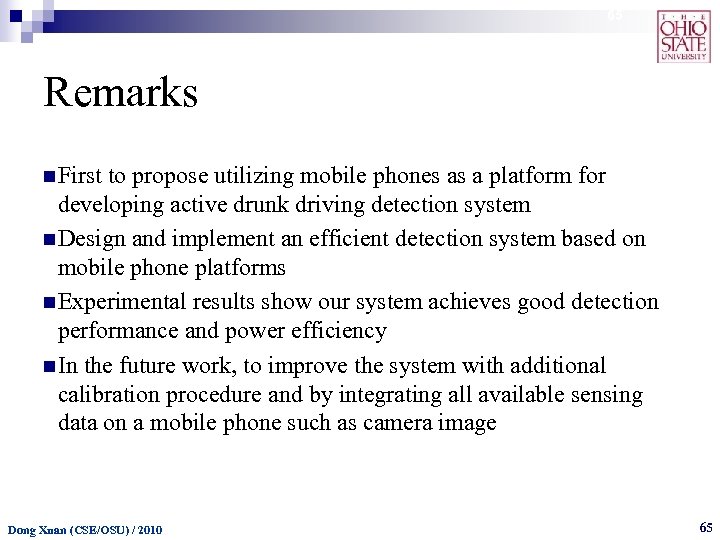
65 Remarks n First to propose utilizing mobile phones as a platform for developing active drunk driving detection system n Design and implement an efficient detection system based on mobile phone platforms n Experimental results show our system achieves good detection performance and power efficiency n In the future work, to improve the system with additional calibration procedure and by integrating all available sensing data on a mobile phone such as camera image Dong Xuan (CSE/OSU) / 2010 65
Exemplary System V: Stealthy Video Capturer Background n SVC Overview n Challenges n Our Approaches n Experimental Evaluations n Remarks n Dong Xuan (CSE/OSU) / 2010 66
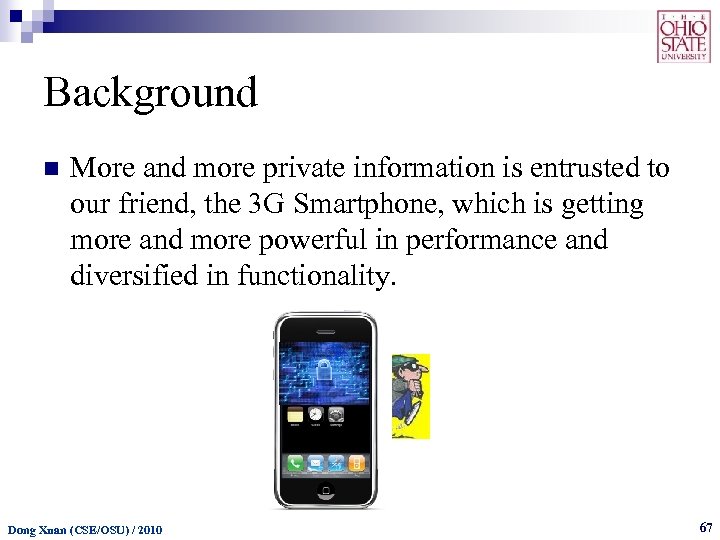
Background n More and more private information is entrusted to our friend, the 3 G Smartphone, which is getting more and more powerful in performance and diversified in functionality. Dong Xuan (CSE/OSU) / 2010 67
SVC Overview n n n Almost every 3 G Smartphone is equipped with a camera and the wireless options, such as 3 G networks, Blue. Tooth, Wi. Fi or Ir. DA. These wireless connections are good enough to handle certain types of video transmission. We turn 3 G Smartphones into an online stealthy video -recorder. Dong Xuan (CSE/OSU) / 2010 68
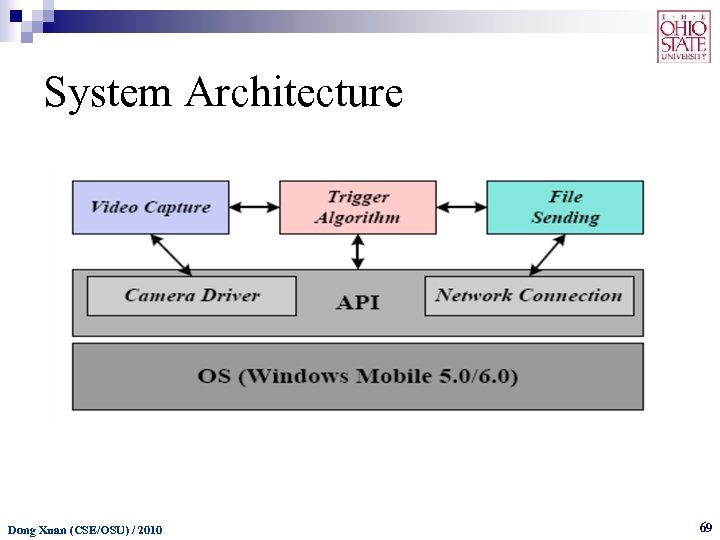
System Architecture Dong Xuan (CSE/OSU) / 2010 69
Challenges n Stealthily install SVC into 3 G Smartphones ¨ Windows Hiding ¨ Infection Method n Collect the video information from 3 G Smartphones ¨ Direct. Show Controls ¨ Data Compressing n Send the video file to the SVC intender ¨ File Sending Dong Xuan (CSE/OSU) / 2010 70
Infection Method To embed SVC in a 3 G Smartphone is called a infection process. n We employ Trojan horse for downloads as the infection approach. n Our experimental SVC is hidden in the game of ”tic-tac-toe” that we develop in Windows Mobile environment. n Dong Xuan (CSE/OSU) / 2010 71
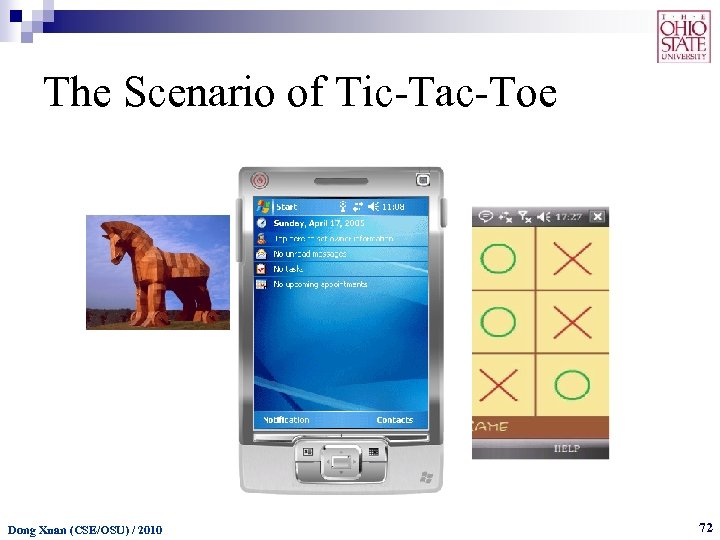
The Scenario of Tic-Tac-Toe Dong Xuan (CSE/OSU) / 2010 72
Triggering Schemes n n Triggering Algorithm is designed to determine when to turn on the video capture process and send the captured video to make SVC stealthier and get more useful information. Three scenarios are under consideration. ¨ The first scenario is tracking. ¨ The second scenario is related with political or business espionage. ¨ The third scenario is a hybrid one, where SVC is used for much diversified everyday purposes. Dong Xuan (CSE/OSU) / 2010 73
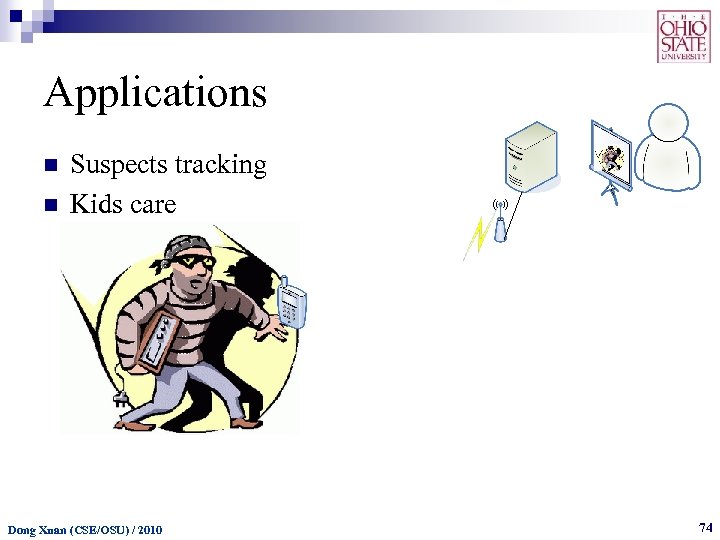
Applications n n Suspects tracking Kids care Dong Xuan (CSE/OSU) / 2010 74
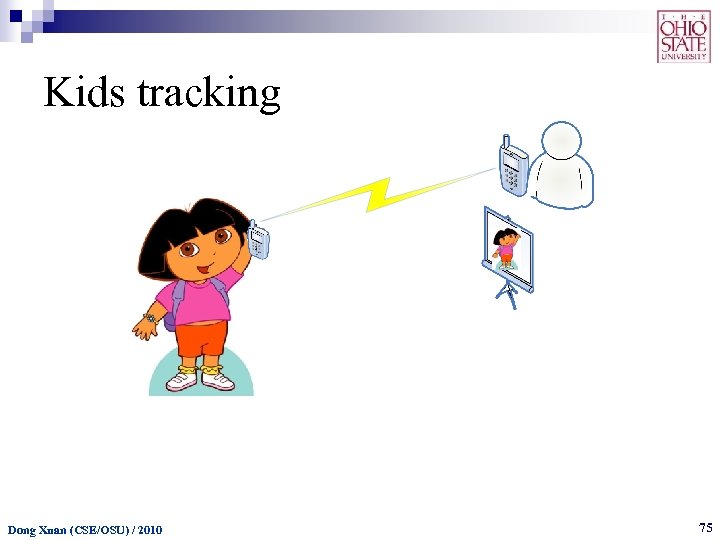
Kids tracking Dong Xuan (CSE/OSU) / 2010 75
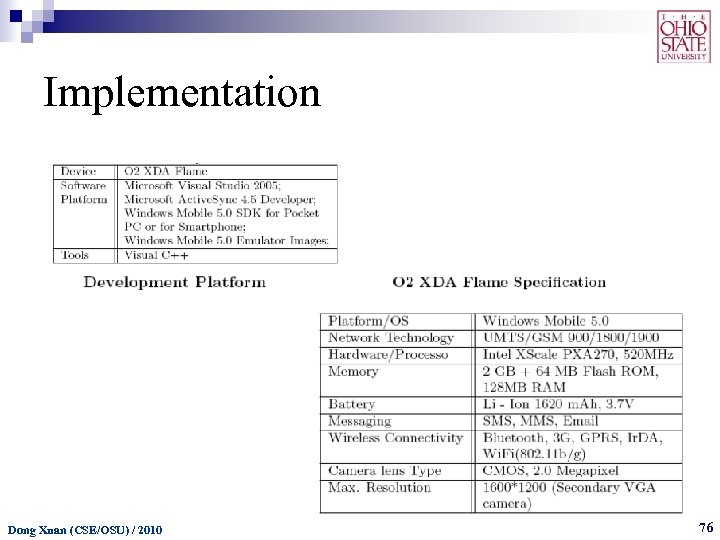
Implementation Dong Xuan (CSE/OSU) / 2010 76
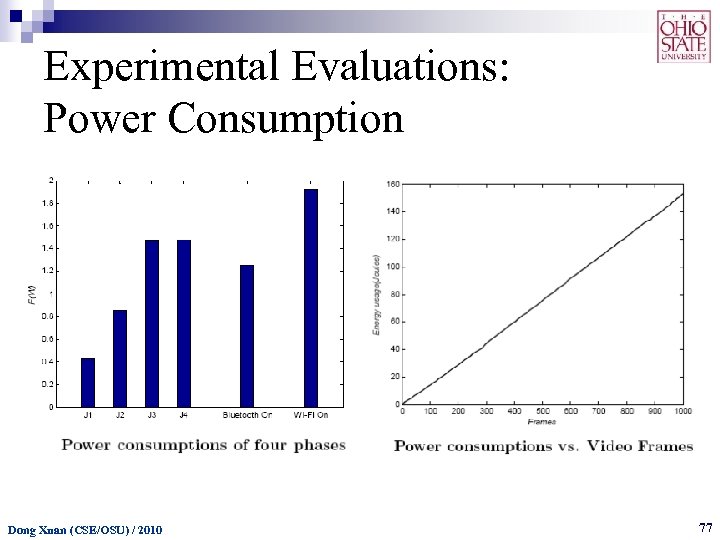
Experimental Evaluations: Power Consumption n Power curve Dong Xuan (CSE/OSU) / 2010 77
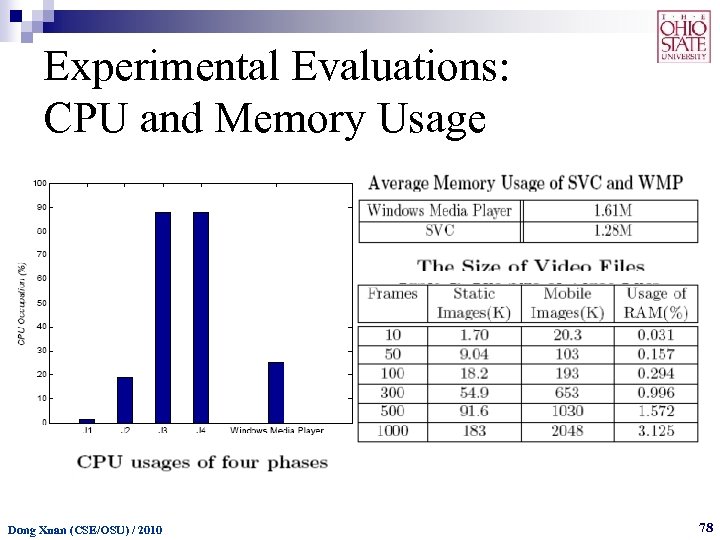
Experimental Evaluations: CPU and Memory Usage n CPU and Memory Dong Xuan (CSE/OSU) / 2010 78
Remarks n n The initial study exploited from SVC will draw wide attentions on 3 G Smartphone’s privacy protection and open a new horizon on 3 G Smartphones security research and applications. We are currently investigating the modeling of smart spyware from the study of ”spear and shield”. Dong Xuan (CSE/OSU) / 2010 79
A Summary Dong Xuan (CSE/OSU) / 2010 80
Future Research Directions n Smartphone-based Systems and Networking ¨ Mobile social networking, e-commerce, e-health, safety monitoring etc. ¨ Easy to start and exciting but too many competitors, lack of scientific depth n Smartphone Core Improvement ¨ Multitasking, power management, efficient local communication protocol, accurate localization, security/privacy protection ¨ Deep but hard to start Dong Xuan (CSE/OSU) / 2010 81
Final Remarks Smartphones have brought significant impacts to our daily life. n We present five exemplary systems on mobile social networking, e-commerce, e-health and safety. n Research and development on smartphones will be hot. n Dong Xuan (CSE/OSU) / 2010 82
Скачать презентацию Design and Implementation of Smartphone-based Systems and Networking
2ec76e77fc447fc84be3825e9ef6eec4.ppt