


 Скачать презентацию Design and Execution of the 30 -year NCEP
de973f651f724361c3f75c929484a682.ppt
- Количество слайдов: 41
 Design and Execution of the 30 -year NCEP CFSRR T 382 L 64 Global Reanalysis and T 126 L 64 Seasonal Reforecast Project (1979 -2008) Suru Saha and Hua-Lu Pan, EMC/NCEP With Input from Stephen Lord, Mark Iredell, Shrinivas Moorthi, David Behringer, Ken Mitchell, Bob Kistler, Jack Woollen, Huug van den Dool, Catherine Thiaw and many others Updated : 15 Jan 2008
 • CFSRR Advisory Board Members Chair: Jeff Anderson (NCAR) • Saki Uppala (ECMWF) • Gabriel Lau (GFDL/NOAA) • Eric Wood (U Princeton) • Gil Compo (CDC/NOAA) • Mark Serreze (U Colorado) • Rick Rosen (CPO/NOAA) • Huug van den Dool (CPC/NCEP) • Jim Carton (U Maryland) • Lars Peter Riishojgaard (JCSDA/NCEP)
 For a new Climate Forecast System (CFS) implementation Two essential components: A new Reanalysis of the atmosphere, ocean, seaice and land over the 31 -year period (1979 -2009) is required to provide consistent initial conditions for: A complete Reforecast of the new CFS over the 28 -year period (1982 -2009), in order to provide stable calibration and skill estimates of the new system, for operational seasonal prediction at NCEP
 For a new CFS implementation (contd) 1. Analysis Systems : Operational GDAS: Atmospheric (GADAS)-GSI Ocean-ice (GODAS) and Land (GLDAS) 2. 2. Atmospheric Model : Operational GFS 3. 3. Ocean Model : New MOM 4 Ocean 4. 4. Land Model : Operational Noah Land Model 5. 5. Sea Ice Model: New Sea Ice Model
 An upgrade to the coupled atmosphere-ocean-seaice-land NCEP Climate Forecast System (CFS) is being planned for 2010. This upgrade involves changes to all components of the CFS, namely: • improvements to the data assimilation of the atmosphere with the new NCEP Gridded Statistical Interpolation Scheme (GSI) and major improvements to the physics and dynamics of operational NCEP Global Forecast System (GFS) • improvements to the data assimilation of the ocean and ice with the NCEP Global Ocean Data Assimilation System, (GODAS) and a new GFDL MOM 4 Ocean Model • improvements to the data assimilation of the land with the NCEP Global Land Data Assimilation System, (GLDAS) and a new NCEP Noah Land model
 For a new CFS implementation (contd) 1. An atmosphere at high horizontal resolution (spectral T 382, ~38 km) and high vertical resolution (64 sigmapressure hybrid levels) 2. An interactive ocean with 40 levels in the vertical, to a depth of 4737 m, and high horizontal resolution of 0. 25 degree at the tropics, tapering to a global resolution of 0. 5 degree northwards and southwards of 10 N and 10 S respectively 3. An interactive sea-ice model 4. An interactive land model with 4 soil levels
 There are three main differences with the earlier two NCEP Global Reanalysis efforts: • Much higher horizontal and vertical resolution (T 382 L 64) of the atmosphere (earlier efforts were made with T 62 L 28 resolution) • The guess forecast will be generated from a coupled atmosphere – ocean – seaice - land system • Radiance measurements from the historical satellites will be assimilated in this Reanalysis To conduct a Reanalysis with the atmosphere, ocean, seaice and land coupled to each other will be a novelty, and will hopefully address important issues, such as the correlations between sea surface temperatures and precipitation in the global tropics, etc.
 UPGRADES TO THE ATMOSHERIC MODEL • Hybrid vertical coordinate (sigma-pressure) • Noah Land Model : 4 soil levels. Improved treatment of snow and frozen soil • Sea Ice Model : Fractional ice cover and depth allowed • Sub grid scale mountain blocking • Reduced vertical diffusion • RRTM long wave radiation • ESMF (3. 0)
 UPGRADES TO THE ATMOSHERIC MODEL • Enthalpy • AER RRTM Shortwave Radiation • New Aerosol Treatment • Inclusion of historical CO 2, solar cycle and volcanic aerosols
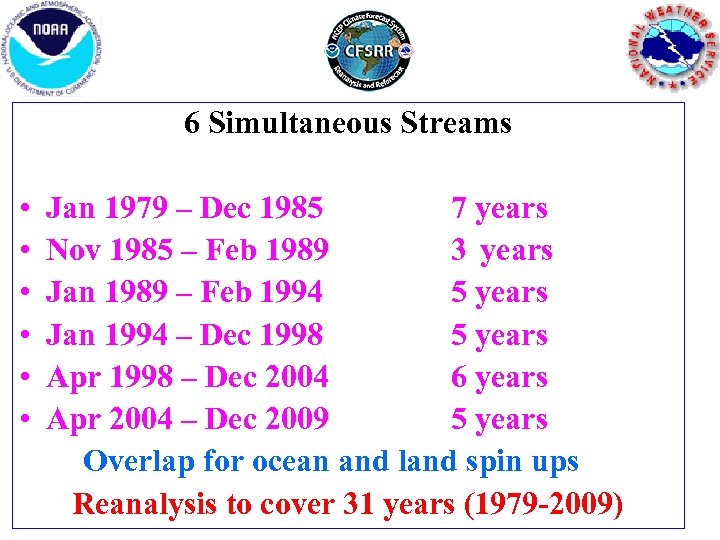 6 Simultaneous Streams • • • Jan 1979 – Dec 1985 7 years Nov 1985 – Feb 1989 3 years Jan 1989 – Feb 1994 5 years Jan 1994 – Dec 1998 5 years Apr 1998 – Dec 2004 6 years Apr 2004 – Dec 2009 5 years Overlap for ocean and land spin ups Reanalysis to cover 31 years (1979 -2009)
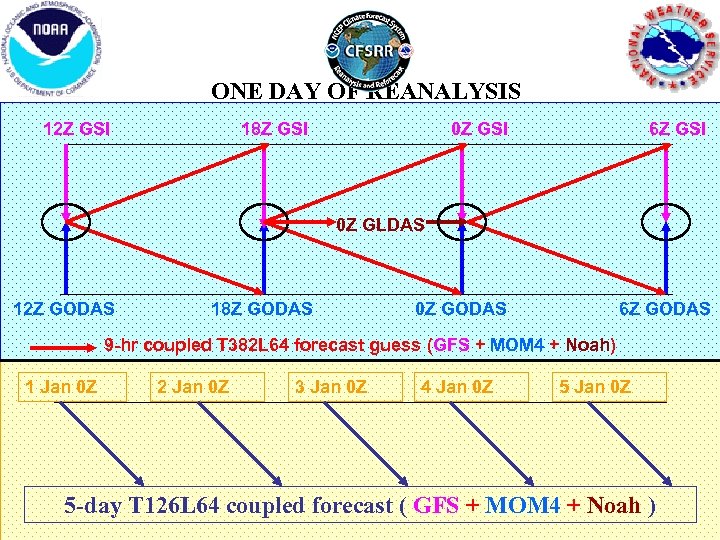 ONE DAY OF REANALYSIS 12 Z GSI 18 Z GSI 0 Z GSI 6 Z GSI 0 Z GODAS 6 Z GODAS 0 Z GLDAS 12 Z GODAS 18 Z GODAS 9 -hr coupled T 382 L 64 forecast guess (GFS + MOM 4 + Noah) 1 Jan 0 Z 2 Jan 0 Z 3 Jan 0 Z 4 Jan 0 Z 5 -day T 126 L 64 coupled forecast ( GFS + MOM 4 + Noah )
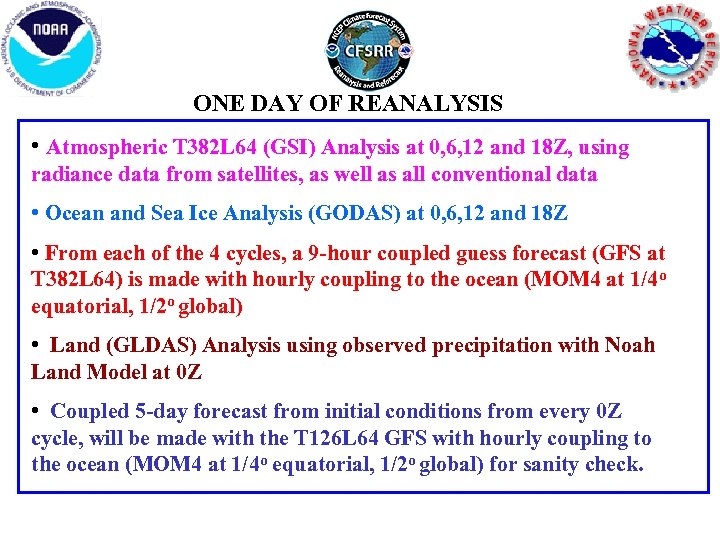 ONE DAY OF REANALYSIS • Atmospheric T 382 L 64 (GSI) Analysis at 0, 6, 12 and 18 Z, using radiance data from satellites, as well as all conventional data • Ocean and Sea Ice Analysis (GODAS) at 0, 6, 12 and 18 Z • From each of the 4 cycles, a 9 -hour coupled guess forecast (GFS at T 382 L 64) is made with hourly coupling to the ocean (MOM 4 at 1/4 o equatorial, 1/2 o global) • Land (GLDAS) Analysis using observed precipitation with Noah Land Model at 0 Z • Coupled 5 -day forecast from initial conditions from every 0 Z cycle, will be made with the T 126 L 64 GFS with hourly coupling to the ocean (MOM 4 at 1/4 o equatorial, 1/2 o global) for sanity check.
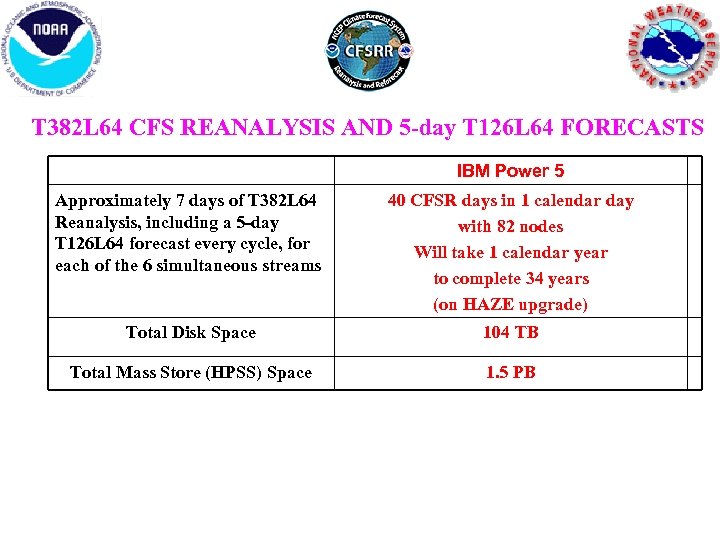 T 382 L 64 CFS REANALYSIS AND 5 -day T 126 L 64 FORECASTS IBM Power 5 Approximately 7 days of T 382 L 64 Reanalysis, including a 5 -day T 126 L 64 forecast every cycle, for each of the 6 simultaneous streams 40 CFSR days in 1 calendar day with 82 nodes Will take 1 calendar year to complete 34 years (on HAZE upgrade) Total Disk Space 104 TB Total Mass Store (HPSS) Space 1. 5 PB
 Collaborators • NOAA/CPC is actively involved in the monitoring of the Reanalysis • NOAA/NCDC is actively involved in the design of the data distribution of the Reanalysis
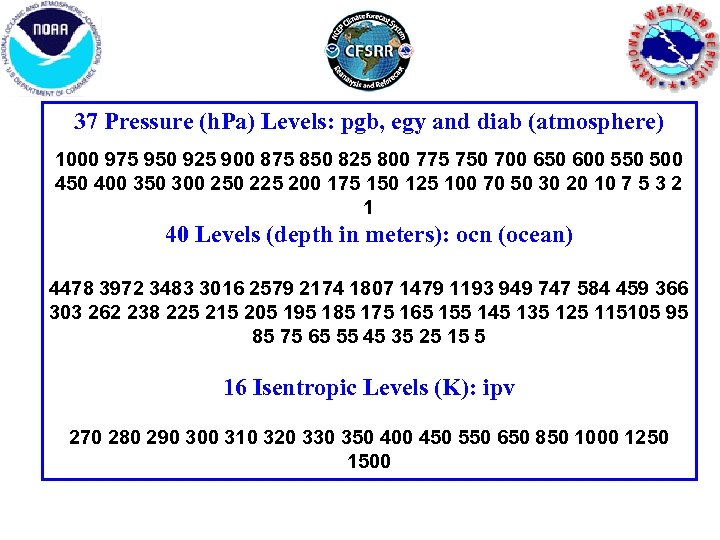 37 Pressure (h. Pa) Levels: pgb, egy and diab (atmosphere) 1000 975 950 925 900 875 850 825 800 775 750 700 650 600 550 500 450 400 350 300 250 225 200 175 150 125 100 70 50 30 20 10 7 5 3 2 1 40 Levels (depth in meters): ocn (ocean) 4478 3972 3483 3016 2579 2174 1807 1479 1193 949 747 584 459 366 303 262 238 225 215 205 195 185 175 165 155 145 135 125 115105 95 85 75 65 55 45 35 25 15 5 16 Isentropic Levels (K): ipv 270 280 290 300 310 320 330 350 400 450 550 650 850 1000 1250 1500
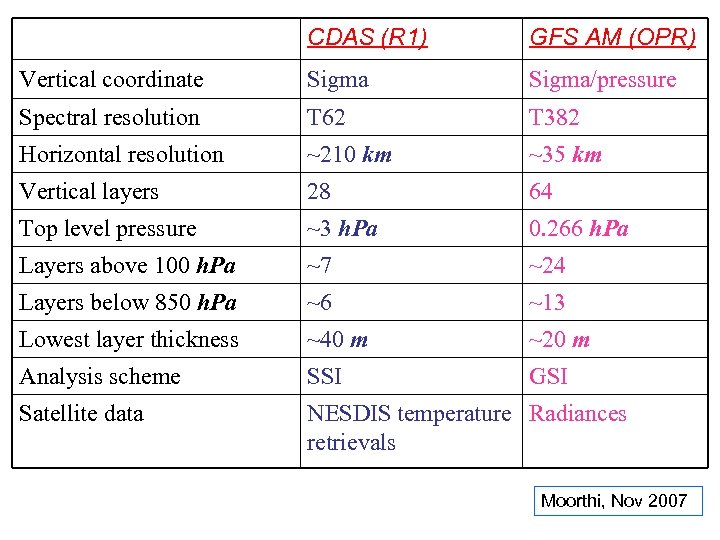 CDAS (R 1) GFS AM (OPR) Vertical coordinate Sigma/pressure Spectral resolution T 62 T 382 Horizontal resolution ~210 km ~35 km Vertical layers 28 64 Top level pressure ~3 h. Pa 0. 266 h. Pa Layers above 100 h. Pa ~7 ~24 Layers below 850 h. Pa ~6 ~13 Lowest layer thickness ~40 m ~20 m Analysis scheme SSI GSI Satellite data NESDIS temperature Radiances retrievals Moorthi, Nov 2007
 DATA STUDIES • We have made 20 data impact studies (using T 62 L 64 atmospheric-only data assimilation system) • We have tested SSU, ERS winds, JMA reprocessed cloud track winds, and PAOBS • We have tested the new Reynolds’ ¼ degree SST for the GODAS • We have tested the new 0. 5 degree global CPC precipitation product for the GLDAS • We have updated snow and sea ice • We have collected tropical storm information from ERA 40 and from our own archive • We have done several satellite radiance bias spin up experiments and are continuing to do them
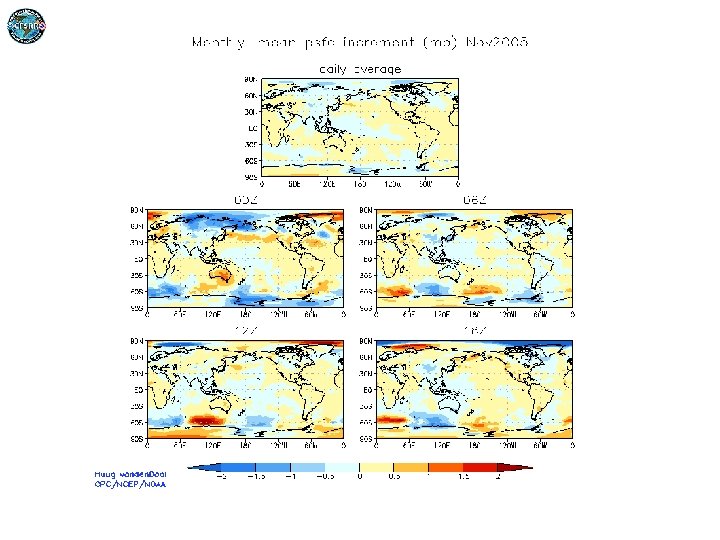
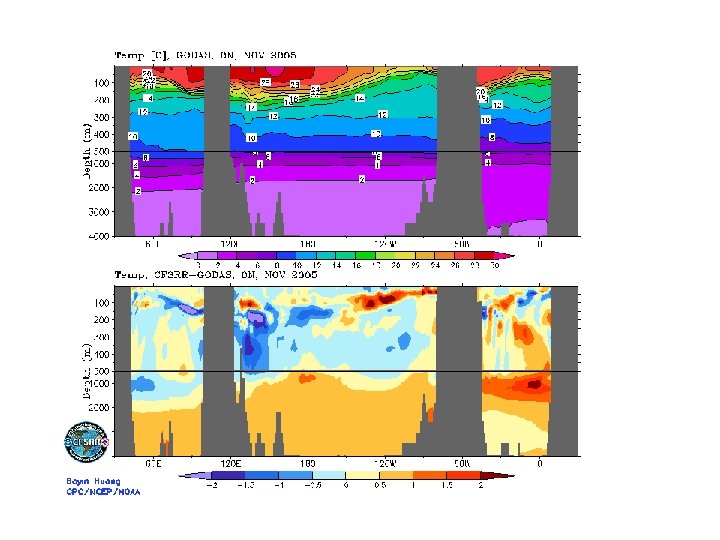
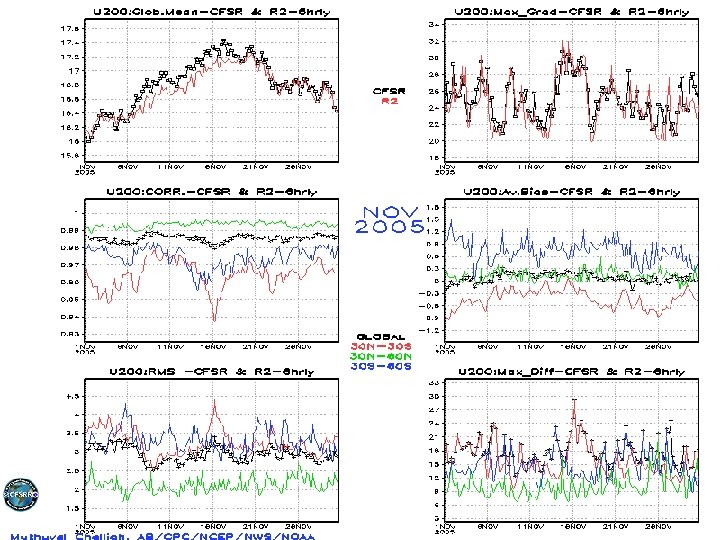
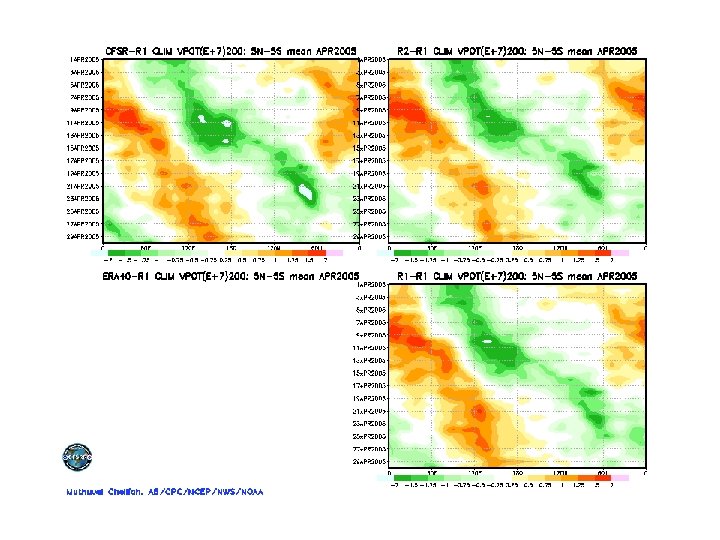
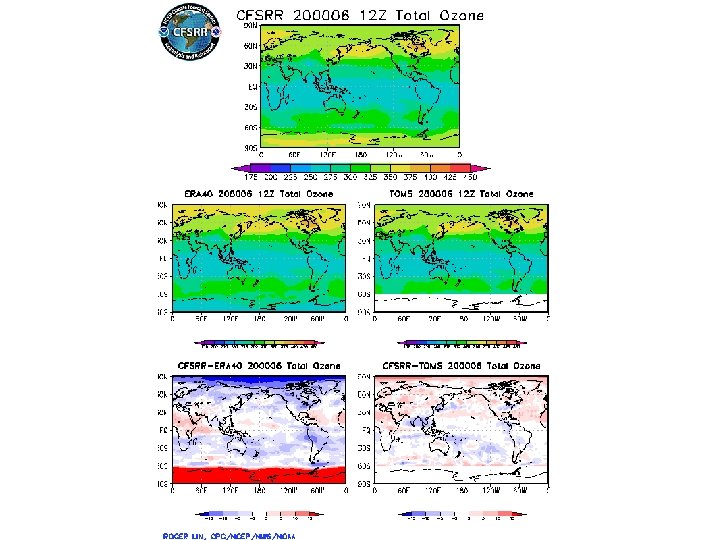
 MONITORING • Monitoring Web site has been built • The CPC team has done an outstanding job of monitoring the: – – Stratosphere Troposphere Surface Ocean • EMC monitoring of data usage and verification of the 5 -day short range forecasts is also underway
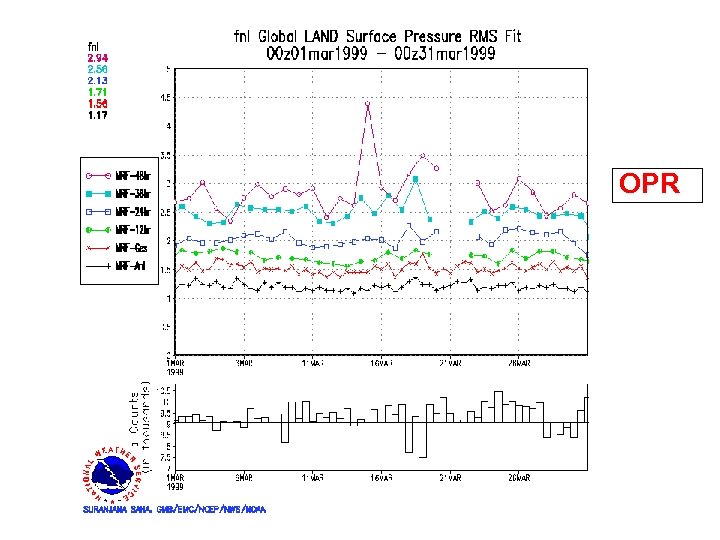 OPR
OPR
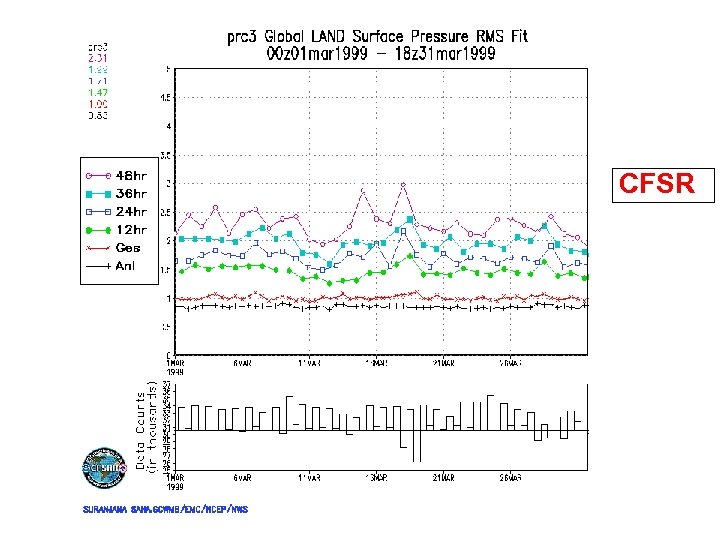 CFSR
CFSR
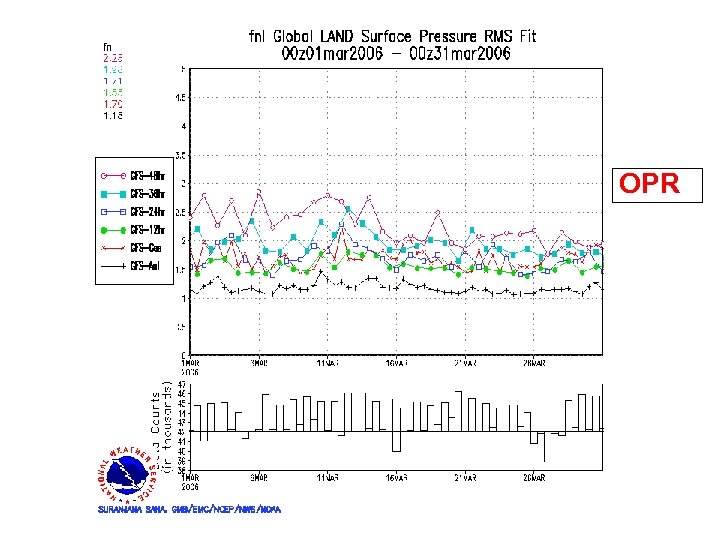 OPR
OPR
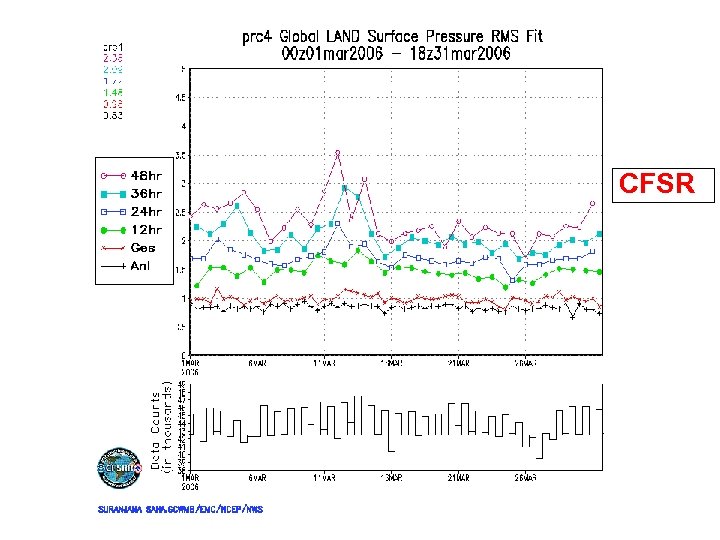 CFSR
CFSR
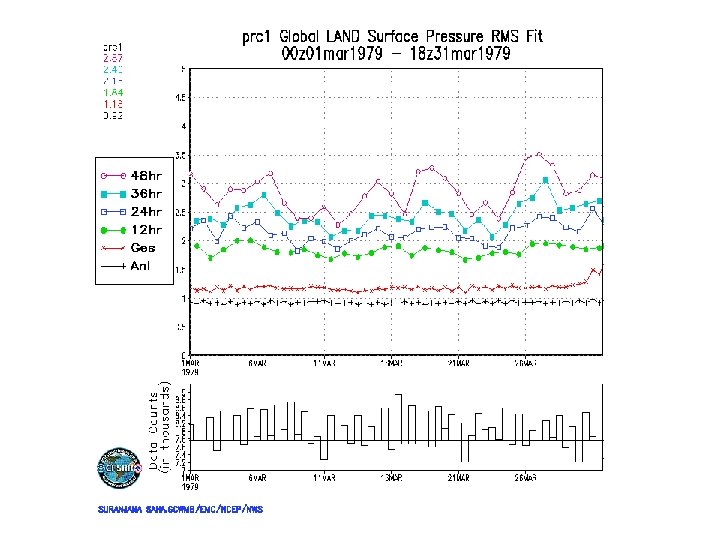
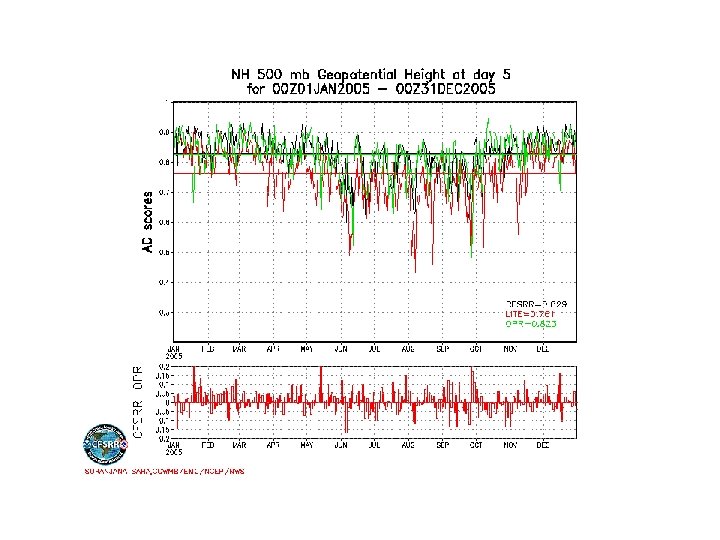
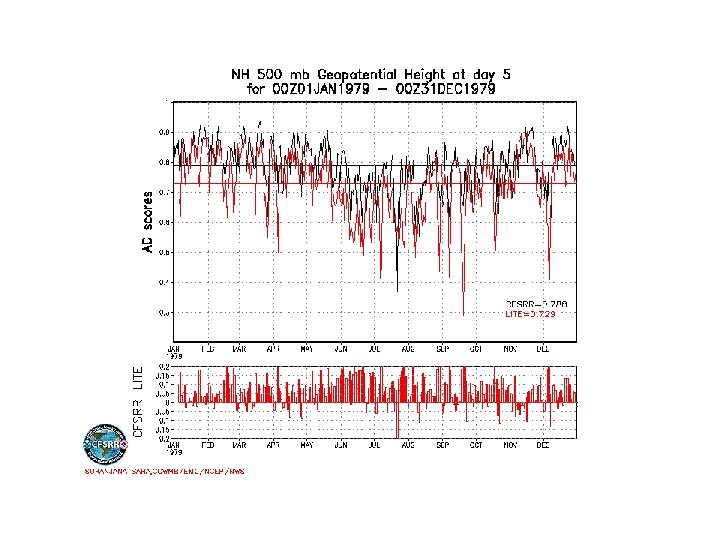
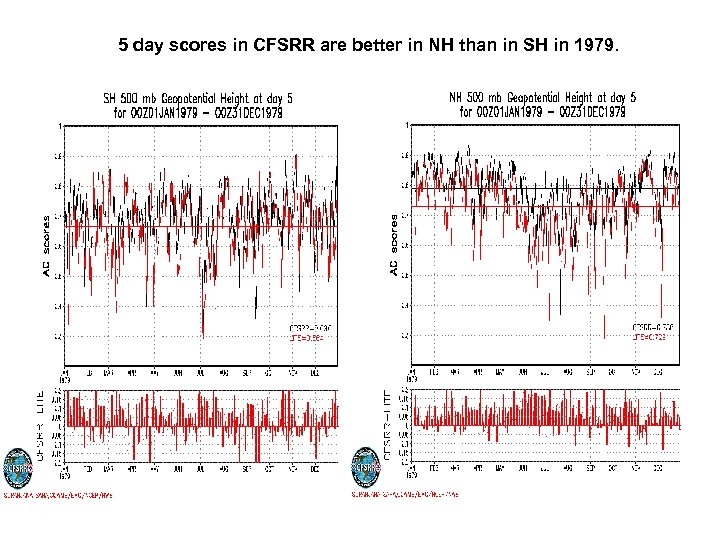 5 day scores in CFSRR are better in NH than in SH in 1979.
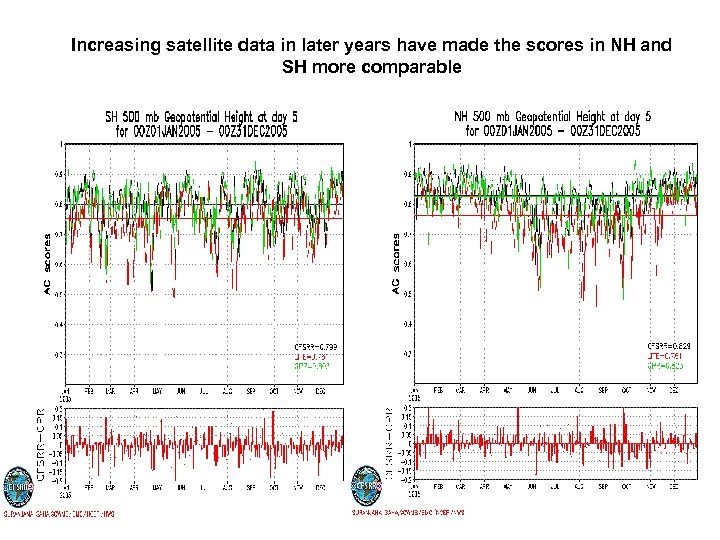 Increasing satellite data in later years have made the scores in NH and SH more comparable
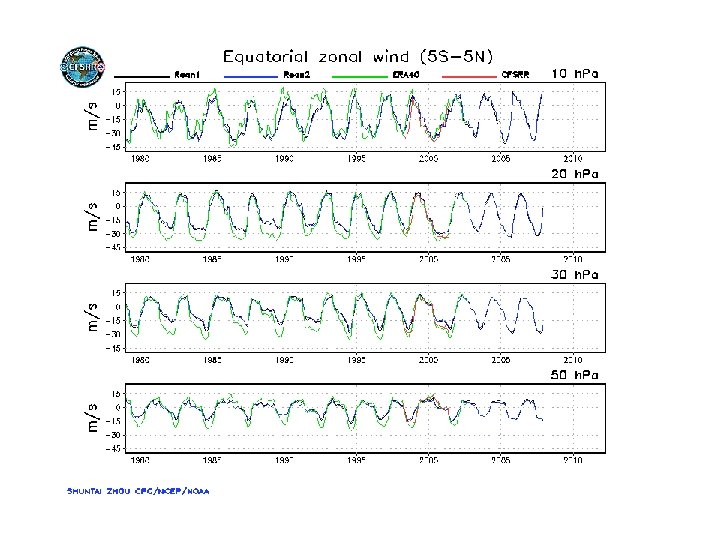
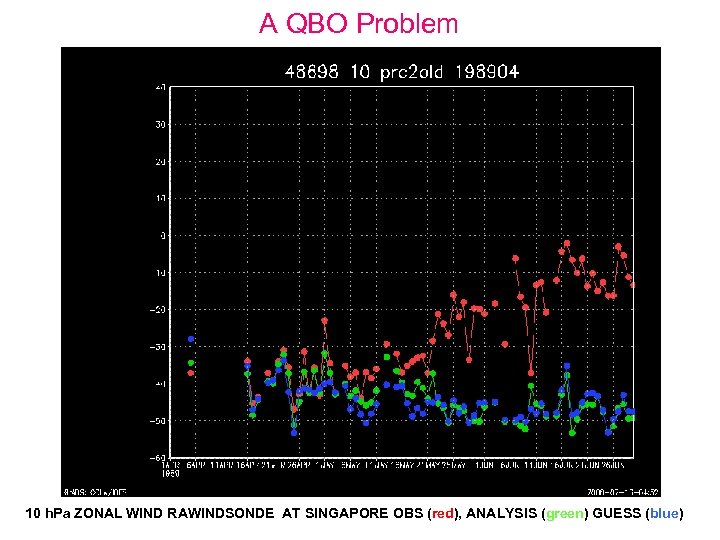 A QBO Problem 10 h. Pa ZONAL WIND RAWINDSONDE AT SINGAPORE OBS (red), ANALYSIS (green) GUESS (blue)
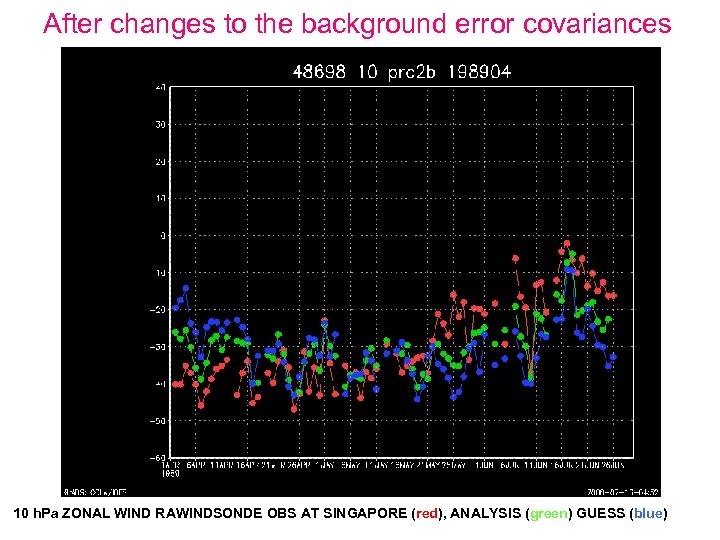 After changes to the background error covariances 10 h. Pa ZONAL WIND RAWINDSONDE OBS AT SINGAPORE (red), ANALYSIS (green) GUESS (blue)
 SOME PROBLEMS FACED DURING THE SPIN UP PHASE OF CFSR • MANY BUG FIXES IN CODES AND SCRIPTS • ADEQUATE COMPUTER RESOURCES NOT RECEIVED UNTIL JULY 1. • ADEQUATE FUNDING NOT RECEIVED UNTIL JULY 1. • DUE TO THIS, CFSR DELIVERY DATE HAS SLIPPED • A QUARTER OF THE PROJECT IS DONE
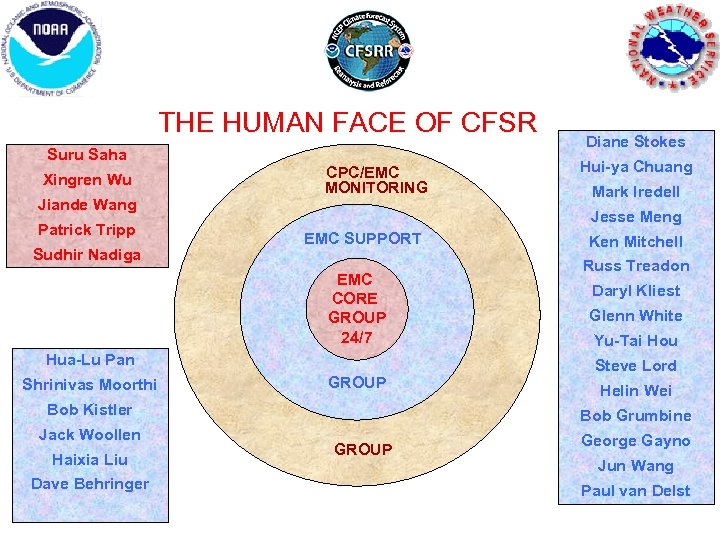 THE HUMAN FACE OF CFSR Suru Saha Xingren Wu Jiande Wang Patrick Tripp Sudhir Nadiga CPC/EMC MONITORING EMC SUPPORT Hua-Lu Pan GROUP Bob Kistler Jack Woollen Haixia Liu Dave Behringer Hui-ya Chuang Mark Iredell Jesse Meng EMC CORE GROUP 24/7 Shrinivas Moorthi Diane Stokes Ken Mitchell Russ Treadon Daryl Kliest Glenn White Yu-Tai Hou Steve Lord Helin Wei Bob Grumbine GROUP George Gayno Jun Wang Paul van Delst
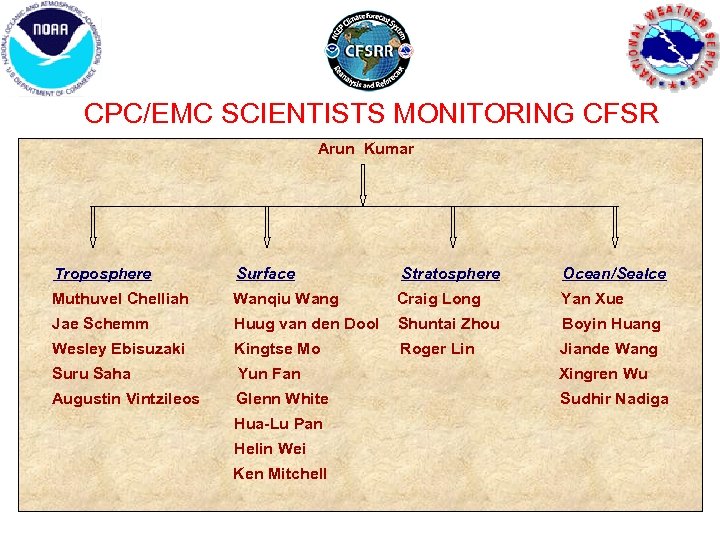 CPC/EMC SCIENTISTS MONITORING CFSR Arun Kumar Troposphere Surface Stratosphere Ocean/Sea. Ice Muthuvel Chelliah Wanqiu Wang Craig Long Yan Xue Jae Schemm Huug van den Dool Shuntai Zhou Boyin Huang Wesley Ebisuzaki Kingtse Mo Roger Lin Jiande Wang Suru Saha Yun Fan Xingren Wu Augustin Vintzileos Glenn White Sudhir Nadiga Hua-Lu Pan Helin Wei Ken Mitchell
 Issues • Integrated Earth System Analysis – Aerosol is in the plan for the operational data assimilation system and will be available at the next CFSRR – CO 2 changes are already built in the current CFS Reanalysis – 20 -century type of CMIP runs indicates that the CFS in the CFSRR system is capable of responding to the CO 2 changes • How can we accelerate the future CFSRR? – Data assimilation – combine satellite radiance usage with the earth system modeling to address atmosphere, ocean, land, ice, and biosphere – Improving both weather and climate signals in the fully coupled models – Resource needed to do both
 Email : cfs@noaa. gov Website : http: //cfs. ncep. noaa. gov