


 Скачать презентацию Descriptive Univariate Statistics Percentages frequencies Ratios and Rates
cc61583493a7478cb9be05cb8224e269.ppt
- Количество слайдов: 15
 Descriptive (Univariate) Statistics Percentages (frequencies) Ratios and Rates Measures of Central Tendency Measures of Variability Descriptive statistics describes variables —We are not testing relationships between variables
 Central Tendency v What is the average value of a variable in a range of values for a given population? MEASURES of Central Tendency ü Mean Sum of all values / N ü Median Center of the distribution (case that cuts the sample into two) ü Mode Most frequently occurring value v
 Calculating Each Measure Mean = ∑X / n – (Sum of all values divided by the sample size). Mode = Count the most frequently occurring value.
 Median = Odd # of cases (Md = middle value) Finding the Middle Position: (n + 1) / 2 (= position of the middle value) Example: 11, 12, 13, 16, 17, 20, 25 (N=7) Md = (7+1) / 2 = 4 th value = 16 50% of cases lie above and below 16
 Median Continued Median = even # of cases ØThere will be two middle cases ØMd. = the average of the scores of the two middle cases. Example: 11, 12, 13, 16, 17, 20, 25, 26 Position of the middle value = (8+1)/2 = 4. 5 Md = 16 + 17 (two middle cases) / 2 = 16. 5 NOTE = Need to sort your values before locating the Md
 Why might we use the median instead of the mean?
 Skewed Distributions See board Mean is most sensitive to outliers EXAMPLE: 5, 6, 6, 7, 8, 9, 10 Md. 7. 5 Mean 7. 63 5, 6, 6, 7, 8, 9, 10, 95 Md. 7. 5 Mean 18. 25
 Measures of Variability—scatter of scores around the mean. How do scores cluster around the mean? Example: Say the average price of a home in Bakersfield is (say 150, 000). Can you buy a home in Hagen Oaks for 150, 000? See bell curve (mean = 150 K, Sd = 10 K)
 Measures of Variability Ø Range The distance between the highest and lowest score (subtract the lowest value from the highest value) Ø A rough measure.
 Standard Deviation = The distance of a given raw score from the mean (X – Mean). We need a summary measure that accounts for all of the scores in a distribution. Variance and SD are summary measures Calculate the SD by taking the Square Root of Variance
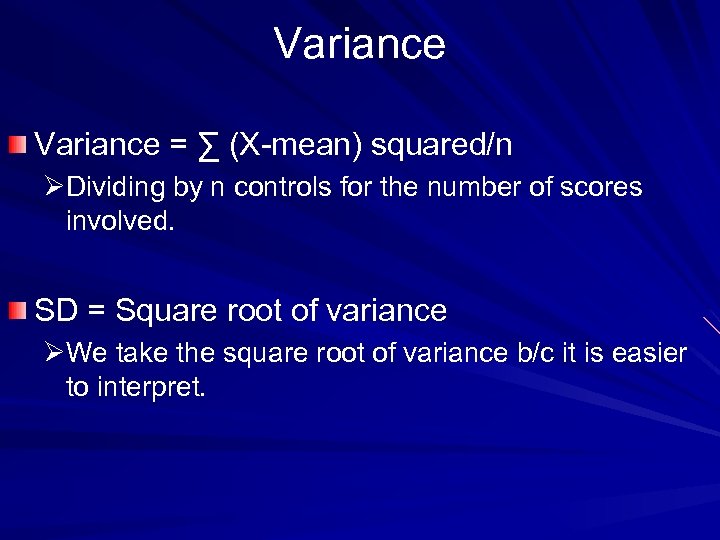 Variance = ∑ (X-mean) squared/n ØDividing by n controls for the number of scores involved. SD = Square root of variance ØWe take the square root of variance b/c it is easier to interpret.
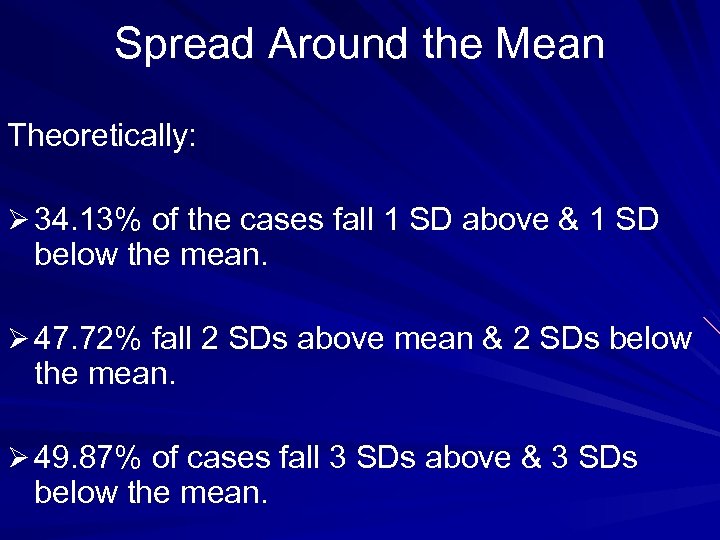 Spread Around the Mean Theoretically: Ø 34. 13% of the cases fall 1 SD above & 1 SD below the mean. Ø 47. 72% fall 2 SDs above mean & 2 SDs below the mean. Ø 49. 87% of cases fall 3 SDs above & 3 SDs below the mean.
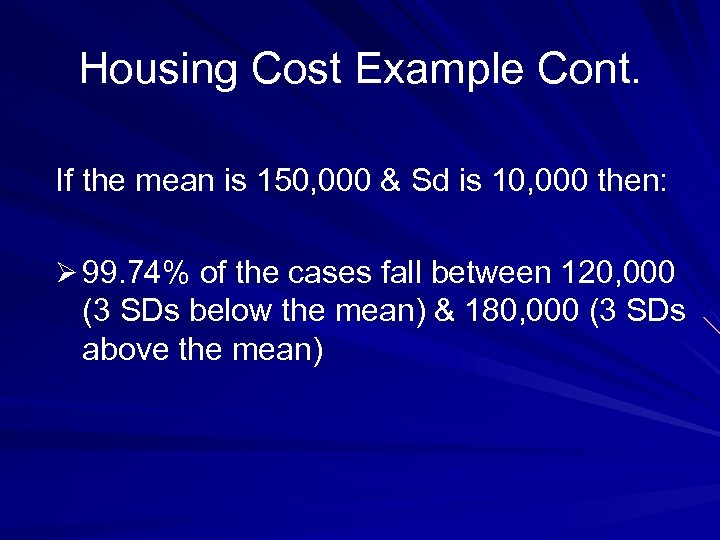 Housing Cost Example Cont. If the mean is 150, 000 & Sd is 10, 000 then: Ø 99. 74% of the cases fall between 120, 000 (3 SDs below the mean) & 180, 000 (3 SDs above the mean)
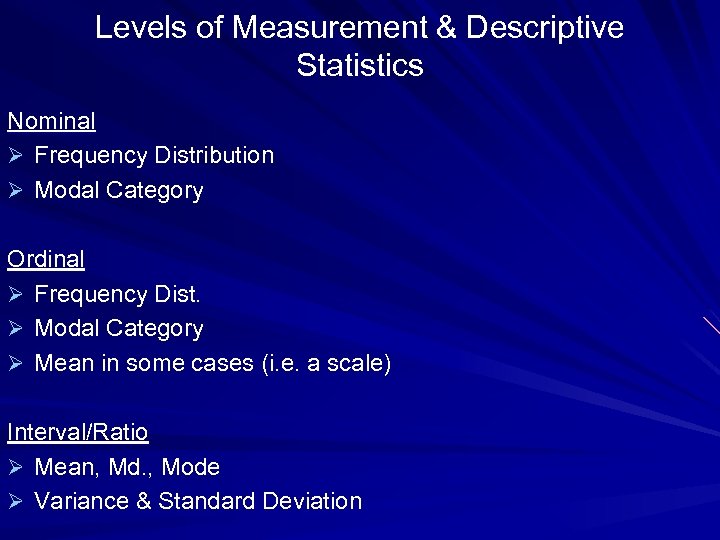 Levels of Measurement & Descriptive Statistics Nominal Ø Frequency Distribution Ø Modal Category Ordinal Ø Frequency Dist. Ø Modal Category Ø Mean in some cases (i. e. a scale) Interval/Ratio Ø Mean, Md. , Mode Ø Variance & Standard Deviation
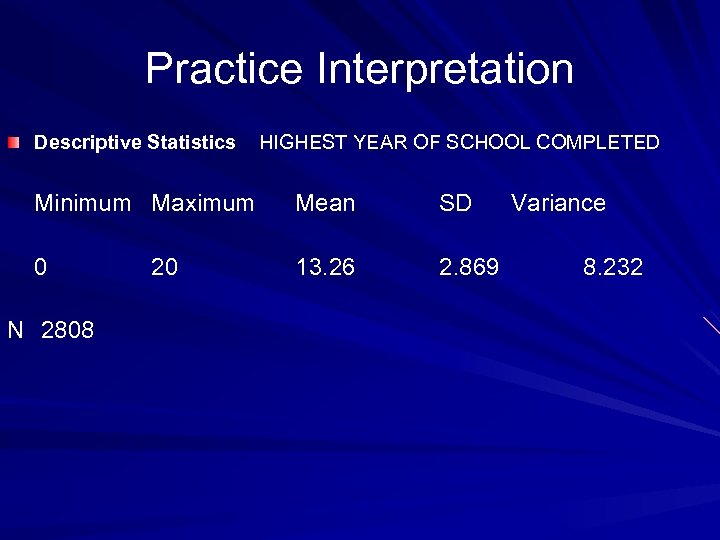 Practice Interpretation Descriptive Statistics HIGHEST YEAR OF SCHOOL COMPLETED Minimum Maximum Mean SD 0 13. 26 2. 869 N 2808 20 Variance 8. 232